
- Buy Crypto
- Markets
- Futures
- Spot
- Copy Trade
 WE-Launch
The US can't control Latin America, so they took out Maduro

Original Article Title: "The US Could Not Control Latin America, So They Took Away Maduro"
Original Article Author: Sleepy.txt, Watcher Beating
In the 1980s, the total external debt of the entire Latin America accounted for nearly 50% of its GDP, a metric Washington used to measure loyalty and control when overseeing its backyard.
Today, this number has dropped to 20%.
However, this 22-percentage-point difference does not mean that the Latin American people are becoming richer day by day. To no longer be subject to others' currency and rules, they are still struggling in the old order and paying a heavy price for it.
This is a struggle between "being controllable" and "being uncontrollable." The United States is trying to control the economic lifeline of this continent through debt, currency, and sanctions. However, when this control is pushed to the limit, the system will inevitably trigger an inherent resistance.
Three Weapons the US Uses to Control Latin American Finance
Over the past half-century, the American financial empire's rule over Latin America has primarily relied on three unbeatable weapons.
The first weapon is debt. This is the empire's oldest colonial tool and the most effective financial governance tool.
On August 12, 1982, a plea call from the Mexican Finance Minister was the catalyst for the Latin American debt crisis. As Mexico declared its inability to repay $80 billion in external debt, the first domino fell. Brazil, Argentina, and Venezuela then fell into the abyss of default one after another.
Subsequently, the "Creditor Alliance" composed of the US Treasury, the Federal Reserve, and the IMF entered the scene. The bailout money they provided was incredibly expensive, and behind each round of aid were extremely harsh conditions.
This was later known as the Washington Consensus, which forced these countries to cut government spending, sell off state assets, fully open domestic markets, and remove all capital controls.
It was an era where the US could determine a country's fate for the next decade with just one check. Debt became a noose around the neck of each Latin American country, with the US holding the end of the rope. Behind every aid package, the price of power had actually been set.
The second weapon is dollarization.
When debt control was not thorough enough, a more extreme solution was pushed to the forefront: simply abandon your national currency and directly adopt the US dollar.
First, the United States triggered foreign exchange depletion and hyperinflation in these countries through early-stage debt harvesting, instilling a visceral fear of their own currency in the populace. Subsequently, Washington's think tanks began massively promoting the "Currency Stability Theory" in public opinion, packaging the US dollar as the only safe haven free from volatility.
When providing emergency loans, the United States often implied or even stated outright that only by adopting the US dollar could a country receive long-term financial credit endorsement. In 2000, on the brink of social unrest, Ecuador was forced to abandon its currency; shortly thereafter, countries like El Salvador and Panama followed suit.
This is a very domineering logic; if a country loses control of its own currency, its economic sovereignty is fundamentally in a trusteeship. Giving up one's domestic currency is akin to handing over the keys to one's home. From then on, your inflation rate, your interest rate, can only be determined by others.
The third weapon is sanctions. This is the ultimate, most destructive heavy weapon, specifically designed to deal with those who attempt to depart from the established order and challenge the existing system.
Take Venezuela, for example. The United States has imposed over 900 sanctions on the country, involving 209 key individuals, nearly closing off all survival space for the nation.
Venezuela is actually rich in oil, quite literally "rich in oil." Its oil reserves amount to a staggering 303 billion barrels, even more than Saudi Arabia. However, the issue lies in the fact that much of this oil is heavy crude like asphalt, extremely difficult to extract, requiring external funding, technology, and diluents to turn into money.
The precision of US sanctions has severed these lifelines, leaving Venezuela sitting on the "world's largest oil tank" but unable to monetize it. As a result, Venezuela's oil production plummeted from 3 million barrels per day to less than 500,000 barrels per day in just seven years.
It wasn't until early 2026, when the US used "drug terrorism" and related criminal charges as justification to remove Maduro through a military operation in Venezuela, that Trump announced major oil companies would take over and invest billions of dollars to restore infrastructure, thus finally completing the loop of this sanction's sharp edge.
By first completely paralyzing a country's liquidity through sanctions, one can then boldly enter this wasteland with billions of dollars under the guise of "management and restoration," and achieve the reaping of the global energy landscape.
Debt, dollarization, sanctions – these three shackles formed the United States' half-century-long financial blockade on Latin America. This network was once impenetrable, stretching from Mexico City all the way to Buenos Aires.
Three Variables
Today, a series of variables is eroding the foundation of imperial hegemony, the three once unbeatable weapons now obsolete in the logic shift of globalized gaming.
The loosening of the debt straitjacket began in the first decade of the 21st century. The biggest variable behind it was China.
In 2001, China joined the WTO, initiating a decade-long commodity supercycle. Latin America, as a major global raw material supplier, became the biggest beneficiary of this feast.
Brazil's iron ore, Chile's copper, Argentina's soybeans, continuously headed eastward, bringing back unprecedented foreign exchange accumulation. This accumulation allowed Latin American countries to catch their breath, gaining the confidence to break free from the IMF's constraints.
In 2005, Brazil and Argentina announced early repayment of all debts owed to the IMF. From 2005 to 2020, China provided Latin America with over $137 billion in non-politically-conditioned loans.
Venezuela received $62 billion, with other major recipient countries including Brazil, Ecuador, and Argentina. These "oil-for-loan" agreements helped countries build much-needed infrastructure and gave them more leverage in negotiations with Western creditors.
Meanwhile, Washington quickly realized it could not control the economic policies of these countries through dollarization. Latin Americans held dollars on a large scale not for the love of the "American Dream" but to hedge against their own currency's collapse. In the streets of Latin America, the dollar was stripped of its political color, reverting to a pure financial tool, a reliable hard currency that wouldn't turn into waste paper tomorrow.
This is the so-called "de-Americanized dollarization."
People needed the stability of the dollar but rejected Washington's rules. The dollar is becoming a global, neutral unit of value, just like gold. It belongs to the world, no longer just the U.S. government.
When a significant amount of dollar transactions spontaneously moved outside the official monitoring system, Washington found that while they could still print money, they increasingly struggled to control other countries' economic lifelines through currency leverage.
As both debt and dollarization began to falter, the U.S. opted for more aggressive sanctions.
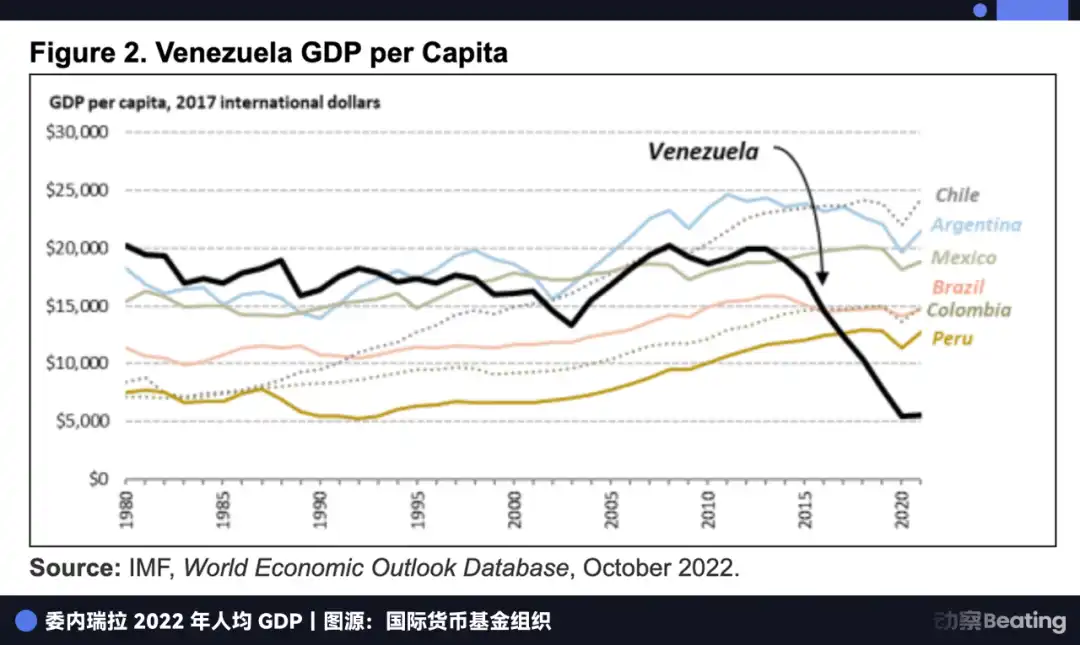
Internally, Venezuela's governance incapacity and corruption led to the collapse of its economic pillars, rendering the local currency practically worthless in hyperinflation; externally, sanctions directly caused its GDP to shrink by about 75%. It's precisely this suffocating sense of an internal and external dilemma that gave rise to a parallel financial ecosystem entirely independent of the dollar-centric closed loop.
Meanwhile, in order to avoid the risk of exorbitant fines from the United States, global large banks have initiated the so-called "de-risking" movement, proactively cutting off business dealings with the Latin American region. According to a report by the Atlantic Council, more than 21 banks in the Caribbean region have lost correspondent banking relationships, and some countries have even lost the ability to process basic dollar trades and migrant remittances.
This defensive financial exclusion has not only failed to strengthen existing hegemony but has instead pushed more innocent individuals and businesses into that emerging parallel financial ecosystem.
The Parallel Financial Ecosystem Beyond the Iron Curtain
In this game of financial sovereignty and survival instinct, Latin America's parallel financial ecosystem, composed of stablecoins, local fintech, non-U.S. trade channels, and the underground economy, is forming a network that is not subject to Washington's will.
In Latin America, stablecoins are no longer mere chips for investment or speculation.
Take Venezuela, for example, where, to evade sanctions, the government has established a shadow financial network. By December 2025, around 80% of the country's oil revenue is received in the form of the USDT stablecoin.
Furthermore, intelligence indicates that through a cross-border gold refining and over-the-counter trading channel spanning Turkey and the UAE, Venezuela may have secretly accumulated a Bitcoin reserve worth as much as $60 billion, a position size rivaling that of MicroStrategy.
However, this alternative to the SWIFT system, traversing gold and cryptocurrency channels via Turkey and the UAE, while circumventing sanctions technically, has also become a key point of Washington's accusations of involvement in illicit fund flows and support for drug trafficking due to its high level of concealment.
For ordinary Latin American people, when their traditional bank accounts are frozen due to sanctions, they no longer pay attention to the cumbersome and politically charged instructions of the settlement system but instead directly move funds across borders through blockchain.
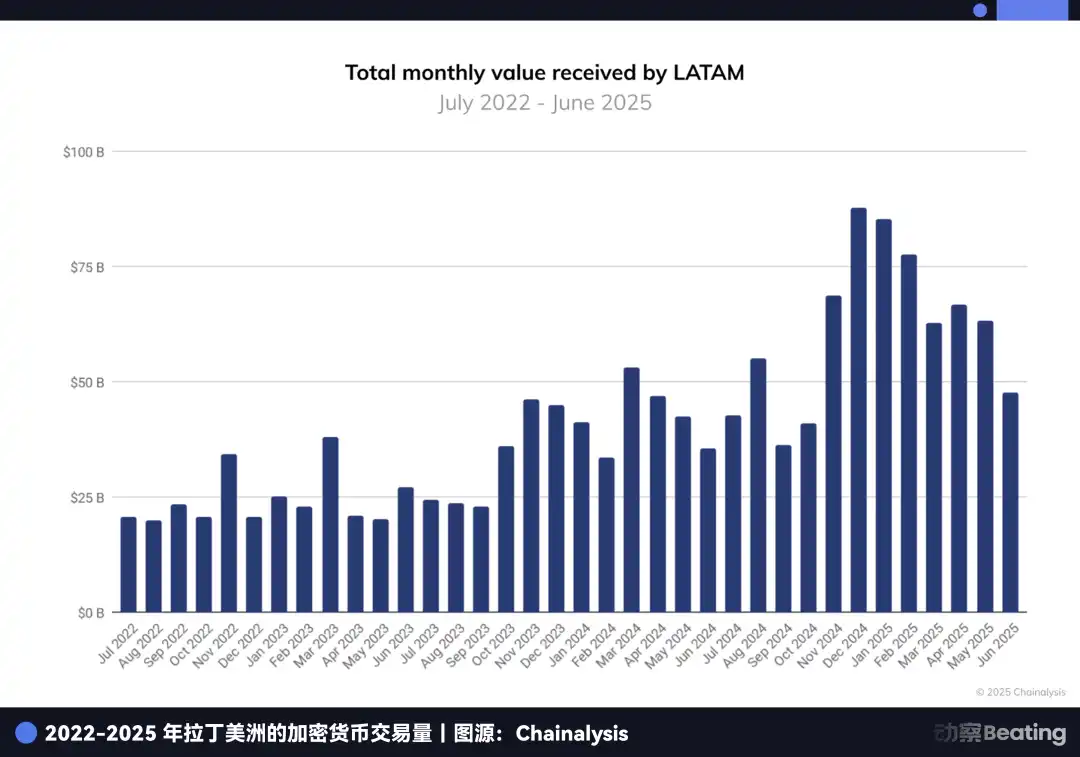
According to Chainalysis data, between 2022 and 2025, Latin American cryptocurrency transactions approached $1.5 trillion, with over 90% of transactions in Brazil involving stablecoins.
Compared to Manhattan bankers accustomed to overseeing from great heights, local fintech companies care more about the ground beneath their feet and the tangible livelihood. Taking Brazil as an example, even though only 60 million people have credit cards, the central bank-led Pix payment system has surprisingly reached 170 million users.
In 2024, Pix's total transaction volume reached $3.8 trillion, 1.7 times Brazil's GDP. Behind this data is the extreme efficiency of fund turnover.
At the same time, digital banking giant Nubank, in just eight years, grew its user base from 1.3 million to 114 million, capturing over 60% of Brazil's adult population and achieving nearly $2 billion in net profit in 2024.
Payment giant Mercado Pago swept $142 billion in payments in Latin America, while the newcomer in the remittance market, Bitso, directly took a 4% share of the US-Mexico remittance market from traditional giants like Western Union.
Furthermore, non-dollar channels and the underground economy are merging. A $5 billion currency swap between Argentina and China, along with the ongoing progress of local currency settlements between China and Brazil, is becoming a symmetric choice amid great power competition. This top-down decoupling is giving Latin American trade a form of breathing room independent of the dollar.
On the streets of Argentina, a black-market exchange rate known as the "Blue Dollar" has become a nationwide economic barometer. The significant spread between it and the official exchange rate starkly reveals the bankruptcy of official credit, giving rise to countless street exchange dealers known as "arbolitos" and "crypto caves" specialized in USDT trading.
The penetration of stablecoins, the penetration rate of local fintech, strategic choices of non-dollar channels, and the rampant growth of the underground economy have woven together a financial network breaking free from centralized control.
Who's Passing the Knife
Any breakout of a species, besides intrinsic survival instincts, often requires a catalyzing external environment. The catalyst for the rise of Latin America's parallel financial system comes precisely from the United States, which seeks to defend the old order.
A series of Washington's operations not only failed to stifle the emergence of the new order but instead provided it with the most abundant nutrients for expansion.
The first thrust came from politicians' forceful expropriation of financial channels.
The Trump administration once proposed a 1% tax on remittances from the United States, which may seem like a minor fee, but when placed against the backdrop of over $150 billion in annual remittances to Latin America, this is enough to shake the lifeline of tens of millions of low-income families.
It's worth noting that within traditional financial channels, sending $200 to Latin America incurs a fee of $6 to $8 just to the likes of Western Union.
This additional 1% tax has become the straw that broke the camel's back. This tax bill has sent an extremely dangerous signal to every worker: traditional remittance channels are not only expensive but can also become a political game's sacrificial lamb at any time.
Trump may have thought he was building a financial wall, but in reality, he has driven tens of millions of users to escape the old system and collectively run into the embrace of stablecoins and local fintech. When the cost of survival is pushed to the limit by politics, users will migrate at an unprecedented speed.
The second push comes from a severe rift among Wall Street elites in interest distribution.
As mentioned earlier, to comply with increasingly strict anti-money laundering regulations, Wall Street giants have launched a "derisking" movement, actively cutting off business ties with Latin America, these "high-risk regions." JPMorgan Chase, in 2014, cited "high risk" as a reason to close the accounts of tens of thousands of Latin American customers.
By the end of 2025, JPMorgan Chase had, on one hand, frozen the bank accounts of two stablecoin companies, BlindPay and Kontigo, operating in Venezuela, playing the role of the most loyal "gatekeeper" of the dollar system. On the other hand, it was frantically hoarding physical precious metals to hedge against dollar risk.
Public data shows that JPMorgan Chase has become the world's largest holder of physical silver. More intriguingly, JPMorgan Chase has transferred a large amount of silver from deliverable to non-deliverable status.
This means that although this silver is lying in warehouses, it is no longer allowed to be used to fulfill futures contract deliveries. In other words, JPMorgan Chase is taking these "chips" off the gambling table and locking them away in its not easily accessible backyard.
While the dollar hegemony is still in effect, these Wall Street elites seek to maximize their financial control within the rules; but at the same time, they are also preparing for the eventual collapse of this system. JPMorgan Chase is both the top defender of the existing dollar system and its biggest "internal short."
Therefore, the more the United States tries to tighten the reins of the dollar, the more the dollar leaps out of bounds in a wild way to find a safer pasture. When core players within a system start preparing exit strategies for the post-dollar era, this control inevitably moves toward its opposite.
The Curse of Hegemony
This dilemma of "control" versus "out of control" is not unique to this era. If we cast our gaze back to the foggy 19th century, in the long river of financial history, we can actually hear a distant and similar echo—a decline of the pound sterling.
In that long century, the pound sterling was once the undisputed world currency. But when a currency truly belongs to the whole world, it no longer exclusively belongs to its home country.
In order to globalize the pound, the UK was forced to maintain a trade deficit for many years, a price that directly led to the hollowing out of its manufacturing industry and the chronic decline of its national strength. In 1931, after enduring three brutal runs on its currency, the UK was forced to abandon the gold standard, and the pound's hegemony fell from grace.
The British Empire paid a hundred years' tuition for a lesson: the more you try to use your currency's status to exploit the world, the more you accelerate its vitality drain.
Today, the US dollar is stepping into the same predicament.
The more Washington wants to wield the dollar as a weapon, using sanctions, taxation, and stringent regulation to encircle and intercept, the more likely the dollar is to accelerate its departure from home. While you take the high road, the public takes the byroads.
Stablecoins, local fintech, non-US trade channels, the rampant growth of the underground economy... all these various choices are essentially covert paths for the dollar to escape Washington's control.
From the recent obsession of central banks around the world with physical gold hoarding to top-tier financial capital locking down on tangible assets, this collective choice is shifting the global financial center of gravity back to the era of hard assets.
This shift is not unfolding in the total collapse of the old empire but in the current surface prosperity of the United States, deconstructed spontaneously by hundreds of millions of individuals and businesses.
The echoes of history are already swirling over Washington, unmistakably resonant.
You may also like

Lurking in 600 Scam Groups, He Wants to Intercept Illicit Funds

Election, Oil Price, and Money Printer: Why Bitcoin Only Looks at Trump

Stuck in a Local Optimum, Predictive Analytics Should Not Stop Here

Tether, which has "enriched" itself through stablecoins, is now heavily investing in AI

If you are long on oil, Maduro's arrest is not good news

India, the Outsourcing Hub of the Crypto World

Key Market Information Discrepancy on January 6th - A Must-See! | Alpha Morning Report

Life’s K-lines can’t cure anxiety, and prediction markets can’t calculate the ending.
Real life often unfolds beyond the K-lines.

Bitcoin getting ‘stable’? 2025 volatility lower than Nvidia

Decode Bitget TradFi: How to Bridge the Final Gap Between Crypto and Traditional Assets?

Crypto Fear & Greed Index Stable, “Fear” Emotion Requires Addressing
Key Takeaways Cryptocurrency fear and greed index remains at a low of 26, improving from “extreme fear” but…

2025 Crypto Violence Retrospective: Increasing Assaults and Fatal Incidents in a Growing Market
Key Takeaways Violent incidents involving cryptocurrency holders have escalated, with 2025 documenting 65 attacks, including 4 fatalities. The…

Key Macro Events and Crypto Whale Movements This Week
Key Takeaways Upcoming releases of key U.S. economic data on unemployment and non-farm payrolls could significantly impact markets.…
Venezuela’s 60 Billion BTC “Shadow Reserve”, Walmart to Embrace Bitcoin Payments: Global Cryptocurrency Conversations Today
Key Takeaways Recent developments in the cryptocurrency market have highlighted significant macroeconomic discussions and ecosystem-specific advancements. The Curve…

Maduro Ousted, “Unlocks” $60 Billion Bitcoin “Shadow Reserve,” Will Reshape Global Market Landscape
Key Takeaways Venezuela under Maduro accumulated a massive reserve of Bitcoin and USDT as a method to evade…
Court Sentences Criminal in Virtual Currency Fraud Case with Major Global Implications
Key Takeaways A landmark case in Beijing reveals a significant cross-border telecom and internet fraud scheme involving virtual…

Japanese and South Korean Stock Markets Surge, South Korea’s KOSPI Index Hits New Record
Key Takeaways Both Japan’s Nikkei 225 Index and South Korea’s KOSPI have seen significant gains, reaching new heights…

Japanese Finance Ministry Ushers in 2026 as “Digital First Year” with Focus on Digital Assets
Key Takeaways Japan’s Minister of Finance, Okatsuka Katsuki, has declared 2026 as Japan’s “Digital First Year,” highlighting the…


 App
App