
- Comprar cripto
- Mercados
- Contratos
- Spot
- Copy trading
 WE-Launch
「Crazier Than Cryptocurrency」: 10-Year Treasury Yield Records Largest Leap in 20 Years, Flash Crash Warns of Financial Crisis

Original Article Title: "A Historic Week Has Passed, Both US Stocks and Bitcoin Have Risen, But the Market Has Changed Completely!"
Original Article Author: Richard Bo, Wall Street View
US stock market volatility has rarely surpassed that of emerging markets and Bitcoin. At the same time, US Treasuries, which have always been seen as a safe asset, experienced sharp fluctuations, leading investors to start questioning the wisdom of holding US assets. UBS believes that once global risk-free rates experience volatility, it means that all markets will be disrupted. Analyst Ed Al-Hussainy bluntly pointed out, "I'm actually not worried about a recession, I'm worried about a financial crisis."
US stocks rebounded on Friday, suggesting a restoration of market risk appetite. However, investors have actually started questioning the safety of US assets, especially with the drastic fluctuations in US Treasuries, reigniting fears of a financial crisis on Wall Street.
Over the past week, the US 10-year Treasury yield saw its largest weekly jump in over 20 years, while US stocks experienced a rollercoaster ride of a dive followed by a surge. On the surface, the S&P 500 index rose by over 5% for the week, US bond yields returned to February levels, and Bitcoin closed higher, appearing as if everything was business as usual.
However, what is unsettling is the simultaneous decline this week in US stocks, US bonds, and the US dollar, a typical characteristic of emerging markets rather than a performance of the world's safest assets. Particularly with such a large fluctuation in US long-term bonds this week, a liquidity crisis seems imminent, prompting investors to question the wisdom of holding US assets. Bhanu Baweja, Chief Strategist at UBS Group, even stated:
This is too scary. We are redefining the global risk-free rate, and if the global risk-free rate experiences volatility, it will disrupt all markets.
Historically Rare: US Asset Volatility Surpasses that of Emerging Markets and Bitcoin
Trump's recent tariff policies have not only damaged confidence in the US economy but also shaken investors' trust in the US policy direction and US dollar assets. Even by Wall Street's long historical standards, this week has been a brutal trading week, with US stocks feeling like they are on a rollercoaster ride, and the movements of US bonds and the US dollar suggesting that the US safe haven status seems to be unsteady:
On Monday, due to the so-called tariff confusion, US stocks experienced a 15-minute seismic pulse, with the Nasdaq plummeting by 10% at one point and US Treasuries taking a nosedive.
On Tuesday, news of no tariff exemptions shattered hopes of a US stock rebound, with the Dow plunging over 2000 points at one point, the S&P erasing over a 4% gain to negative territory, and the US Treasury market experiencing a deleveraging sell-off.
On Wednesday, the US temporarily delayed some tariffs, with the three major US stock indices rising by nearly 8% at least, the S&P seeing its largest gain since 2008, US stock trading volume hitting a historic high of 30 billion shares. The 10-year US Treasury yield spiked and then retreated.
On Thursday, global investors fled from US assets, leading to a triple hit on US stocks, bonds, and the dollar. The Nasdaq plummeted over 4%, marking the dollar's largest daily drop in two years and pushing gold to a new high.
On Friday, the Federal Reserve hinted at intervention, prompting a rebound in US stocks. However, the downward trend of US bonds and the dollar served as a warning that the US's status as a safe haven may no longer be assured.
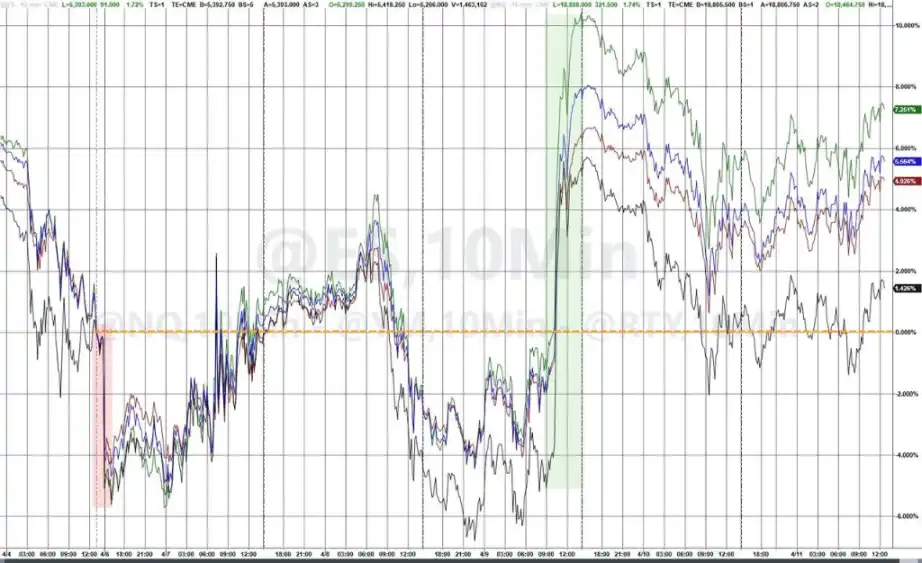
Andrea DiCenso, an investment manager at Loomis, Sayles & Company, stated, "Is the US market starting to behave like an emerging market? Undoubtedly, yes, that is exactly what we are seeing."
According to data, the volatility of US stock ETFs has even exceeded that of funds tracking emerging markets and has at times been higher than Bitcoin. This situation has rarely occurred except during the pandemic, the crisis in August of last year, and the Fed's aggressive rate hike period.
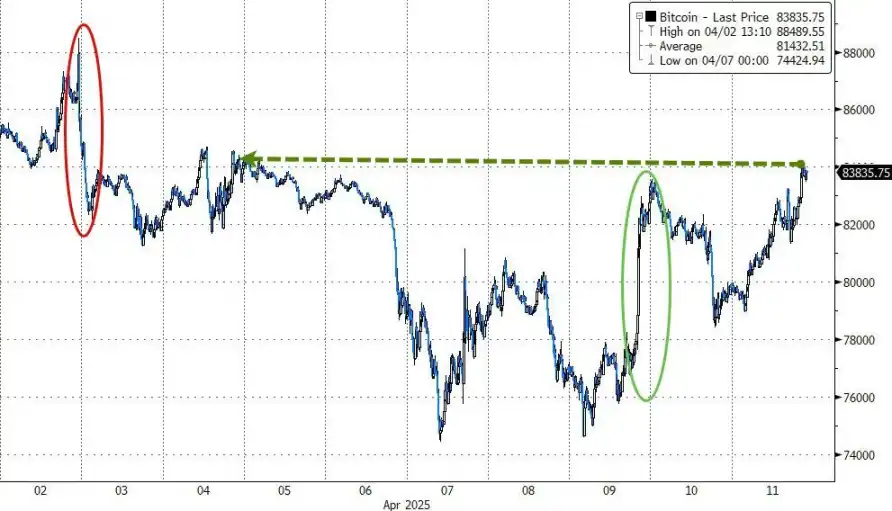
Neil Dutta from Renaissance Capital bluntly expressed in a client email, "The S&P 500 index is trading like a cryptocurrency, and that may not be a good thing."
Sharp Fluctuations in Risk-Free Rates Signal a Replay of the Financial Crisis
When the long-term bond market experiences sharp volatility, significant spreads, and low liquidity, it affects all other capital markets, especially exerting upward pressure on rates and US government debt, potentially evolving into a financial crisis if sustained over the long term.
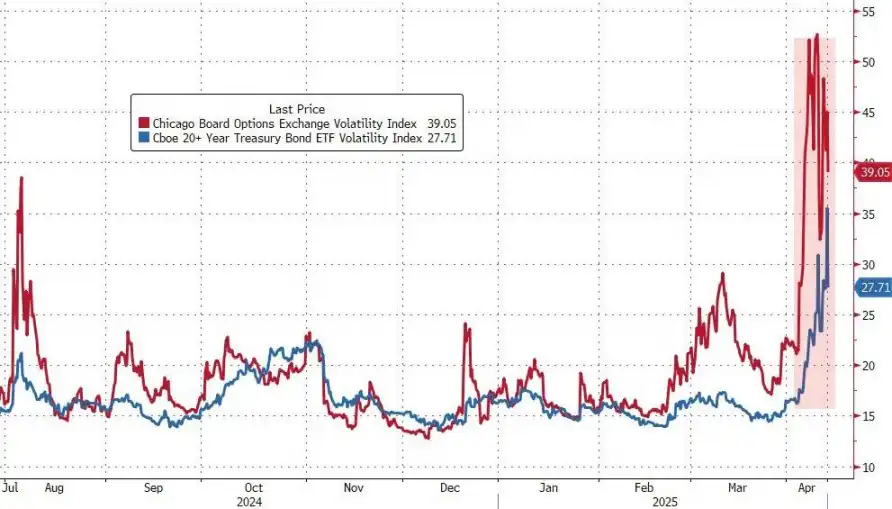
US bond volatility surged this week, with the 20-year Treasury bond volatility rapidly catching up to the VIX stock volatility.
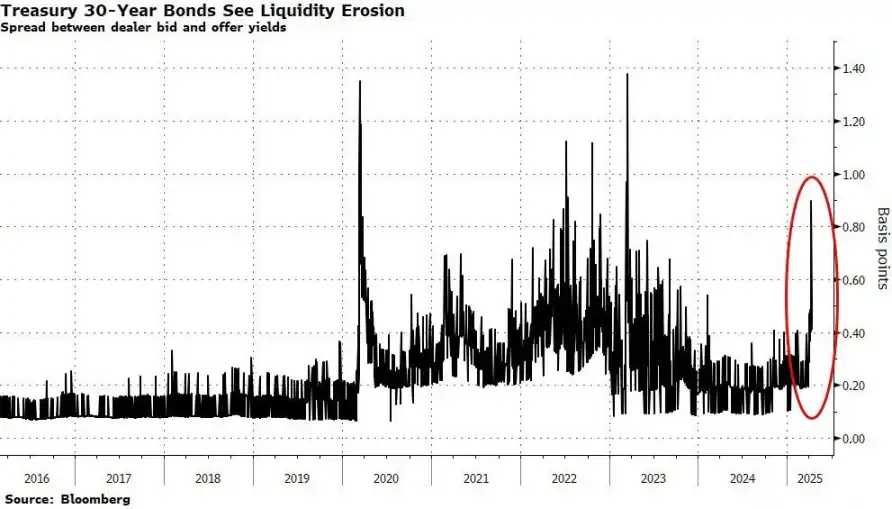
Although this week the decline in 30-year US bonds did not continue from last week, presenting a broadening trend, there were some cracks in the trading spread of the benchmark 30-year bond—which is a signal of the long-term decline in liquidity in the US Treasury yield curve. This week, the spread almost reached a full basis point, a level unseen since early 2023.
Confidence from regions outside the US in the quality of US stocks, fixed-income, and currency assets has been eroded. Fund strategist Nathan Thooft stated, "The question is whether this is a temporary shock or a long-term shift. We still believe the former. However, it cannot be denied that some large asset owners are seeking alternative safe-haven assets and diversified allocations."
Analyst Ed Al-Hussainy succinctly pointed out:
I'm actually not worried about a recession, I'm worried about a financial crisis.
Funds Flowing to Safe-Haven Assets, Wall Street Calls for Fed Intervention
Under the shadow of a financial crisis, global investors, after withdrawing from the U.S., have poured into safe-haven assets such as the European bond market, gold, the yen, and the Swiss franc to avoid broader turmoil.
This week, German bond yields remained largely unchanged, while U.S. 10-year bond yields surged over 50 basis points, marking the largest divergence between U.S. and German bond yields since 1989. In contrast, the U.S. dollar index fell below the key level of 100, posting its most severe two-week decline since November 2022, while the euro strengthened significantly, with the week's appreciation surpassing that of the yen.
Extreme volatility has brought unprecedented psychological pressure to investors and traders, prompting calls from Wall Street for Fed intervention. On Friday, JPMorgan CEO Jamie Dimon stated that he anticipates "turmoil" in the U.S. Treasury market.
Dimon said during an earnings call, "When you have a lot of volatile markets, very wide bid-offer spreads in Treasuries, low liquidity, it affects all other capital markets. That's the reason the Fed should intervene, not to help the banks."
Fortunately, Fed Governor Lael Brainard stated on Friday that if market conditions become disorderly, the Fed is "absolutely prepared" to help stabilize the financial markets. However, she emphasized:
"The markets are functioning well, and we haven't seen broad-based liquidity concerns."
También te puede gustar

Opciones de Criptomonedas: Bitcoin y Ethereum Enfrentan Expiración Histórica
Key Takeaways Un imponente vencimiento de opciones de Bitcoin y Ethereum, valorado en más de $27 mil millones,…

Los movimientos de las ballenas en Hyperliquid alteran el panorama de criptomonedas
Key Takeaways La cantidad de ballenas BTC al alza en Hyperliquid ha disminuido notablemente. Los inversores bajistas en…

Trust Wallet Resuelve Problema de Seguridad en Extensión del Navegador
Key Takeaways Trust Wallet confirmó que un incidente de seguridad afectó específicamente a la versión 2.68 de su…

El Impacto de la Expiración Masiva de Opciones en el Precio de Bitcoin
Key Takeaways La expiración de opciones de Bitcoin este trimestre es la más grande registrada, con un impacto…

Matrixport Predice Cambio en el Juego de Bitcoin
Key Takeaways Matrixport observa un cambio en la dinámica del mercado de Bitcoin, pasando de un riesgo de…

Las Ballenas de Ethereum Impulsan el Mercado: Predicciones y Tendencias 2025-2030
Key Takeaways Las ballenas de Ethereum están acumulando grandes cantidades de ETH, lo que sugiere confianza en el…
Fed Q1 2026: Potencial impacto en Bitcoin y mercados cripto
Key Takeaways Las pausas de la Fed podrían presionar a los criptomercados, pero la “QE encubierta” podría amortiguar…

El volumen de los derivados de criptomonedas explota a $86T en 2025, con Binance liderando
Puntos Clave En 2025, el comercio de derivados de criptomonedas alcanzó un volumen de 86 billones de dólares,…

Ethereum en 2026: Forks Glamsterdam y Hegota, Escalado L1 y Más
Puntos Clave: Los forks Glamsterdam y Hegota prometen mejorar significativamente el rendimiento y la escalabilidad de Ethereum en…

OPI de Kraken y fusiones para avivar el ciclo ‘intermedio’ de las criptomonedas
Key Takeaways La OPI potencial de Kraken y las fusiones y adquisiciones podrían atraer capital de las finanzas…

Amenazas a la seguridad humana en criptomonedas para 2026: Consejos de expertos
Key Takeaways La ingeniería social se ha convertido en la principal amenaza para la seguridad de las criptomonedas.…

Consejos para Nuevos en Cripto, Veteranos y Escépticos de un Bitcoiner que Perdió $700 Millones
Key Takeaways: Comprender antes de invertir: Los principiantes deben entender las criptomonedas antes de comprarlas. Evitar el apalancamiento:…
Trust Wallet cubrirá pérdida de $7 millones en hackeo navideño, dice Zhao
Puntos clave Trust Wallet sufrió un hackeo el día de Navidad, resultando en pérdidas cerca de $7 millones,…

Feliz Navidad, Caroline Ellison: Aquí llega su liberación anticipada
Resumen de Claves Caroline Ellison, ex CEO de Alameda Research, será liberada en enero tras cumplir una sentencia…

La computación cuántica en 2026: No habrá un apocalipsis criptográfico, pero es momento de prepararse
Puntos Clave La computación cuántica no representará una amenaza inmediata para la criptografía en 2026, pero el concepto…

Ethereum No Es Probable Que Alcance Nuevos Máximos en 2026: Análisis de Ben Cowen
La perspectiva de Ether de alcanzar nuevos máximos en 2026 según Ben Cowen es pesimista; podría ser solo…
Blockchains se preparan silenciosamente para la amenaza cuántica mientras Bitcoin debate su cronograma
Key Takeaways Las computadoras cuánticas aún no pueden romper Bitcoin, pero blockchains importantes están preparándose para un futuro…

El token financiero World Liberty de Trump termina 2025 con una caída de más del 40%
Key Takeaways El proyecto de criptomoneda de la familia Trump, World Liberty Financial, ha experimentado una caída significativa…
Opciones de Criptomonedas: Bitcoin y Ethereum Enfrentan Expiración Histórica
Key Takeaways Un imponente vencimiento de opciones de Bitcoin y Ethereum, valorado en más de $27 mil millones,…
Los movimientos de las ballenas en Hyperliquid alteran el panorama de criptomonedas
Key Takeaways La cantidad de ballenas BTC al alza en Hyperliquid ha disminuido notablemente. Los inversores bajistas en…
Trust Wallet Resuelve Problema de Seguridad en Extensión del Navegador
Key Takeaways Trust Wallet confirmó que un incidente de seguridad afectó específicamente a la versión 2.68 de su…
El Impacto de la Expiración Masiva de Opciones en el Precio de Bitcoin
Key Takeaways La expiración de opciones de Bitcoin este trimestre es la más grande registrada, con un impacto…
Matrixport Predice Cambio en el Juego de Bitcoin
Key Takeaways Matrixport observa un cambio en la dinámica del mercado de Bitcoin, pasando de un riesgo de…
Las Ballenas de Ethereum Impulsan el Mercado: Predicciones y Tendencias 2025-2030
Key Takeaways Las ballenas de Ethereum están acumulando grandes cantidades de ETH, lo que sugiere confianza en el…
Monedas populares
Últimas noticias cripto


Atención al cliente:@weikecs
Cooperación comercial:@weikecs
Trading cuantitativo y MM:[email protected]
Servicios VIP:[email protected]
 App
App