
- Comprar cripto
- Mercados
- Futuros
- Spot
- Copy trading
 WE-Launch
Does the US Intentionally "Want" a Recession?

Original Author: The Kobeissi Letter
Original Translation: Deep Tide TechFlow
Is the U.S. Government Expecting an Economic Recession?
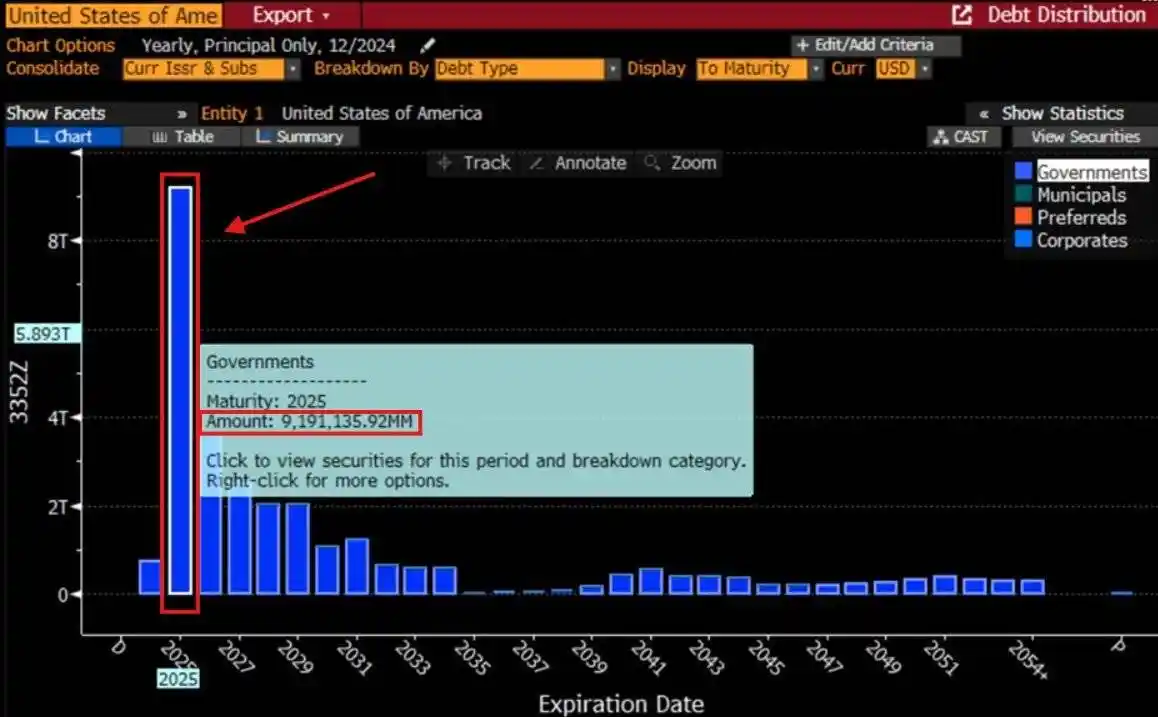
By 2025, the U.S. will have $92 trillion in debt maturing or needing to be refinanced. Faced with this massive refinancing, the quickest way to lower rates may be to induce an economic recession.
But can the U.S. benefit from a market crash?
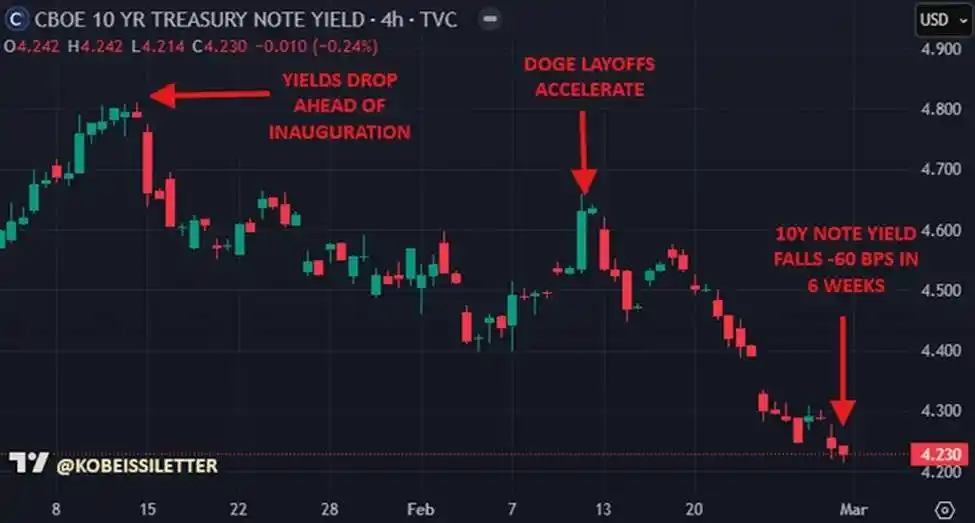
Over the past two months, the 10-year treasury yield has dropped by around 60 basis points. This is partly due to market expectations of cuts to the government's discretionary sector spending. However, it is also tied to increased uncertainty and the rising possibility of a U.S. economic recession.
An economic recession almost guarantees a rate cut.
But why does an economic recession signify a rate cut?
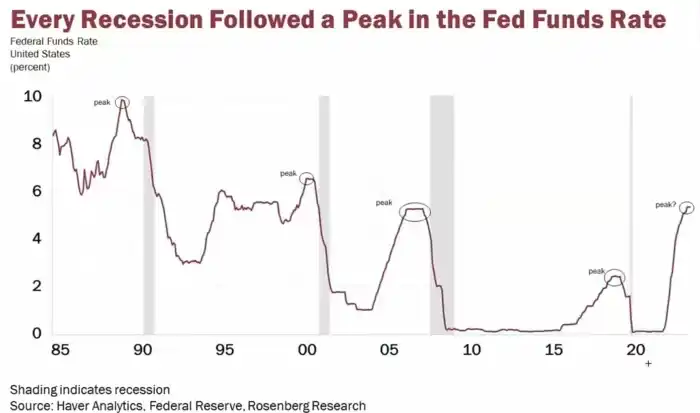
Since the 1980s, every U.S. economic recession has occurred after the federal funds rate has peaked. When economic growth stalls, the Fed acts to "stimulate" the economy. This means lowering rates to reduce the cost of capital and encourage spending.
Since the start of the trade war, U.S. economic growth expectations have plummeted significantly. Meanwhile, oil prices have hit a new 6-month low. Interestingly, President Trump has repeatedly expressed his desire to lower oil prices to alleviate inflationary pressures.
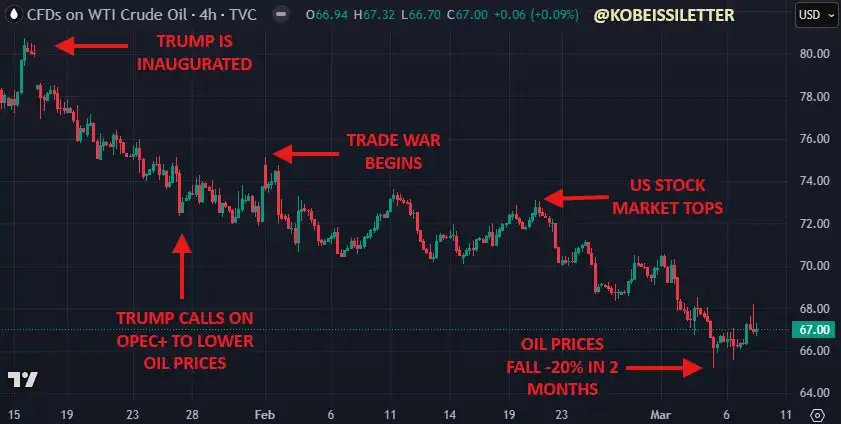
On January 25, President Trump claimed he has a solution to the Fed's more than 3-year fight against inflation. He called on the Organization of the Petroleum Exporting Countries (OPEC) to lower oil prices and urged a global rate cut.
However, the quickest way to lower oil prices is most likely through a demand-reducing economic recession.
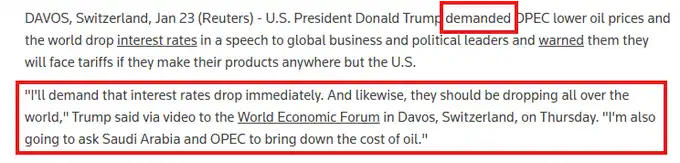
In a recent interview with Fox News, President Trump mentioned that he would prioritize lowering rates.
He said, "Rates are coming down... and I hope they do because I love the country and I'd like to see the country thrive." This quote is from @amitisinvesting's report.
Next, let's take a look at the inflation data.
American consumers believe that the inflation rate for the next 12 months will rise to +6.0%, the highest level since May 2023. This marks the third consecutive month of rising inflation expectations.
Inflation is on the rise, rate cuts are postponed, yet interest rates are declining.
The market is pricing in an economic recession.
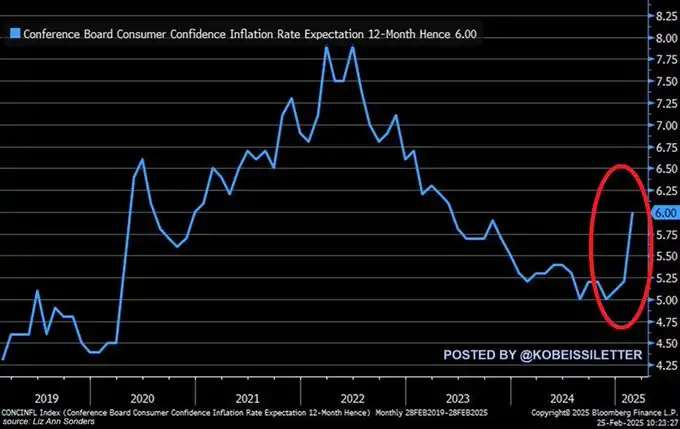
In the escalating trade war of soaring inflation, a sharp rate cut is almost inevitably a precursor to an economic recession. Furthermore, on March 6, President Trump stated that he doesn't even pay attention to the stock market. The reality, however, is that, just as we saw in his first term, Trump has always been watching the market.
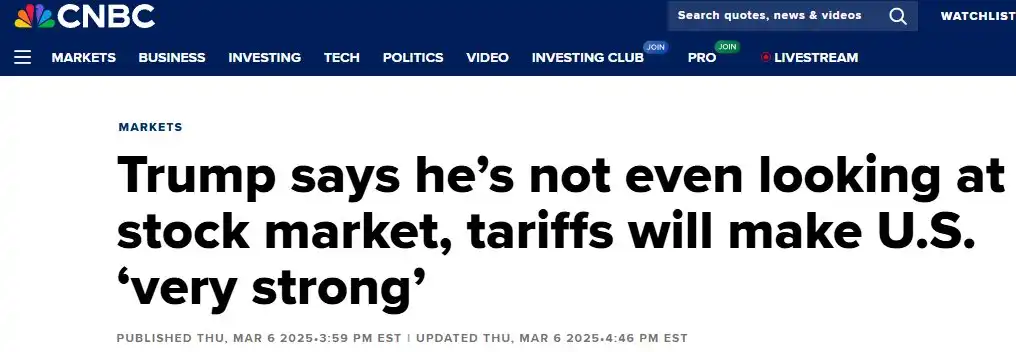
President Trump's statement of "not paying attention to the market" is significant.
In a scenario where he clearly does pay attention to the market, this is actually a signal he is sending to Wall Street, indicating his willingness to lower interest rates and reduce the trade deficit at all costs, even if it means potentially triggering an economic recession.
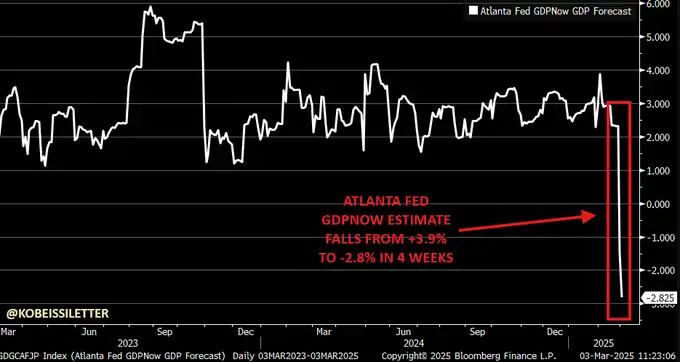
In the chaos of the trade war, we see a significant downward revision in economic growth expectations. The Atlanta Fed last week lowered its GDP growth forecast for the first quarter of 2025 to as low as -2.8%. Therefore, we see a sharp increase in market expectations for rate cuts last week.
Is this intentional?
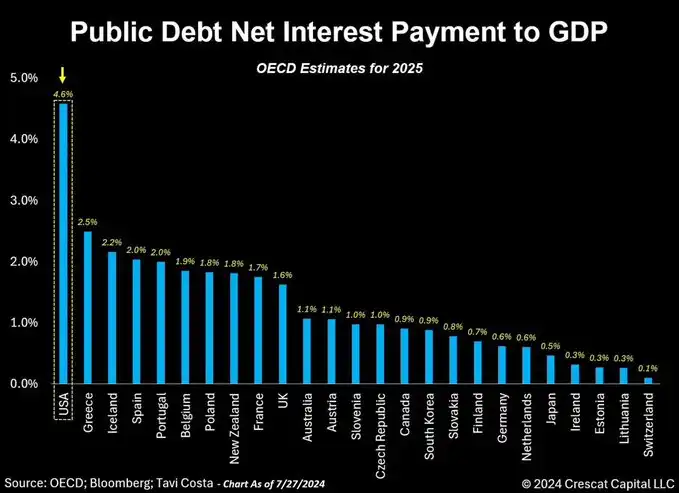
High-interest rates are the biggest challenge facing the U.S. government.
As interest rates soar, the cost of debt interest payments increases significantly. Currently, the average interest rate on the U.S.'s $36.2 trillion national debt is 3.2%, hitting the highest level since 2010. The U.S. government needs a rate cut more than anyone.
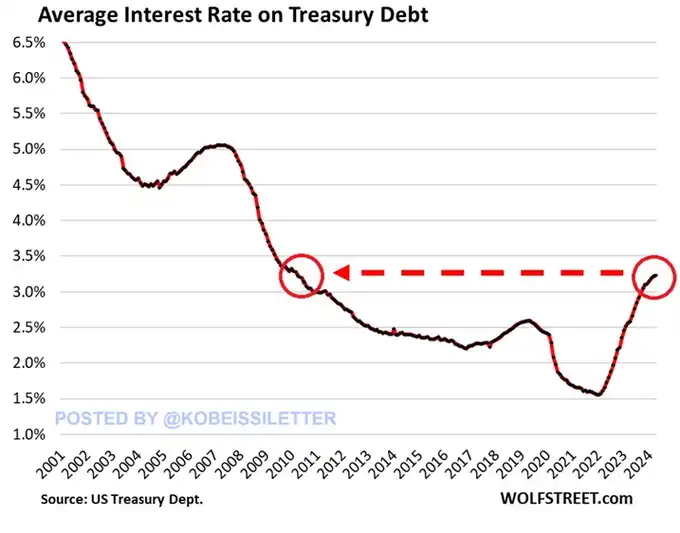
Furthermore, a rate cut is imminent:
The U.S.'s $9.2 trillion debt maturity is heavily concentrated in the first half of 2025, with 70% of the debt needing refinancing from January to June 2025.
The average interest rate on this debt is expected to rise by about 1 percentage point.
Moreover, efforts to reduce deficit spending in the U.S. will not happen overnight.
In the 2024 fiscal year, the United States had expenditures of up to $7.8 trillion, while income was only about $5.0 trillion. This means that for every $1 of income generated, there was $1.56 in costs. The shadow of a debt crisis will loom over the United States for a long time to come.
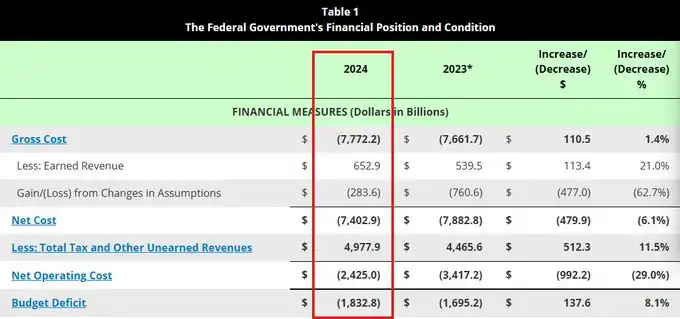
These significant changes in the macroeconomic landscape will have a broad impact on the entire market, and we are currently and will continue to seize opportunities from them.
Interested in how we trade the market? Click the link below to subscribe to our premium analysis and alert service: https://www.thekobeissiletter.com/pricing
Finally, let's go back to 2023 when the Federal Reserve was on the verge of calling for an economic recession to curb inflation.
In February 2023, many studies indicated that an economic recession might be the only solution. Subsequently, the Fed shifted to the narrative of a "soft landing," but this strategy has so far failed to lower interest rates.
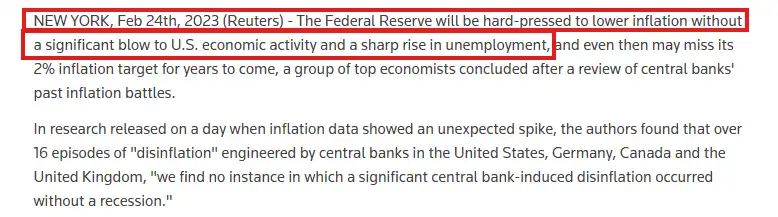
The reality is that the U.S. debt crisis is currently the most severe yet most neglected crisis. While President Trump has acknowledged this, it may be too late. An economic recession may be the only solution to lower interest rates.
Follow us @KobeissiLetter for real-time analysis updates.
Te puede gustar

Trust Wallet Sufre un Hackeo que Lleva a la Pérdida de 3,5 Millones de Dólares
Key Takeaways Un hackeo a Trust Wallet resultó en una pérdida de 3,5 millones de dólares para el…

Trust Wallet Resuelve Brecha de Seguridad en Extensión del Navegador
Key Takeaways Trust Wallet solucionó una brecha de seguridad en la versión 2.68 de su extensión de navegador…

Los Gigantes de Ethereum Acumulan Monedas: Reflexiones y Predicciones para el Futuro
Key Takeaways En la última semana, grandes inversores han incrementado su posesión de Ethereum (ETH) de forma significativa.…

Bitcoin Experimenta Menor Riesgo de Caída: ¿Un Cambio en el Horizonte?
Key Takeaways Matrixport destaca una disminución marginal en el riesgo bajista de Bitcoin, situando el mercado en un…

Fed Q1 2026 Outlook: Potential Bitcoin and Crypto Market Impacts
Key Takeaways Fed pauses on rate cuts could put pressure on the crypto market, but “stealth QE” measures…

Ethereum en 2026: Forks Glamsterdam y Hegota, y escalado de L1
Key Takeaways En 2026, se espera que Ethereum implemente el fork Glamsterdam, mejorando el procesamiento paralelo perfecto y…

Kraken IPO y las Fusiones y Adquisiciones para Reavivar el Ciclo ‘Intermedio’ de Criptomonedas
Key Takeaways El próximo IPO de Kraken y las fusiones y adquisiciones estratégicas podrían atraer capital nuevo desde…

Volumen de derivados de criptomonedas se dispara a $86 billones en 2025, promediando $265 mil millones por día
Aspectos Clave El comercio de derivados de criptomonedas alcanzó los $86 billones en 2025, con un promedio diario…

Amenazas de ingeniería social que costaron miles de millones en 2025: Cómo protegerte
Principales conclusiones: La mayoría de los ataques criptográficos en 2025 no surgieron de errores de código, sino de…
Trust Wallet Cubre Pérdidas de 7 Millones de Dólares por Hackeo el Día de Navidad: Insiders en la Mira
Key Takeaways Trust Wallet sufrió un ataque que resultó en la pérdida de $7 millones en criptomonedas durante…

Aave governance vote ends in rejection after community feedback
Key Takeaways Aave’s governance proposal to place control of brand assets under DAO ownership was rejected by the…

Una Feliz Navidad, Caroline Ellison: Aquí un adelanto de su liberación de custodia
Key Takeaways Caroline Ellison, la ex directora ejecutiva de Alameda Research, será liberada de prisión antes de lo…

Consejos para Cripto Principiantes, Veteranos y Escépticos de un Bitcoiner que Sepultó $700M
Key Takeaways Educación fundamental: Antes de invertir en criptomonedas, entender cómo funcionan las blockchain y el propósito de…
Quantum computing en 2026: No hay un día del fin para las criptomonedas, pero es momento de prepararse
La computación cuántica aún no representa una amenaza inminente para Bitcoin y otras criptomonedas, sin embargo, los preparativos…
Los sueños de Bitcoin de El Salvador acercados a la realidad en 2025
Key Takeaways En 2025, los planes de adopción de Bitcoin de El Salvador enfrentaron desafíos debido a las…

Ethereum poco probable que alcance nuevos máximos en 2026: análisis de Ben Cowen
Key Takeaways Ben Cowen, analista de criptomonedas, cree que Ethereum probablemente no alcanzará nuevos máximos en 2026 debido…

El token financiero World Liberty de Trump termina 2025 con una caída de más del 40%
Key Takeaways: El proyecto criptográfico del Trump presenta una disminución importante en el valor del token financiero World…
Blockchains se preparan en silencio para la amenaza cuántica mientras Bitcoin debate el cronograma
Los blockchains altcoin están tomando medidas para protegerse contra los riesgos cuánticos a largo plazo, mientras Bitcoin enfrenta…
Trust Wallet Sufre un Hackeo que Lleva a la Pérdida de 3,5 Millones de Dólares
Key Takeaways Un hackeo a Trust Wallet resultó en una pérdida de 3,5 millones de dólares para el…
Trust Wallet Resuelve Brecha de Seguridad en Extensión del Navegador
Key Takeaways Trust Wallet solucionó una brecha de seguridad en la versión 2.68 de su extensión de navegador…
Los Gigantes de Ethereum Acumulan Monedas: Reflexiones y Predicciones para el Futuro
Key Takeaways En la última semana, grandes inversores han incrementado su posesión de Ethereum (ETH) de forma significativa.…
Bitcoin Experimenta Menor Riesgo de Caída: ¿Un Cambio en el Horizonte?
Key Takeaways Matrixport destaca una disminución marginal en el riesgo bajista de Bitcoin, situando el mercado en un…
Fed Q1 2026 Outlook: Potential Bitcoin and Crypto Market Impacts
Key Takeaways Fed pauses on rate cuts could put pressure on the crypto market, but “stealth QE” measures…
Ethereum en 2026: Forks Glamsterdam y Hegota, y escalado de L1
Key Takeaways En 2026, se espera que Ethereum implemente el fork Glamsterdam, mejorando el procesamiento paralelo perfecto y…
Monedas populares
Últimas noticias cripto


Atención al cliente:@weikecs
Cooperación empresarial:@weikecs
Trading cuantitativo y CM:[email protected]
Servicios VIP:[email protected]
 App
App