
- Comprar cripto
- Mercados
- Futuros
- Spot
- Copy trading
 WE-Launch
Solana's Crisis of Faith: Unbeatable Fundamentals, So Why is the Price 'Flatlining'?

Original Article Title: "SOL Sentinel's Faith Crisis: Fundamental Invincible, Why the Price 'Flatlined'?"
Original Author: CryptoLeo, Odaily Planet Daily
As a loyal SOL Sentinel, I have now lost some confidence in SOL.
From the perspective of token price, this cycle may not be over yet. However, among the top-ranked tokens by market capitalization, BTC, ETH, BNB, and even XRP have all hit new all-time highs in the second half of 2025, while SOL, after reaching a high of $295 in January, has not broken its previous high (during which there was a months-long Solana Meme coin craze).
Why has SOL not risen yet? It may be due to the token's inflation mechanism, the shift of meme craze to other networks, liquidity issues, and whale bearishness. One more thing to pay attention to is that Solana always seems to be one step behind in catching up with the hype.
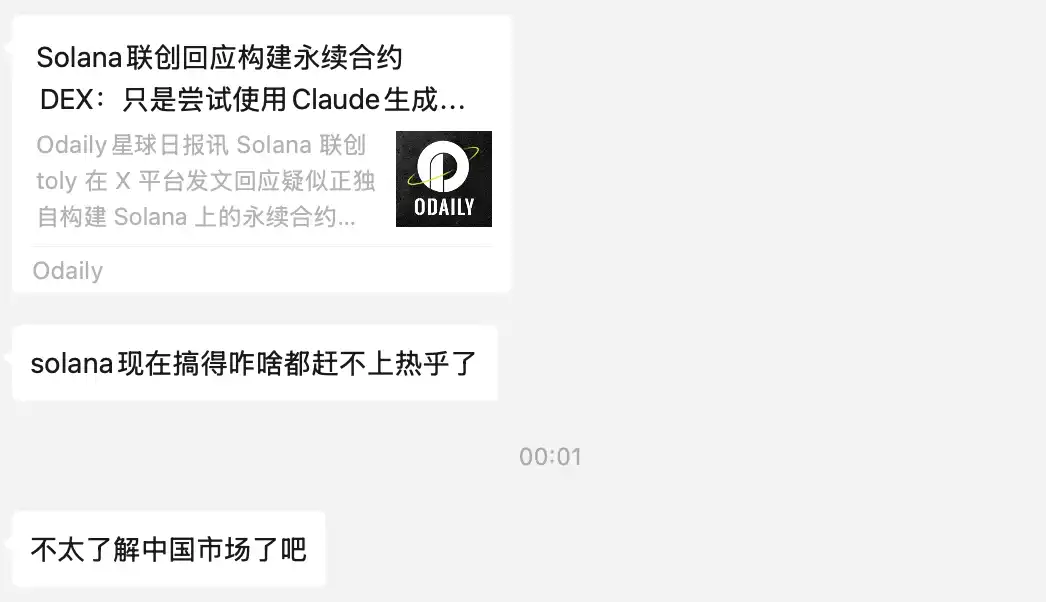
(Group Chat Screenshot)
Recently, Grayscale released a report titled "Solana: Crypto's Financial Bazaar," analyzing Solana's technological aspects, network ecosystem, token supply, and value data indicators, providing some confidence to the "SOL Sentinel." Odaily Planet Daily summarized the key points of the report as follows:
Solana's Fundamentals: Technology, On-chain Activity, Transaction Volume
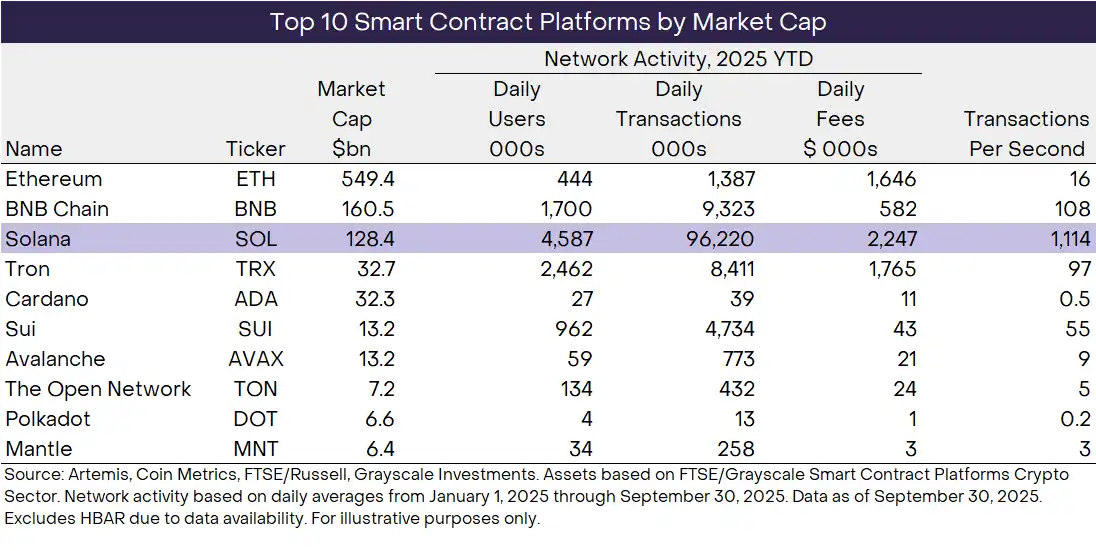
According to the report, compared to other networks such as Ethereum, BNB Chain, Tron, Cardano, and Sui, Solana has a significant advantage in the depth and diversity of on-chain activity. It is leading in terms of users, transaction volume, and transaction fees, with the Solana network having more users and economic activity, which translates to higher network value.
On-chain Data and Transaction Volume
As shown in the chart below, SOL ranks third in market capitalization, but it leads similar blockchains in daily active users, daily transaction volume, daily transaction fees, and transactions per second.
Ecosystem Applications and Network Revenue
Additionally, the Solana network hosts many industry-leading applications, such as:
1. Raydium DEX, also a core component of the Solana DeFi infrastructure. From the beginning of the year to date, the Solana DEX has processed a trading volume exceeding $1.2 trillion, surpassing any other blockchain ecosystem. Furthermore, Solana's leading DEX aggregator, Jupiter, is the cryptocurrency industry's largest aggregator in terms of trading volume;
2. pump.fun, a long-standing token launch platform, with approximately 2 million monthly active users and a daily revenue of around $1.2 million;
3. Helium, a DePIN project focused on mobile hotspots. Helium allows users to contribute to network capacity, thereby building a nationwide mobile hotspot network. These services are often cheaper than centralized alternatives, and Helium currently boasts 1.5 million daily active users, 112,000 hotspots, and has established partnerships with major telecom companies such as AT&T and Telefónica.
The above applications represent only a small fraction of Solana's 500+ applications. Additionally, as a blockchain that almost fully replicates the functionalities of other mainstream networks, Solana ranks third in NFT transactions, fifth in stablecoin transaction volume, and seventh in tokenized assets. Recent use cases that have gained traction include Pokémon card collectibles trading and on-chain issuance of tokenized stocks.
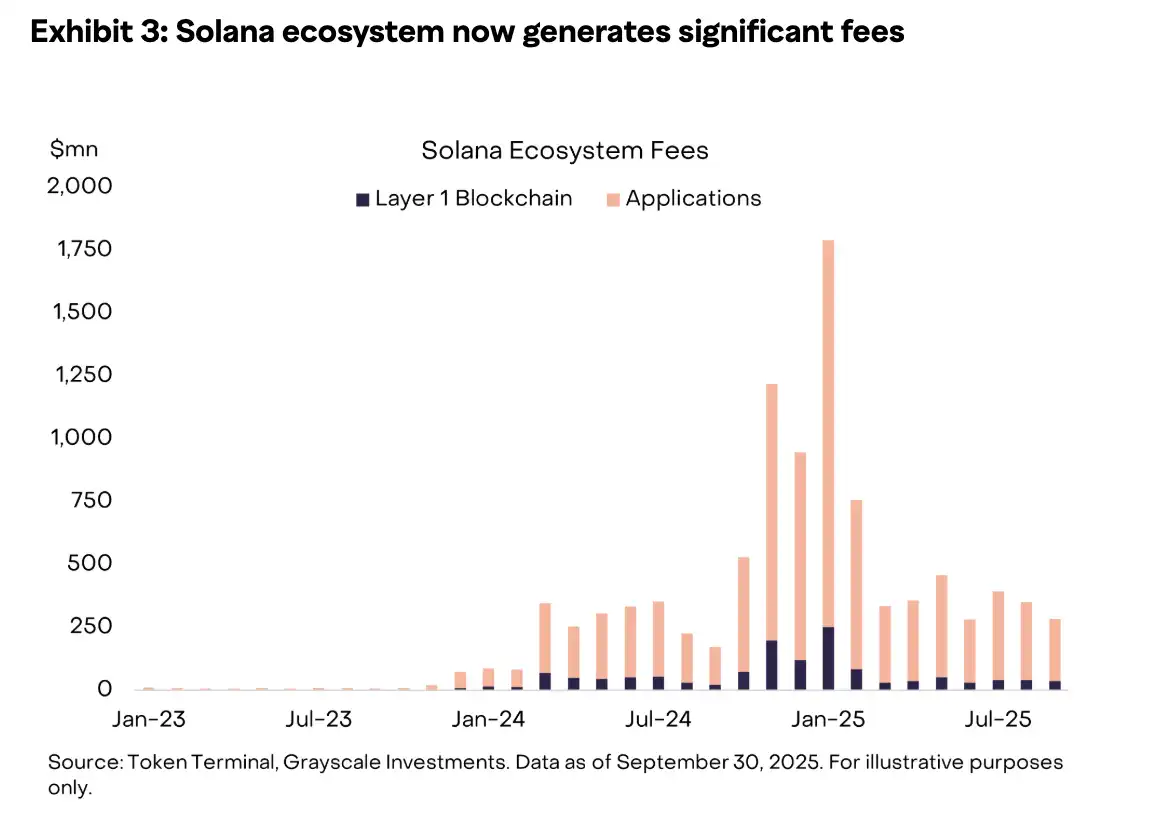
When measuring the Solana ecosystem, one should consider both the blockchain itself and the economic activities of its hosted applications. While these figures may evolve over time, the Solana ecosystem generates approximately $425 million in fees per month, with an annual income exceeding $5 billion. Grayscale believes that fees are the most direct indicator of measuring total demand for a blockchain and its applications, and all these data points indicate significant demand for Solana.
Solana's Advantages: Developer Scale Second Only to Ethereum, and Universally Accessible
Universal Technological Superiority
In addition to fundamental analysis, Grayscale also mentioned that Solana's good performance is due to its fast, low-cost transactions, and seamless user experience. The network generates a new block every 400 milliseconds, and transactions can be finalized in about 12-13 seconds. Apart from high throughput, transaction costs have also remained relatively low:
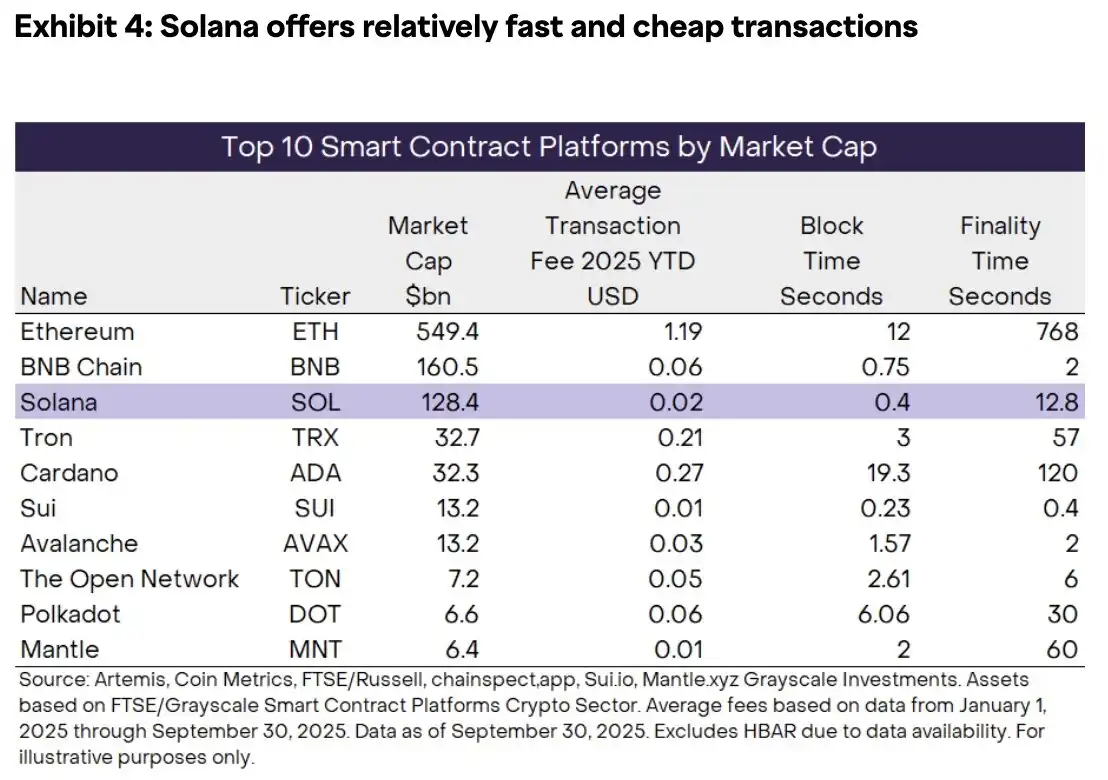
Solana uses a "local fee markets" technology, which restricts fee competition to specific applications. So far this year, the average transaction fee paid by users has been only $0.02, partly due to this feature. The median daily transaction fee this year is only $0.001. Solana's transaction speed and cost efficiency are faster and cheaper compared to similar blockchains. Its upcoming Solana upgrade, Alpenglow, is expected to reduce final confirmation time to 100-150 milliseconds.
Solana's user experience is mainly due to its "monolithic" (single-layer blockchain) design rather than a layered design (which avoids the need to bridge assets between network components), and the wallet infrastructure led by Phantom. In recent years, Solana's network failure rate has also been significantly lower than the industry average, which is also a foundational factor for user adoption.
Furthermore, Solana smart contracts do not rely on the Ethereum Virtual Machine (used by Ethereum and many other smart contract platforms like BNB Chain, Polygon, and Avalanche). Instead, they use Solana's unique Solana Virtual Machine (SVM) architecture. Applications based on the SVM cannot easily move to non-SVM blockchains, leading to stable user retention.
Second Only to Ethereum in Developer Count
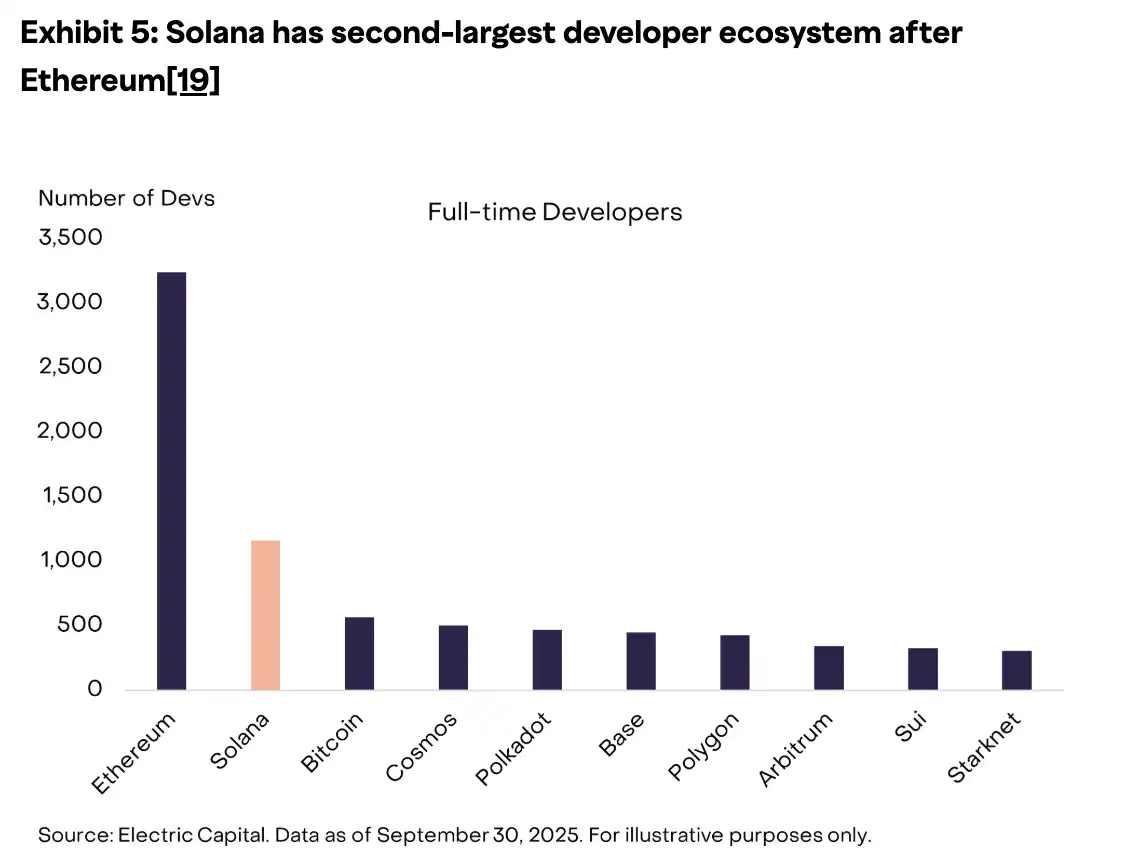
Currently, there are over 1,000 full-time developers working on Solana and SVM applications, and in the past two years, the growth rate of developers focused on Solana has outpaced any other smart contract platform (as shown below), second only to Ethereum. Over time, this human capital can contribute to Solana's sustained innovation.
The Long-Term Storage Value of the SOL Token (Inflation, Token Performance, and Competitor Competition)
It is well known that due to FTX's collapse, the price of the SOL token plummeted from its peak of nearly $260 in November 2021 to just $2 in December 2022. Following FTX's bankruptcy, many retail investors felt uncertain about Solana's future, despite a significant number of SVM developers still remaining on Solana at the time.
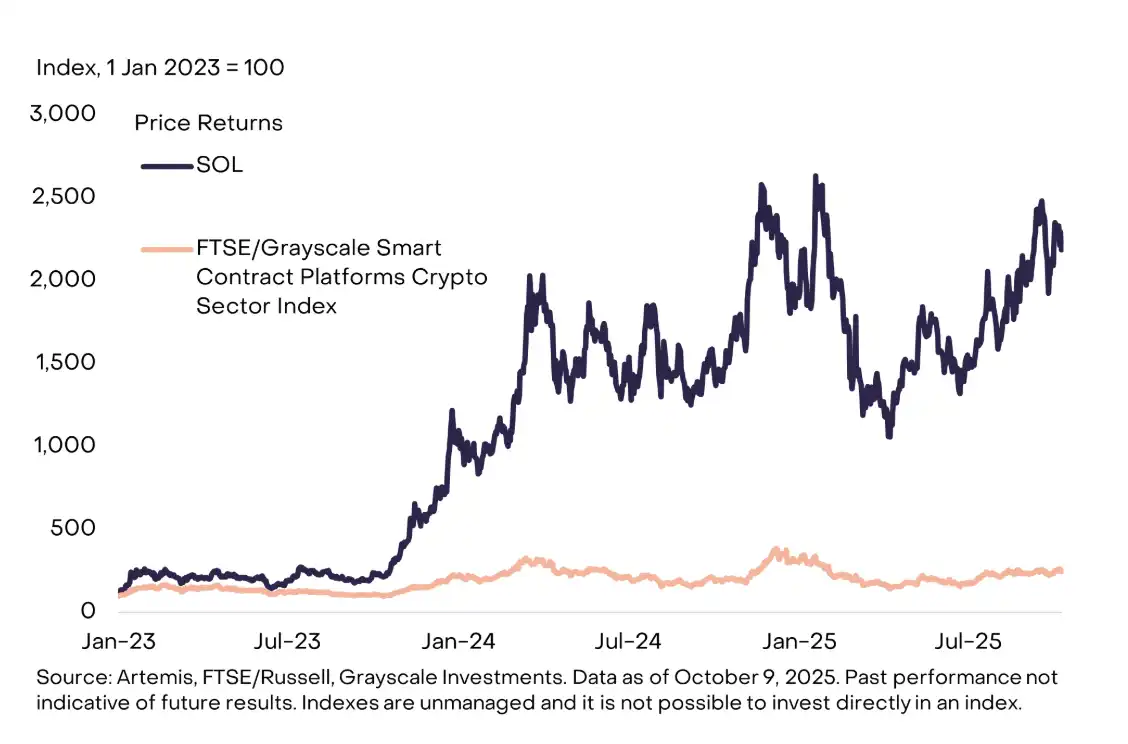
However, starting from the end of 2023, the SOL token began to recover, outperforming notably the FTSE/Grayscale Smart Contract Platform Cryptocurrency Industry Index.
Currently, the SOL token's supply is increasing at a rate of around 4% to 4.5% per year, which, under unchanged conditions, can be seen as a reason for token holder value dilution. According to the network state, SOL stakers can receive around a 7% nominal yield, but the "actual" yield adjusted for inflation is approximately 2.5% to 3%. Currently, about two-thirds of unissued SOL tokens have been staked.

Grayscale states that SOL offers utility on the Solana network and may receive additional corresponding financial returns, but their value is tied to the network's scale, similar to other smart contract platform tokens, the investment thesis of the SOL token revolves around the potential growth of the Solana network. Like other assets, the SOL token price does not always move in line with the network's fundamentals. However, if the Solana network grows over time—acquiring more users, processing more transactions, and earning more fees—investors can expect the SOL price to rise.
Grayscale believes: Solana is envisioned as an "open, fast, low-cost blockchain for everyone". But its specific design leaves room for its competitors to seize or retain market share in certain use cases.
For example, other blockchains sometimes achieve faster and/or cheaper transactions by operating a more centralized network (e.g., using a small number of active network nodes). Even though centralization may bring risks, users may prefer this convenience. Other blockchains may compete with Solana by maintaining permissioning on their network (i.e., only allowing approved users and/or approved activities).
On the other hand, compared to Bitcoin or Ethereum, the SOL token may not be as suitable as a long-term "store of value" currency asset. This to some extent reflects SOL's relatively high nominal supply inflation: scarcity is a key feature of any long-term value store. But a more important factor may be the network's ability to resist third-party interference. For a digital asset to be used as a long-term store of value, users need to have confidence that they will be able to transact under almost all circumstances in the future. One way to support this outcome is to maintain low node requirements to keep the network highly decentralized and easy to replicate. Solana's efficiency comes at the cost of relatively high hardware and bandwidth requirements, so many network nodes operate in data centers. In theory, over time, this could become a source of centralization and a conduit for third-party interference with the network.
Of course, these are complex and unresolved issues, and investors' views on cryptocurrency as a long-term store of value may change over time.
Conclusion
Finally, Grayscale believes that the three most important metrics for measuring on-chain activity are users, transaction volume, and transaction fees, and Solana is currently the leading network in these metrics of on-chain activity. While the Solana network faces many powerful competitors, the depth and diversity of the Solana on-chain economy have laid a solid foundation for SOL's valuation, which is also a necessary condition for its future growth.
A network with strong performance, a large number of users, leading transaction volume and transaction fees, having gone through a phoenix-like rebirth, leading the Meme trend. In addition, Solana also has a large SOL treasury to support it. Aside from the inflation mechanism, SOL seems to have no significant flaws that would impact the token's value, seemingly holding the script of a "cool protagonist," yet it has failed to reach new highs. At the time of the end of this article, the SOL token price has dropped back to $185, and the SOL guards seem to be at a loss.
Te puede gustar

Whale Sells Massive Amount of ETH and Profits Millions
Key Takeaways A significant Ethereum whale address, “0xa339”, recently engaged in substantial ETH sales, benefiting from ongoing price…

# Trader provocó pérdidas al cerrar posición corta de ETH
Key Takeaways Pension-usdt.eth incurrió en una pérdida de 3.4 millones de dólares al cerrar una posición corta de…

Importante Repunte de ZKC (Boundless): Un Análisis Completo
Key Takeaways ZKC experimentó un aumento del 20.72% en las últimas 24 horas. La red Boundless ha iniciado…

# Título: Lanzamiento de ETF de XRP Impulsa Entradas de Capital y Expansión Multicadena
Key Takeaways Los ETFs de XRP, lanzados en noviembre, han registrado entradas constantes de capital, sumando más de…

Inversor Institucional Se Mueve de Posiciones Largas a Cortas en Criptos
Key Takeaways Un inversor con gran capital ha liquidado posiciones largas en BTC, SOL y ZEC. Se han…

Japón Continúa Ajustando Tasas de Interés, Impactando el Mercado de Criptomonedas
Key Takeaways El Banco de Japón podría continuar aumentando las tasas de interés, con un objetivo futuro del…

Hong Kong Implements Basel Crypto Regulatory Standards
Key Takeaways Hong Kong’s Monetary Authority (HKMA) will enforce Basel crypto regulatory standards starting January 1, 2026. The…
# Outline of the Article
H1: Ballena de Criptomonedas Aumenta su Apuesta en Cortos de BTC, ETH y SOL con $243M en Juego…

SOL Aumenta 3.98% por Influencia de Fondos ETFs y Mejora de Infraestructura
Key Takeaways Incremento en la Valorización: Solana (SOL) ha incrementado un 3.98% en las últimas 24 horas, alcanzando…
La Perspectiva de los Mercados de Activos Digitales para 2026 Según Altan Tutar
Puntos Clave Altan Tutar, cofundador de MoreMarkets, anticipa un futuro sombrío para la mayoría de las compañías de…

Trend Research Compra Masivamente Ethereum para Aumentar su Posición
Puntos Clave Trend Research ha adquirido 46,379 ETH, elevando su total de tenencias a aproximadamente 580,000 ETH. Ahora,…

La actualización ‘Hegota’ de Ethereum programada para finales de 2026 mientras los desarrolladores aceleran la hoja de ruta
Puntos Clave Los desarrolladores de Ethereum han acordado el nombre y el tiempo aproximado de la próxima gran…

La acción de precios de las memecoins de perros como Dogecoin y Shiba Inu es moderada en medio de la baja liquidez navideña
Key Takeaways: – Dogecoin (DOGE) y Shiba Inu (SHIB) experimentan caídas de precios debido a la debilidad del…

Coinbase destaca tres áreas que dominarán el mercado cripto en 2026
Puntos clave Coinbase Institutional resalta que el comportamiento del mercado cripto está siendo moldeado por fuerzas estructurales más…

2026, el año en que Ethereum empieza a escalar exponencialmente con tecnología ZK
Key Takeaways: La implementación de pruebas de conocimiento cero (ZK-proofs) permite que Ethereum escale hasta 10,000 transacciones por…
Usuarios de Trust Wallet pierden $7 millones debido a una extensión de Chrome pirateada
Puntos Clave Se estima que los usuarios de Trust Wallet han perdido más de $7 millones tras una…
La mayoría de los tesoros de criptomonedas ‘desaparecerán’ ante el sombrío panorama de 2026: Ejecutivos
Key Takeaways Se prevé que muchas empresas de tesorería de criptomonedas podrían no sobrevivir al 2026 debido a…

Ethereum 2026: Glamsterdam y Hegota, Progreso de la L1 y Más
Key Takeaways En 2026 se espera un avance significativo para Ethereum en términos de escalabilidad y eficiencia, con…
Whale Sells Massive Amount of ETH and Profits Millions
Key Takeaways A significant Ethereum whale address, “0xa339”, recently engaged in substantial ETH sales, benefiting from ongoing price…
# Trader provocó pérdidas al cerrar posición corta de ETH
Key Takeaways Pension-usdt.eth incurrió en una pérdida de 3.4 millones de dólares al cerrar una posición corta de…
Importante Repunte de ZKC (Boundless): Un Análisis Completo
Key Takeaways ZKC experimentó un aumento del 20.72% en las últimas 24 horas. La red Boundless ha iniciado…
# Título: Lanzamiento de ETF de XRP Impulsa Entradas de Capital y Expansión Multicadena
Key Takeaways Los ETFs de XRP, lanzados en noviembre, han registrado entradas constantes de capital, sumando más de…
Inversor Institucional Se Mueve de Posiciones Largas a Cortas en Criptos
Key Takeaways Un inversor con gran capital ha liquidado posiciones largas en BTC, SOL y ZEC. Se han…
Japón Continúa Ajustando Tasas de Interés, Impactando el Mercado de Criptomonedas
Key Takeaways El Banco de Japón podría continuar aumentando las tasas de interés, con un objetivo futuro del…
Monedas populares
Últimas noticias cripto


Atención al cliente:@weikecs
Cooperación empresarial:@weikecs
Trading cuantitativo y CM:[email protected]
Servicios VIP:[email protected]
 App
App