Data Analysis How Much Does Raydium Really Rely on pump.fun?

Original Title: "Data Analysis: How Dependent Is Raydium on pump.fun?"
Original Author: Azuma, Odaily Planet Daily
The mainstream DEX protocol on Solana, Raydium (RAY), experienced a sharp decline today, directly triggered by pump.fun seemingly testing its own AMM liquidity pool. The market speculates that this move may lead to future pump.fun ecosystem tokens not being pooled on Raydium after breaking out of the "seed round," but instead being directly diverted to the pump.fun protocol, resulting in a reduction in Raydium's trading volume, corresponding revenue, and buyback amount.
Logic Behind RAY's Decline (Readers familiar with the relevant logic can skip this section)
Let's briefly outline the relationship between Raydium and pump.fun.
As the current leading meme token launchpad platform on Solana, the issuance of pump.fun's token goes through two stages: "seed round" and "public round." After the token is issued, it will first enter the "seed round" trading phase, which relies on pump.fun's protocol's own Bonding Curve for matching transactions. When the trading volume reaches $69,000, it will then enter the "public round" trading phase, at which point liquidity will migrate to Raydium, where a pool will be created and trading will continue.
Next, let's look at Raydium and RAY.
Currently, Raydium charges a 0.25% fee per transaction, with 0.22% allocated to Raydium's liquidity providers (LP) and 0.03% used for RAY buyback and ecosystem support. In summary, Raydium's trading volume will indirectly affect RAY's price through fee revenue.
So the current situation is that if pump.fun builds its own AMM, liquidity will no longer migrate to Raydium in the future, thereby reducing the latter's trading volume, fees, and consequently affecting RAY's value performance.
How Dependent Is Raydium on pump.fun?
Today, there has already been a lot of analysis in the market on the above points. However, it seems that no one has carefully examined how much Raydium relies on pump.fun in terms of trading volume. Therefore, we queried some data sources on Defillama and Dune, and the conclusion is shown in the following figure.
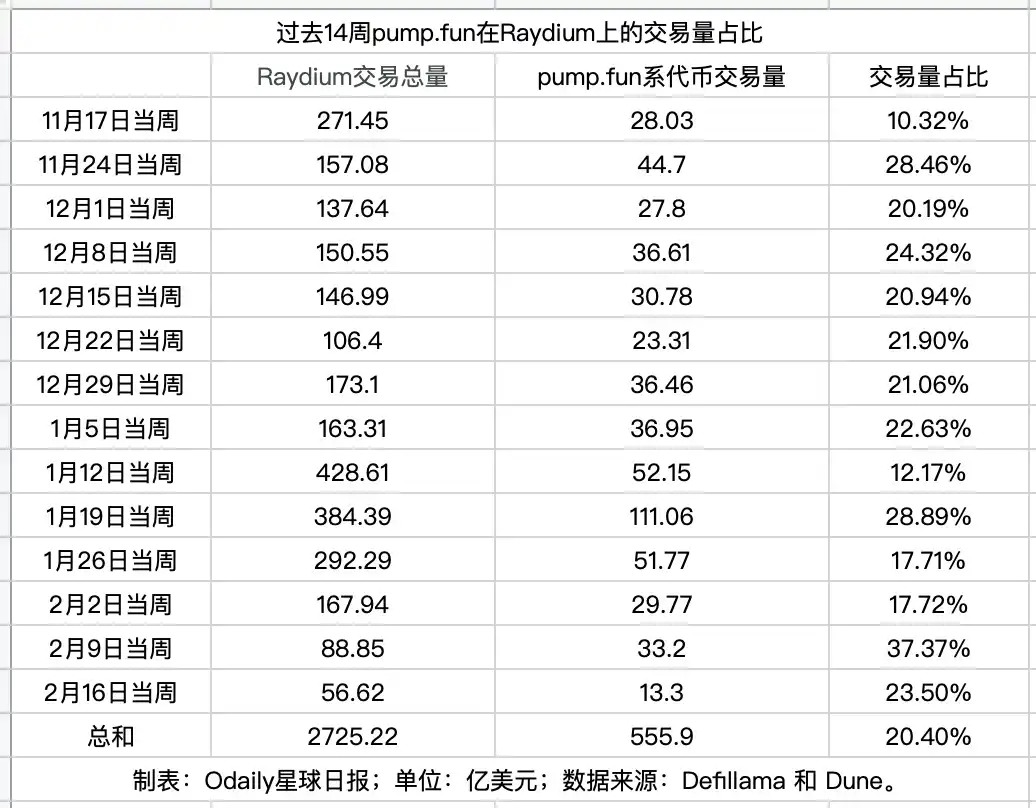
As can be seen from the above chart, in the past 14 weeks, the trading volume of the pump.fun token on Raydium has generally accounted for around 20%. This means that if pump.fun does indeed redirect trading volume from Raydium in the future through its own AMM (excluding autonomous liquidity migration activities due to uncertain platform fee rate differences), Raydium is expected to experience around a 20% reduction in trading volume.
Oversold?
Turning back to the market situation, OKX data shows that RAY dropped to a low of $2.82 today, corresponding to a decrease of over 30% (the data was delayed, but in hindsight, there was indeed some overselling at that time). The current price has gradually recovered to $3.15, representing a 25.43% decrease.
Considering that SOL also experienced a 5.8% decrease, RAY's current decline is basically within a reasonable range, meaning that the market has preemptively priced in pump.fun's frontrunning behavior.
Let's end with a quote from Fluid COO DMH:
“RAY's plummet once again proves to us that ‘distribution >>> tech.’ Both the traditional world (Microsoft) and the crypto space (Metamask) have countless examples showing that if you have a large enough user base, your product isn't that important.”
Vous pourriez aussi aimer

Un nouveau portefeuille retire 35 000 ETH de Binance et les transfère à BitGo
Un portefeuille nouvellement créé a retiré 35 000 ETH de Binance, évalués à environ 80,7 millions de dollars,…

Analyste : L’Iran n’a pas encore répondu à la participation aux pourparlers, les prix du pétrole grimpent
Le ministre pakistanais attend toujours la réponse officielle de l’Iran concernant sa participation à la réunion. Les prix…
Les contrats intelligents peuvent-ils sauver le prix en chute libre du Pi Crypto?
La Pi Crypto Network s’effondre, perdant plus de 85% depuis son record historique. Les fluctuations récentes du prix…

# Un investisseur positionne ses actifs entre BTC et pétrole brut
Key Takeaways Un investisseur important, surnommé “UnRektCapital”, adopte des positions opposées sur le Bitcoin (BTC) et le pétrole…

Comment équilibrer le risque et le rendement dans les investissements DeFi ?

La thèse de Tom Lee sur l'Ethereum : Pourquoi celui qui avait prédit le dernier cycle mise encore plus gros sur Bitmine
Tom Lee s'impose comme l'un des plus fervents défenseurs d'Ethereum. De Fundstrat à Bitmine, son analyse sur l'Ethereum associe rendement du staking, accumulation de trésorerie et valeur à long terme du réseau. Voici pourquoi « Tom Lee Ethereum » est devenu l'un des sujets les plus suivis dans le monde des cryptomonnaies.

Succession complexe chez Apple : John Turner prend les rênes
Apple change de PDG après 15 ans, signalant un “retour au matériel”. John Turner, ancien responsable du matériel,…
Naval prend personnellement la scène : La collision historique entre les gens ordinaires et le capital-risque

a16z Crypto : 9 graphiques pour comprendre les tendances de l'évolution des stablecoins
Réfutation de « La fin de la cryptomonnaie » de Yang Haipo

Un sèche-cheveux peut-il rapporter 34 000 $ ? Interprétation du paradoxe de réflexivité des marchés de prédiction

Fondateur de 6MV : En 2026, le « point de bascule historique » pour l’investissement en cryptomonnaies est arrivé

Abraxas Capital émet 2,89 milliards de USDT : Un coup de pouce à la liquidité ou simplement plus d'arbitrage de stablecoins ?
Abraxas Capital vient de recevoir 2,89 milliards de dollars en USDT fraîchement émis de Tether. S'agit-il d'une injection de liquidité haussière pour les marchés de la crypto, ou est-ce le train-train habituel pour un géant de l'arbitrage de stablecoins ? Nous analysons les données et l'impact probable sur le Bitcoin, les altcoins et la DeFi.
Un VC du monde de la Crypto a déclaré que l'IA est trop folle, et qu'ils sont très conservateurs
L'histoire évolutive des algorithmes de contrats : Une décennie de contrats perpétuels, le rideau n'est pas encore tombé

Actualités sur les ETF Bitcoin aujourd'hui : des entrées de 2,1 milliards de dollars signalent une forte demande institutionnelle pour le BTC
Les actualités sur les ETF Bitcoin ont enregistré des entrées de <g id='1'>2,1 milliards de dollars sur 8 jours consécutifs</g>, marquant l'une des plus fortes séquences d'accumulation récentes. Voici ce que signifient les dernières actualités sur les ETF Bitcoin pour le prix du BTC et si le niveau de rupture de 80 000 $ est le prochain.

Mis à la porte par PayPal, Musk veut faire son retour sur le marché des cryptomonnaies

Michael Saylor : L'hiver est terminé – a-t-il raison ? 5 points de données clés (2026)
Michael Saylor a tweeté hier « L'hiver est terminé. » C'est court. C'est audacieux. Et cela fait parler le monde de la crypto.
Mais a-t-il raison ? Ou est-ce juste un autre PDG qui fait monter ses actions ?
Examinons les données. Soyons neutres. Voyons si la glace a vraiment fondu.
Un nouveau portefeuille retire 35 000 ETH de Binance et les transfère à BitGo
Un portefeuille nouvellement créé a retiré 35 000 ETH de Binance, évalués à environ 80,7 millions de dollars,…
Analyste : L’Iran n’a pas encore répondu à la participation aux pourparlers, les prix du pétrole grimpent
Le ministre pakistanais attend toujours la réponse officielle de l’Iran concernant sa participation à la réunion. Les prix…
Les contrats intelligents peuvent-ils sauver le prix en chute libre du Pi Crypto?
La Pi Crypto Network s’effondre, perdant plus de 85% depuis son record historique. Les fluctuations récentes du prix…
# Un investisseur positionne ses actifs entre BTC et pétrole brut
Key Takeaways Un investisseur important, surnommé “UnRektCapital”, adopte des positions opposées sur le Bitcoin (BTC) et le pétrole…
Comment équilibrer le risque et le rendement dans les investissements DeFi ?
La thèse de Tom Lee sur l'Ethereum : Pourquoi celui qui avait prédit le dernier cycle mise encore plus gros sur Bitmine
Tom Lee s'impose comme l'un des plus fervents défenseurs d'Ethereum. De Fundstrat à Bitmine, son analyse sur l'Ethereum associe rendement du staking, accumulation de trésorerie et valeur à long terme du réseau. Voici pourquoi « Tom Lee Ethereum » est devenu l'un des sujets les plus suivis dans le monde des cryptomonnaies.