
- Acheter crypto
- Marchés
- Futures
- Spot
- Copy trading
 WE-Launch
"Fiat On-Ramp" Ceiling, Stablecoin Network Effect

Original Article Title: Stablecoins: Better, Faster, Cheaper—Why They Matter
Original Article Author: @proofofnathan
Original Article Translation: zhouzhou, BlockBeats
Editor's Note: Stablecoins are breaking the traditional payment trilemma of "better, faster, cheaper," providing a 24/7, low-cost, permissionless open payment network for global users. They are evolving from intermediaries to mainstream value carriers, although still facing bottlenecks such as fiat currency exchange. With the expansion of network effects, stablecoins are poised to reshape the global financial landscape.
The following is the original article content (rearranged for easier comprehension):
These three key features differentiate stablecoins from traditional payment systems and break an age-old rule: you cannot have all three at once. Any upgrade comes with a trade-off. Improving quality can slow down delivery speed; speeding up production can increase costs; lowering costs can reduce excellence. Builders typically choose to optimize one of these dimensions—better, faster, or cheaper.
Historically, innovators could only solve two out of the three, unable to tackle all issues simultaneously. Stablecoins resolve this innovation trilemma.
This is crucial for retail users. They now have access to an open payment network that operates 24/7, settles in seconds, and costs a few cents rather than a percentage.
Stablecoins are better. They represent the obvious next step in value transfer. As the world gradually goes fully digital, it is only natural that value itself takes on a fundamentally digital form. Stablecoins facilitate this transformation. They operate on an open network 24/7, storing and exchanging value, more succinctly than fiat currency. Anyone can access them, and as I mentioned earlier, they are programmable.

Stablecoins are faster. Settlement speed depends on the blockchain, but even the slowest network far surpasses traditional payment systems. Ethereum transactions are completed in about 12 seconds, Tron in about 3 seconds, and Plasma aims for millisecond confirmation. Traditional payment systems take hours to several working days. Faster settlement reduces opportunity costs, mitigates currency risk, and in emergencies, can swiftly transfer funds to those in need at critical moments without delay.
Stablecoins are cheaper. Regardless of which blockchain they exist on, their cost structure is lighter. The fixed transaction fee for global transfers is almost always more cost-effective than the percentage-based fees included in card network or international bank transfers. On Plasma, USD₮ transfers do not require a gas fee, pushing the marginal cost close to zero, opening up the realm of true on-chain micropayments.
Better, faster, cheaper. Stablecoins address the innovation trilemma mentioned earlier. But why is this important, and who will benefit?
Why Is This Important?
Stablecoins have attracted a lot of attention, but the "why" is often overlooked. The answer is simple: because they are better, faster, and cheaper, directly serving global retail users.
So far, we have analyzed stablecoins through the lens of the innovation trilemma. Now, let's look at the issue from a different perspective.
Mikey Kremer succinctly summarized the importance of cryptocurrency in the digital world:
"The crypto ecosystem didn't invent a new financial system; it invented a new venue. By moving familiar services—payments, lending, market making—into nominally 'permissionless' code, projects have exploited the gaps left by the post-2008 over-regulatory framework."
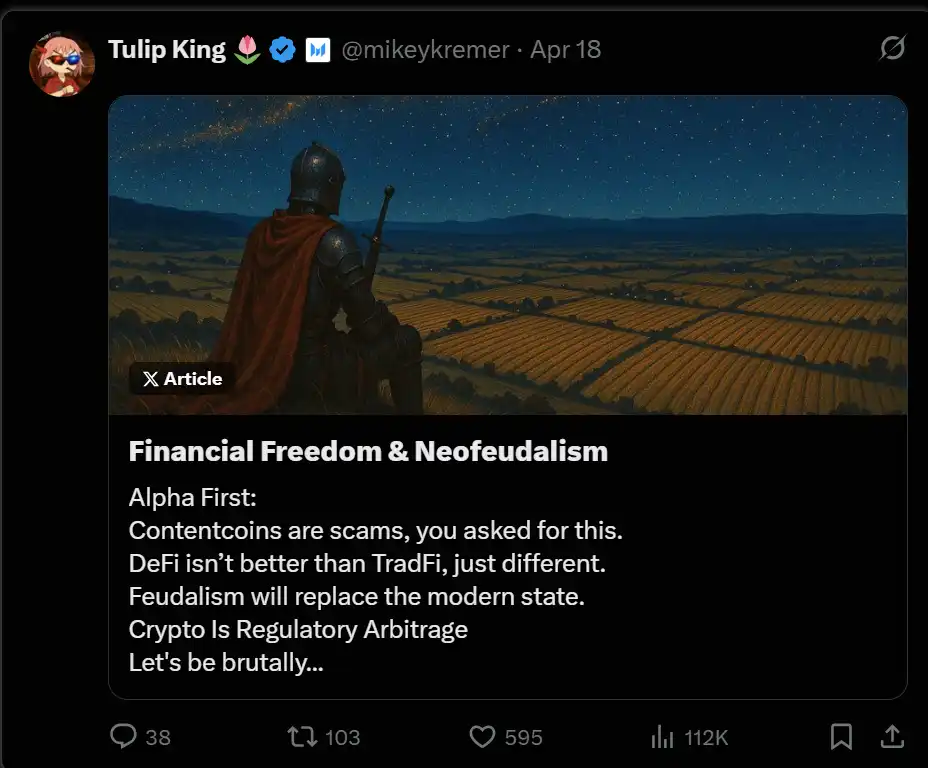
Stablecoins operate in an open field where anyone can access—the very feature that unlocks the most for retail users.
In a sense, stablecoins are merely a tokenized form of the dollar, not particularly radical. But as Mikey astutely points out: "True innovation isn't the service itself; it's the ability to provide that service without permission."
This is where the advantage of stablecoins lies: while breaking the "trilemma," they still maintain complete openness and permissionlessness. Throughout history, real breakthroughs have often come from changes in human collaboration, and currency, as a core tool of collaboration, has evolved with society for centuries.
But with each currency upgrade, the transfer of value has become increasingly tied to the nation-state. Today's payment systems are regulated by government-related agencies and owned and maintained by them.
One core idea of Bitcoin is libertarianism. As more and more people globally seek to extricate themselves from state control, they are turning to Bitcoin.
Today, this pursuit of freedom is also leading them toward stablecoins.
For retail users, the simplest reason why stablecoins are superior is: it exists for everyone. In this sense, the blockchain that stablecoins rely on is essentially a permissionless payment system. People from around the world can access it, freely transferring funds in a better, faster, and cheaper way.
However, Stablecoins Are Not a Perfect Solution
Bottleneck Issues
If one thinks that a new system has no flaws, that is too idealistic. Stablecoins certainly have their shortcomings. The most critical bottleneck lies in the "last mile" — the final settlement stage between stablecoins and fiat currencies. The main obstacles include but are not limited to:
· Liquidity and settlement issues: Converting a large amount of stablecoins into fiat currency, or vice versa, still heavily relies on dispersed banking channels and partnerships;
· Cash-out and real-world spending issues: Conveniently using stablecoins for daily expenses or cashing out to fiat still faces many frictions, making it less convenient compared to fiat;
· Local regulations and capital controls: Many countries have not yet established clear rules for stablecoins, and some countries' strict capital controls directly limit their citizens' access to the US dollar.
As the "last mile" still relies on the traditional financial system, global fund flows in this stage are inevitably constrained by the existing framework.
I believe that stablecoins will ultimately become the default medium of exchange. With the arrival of that day, these frictions will gradually disappear, and consumers will effectively enjoy all the benefits of stablecoins.
However, to achieve this future, the network effect of stablecoins must continue to grow.
Network Effect
Stablecoins rely on a thriving network effect. Monzo co-founder Tom Blomfield explains the essence of the network effect: "The network effect is different from other growth — the product itself gets better as more people join your network. WhatsApp and Skype are good examples, the more friends join, the more convenient and free it is to contact them."
This mechanism is highly applicable to stablecoins. As the number of users increases, more merchants accept it, more businesses begin to integrate it, and the trust foundation of the entire system also accumulates.
The adoption path is usually divided into two stages: initially, people accept stablecoins still anchored in cash thinking; but over time, they actively choose to use stablecoins because it is indeed better, faster, and cheaper. At this point, the network effect is fully activated.
As the network effect of stablecoins continues to expand, they naturally become more suitable for a wider range of retail users. Although the barrier to entry for stablecoin usage has been relatively low, and the networks they operate on are mostly permissionless, global adoption is still gradually progressing. The two key forces truly driving adoption are:
Organic network effect diffusion
Innovative ways of making stablecoins more applicable to everyday life
The future of stablecoins is slowly but steadily unfolding in this manner.
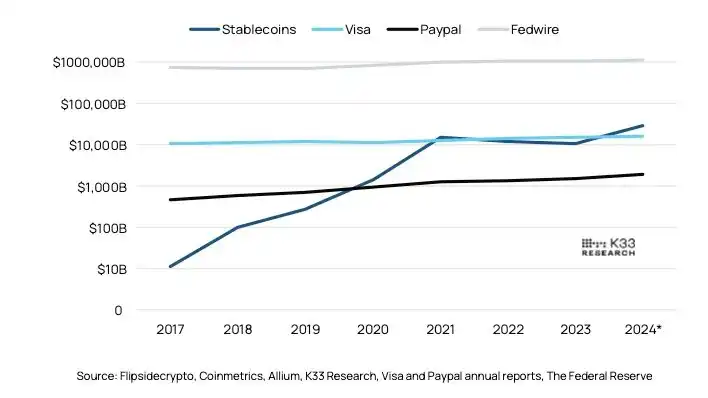
Shhhigurh accurately depicted this transformation in "The Stablecoin Paradox":
"The stablecoin ecosystem processes less transaction volume than Visa or PayPal, but the average transaction size is much larger. In 2023, Visa processed 276 billion payments averaging $54 each; PayPal processed 25 billion averaging $61 each. Meanwhile, Fedwire only processed 193 million payments, but each averaged a whopping $5.6 million. In comparison, stablecoins processed 2.6 billion transactions in 2023, with an average amount of $4,200, squarely positioned between retail and institutional transactions."
This passage reveals a key trend: stablecoins are currently in the "mid-tier zone"—between everyday retail swipes and institutional-sized transfers. They have not yet become the default track for processing small, high-frequency payments—Visa's swipes and PayPal's clicks still dominate this realm.
However, due to the clear advantages of stablecoins in terms of cost, speed, and openness, their further penetration into everyday consumer payment scenarios is only a matter of time.
The World After Stablecoin Mass Adoption
I have long contemplated and written about how the future stack of a "Stablecoin-Based Payment Network" would be constructed.
If stablecoins truly become a mainstream payment tool, we might witness an entirely new financial interaction paradigm:
Wallet = Account, no need for a bank account; global users only need a wallet address to send and receive payments;
Smart Contract = Router, fund allocation, payment splitting, supply chain settlements, financial product automatic execution, all done on-chain;
On-chain Identity = Trust layer, connecting social graphs, reputation systems, and payment systems, where identity equals creditworthiness;
Open API = Application Programming Interface, allowing any product to directly integrate stablecoin payments without the need for intermediary institution permission;
Micro-payments activate the long tail scenario, gradually normalizing scenarios such as content tipping, creator income, real-time salary distribution, and IoT device settlements.
In other words, a stablecoin is not just a "digital dollar," but rather the key to unlocking a permissionless, real-time settlement, globally interconnected financial new world.
From the current "average transaction amount of $4200" to the future "content tip of $0.42," this distance is slowly being pieced together by infrastructure, regulation, user experience, and network effects.
We are witnessing the construction of an era. Are you ready?
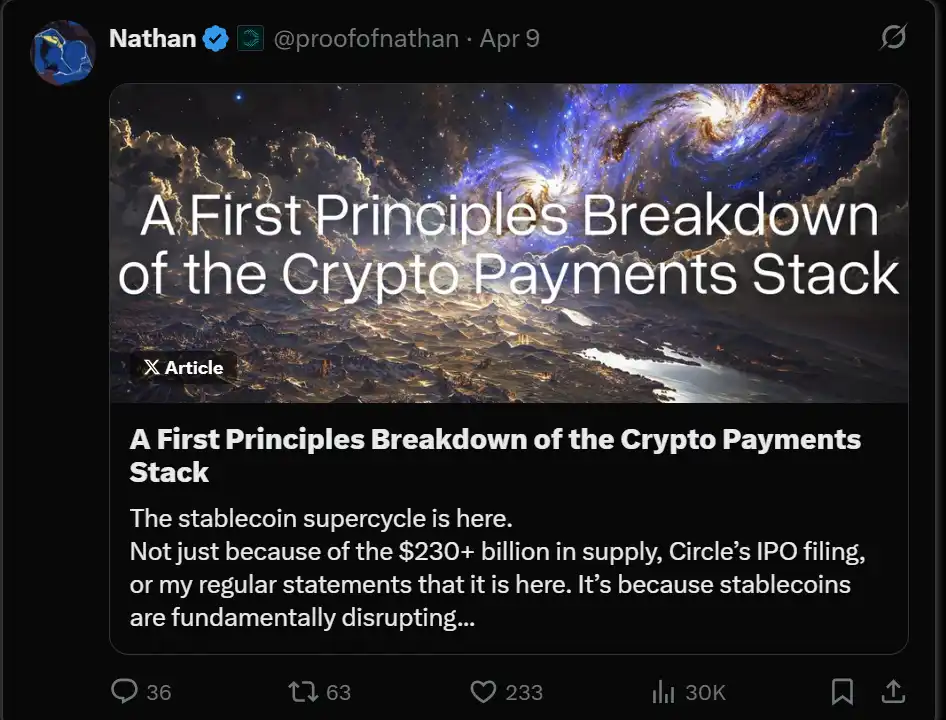
However, what I rarely delve into is the most ideal ultimate vision.
If retail adoption continues to grow exponentially, we will eventually reach a point where:
Stablecoins no longer need "seamless conversion to cash" as support but instead become the default form of currency. Everyone regards stablecoins as the underlying payment layer, replacing fiat for daily settlements.
In this future world:
Value naturally flows on-chain,
People are accustomed to transferring stablecoins, receiving payments, paying wages, and shopping,
Merchants, businesses, and even governments use stablecoins as the primary currency,
Traditional fiat becomes "off-chain assets," while stablecoins become the mainstream "money" in real life.
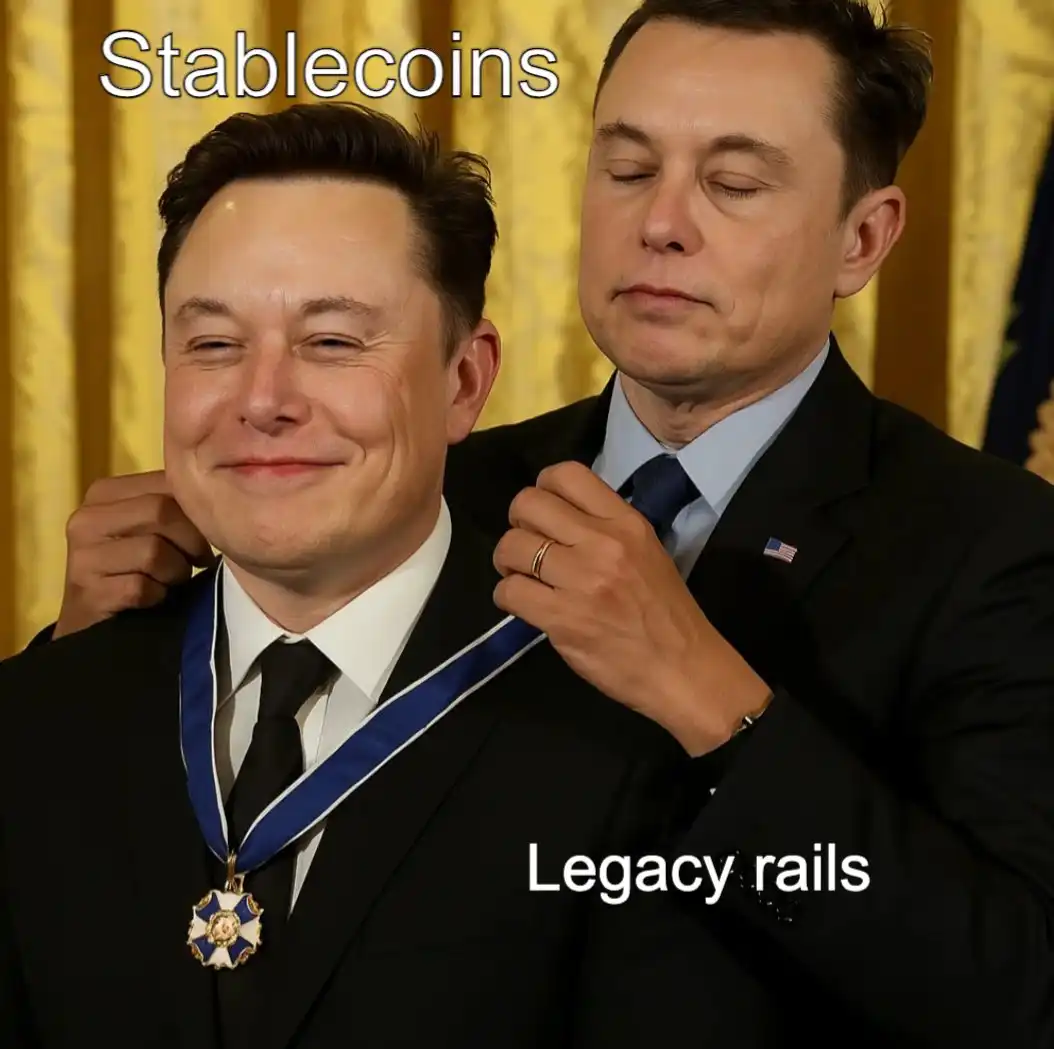
In such an "ideal utopia," stablecoins have completely triumphed. This is not just a transformation of currency form but a vision of a decentralized, cross-border, real-time programmable financial infrastructure replacing the old financial system entirely.
Of course, we have not yet reached that future. But you can sense the direction of the trend:
From fringe players to mainstream adoption, stablecoins are rewriting the age-old question of "what is money."

I have obviously gotten a bit ahead of myself. That ideal future is still far from our current world. The existing fiat system still makes people feel "safe and reliable," even though it is already lagging behind in terms of cost, speed, and accessibility. The key to achieving that future lies in whether the network effect can continue to expand.
Traditional network effects usually occur within a "walled garden," such as Facebook, Instagram, Monzo, Revolut—where the more users there are, the better the experience, but the platform is closed.
Stablecoins have disrupted this model: they operate on an open, permissionless blockchain rather than within a closed system.
However, even so, as more people use stablecoins for payments, the overall user experience will continue to improve: more merchants, higher acceptance; faster transfers, lower fees; wallets, infrastructure, and user interfaces more user-friendly; trust and liquidity are constantly accumulating.
Imagine: if every person in the world could access a borderless, permissionless, low-cost payment network at any time, then "fast and cheap remittances" would no longer be a privilege but a fundamental human right.
Final Thoughts:
All of this is happening because stablecoins are tangibly benefiting ordinary users worldwide: easier to use, faster to transfer, cheaper, and most importantly: anyone can use them without permission.
Original Tweet: Original Tweet Link
Vous pourriez aussi aimer

WEEXPERIENCE Nuit des baleines : Trading IA, communauté crypto et marché crypto
Le 12 décembre 2025, WEEX a organisé WEEXPERIENCE Whales Night, un rassemblement communautaire hors ligne conçu pour rassembler les membres de la communauté crypto locale. L'événement a combiné le partage de contenu, des jeux interactifs et des présentations de projets pour créer une expérience hors ligne détendue et attrayante.
Risque de trading d'IA en cryptomonnaie : Pourquoi de meilleures stratégies de trading crypto peuvent-elles générer des pertes plus importantes ?
Le risque ne réside plus principalement dans une mauvaise prise de décision ou des erreurs émotionnelles. Il vit de plus en plus dans la structure du marché, les parcours d'exécution et le comportement collectif. Comprendre ce changement est plus important que de trouver la prochaine stratégie « meilleure ».

Les agents de l'IA remplacent-ils la recherche crypto ? Comment l'IA autonome remodele le trading crypto
L'IA passe de l'assistance aux traders à l'automatisation de l'ensemble du processus de recherche à l'exécution sur les marchés crypto. L'avantage est passé de l'information humaine aux pipelines de données, à la vitesse et aux systèmes d'IA prêts à être exécutés, ce qui fait des retards dans l'intégration de l'IA un désavantage concurrentiel.

Boots de trading et copy trading IA : Comment les stratégies synchronisées remodèlent la volatilité du marché crypto
Les traders crypto de détail sont confrontés depuis longtemps aux mêmes défis : mauvaise gestion des risques, entrées tardives, décisions émotionnelles et exécution incohérente. Les outils de trading IA promettaient une solution. Aujourd'hui, les systèmes de copy trading et les bots de cassage alimentés par l'IA aident les traders à dimensionner leurs positions, à définir des stops et à agir plus rapidement que jamais. Au-delà de la vitesse et de la précision, ces outils remodèlent tranquillement les marchés : les traders ne tradent pas seulement plus malin, ils évoluent de façon synchronisée, créant une nouvelle dynamique qui amplifie à la fois les risques et les opportunités.

Le trading d'IA en crypto expliqué : Comment le trading autonome remodele les marchés crypto et les plateformes d’échange crypto
L’IA Trading transforme rapidement le paysage crypto. Les stratégies traditionnelles peinent à suivre la volatilité constante de la crypto et la structure complexe du marché, tandis que l'IA peut traiter des données massives, générer des stratégies adaptatives, gérer les risques et exécuter des trades de manière autonome. Cet article guide les utilisateurs de WEEX sur ce qu'est le trading d'IA, pourquoi la crypto accélère son adoption, comment le secteur évolue vers des agents autonomes et pourquoi WEEX construit l'écosystème de trading d'IA de nouvelle génération.

Appelez à rejoindre AI Wars : WEEX Alpha Awakens – Tournoi mondial de trading d’IA avec une cagnotte de 880 000 $
Maintenant, nous lançons un appel aux traders d'IA du monde entier pour qu'ils rejoignent AI Wars : WEEX Alpha Awakens, un tournoi mondial de trading d'IA doté d'une cagnotte de 880 000 $.

Trading d'IA sur les marchés crypto : Des bots de trading automatisés aux stratégies algorithmiques
Le trading basé sur l'IA fait passer la crypto de la spéculation au détail à une concurrence de niveau institutionnel, où l'exécution et la gestion des risques comptent plus que dans le sens. À mesure que le trading de l'IA prend de l'ampleur, les risques systémiques et la pression réglementaire augmentent, faisant des performances à long terme, des systèmes robustes et de la conformité les principaux facteurs de différenciation.

Analyse du sentiment de l'IA et volatilité des cryptomonnaies : Ce qui fait bouger les prix crypto
Le sentiment lié à l'IA influence de plus en plus les marchés crypto, les changements d'attente liés à l'IA se traduisant par une certaine volatilité pour les principaux actifs numériques. Les marchés crypto ont tendance à amplifier les discours sur l'IA, permettant aux flux basés sur les sentiments de l'emporter sur les fondamentaux à court terme. Comprendre comment le sentiment IA se forme et se propage aide les investisseurs à mieux anticiper les cycles de risque et les opportunités de positionnement sur les actifs numériques.

Guerres de l'IA : Guide du participant
Dans cette confrontation ultime, les meilleurs développeurs, quants et traders du monde entier déploieront leurs algorithmes dans des batailles sur le marché réel, en compétition pour l'un des prix les plus importants de l'histoire du trading crypto basé sur l'IA : 880 000 dollars américains, dont une Bentley Bentayga S pour le champion. Ce guide vous accompagnera à travers toutes les étapes nécessaires, de l'inscription au début officiel de la compétition.

Semaine des banques centrales et volatilité des marchés crypto : Comment les décisions relatives aux taux d'intérêt influencent les conditions de trading sur WEEX
Les décisions relatives aux taux d'intérêt prises par les grandes banques centrales, comme la Réserve fédérale, sont des événements macroéconomiques importants qui ont un impact sur les marchés financiers mondiaux et influencent directement les attentes de liquidité des marchés et l'appétence au risque. À mesure que le marché des cryptomonnaies continue de se développer et que sa structure de trading et ses participants mûrissent, le marché des cryptomonnaies est progressivement intégré dans le système d'établissement des prix macroéconomiques.

Test de l'API WEEX : Guide officiel des API de trading de Hackathon et de Crypto pour le trading d’IA
WEEX API Testing est conçu pour garantir que chaque participant peut transformer la logique de trading en exécution réelle. Toutes les interactions API ont lieu sur le système de trading en direct de WEEX, ce qui permet aux participants de travailler dans des conditions de marché authentiques plutôt que dans des simulations. Avec une faible exigence d'entrée, la tâche est accessible à la fois aux développeurs expérimentés et aux débutants motivés, tout en validant les compétences techniques essentielles.
Pourquoi WEEX Alpha se réveille-t-il le meilleur tournoi de trading d'IA de 2025 ? Tout ce que vous devez savoir
Pour accélérer les percées à l'intersection de l'IA et de la crypto, WEEX lance le premier Hackathon mondial de trading d'IA – AI Wars: Alpha se réveille. L'événement propose une cagnotte révolutionnaire dépassant 880 000 $, dont une Bentley Bentayga S pour le champion ultime.
AI Wars: WEEX Alpha Awakens | Guide des processus de test de l'API WEEX Global Hackathon
AI Wars : L'inscription au Réveil Alpha WEEX est maintenant ouverte. Ce guide explique comment accéder au test API et terminer le processus avec succès.

Qu'est-ce que le réveil de WEEX Alpha et comment participer ? Un guide complet
Pour accélérer les percées à l'intersection de l'IA et de la crypto, WEEX lance le premier Hackathon mondial de trading d'IA – AI Wars: Alpha se réveille.
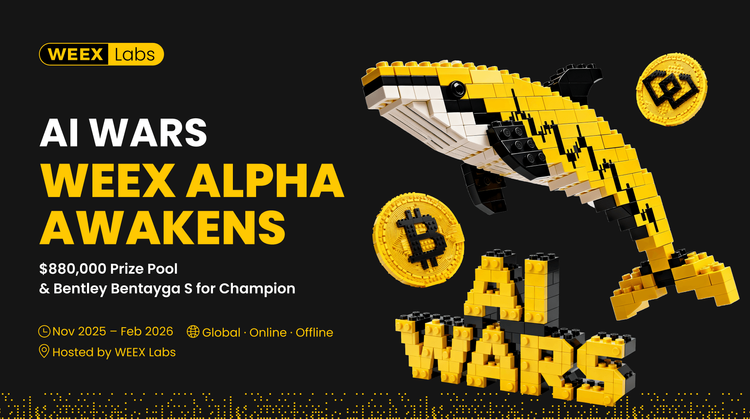
Join AI Wars: WEEK Alpha se réveille !Appel mondial pour les Alphas de Trading IA
AI Wars: WEEX Alpha Awakens est un hackathon mondial de trading sur l'IA à Dubaï, appelant les équipes quantiques, les traders algorithmiques et les développeurs d'IA à lancer leurs stratégies de trading crypto sur les marchés en direct pour une part d'une cagnotte de 880 000 $ US.

WEEX dévoile le trade to Earn: Jusqu'à 30 % de remise instantanée + 2 M$ WXT Rachat
WEEX est heureuse d’annoncer le lancement de son programme Trade to Earn, qui vous accorde automatiquement jusqu’à 30% de rabais sur les frais de trading. Toutes les récompenses sont créditées directement sur votre compte au comptant en WXT $, soutenu par notre plan de rachat de WXT $2,000,000 qui alimente la valeur à long terme des jetons.

Nouveau: Prix de liquidation estimé sur les graphiques App Candlestick
WEEX a introduit un nouveau prix estimatif de liquidation (Est. Liq. Price) figure sur le graphique en chandelier pour aider les traders à mieux gérer le risque et à identifier des fourchettes sûres pour leurs positions.
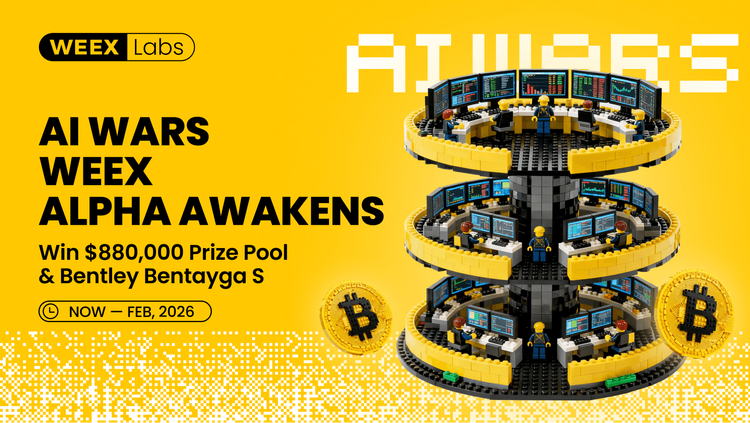
WEEX AI Hackathon Guide: Trouvez votre UID WEEK et inscrivez-vous
D'ici février 2026, WEEX lance AI Wars: WEEK Alpha Awakens, le premier hackathon mondial de trading de crypto-IA. Venez votre UID et inscrivez-vous au WEEX Global AI Trading Hackathon.
WEEXPERIENCE Nuit des baleines : Trading IA, communauté crypto et marché crypto
Le 12 décembre 2025, WEEX a organisé WEEXPERIENCE Whales Night, un rassemblement communautaire hors ligne conçu pour rassembler les membres de la communauté crypto locale. L'événement a combiné le partage de contenu, des jeux interactifs et des présentations de projets pour créer une expérience hors ligne détendue et attrayante.
Risque de trading d'IA en cryptomonnaie : Pourquoi de meilleures stratégies de trading crypto peuvent-elles générer des pertes plus importantes ?
Le risque ne réside plus principalement dans une mauvaise prise de décision ou des erreurs émotionnelles. Il vit de plus en plus dans la structure du marché, les parcours d'exécution et le comportement collectif. Comprendre ce changement est plus important que de trouver la prochaine stratégie « meilleure ».
Les agents de l'IA remplacent-ils la recherche crypto ? Comment l'IA autonome remodele le trading crypto
L'IA passe de l'assistance aux traders à l'automatisation de l'ensemble du processus de recherche à l'exécution sur les marchés crypto. L'avantage est passé de l'information humaine aux pipelines de données, à la vitesse et aux systèmes d'IA prêts à être exécutés, ce qui fait des retards dans l'intégration de l'IA un désavantage concurrentiel.
Boots de trading et copy trading IA : Comment les stratégies synchronisées remodèlent la volatilité du marché crypto
Les traders crypto de détail sont confrontés depuis longtemps aux mêmes défis : mauvaise gestion des risques, entrées tardives, décisions émotionnelles et exécution incohérente. Les outils de trading IA promettaient une solution. Aujourd'hui, les systèmes de copy trading et les bots de cassage alimentés par l'IA aident les traders à dimensionner leurs positions, à définir des stops et à agir plus rapidement que jamais. Au-delà de la vitesse et de la précision, ces outils remodèlent tranquillement les marchés : les traders ne tradent pas seulement plus malin, ils évoluent de façon synchronisée, créant une nouvelle dynamique qui amplifie à la fois les risques et les opportunités.
Le trading d'IA en crypto expliqué : Comment le trading autonome remodele les marchés crypto et les plateformes d’échange crypto
L’IA Trading transforme rapidement le paysage crypto. Les stratégies traditionnelles peinent à suivre la volatilité constante de la crypto et la structure complexe du marché, tandis que l'IA peut traiter des données massives, générer des stratégies adaptatives, gérer les risques et exécuter des trades de manière autonome. Cet article guide les utilisateurs de WEEX sur ce qu'est le trading d'IA, pourquoi la crypto accélère son adoption, comment le secteur évolue vers des agents autonomes et pourquoi WEEX construit l'écosystème de trading d'IA de nouvelle génération.
Appelez à rejoindre AI Wars : WEEX Alpha Awakens – Tournoi mondial de trading d’IA avec une cagnotte de 880 000 $
Maintenant, nous lançons un appel aux traders d'IA du monde entier pour qu'ils rejoignent AI Wars : WEEX Alpha Awakens, un tournoi mondial de trading d'IA doté d'une cagnotte de 880 000 $.
Pièces populaires
Dernières actus crypto


Assistance client:@weikecs
Collaborations commerciales:@weikecs
Trading quantitatif/Market makers:[email protected]
Programme VIP:[email protected]
 App
App