
- Acheter crypto
- Marchés
- Futures
- Spot
- Copy trading
 WE-Launch
History Repeating Itself: Grayscale Report Reveals New Safe Haven Logic Amid Tariff Storm

Original Article Title: Market Byte: Tariffs, Stagflation, and Bitcoin
Original Article Author: Zach Pandl
Original Article Translation: Asher, Odaily Planet Daily
Editor's Note: This article analyzes the recent impact of the United States' global tariff policy changes on the financial markets, particularly focusing on Bitcoin's unique performance during this process; discusses the long-term effects of tariffs on the economy, especially in stagflation periods and the asset allocation choices, as well as the performances of Bitcoin and gold in this environment; analyzes the current trade tensions' impact on the US dollar and potential adoption of Bitcoin, and finally provides an outlook on the economic prospects for the coming years, pointing out that scarce commodities like Bitcoin and gold may receive more attention and demand in a high inflation environment.
Since the announcement of the new global tariff policy by the United States on April 2, global asset prices have seen a significant decline, only gradually recovering until this morning's announcement of tariff suspension by Trump (excluding China). However, the initial tariff announcement nearly affected all assets, and during this time, looking at risk-adjusted benchmarks, Bitcoin's decline was relatively small. Therefore, if the Bitcoin-to-stock market return correlation is 1:1, the S&P 500's decline should have meant a 36% drop in Bitcoin price. However, in reality, Bitcoin only fell by 10%, highlighting that even during a deep market retreat, holding Bitcoin as part of a portfolio can still bring significant diversification benefits.
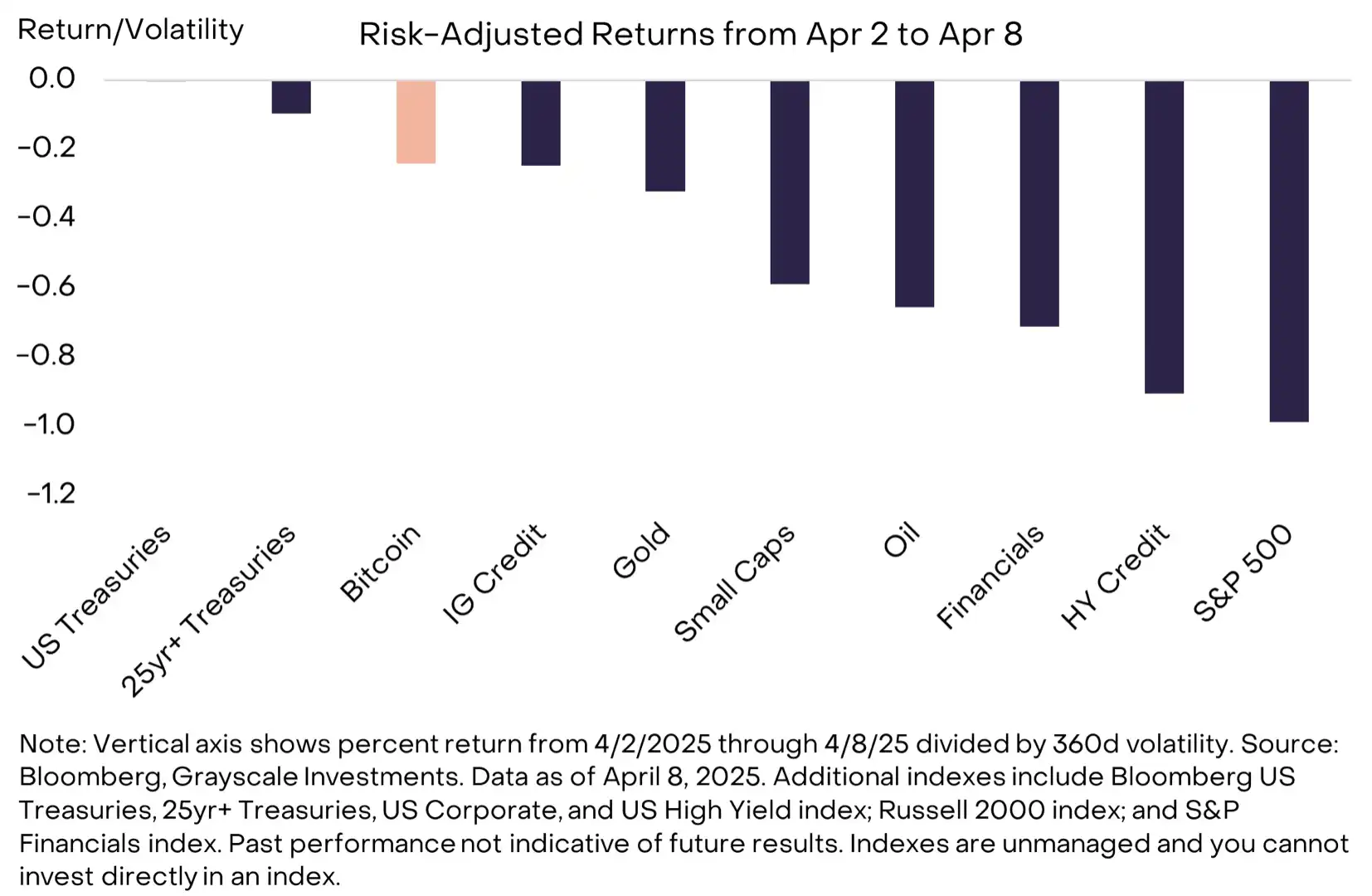
After risk adjustment, Bitcoin's price decline was relatively small
In the short term, the global market outlook may depend on the trade negotiations between the White House and other countries. While negotiations could lead to tariff reductions, setbacks in negotiations could also trigger more retaliatory actions. The actual volatility of traditional markets, both realized and implied, remains high and it is difficult to predict how trade conflicts will unfold in the coming weeks. Therefore, investors should cautiously adjust their positions in a high-risk market environment. In addition, Bitcoin's price volatility has increased much less than that of stocks, and several indicators show that speculative traders in the cryptocurrency market have relatively low positions. If macro risks ease in the next few weeks, the cryptocurrency market capitalization is expected to rebound.
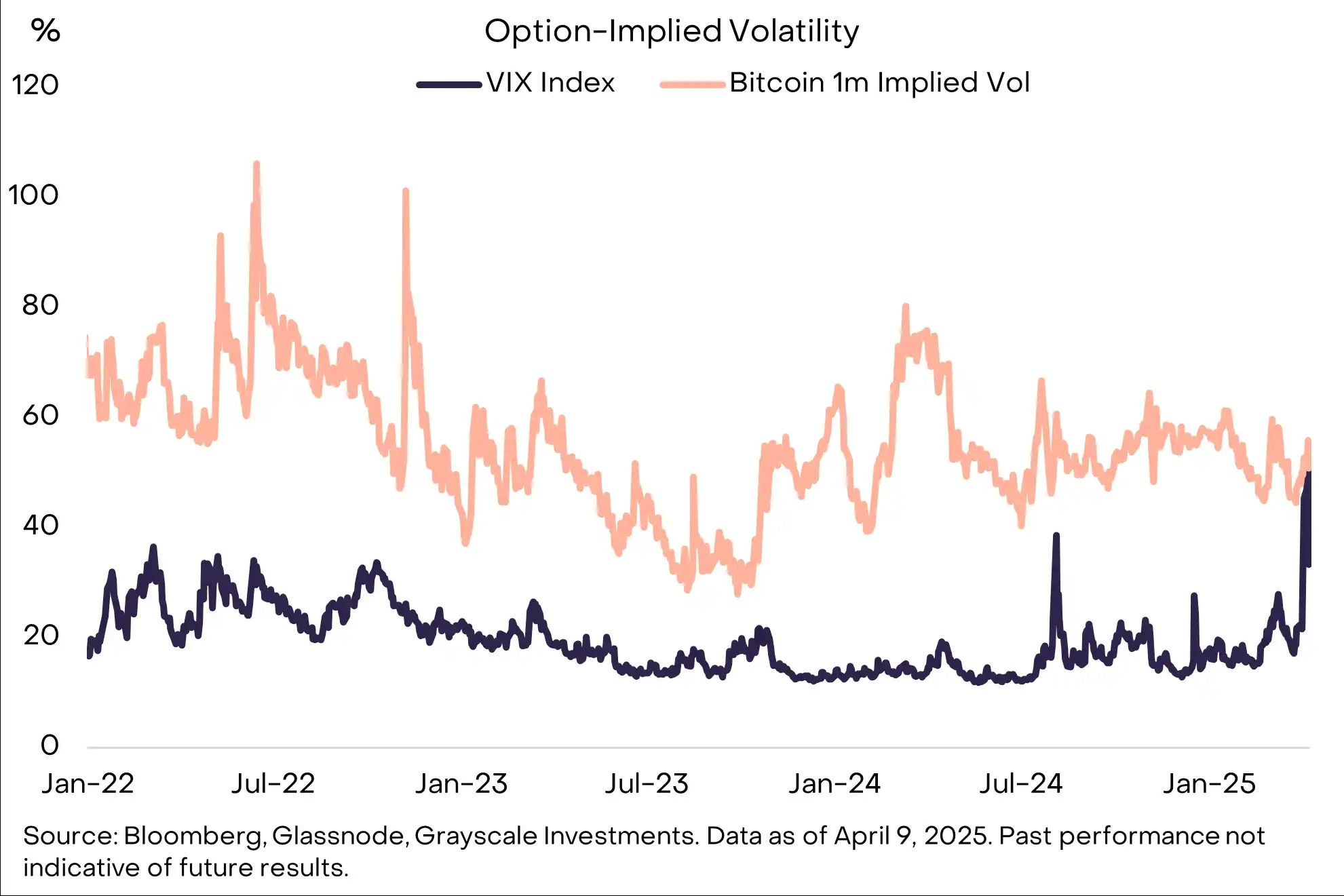
Stocks' implied volatility is close to Bitcoin's
Regarding Bitcoin, despite its price decline over the past week, from a longer-term perspective, the impact of higher tariffs on Bitcoin will depend on its effect on the economy and international capital flows. Tariffs (and changes in related non-tariff trade barriers) may lead to "stagflation" and could result in a structurally weaker dollar demand, so in this scenario, tariff increases and changes in the global trade pattern may be a positive factor for Bitcoin adoption in the medium to long term.
Asset Allocation in Stagflation
Stagflation refers to an economic state where growth is slow/sluggish while the inflation rate is high/accelerating. Tariffs increase the prices of imported goods, therefore causing inflation to rise (at least in the short term). Additionally, tariffs may slow down economic growth due to reduced real incomes for residents and adjustment costs for businesses. Over the long term, this impact may be partially offset by increased domestic manufacturing investment, and most economists expect these new tariffs to continue to drag on the economy for at least the next year.
From a historical perspective, the asset returns of the 1970s vividly demonstrated the impact of stagflation on financial markets (Bitcoin has been around for too short a time to backtest its performance). During that decade, the annualized returns of U.S. stocks and long-term bonds were both around 6%, below the average inflation rate of 7.4% at the time. In contrast, the price of gold had an annualized increase of around 30%, far surpassing the inflation rate.
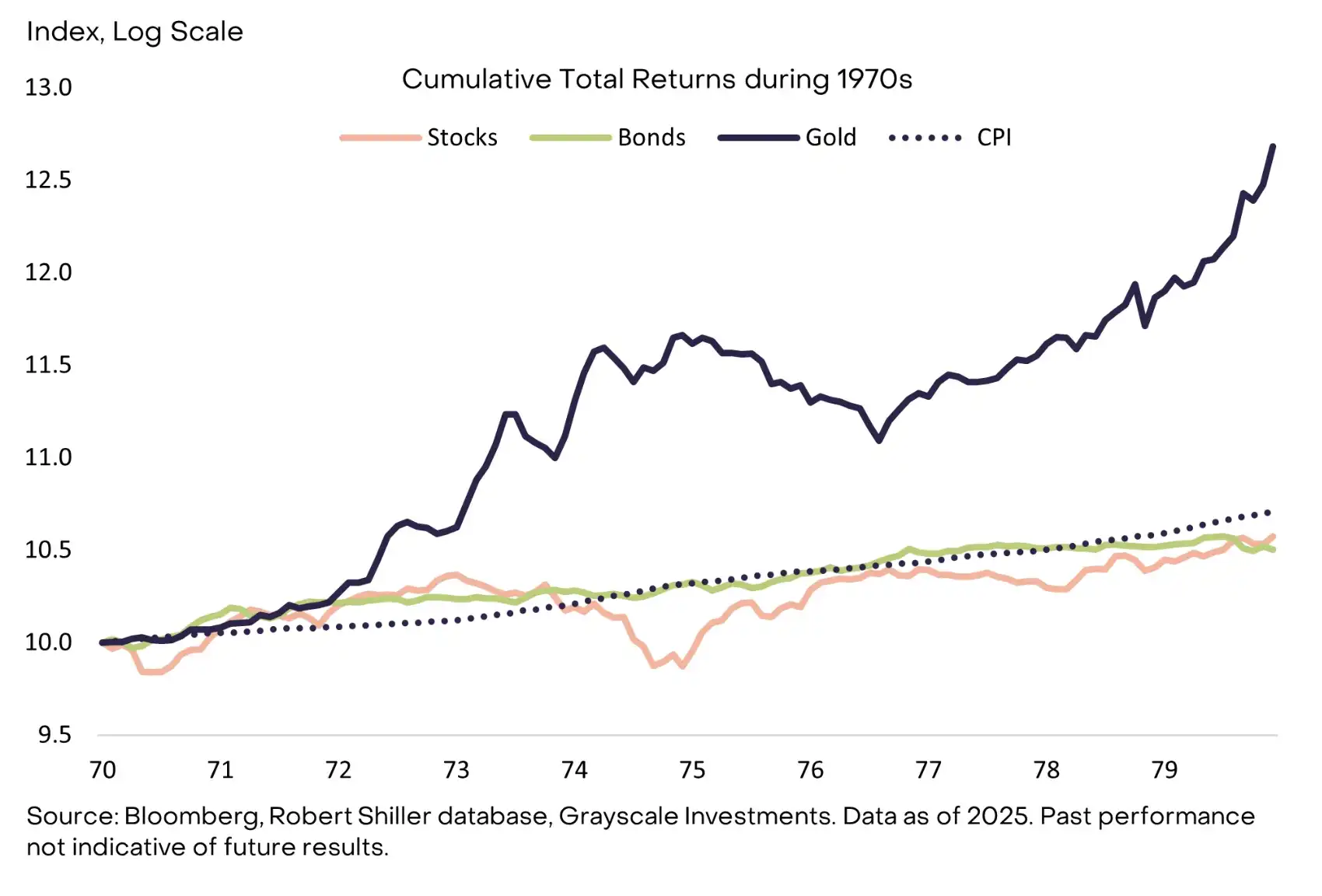
Traditional assets had negative real returns in the 1970s
Generally, extreme stagflation periods are rare, but their impact on asset returns remains largely consistent over time. The chart below shows the average annual returns of U.S. stocks, government bonds, and gold in different economic growth and inflation cycles from 1900 to 2024.
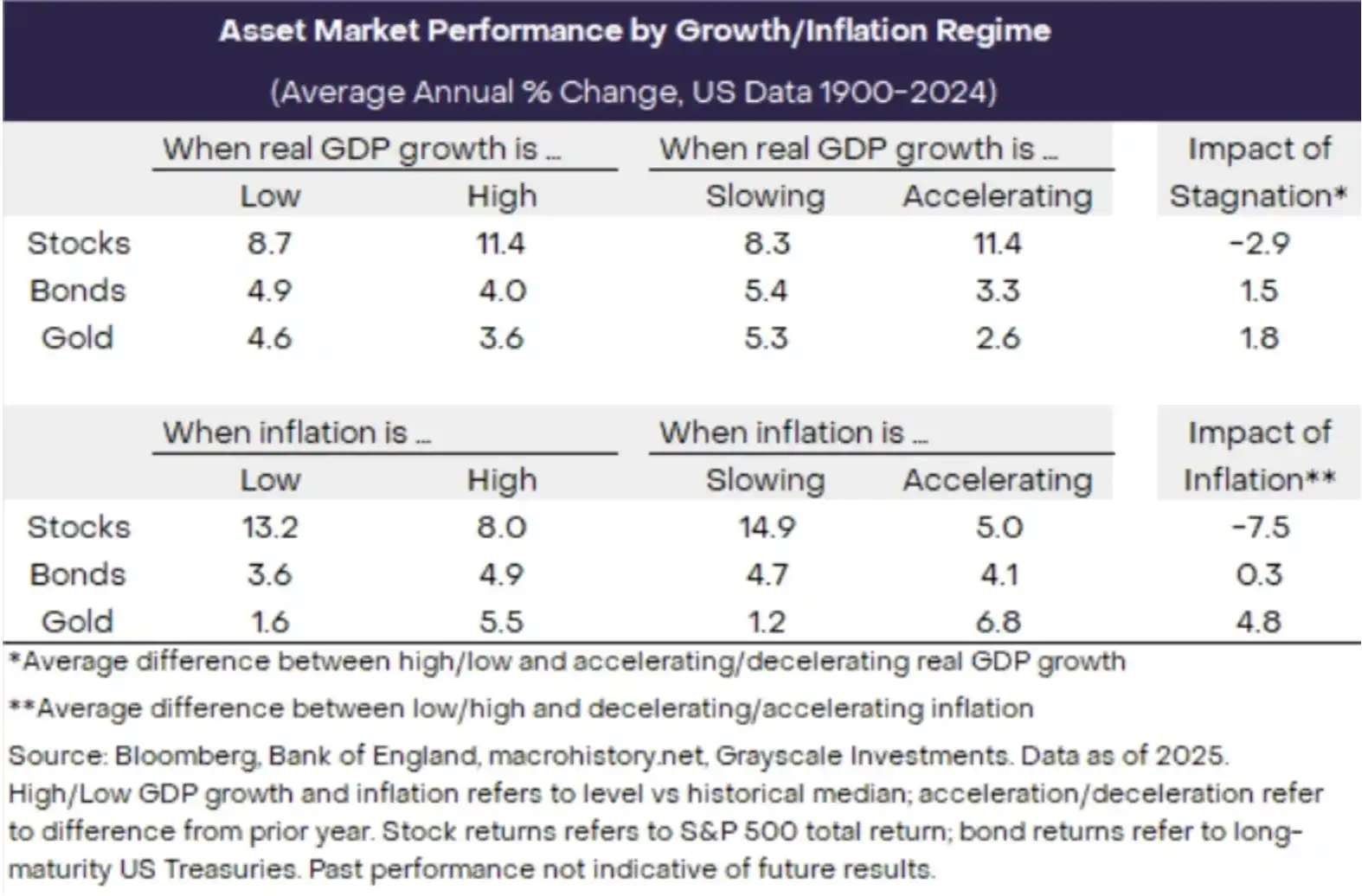
Stagflation reduces stock returns and increases gold returns
Historical data reveals three key points:
When GDP is high or accelerating and inflation is low or decelerating, stock market returns usually increase. Therefore, during stagflation, stock market returns are expected to decline, and investors may need to reduce their equity allocation;
When economic growth is sluggish and inflation is rising, gold often performs well, especially during stagflation. Gold becomes a primary hedge against inflation. This suggests that in this environment, gold is usually a more attractive investment choice;
Bond performance is closely related to inflation changes. When inflation is low, bond yields usually perform well, but when inflation rises, bond performance usually lags. Therefore, during periods of rising inflation, bond investors may face the risk of declining returns.
In summary, different assets perform differently during the economic cycle, and investors should adjust their asset allocation based on the macroeconomic environment. The stagflation period is particularly important as it often has a negative impact on stocks while gold may see growth.
Bitcoin and the US Dollar
Tariffs and trade tensions may drive the adoption of Bitcoin in the medium term, partly due to pressure on the US dollar. Specifically, if overall trade volumes with the US decline and much of the trade is dollar-denominated, the demand for the dollar in transactions will decrease. Additionally, if tariff impositions also lead to conflicts with other major countries, they may weaken the demand for the dollar as a store of value.
The share of the dollar in global foreign exchange reserves far exceeds the US's share in global economic output. There are many reasons for this, but network effects play a significant role: countries engage in trade with the US, borrow in the dollar market, and often price their exports of commodities in dollars. If trade tensions lead to a weakening of ties with the US economy/dollar-based financial markets, countries may accelerate the diversification of foreign exchange reserves.
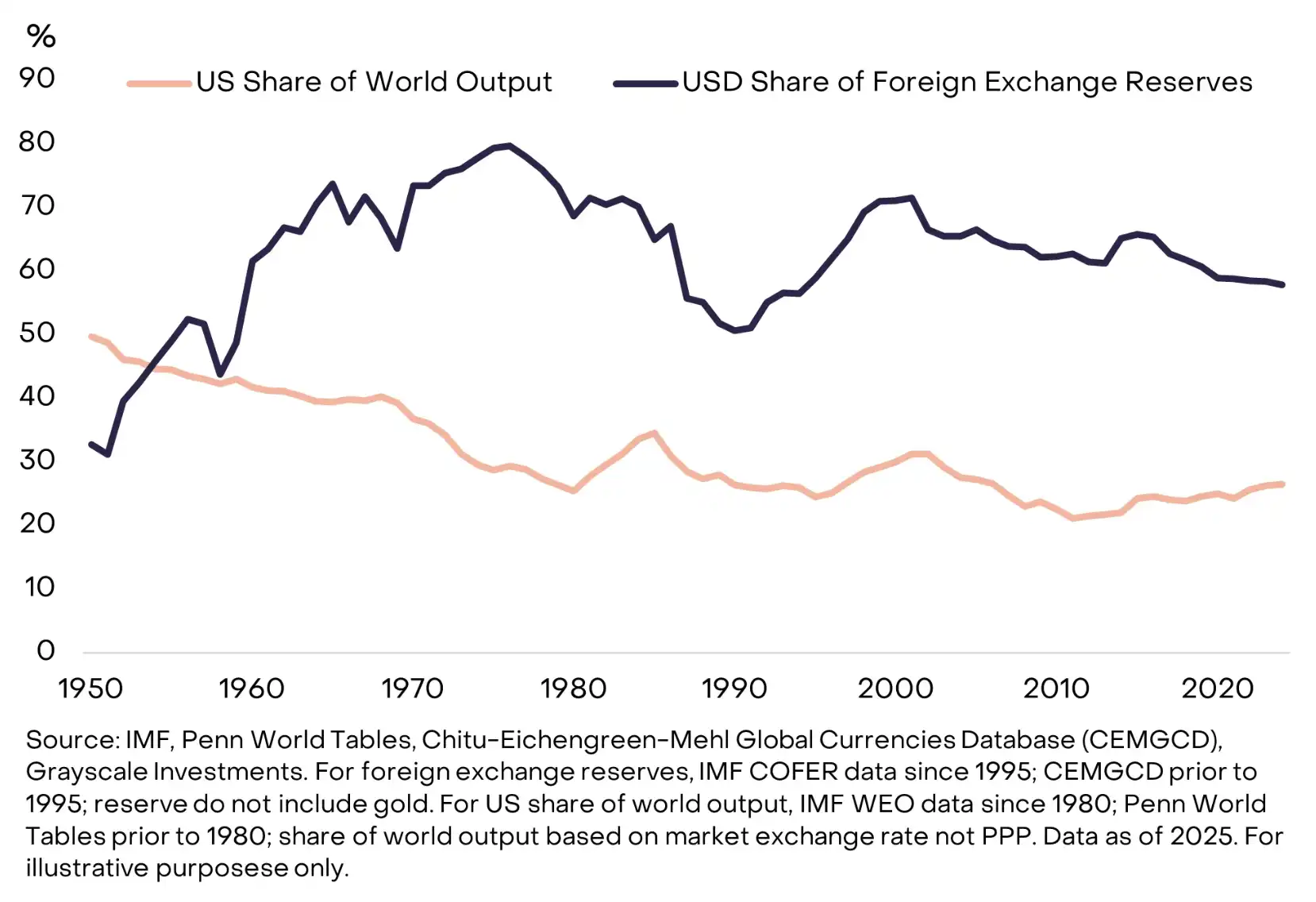
The share of the dollar in global reserves far exceeds the US's share in the global economy
Many central banks have increased their gold purchases after Russia faced Western sanctions. It is understood that besides Iran, no other country's central bank currently holds Bitcoin on its balance sheet. However, the Czech National Bank has started exploring this option, the US has also established a strategic Bitcoin reserve, and some sovereign wealth funds have publicly announced investments in Bitcoin. In our view, disruptions to the dollar-centric international trade and financial system could lead central banks to further diversify reserves, including investing in Bitcoin.
A moment in US history most similar to former President Trump's "Liberation Day" declaration may be the "Nixon Shock" on August 15, 1971. That night, President Nixon announced a comprehensive 10% tariff and ended the gold standard for the dollar—an arrangement that had supported the global trade and financial system since the end of World War II. This action triggered diplomatic activities between the US and other countries, eventually leading to the Smithsonian Agreement in December 1971, where other countries agreed to revalue their currencies against the dollar. The dollar eventually devalued by 27% between the second quarter of 1971 and the third quarter of 1978. Over the past 50 years, there have been several instances of (partially negotiated) dollar weakening following trade tensions.
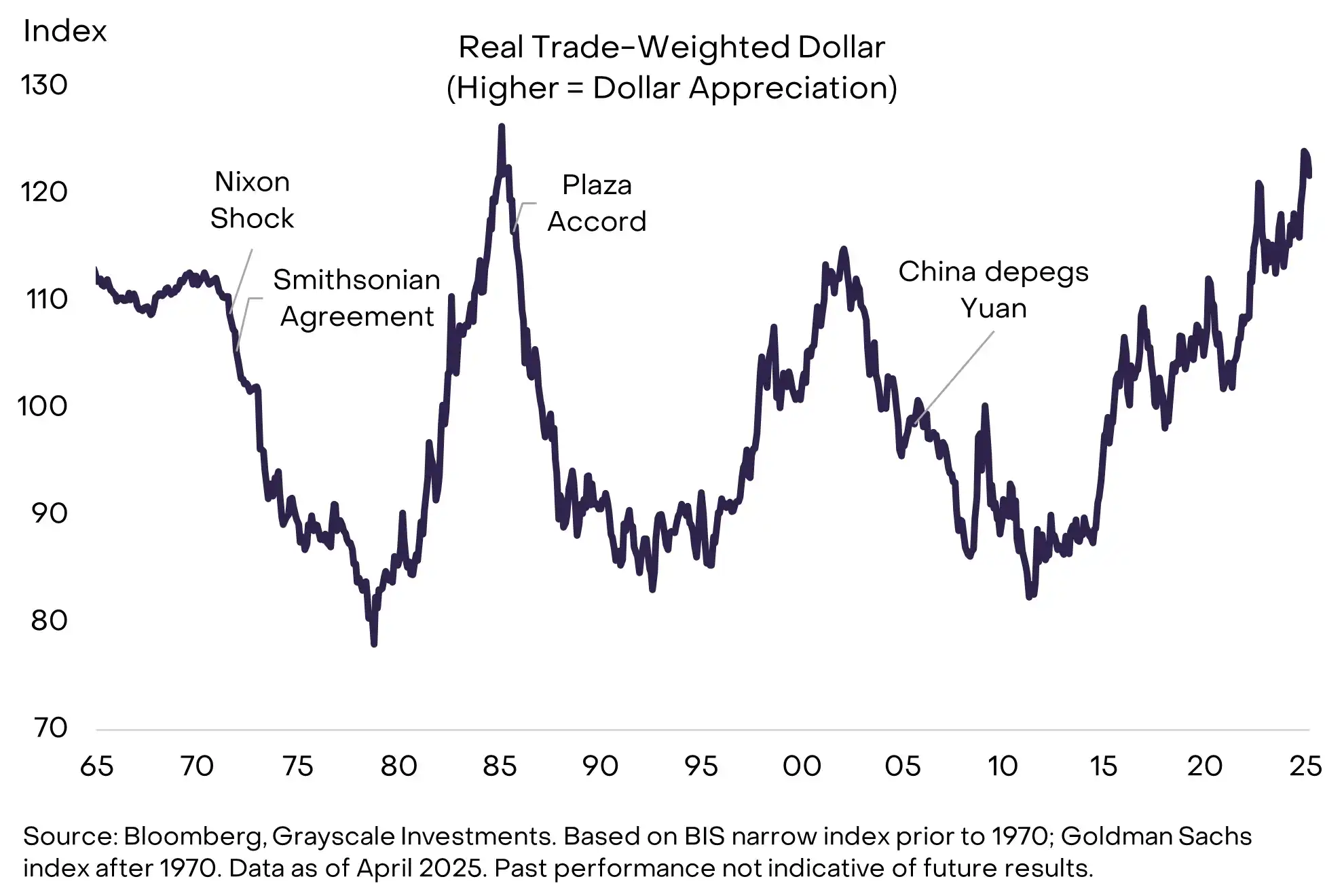
The expected recent trade tension is once again set to result in continued weakness of the U.S. dollar. According to relevant indicators, the U.S. dollar is already overvalued, the Federal Reserve has room to lower interest rates, and the White House aims to reduce the U.S. trade deficit. Although tariffs will alter effective import and export prices, dollar depreciation may gradually achieve trade flow rebalancing through market mechanisms, thereby achieving the desired effect.
Son of the Era - Bitcoin
The U.S. trade policy's shift is causing adjustments in the financial markets, which will have a short-term negative impact on the economy. However, the market conditions of the past week are unlikely to become the norm for the next four years. The Trump administration is implementing a series of policy measures that will have different impacts on GDP growth, inflation, and the trade deficit. For example, while tariffs may reduce economic growth and increase inflation (i.e., stagflation), certain types of deregulation may enhance growth and reduce inflation (i.e., reduce stagflation). The ultimate outcome will depend on the extent to which the White House pursues its policy agenda in these areas.
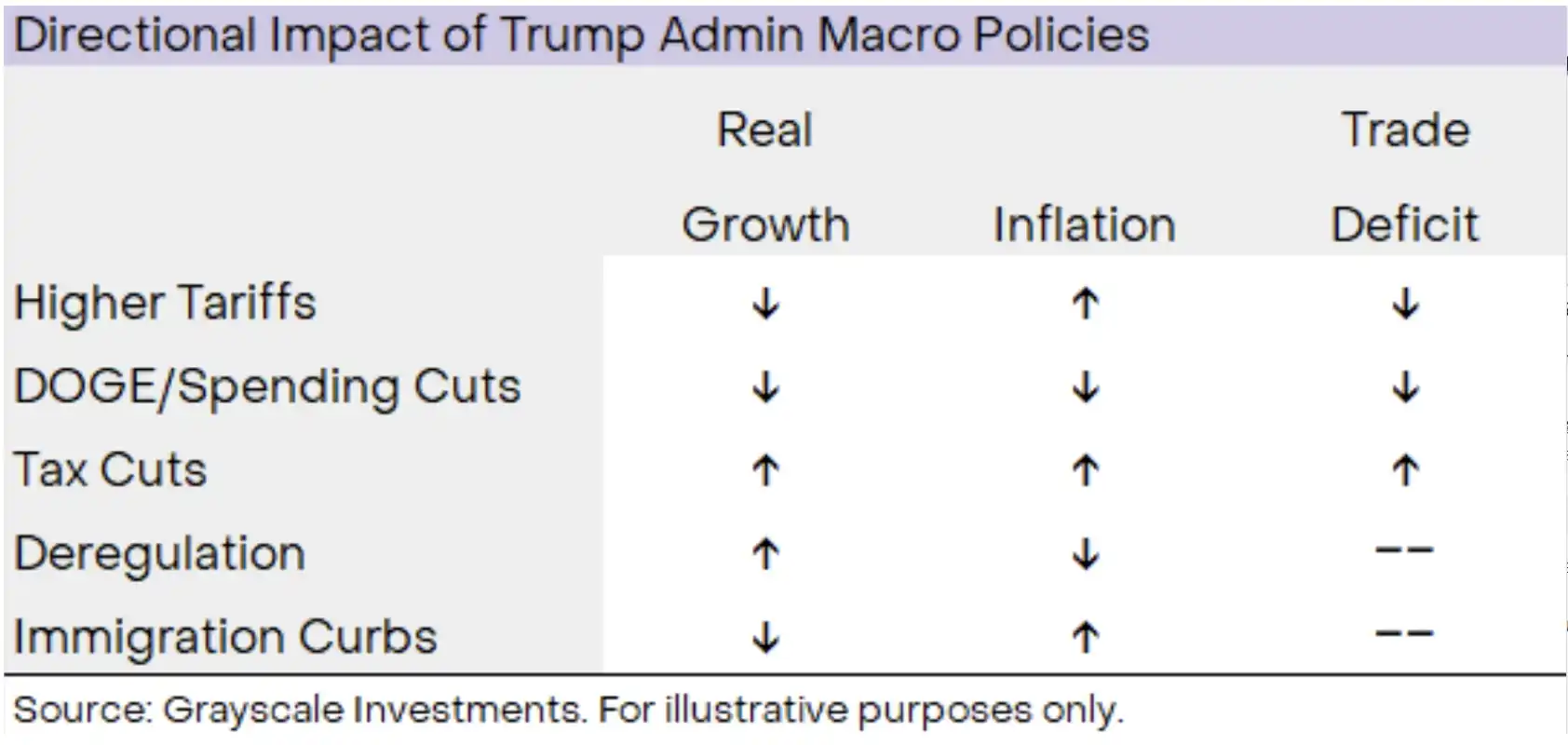
U.S. macroeconomic policies will have a series of impacts on growth and inflation
Despite uncertainties in the outlook, the best guess is that U.S. government policies will lead to sustained dollar weakness and overall above-target inflation in the next 1 to 3 years. Tariffs themselves may slow growth, but this impact may be partially offset by tax cuts, deregulation, and dollar depreciation. If the White House also actively pursues other growth-promoting policies, GDP growth may still remain relatively robust despite the initial impact of tariffs. Regardless of whether actual growth is strong, history suggests that a period of sustained inflationary pressure may be favorable for scarce commodities such as Bitcoin and gold.
Furthermore, much like gold in the 1970s, Bitcoin now has rapidly improving market structure — which is supported by U.S. government policy changes. Throughout this year, the White House has implemented a wide range of policy changes that should support investment in the digital asset industry, including dismissing a series of lawsuits, ensuring asset suitability for traditional commercial banks, and permitting regulated entities (such as custodians) to offer cryptocurrency services. This has, in turn, sparked a wave of mergers and other strategic investments. The new tariffs are a short-term negative factor for the valuation of digital assets like Bitcoin, but the Trump administration's cryptocurrency-specific policies have consistently supported the industry. Overall, the rising demand for scarce commodities assets in the macroeconomy and the improvement in the investor operating environment could be a potent combination for widespread Bitcoin adoption in the coming years.
Vous pourriez aussi aimer

WEEXPERIENCE Nuit des baleines : Trading IA, communauté crypto et marché crypto
Le 12 décembre 2025, WEEX a organisé WEEXPERIENCE Whales Night, un rassemblement communautaire hors ligne conçu pour rassembler les membres de la communauté crypto locale. L'événement a combiné le partage de contenu, des jeux interactifs et des présentations de projets pour créer une expérience hors ligne détendue et attrayante.
Risque de trading d'IA en cryptomonnaie : Pourquoi de meilleures stratégies de trading crypto peuvent-elles générer des pertes plus importantes ?
Le risque ne réside plus principalement dans une mauvaise prise de décision ou des erreurs émotionnelles. Il vit de plus en plus dans la structure du marché, les parcours d'exécution et le comportement collectif. Comprendre ce changement est plus important que de trouver la prochaine stratégie « meilleure ».
Les agents de l'IA remplacent-ils la recherche crypto ? Comment l'IA autonome remodele le trading crypto
L'IA passe de l'assistance aux traders à l'automatisation de l'ensemble du processus de recherche à l'exécution sur les marchés crypto. L'avantage est passé de l'information humaine aux pipelines de données, à la vitesse et aux systèmes d'IA prêts à être exécutés, ce qui fait des retards dans l'intégration de l'IA un désavantage concurrentiel.

Boots de trading et copy trading IA : Comment les stratégies synchronisées remodèlent la volatilité du marché crypto
Les traders crypto de détail sont confrontés depuis longtemps aux mêmes défis : mauvaise gestion des risques, entrées tardives, décisions émotionnelles et exécution incohérente. Les outils de trading IA promettaient une solution. Aujourd'hui, les systèmes de copy trading et les bots de cassage alimentés par l'IA aident les traders à dimensionner leurs positions, à définir des stops et à agir plus rapidement que jamais. Au-delà de la vitesse et de la précision, ces outils remodèlent tranquillement les marchés : les traders ne tradent pas seulement plus malin, ils évoluent de façon synchronisée, créant une nouvelle dynamique qui amplifie à la fois les risques et les opportunités.
Le trading d'IA en crypto expliqué : Comment le trading autonome remodele les marchés crypto et les plateformes d’échange crypto
L’IA Trading transforme rapidement le paysage crypto. Les stratégies traditionnelles peinent à suivre la volatilité constante de la crypto et la structure complexe du marché, tandis que l'IA peut traiter des données massives, générer des stratégies adaptatives, gérer les risques et exécuter des trades de manière autonome. Cet article guide les utilisateurs de WEEX sur ce qu'est le trading d'IA, pourquoi la crypto accélère son adoption, comment le secteur évolue vers des agents autonomes et pourquoi WEEX construit l'écosystème de trading d'IA de nouvelle génération.
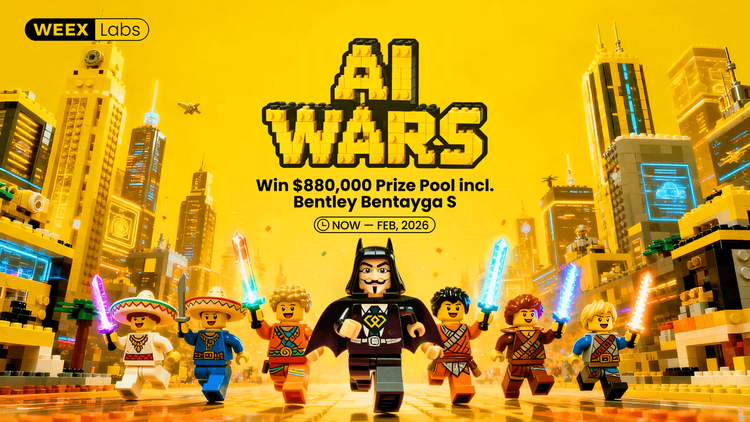
Appelez à rejoindre AI Wars : WEEX Alpha Awakens – Tournoi mondial de trading d’IA avec une cagnotte de 880 000 $
Maintenant, nous lançons un appel aux traders d'IA du monde entier pour qu'ils rejoignent AI Wars : WEEX Alpha Awakens, un tournoi mondial de trading d'IA doté d'une cagnotte de 880 000 $.

Trading d'IA sur les marchés crypto : Des bots de trading automatisés aux stratégies algorithmiques
Le trading basé sur l'IA fait passer la crypto de la spéculation au détail à une concurrence de niveau institutionnel, où l'exécution et la gestion des risques comptent plus que dans le sens. À mesure que le trading de l'IA prend de l'ampleur, les risques systémiques et la pression réglementaire augmentent, faisant des performances à long terme, des systèmes robustes et de la conformité les principaux facteurs de différenciation.

Analyse du sentiment de l'IA et volatilité des cryptomonnaies : Ce qui fait bouger les prix crypto
Le sentiment lié à l'IA influence de plus en plus les marchés crypto, les changements d'attente liés à l'IA se traduisant par une certaine volatilité pour les principaux actifs numériques. Les marchés crypto ont tendance à amplifier les discours sur l'IA, permettant aux flux basés sur les sentiments de l'emporter sur les fondamentaux à court terme. Comprendre comment le sentiment IA se forme et se propage aide les investisseurs à mieux anticiper les cycles de risque et les opportunités de positionnement sur les actifs numériques.
Guerres de l'IA : Guide du participant
Dans cette confrontation ultime, les meilleurs développeurs, quants et traders du monde entier déploieront leurs algorithmes dans des batailles sur le marché réel, en compétition pour l'un des prix les plus importants de l'histoire du trading crypto basé sur l'IA : 880 000 dollars américains, dont une Bentley Bentayga S pour le champion. Ce guide vous accompagnera à travers toutes les étapes nécessaires, de l'inscription au début officiel de la compétition.
Semaine des banques centrales et volatilité des marchés crypto : Comment les décisions relatives aux taux d'intérêt influencent les conditions de trading sur WEEX
Les décisions relatives aux taux d'intérêt prises par les grandes banques centrales, comme la Réserve fédérale, sont des événements macroéconomiques importants qui ont un impact sur les marchés financiers mondiaux et influencent directement les attentes de liquidité des marchés et l'appétence au risque. À mesure que le marché des cryptomonnaies continue de se développer et que sa structure de trading et ses participants mûrissent, le marché des cryptomonnaies est progressivement intégré dans le système d'établissement des prix macroéconomiques.
Test de l'API WEEX : Guide officiel des API de trading de Hackathon et de Crypto pour le trading d’IA
WEEX API Testing est conçu pour garantir que chaque participant peut transformer la logique de trading en exécution réelle. Toutes les interactions API ont lieu sur le système de trading en direct de WEEX, ce qui permet aux participants de travailler dans des conditions de marché authentiques plutôt que dans des simulations. Avec une faible exigence d'entrée, la tâche est accessible à la fois aux développeurs expérimentés et aux débutants motivés, tout en validant les compétences techniques essentielles.
Pourquoi WEEX Alpha se réveille-t-il le meilleur tournoi de trading d'IA de 2025 ? Tout ce que vous devez savoir
Pour accélérer les percées à l'intersection de l'IA et de la crypto, WEEX lance le premier Hackathon mondial de trading d'IA – AI Wars: Alpha se réveille. L'événement propose une cagnotte révolutionnaire dépassant 880 000 $, dont une Bentley Bentayga S pour le champion ultime.
AI Wars: WEEX Alpha Awakens | Guide des processus de test de l'API WEEX Global Hackathon
AI Wars : L'inscription au Réveil Alpha WEEX est maintenant ouverte. Ce guide explique comment accéder au test API et terminer le processus avec succès.
Qu'est-ce que le réveil de WEEX Alpha et comment participer ? Un guide complet
Pour accélérer les percées à l'intersection de l'IA et de la crypto, WEEX lance le premier Hackathon mondial de trading d'IA – AI Wars: Alpha se réveille.
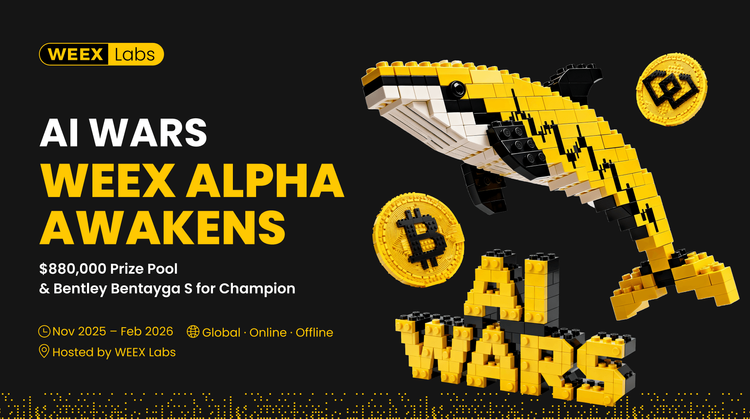
Join AI Wars: WEEK Alpha se réveille !Appel mondial pour les Alphas de Trading IA
AI Wars: WEEX Alpha Awakens est un hackathon mondial de trading sur l'IA à Dubaï, appelant les équipes quantiques, les traders algorithmiques et les développeurs d'IA à lancer leurs stratégies de trading crypto sur les marchés en direct pour une part d'une cagnotte de 880 000 $ US.
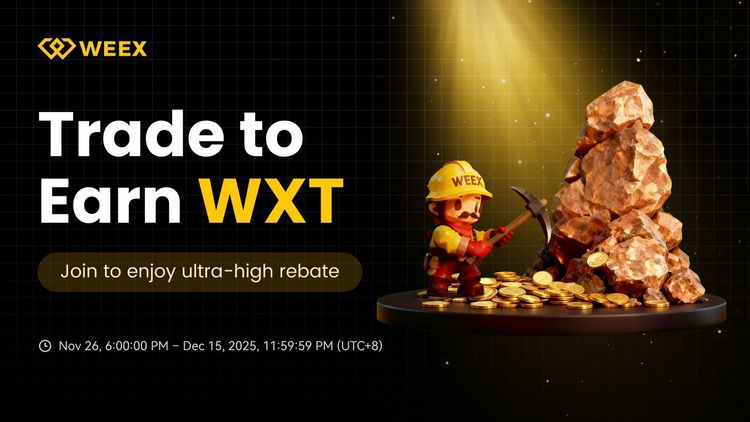
WEEX dévoile le trade to Earn: Jusqu'à 30 % de remise instantanée + 2 M$ WXT Rachat
WEEX est heureuse d’annoncer le lancement de son programme Trade to Earn, qui vous accorde automatiquement jusqu’à 30% de rabais sur les frais de trading. Toutes les récompenses sont créditées directement sur votre compte au comptant en WXT $, soutenu par notre plan de rachat de WXT $2,000,000 qui alimente la valeur à long terme des jetons.

Nouveau: Prix de liquidation estimé sur les graphiques App Candlestick
WEEX a introduit un nouveau prix estimatif de liquidation (Est. Liq. Price) figure sur le graphique en chandelier pour aider les traders à mieux gérer le risque et à identifier des fourchettes sûres pour leurs positions.
WEEX AI Hackathon Guide: Trouvez votre UID WEEK et inscrivez-vous
D'ici février 2026, WEEX lance AI Wars: WEEK Alpha Awakens, le premier hackathon mondial de trading de crypto-IA. Venez votre UID et inscrivez-vous au WEEX Global AI Trading Hackathon.
WEEXPERIENCE Nuit des baleines : Trading IA, communauté crypto et marché crypto
Le 12 décembre 2025, WEEX a organisé WEEXPERIENCE Whales Night, un rassemblement communautaire hors ligne conçu pour rassembler les membres de la communauté crypto locale. L'événement a combiné le partage de contenu, des jeux interactifs et des présentations de projets pour créer une expérience hors ligne détendue et attrayante.
Risque de trading d'IA en cryptomonnaie : Pourquoi de meilleures stratégies de trading crypto peuvent-elles générer des pertes plus importantes ?
Le risque ne réside plus principalement dans une mauvaise prise de décision ou des erreurs émotionnelles. Il vit de plus en plus dans la structure du marché, les parcours d'exécution et le comportement collectif. Comprendre ce changement est plus important que de trouver la prochaine stratégie « meilleure ».
Les agents de l'IA remplacent-ils la recherche crypto ? Comment l'IA autonome remodele le trading crypto
L'IA passe de l'assistance aux traders à l'automatisation de l'ensemble du processus de recherche à l'exécution sur les marchés crypto. L'avantage est passé de l'information humaine aux pipelines de données, à la vitesse et aux systèmes d'IA prêts à être exécutés, ce qui fait des retards dans l'intégration de l'IA un désavantage concurrentiel.
Boots de trading et copy trading IA : Comment les stratégies synchronisées remodèlent la volatilité du marché crypto
Les traders crypto de détail sont confrontés depuis longtemps aux mêmes défis : mauvaise gestion des risques, entrées tardives, décisions émotionnelles et exécution incohérente. Les outils de trading IA promettaient une solution. Aujourd'hui, les systèmes de copy trading et les bots de cassage alimentés par l'IA aident les traders à dimensionner leurs positions, à définir des stops et à agir plus rapidement que jamais. Au-delà de la vitesse et de la précision, ces outils remodèlent tranquillement les marchés : les traders ne tradent pas seulement plus malin, ils évoluent de façon synchronisée, créant une nouvelle dynamique qui amplifie à la fois les risques et les opportunités.
Le trading d'IA en crypto expliqué : Comment le trading autonome remodele les marchés crypto et les plateformes d’échange crypto
L’IA Trading transforme rapidement le paysage crypto. Les stratégies traditionnelles peinent à suivre la volatilité constante de la crypto et la structure complexe du marché, tandis que l'IA peut traiter des données massives, générer des stratégies adaptatives, gérer les risques et exécuter des trades de manière autonome. Cet article guide les utilisateurs de WEEX sur ce qu'est le trading d'IA, pourquoi la crypto accélère son adoption, comment le secteur évolue vers des agents autonomes et pourquoi WEEX construit l'écosystème de trading d'IA de nouvelle génération.
Appelez à rejoindre AI Wars : WEEX Alpha Awakens – Tournoi mondial de trading d’IA avec une cagnotte de 880 000 $
Maintenant, nous lançons un appel aux traders d'IA du monde entier pour qu'ils rejoignent AI Wars : WEEX Alpha Awakens, un tournoi mondial de trading d'IA doté d'une cagnotte de 880 000 $.
Pièces populaires
Dernières actus crypto


Assistance client:@weikecs
Collaborations commerciales:@weikecs
Trading quantitatif/Market makers:[email protected]
Programme VIP:[email protected]
 App
App