
- Acheter crypto
- Marchés
- Futures
- Spot
- Copy trading
 WE-Launch
Mining Rig Prices Increase by 24% as Trump's Tariff Policy Hits US Bitcoin Mining Industry

Original Article Title: How Trump's Tariffs Will Affect Bitcoin Mining
Original Article Author: Jaran Mellerud
Original Article Translation: Deep Tide TechFlow
Trump's tariff policy will have a significant impact on the Bitcoin mining industry. Here is an analysis of the policy's impact on the industry.
On April 2nd, Trump announced comprehensive new tariffs on imported goods aimed at strengthening U.S. trade balance. The Southeast Asia region was hit the hardest, impacting the Bitcoin mining machine supply chain profoundly. This region is home to most of the major mining hardware manufacturers, including Bitmain, MicroBT, and Canaan.
Furthermore, as the U.S. holds 36% of the global hashrate, these tariffs could significantly affect miners' profitability, hardware prices in the U.S. and abroad, and the global hashrate distribution.
Before delving into the multifaceted impact of these tariffs on the Bitcoin mining industry, let's first briefly explain how tariffs work.
How Do Tariffs Work?
Tariffs are taxes imposed by the government on imported goods, usually aimed at protecting domestic industries by raising the prices of foreign products. When tariffs are in place, importers must pay a certain percentage of the declared value of the goods to customs upon entry.
For example, if a U.S. company imports $1,000 worth of electronics from China and the tariff rate is 54%, the importer must pay an additional $540 in tariffs, bringing the total import cost to $1,540. This increased cost is often passed on to consumers or reduces the importer's profit margins.
Tariff History: The U.S.-China Trade War and Its Ripple Effects
Bitcoin mining is a global industry, with the U.S. being a significant player, and the trade war and resulting tariffs have already impacted the industry. However, in the past, companies in the industry have found ways to circumvent these tariffs. In the following section, we will explore how tariffs have historically affected the Bitcoin mining supply chain and what strategies companies have employed to bypass these tariffs.
In 2018, the U.S. government imposed a 25% tariff on a range of Chinese goods, including electronics, as part of the U.S.-China trade war.
In response, companies such as Bitmain began seeking ways to circumvent these high tariffs. They shifted their production from mainland China to Southeast Asian countries such as Indonesia, Thailand, and Malaysia, where exported goods to the US are either tariff-free or subject to lower tariffs—typically ranging from 1% to 3% for electronic products.
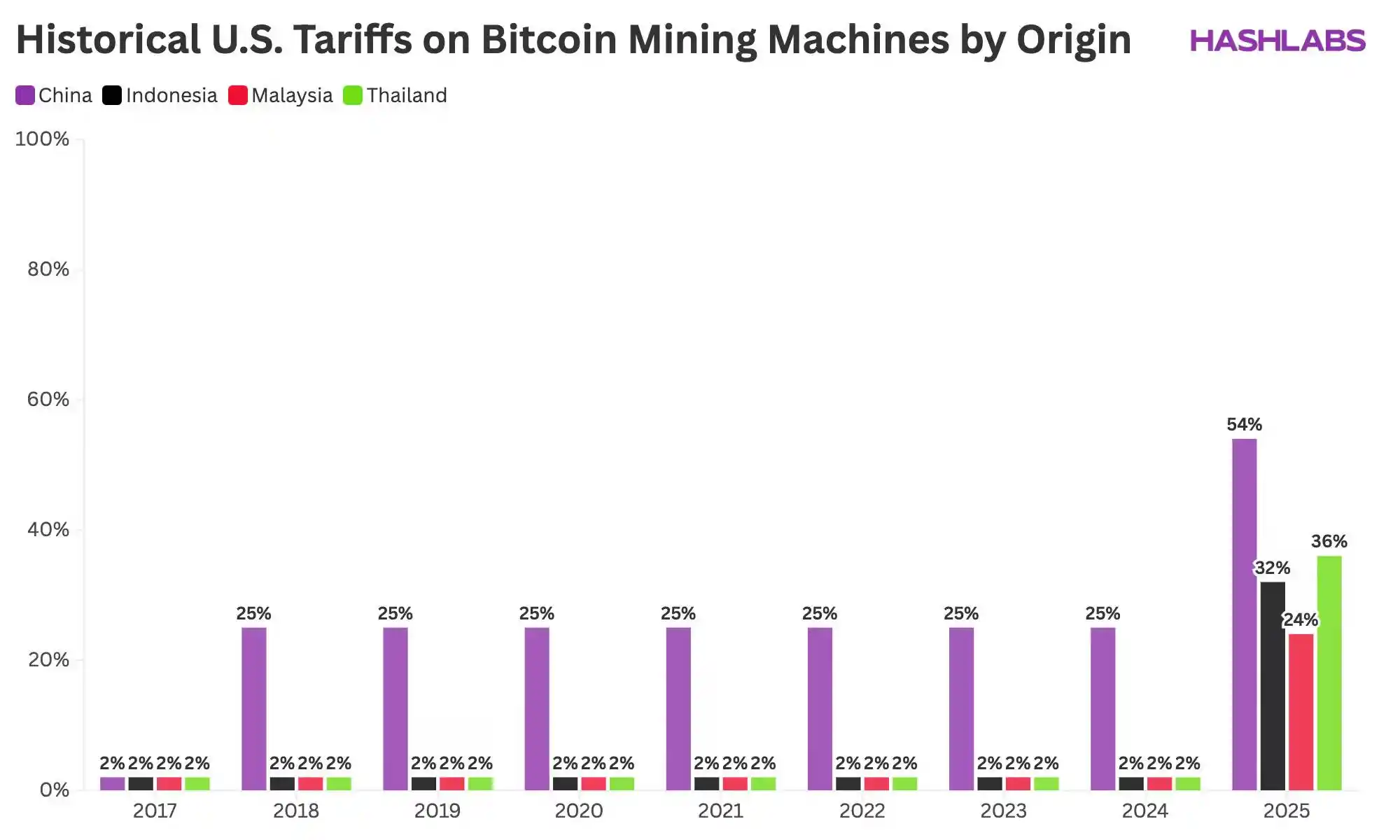
This strategy was effective until earlier this month when Trump raised tariffs on imports from Indonesia, Malaysia, and Thailand to 32%, 24%, and 36%, respectively. As a result, companies like Bitmain and MicroBT can no longer entirely avoid these high tariffs, which were initially targeted at goods imported from China.
In the following sections, we will elaborate on how these newly imposed tariffs will impact the Bitcoin mining industry.
Significant Price Increase Expected for Mining Machines in the US
The most direct and noticeable impact of the tariffs is that mining machine prices in the US are expected to increase significantly.
As Ethan Vera pointed out in "The Mining Pod" show: "...any company operating in the United States looking to purchase mining machines will need to pay an additional 22% to 36% for these machines." This aligns with our data.
However, the 22% price hike only applies to imported mining machines. Currently, there is still a substantial amount of mining machine inventory in the US. Based on Bitmars' pricing data, there is a 13% to 25% price difference between mining machines in the US and those in Hong Kong. As the US inventory diminishes, this price difference could narrow to 22%, plus a small shipping cost.
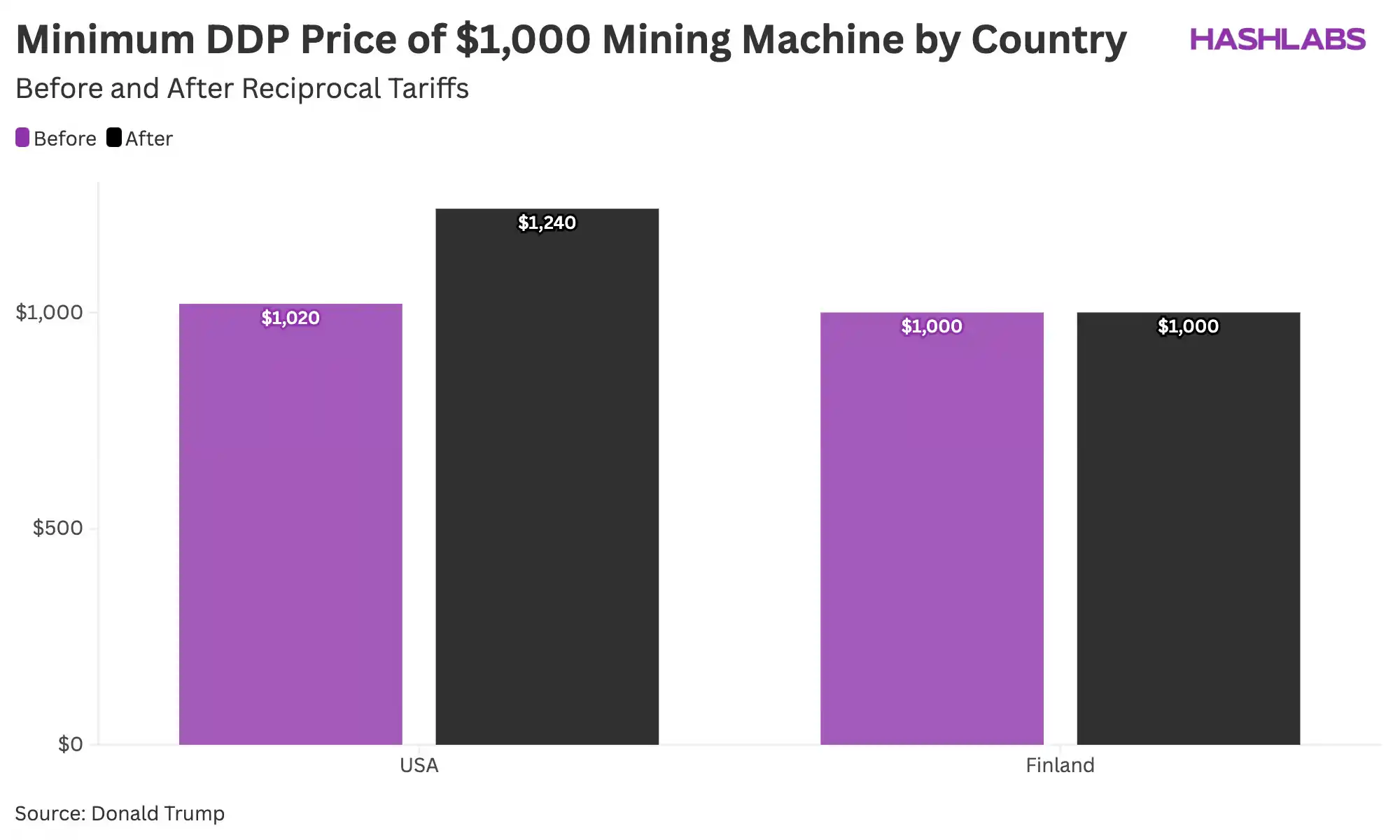
The graph above shows the final cost of importing a $1000 Bitcoin mining device into the US and Finland before and after the introduction of equivalent tariffs. Finland, like most other countries, has no tariffs on electronics imported from Asia—we use it as an example because we mine there.
As shown in the graph, due to approximately 2% tariff, the initial cost of importing a mining machine to the US was slightly higher. However, after the introduction of the new tariffs, the lowest cost of a $1000 mining machine in the US increased to $1240. This is a significant increase. Meanwhile, in Finland and most other countries, the cost of a $1000 mining machine remains the same due to the absence of tariffs.
In an industry as cost-sensitive as Bitcoin mining, a 22% increase in mining machine prices may render operations financially unsustainable. In the subsequent sections of this article, we will explore how these changes affect mining profitability in the US compared to other regions.
Mining Machines Outside the US May Become Cheaper
As mining machine prices within the US rise, prices of mining machines in other parts of the world may see an opposite downward trend.
The demand for mining machines shipped to the US is expected to plummet, possibly approaching zero. Given the US has been a dominant player in the ASIC (Application-Specific Integrated Circuit) market, representing nearly 40% of the global hashrate, the sharp decline in US purchases will lead to a significant drop in global demand.
With reduced demand from US miners, manufacturers will face an oversupply of inventory originally intended for the US market. To clear this surplus stock, they may need to lower prices to attract buyers from other regions.
While it's difficult to precisely predict how much mining machine prices will drop—since mining profitability also impacts prices—we can draw a conclusion based on fundamental economic principles: a decrease in demand for an asset usually leads to a price drop.
This price drop will make it easier for miners outside the US to expand further, which may also result in the decline of the US's share in global hashrate that we will discuss next.
US Share in the Global Bitcoin Mining Industry Will Decline
Since China banned Bitcoin mining in 2021, the US has been a dominant force in Bitcoin mining. According to data from Hashrate Index, the US currently holds 36% of the global hashrate.
Like any business activity, the core of Bitcoin mining lies in balancing risk and reward. Over the past four years, the US has attracted significant mining investment as it is seen as one of the lowest-risk environments in the world, with political stability, abundant energy, and a liberalized electricity market. Additionally, miners have so far avoided major import tariffs, helping them control capital expenditures. These factors together have created an unparalleled risk-reward balance.
To understand how new tariffs are reshaping the US's share in global mining, we first analyze from the perspective of returns.
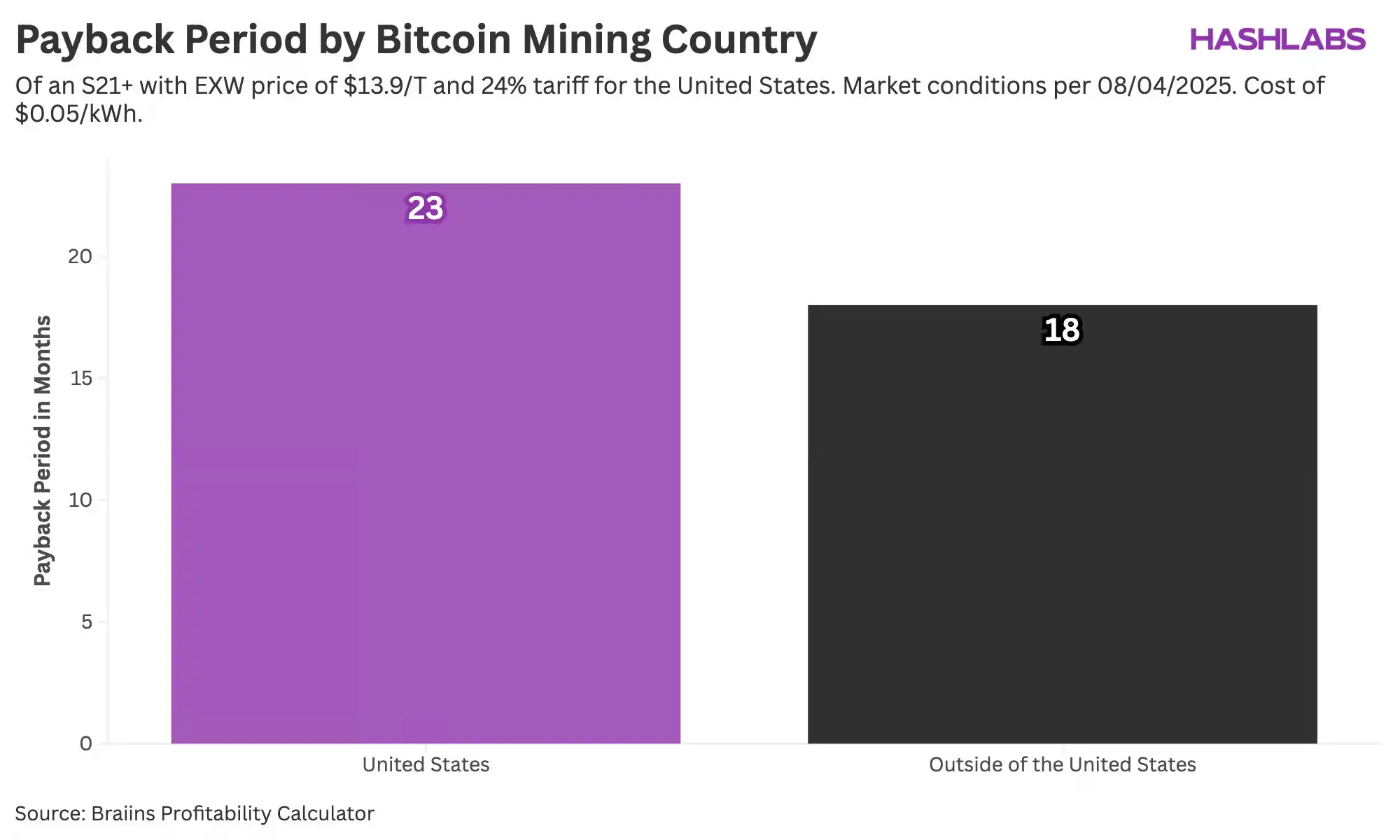
The following graph shows the estimated payback period for deploying an Antminer S21+ in the US and a country unaffected by tariffs. As the data shows, overpaying by 24% for the same mining machine in the US significantly extends the payback period—undermining the core economic rationale for mining in the US.
In addition to the higher mining machine cost, the risk aspect has also been impacted. Many US miners felt reassured during the Trump administration, expecting a stable regulatory environment. But they are now experiencing the flip side of his policy volatility. Even if these tariffs are rescinded within months, the damage has been done—the confidence in long-term planning has been shaken. In a scenario where key variables could change overnight, few are willing to make significant investments.
In any case, the once unparalleled risk-return balance of U.S. Bitcoin mining has significantly deteriorated. This change could lead to a gradual decline in the U.S.' share of the global mining industry relative to other countries.
Of course, existing mining machines already imported into the U.S. will not be affected—miners have no reason to shut them down. However, the path to expansion has now become steep and filled with uncertainty.
Meanwhile, miners in tax-free jurisdictions will continue to scale up, solidifying their competitive advantage. Therefore, it is expected that the U.S.' global hash rate share will decrease—not because miners are exiting, but because they are no longer growing.
From a broader perspective, this could lead to a more diverse geographical distribution of Bitcoin mining than ever before. While the U.S. will still be a major player, its dominance will weaken, and the global hash rate distribution will become more balanced. This aligns with predictions from Braiins' Kristian Csepcar and Bitmars' Summer Meng.
Network Hash Rate Growth Will Slow Down
In the previous section, we explained how the new tariffs could lead to a decrease in the U.S.' share of the global Bitcoin mining industry. Given the U.S.' significant role in global hash rate, its slowdown—or even halt—in growth will inevitably result in an overall deceleration of global hash rate growth.
According to Hashrate Index data, as of the second quarter of 2025, the U.S. accounts for approximately 36% of the global hash rate. In contrast, CBECI data shows that as of January 2022, the U.S.' hash rate share was around 38%. This suggests that over the past three years, the growth rate of the U.S. mining industry has been roughly in line with other regions worldwide.
If this growth trajectory were to continue, the U.S. would contribute around 36% to future global hash rate growth. Therefore, if the U.S. mining industry stagnates due to tariffs' impact, it could lead to a reduction in the global hash rate growth rate of up to 36%.
However, the likelihood of a complete halt in U.S. mining industry growth is very low. As we will explain in the next section, these tariffs may be temporary, and there may be ways to circumvent them in the future. Therefore, the more realistic expectation is that the U.S. mining industry will continue to expand, but at a much slower pace than before. The assumption of a 36% reduction in global hash rate growth should be seen as an absolute upper limit—the actual impact may be slightly lower.
In the long run, if U.S. growth slows down or stalls, miners from other countries may accelerate their expansion to gradually fill this gap.
Nevertheless, in the short to medium term—within the next year or two—we may see global hash rate growth slower than previously expected. In an industry where slower hash rate growth translates to higher earnings, this will be a welcome development for miners worldwide.
Is This Temporary or Permanent?
So far, this article has taken a rather pessimistic view of how these tariffs could impact the U.S. Bitcoin mining industry—an outlook that is understandable given the immediate and severe effects they could bring about. However, the situation is more nuanced, and there are some crucial questions worth exploring.
In the following sections, we will address these questions and assess how the long-term prospects of the U.S. mining industry could cope with the current challenges.
Will Trump repeal the tariffs after implementing them for a few months?
It is entirely possible—especially considering the unpredictable and reactive nature of Trump's policy-making style. If the tariffs are repealed, U.S. miners would once again be able to import mining equipment at competitive prices, alleviating many of the immediate pressures they face.
However, the damage to long-term investor confidence may already have been done. Even if the tariffs are lifted, the sudden introduction of them has made large-scale, long-term investments in the U.S. mining industry more challenging. In a capital-intensive industry like Bitcoin mining, policy stability is crucial—and right now, that is in short supply.
Can mining equipment manufacturers circumvent the tariffs by importing chips from China Taiwan and assembling the miners in the U.S.?
Mining equipment manufacturers may indeed circumvent the tariffs by importing chips from China Taiwan and assembling miners locally in the U.S. According to the White House's official statement, semiconductors are not subject to the reciprocal tariffs. This means that chips can be imported into the U.S. duty-free. However, local production of miners in the U.S. still requires other components, many of which have become more expensive due to tariffs, leading to overall economic inflation in the U.S.
Currently, manufacturers like MicroBT have established assembly lines in the U.S., but Bitmain has yet to follow suit. Even with MicroBT's assembly capabilities, their production capacity is far from sufficient to meet U.S. demand for miners in the next 1-2 years.
Therefore, while this option is technically viable, it does not address the immediate concerns of U.S. miners. However, in the long run, we anticipate more miner assembly gradually shifting to the U.S. as manufacturers adapt to the new tariff environment and expand local production capacity. This transition may help reduce reliance on international imports and lessen the impact of tariffs over time.
Is it realistic to establish a complete Bitcoin mining hardware supply chain in the United States from chip manufacturing to final assembly?
Establishing a full Bitcoin mining hardware supply chain in the United States from chip manufacturing to final assembly is a complex challenge, despite strong advocacy from the Bitcoin mining industry and political leaders for localized chip production. Currently, the most advanced chips used in Bitcoin mining are manufactured in Taiwan and South Korea, regions with decades of expertise and finely tuned supply chains. The United States' reliance on key components from Asian countries poses a significant geopolitical risk not only to the Bitcoin mining industry but to the entire high-tech sector.
While localizing mining rig assembly in the U.S. is feasible, continued dependency on imported chips remains a major hurdle. Companies like Bitmain, MicroBT, and Canaan could establish assembly lines in the U.S., with new players such as Auradine also eyeing this market. However, without domestically produced cutting-edge chips, these manufacturers will still rely on imports in the foreseeable future.
Kristian Csepcsar from Braiins further emphasized this challenge, saying: "Chip foundries have started setting up manufacturing facilities in the U.S., but they are starting from a high nanometer level. It takes years to nurture talent and expertise to transition to lower nanometer levels. This is a progressive process—companies start with high nanometer chips to ensure a return on investment, then strive to expand to more advanced technology. Even as the U.S. progresses, establishing a fully localized Bitcoin mining hardware supply chain is nearly impossible due to the high costs. The real question is, if demand is high, whether it is still cheaper to manufacture in China and pay tariffs. After all, starting end-to-end manufacturing in the U.S. requires time and substantial investment, just as Bitmain recently attempted to set up assembly lines in China—although there has been little news since."
In summary, while the U.S. has great potential in assembly and chip manufacturing, a fully localized Bitcoin mining hardware supply chain remains a long-term goal rather than a short-term reality. The cost, time, and complexity of this transition make it unlikely to be achieved on a large scale in the coming years.
Conclusion
In conclusion, the newly implemented import tariffs will significantly impact the U.S. Bitcoin mining industry—leading to price increases for hardware, a decrease in U.S. market share, and a slowdown in global hash rate growth—but the long-term implications are more intricate.
As events unfold, miners and industry stakeholders need to closely monitor the political and economic landscape to address potential tariff and policy changes. The U.S. mining industry may face challenges in the short term, but there are still opportunities for growth and adaptation within the global mining ecosystem.
Vous pourriez aussi aimer

WEEXPERIENCE Nuit des baleines : Trading IA, communauté crypto et marché crypto
Le 12 décembre 2025, WEEX a organisé WEEXPERIENCE Whales Night, un rassemblement communautaire hors ligne conçu pour rassembler les membres de la communauté crypto locale. L'événement a combiné le partage de contenu, des jeux interactifs et des présentations de projets pour créer une expérience hors ligne détendue et attrayante.
Risque de trading d'IA en cryptomonnaie : Pourquoi de meilleures stratégies de trading crypto peuvent-elles générer des pertes plus importantes ?
Le risque ne réside plus principalement dans une mauvaise prise de décision ou des erreurs émotionnelles. Il vit de plus en plus dans la structure du marché, les parcours d'exécution et le comportement collectif. Comprendre ce changement est plus important que de trouver la prochaine stratégie « meilleure ».

Les agents de l'IA remplacent-ils la recherche crypto ? Comment l'IA autonome remodele le trading crypto
L'IA passe de l'assistance aux traders à l'automatisation de l'ensemble du processus de recherche à l'exécution sur les marchés crypto. L'avantage est passé de l'information humaine aux pipelines de données, à la vitesse et aux systèmes d'IA prêts à être exécutés, ce qui fait des retards dans l'intégration de l'IA un désavantage concurrentiel.

Boots de trading et copy trading IA : Comment les stratégies synchronisées remodèlent la volatilité du marché crypto
Les traders crypto de détail sont confrontés depuis longtemps aux mêmes défis : mauvaise gestion des risques, entrées tardives, décisions émotionnelles et exécution incohérente. Les outils de trading IA promettaient une solution. Aujourd'hui, les systèmes de copy trading et les bots de cassage alimentés par l'IA aident les traders à dimensionner leurs positions, à définir des stops et à agir plus rapidement que jamais. Au-delà de la vitesse et de la précision, ces outils remodèlent tranquillement les marchés : les traders ne tradent pas seulement plus malin, ils évoluent de façon synchronisée, créant une nouvelle dynamique qui amplifie à la fois les risques et les opportunités.

Le trading d'IA en crypto expliqué : Comment le trading autonome remodele les marchés crypto et les plateformes d’échange crypto
L’IA Trading transforme rapidement le paysage crypto. Les stratégies traditionnelles peinent à suivre la volatilité constante de la crypto et la structure complexe du marché, tandis que l'IA peut traiter des données massives, générer des stratégies adaptatives, gérer les risques et exécuter des trades de manière autonome. Cet article guide les utilisateurs de WEEX sur ce qu'est le trading d'IA, pourquoi la crypto accélère son adoption, comment le secteur évolue vers des agents autonomes et pourquoi WEEX construit l'écosystème de trading d'IA de nouvelle génération.

Appelez à rejoindre AI Wars : WEEX Alpha Awakens – Tournoi mondial de trading d’IA avec une cagnotte de 880 000 $
Maintenant, nous lançons un appel aux traders d'IA du monde entier pour qu'ils rejoignent AI Wars : WEEX Alpha Awakens, un tournoi mondial de trading d'IA doté d'une cagnotte de 880 000 $.

Trading d'IA sur les marchés crypto : Des bots de trading automatisés aux stratégies algorithmiques
Le trading basé sur l'IA fait passer la crypto de la spéculation au détail à une concurrence de niveau institutionnel, où l'exécution et la gestion des risques comptent plus que dans le sens. À mesure que le trading de l'IA prend de l'ampleur, les risques systémiques et la pression réglementaire augmentent, faisant des performances à long terme, des systèmes robustes et de la conformité les principaux facteurs de différenciation.

Analyse du sentiment de l'IA et volatilité des cryptomonnaies : Ce qui fait bouger les prix crypto
Le sentiment lié à l'IA influence de plus en plus les marchés crypto, les changements d'attente liés à l'IA se traduisant par une certaine volatilité pour les principaux actifs numériques. Les marchés crypto ont tendance à amplifier les discours sur l'IA, permettant aux flux basés sur les sentiments de l'emporter sur les fondamentaux à court terme. Comprendre comment le sentiment IA se forme et se propage aide les investisseurs à mieux anticiper les cycles de risque et les opportunités de positionnement sur les actifs numériques.

Guerres de l'IA : Guide du participant
Dans cette confrontation ultime, les meilleurs développeurs, quants et traders du monde entier déploieront leurs algorithmes dans des batailles sur le marché réel, en compétition pour l'un des prix les plus importants de l'histoire du trading crypto basé sur l'IA : 880 000 dollars américains, dont une Bentley Bentayga S pour le champion. Ce guide vous accompagnera à travers toutes les étapes nécessaires, de l'inscription au début officiel de la compétition.

Semaine des banques centrales et volatilité des marchés crypto : Comment les décisions relatives aux taux d'intérêt influencent les conditions de trading sur WEEX
Les décisions relatives aux taux d'intérêt prises par les grandes banques centrales, comme la Réserve fédérale, sont des événements macroéconomiques importants qui ont un impact sur les marchés financiers mondiaux et influencent directement les attentes de liquidité des marchés et l'appétence au risque. À mesure que le marché des cryptomonnaies continue de se développer et que sa structure de trading et ses participants mûrissent, le marché des cryptomonnaies est progressivement intégré dans le système d'établissement des prix macroéconomiques.

Test de l'API WEEX : Guide officiel des API de trading de Hackathon et de Crypto pour le trading d’IA
WEEX API Testing est conçu pour garantir que chaque participant peut transformer la logique de trading en exécution réelle. Toutes les interactions API ont lieu sur le système de trading en direct de WEEX, ce qui permet aux participants de travailler dans des conditions de marché authentiques plutôt que dans des simulations. Avec une faible exigence d'entrée, la tâche est accessible à la fois aux développeurs expérimentés et aux débutants motivés, tout en validant les compétences techniques essentielles.
Pourquoi WEEX Alpha se réveille-t-il le meilleur tournoi de trading d'IA de 2025 ? Tout ce que vous devez savoir
Pour accélérer les percées à l'intersection de l'IA et de la crypto, WEEX lance le premier Hackathon mondial de trading d'IA – AI Wars: Alpha se réveille. L'événement propose une cagnotte révolutionnaire dépassant 880 000 $, dont une Bentley Bentayga S pour le champion ultime.

AI Wars: WEEX Alpha Awakens | Guide des processus de test de l'API WEEX Global Hackathon
AI Wars : L'inscription au Réveil Alpha WEEX est maintenant ouverte. Ce guide explique comment accéder au test API et terminer le processus avec succès.

Qu'est-ce que le réveil de WEEX Alpha et comment participer ? Un guide complet
Pour accélérer les percées à l'intersection de l'IA et de la crypto, WEEX lance le premier Hackathon mondial de trading d'IA – AI Wars: Alpha se réveille.

Join AI Wars: WEEK Alpha se réveille !Appel mondial pour les Alphas de Trading IA
AI Wars: WEEX Alpha Awakens est un hackathon mondial de trading sur l'IA à Dubaï, appelant les équipes quantiques, les traders algorithmiques et les développeurs d'IA à lancer leurs stratégies de trading crypto sur les marchés en direct pour une part d'une cagnotte de 880 000 $ US.
WEEX dévoile le trade to Earn: Jusqu'à 30 % de remise instantanée + 2 M$ WXT Rachat
WEEX est heureuse d’annoncer le lancement de son programme Trade to Earn, qui vous accorde automatiquement jusqu’à 30% de rabais sur les frais de trading. Toutes les récompenses sont créditées directement sur votre compte au comptant en WXT $, soutenu par notre plan de rachat de WXT $2,000,000 qui alimente la valeur à long terme des jetons.

Nouveau: Prix de liquidation estimé sur les graphiques App Candlestick
WEEX a introduit un nouveau prix estimatif de liquidation (Est. Liq. Price) figure sur le graphique en chandelier pour aider les traders à mieux gérer le risque et à identifier des fourchettes sûres pour leurs positions.
WEEX AI Hackathon Guide: Trouvez votre UID WEEK et inscrivez-vous
D'ici février 2026, WEEX lance AI Wars: WEEK Alpha Awakens, le premier hackathon mondial de trading de crypto-IA. Venez votre UID et inscrivez-vous au WEEX Global AI Trading Hackathon.
WEEXPERIENCE Nuit des baleines : Trading IA, communauté crypto et marché crypto
Le 12 décembre 2025, WEEX a organisé WEEXPERIENCE Whales Night, un rassemblement communautaire hors ligne conçu pour rassembler les membres de la communauté crypto locale. L'événement a combiné le partage de contenu, des jeux interactifs et des présentations de projets pour créer une expérience hors ligne détendue et attrayante.
Risque de trading d'IA en cryptomonnaie : Pourquoi de meilleures stratégies de trading crypto peuvent-elles générer des pertes plus importantes ?
Le risque ne réside plus principalement dans une mauvaise prise de décision ou des erreurs émotionnelles. Il vit de plus en plus dans la structure du marché, les parcours d'exécution et le comportement collectif. Comprendre ce changement est plus important que de trouver la prochaine stratégie « meilleure ».
Les agents de l'IA remplacent-ils la recherche crypto ? Comment l'IA autonome remodele le trading crypto
L'IA passe de l'assistance aux traders à l'automatisation de l'ensemble du processus de recherche à l'exécution sur les marchés crypto. L'avantage est passé de l'information humaine aux pipelines de données, à la vitesse et aux systèmes d'IA prêts à être exécutés, ce qui fait des retards dans l'intégration de l'IA un désavantage concurrentiel.
Boots de trading et copy trading IA : Comment les stratégies synchronisées remodèlent la volatilité du marché crypto
Les traders crypto de détail sont confrontés depuis longtemps aux mêmes défis : mauvaise gestion des risques, entrées tardives, décisions émotionnelles et exécution incohérente. Les outils de trading IA promettaient une solution. Aujourd'hui, les systèmes de copy trading et les bots de cassage alimentés par l'IA aident les traders à dimensionner leurs positions, à définir des stops et à agir plus rapidement que jamais. Au-delà de la vitesse et de la précision, ces outils remodèlent tranquillement les marchés : les traders ne tradent pas seulement plus malin, ils évoluent de façon synchronisée, créant une nouvelle dynamique qui amplifie à la fois les risques et les opportunités.
Le trading d'IA en crypto expliqué : Comment le trading autonome remodele les marchés crypto et les plateformes d’échange crypto
L’IA Trading transforme rapidement le paysage crypto. Les stratégies traditionnelles peinent à suivre la volatilité constante de la crypto et la structure complexe du marché, tandis que l'IA peut traiter des données massives, générer des stratégies adaptatives, gérer les risques et exécuter des trades de manière autonome. Cet article guide les utilisateurs de WEEX sur ce qu'est le trading d'IA, pourquoi la crypto accélère son adoption, comment le secteur évolue vers des agents autonomes et pourquoi WEEX construit l'écosystème de trading d'IA de nouvelle génération.
Appelez à rejoindre AI Wars : WEEX Alpha Awakens – Tournoi mondial de trading d’IA avec une cagnotte de 880 000 $
Maintenant, nous lançons un appel aux traders d'IA du monde entier pour qu'ils rejoignent AI Wars : WEEX Alpha Awakens, un tournoi mondial de trading d'IA doté d'une cagnotte de 880 000 $.
Pièces populaires
Dernières actus crypto


Assistance client:@weikecs
Collaborations commerciales:@weikecs
Trading quantitatif/Market makers:[email protected]
Programme VIP:[email protected]
 App
App