
- Acheter crypto
- Marchés
- Futures
- Spot
- Copy trading
 WE-Launch
Solana's Crisis of Faith: Unbeatable Fundamentals, So Why is the Price 'Flatlining'?

Original Article Title: "SOL Sentinel's Faith Crisis: Fundamental Invincible, Why the Price 'Flatlined'?"
Original Author: CryptoLeo, Odaily Planet Daily
As a loyal SOL Sentinel, I have now lost some confidence in SOL.
From the perspective of token price, this cycle may not be over yet. However, among the top-ranked tokens by market capitalization, BTC, ETH, BNB, and even XRP have all hit new all-time highs in the second half of 2025, while SOL, after reaching a high of $295 in January, has not broken its previous high (during which there was a months-long Solana Meme coin craze).
Why has SOL not risen yet? It may be due to the token's inflation mechanism, the shift of meme craze to other networks, liquidity issues, and whale bearishness. One more thing to pay attention to is that Solana always seems to be one step behind in catching up with the hype.
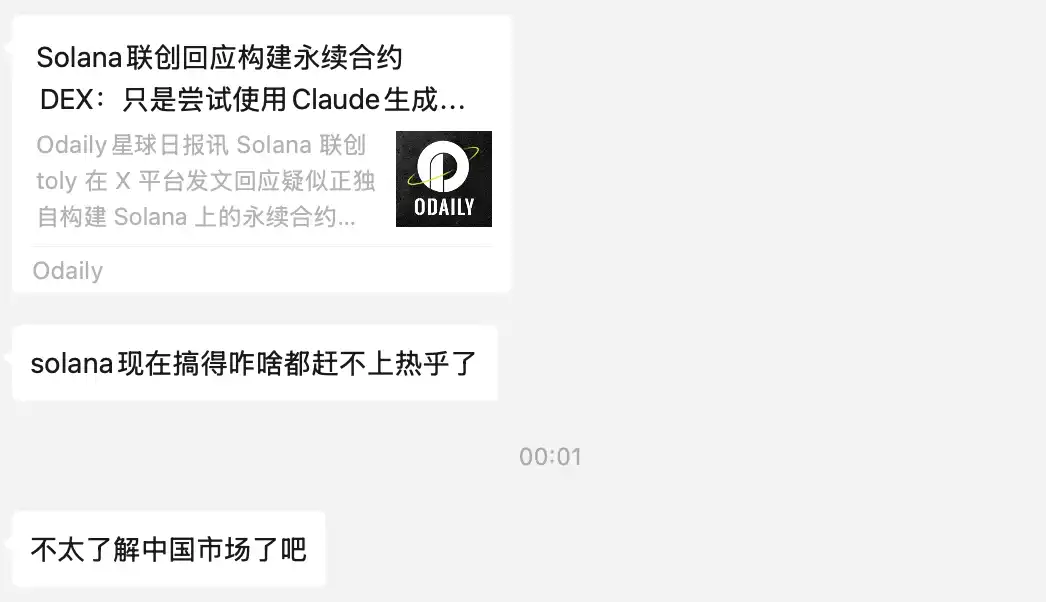
(Group Chat Screenshot)
Recently, Grayscale released a report titled "Solana: Crypto's Financial Bazaar," analyzing Solana's technological aspects, network ecosystem, token supply, and value data indicators, providing some confidence to the "SOL Sentinel." Odaily Planet Daily summarized the key points of the report as follows:
Solana's Fundamentals: Technology, On-chain Activity, Transaction Volume
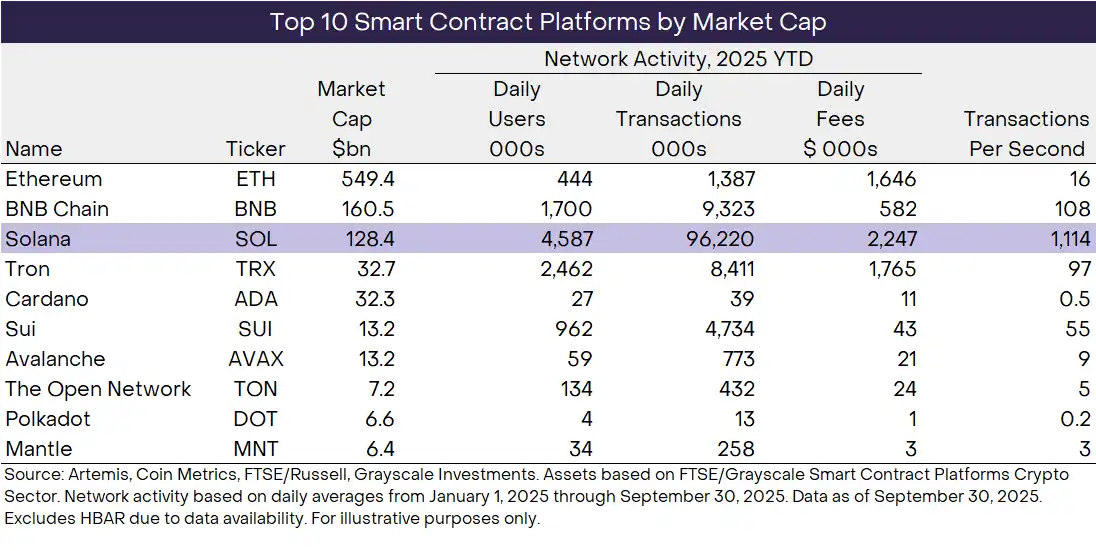
According to the report, compared to other networks such as Ethereum, BNB Chain, Tron, Cardano, and Sui, Solana has a significant advantage in the depth and diversity of on-chain activity. It is leading in terms of users, transaction volume, and transaction fees, with the Solana network having more users and economic activity, which translates to higher network value.
On-chain Data and Transaction Volume
As shown in the chart below, SOL ranks third in market capitalization, but it leads similar blockchains in daily active users, daily transaction volume, daily transaction fees, and transactions per second.
Ecosystem Applications and Network Revenue
Additionally, the Solana network hosts many industry-leading applications, such as:
1. Raydium DEX, also a core component of the Solana DeFi infrastructure. From the beginning of the year to date, the Solana DEX has processed a trading volume exceeding $1.2 trillion, surpassing any other blockchain ecosystem. Furthermore, Solana's leading DEX aggregator, Jupiter, is the cryptocurrency industry's largest aggregator in terms of trading volume;
2. pump.fun, a long-standing token launch platform, with approximately 2 million monthly active users and a daily revenue of around $1.2 million;
3. Helium, a DePIN project focused on mobile hotspots. Helium allows users to contribute to network capacity, thereby building a nationwide mobile hotspot network. These services are often cheaper than centralized alternatives, and Helium currently boasts 1.5 million daily active users, 112,000 hotspots, and has established partnerships with major telecom companies such as AT&T and Telefónica.
The above applications represent only a small fraction of Solana's 500+ applications. Additionally, as a blockchain that almost fully replicates the functionalities of other mainstream networks, Solana ranks third in NFT transactions, fifth in stablecoin transaction volume, and seventh in tokenized assets. Recent use cases that have gained traction include Pokémon card collectibles trading and on-chain issuance of tokenized stocks.
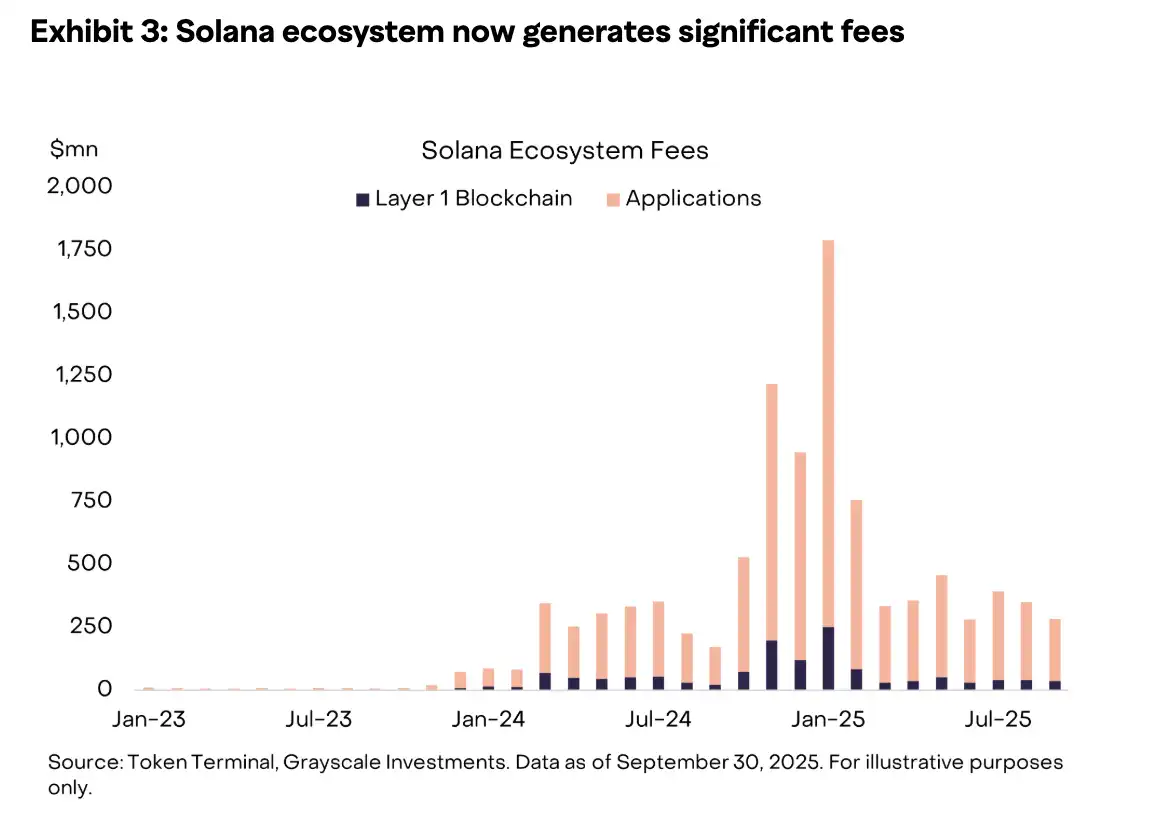
When measuring the Solana ecosystem, one should consider both the blockchain itself and the economic activities of its hosted applications. While these figures may evolve over time, the Solana ecosystem generates approximately $425 million in fees per month, with an annual income exceeding $5 billion. Grayscale believes that fees are the most direct indicator of measuring total demand for a blockchain and its applications, and all these data points indicate significant demand for Solana.
Solana's Advantages: Developer Scale Second Only to Ethereum, and Universally Accessible
Universal Technological Superiority
In addition to fundamental analysis, Grayscale also mentioned that Solana's good performance is due to its fast, low-cost transactions, and seamless user experience. The network generates a new block every 400 milliseconds, and transactions can be finalized in about 12-13 seconds. Apart from high throughput, transaction costs have also remained relatively low:
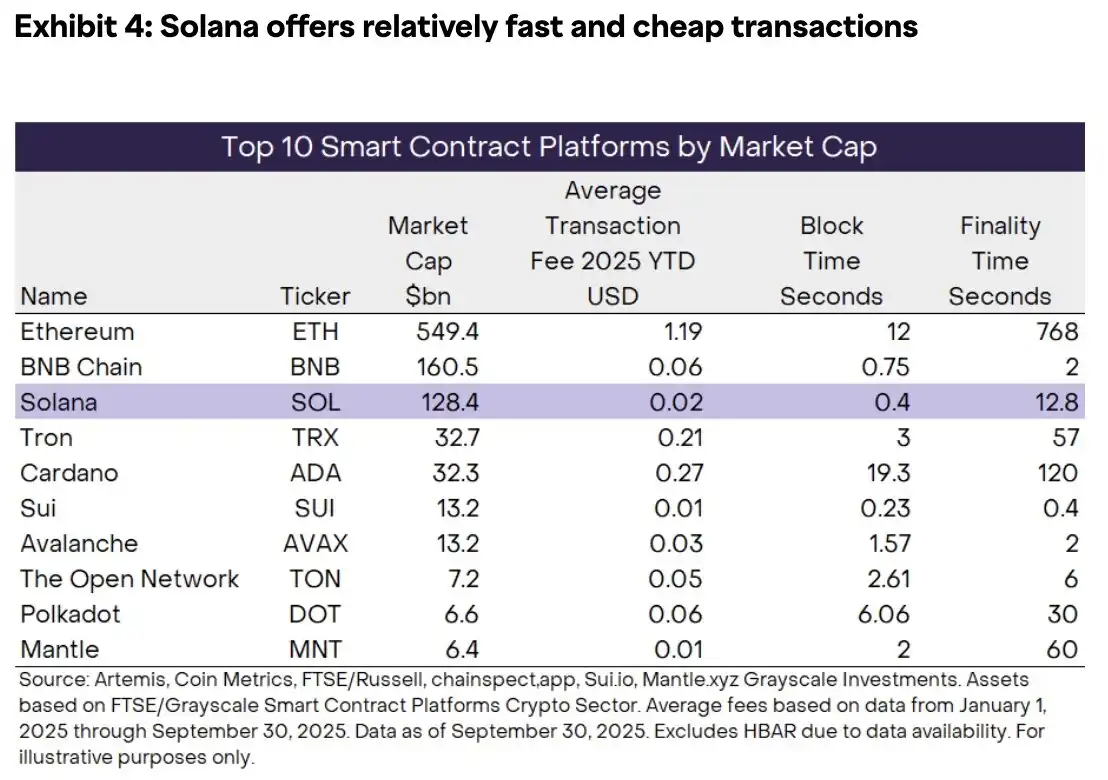
Solana uses a "local fee markets" technology, which restricts fee competition to specific applications. So far this year, the average transaction fee paid by users has been only $0.02, partly due to this feature. The median daily transaction fee this year is only $0.001. Solana's transaction speed and cost efficiency are faster and cheaper compared to similar blockchains. Its upcoming Solana upgrade, Alpenglow, is expected to reduce final confirmation time to 100-150 milliseconds.
Solana's user experience is mainly due to its "monolithic" (single-layer blockchain) design rather than a layered design (which avoids the need to bridge assets between network components), and the wallet infrastructure led by Phantom. In recent years, Solana's network failure rate has also been significantly lower than the industry average, which is also a foundational factor for user adoption.
Furthermore, Solana smart contracts do not rely on the Ethereum Virtual Machine (used by Ethereum and many other smart contract platforms like BNB Chain, Polygon, and Avalanche). Instead, they use Solana's unique Solana Virtual Machine (SVM) architecture. Applications based on the SVM cannot easily move to non-SVM blockchains, leading to stable user retention.
Second Only to Ethereum in Developer Count
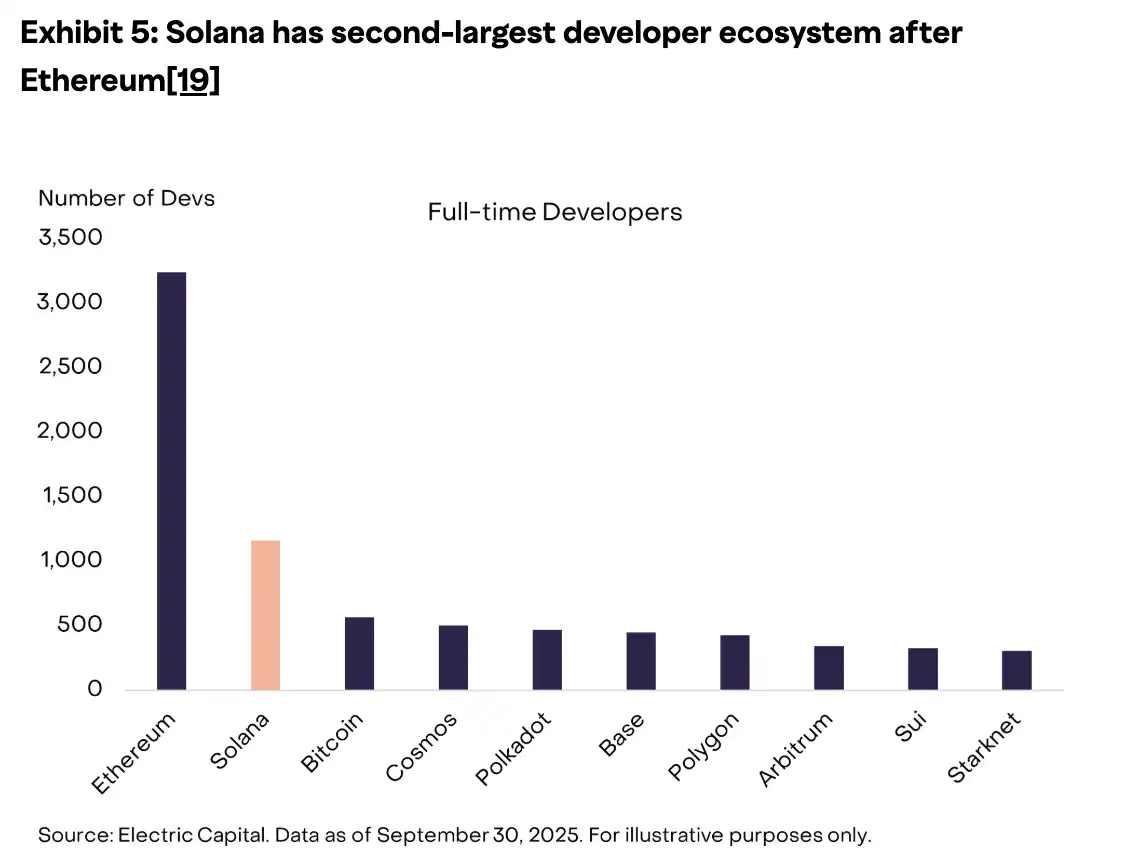
Currently, there are over 1,000 full-time developers working on Solana and SVM applications, and in the past two years, the growth rate of developers focused on Solana has outpaced any other smart contract platform (as shown below), second only to Ethereum. Over time, this human capital can contribute to Solana's sustained innovation.
The Long-Term Storage Value of the SOL Token (Inflation, Token Performance, and Competitor Competition)
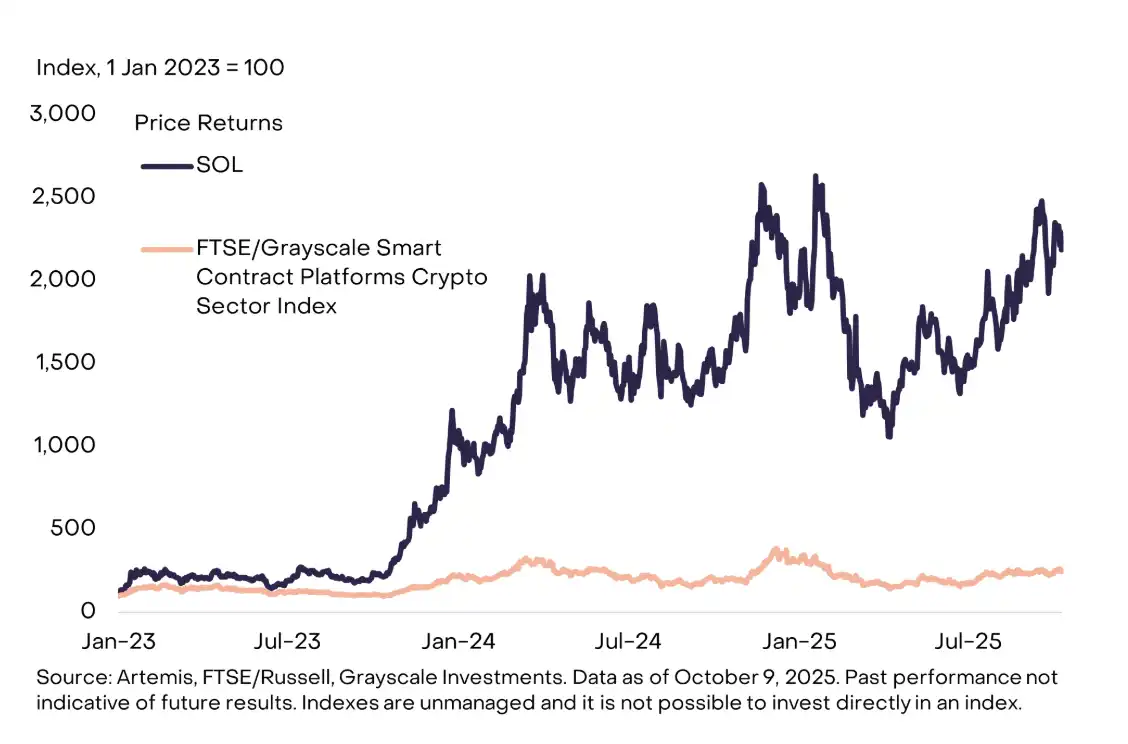
It is well known that due to FTX's collapse, the price of the SOL token plummeted from its peak of nearly $260 in November 2021 to just $2 in December 2022. Following FTX's bankruptcy, many retail investors felt uncertain about Solana's future, despite a significant number of SVM developers still remaining on Solana at the time.
However, starting from the end of 2023, the SOL token began to recover, outperforming notably the FTSE/Grayscale Smart Contract Platform Cryptocurrency Industry Index.
Currently, the SOL token's supply is increasing at a rate of around 4% to 4.5% per year, which, under unchanged conditions, can be seen as a reason for token holder value dilution. According to the network state, SOL stakers can receive around a 7% nominal yield, but the "actual" yield adjusted for inflation is approximately 2.5% to 3%. Currently, about two-thirds of unissued SOL tokens have been staked.

Grayscale states that SOL offers utility on the Solana network and may receive additional corresponding financial returns, but their value is tied to the network's scale, similar to other smart contract platform tokens, the investment thesis of the SOL token revolves around the potential growth of the Solana network. Like other assets, the SOL token price does not always move in line with the network's fundamentals. However, if the Solana network grows over time—acquiring more users, processing more transactions, and earning more fees—investors can expect the SOL price to rise.
Grayscale believes: Solana is envisioned as an "open, fast, low-cost blockchain for everyone". But its specific design leaves room for its competitors to seize or retain market share in certain use cases.
For example, other blockchains sometimes achieve faster and/or cheaper transactions by operating a more centralized network (e.g., using a small number of active network nodes). Even though centralization may bring risks, users may prefer this convenience. Other blockchains may compete with Solana by maintaining permissioning on their network (i.e., only allowing approved users and/or approved activities).
On the other hand, compared to Bitcoin or Ethereum, the SOL token may not be as suitable as a long-term "store of value" currency asset. This to some extent reflects SOL's relatively high nominal supply inflation: scarcity is a key feature of any long-term value store. But a more important factor may be the network's ability to resist third-party interference. For a digital asset to be used as a long-term store of value, users need to have confidence that they will be able to transact under almost all circumstances in the future. One way to support this outcome is to maintain low node requirements to keep the network highly decentralized and easy to replicate. Solana's efficiency comes at the cost of relatively high hardware and bandwidth requirements, so many network nodes operate in data centers. In theory, over time, this could become a source of centralization and a conduit for third-party interference with the network.
Of course, these are complex and unresolved issues, and investors' views on cryptocurrency as a long-term store of value may change over time.
Conclusion
Finally, Grayscale believes that the three most important metrics for measuring on-chain activity are users, transaction volume, and transaction fees, and Solana is currently the leading network in these metrics of on-chain activity. While the Solana network faces many powerful competitors, the depth and diversity of the Solana on-chain economy have laid a solid foundation for SOL's valuation, which is also a necessary condition for its future growth.
A network with strong performance, a large number of users, leading transaction volume and transaction fees, having gone through a phoenix-like rebirth, leading the Meme trend. In addition, Solana also has a large SOL treasury to support it. Aside from the inflation mechanism, SOL seems to have no significant flaws that would impact the token's value, seemingly holding the script of a "cool protagonist," yet it has failed to reach new highs. At the time of the end of this article, the SOL token price has dropped back to $185, and the SOL guards seem to be at a loss.
Vous pourriez aussi aimer
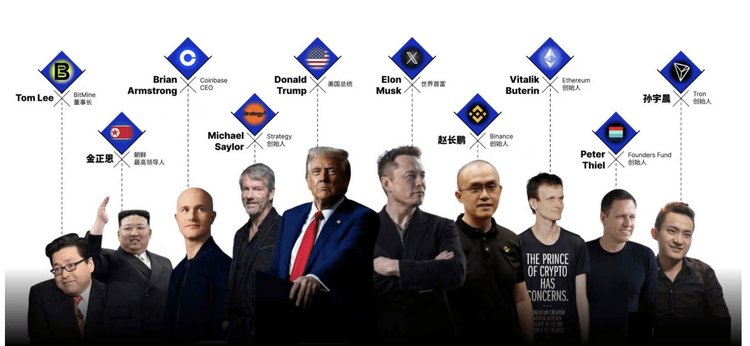
Dix personnes redéfinissent les limites de puissance de la crypto en 2025
De Wall Street à la Maison Blanche, de la Silicon Valley à Shenzhen, un nouveau réseau électrique se dessine.
Trading d'IA sur les marchés crypto : Des bots de trading automatisés aux stratégies algorithmiques
Le trading basé sur l'IA fait passer la crypto de la spéculation au détail à une concurrence de niveau institutionnel, où l'exécution et la gestion des risques comptent plus que dans le sens. À mesure que le trading de l'IA prend de l'ampleur, les risques systémiques et la pression réglementaire augmentent, faisant des performances à long terme, des systèmes robustes et de la conformité les principaux facteurs de différenciation.
Analyse du sentiment de l'IA et volatilité des cryptomonnaies : Ce qui fait bouger les prix crypto
Le sentiment lié à l'IA influence de plus en plus les marchés crypto, les changements d'attente liés à l'IA se traduisant par une certaine volatilité pour les principaux actifs numériques. Les marchés crypto ont tendance à amplifier les discours sur l'IA, permettant aux flux basés sur les sentiments de l'emporter sur les fondamentaux à court terme. Comprendre comment le sentiment IA se forme et se propage aide les investisseurs à mieux anticiper les cycles de risque et les opportunités de positionnement sur les actifs numériques.
novembre 2025 Revue du marché cryptographique: Correction des prix, rachats d’ETF et évolution du paysage de la blockchain
Novembre 2025 a été marqué par une forte volatilité et une correction structurelle au sein de l’écosystème global de la blockchain, principalement sous l’effet des prévisions macroéconomiques fluctuantes et de la dynamique spécifique des flux de capitaux.
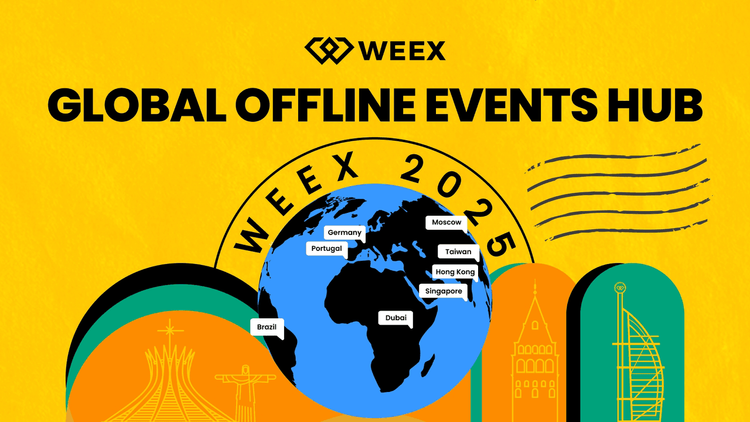
WEEX illumine la scène mondiale avec une série d'événements en personne en 2025
Au cœur de l'empreinte mondiale de WEEX : un élan que rien n'arrête

Les ETFs XRP et Dogecoin se préparent au trading alors que Bitwise cible AVAX
CryptoTale : Aperçu des dernières tendances en crypto Imaginez un monde où les cryptomonnaies comme XRP et Dogecoin…

Les Whales Ciblent la Presale de BullZilla Alors que le Volume de Hyperliquid Explose et Monero Maintient 305 $ : Meilleurs Cryptos à Acheter Maintenant
Économie des Crypto-Monnaies Dans le monde dynamique des crypto-monnaies, les grandes tendances captivent l’attention des investisseurs. Imaginez les…

Prévision de Prix Cardano : ADA Atteindra-t-il 3 $ dans le Prochain Bull Run, Tandis que cet AI Token Promet des Retours de 10 000 % ?
Table des Matières Crypto Daily™ Imaginez un monde où les cryptomonnaies comme Cardano et Bitcoin redessinent l’avenir financier,…

Les ETFs XRP et Dogecoin prêts à être lancés cette semaine dans un nouveau jalon pour les altcoins
Imaginez un monde où investir dans des cryptomonnaies comme XRP et Dogecoin devient aussi simple que d’acheter des…

Ce qui s’est passé en Crypto Aujourd’hui
Publié le 2025-09-16T17:23:20.000Z Voici un aperçu des dernières nouvelles en matière de Bitcoin price, blockchain, DeFi, NFTs, Web3…

Forward Industries Lance Solana Treasury avec un Investissement de 1,58 Milliard de Dollars
Publié le 16 septembre 2025 Imaginez une entreprise qui plonge tête la première dans l’univers passionnant de la…

Le Prix de Avantis Bondit de 576% vers un All-Time High en Seulement Six Jours Depuis le Lancement du AVNT Token
Imaginez un token qui décolle comme une fusée, surpassant les attentes en un clin d’œil. C’est exactement ce…

MetaMask Lance mUSD : Un Game-Changer pour les Stablecoins
Table des Matières CoinCryptoNewz Dans le monde en constante évolution des cryptomonnaies, imaginez un outil qui simplifie les…
Binance annonce l’Avantis Airdrop comme 40ème projet HODLer
Imaginez que vous détenez simplement du BNB et que, sans effort supplémentaire, vous recevez des tokens gratuits d’un…
Prédiction de Prix ZKC : Boundless Vise 1,50 $ Malgré une Chute de 50 %
Prédiction de Prix Boundless (ZKC) : Que Se Passe-t-Il Après une Baisse de 50 % ? Le graphique…
Pump.fun réalise 3,12M$ de revenus quotidiens alors que PUMP Token approche des sommets records
Imaginez un peu : une plateforme comme Pump.fun qui transforme le monde des meme coins en une machine…

Découvrez les Top Crypto to Buy : Tokens en Tendance avec une Forte Croissance
Dans l’univers passionnant des cryptomonnaies, de nouvelles opportunités émergent constamment, et certains tokens se distinguent par leur performance…

Voici pourquoi le prix de Immutable (IMX) pompe aujourd’hui
Table des matières CaptainAltcoin Imaginez que le marché crypto soit comme une montagne russe pleine d’émotions : un…
Dix personnes redéfinissent les limites de puissance de la crypto en 2025
De Wall Street à la Maison Blanche, de la Silicon Valley à Shenzhen, un nouveau réseau électrique se dessine.
Trading d'IA sur les marchés crypto : Des bots de trading automatisés aux stratégies algorithmiques
Le trading basé sur l'IA fait passer la crypto de la spéculation au détail à une concurrence de niveau institutionnel, où l'exécution et la gestion des risques comptent plus que dans le sens. À mesure que le trading de l'IA prend de l'ampleur, les risques systémiques et la pression réglementaire augmentent, faisant des performances à long terme, des systèmes robustes et de la conformité les principaux facteurs de différenciation.
Analyse du sentiment de l'IA et volatilité des cryptomonnaies : Ce qui fait bouger les prix crypto
Le sentiment lié à l'IA influence de plus en plus les marchés crypto, les changements d'attente liés à l'IA se traduisant par une certaine volatilité pour les principaux actifs numériques. Les marchés crypto ont tendance à amplifier les discours sur l'IA, permettant aux flux basés sur les sentiments de l'emporter sur les fondamentaux à court terme. Comprendre comment le sentiment IA se forme et se propage aide les investisseurs à mieux anticiper les cycles de risque et les opportunités de positionnement sur les actifs numériques.
novembre 2025 Revue du marché cryptographique: Correction des prix, rachats d’ETF et évolution du paysage de la blockchain
Novembre 2025 a été marqué par une forte volatilité et une correction structurelle au sein de l’écosystème global de la blockchain, principalement sous l’effet des prévisions macroéconomiques fluctuantes et de la dynamique spécifique des flux de capitaux.
WEEX illumine la scène mondiale avec une série d'événements en personne en 2025
Au cœur de l'empreinte mondiale de WEEX : un élan que rien n'arrête
Les ETFs XRP et Dogecoin se préparent au trading alors que Bitwise cible AVAX
CryptoTale : Aperçu des dernières tendances en crypto Imaginez un monde où les cryptomonnaies comme XRP et Dogecoin…
Pièces populaires
Dernières actus crypto


Assistance client:@weikecs
Collaborations commerciales:@weikecs
Trading quantitatif/Market makers:[email protected]
Programme VIP:[email protected]
 App
App