
- Acheter crypto
- Marchés
- Futures
- Spot
- Copy trading
 WE-Launch
Unveiling the U.S. Tariffs 'Invisible Hand' Peter Navarro: From Obscure Professor to White House Policy Driver

Original Title: "Peter Navarro, the Driving Force behind Trump's Extreme Tariff Policy, a 'Heterodox' Economist"
Original Source: DeepTech TechFlow
The global financial market is currently being hit by a sudden and severe cold spell.
Following Trump's announcement of an extreme policy imposing "reciprocal tariffs" on almost all trading partners, global capital markets reached a peak of panic:
On April 7, as of 10:00 PM Eastern Time, S&P 500 index futures fell by 5.98%, Nasdaq 100 index futures fell by 6.2%, and Dow Jones index futures fell by 5.5%.
The Asian markets were filled with risk aversion sentiment, with the Nikkei index plummeting by 8.9% in early trading. The Taiwan Weighted Index experienced a nearly 10% freefall after a two-day holiday, triggering circuit breakers on major stocks such as TSMC and Foxconn.
The crypto market was not spared either.
Investors watched helplessly as their assets shrank, with red lines on crypto trading screens acting as alarms, heralding an even larger upheaval.
According to CoinGlass data, cryptocurrency liquidation volume has surged to around $8.92 billion, including over $3 billion in Bitcoin long and short positions.
BTC has dropped to around $77,000, while ETH has plummeted to $1,500.
The trumpet of a trade war has sounded once again, and standing at the forefront is Trump's top trade adviser, Peter Navarro.
On April 6, Navarro appeared on Fox News for an interview.
He attempted to calm investor sentiment and resorted to a somewhat laughable language artistry during the interview:
"The first principle, especially for small investors, is --- unless you sell your stocks now, you will not lose money. The wise strategy is not to panic and hold on."
Realized losses are not losses, and not selling is equivalent to not losing.
It is hard to imagine that this almost spirit-of-victory-inspired ineffective comfort stems from a senior presidential trade adviser and university economics professor.
This statement clearly failed to quell the market's anxiety, instead directing attention towards him — this individual who is sarcastically referred to by the outside world as a "heterodox economist," a Harvard Ph.D., who seems to be not just a policy spokesperson but an undeniable driving force behind extreme trade protectionism.
Even Musk, who was on good terms with President Trump, publicly criticized and ridiculed this presidential advisor on social media a few days ago, bluntly stating that "earning a Ph.D. in Economics from Harvard is not a good thing and may lead to decision-making mistakes due to excessive self-confidence"; and questioning whether Navarro has ever personally created any substantial results.
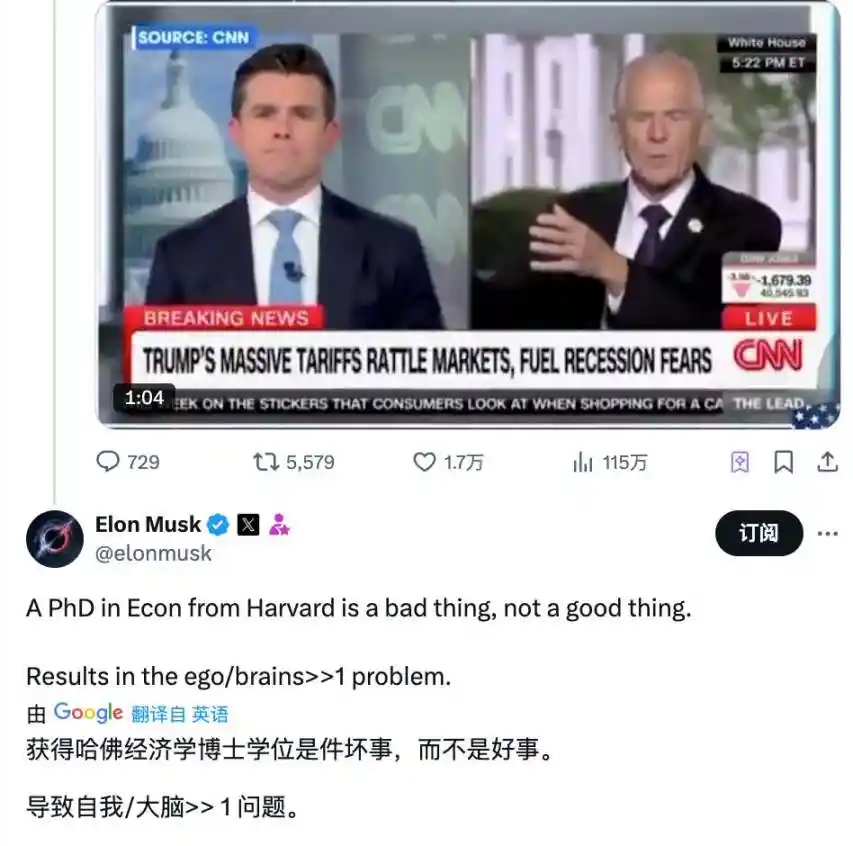
Who is this economist standing behind Trump? How has he driven this global tariff policy storm?
From the edge of academia to the decision-making core of the White House, Navarro's life intersects with Trump's protectionist ideology, perhaps jointly brewing this crisis.
From Academic to Political Outsider
Peter Navarro's story began on July 15, 1959, in a typical family in Cambridge, Massachusetts.
His father, Albert "Al" Navarro, was a saxophone and clarinet player, and his mother, Evelyn Littell John, was a secretary on Sax Fifth Avenue.
However, this family time was short-lived and tumultuous, as his parents divorced when he was 9 or 10, leaving Navarro and his mother to move between Palm Beach, Florida, and Bethesda, Maryland.
The experience of growing up in a single-parent household may have planted in him a desire for stability and self-reliance, which eventually blossomed when he completed his studies at Bethesda-Chevy Chase High School in Maryland.
In 1972, with an academic scholarship, Navarro entered Tufts University and earned a Bachelor's degree. That same year, he joined the Peace Corps and served in Thailand for three years. This experience exposed him to the complexity of the international community for the first time, possibly laying the groundwork for his later focus on global trade imbalances.
In 1979, he obtained a Master's in Public Administration from Harvard University, and then in 1986, under the guidance of the economics guru Richard E. Caves, he earned his Ph.D. Having obtained his degree, he chose to remain in academia and has been a professor of economics and public policy at the University of California, Irvine since 1989, eventually becoming a distinguished professor.
However, Navarro was not content to be just an academic. He ran for office five times, trying to put his ideas into practice.
In 1992, he ran for Mayor of San Diego, leading in the primary with 38.2% of the vote but narrowly losing in the runoff with 48%;
Subsequently, he ran for City Council, Board of Supervisors, and Congress, all ending in failure—receiving 41.9% of the vote in the 1996 Congressional election and only 7.85% in the 2001 special City Council election. These failures did not make him retreat but instead highlighted his perseverance and outsider qualities.
Throughout his campaign, he repeatedly emphasized economic protectionism and job priority, echoing what would later become Trump's "America First" policy, yet he failed to win the voters' favor at that time.
From a teenager from a single-parent family to a Harvard Ph.D. in economics, and then to a perennially unsuccessful political figure on the edge, Navarro's trajectory is full of contradictions.
He appears to be a meticulous scholar, yet he is also a radical activist; he has left a mark in academia while facing repeated setbacks in politics.
In the twists and turns between academia and politics, it seems that the seeds of trade protectionism and a tough stance on China were already planted.
The China Threat Theory Has Long Been Evident
From the moment Peter Navarro received his Ph.D. in economics from Harvard University, it was clear that he would not be content with the tranquility of the ivory tower.
His subsequent trajectory shows that this new Ph.D. has had a keen interest in the global economic landscape.
In 1989, when he joined the University of California, Irvine, Navarro began to transform his academic enthusiasm into sharp criticisms. His target was squarely aimed at an increasingly rising power—China.
What truly made him stand out was a series of works promoting the China threat theory.
In 2006, he published "The Coming China Wars," issuing almost prophetic warnings that China's economic expansion was not just commercial competition but a threat to the survival of American manufacturing.
The book revealed a kind of almost prejudiced stubbornness, such as "China's development is a threat to humanity, which will bring more conflict and destabilizing factors to the world."
At that time, many Amazon online reader reviews suspected the book of intentional sensationalism and alarmism.
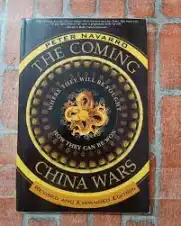
While this book did not resonate widely in the mainstream economic community, it stirred up ripples within certain conservative circles.
Five years later, in 2011, "Death by China" took Navarro's criticism to a climax. This book was not just an academic analysis but more like an indictment.
His radical accusations pointed to China systematically destroying the economic foundation of the United States through illegal export subsidies, production subsidies, currency manipulation, and intellectual property theft...
However, Navarro's views were not without controversy.
Mainstream economists, such as Simon Johnson of MIT, publicly criticized his analysis as "too one-sided, overlooking the complexity of the global supply chain"; and Navarro's strong language in the book, contrasting sharply with the generally perceived genteel academic image, also earned him the label of "eccentric" in the economics community.
However, Navarro, with over a decade of academic accumulation, constructed a set of trade confrontation theories aimed at China. The U.S. must reverse the trade deficit by forceful means to protect domestic industries. This theory also laid the groundwork for his future entry into Trump's decision-making circle.
His pen had long been pointing towards China, and fate would open a bigger door for him in 2016.
Gaining Trump's Son-in-law's Favor, Entering the Inner Circle
His book, "Death by China," did not cause a stir in the mainstream economic community but unexpectedly knocked on the door of the Trump campaign team.
Reportedly, in 2016, during Trump's campaign before his first term, his son-in-law, Jared Kushner, accidentally discovered it on Amazon, attracted by its sharp criticism of China's trade practices, and promptly recommended the book to Donald Trump.
Trump greatly appreciated the read and said, "This guy understands my thoughts."
Navarro later recalled that his role from the beginning was to "provide analytical support for Trump's trade intuition." With Trump's background as a businessman well-versed in trade, the two might have coincided at a fundamental logic level, and thus, fate was ignited.
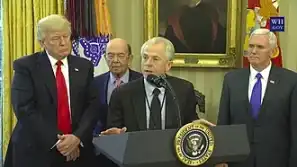
On January 20, 2017, the same day Trump was sworn in, Navarro officially entered the White House as the Director of the newly established National Trade Council.
His first task was unsurprising: against China. He promptly pushed for a 43% tariff on Chinese goods and spearheaded the policy of imposing a 25% additional tax on steel and aluminum imports.
When the U.S.-China trade war broke out in 2018, Navarro was ubiquitous. He declared at a White House briefing, "China must pay the price for its unfair trade."
That year, he also assisted in drafting Trump's tariffs on global steel and aluminum imports, leading directly to trade disputes with the EU and Canada. Navarro's toughness not only catered to Trump's "America First" agenda but also solidified his position in the White House.
However, Navarro's days in the inner circle were not without challenges.
In 2020, he published a report alleging election fraud and participated in the January 6, 2021, "Green Bay Sweep" plan, ultimately leading to a 4-month prison sentence in 2023 for contempt of Congress. Nevertheless, Trump's trust in him did not waver, even referring to him as a "loyal warrior" while in jail.
On January 20, 2025, Trump returned to the White House, with Navarro also returning as Senior Trade and Manufacturing Advisor. This time, his goals were more radical.
In February, he co-led tariff economic discussions with Canada, China, and Mexico alongside Stephen Miller, which drove the trade policy memorandum signed by Trump on his first day.
Navarro's spearheaded "Reciprocal Tariffs" plan — based on calculating additional tax rates based on trade deficits, such as 46% for Vietnam, 20% for the EU — became the cornerstone of the new policy. He defended this approach in an interview with CNBC: "These are not negotiation chips but essential items in a national emergency."
This stance is in line with his academic advocacy over a decade ago.
From a book in 2016 to the trade war strategist in 2025, Navarro's connection with Trump is no coincidence.
His protectionist ideology aligns with Trump's disdain for trade deficits; his tough personality perfectly matches Trump's policy style.
Despite controversies, and even a brief prison stint, Navarro has always been a key figure in Trump's trade war strategy. Transitioning from the academic fringe to the center of power, he relied not only on luck but also on his steadfast commitment to trade confrontation.
Opportunities multiply as they are seized
The culmination of Trump and Navarro's intersection is about to face its most severe test in the global market of 2025.
Returning to Navarro's initial statement, "You don't lose money if you don't sell stocks," does this unconventional economist truly understand the workings of the economy?
Navarro may be well-versed in tariff data but seems to have not grasped the essence of military strategy.
Sun Tzu's The Art of War states: "Opportunities multiply as they are seized; the city must be attacked only when victory is assured." The pinnacle is to subdue the enemy without fighting.
Our ancestors' wisdom emphasized winning through strategy and diplomacy, not direct conflict.
However, Navarro and Trump's tariff declaration of war is precisely the opposite — choosing direct confrontation, incurring a high economic cost in exchange for so-called "fairness."
This head-on approach not only failed to weaken the opponent but also put American businesses and consumers at the forefront. Economists estimate that 60% of tariffs on China will raise import prices, ultimately paid by the American people.
Reality is far from theoretical discussions.
Plunging the global economy into chaos. His role as the driving force is undisputed, but whether the cost of this war is worthwhile remains an unknown.
Vous pourriez aussi aimer
WEEXPERIENCE Nuit des baleines : Trading IA, communauté crypto et marché crypto
Le 12 décembre 2025, WEEX a organisé WEEXPERIENCE Whales Night, un rassemblement communautaire hors ligne conçu pour rassembler les membres de la communauté crypto locale. L'événement a combiné le partage de contenu, des jeux interactifs et des présentations de projets pour créer une expérience hors ligne détendue et attrayante.
Risque de trading d'IA en cryptomonnaie : Pourquoi de meilleures stratégies de trading crypto peuvent-elles générer des pertes plus importantes ?
Le risque ne réside plus principalement dans une mauvaise prise de décision ou des erreurs émotionnelles. Il vit de plus en plus dans la structure du marché, les parcours d'exécution et le comportement collectif. Comprendre ce changement est plus important que de trouver la prochaine stratégie « meilleure ».
Les agents de l'IA remplacent-ils la recherche crypto ? Comment l'IA autonome remodele le trading crypto
L'IA passe de l'assistance aux traders à l'automatisation de l'ensemble du processus de recherche à l'exécution sur les marchés crypto. L'avantage est passé de l'information humaine aux pipelines de données, à la vitesse et aux systèmes d'IA prêts à être exécutés, ce qui fait des retards dans l'intégration de l'IA un désavantage concurrentiel.

Boots de trading et copy trading IA : Comment les stratégies synchronisées remodèlent la volatilité du marché crypto
Les traders crypto de détail sont confrontés depuis longtemps aux mêmes défis : mauvaise gestion des risques, entrées tardives, décisions émotionnelles et exécution incohérente. Les outils de trading IA promettaient une solution. Aujourd'hui, les systèmes de copy trading et les bots de cassage alimentés par l'IA aident les traders à dimensionner leurs positions, à définir des stops et à agir plus rapidement que jamais. Au-delà de la vitesse et de la précision, ces outils remodèlent tranquillement les marchés : les traders ne tradent pas seulement plus malin, ils évoluent de façon synchronisée, créant une nouvelle dynamique qui amplifie à la fois les risques et les opportunités.
Le trading d'IA en crypto expliqué : Comment le trading autonome remodele les marchés crypto et les plateformes d’échange crypto
L’IA Trading transforme rapidement le paysage crypto. Les stratégies traditionnelles peinent à suivre la volatilité constante de la crypto et la structure complexe du marché, tandis que l'IA peut traiter des données massives, générer des stratégies adaptatives, gérer les risques et exécuter des trades de manière autonome. Cet article guide les utilisateurs de WEEX sur ce qu'est le trading d'IA, pourquoi la crypto accélère son adoption, comment le secteur évolue vers des agents autonomes et pourquoi WEEX construit l'écosystème de trading d'IA de nouvelle génération.
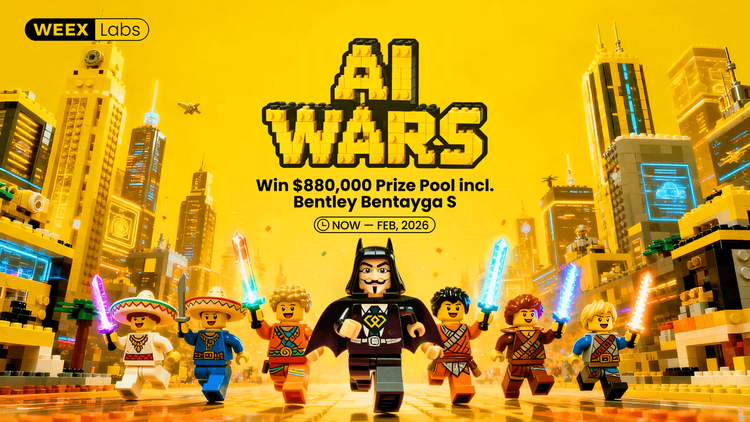
Appelez à rejoindre AI Wars : WEEX Alpha Awakens – Tournoi mondial de trading d’IA avec une cagnotte de 880 000 $
Maintenant, nous lançons un appel aux traders d'IA du monde entier pour qu'ils rejoignent AI Wars : WEEX Alpha Awakens, un tournoi mondial de trading d'IA doté d'une cagnotte de 880 000 $.
Trading d'IA sur les marchés crypto : Des bots de trading automatisés aux stratégies algorithmiques
Le trading basé sur l'IA fait passer la crypto de la spéculation au détail à une concurrence de niveau institutionnel, où l'exécution et la gestion des risques comptent plus que dans le sens. À mesure que le trading de l'IA prend de l'ampleur, les risques systémiques et la pression réglementaire augmentent, faisant des performances à long terme, des systèmes robustes et de la conformité les principaux facteurs de différenciation.
Analyse du sentiment de l'IA et volatilité des cryptomonnaies : Ce qui fait bouger les prix crypto
Le sentiment lié à l'IA influence de plus en plus les marchés crypto, les changements d'attente liés à l'IA se traduisant par une certaine volatilité pour les principaux actifs numériques. Les marchés crypto ont tendance à amplifier les discours sur l'IA, permettant aux flux basés sur les sentiments de l'emporter sur les fondamentaux à court terme. Comprendre comment le sentiment IA se forme et se propage aide les investisseurs à mieux anticiper les cycles de risque et les opportunités de positionnement sur les actifs numériques.
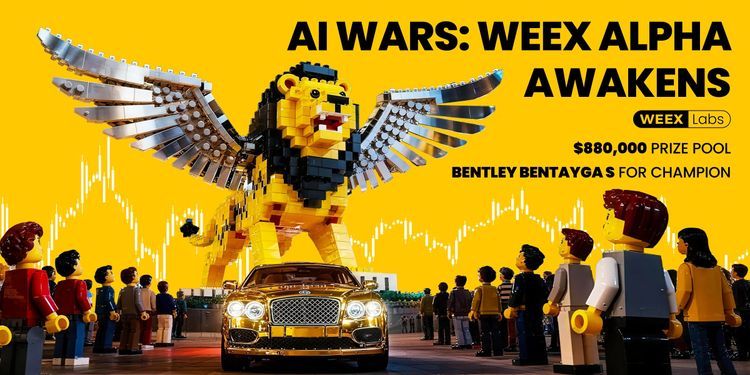
Guerres de l'IA : Guide du participant
Dans cette confrontation ultime, les meilleurs développeurs, quants et traders du monde entier déploieront leurs algorithmes dans des batailles sur le marché réel, en compétition pour l'un des prix les plus importants de l'histoire du trading crypto basé sur l'IA : 880 000 dollars américains, dont une Bentley Bentayga S pour le champion. Ce guide vous accompagnera à travers toutes les étapes nécessaires, de l'inscription au début officiel de la compétition.

Semaine des banques centrales et volatilité des marchés crypto : Comment les décisions relatives aux taux d'intérêt influencent les conditions de trading sur WEEX
Les décisions relatives aux taux d'intérêt prises par les grandes banques centrales, comme la Réserve fédérale, sont des événements macroéconomiques importants qui ont un impact sur les marchés financiers mondiaux et influencent directement les attentes de liquidité des marchés et l'appétence au risque. À mesure que le marché des cryptomonnaies continue de se développer et que sa structure de trading et ses participants mûrissent, le marché des cryptomonnaies est progressivement intégré dans le système d'établissement des prix macroéconomiques.
Test de l'API WEEX : Guide officiel des API de trading de Hackathon et de Crypto pour le trading d’IA
WEEX API Testing est conçu pour garantir que chaque participant peut transformer la logique de trading en exécution réelle. Toutes les interactions API ont lieu sur le système de trading en direct de WEEX, ce qui permet aux participants de travailler dans des conditions de marché authentiques plutôt que dans des simulations. Avec une faible exigence d'entrée, la tâche est accessible à la fois aux développeurs expérimentés et aux débutants motivés, tout en validant les compétences techniques essentielles.
Pourquoi WEEX Alpha se réveille-t-il le meilleur tournoi de trading d'IA de 2025 ? Tout ce que vous devez savoir
Pour accélérer les percées à l'intersection de l'IA et de la crypto, WEEX lance le premier Hackathon mondial de trading d'IA – AI Wars: Alpha se réveille. L'événement propose une cagnotte révolutionnaire dépassant 880 000 $, dont une Bentley Bentayga S pour le champion ultime.
AI Wars: WEEX Alpha Awakens | Guide des processus de test de l'API WEEX Global Hackathon
AI Wars : L'inscription au Réveil Alpha WEEX est maintenant ouverte. Ce guide explique comment accéder au test API et terminer le processus avec succès.
Qu'est-ce que le réveil de WEEX Alpha et comment participer ? Un guide complet
Pour accélérer les percées à l'intersection de l'IA et de la crypto, WEEX lance le premier Hackathon mondial de trading d'IA – AI Wars: Alpha se réveille.
Join AI Wars: WEEK Alpha se réveille !Appel mondial pour les Alphas de Trading IA
AI Wars: WEEX Alpha Awakens est un hackathon mondial de trading sur l'IA à Dubaï, appelant les équipes quantiques, les traders algorithmiques et les développeurs d'IA à lancer leurs stratégies de trading crypto sur les marchés en direct pour une part d'une cagnotte de 880 000 $ US.
WEEX dévoile le trade to Earn: Jusqu'à 30 % de remise instantanée + 2 M$ WXT Rachat
WEEX est heureuse d’annoncer le lancement de son programme Trade to Earn, qui vous accorde automatiquement jusqu’à 30% de rabais sur les frais de trading. Toutes les récompenses sont créditées directement sur votre compte au comptant en WXT $, soutenu par notre plan de rachat de WXT $2,000,000 qui alimente la valeur à long terme des jetons.

Nouveau: Prix de liquidation estimé sur les graphiques App Candlestick
WEEX a introduit un nouveau prix estimatif de liquidation (Est. Liq. Price) figure sur le graphique en chandelier pour aider les traders à mieux gérer le risque et à identifier des fourchettes sûres pour leurs positions.
WEEX AI Hackathon Guide: Trouvez votre UID WEEK et inscrivez-vous
D'ici février 2026, WEEX lance AI Wars: WEEK Alpha Awakens, le premier hackathon mondial de trading de crypto-IA. Venez votre UID et inscrivez-vous au WEEX Global AI Trading Hackathon.
WEEXPERIENCE Nuit des baleines : Trading IA, communauté crypto et marché crypto
Le 12 décembre 2025, WEEX a organisé WEEXPERIENCE Whales Night, un rassemblement communautaire hors ligne conçu pour rassembler les membres de la communauté crypto locale. L'événement a combiné le partage de contenu, des jeux interactifs et des présentations de projets pour créer une expérience hors ligne détendue et attrayante.
Risque de trading d'IA en cryptomonnaie : Pourquoi de meilleures stratégies de trading crypto peuvent-elles générer des pertes plus importantes ?
Le risque ne réside plus principalement dans une mauvaise prise de décision ou des erreurs émotionnelles. Il vit de plus en plus dans la structure du marché, les parcours d'exécution et le comportement collectif. Comprendre ce changement est plus important que de trouver la prochaine stratégie « meilleure ».
Les agents de l'IA remplacent-ils la recherche crypto ? Comment l'IA autonome remodele le trading crypto
L'IA passe de l'assistance aux traders à l'automatisation de l'ensemble du processus de recherche à l'exécution sur les marchés crypto. L'avantage est passé de l'information humaine aux pipelines de données, à la vitesse et aux systèmes d'IA prêts à être exécutés, ce qui fait des retards dans l'intégration de l'IA un désavantage concurrentiel.
Boots de trading et copy trading IA : Comment les stratégies synchronisées remodèlent la volatilité du marché crypto
Les traders crypto de détail sont confrontés depuis longtemps aux mêmes défis : mauvaise gestion des risques, entrées tardives, décisions émotionnelles et exécution incohérente. Les outils de trading IA promettaient une solution. Aujourd'hui, les systèmes de copy trading et les bots de cassage alimentés par l'IA aident les traders à dimensionner leurs positions, à définir des stops et à agir plus rapidement que jamais. Au-delà de la vitesse et de la précision, ces outils remodèlent tranquillement les marchés : les traders ne tradent pas seulement plus malin, ils évoluent de façon synchronisée, créant une nouvelle dynamique qui amplifie à la fois les risques et les opportunités.
Le trading d'IA en crypto expliqué : Comment le trading autonome remodele les marchés crypto et les plateformes d’échange crypto
L’IA Trading transforme rapidement le paysage crypto. Les stratégies traditionnelles peinent à suivre la volatilité constante de la crypto et la structure complexe du marché, tandis que l'IA peut traiter des données massives, générer des stratégies adaptatives, gérer les risques et exécuter des trades de manière autonome. Cet article guide les utilisateurs de WEEX sur ce qu'est le trading d'IA, pourquoi la crypto accélère son adoption, comment le secteur évolue vers des agents autonomes et pourquoi WEEX construit l'écosystème de trading d'IA de nouvelle génération.
Appelez à rejoindre AI Wars : WEEX Alpha Awakens – Tournoi mondial de trading d’IA avec une cagnotte de 880 000 $
Maintenant, nous lançons un appel aux traders d'IA du monde entier pour qu'ils rejoignent AI Wars : WEEX Alpha Awakens, un tournoi mondial de trading d'IA doté d'une cagnotte de 880 000 $.
Pièces populaires
Dernières actus crypto


Assistance client:@weikecs
Collaborations commerciales:@weikecs
Trading quantitatif/Market makers:[email protected]
Programme VIP:[email protected]
 App
App