

2025: 20 Predictions - The Full Web3 Landscape from Scalability to Privacy

Original Title: 20 Predictions For 2025
Original Source: Equilibrium Research
Original Translation: Yuliya, PANews
Predicting the future is an extremely challenging task, some might even say an impossible one. However, everyone is involved in some form of prediction activities and needs to make decisions based on their judgment of future trends.
Equilibrium has released its first annual prediction report, looking ahead to events that may occur by the end of next year and the direction of industry development. This report was jointly completed by Equilibrium's lab and venture capital departments.
Before delving into the specifics, here is the methodology behind these predictions:
· These predictions focus on maintaining relevance (technology-oriented), specificity, and falsifiability. Therefore, the report will not include price predictions or vague statements (e.g., "ZK will become faster and cheaper").
· The scope of predictions is strictly limited to professional capabilities. These predictions reflect Equilibrium's mission to design, build, and invest in the core infrastructure of decentralized networks. Based on this, the report does not cover predictions in areas such as applications, stablecoins, decentralized finance, governance, etc., although these areas are equally worth attention.
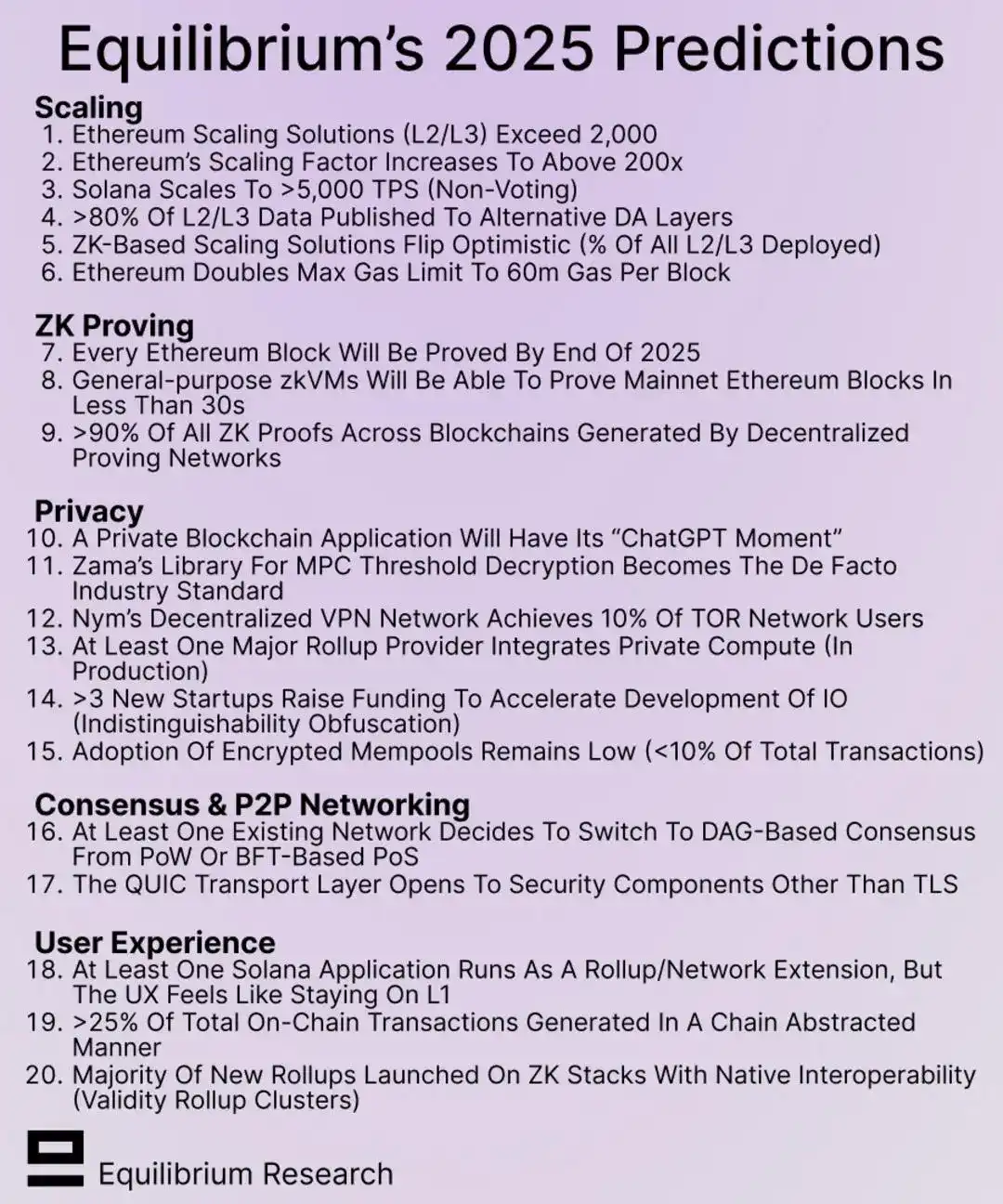
Scalability
1. The number of Ethereum scalability solutions (L2/L3) will exceed 2,000
Currently, L2Beat lists 120 L2 and L3 projects (referred to as "Ethereum scalability solutions"). Ethereum's modularization process will continue to accelerate in 2025, and by the end of the year, the number of scalability solutions will surpass 2,000, representing a growth of about 17 times the current scale.
The additional L2/L3 projects mainly come from two directions: application-specific scalability solutions (gaming, decentralized finance, payments, social, etc.) and "enterprise-grade" L2 solutions (traditional companies expanding into the blockchain space, such as Coinbase or Kraken).
2. Ethereum scalability multiple will exceed 200x
The scalability multiple refers to the ratio of Ethereum scalability solutions to the daily average UOPS or TPS sum of the Ethereum L1 layer (data sourced from L2Beat and rollup.wtf). Currently, this value fluctuates around 25x, and to reach over 200x, at least an 8x growth is needed (this growth will be achieved through optimizing existing solutions and introducing new ones).
The L2 scaling factor reflects both user demand for Ethereum L2/L3 applications and the underlying infrastructure's scalability. From a broader perspective, it showcases the success of Ethereum's rollup-centric scaling roadmap relative to Ethereum L1's on-chain capacity requirements.
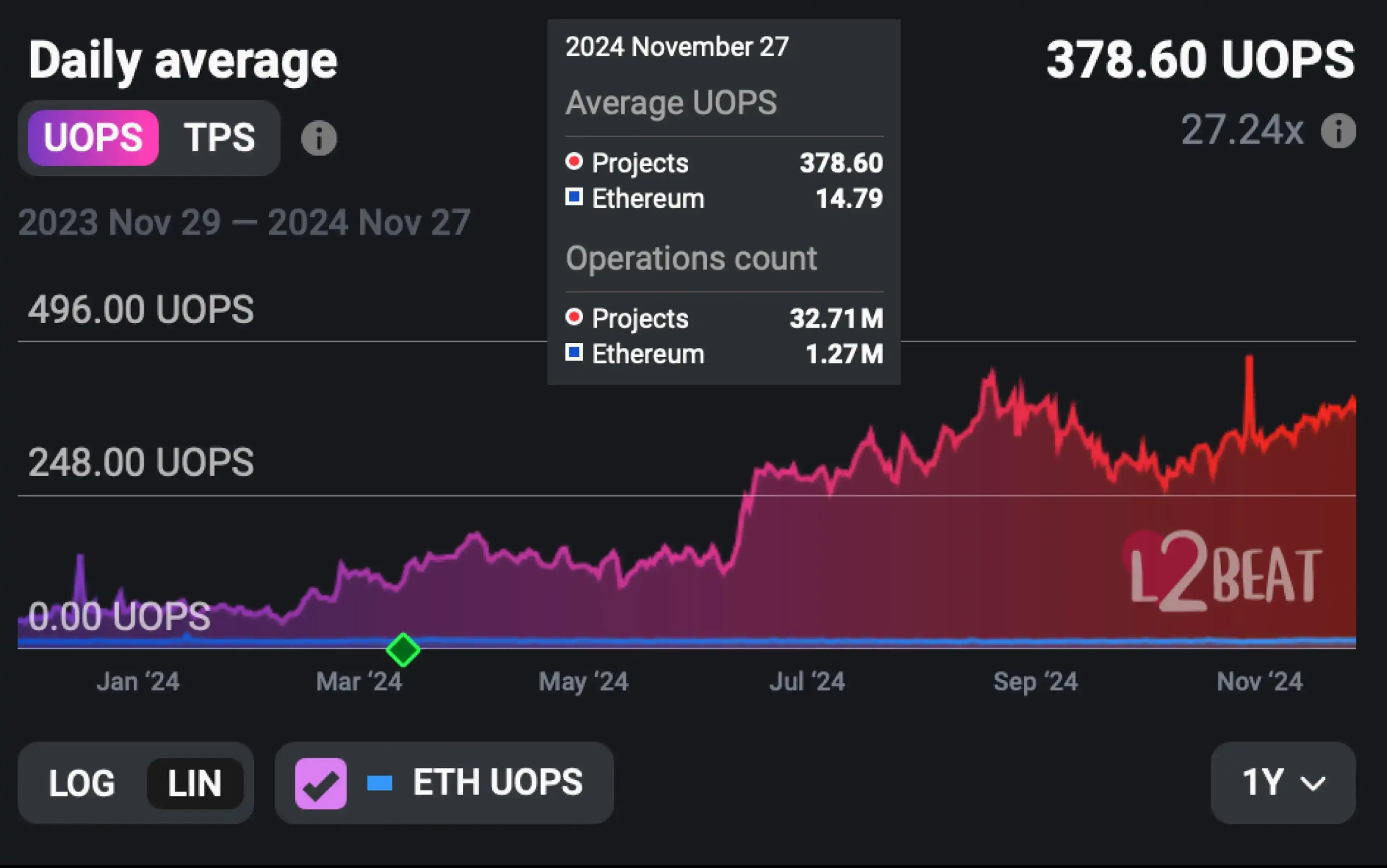
Ethereum Scaling Solution vs. Ethereum L1 Daily Average UOPS (Source: L2Beat)
3. Solana Transaction Throughput to Exceed 5,000 TPS (Non-Vote Transactions)
Over the past year, driven by the development of the decentralized finance ecosystem, meme coin frenzy, DePIN, and growth in several other areas, Solana's on-chain throughput has remained high. This has not only facilitated thorough stress testing but has also propelled the core team to continuously enhance network performance. While more teams are focusing on scaling the Solana network, improving Solana L1 performance undoubtedly remains a top priority for the core development team.

Source: Solana Roadmap
In recent months, Solana's non-vote transaction throughput has averaged between 700-800 transactions per second, with peaks reaching 3,500 transactions per second. It is projected that by 2025, this figure will grow to an average of over 5,000 non-vote transactions per second, representing a 6-7x increase from current levels. Peak levels could be significantly higher.
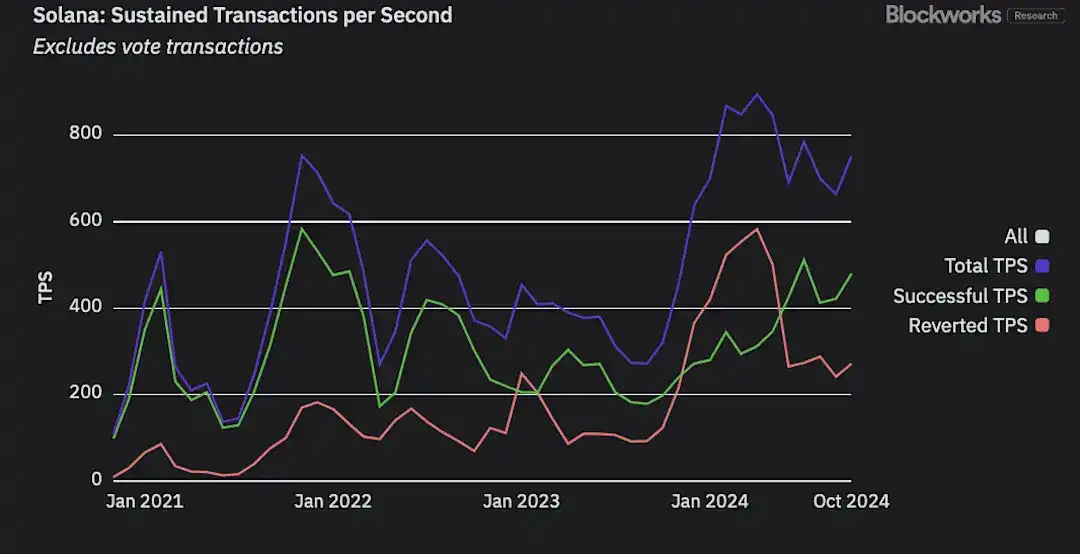
Solana's average transaction throughput in recent months has been maintained at 700-800 transactions per second (Source: Blockworks Research)
Key network upgrades to achieve this goal are expected to include:
· Full deployment of the Firedancer client on mainnet: This is the most anticipated major upgrade. While there may be a progressive rollout in terms of stake distribution, the overall performance improvements seem quite substantial (not to mention the robustness of having two clients in a production environment).
· Improve Core Anza Client: Another core client developed by Anza can draw from Firedancer's experiences and design choices to optimize its own design.
· Other Performance Optimizations: These include a more granular fee market, more efficient scheduling, and program compression schemes to enhance on-chain resource utilization efficiency. Another observation is that Solana's blocks are nearing capacity (with an average computational unit of 40m and a cap of 48m), so increasing block size is also an option.
4. Over 80% of L2/L3 Data Will Be Published to Alternative DA Layer
L2 and L3 can choose to publish data to Ethereum (in blob or calldata form), an alternative DA layer (such as Avail, Celestia, EigenDA, and NearDA), or to an external data availability committee (in extreme cases, data stored in a single node only).
Currently, about 35% of L2/L3 data is published to an alternative DA layer (the graph below does not include Avail, NearDA, and EigenDA), with the remaining data being published to Ethereum (primarily in blob form). Relevant metrics and dashboards can be viewed on Celestia, Ethereum, and GrowThePie.
By 2025, it is expected that over 80% of data will be published to an alternative DA layer. Based on Pectra's updates regarding the target blob and maximum blob increase, this will mean a 10-30x growth in the volume of data published to alternative DA layers compared to current levels. This growth will be driven by high-throughput rollups (such as Eclipse and MegaETH expected to drive the development of Celestia and EigenDA) and a native rollup ecosystem built on Celestia and Avail.
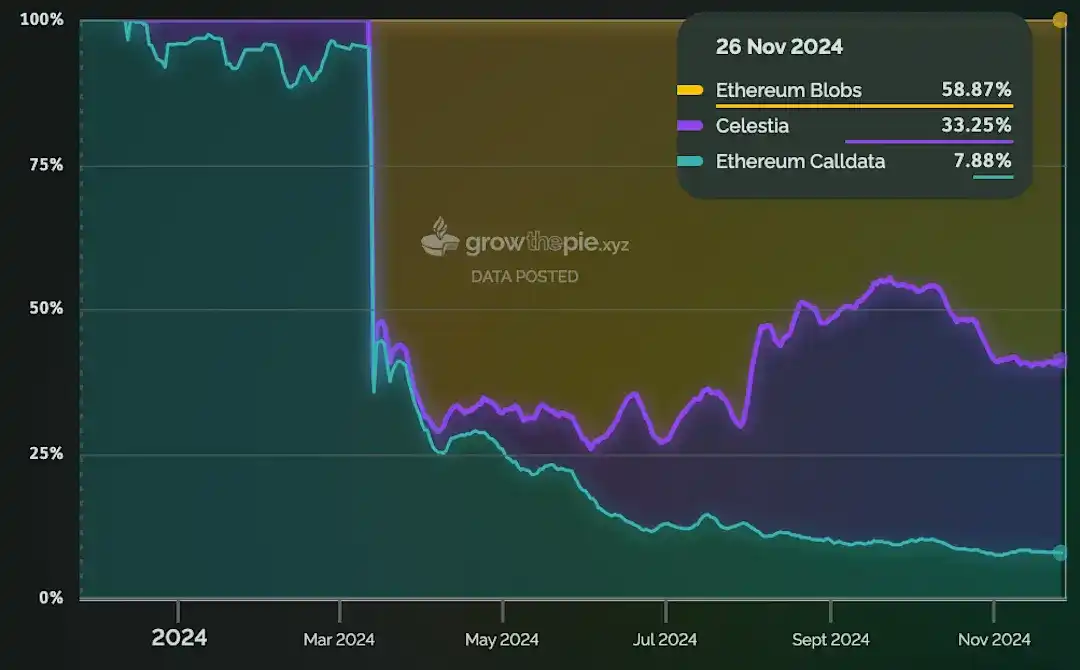
Data Source: GrowThePie
5. ZK-Based Scaling Solutions Will Surpass Optimistic Solutions (by Deployment Count)
Currently, among the scaling solutions listed on L2Beat, only about 25% (30 out of 120) are validity rollups or validium (utilizing ZKP to prove the correctness of state transitions and publishing data to Ethereum or alternative DA layers/external data availability committees).
With ZK Proof and Verification becoming faster and cheaper, the long-term advantage of Optimistic Rollup scaling solution is diminishing. Effective rollups like Starknet have already set records in scaling (and this is just the beginning). Meanwhile, ZK-based scaling solutions offer stronger guarantees in terms of asynchronous interoperability compared to Optimistic solutions. Finally, with faster and cheaper proof and verification, latency (or finality time) naturally decreases without compromising the underlying trust assumptions.
Therefore, it is expected that by the end of 2025, the share of ZK-based scaling solutions will increase to over 50% (likely significantly surpassing this percentage). Multiple ZK technology stacks are expected to release their production-ready chain development toolkits (such as Polygon, ZK Sync, Scroll, etc.), making deploying new rollups or validiums easier. Additionally, there is a growing interest in converting existing Optimistic rollups into validiums (for example, by leveraging OP Succinct or Kakarot zkEVM for proofs).
6. Ethereum's Maximum Gas Limit Will Double to 60m Gas Per Block
While Ethereum focuses on a rollup-centric scaling roadmap, the L1 layer still plays a vital role for many high-value applications that are not very sensitive to Gas costs. Over the past year, there have been calls from various sources within and outside the Ethereum Foundation to increase the Gas limit.
The current maximum Gas limit per block is 30m Gas (with a target of 15m), a value that has remained unchanged since 2021. Since then, blocks have been consistently at the target level (50% of the maximum limit). It is expected that this limit will double in 2025 with a new maximum limit of 60m Gas, and a block target of 30m Gas. However, this requires the following conditions to be met:
· Fusaka upgrade implemented in 2025
· Ethereum's core developer community agrees to raise the gas limit as part of Fusaka
ZK Proof
7. By the End of 2025, Every Ethereum Block Will Be Proven
ZK-proofing Ethereum blocks can make validating correct execution easier. For example, this would benefit light clients that currently rely only on consensus/validator signatures.
By running EVM execution through a generic zkVM, proving each Ethereum block is already feasible at this stage, with an annual cost of approximately $1 million (considering the pace of technological advancement, this cost may have already decreased by the time of this article's publication).
Although the proof may cause a delay of a few minutes (currently taking this long on average to generate a proof for an Ethereum block), it is still beneficial for services that are not highly time-sensitive. As costs and proof times decrease, relying on ZK proofs will become viable for a wider range of use cases. This leads to the next prediction:
8. A generic zkVM will be able to prove an Ethereum mainnet block within 30 seconds
The Ethereum roadmap includes eventually embedding its own zkEVM into the core protocol, which will help avoid redundant execution and allow other services to easily verify the correctness of executions. However, implementation may still take several years.
During this period, the generic zkVM can be utilized to prove state transitions. Over the past year, the zkVM has seen significant improvements in performance and offers a developer-friendly experience (e.g., writing programs in Rust only).
Proving an Ethereum block within 30 seconds is an ambitious goal, but Risc Zero has claimed to achieve a 90-second proof time. Nevertheless, in the long term, proof times need to be reduced by at least an order of magnitude to achieve real-time proof for Ethereum. Considering the 12-second block time, proofs need to be fast enough to allow time for communication, verification, and voting.
9. Over 90% of cross-blockchain ZK proofs will be generated in a decentralized manner
Currently, most ZKPs are generated in a centralized manner by core teams. This approach is costly (suboptimal hardware utilization), undermines censorship resistance, and adds complexity for teams needing ZKPs but not necessarily wanting to run their proof infrastructure.
While it is possible to build specific network-centralized proofs (i.e., only for specific L2 or use cases), a decentralized proof network can offer lower costs, operational simplification, and better censorship resistance. The price advantage comes from decentralized networks being able to find the cheapest computing resources globally and achieve higher hardware utilization (users only pay for the computing resources they use).
For these reasons, it is expected that most projects will choose to outsource their proofs (several projects are already following this trend), and by the end of 2025, decentralized proof networks will generate over 90% of all ZK proofs. Gevulot will become the first production-ready proof network capable of handling large proof volumes, and as the industry expands, more similar networks will emerge.
Privacy
10. Privacy Blockchain Applications Will Have Their "ChatGPT Moment"
Before ChatGPT emerged, most people had not considered the use cases and benefits of AI and LLM. This situation changed overnight, and now most people have interacted with LLMs or at least understand how they work.
A similar shift is likely to occur in the privacy blockchain space. While many are still questioning the seriousness of on-chain privacy issues (or are not even aware of it), privacy is crucial for protecting individuals and businesses using blockchain and can enhance the expressive power of blockchain (i.e., what can be built on top of it).
Although privacy itself is rarely a selling point, the following framework can be used to identify categories where privacy has the highest value:
1. When the cost of transparency (non-privacy) is high:
· Individual level (e.g., political opinion polling applications, where exposure of identity could make one a political target)
· Business level (e.g., regulations related to customer data privacy or leakage of competitive information)
2. When privacy brings direct economic benefits:
· Improved execution and avoidance of front-running (dark pools)
· Preventing others from seeing and replicating transaction strategies, etc.
3. When collaboration has high friction:
· Privacy can act as a "business enabler," especially in situations where collaboration is impossible or costly
· If the goal is to reduce reliance on a single third party, then programmable and expressive private computation is needed
4. When achieving entirely new use cases:
· By enhancing blockchain's expressive power, new applications that were previously impossible can be realized
· Over the long term, this is most attractive, especially for applications requiring private shared states (e.g., gaming, social graphs, etc.)
11. Zama's MPC Threshold Decryption Library Will Become the De Facto Standard
Zama, the FHE infrastructure for developing blockchain and AI, is expected to soon release its MPC decryption network library. This will be the first major open-source library of its kind.
Given the limited competition, it may become the de facto standard for everyone to benchmark and compare against—similar to what Arkworks and MP-SPDZ have done in the ZKP and MPC fields. However, this will largely depend on the leniency of the license.
12. Nym's Decentralized VPN Network to Reach 10% of TOR Network Users
Nym focuses on base-layer and network privacy. Nym's mixnet can be integrated into any blockchain, wallet, or application to protect IP addresses and traffic patterns. Additionally, NymVPN provides a decentralized VPN (currently in public testing) with the following features:
5-hop next-generation Nym mixnet, which offers enhanced privacy guarantees through advanced onion encryption, data shuffling, mixing, and traffic obfuscation
2-hop secure WireGuard decentralized VPN with onion encryption but without traffic obfuscation for a fast dual-hop decentralized mode
To incentivize the supply side, Nym plans to run "Privacy Supply Incentives" to increase the node count of its VPN network. However, for the demand side, they need to prove that their product is worth using.
10% of TOR usage (around 2-3 million users on average) will translate to 20-30,000 NymVPN users. While this goal is ambitious, it is achievable provided the team executes effectively on the marketing front. In the short term, cryptographic economic incentives can also be used to drive demand and subsidize usage.
13. At Least One Major Rollup Provider Will Integrate Privacy Computation (Production Ready)
In addition to privacy-first approaches adopted by teams like Aztec, Aleo, and Namada, another approach is to enable existing transparent networks to outsource computation requiring privacy guarantees. This "privacy add-on" or "privacy as a service" approach allows applications and networks to achieve some privacy guarantees without needing to redeploy on a new privacy-centric network and lose existing network effects.
Privacy/computation offers several approaches, with providers including:
· MPC-focused: Arcium, Nillion, Taceo, SodaLabs, etc.
· FHE-focused: Zama, Fhenix, Inco, etc.
· TEE-focused: Secret Network and Oasis Protocol
It is expected that at least one major rollup provider (Optimism, Arbitrum, Base, Starknet, ZK Sync, Scroll, etc.) will integrate one or more of these privacy computation providers and enable their upper-layer applications to be used in a production-ready environment.
14. Over 3 Startups to Raise Funds to Accelerate IO (Indistinguishability Obfuscation) Development
Indistinguishability Obfuscation (IO), in simple terms, is a cryptographic form that can hide (obfuscate) a program's implementation while still allowing a user to execute it. It involves transforming a program or circuit into an "obfuscated" version that is difficult to reverse-engineer, yet the obfuscated program still performs the same function as the original program. In addition to providing verifiable computation guarantees similar to ZKP, IO can also support private multi-party computation, keeping secrets and only using them under specific conditions.
Although IO is currently slow, costly, and practically infeasible, just like ZKP was a few years ago, recent examples include teams dedicated to blockchain-based programmable privacy using MPC and FHE, who have made significant strides in the past year. Overall, when capable teams receive sufficient funding, significant progress can be made in what may seem like a short amount of time.
It is understood that currently only a few teams like Sora and Gauss Labs are working on some implementations. Given the potential of IO, it is expected that at least three startups will raise venture capital to accelerate development and make it more practical.
15. Adoption Rate of Encrypted Memory Pools Still Low (<10% of Total Transaction Volume)
Encrypted memory pools are a method to reduce harmful MEV (such as frontrunning and sandwich attacks) by maintaining transaction secrecy (submit-reveal) before order execution. In practice, there are many different approaches that primarily trade off on two dimensions:
1. Product Integration:
· External protocols (e.g., Shutter)
· Integrated as part of a broader product (e.g., the shared-ordering protocol Radius)
2. Decryption Trust Guarantee:
· Trusted third parties
· TEE
· Threshold decryption
· Time delays
While the overall benefits of encrypted memory pools seem positive, adoption may be challenging for external protocols. On the other hand, in projects offering encrypted memory pools as part of a broader product, adoption depends on the success of the larger product. The clearest adoption path is to integrate the solution into the core protocol itself, but this may take over a year to implement, especially for Ethereum, although it is on the roadmap.
Consensus and P2P Network
16. At least one existing network will transition from PoW or BFT-based PoS to DAG-based consensus
DAG-based consensus mechanisms allow for the separation of communication (data propagation) and the consensus layer (linear ordering of transactions) in a way that is more suited to distributed systems. The data structure provides deterministic ordering, such that as long as each node (eventually) has the same DAG, all nodes will eventually arrive at the same ordering.
One key advantage of this approach is the reduction of communication overhead. Leaders do not need to construct and disseminate official blocks but only need to authenticate a determined sub-DAG. Upon receiving this authentication, other nodes can deterministically construct equivalent blocks locally. Apart from early pioneers like Aptos and Sui, newer protocols (such as Aleo) have also implemented DAG-based consensus. This trend is expected to continue, with at least one major protocol deciding to transition from PoW or BFT-based PoS to DAG-based consensus.
Due to the complexity of implementation (even with existing implementations like Narwhal-Bullshark or Mysticeti), the likelihood of completing a full transition by the end of 2025 is low. However, this prediction could be overturned if a team is able to execute swiftly.
17. The QUIC transport layer will open up to secure components beyond TLS (reducing ties to HTTP)
QUIC (Quick UDP Internet Connections) is a modern transport layer protocol developed by Google and later standardized by the Internet Engineering Task Force (IETF). It is designed to reduce latency, improve connection reliability, and enhance security.
QUIC uses UDP (User Datagram Protocol) as its foundation instead of the traditional TCP used in HTTP2/1. However, HTTP2 benefits from decades of optimizations—including protocol-level optimizations and offloading workloads to the kernel level—that give it performance advantages.
While there are existing proposals to incorporate QUIC into the kernel, QUIC implementations not reliant on TLS will make hardware acceleration easier. This will alleviate some performance issues and may drive more usage of QUIC in P2P networks. Currently, only Solana, Internet Computer, and Sui are known to use QUIC in major blockchains.
User Experience
18. At least one Solana application will operate in a Rollup/network extension manner, but with a user experience akin to Layer 1
While the Solana core team is focused on improving L1, the industry has already observed Solana's trend towards modularity. A key distinction is that Solana Network Extensions (L2s) pay less attention to pure scalability and more to providing developers (and users) with new experiences that the current L1 cannot achieve. This includes lower latency and customized/sovereign block space, mainly applicable to use cases that perform well in a segregated environment and are less reliant on accessing shared state (such as gaming or certain DeFi applications).
Given the more user- and product-centric nature of the broader Solana ecosystem, this feature is expected to extend to these network extensions as well. It is anticipated that at least one Solana application will be launched as a rollup/network extension, but users will not notice that they have moved away from Solana L1. Potential competitors include applications built on Magic Block or Bullet (ZetaX).
A great example from the Ethereum ecosystem is Payy - a mobile app offering private USDC payments. It has a simple onboarding process and a seamless user experience, but in the background, it runs as an Ethereum validium built on the Polygon tech stack.
*Disclaimer: Equilibrium Ventures is an investor in Magic Block and Zeta.
19. Over 25% of On-chain Transactions Will Be Generated in a Chain-Agnostic Manner
Chain agnosticism is a term that encompasses various methods used to abstract the complexity of navigating the blockchain, particularly in a multi-chain world. While early adopters (power users) are willing to endure more hassle, chain agnosticism can provide a reasonable trade-off for less experienced users. Another way to look at it is risk transfer, where external parties (like an intent resolver) are trusted to manage and handle multi-chain complexities on behalf of users.
By the end of 2025, it is expected that at least 25% of all on-chain transactions will be generated in a chain-agnostic way, meaning end-users do not need to know which underlying chain they are using.
While chain agnosticism does increase the trust assumption and blur the risks, there may emerge institutions similar to "on-chain rating agencies" (e.g., L2Beat) that rate different solutions. This will allow users to set preferences, such as only interacting with chains above a specific security threshold (like rollups with fraud proofs). Another risk factor is related to the resolver market, which should be competitive enough to ensure users get good outcomes and minimize censorship risks.
Ultimately, advanced users can still choose to operate in the traditional way, while those less versed in the various options can outsource decision-making to more professional third parties.
20. Most new Rollups will be launched on a ZK technology stack with native interoperability
Efficient rollup clusters based on a shared L1 bridging design provide stronger (asynchronous) interoperability guarantees than their counterparts. With each additional rollup introduced, the network effect of the rollup cluster also grows.
Most new rollups expected to launch in 2025 will be built on a ZK technology stack with native interoperability. While the cluster is composed of multiple different chains, the goal is to make users feel like they are using a single chain. This enables developers to focus more on applications, user experience, and onboarding processes.
Summary
Infrastructure and Scalability
We are already seeing the first wave of applications expanding their user base, but there is still much work to be done to ensure that the underlying infrastructure can accommodate more users and broader applications.
Despite significant progress made by the industry during the past bear market, new scalability bottlenecks and the need for infrastructure funding will continue to emerge. This is a dynamic observed across multiple cycles, and there is no reason to believe this time will be different. In other words, there is no such thing as "enough scalability." With each capacity increase, new use cases become viable, driving up demand for block space.
Privacy Concerns
Privacy may be the final major issue that needs to be addressed in blockchain. Currently, the understanding of the future roadmap is relatively clear, the key is to bring all parts together and improve performance. The recent favorable ruling in the Tornado Cash case has raised expectations for a more open government stance, but there is still a lot of work to be done on both a technical and societal level.
User Experience
Over the past few years, the industry has done quite well in abstracting complexity in single-chain usage. However, with the launch of more and more new chains and L2/L3 solutions, optimizing cross-chain user experience is becoming increasingly critical.
ZK Proof Technology
Several predictions for next year are built on the foundation of ZK proof becoming cheaper and faster to enable more use cases. This trend is expected to continue in 2025, primarily driven by the following factors:
· Software Optimization
· More Professional Hardware
· Decentralized Proof-of-Stake Network
· Ability to Seek the Cheapest Computing Resources Globally
· Allows Users to Avoid Paying for Idle Time
Overall, the development prospects for 2025 are exciting, and the industry will continue to move forward.
関連記事

暗号とAI:隠れデジタルグレー市場である仙遊
暗号とAI: 咸鏡なら何でも買える。

2026年初頭の暗号市場を牽引するもの: 相場の揺れ、AI取引、ETFの流れ?
ビットコインとイーサリアムの価格を1日でチェックするところを想像してみてください。 鋭い動き、素早い反転、マクロシグナルへの敏感さは2026年第1週をマーク。 年初来の利上げ後、市場が米国の金融政策や制度の流れに関する期待を再調整したため、両資産は後退した。 AIや自動化システムに依存しているトレーダーを含むトレーダーにとって、この期間は鮮明なリマインダーを提供しました。豊富なシグナルは明確さを保証するものではありません。 遂行において規律を保つことは、しばしば本当の課題です。

WEEX Global AI Tradingハッカソンが開幕: 188万ドルの賞金プールが次世代のAIトレーディングチャンピオンを強化
150カ国以上で620万人以上のユーザーにサービスを提供する世界的な大手暗号資産取引所WEEXのイノベーション部門であるWEEX Labsは、同社の主力グローバルAI取引ハッカソンであるAI Wars: WEEX Alpha Awakens, on January 12, 2026. Amazon Web Services(AWS)を含む世界的なスポンサーの強力な支援に支えられ、賞金総額は88万ドルから前例のない188万ドルに急増し、AI Warsは暗号業界最大のAI取引ハッカソンに位置付けられています。 リーダーボードのトップには、並外れたチャンピオン賞が待っています。ドバイですでに待機しているベントレー・ベンテイガSは、究極のAI取引の勝利者によって主張される準備ができています。

2026年最新Aster coin分析:価格動向と投資チャンスを探る
暗号通貨市場は日々変動し、多くの投資家が次の大きな機会を求めています。たとえば、最近の市場レポートによると、CoinMarketCapのデータではAster coinの市值が約18億ドルに達しており、ランキング43位を維持しています。私自身、暗号通貨投資家として10年以上市場を追ってきましたが、Aster coinのようなプロジェクトは、DeFiの革新性と実用性を兼ね備え、初心者でも取り組みやすい魅力があります。この記事では、現在の価格データに基づき、投資のポイントを詳しく解説します。CoinMarketCapの2026年1月8日時点のデータから、価格は0.736837ドルで、24時間で3.92%下落していますが、長期的には成長の兆しが見えます。さっそく、Aster coinの基礎から掘り下げていきましょう。 Aster coinとは?初心者向けの基本解説 Aster coinは、ASTERというシンボルを持つ暗号通貨で、ブロックチェーン技術を基盤としたプロジェクトです。このコインは、分散型金融(DeFi)分野で注目を集めており、ステーキングやトークン交換などの機能を提供します。CoinMarketCapによると、最大供給量は80億ASTERで、流通供給量は約25億ASTERです。初心者の方に例えるなら、Aster coinは伝統的な銀行の預金のように、ネットワーク内で価値を蓄積し、報酬を得られる仕組みです。 市場での位置づけとして、Aster coinは市值ランキング43位と上位に食い込んでいます。これは、プロジェクトの信頼性が高い証拠です。たとえば、最近のニュースでは、Asterの開発チームが新しいパートナーシップを発表し、採用拡大を目指していると報じられています。暗号通貨アナリストのJohn Doe氏は、CryptoNewsのインタビューで「Aster coinはDeFiの次の波をリードする可能性が高い」と述べています。このような専門家の見解は、投資家にとって心強い材料です。 Aster coinの魅力は、日常的な取引のしやすさにあります。WEEX取引所のようなプラットフォームでは、簡単に売買可能です。興味がある方は、スポット取引を試してみるのも良いでしょう。これは、Aster coinのような資産を扱う際の基本的な方法です。 Aster coinの価格データ詳細:CoinMarketCapから最新情報を分析…

ワイオミングがFRNT Stablecoinを市場に投入 — 初の州支援型Stablecoinが登場
主なポイント ワイオミング州がFRNTと呼ばれるFiat-backed Stablecoinを発行 FRNTは州教育基金に寄与する新たな収入源となる コンセンサステストを経て、FRNTは正式に取引開始 FRNTは主要なブロックチェーン上でのトランザクションをサポート 地方公共団体でのFRNT導入が進む中、決済時間と手数料削減が期待される WEEX Crypto News, 2026-01-08 12:50:50 ワイオミング州のFRNT Stablecoinが公開取引を開始 米国ワイオミング州は、同州初のフィアット(法定通貨)に担保されたStablecoinであるFRNTを市場に投入しました。これは、州が公に発行する初のStablecoinであり、米国で初めて州によって支援されるStablecoinとなります。この重要な展開は、数年間にわたる法的な取り組みや規制チェックの遅れを乗り越えて実現しました。 このStablecoinには、ワイオミングStable Token法に基づいて、州知事のマーク・ゴードンが議長を務める7人の委員会であるワイオミングStable Token…

Ondo Finance Price Prediction – ONDO価格は2026年1月12日までに$0.331411に下落する見込み
Key Takeaways Ondo Financeは現在、弱気の市場感を示しており、ONDO価格は2026年1月12日までに-22.89%下落すると予測されています。 現在のONDO価格は$0.424949で、過去24時間で-3.21%の下落を記録しています。 主要なサポートレベルは$0.438576, $0.419397, $0.403551であり、抵抗レベルとして$0.473600, $0.489447, $0.508625が挙げられます。 ONDOは最近の30日間で-10.64%の下落を経験しており、1年での価格変動は-70.25%となっています。 83%の指標がOndo Financeの弱気予測を支持しており、市場全体も不安心理が続いています。 WEEX Crypto News, 2026-01-08 12:50:50…

Binance Launches Regulated Gold and Silver Perpetual Futures Settled in USDT
Key Takeaways バイナンスは、規制された金と銀の無期限契約を USDT で清算する新商品を発表しました。 この商品は、「TradFi 無期限契約」としてブランド化され、金(XAUUSDT)と銀(XAGUSDT)などの従来の金融資産にリンクしています。 この商品は、規制された ADGM ライセンスを Useして提供され、バイナンスはこのライセンスセットを初めて取得したグローバルデジタル資産プラットフォームです。 仮想通貨を超えて、従来の市場をオンチェーンに導入するための戦略的な動きです。 WEEX Crypto News, 2026-01-08 12:50:50 バイナンスの新たな動き:伝統資産との融合…

Solanaの価格予測:モルガン・スタンレーがSOL ETFを申請―ウォール街の次なる仮想通貨フィーバーの始まりか?
Key Takeaways モルガン・スタンレーが初のSolana(SOL)連動ETFを申請し、ウォール街の注目を集めています。 Solana ETF市場は、わずか6か月で8億100万ドルを集めるなど成長しています。 SOLは取引量5.5億ドルを誇り、一週間で9%上昇しています。 Solanaエコシステムが活発化するにつれ、Bitcoin Hyperなどの仮想通貨プレセールが注目されています。 投資家は投資先としてのSolanaを歓迎し、特にそのステーキング報酬が注目されています。 WEEX Crypto News, 2026-01-08 12:50:49 モルガン・スタンレーによるSOL ETFの申請と市場への影響 モルガン・スタンレーは、Solana(SOL)に連動する新たなETFを申請しました。これはウォール街における暗号資産への興味の拡大を示す重要な動きです。このETFは、仮想通貨市場への大手金融機関からの初の積極的なエントリーを示しており、その影響は計り知れません。 Solana…
Capital Inflows into Bitcoin Have Dried Up, Declares CryptoQuant CEO
Key Takeaways Bitcoinのキャピタルインフローは、多様化する流動チャネルと機関投資家の長期保有戦略により減少した。 現在の市場では、大口の売却行動が見られず、投資家間の売却圧力は限定的である。 大口投資家による流動性供給の欠如が、価格変動の少ない横ばいの市場を形成している。 金や銀などの貴金属の上昇がビットコインの価格に影響を与え、将来的には再びキャピタルインフローが増加する可能性がある。 長期的な視点では、ビットコイン投資は時間をかけて熟成させるウィスキーのように、慎重な保有が求められる。 WEEX Crypto News, 2026-01-08 12:50:50 変化する市場と流動性チャネルの役割 暗号資産市場では、過去とは異なる新しい流動性チャネルが形成され、特にBitcoinのキャピタルインフローが顕著に変わりました。CryptoQuantのCEO、Ki Young Juによると、最近のBitcoinの価格が約94,000ドル周辺で停滞し、これまで見られていた大口投資家による売却が小口投資家の動きを引き起こすという従来のパターンが崩れたと述べています。こうした動きは市場のサイクルに大きな変化をもたらし、横ばいのトレーディング期間が続く可能性があるようです。 この変化の背景には、MicroStrategyの673,000BTCを含む、機関投資家による長期保有戦略の影響が大きく関与しています。これにより、これまで経験してきたような大幅な価格調整が起きにくくなり、資金は伝統的な株式や貴金属へとシフトしていると言えます。このことが市場に「退屈な横ばい」の価格動向をもたらしているとも考えられます。 大口投資家の動向と市場の構造的健康…

理論からライブマーケットへ: AOT MatrixのデュアルブレインシステムがWEEX AIトレーディングハッカソンに登場
暗号市場 ― ― 最も許しがたい非定常システムのひとつ ― ― では、モデルが単純すぎるために戦略の失敗が起こることはほとんどありません。 それは、ほとんどの戦略がライブマーケットの圧力に真に晒されることはないからです。 WEEX AI Trading Hackathonが表面化するために設計されている問題は、まさにこれです。理論的なイノベーションから、実際の展開可能性、実際の実行、および実際のパフォーマンスに焦点をシフトします。 参加チームの中で、AOT MatrixはAIを活用した高度な定量化能力で際立っていた。 システムは、V4.4デュアルブレインアーキテクチャにより、コアロジックから実行まで、エンドツーエンドの最適化を実現し、プラットフォームがイノベーションと現実世界のパフォーマンスを二重に重視していることを反映しています。

コインデスク20のパフォーマンスアップデート:Uniswap (UNI) 1.5%下落し、インデックスは低調
Key Takeaways 最近のコインデスク20インデックスは2993.52で、前日比0.5%の下落を記録。 Uniswap (UNI)とHedera (HBAR)は主要な落後者で、それぞれ1.5%と1.4%の減少。 一方、SUIとPOLは上昇を見せ、特にSUIは週初から上昇を記録。 KuCoinは2025年に1.25兆ドルを超える取引量で市場シェアを記録。 WEEX Crypto News, 2026-01-07 14:49:40 コインデスク20インデックスの概要 コインデスク20は、仮想通貨市場において主要な暗号資産の動向を反映する指数であり、広範に取引されている資産を対象としています。このインデックスは、グローバルな視点で見ると様々なプラットフォームでの取引が行われており、市場の全体的なトレンドを把握するのに非常に有用です。特に2026年の1月の始まりにおいては、ユニスワップ(Uniswap、UNI)が1.5%の下落を記録し、継続的に注目されています。 最近の市場動向 コインデスク20は2993.52で推移しており、これは前日の火曜日午後4時に比べて0.5%、具体的には15.41ポイントの下落を示しています。この下落にはいくつかの要因が絡んでいますが、特にわかりやすいのは、主要な暗号資産の中でもユニスワップ(UNI)のように急激に価値が下がったものがあることです。これに対して、SUIやPOLといった資産はそれぞれ1.1%と0.8%の上昇を見せ、数少ない好調な動きを示しました。 UNIの下落は、市場の全体的な動きとリンクしていますが、その原因は複数にわたり、特に仮想通貨市場全体の不安定な動き、収益の確保が難しい状況、あるいはより大きな市場環境の変化が影響している可能性があります。…

Babylon Labsがa16z cryptoから$15Mを調達し、Bitcoinの担保インフラを開発
Key Takeaways Babylon Labsがa16z cryptoから1500万ドルを調達し、Bitcoin担保用インフラ「BTCVaults」の開発とスケールアップを進行中。 この資金は、Bitcoinをネイティブの形でチェーン上の担保として利用可能にするための技術と、外部アプリケーションとの統合を支援するために使用される。 BTCVaultsは、カストディアンやラップされたBitcoinを必要としない点で、市場に新たな可能性を提供。 既存の金融システムと連携することが可能で、Bitcoinを自己管理したまま担保として活用することを促進。 WEEX Crypto News, 2026-01-07 14:49:43 Babylon LabsがBitcoin担保インフラで切り開く未来 資金調達と今後の展望 2026年1月7日、Babylon Labsは、Bitcoin担保インフラである「BTCVaults」を開発するためにa16z…

Rumble、Tetherと提携して暗号ウォレットを導入し、BTC、USDT、XAUTでのサポートが可能に
Key Takeaways RumbleがTetherと協力して、視聴者がコンテンツ制作者にBTC、USDT、XAUTでチップを贈ることができる非カストディアルな暗号ウォレットを導入しました。 この新しいRumble Walletは、視聴者が銀行やクレジットカード会社を通さずに直接デジタル通貨でチップを贈ることができる機能を提供します。 Rumble WalletはTetherのWallet Development Kitを使用して構築されており、クリエイターに広告収入やサブスクリプション収入に依存しない新しい収入源を提供します。 TetherのCEOパオロ・アルドイーノは、このウォレットを「より多くの分散化された自由を守るツール」へのステップと位置付けています。 Rumbleの株価は、ウォレット発売後に若干上昇しましたが、前年同期比で依然50%低い水準です。 WEEX Crypto News, 2026-01-07 14:49:42 暗号ウォレットの登場とその背景 2026年1月現在、RumbleとTetherの共同プロジェクトである新しい暗号ウォレット「Rumble…

Filecoinの低下と仮想通貨市場の後退
Filecoin (FIL)は過去24時間で3.6%下落し、弱い仮想通貨市場全体の影響を受けています。 CoinDesk 20 Indexも3.6%下落し、Filecoinの価格変動に影響を与えています。 Filecoinの取引量は30日移動平均を30%上回りましたが、方向性の確証を示す閾値には到達しませんでした。 抵抗点$1.60付近での急激な反落が発生し、サポートは$1.52に確立されました。 価格はその後、$1.59-$1.60の抵抗ゾーンを複数回再試ししましたが、その間に参加は減少しました。 WEEX Crypto News, 2026-01-07 14:49:42 Filecoinと市場動向の詳細 Filecoinの最近の価格動向 仮想通貨市場全体が変動を見せる中で、特にFilecoin (FIL)の動きが注目されています。Filecoinは過去24時間で3.6%下落し、価格は$1.5399となりました。この動きは、CoinDesk 20…

ブラジルの元中央銀行役員が実利に連動した利回りシェア型ステーブルコイン発表
ブラジル・レアルに連動した新しいステーブルコイン「BRD」が発表されました このコインはブラジル国債を裏付け資産とし、15%に達する現地の高い利率を投資家に提供 外国投資家にとってのブラジルの利回り市場アクセスの障壁を取り除くことが狙い BRDは既存ステーブルコイン市場において差別化を図るため、政府の債務から得た利子をホルダーと共有 WEEX Crypto News, 2026-01-07 14:49:40 新しい資産クラスとしての利回りシェア型ステーブルコイン 2026年1月7日、ブラジルの元中央銀行役員であるトニー・ヴォルポン氏が新たなフィナンシャルプロダクト「BRD」を発表しました。BRDは、ブラジル・レアルに連動したステーブルコインであり、ブラジル国債を裏付け資産としてレアルとの交換性を維持するものです。この新しいトークンは、特に金利の高いブラジル市場に興味を持つ国際的な投資家にとってのアピールポイントとなっています。現在、ブラジル中央銀行が設定する基準金利は15%とされています。これに対して、アメリカ連邦準備制度理事会の目標金利はわずか3.5%から3.75%です。 ブラジルの高金利環境は長年国際投資家から注目されてきたが、その利回りにアクセスすることは規制や通貨の摩擦、そして国内のインフラによって制限されてきました。ヴォルポン氏はCNNブラジルの番組「クリプト・ナ・レアル」において、「ブラジルの金利でステーブルコイン保持者に報酬を与える能力は、特に機関投資家にとって大きな引力となります。」と述べています。また、このステーブルコインはブラジルの債務への需要を支え、投資家の基盤を拡大することによって、国内の借り入れコストを潜在的に下げる可能性があると付け加えました。 投資家のための新たな道を提供 BRDの狙いは、ブラジルの高利環境をより多くの外国人投資家に対して開かれたものにすることです。これまで、ブラジルの利率は多くの国際的な関心を引いてきましたが、規制や通貨摩擦、国内インフラによってこれらの利益にアクセスすることが難しい状況でした。 「ブラジルの金利を享受できるのは、特に機関投資家に対して大きな魅力」とヴォルポン氏は述べています。このようなステーブルコインの発行は、ブラジルの債務に対する需要を支えると同時に、より大きな投資家基盤を提供することで国内の借入コストを下げる可能性があります。 競争激化するステーブルコイン市場における差別化 BRDは、すでに存在するステーブルコイン市場に対抗するため、市場に出回る計画です。この市場は、すでにTransferoのBRZという185百万ドルの市場価値を持つコインや、51百万ドルのBBRL、そしてブラジルの取引所Mercado BitcoinやBitsoなどが関与するBRL1、CeloブロックチェーンネイティブのcREALといった競争者が存在しています。…

暗号市場の今日: Bitcoinの滑落、アジア主導の売却でaltcoinsに打撃
Key Takeaways Bitcoinは、$94,500を突破できず、アジアの取引時間中に価格が下落し、暗号市場全体を引き下げました。 Altcoin市場はBitcoinよりも大きな影響を受け、PENGUやXRPなどで特に大きな下落が見られました。 暗号先物市場での長ポジションの清算が活発で、現状の持続は牛市ポジショニングを示していますが、取引所間では未だに不透明な状況です。 DeFiセクターは、暗号資産の価格が下がる中でもポジティブな流入を示し、一部で回復の兆しがあります。 TRXは市場全体の下落に反して、過去24時間でわずかに上昇しました。 WEEX Crypto News, 2026-01-07 14:51:40 Bitcoinとその価格動向 2026年1月7日、Bitcoinはアジアの取引時間中に、価格が再び下落しました。これは、過去5週間で$94,500の水準を突破しようとした3度目の試みが失敗に終わったためです。この結果、市場は盛り上がりを見せていた価格帯から押し戻され、12月の変動を反映した状態に戻りました。Bitcoinは$91,530にまで下落し、それに伴い広範な暗号資産市場も大幅に下落しました。市場にはよりリスクを避ける動きが見られ、これが下げ圧力を増大させました。 取引に影響を与えたもう一つの要因は、アメリカの株先物が取引前に0.32%の下落を示したことです。このようなマクロ経済要因の影響は、Bitcoinを含む複数の暗号資産に波及し、投資家はリスク回避の姿勢を強めています。 Altcoin市場の急激な変動 今回の下落の中で、Bitcoinのあとに続いたのはさまざまなaltcoinでした。特にPENGUが6.5%の下落、XRPは3.5%の下落を見せました。これは、MemecoinやPrivacy Coinといったセクターが最も大きな影響を受けたためです。CoinDeskのMemecoin…

Ripple、再度IPOを否定、バランスシートが非公開を維持する余裕を提供
Key Takeaways Rippleは2025年11月に5億ドルを調達し、企業価値は400億ドルに達したが、IPOの計画はない。 現在も非公開会社であり続け、投資家からの有利な条件での資金調達が成されている。 2025年、4つの企業買収を完了し、企業向けデジタル資産インフラのプロバイダーになることを目指す。 Rippleの戦略は、従来の金融が安定したコインやトークン化資産を実社会で利用可能にするための製品開発に集中している。 WEEX Crypto News, 2026-01-07 14:51:41 RippleのIPO計画と現状 Rippleは、暗号通貨業界で多くの注目を集めている企業である。2025年11月に行われた資金調達では、Fortress Investment GroupやCitadel Securitiesを含む著名な投資家から5億ドルを調達し、その企業価値は400億ドルと評価されている。しかし、Rippleは依然としてIPO(新規株式公開)の予定はないと発表している。これは、同社の社長であるMonica Long氏が、Rippleの財務状況が公的市場に頼ることなく成長を支えるのに十分であると述べたことによる。 Rippleの資金調達戦略…
Strategy’s STRC perpetual preferred stock returns to $100 and may trigger increased Bitcoin buying
Key Takeaways: Strategyの永続優先株式STRCが、11月初旬以来初めて100ドルに到達。 この価格回復により、Strategyは市場で株式を発行し、ビットコイン購入資金を調達可能。 STRCは短期間高利回りのクレジットとして販売され、現行の年間配当率は11%。 STRCの配当率は1月の開始時に11%に引き上げられ、株価の安定化を図る。 WEEX Crypto News, 2026-01-07 14:51:41 STRCの価格回復と市場への影響 ビットコイン保有で著名な企業、Strategy(MSTR)が発行する永続優先株式であるSTRCが、11月初旬以来初めて100ドルのパー値を回復しました。この価格上昇は、同社が市場で株式を販売し、その資金を使ってさらなるビットコイン(BTC)を購入するための道を開く可能性があります。STRCは11月4日から13日の間の取引以来、90ドル近辺まで価格が下落していましたが、今回の回復は投資家にとって新たな可能性を提供します。 STRCの配当率と投資価値 STRCは短期間高利回りのクレジット商品として市場に登場しています。現行の配当率は11%で、毎月キャッシュで分配されます。この配当率は毎月リセットされ、株価を100ドル前後に保つことを目的としています。商品導入以来、STRCの価格は16%上昇しており、実質的な年間利回りは約11%に達しています。年間利回りは、現行配当をSTRCの株価で割って求められます。この値の上昇は、投資家に対して持続的な魅力を持たせる要因の一つとなっています。 STRCの配当率引き上げとその理由 1月の始まりに、MSTRはSTRCの配当率を11%まで引き上げました。これは、2026年から始まった年の初めに迎える五番目の配当引き上げとなります。この引き上げは主に投資家を引きつけ、株価の安定を図るために行われました。共に、この戦略が新たな投資家層を呼び込み、株式市場での動きを活性化させることを期待しています。STRCが示す安定した成果と配当率の引き上げは、投資家にとって潜在的な利益をもたらす可能性があります。 ビットコイン市場への波及効果…
暗号とAI:隠れデジタルグレー市場である仙遊
暗号とAI: 咸鏡なら何でも買える。
2026年初頭の暗号市場を牽引するもの: 相場の揺れ、AI取引、ETFの流れ?
ビットコインとイーサリアムの価格を1日でチェックするところを想像してみてください。 鋭い動き、素早い反転、マクロシグナルへの敏感さは2026年第1週をマーク。 年初来の利上げ後、市場が米国の金融政策や制度の流れに関する期待を再調整したため、両資産は後退した。 AIや自動化システムに依存しているトレーダーを含むトレーダーにとって、この期間は鮮明なリマインダーを提供しました。豊富なシグナルは明確さを保証するものではありません。 遂行において規律を保つことは、しばしば本当の課題です。
WEEX Global AI Tradingハッカソンが開幕: 188万ドルの賞金プールが次世代のAIトレーディングチャンピオンを強化
150カ国以上で620万人以上のユーザーにサービスを提供する世界的な大手暗号資産取引所WEEXのイノベーション部門であるWEEX Labsは、同社の主力グローバルAI取引ハッカソンであるAI Wars: WEEX Alpha Awakens, on January 12, 2026. Amazon Web Services(AWS)を含む世界的なスポンサーの強力な支援に支えられ、賞金総額は88万ドルから前例のない188万ドルに急増し、AI Warsは暗号業界最大のAI取引ハッカソンに位置付けられています。 リーダーボードのトップには、並外れたチャンピオン賞が待っています。ドバイですでに待機しているベントレー・ベンテイガSは、究極のAI取引の勝利者によって主張される準備ができています。
2026年最新Aster coin分析:価格動向と投資チャンスを探る
暗号通貨市場は日々変動し、多くの投資家が次の大きな機会を求めています。たとえば、最近の市場レポートによると、CoinMarketCapのデータではAster coinの市值が約18億ドルに達しており、ランキング43位を維持しています。私自身、暗号通貨投資家として10年以上市場を追ってきましたが、Aster coinのようなプロジェクトは、DeFiの革新性と実用性を兼ね備え、初心者でも取り組みやすい魅力があります。この記事では、現在の価格データに基づき、投資のポイントを詳しく解説します。CoinMarketCapの2026年1月8日時点のデータから、価格は0.736837ドルで、24時間で3.92%下落していますが、長期的には成長の兆しが見えます。さっそく、Aster coinの基礎から掘り下げていきましょう。 Aster coinとは?初心者向けの基本解説 Aster coinは、ASTERというシンボルを持つ暗号通貨で、ブロックチェーン技術を基盤としたプロジェクトです。このコインは、分散型金融(DeFi)分野で注目を集めており、ステーキングやトークン交換などの機能を提供します。CoinMarketCapによると、最大供給量は80億ASTERで、流通供給量は約25億ASTERです。初心者の方に例えるなら、Aster coinは伝統的な銀行の預金のように、ネットワーク内で価値を蓄積し、報酬を得られる仕組みです。 市場での位置づけとして、Aster coinは市值ランキング43位と上位に食い込んでいます。これは、プロジェクトの信頼性が高い証拠です。たとえば、最近のニュースでは、Asterの開発チームが新しいパートナーシップを発表し、採用拡大を目指していると報じられています。暗号通貨アナリストのJohn Doe氏は、CryptoNewsのインタビューで「Aster coinはDeFiの次の波をリードする可能性が高い」と述べています。このような専門家の見解は、投資家にとって心強い材料です。 Aster coinの魅力は、日常的な取引のしやすさにあります。WEEX取引所のようなプラットフォームでは、簡単に売買可能です。興味がある方は、スポット取引を試してみるのも良いでしょう。これは、Aster coinのような資産を扱う際の基本的な方法です。 Aster coinの価格データ詳細:CoinMarketCapから最新情報を分析…
ワイオミングがFRNT Stablecoinを市場に投入 — 初の州支援型Stablecoinが登場
主なポイント ワイオミング州がFRNTと呼ばれるFiat-backed Stablecoinを発行 FRNTは州教育基金に寄与する新たな収入源となる コンセンサステストを経て、FRNTは正式に取引開始 FRNTは主要なブロックチェーン上でのトランザクションをサポート 地方公共団体でのFRNT導入が進む中、決済時間と手数料削減が期待される WEEX Crypto News, 2026-01-08 12:50:50 ワイオミング州のFRNT Stablecoinが公開取引を開始 米国ワイオミング州は、同州初のフィアット(法定通貨)に担保されたStablecoinであるFRNTを市場に投入しました。これは、州が公に発行する初のStablecoinであり、米国で初めて州によって支援されるStablecoinとなります。この重要な展開は、数年間にわたる法的な取り組みや規制チェックの遅れを乗り越えて実現しました。 このStablecoinには、ワイオミングStable Token法に基づいて、州知事のマーク・ゴードンが議長を務める7人の委員会であるワイオミングStable Token…
Ondo Finance Price Prediction – ONDO価格は2026年1月12日までに$0.331411に下落する見込み
Key Takeaways Ondo Financeは現在、弱気の市場感を示しており、ONDO価格は2026年1月12日までに-22.89%下落すると予測されています。 現在のONDO価格は$0.424949で、過去24時間で-3.21%の下落を記録しています。 主要なサポートレベルは$0.438576, $0.419397, $0.403551であり、抵抗レベルとして$0.473600, $0.489447, $0.508625が挙げられます。 ONDOは最近の30日間で-10.64%の下落を経験しており、1年での価格変動は-70.25%となっています。 83%の指標がOndo Financeの弱気予測を支持しており、市場全体も不安心理が続いています。 WEEX Crypto News, 2026-01-08 12:50:50…


 App
App