

Is the Discrepancy in CEX Liquidity Data Signaling a Larger Issue?

Original Title: Liquidations, liquidations everywhere!
Original Author: threesigmaxyz Original Translation: zhouzhou, BlockBeats
Editor's Note: This article explores the significant discrepancy between the liquidation data reported by centralized exchanges (CEX) and actual liquidation activities. By comparing Hyperliquid's transparent liquidation data with CEX reported data, it reveals that CEX may underreport liquidation data to mask market volatility or manage public perception. The article also emphasizes the importance of transparency in understanding market risk and systemic risk, and points out that exchanges like Bybit are taking more open approaches to releasing liquidation data, driving the industry towards greater transparency.
Below is the original content (reorganized for easier reading comprehension):
Traders getting liquidated, billions evaporating. But what if the actual liquidation figures were 19 times higher than reported? We dug into the data, and the results are worse than you might think.
1. Liquidation
The world of trading has become increasingly accessible to the average person, whether through the glamorous courses of so-called "gurus" or as an alternative to traditional work, trading offers the temptation of earning a substantial income from the comfort of one's home, through a computer.
However, this is far from easy, and if it were that simple, everyone would succeed. In fact, most people who enter trading end up losing money and eventually blowing up their accounts. So, what causes these losses? Usually, all of this boils down to a pivotal event that every trader fears: liquidation.
Liquidation is a key mechanism in leveraged trading, where a trader's margin is insufficient to cover the losses of an open position, resulting in liquidation. In this scenario, the exchange will intervene, automatically closing the position to ensure that the trader or platform no longer incurs further losses.
Depending on the severity of the margin shortfall and the platform's risk management mechanisms, liquidation can take different forms. These forms can be roughly divided into two types:
· Partial Liquidation: Involves reducing part of the trader's position, while the remaining part remains active. This allows the trader to stay in the market, while reducing the associated risk.
· Full Liquidation: The entire position is liquidated, completely eliminating the trader's exposure risk. Full liquidation is more common in high leverage environments, as in such environments, even slight price movements can completely wipe out a trader's margin.
The Key Factors Behind Liquidation
There are multiple factors contributing to liquidation, all revolving around the delicate balance between risk and margin:
· Leverage: Leverage allows traders to control larger positions with less capital, but this potential for amplified profits comes with higher risk. The higher the leverage, the smaller the price swing needed to trigger liquidation. For example, with 50x leverage, a price movement of just 2% against the position would lead to the complete loss of margin. This underscores the critical importance of risk management in leveraged trading.
· Maintenance Margin: Every exchange sets a minimum margin requirement that traders must maintain to keep a position open, serving as a safety buffer. When losses cause the margin to fall below this threshold, the exchange will liquidate to prevent further losses. Ignoring or failing to monitor these requirements can quickly lead to forced liquidation.
· Market Volatility: Sudden and extreme price swings are a trader's greatest enemy, especially in highly leveraged positions. Volatility can rapidly deplete available margin, leaving traders with little time to react. Moreover, periods of high volatility often trigger a cascade of liquidations, where one liquidation sets off a series of others, further driving prices in the wrong direction.

Squeeze
A squeeze is one of the most intense and rapid triggering factors for liquidation, usually occurring during sharp price movements that force counter-traders in the market to close their positions. These events are typically driven by high leverage and low liquidity, forming a snowball effect that accelerates price swings and exacerbates market volatility.
When prices surge rapidly, traders holding short positions find themselves in trouble as their margin is insufficient to support the trade. To avoid further losses, they are forced to buy back assets to close their positions, adding more upward pressure on the price. This dynamic often quickly evolves into a series of liquidation events, where one trader's closure drives the price up, forcing others to liquidate as well.
Conversely, when prices suddenly plummet, traders with long positions also face the same risk. As their margin shrinks, they are forced to sell off their positions to meet maintenance margin requirements, further intensifying the downward momentum. This selling pressure amplifies the price drop, triggering more liquidation events and forming a downward spiral.
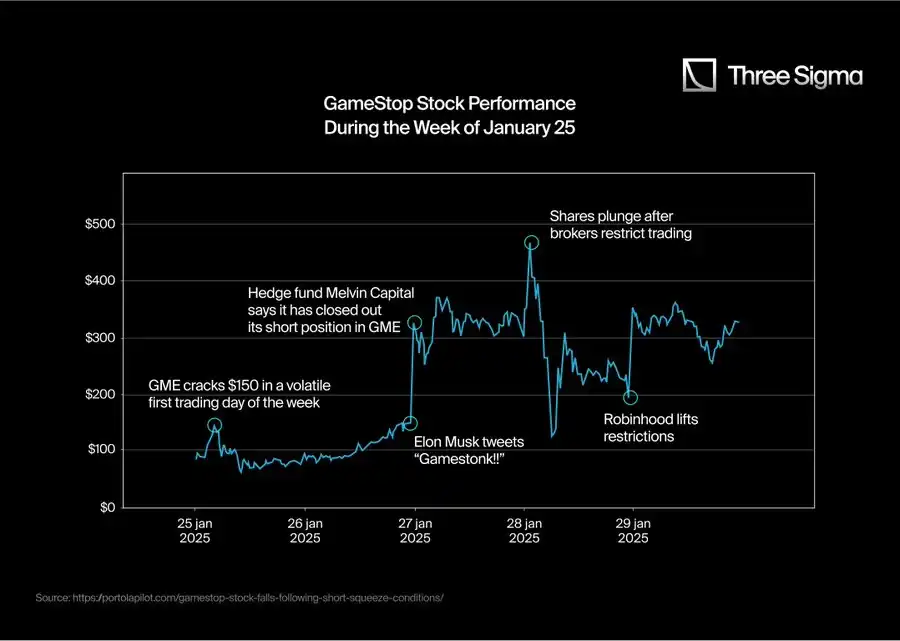
However, coordinated retail buying, especially initiatives like the one seen on Reddit's WallStreetBets community, caused stock prices to unexpectedly soar. As the price rose, short sellers were forced to buy back the stock, driving the price higher and further fueling the upward momentum.
This feedback loop eventually evolved into a historic event, with GameStop's stock price soaring from around $20 in early January 2021 to an intraday high of $483 by the end of the month. This squeezing event led to many institutional investors who were in short positions losing billions of dollars.
2. API and Liquidation Events
In the cryptocurrency space, there have been several notable liquidation events in history. However, the most memorable and impactful ones often occur during a bear market's "short squeeze." These events are larger in scale and have a more profound impact on traders and the market.
Here are some of the biggest liquidation events in cryptocurrency history:
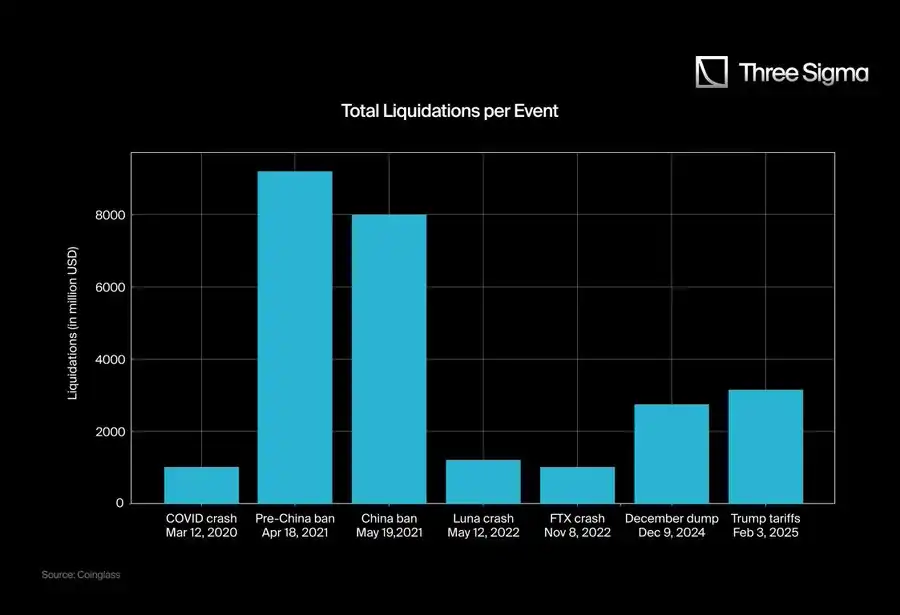
Notice anything unusual, anon? Do you think the FTX collapse or Luna crash did more damage than the liquidation events we've seen this year? Well, you're not wrong.
Behind the recent liquidation events being more severe than the FTX or Luna collapses are three key factors:
Total Market Capitalization
In March 2020, the total market cap reached $2.66 trillion, and by 2025, the peak market cap had reached $3.71 trillion. To truly understand the scale of these liquidation events, we should consider the ratio of liquidations to market cap rather than just looking at the absolute numbers of liquidations. Raw numbers can make recent liquidations seem more severe than they actually are.
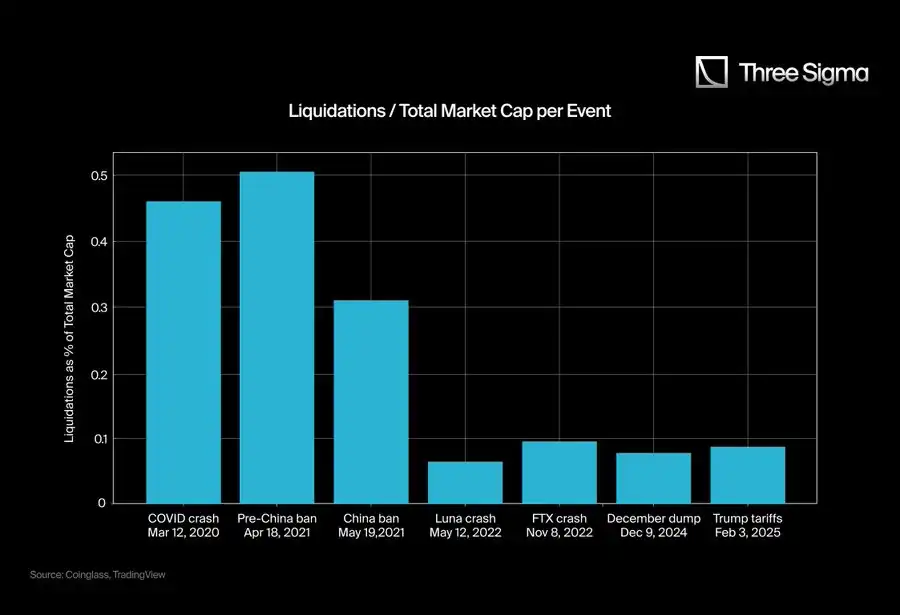
This chart helps us see the scale and impact of liquidations more clearly, but there's still some data that isn't quite accurate; this leads to the second issue.
CEX WebSocket API Limitations
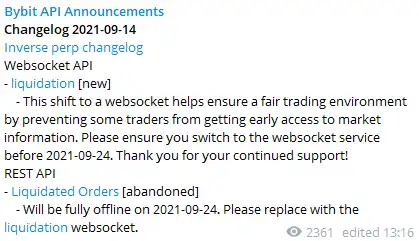
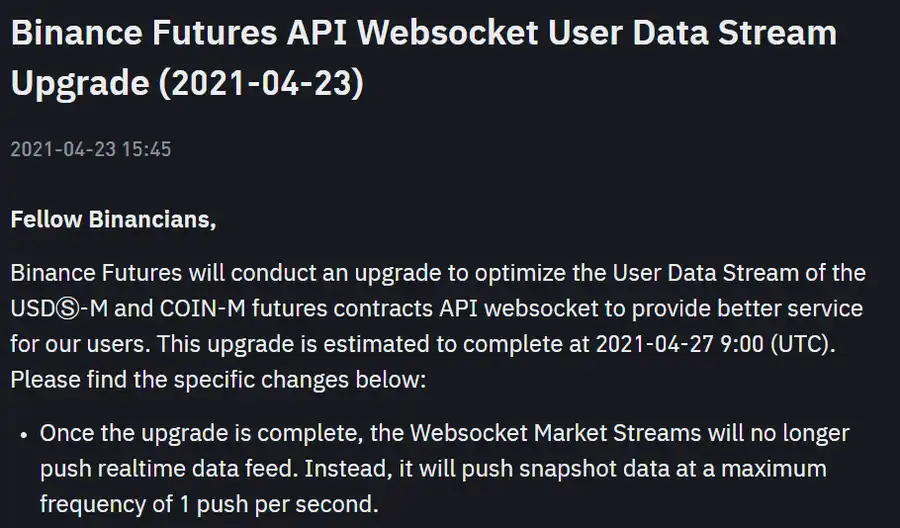
Until the second quarter of 2021, most centralized exchanges (CEX) provided accurate liquidation data via their APIs, reporting each liquidation. However, starting in 2021, they introduced limitations, restricting liquidation data to one per second, regardless of how many actual liquidations occurred.
This change significantly reduced the reported liquidation numbers, making the data from late 2021 appear smaller and less impactful compared to before 2021.
@K33Research has written a research article explaining this situation and illustrated it through two simple yet powerful charts:
In the first chart, you can see that after the API changes, the number of liquidations has significantly slowed down, even though the total market value is much higher than in 2021, the liquidation data remains at a lower level.
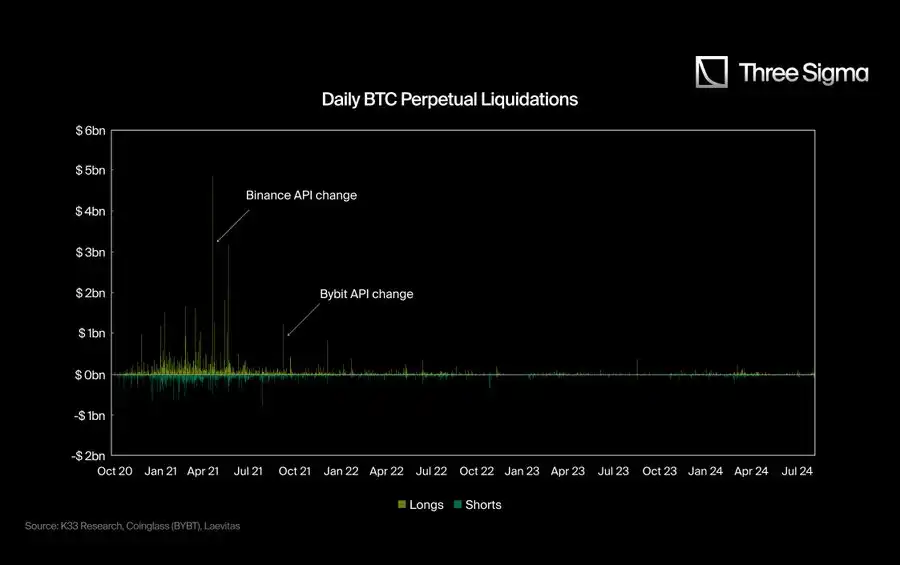
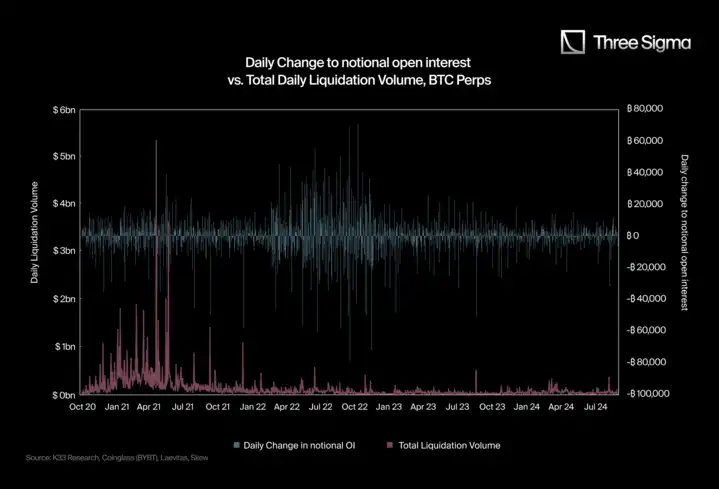
In the second chart, the author compares the total liquidation amount with the daily nominal Open Interest (OI) change.
The substantial intraday fluctuations in Open Interest usually trigger a large number of liquidations, but as we can see in the chart, after the second quarter of 2021, on days with such significant OI fluctuations, there was no notable increase in liquidations.
The official reasons behind these API changes are: "to provide a 'fair trading environment' (Bybit, September 2021) and to 'optimize user data flow' (Binance, April 2021)," but some believe that this is actually just for PR reasons to avoid causing excessive panic while also retaining genuine data.
Hyperliquid as a Genuine Platform
Hyperliquid is the first Layer 1 blockchain perpetual DEX to reach sufficient trading volume to compete with CEX. Unlike CEX, Hyperliquid provides fully transparent and unrestricted reporting of all liquidation events since its data is public.
This creates a unique environment where, on one hand, CEX's liquidation data is limited (due to reporting restrictions), while on the other hand, Hyperliquid's data is unrestricted. As a result, the reported total liquidation data has significantly increased, benefiting from Hyperliquid's transparency.
This transparency has a significant impact on the broader trading ecosystem. In traditional centralized exchanges, liquidation data is often selectively reported or summarized, limiting traders' ability to analyze market dynamics in real-time. Hyperliquid ensures that every liquidation event is publicly visible, providing a more accurate and comprehensive understanding of leverage trading activities.
For traders, this means a better understanding of the market situation, enabling them to identify potential squeeze scenarios, monitor risk levels, or gauge market sentiment. Researchers and analysts have also benefited from unfiltered on-chain liquidation data, providing valuable insights into volatility patterns, risk behavior, and market reactions to liquidations.
This unrestricted access to data has promoted a more equitable, efficient trading environment where all participants have equal access to information. By setting new transparency standards for perpetual trading, Hyperliquid has not only challenged the opacity of CEXs but has also enhanced the overall reliability of liquidation data, allowing traders to operate with greater trust and deeper market insights.
3. Real Liquidation Data
3.1 Calculating the Hyperliquid Ratio
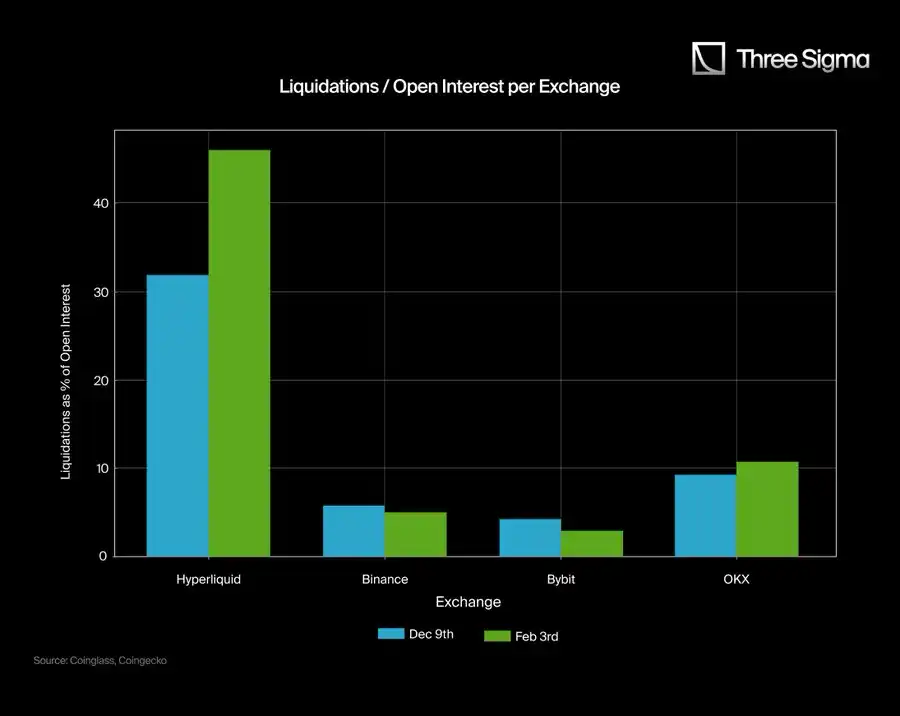
Hyperliquid's transparency and comprehensive metrics allow us to see what has been happening over an extended period, whereas the derivative segments of CEXs have not been able to report real-aligned figures due to API limitations. The data discrepancies seen in the charts further confirm this issue, showing that despite CEXs having much larger open interest contracts and volumes compared to Hyperliquid, their reported liquidation figures are still unrealistically low.
Thanks to Hyperliquid, we now have a verifiable and accurate dataset to compare the distortion in CEX liquidation reports.
The data provided to the media often presents an incomplete picture as they are based on limited APIs, failing to capture the full extent of liquidation events. In contrast, Hyperliquid's unrestricted reporting offers transparent and detailed records of all liquidation events, proving that CEX liquidation activity may be significantly higher than publicly disclosed figures.
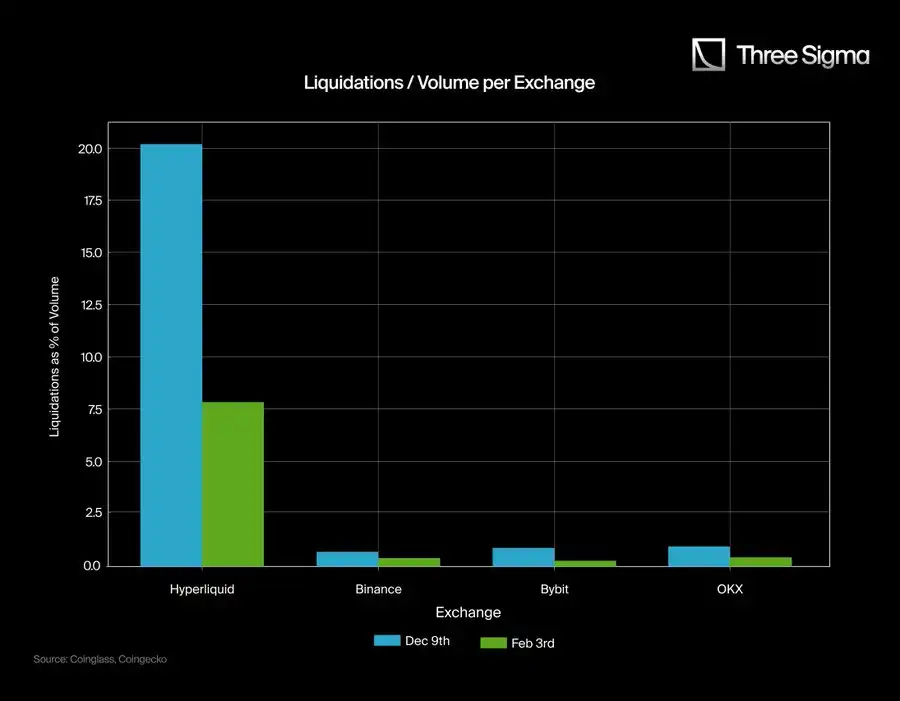
3.2 Adjusting CEX Liquidation Data Using the Hyperliquid Ratio
To estimate CEX's "true" liquidation figures, we used Hyperliquid's liquidation/trading volume ratio and liquidation/open interest ratio as benchmarks. We then compared these ratios to the data reported by CEXs on two specific dates (December 9 and February 3), resulting in an adjustment factor.
Calculate Hyperliquid's Average Ratios:
Liquidation / Open Interest (Hyperliquid)
Dec 9: 1.07B / 3.37B ≈ 0.3175
Feb 3: 1.42B / 3.08B ≈ 0.461
Average ≈ 0.389 (38.9%)
Liquidation / Trading Volume (Hyperliquid)
Dec 9: 1.07B / 5.30B ≈ 0.2021
Feb 3: 1.42B / 18.0B ≈ 0.0789
Average ≈ 0.14 (14%)
We use these percentages (38.9% and 14%) as reference points to assess what the liquidation data might look like if other exchanges were to follow a similar ratio to Hyperliquid.
Applying These Ratios to Binance, Bybit, and OKX:
For each CEX, we calculate two "adjusted" liquidation data:
Using Hyperliquid's Liquidation/Trading Volume Ratio
Using Hyperliquid's Liquidation/Open Interest Ratio
Then, we take the average of these two adjusted results for each date.
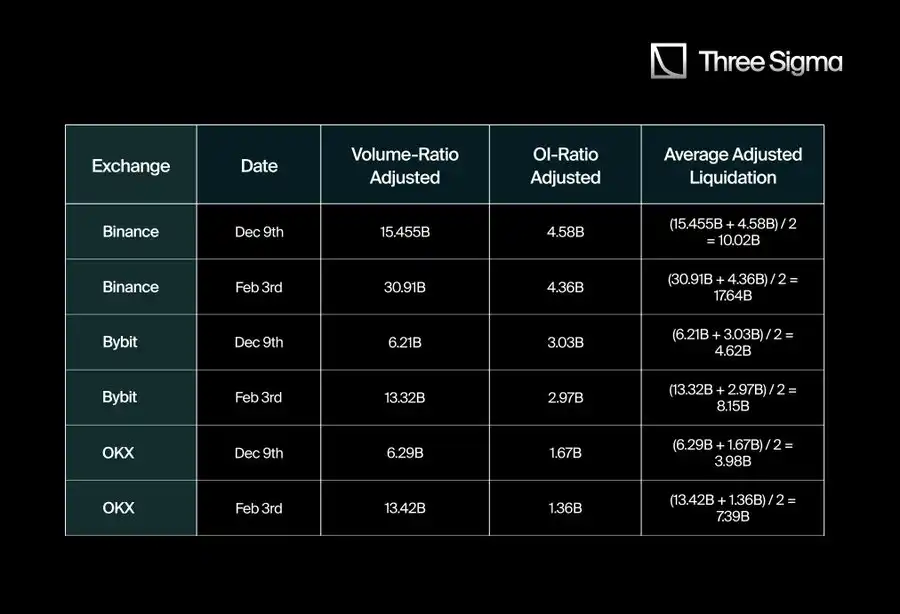
Therefore, the CEX-reported liquidation data (often in the range of billions of dollars) is significantly lower than the implied billion-dollar range based on the Hyperliquid ratios.
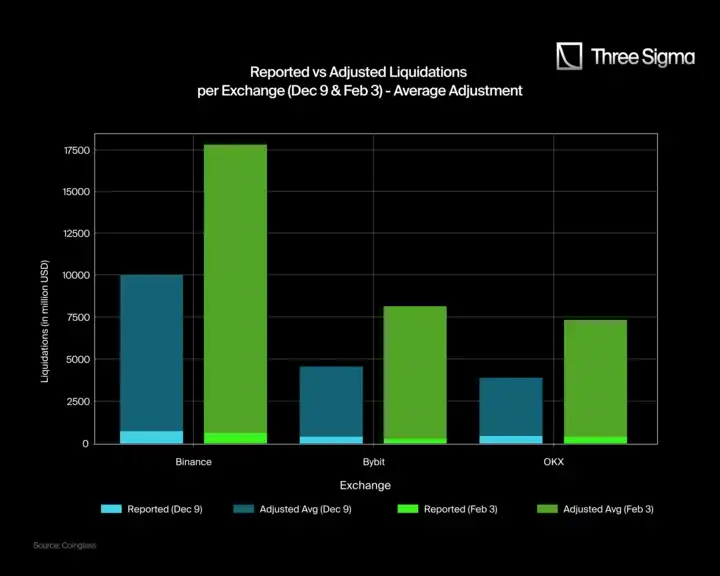
Below are the reports and adjusted liquidation data charts for Dec 9 and Feb 3. Each exchange has two bar graphs, with light blue and light green representing the reported liquidation data and dark blue and dark green representing the adjusted liquidation data.
The adjusted values are calculated by taking the average of the Liquidation/Trading Volume ratio and the Liquidation/Open Interest ratio from Hyperliquid as the baseline. While this provides a clearer perspective on potential liquidation data differences, variations may still exist due to differences in exchange market structure, retail participation, liquidity provider activity, etc.
Key Insights:
Liquidation data from Binance, Bybit, and OKX is significantly underreported: The reported liquidation data (light blue/light green) is much lower than the adjusted data (dark blue/dark green), indicating that the actual liquidation data may be much higher than publicly disclosed numbers.
Binance should report approximately 17,640M in liquidation data: The adjusted data suggests that Binance's actual liquidation data on February 3 should be close to 17,640M, rather than the reported 611M, highlighting a significant discrepancy. On December 9, Binance should report 10,020M instead of 739M.
Bybit and OKX follow a similar pattern: Bybit's adjusted liquidation data on February 3 is 8,150M, not 247M as reported; on December 9, it is 4,620M instead of 370M. OKX also shows significant differences, with adjusted liquidation data of 7,390M on February 3 and 3,980M on December 9, compared to reported figures of 402M and 425M, respectively.
3.3 Major Liquidation Events and their "True" Estimates
After comparing Hyperliquid's liquidation data with the limited data reported by major CEXs, we found significant variances. To quantify this difference, we collected reported data from Binance, Bybit, and OKX on December 9 and February 3, specifically analyzing their liquidation/trading volume and liquidation/open interest ratios.
To estimate the true liquidation data, we calculated the average ratio of Hyperliquid's liquidation/trading volume and then applied these ratios to CEX data. We did not use a simple arithmetic average but instead calculated the liquidation ratios weighted by the proportion of each exchange's trading volume on each date. This method offers a more accurate reflection of overall market liquidation activity.
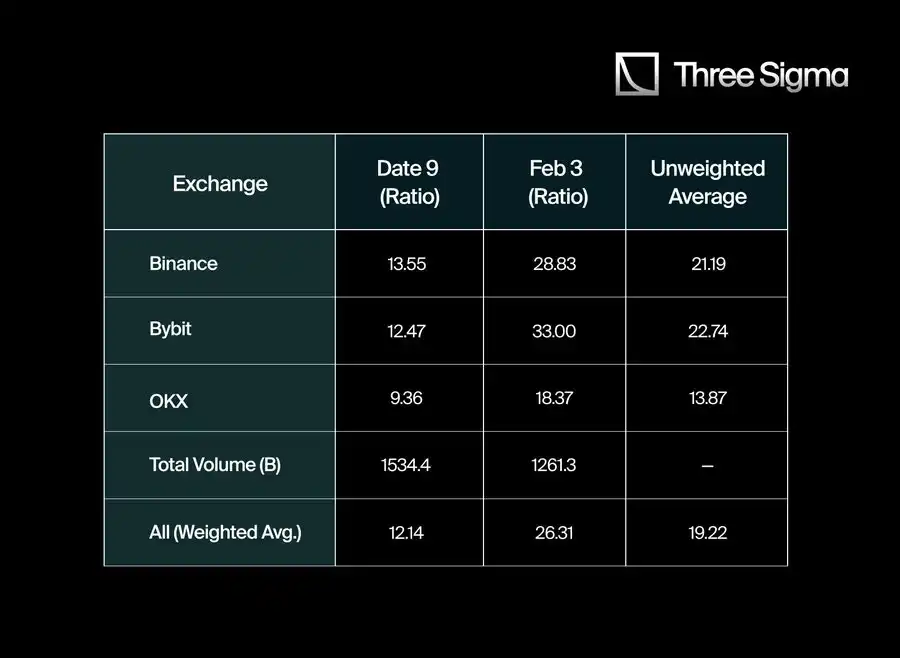
When we initially calculated the adjustment factors for each exchange (Binance: 21.19, Bybit: 22.74, OKX: 13.87), a simple average yielded a global adjustment factor of 19.27x. However, considering the weighted differences in exchange volumes, the more precise weighted average is 19.22x.
This indicates that the actual settlement data from CEXs may be roughly 19 times higher than what is officially reported, or at least 19 times higher than the data disclosed through their restrictive APIs.
With this 19.22x adjustment factor in mind, we analyzed some significant settlement events in the history of crypto to estimate how much their actual settlement data might be if they had the same level of transparency as Hyperliquid. The table below compares common settlement amounts to the values adjusted by the 19.22x factor:
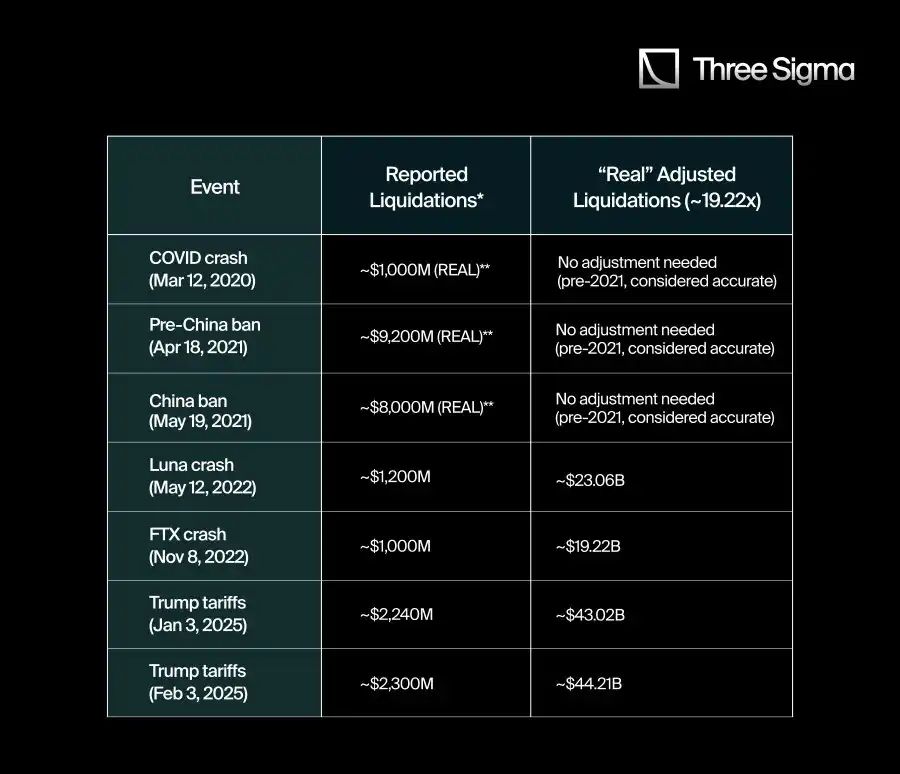
“Reported” refers to the figures published on aggregators, social media, or limited APIs.
For events prior to Q2 2021, settlement data is much more reliable due to the absence of API restrictions.
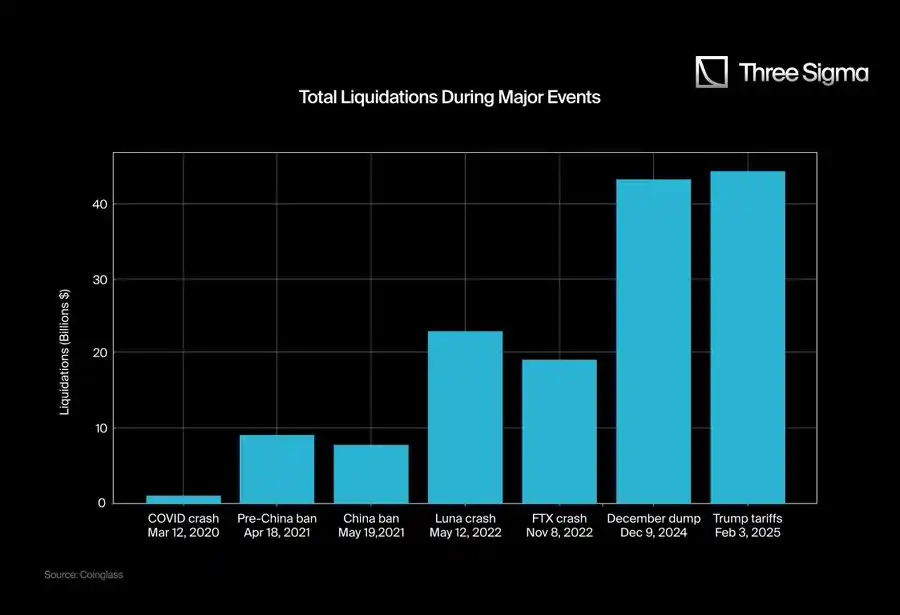
As highlighted in this chart, the settlement figures derived from data sources reported post-2021 may significantly underestimate the true picture. By applying the multiplier derived from Hyperliquid's full transparency, the settlement scales of these events are much larger than what the official figures assume.
3.4. Comparing Settlement to Total Market Cap
To provide more context, we compare the total “true” settlements of these events to the total market cap at the time. The ratio calculation formula is: (Settlement Amount / Market Cap) × 100.
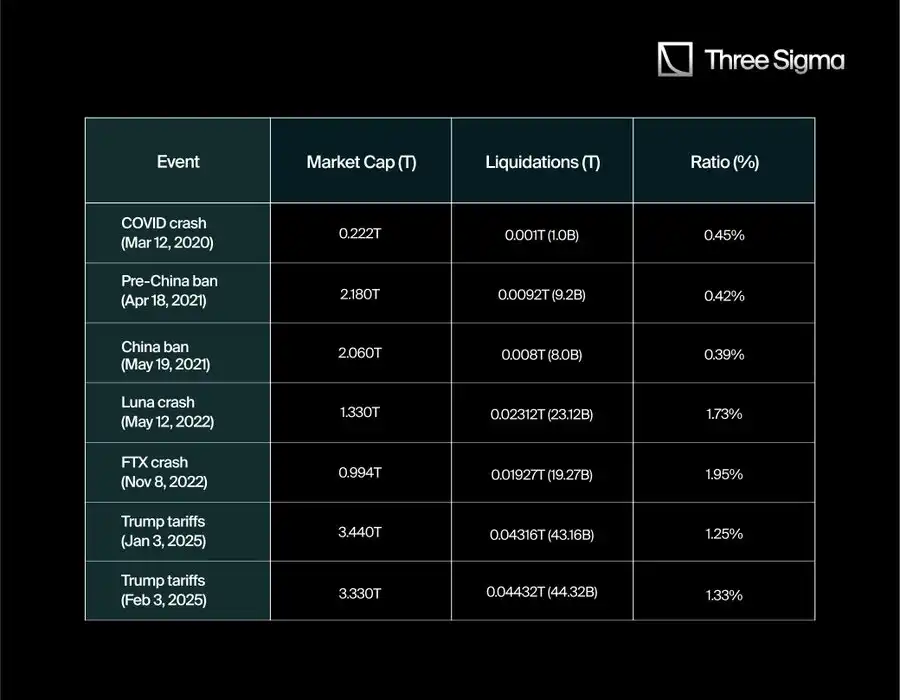

By comparing the “true” settlement data to the broader cryptocurrency market cap, we can gain a deeper understanding of the impact of each event on market dynamics. This not only demonstrates the scale of capital that vanished in a short period but also reflects how market sentiment drastically changed when leverage effects were unwound.
In many cases, the ratio becomes more pronounced after adjustment, indicating that participants may have been exposed to greater systemic risks than initially apparent. Therefore, understanding these settlement-to-market cap ratios can provide a clearer perspective to help us grasp how market psychology and liquidity conditions shift during periods of extreme volatility.
4. Conclusion
From all the preceding data and comparisons, a pattern emerges clearly: the figures reported in CEX public disclosures are often significantly lower than the "true" settlement activity. When adjusted to match the Hyperliquid transparent ratio, events like the Luna and FTX collapses have revealed a larger impact than what official data suggests, further reinforcing the view that CEXs may underreport settlement data to mask volatility or manage public perception.
This contrast becomes even more pronounced when looking at historical events: the COVID crash of 2020, while a major market event at the time, now appears relatively minor precisely because there were fewer leveraged participants then. With the mainstreaming of leverage, settlement's absolute and relative scale continues to grow, but the constraints of official data flows may give traders and analysts a distorted view of systemic risk.
Furthermore, exchanges often cite "optimizing data flow" or "ensuring fair trading conditions" as reasons, but it is not hard to see that restricting the real-time release of settlement data can serve broader interests. Underreporting settlement data can reduce the fear of new retail investors while also allowing exchanges to gain exclusive insights into market-wide risk exposure.
While these measures may help narrow the gap between reported data and actual settlement activity, Hyperliquid's reliance on on-chain, unrestricted reporting still highlights how crucial true transparency is for anyone looking to navigate leveraged crypto trading.
関連記事

Trust Walletハッキングでユーザーは350万ドルの資産を失う
Key Takeaways Trust Walletのハッキング事件で、最大の損失を出したのは350万ドル相当の資産を持つアドレス。 第二の損失者は140万ドル相当の資産を失い、これらのウォレットは長期間休眠していた。 今回の事件で、Trust Walletから合計600万ドル以上の暗号資産が盗まれた。 この事件は、非托管型ウォレットのセキュリティーに関する大きな懸念を生む。 WEEX Crypto News, 26 December 2025 Trust Walletの概要とハッキング事件の発生 Trust Walletは、2017年にウクライナの開発者ヴィクトル・ラドチェンコによって設立され、現在は100以上のブロックチェーンをサポートする多機能暗号通貨ウォレットです。Binanceによる初めての買収として2018年に買収されたことで、その成長は加速しました。モバイルデバイスだけでなく、デスクトップブラウザでも使用でき、デジタル資産の保存、送信、受信をより確実に行うために設計されています。…

ビットコインとイーサリアムの歴史的オプション満期が迫る:市場はどう反応するか
Key Takeaways 本日、ビットコインとイーサリアムのオプション満期が合計270億ドルに達し、史上最大の規模となる。 ビットコインは約236億ドルのオプションを抱えており、88000ドル付近での価格動向が注目される。 イーサリアムでは、オプションの約37億ドル分が満期を迎え、短期的には3000ドルが重要な価格ポイント。 オプション満期後の資金フローと機関投資家の動向により、市場の次の動きが左右される。 WEEX Crypto News, 26 December 2025 オプション満期の影響について 本日、ビットコイン(BTC)とイーサリアム(ETH)のオプションが合わせて約270億ドルに達し、暗号通貨市場に大きな影響を及ぼすとみられています。特に、ビットコインのオプション満期は歴史的に最大規模で、これは市場に新たな波紋を投げかけています。オプション市場は、通常の現物市場とは異なり、価格変動やトレーダーの心理に大きな影響を与えることが知られていますが、今回の規模の大きさは特筆すべき事態です。 ビットコイン市場の展望 ビットコインのオプション満期額は236億ドルに達し、その多くがDeribitで取引されています。BTCの価格は現在87,000ドル近辺で推移しており、この満期は短期的な価格動向に大きな影響をもたらす可能性があります。特に、ビットコインオプションのプット・コール比率が0.33とされており、これが市場のボラティリティをさらに高める要因となっています。 イーサリアム市場の行方 イーサリアムは、本日満期を迎えるオプションが37億ドル分あり、これはトレーダーの動向にさらなる波乱をもたらす可能性があります。ETHの価格は3000ドルを軸に揺れ動いており、今回の満期が価格の上昇や下降を引き起こすか注目されています。特に、プット・コール比率が0.43であるため、ここでの動きが市場センチメントをどう変えるかが鍵となります。…

BDXNプロジェクトが40万ドル相当のBDXNトークンを複数の取引所に送金
Key Takeaways BDXN関連の3つのウォレットアドレスが、合計40万ドル相当のBDXNトークンを複数の取引所に送金。 トークンはプロジェクトのウォレットから2ヶ月前に移動された。 関与したアドレスは以下の通り:0xD5682dcA35D78c13b5103eB85c46cDCe28508dfB、0xD0Fc2894Dd2fe427a05980c2E3De8B7A89CB2672、0xAc245a570A914C84300f24a07eb59425bbdC1B48。 お金の動きはonchainschool.proによって監視されていた。 この出来事は、仮想通貨マーケットの透明性と監視能力の重要性を強調している。 WEEX Crypto News, 26 December 2025 BDXNトークンの大量送金の背景 BDXNプロジェクト関連の3つのウォレットアドレスが、いくつかの主要な仮想通貨取引所に40万ドル相当のBDXNトークンを送金したことが明らかになりました。この情報はonchainschool.proの監視によって報告されており、ウォレットの動きが詳細に追跡されています。 プロジェクトの目的と送金の理由 BDXNは、新興のプロジェクトであり、そのトークンは様々な用途に利用されます。この度の送金は、プロジェクトの資金管理や市場での取引に関連する可能性があります。特に、多くのプロジェクトが取引所での流動性を高めるためにトークンを移動することが一般的です。 ウォレットのアドレスとトークンの送金履歴…

ハイパーリクイッドでのビットコインとイーサリアムポジションの変化が浮き彫りに
Key Takeaways 最近、ハイパーリクイッドにおけるBTCの多頭巨鯨数が約2ヶ月で半減した。 ETHでは空頭巨鯨が多頭の2倍に増加している。 大手BTC空頭巨鯨の平均ポジション価格は8.82万ドル、清算価格は9.41万ドル。 ETH最大空頭巨鯨はポジション平均価格が3129ドル、清算価格が3796ドル。 WEEX Crypto News, 26 December 2025 ハイパーリクイッドにおけるポジションの動向 仮想通貨市場での最近の出来事は、投資家やトレーダーにとても重要な情報を提供しています。特にハイパーリクイッドプラットフォームでのビットコイン(BTC)およびイーサリアム(ETH)の動向に変化が見られます。市場分析ツールHyperInsightによると、このプラットフォーム上での多頭(買い)と空頭(売り)ポジションに大きな変化がありました。 BTC多頭ポジションの急減 過去2ヶ月間で、ハイパーリクイッドにおけるBTCの多頭巨鯨数が劇的に減少しました。今年の10月14日には234名の多頭巨鯨が存在しましたが、最新のデータではこれが122名にまで減少しています。これは約50%の減少を意味し、多頭の勢いが弱まっていることを示しています。一方で、現在の空頭巨鯨数は116名で、過去に比べて変化は少なく、若干の増加に留まっています。この動きは、ビットコインに対する市場全体のリスクアペタイトの変化を示唆しています。 ETH空頭の増加 イーサリアム市場では、空頭が多頭をかなり上回っています。現在、ETHの空頭巨鯨は113名で、多頭の58名に対して倍に達しています。このことは、特にイーサリアム市場での売り圧力が増している可能性を示唆しています。市場のセンチメントが冷却し、ETHに対して伝統的な強気ポジションを取り控える動きが広まっていると言えるでしょう。…

ビットコイン、9万ドルへの勢いを再び満たす
Key Takeaways マーケットでは短期的にビットコインが8.2万ドルから9.5万ドルまでの変動が予測される。 BTC価格が9万ドルを超え、24時間で1.53%上昇した。 Deribitで270億ドル相当のビットコインとイーサリアムのオプションが到期し、市場に影響を与える。 現物金と銀の価格が歴史的高値を更新、多くの投資家が注目している。 WEEX Crypto News, 26 December 2025 ビットコインの価格動向と市場の反応 12月26日、ビットコインの価格は再び9万ドルを試す動きを見せ、価格は急騰しています。最新のデータによれば、特に12月22日以降の上昇が顕著で、90,027ドルを記録し、24時間での上昇率は1.53%でした。この背景には、近日中に満期を迎えるビットコイン・オプションが市場に与える影響があると見られています。12月26日に予定されている270億ドル相当のオプション到期は、市場に新たな変革をもたらす可能性があります。 マーケットの変動と価格の背景 現時点でのビットコインの動きは、年内に9.5万ドルを超える可能性があると予測されています。この見通しの中では、特にオプション取引の影響が注目されています。取引所情報によると、ビットコイン価格の上昇は、このオプション取引の満期に伴う市場動向との関連が指摘されています。 また、市場は過去のビットコイン価格の大幅な変動に基づき、価格への影響を予測しています。今年初の価格からの回復は比較的遅れたものの、オプションの影響で通常の市場ダイナミクスが回復しつつあります。 現物資産の相場動向…

比特コイン史上最大の期権到期、BTC価格に波紋
Key Takeaways 236億ドル規模のビットコイン期権が到期し、短期的な価格変動が予想される。 BTCの取引価格は現在約8.7万ドルで推移している。 取引所Deribitで大量の未平倉契約が期権到期により清算される見込み。 市場は最大痛点価格9.5万ドルに向かって動く可能性がある。 短期的には約8.2万ドルまで下落した後に反発する予測がある。 WEEX Crypto News, 26 December 2025 史上最大の期権到期が及ぼすBTCの今後の動向 2025年12月26日、ビットコイン(BTC)は8.7万ドルの水準で圧力が続いている中、史上最大とされる期権到期を迎え、短期価格の動向を大きく揺るがしそうです。約236億ドル規模のBTC期権契約が12月24日にDeribitで到期する予定で、これは同取引所での未清算契約の半分以上を占めます。この結果、ビットコイン価格の短期的な方向性に注目が集まっています。 Deribit上の巨大な期権到期による市場への影響 Deribitでは、約30万枚のビットコイン期権と44.6万枚のiSharesビットコイン信託期権が到期します。この期権決済だけで市場の風向きを変えることはないかもしれませんが、過去数回のクリスマス期にみられた5%から7%の価格変動が再び発生する可能性が指摘されています。 Deribitのデータは、「最大痛点価格」が約9.5万ドルであることを示しており、多くの期権はこの価格で無価値となります。市場では0.38のプット・コール比率が報告されており、投資家は全体としてビットコインの中期的な見込みを楽観視しています。…

マトリックスポートのビットコイン市場に関する見解が示唆する新たな動向
Key Takeaways マトリックスポートの最新報告では、ビットコイン市場が「下行受限」フェーズへ向かっていると指摘。 2025年末に向けて市場の感情が保守的になり、2026年には圧力が続く可能性。 ビットコインの価格変動は金融派生商品の影響を受けやすく、リスク管理が重要。 歴史的に年末は慎重な動きが多いが、新年には急速な感情転換の可能性も。 史上最大規模のビットコインオプションの到期が市場のプレッシャーやチャンスを示唆。 WEEX Crypto News, 26 December 2025 マトリックスポートによるビットコイン市場の分析 マトリックスポートはビットコインの最新動向を分析し、その市場が「下行受限」の段階に移行しつつあると報告しています。この段階では、ビットコインの下向きのリスクが相対的に抑えられ、多くの市場参加者はリスクに対してより慎重になる傾向があります。この分析は、2025年12月現在、マトリックスポートが提供する広範な金融サービスを活用した調査に基づいています。 市場環境とビットコインの圧力 2025年末に向けて、ビットコイン市場は保守的な動きを見せています。市場の参加者は慎重になり、特に金融市場の年末の特徴であるリスク回避の動きが鮮明です。この動きは、2026年にかけてビットコインがさらなる圧力下に置かれる可能性を示しています。過去のデータによれば、新しい年が始まると、資金の再編成とリスク予算の回復により市場感情が予期せぬ速さで変わることがあり、これが市場の活性化の鍵となる可能性があります。 ビットコインの価格変動と金融派生商品…

Crypto Derivatives Volume Explodes to $86T in 2025
Key Takeaways 仮想通貨デリバティブ取引量は2025年に86兆ドルに達し、1日あたり平均2650億ドルとなった。 Binanceは世界市場の約30%を占め、主要な取引所としての地位を確保。 OKX、Bybit、Bitgetも含み、トップ4の取引所で総市場シェアの62.3%を占めた。 デリバティブの複雑性が増し、機関投資家主導の市場へと進化。 極端な市場イベントがリスク管理を試すことになり、既存のマージンメカニズムや清算ルールが検証された。 WEEX Crypto News, 2025-12-26 10:06:42 仮想通貨デリバティブ市場の急成長 2025年、仮想通貨デリバティブ市場は過去に類を見ない成長を遂げ、その取引量は86兆ドルに到達しました。この成長は、1日あたり平均2650億ドルの取引を意味しています。Binanceはこの急増の中で市場をリードし、全体の約30%の取引量を占めることになりました。その結果、世界中で取引される100ドルのうち約30ドルが同取引所を経由していることになります。 Binanceの成功は、主にその効率的な取引メカニズムと包括的なサービス提供によるものであり、利用者は多様な金融商品を利用できます。その影響により、OKX、Bybit、Bitgetなどの他の主要取引所も市場の重要な位置を占めることになり、これらの取引所での年間取引量はそれぞれ8.2兆ドルから10.8兆ドルに及びました。これにより、これら4つの取引所が市場の約62.3%を占めています。 仮想通貨デリバティブの進化とその影響 2025年を通じて、仮想通貨デリバティブ市場は、これまでの小売主導のハイレバレッジを用いたバブルと崩壊のモデルから、証券取引所取引型ファンド(ETF)やオプション、コンプライアントな先物取引を通じて機関投資家主導の流れに移行しました。この変化は市場の安定性をもたらしましたが、それに伴いリスクも増大しました。 市場はより複雑になり、さまざまなリスク管理の枠組みが試されることになりました。特に、極端な市場イベントが発生した際には、既存のマージンメカニズムや清算ルールがその耐久性を試されました。このようなストレステストを経て、市場の強さと弱さがより明確になりました。…

Kraken IPOが暗号『中期段階』サイクルを再燃させる可能性
重要なポイント KrakenのIPO(新規株式公開)は、暗号通貨の成長を加速し、伝統的な金融(TradFi)から新たな資本を引き寄せる可能性があります。 Bitcoinは過去最高値を記録しましたが、その後の市場変動によって価格が下落しました。 一部の専門家は、2026年にBitcoinが下落の年になると予測していますが、他の専門家は長期的な上昇トレンドを主張しています。 市場の動向は、流動性や国家の採用といったマクロ経済的な要因によって左右されるようになっています。 WEEX Crypto News, 2025-12-26 10:06:43 Krakenと伝統的金融資本の相互作用 Krakenの新規株式公開(IPO)は、暗号通貨界における新たな潮流を生み出す可能性があります。これは特に、伝統的な金融制度(TradFi)からの新たな資本を呼び込む一助となるでしょう。この動きは、様々な暗号通貨企業が上場を目指す一大トレンドの一環でもあります。 Bitcoinは10月6日に過去最高値である126,000ドル以上を記録しましたが、その後の19億ドルに及ぶ清算イベントの影響を受けて現在は87,015ドル(記事執筆時点)の取引価格となっています。これにより、最近二週間で6%の減少を示していますが、50T Fundsの創設者兼CEOであるDan Tapieroは、「Bitcoinブル市場はまだ中期段階にある」と主張しています。彼は、KrakenのIPO及び増加するM&A(合併・買収)活動が、新たな資本を引き寄せる「追い風」を提供すると見ています。 Krakenは11月18日に20億ドルの評価額に達するために8億ドルの資金を調達し、同年11月初めに米国でのIPOを申請しました。これにより新たな市場の局面がどのように進展するか、注目されています。 Bitcoin市場の予測と見解の相違 しかし、すべてのアナリストが現行のブルサイクルの継続を信じているわけではありません。Fidelityのグローバルマクロ経済研究ディレクターであるJurrien…
Fed Q1 2026 Outlook: Bitcoinと仮想通貨市場への影響
Key takeaways Fedの金利引き下げの休止は仮想通貨に圧力をかける可能性があるが、「隠れ量的緩和」が下振れリスクを軽減するかもしれない。 流動性は金利引き下げ以上に重要であり、2026年第1四半期のBitcoinとETHの動向を形作る。 2025年には米連邦準備制度理事会(Fed)が三度の金利引き下げを実施したが、インフレ率によっては2026年初にはさらに下がる可能性がある。 軽微な供給施策が市場の方向性に影響を与え、特にETFの流入が投資家のリスク志向を支えると予想される。 WEEX Crypto News, 2025-12-26 10:06:42(today’s date,foramt: day, month, year) Fedの政策に対する仮想通貨市場の反応 2025年の米連邦準備制度理事会(Fed)は、経済の減速とインフレ圧力の緩和に対処するために金利引き下げを三回実施しました。特に、雇用の減少と消費者物価指数(CPI)の改善が見られる中、第4四半期に集中的に利下げが行われました。しかし、仮想通貨市場はこの養成政策に対して常識外の反応を見せました。Bitcoin(BTC)、Ethereum(ETH)などの主要な仮想通貨は、これまでの高値から1.45兆ドルを超える時価総額の減少を経験しました。 BitcoinとEthereumに対する金利引き下げ休止の影響…

Ethereum in 2026: Glamsterdam and Hegota Forks, L1 Scaling, and Beyond
新しいEthereumフォーク「Glamsterdam」は2026年にEthereumスケーリングの新たな一章を開く。 ガスリミットの200万への増加は、より大量の取引を同時に処理する能力をもたらす。 Zero-Knowledge( ZK )証明が進化し、Ethereum L1のスケーリングを加速させる。 新たなデータブロブを活用することで、Layer 2のネットワークが飛躍的に性能を向上させる。 「Heze-Bogota」フォークは、検閲への抵抗力を強化し、セキュリティ面での向上を目指す。 WEEX Crypto News, 2025-12-26 10:06:42 2026年には、Ethereumにとって重要な年となることが予想されています。この年、GlamsterdamフォークがEthereumブロックチェーンの処理能力を一段と向上させることが期待されています。特にガスリミットの大幅な引き上げやZero-Knowledge (ZK) 証明の普及が、Ethereumのスケーリングを新たなレベルへ引き上げる要因として注目されています。 Glamsterdamフォークの詳細とその影響…

2025年の暗号通貨セキュリティ:ソーシャルエンジニアリングに対抗する方法
2025年において暗号通貨業界でのハッキングの多くは技術的な欠陥よりもソーシャルエンジニアリングによるもの。 ソーシャルエンジニアリングは、AIの進化により検出が難しくなってきている。 暗号通貨セキュリティの未来は、アイデンティティ検証とAI駆動の脅威検出によって形作られる。 個人情報の隠ぺいやインフラストラクチャの分離がセキュリティの向上につながる。 セキュリティ対策には、公式ソフトウェアの使用や、ハードウェアウォレットによる管理が推奨される。 WEEX Crypto News, 2025-12-26 10:06:42 2025年は暗号通貨業界におけるセキュリティ上の問題が増加し、その焦点はテクノロジー的な弱点よりも人間の行動に移っています。すでに3.4億ドル以上がハッカーの手に渡ったと報告されています。これらの攻撃の多くは、ソーシャルエンジニアリング手法によるもので、暗号通貨のセキュリティの未来がAI駆動の脅威検出とより賢明なアイデンティティ認証によって形作られていくでしょう。 ソーシャルエンジニアリングとは何か? ソーシャルエンジニアリングとは、人を操作して秘密情報を開示させたり、セキュリティを脅かす行動を取らせるサイバー攻撃の手法です。2025年には、この手段が更に高度になり、攻撃者は技術的手段よりも人間の心理に攻撃ポイントを移しています。暗号通貨の重要なコミュニケーションに関しては、サイバー空間ではなく人々の心理が戦場となっています。 例えば、2025年2月に起こったBybitの大規模なセキュリティ侵害事件では、悪意のあるJavaScriptが使用され、データが盗まれました。ニック・パーココ(Nick Percoco)氏は、セキュリティは高い壁を築くことではなく、心を訓練して操作を認識することであると述べています。「城の鍵を持っているからといって誰でも中に入れてはいけないんです。彼らが中の者や恐怖を煽る者だからといって、信じるべきではありません。」 自動化を活用して脅威に備える 暗号通貨のセキュリティにおける将来の道筋は、よりスマートなアイデンティティ確認とAIを使った脅威検出によって辿られることでしょう。パーココ氏によれば、将来は予防的防御がより重視され、人間の信頼ポイントを最小限にすることが重要です。 今後については、供給チェーンの妥協も重要な課題であり、些細なセキュリティ侵害が後々重大な問題を引き起こす可能性があるとされています。このため、自動化された防御を取り入れ、デジタルインタラクションを認証で確認することが推奨されています。…

Merry Christmas, Caroline Ellison: 早期釈放へのクリスマスプレゼント
元Alameda ResearchのCEOであるキャロライン・エリソンは、仮想通貨取引所FTXでの顧客資金の乱用に関与し2年間の懲役刑を受けましたが、アメリカ連邦当局の更新により、1月に釈放される予定です。 エリソンは、2022年11月のFTXの崩壊後、詐欺およびマネーロンダリングの罪で起訴され、有罪答弁をしました。 サム・バンクマン-フリードと共に裁判で証言したことにより、刑務所内の生活から数週間で解放されます。 釈放後もエリソンは、10年間の役員および取締役としての役職に就くことが禁止されています。 WEEX Crypto News, 2025-12-26 10:08:41 元Alameda ResearchのCEOであるキャロライン・エリソンが、連邦拘置所から早期の釈放を予定しています。この知らせは、多くの注意を集めた彼女の役割と関連のあるFTXの崩壊に関するもので、特にSam Bankman-Friedとの関係が注目されています。以下では、彼女の早期釈放に至る経緯や法的な影響を詳しく見ていきます。 キャロライン・エリソンの拘束と釈放 キャロライン・エリソンは、FTXの顧客資金の不正使用により2年間の収監を言い渡されていました。しかし、2025年12月の時点で彼女の釈放が2026年1月21日に決定しています。彼女は10月に刑務所からニューヨーク市の住宅出所管理フィールドオフィスに移送され、最初は2026年2月20日までそこに留まる予定でしたが、早めの釈放が決まりました。 釈放の背景と拘束の理由 アメリカ連邦当局は、彼女の釈放が連邦囚人に与えられる良好な行動のためのクレジットと再入所プログラムに関連している可能性があると示唆しています。具体的な理由は公開されていませんが、彼女がAlameda Researchの共同CEOとして参加し、その後単独CEOとなった経緯と、FTXの崩壊後に詐欺とマネーロンダリングで起訴されたことが大きく影響しています。…

Aaveのガバナンス投票でDAOによるブランド資産管理が拒否される
Key Takeaways Aaveのガバナンスプロポーザルが拒否されたことで、DeFiにおけるトークン価値の取り込みやガバナンスの問題が浮き彫りになった。 投票では55.29%が反対票を投じ、3.5%のみが支持する結果となった。 提案の拒否を通じて、トークン保有者の間での根深いトークン-エクイティの緊張が明らかになった。 ガバナンスの過程での早急な決定が批判され、特定の人物による影響力についての議論が起きた。 WEEX Crypto News, 2025-12-26 10:08:41(today’s date,foramt: day, month, year) Aaveコミュニティにおける最近のガバナンス投票では、Aaveトークン(AAVE)保有者が同プロトコルのブランド資産を分散型自律組織(DAO)の管轄下に置くという提案に対して「反対」の姿勢を示しました。この投票は、DeFi分野におけるガバナンスのダイナミクスがどのように変動し得るかを示す重要な事例です。 Aaveのガバナンス投票の結果とその影響 Aaveのガバナンスにおいて、DAOを通じてブランド管理を行う提案が55.29%の反対を受け、僅か3.5%の支持しか得られない結果に終わりました。これは、AaveのようなDeFiプラットフォームでどのようにしてブランドのアイデンティティを効果的に管理するかという問題に対する懸念を強調しています。…

Crypto Tips for Newcomers, Vets, and Skeptics in 2026
Key Takeaways 理解されていないまま暗号通貨に参入している人が増えている。 暗号通貨の仕組みや可能性を知ることが重要。 ベテランは新参者を教育し、暗号通貨を日常生活で使うべき。 批判する前に実際に暗号通貨を試すことが重要。 WEEX Crypto News, 2025-12-26 10:08:40 長年の経験を持つビットコイナーのジェームズ・ハウエルズは、過去に誤って8,000 BTCが入ったハードドライブを捨ててしまったことで知られています。彼がこの事実を乗り越え、2026年に向けて新参者やベテラン、そして懐疑的な人たちに向けたアドバイスを共有することにしました。この貴重な経験談を基に、私たちは暗号通貨について深く掘り下げ、なぜ理解が重要であるかを探ります。 新参者は暗号通貨を理解することから始めるべき 暗号通貨に初めて参入する人々は、まず購入する前に基礎をしっかり理解することが大切です。ジェームズ・ハウエルズは、新しい投資家が最初に学ぶべきことは、ブロックチェーンの仕組みや分散型金融の背景とその解決すべき現実世界の課題です。「ブロックチェーンやDeFi(分散型金融)がどのように運営されているか、そしてそれが何を解決するのかを理解することが大切だ」と、彼は述べています。 ブロックチェーンの意義を理解する 法定通貨のシステムは、政府や仲介者に力を集中させがちですが、一方でブロックチェーンは第三者の許可なしに選択できる代替手段を提供します。これは個人がより自由に金融活動を行うための道でもあります。 安全に実験を行う…
量子コンピューティングと2026年における暗号の安全性
Key Takeaways 2026年に量子コンピュータがBitcoinなどの暗号通貨を破壊するリスクは低いが、現時点で準備が進んでいる。 量子コンピュータが暗号通貨に与える影響は「収集して後に解読」という待機戦略が懸念されている。 暗号通貨のセキュリティ脆弱性の多くは公開鍵暗号技術に依存しており、量子攻撃に備える必要がある。 専門家の間で議論が続いており、増え続けるデータセキュリティの意識が2026年に重要なテーマとなるだろう。 WEEX Crypto News, 2025-12-26 10:08:41 2026年に量子コンピューティングが暗号通貨に与える影響について、多くの思惑が交錯しています。「収穫して後で解読する」という手法が暗号通貨業界全体に動揺を与えており、近未来の量子技術の進展に備える必要性を強く感じる場面も増えています。しかし、そのリスクは実際にどれほど深刻なのでしょうか?そして2026年に本当に暗号通貨が危機にさらされるのか、専門家たちの見解を考えてみましょう。 暗号通貨に対する量子技術の脅威 量子コンピュータの登場は、長らく暗号通貨の世界において潜在的な脅威とされてきました。特にBitcoin(BTC)などのブロックチェーン技術を基本とした通貨は、公開鍵暗号技術に依存しています。公開鍵から秘密鍵を導出できるほどの量子コンピュータが実現されると、広範囲にわたって資金が盗まれるリスクが生じると指摘されています。 公開鍵暗号技術の脆弱性 Neil Puckrin氏など多くの専門家は、量子コンピュータによる暗号技術破壊のリスクを「現在のところほぼマーケティングであり、10%未満が実際の危険」としています。しかし、仮想通貨のセキュリティは公開鍵暗号技術に依存しており、この部分が量子攻撃の「最も弱い部分」とみなされています。特にアメリカ合衆国の規制当局である米国証券取引委員会(SEC)でも、量子コンピューティングが将来的に暗号通貨の保護を破る可能性があるとの警鐘が鳴らされています。 2026年に予測される状況…
Trust Walletの$7Mハック補償、CZが発表
クリスマスの日に約$7百万の損失を出したハックにつき、Trust Walletが補償を発表しました。 信頼の置けなかった拡張機能が、ユーザー情報を流出させた可能性があり、インサイダー関与の疑惑があります。 Binanceの共同創業者であるChangpeng Zhaoは、被害者への資金補償を保証しました。 仮想通貨ウォレットのセキュリティリスクが増大しており、Trust Walletのハックもその一例です。 ハックプランは12月初頭から準備されていたと報じられています。 WEEX Crypto News, 2025-12-26 10:08:40 Trust Walletのクリスマス・ハックの概要 仮想通貨の世界ではセキュリティの脅威が絶えません。信頼されていた仮想通貨ウォレット「Trust Wallet」が、2025年のクリスマスにユーザーから約$7百万を奪われるという衝撃的な事件が発生しました。このハック事件は、12月初頭から準備が進められていたことが判明し、業界に波紋を呼んでいます。ここではこの事件の詳細と、その背景について詳しく見ていきましょう。 ハック被害の詳細…

トランプのWorld Liberty Financialトークン、2025年末に40%以上減少
Key Takeaways World Liberty Financialトークン(WLFI)は、2025年末に40%以上の減少を記録。 プロジェクトは、トークンセールや主要暗号資産の取得などで始まったが、その後の公募取引で値下がり。 トランプ家が両手に抱えるビジネスは、潜在的な利益相反の懸念を呼んでいる。 World Liberty Financialは、2026年1月にリアルワールドアセットを立ち上げる予定。 WEEX Crypto News, 2025-12-26 10:10:42 プロジェクトの背景と発展 2025年末にトランプ家の暗号資産プロジェクトであるWorld Liberty…
Trust Walletハッキングでユーザーは350万ドルの資産を失う
Key Takeaways Trust Walletのハッキング事件で、最大の損失を出したのは350万ドル相当の資産を持つアドレス。 第二の損失者は140万ドル相当の資産を失い、これらのウォレットは長期間休眠していた。 今回の事件で、Trust Walletから合計600万ドル以上の暗号資産が盗まれた。 この事件は、非托管型ウォレットのセキュリティーに関する大きな懸念を生む。 WEEX Crypto News, 26 December 2025 Trust Walletの概要とハッキング事件の発生 Trust Walletは、2017年にウクライナの開発者ヴィクトル・ラドチェンコによって設立され、現在は100以上のブロックチェーンをサポートする多機能暗号通貨ウォレットです。Binanceによる初めての買収として2018年に買収されたことで、その成長は加速しました。モバイルデバイスだけでなく、デスクトップブラウザでも使用でき、デジタル資産の保存、送信、受信をより確実に行うために設計されています。…
ビットコインとイーサリアムの歴史的オプション満期が迫る:市場はどう反応するか
Key Takeaways 本日、ビットコインとイーサリアムのオプション満期が合計270億ドルに達し、史上最大の規模となる。 ビットコインは約236億ドルのオプションを抱えており、88000ドル付近での価格動向が注目される。 イーサリアムでは、オプションの約37億ドル分が満期を迎え、短期的には3000ドルが重要な価格ポイント。 オプション満期後の資金フローと機関投資家の動向により、市場の次の動きが左右される。 WEEX Crypto News, 26 December 2025 オプション満期の影響について 本日、ビットコイン(BTC)とイーサリアム(ETH)のオプションが合わせて約270億ドルに達し、暗号通貨市場に大きな影響を及ぼすとみられています。特に、ビットコインのオプション満期は歴史的に最大規模で、これは市場に新たな波紋を投げかけています。オプション市場は、通常の現物市場とは異なり、価格変動やトレーダーの心理に大きな影響を与えることが知られていますが、今回の規模の大きさは特筆すべき事態です。 ビットコイン市場の展望 ビットコインのオプション満期額は236億ドルに達し、その多くがDeribitで取引されています。BTCの価格は現在87,000ドル近辺で推移しており、この満期は短期的な価格動向に大きな影響をもたらす可能性があります。特に、ビットコインオプションのプット・コール比率が0.33とされており、これが市場のボラティリティをさらに高める要因となっています。 イーサリアム市場の行方 イーサリアムは、本日満期を迎えるオプションが37億ドル分あり、これはトレーダーの動向にさらなる波乱をもたらす可能性があります。ETHの価格は3000ドルを軸に揺れ動いており、今回の満期が価格の上昇や下降を引き起こすか注目されています。特に、プット・コール比率が0.43であるため、ここでの動きが市場センチメントをどう変えるかが鍵となります。…
BDXNプロジェクトが40万ドル相当のBDXNトークンを複数の取引所に送金
Key Takeaways BDXN関連の3つのウォレットアドレスが、合計40万ドル相当のBDXNトークンを複数の取引所に送金。 トークンはプロジェクトのウォレットから2ヶ月前に移動された。 関与したアドレスは以下の通り:0xD5682dcA35D78c13b5103eB85c46cDCe28508dfB、0xD0Fc2894Dd2fe427a05980c2E3De8B7A89CB2672、0xAc245a570A914C84300f24a07eb59425bbdC1B48。 お金の動きはonchainschool.proによって監視されていた。 この出来事は、仮想通貨マーケットの透明性と監視能力の重要性を強調している。 WEEX Crypto News, 26 December 2025 BDXNトークンの大量送金の背景 BDXNプロジェクト関連の3つのウォレットアドレスが、いくつかの主要な仮想通貨取引所に40万ドル相当のBDXNトークンを送金したことが明らかになりました。この情報はonchainschool.proの監視によって報告されており、ウォレットの動きが詳細に追跡されています。 プロジェクトの目的と送金の理由 BDXNは、新興のプロジェクトであり、そのトークンは様々な用途に利用されます。この度の送金は、プロジェクトの資金管理や市場での取引に関連する可能性があります。特に、多くのプロジェクトが取引所での流動性を高めるためにトークンを移動することが一般的です。 ウォレットのアドレスとトークンの送金履歴…
ハイパーリクイッドでのビットコインとイーサリアムポジションの変化が浮き彫りに
Key Takeaways 最近、ハイパーリクイッドにおけるBTCの多頭巨鯨数が約2ヶ月で半減した。 ETHでは空頭巨鯨が多頭の2倍に増加している。 大手BTC空頭巨鯨の平均ポジション価格は8.82万ドル、清算価格は9.41万ドル。 ETH最大空頭巨鯨はポジション平均価格が3129ドル、清算価格が3796ドル。 WEEX Crypto News, 26 December 2025 ハイパーリクイッドにおけるポジションの動向 仮想通貨市場での最近の出来事は、投資家やトレーダーにとても重要な情報を提供しています。特にハイパーリクイッドプラットフォームでのビットコイン(BTC)およびイーサリアム(ETH)の動向に変化が見られます。市場分析ツールHyperInsightによると、このプラットフォーム上での多頭(買い)と空頭(売り)ポジションに大きな変化がありました。 BTC多頭ポジションの急減 過去2ヶ月間で、ハイパーリクイッドにおけるBTCの多頭巨鯨数が劇的に減少しました。今年の10月14日には234名の多頭巨鯨が存在しましたが、最新のデータではこれが122名にまで減少しています。これは約50%の減少を意味し、多頭の勢いが弱まっていることを示しています。一方で、現在の空頭巨鯨数は116名で、過去に比べて変化は少なく、若干の増加に留まっています。この動きは、ビットコインに対する市場全体のリスクアペタイトの変化を示唆しています。 ETH空頭の増加 イーサリアム市場では、空頭が多頭をかなり上回っています。現在、ETHの空頭巨鯨は113名で、多頭の58名に対して倍に達しています。このことは、特にイーサリアム市場での売り圧力が増している可能性を示唆しています。市場のセンチメントが冷却し、ETHに対して伝統的な強気ポジションを取り控える動きが広まっていると言えるでしょう。…
ビットコイン、9万ドルへの勢いを再び満たす
Key Takeaways マーケットでは短期的にビットコインが8.2万ドルから9.5万ドルまでの変動が予測される。 BTC価格が9万ドルを超え、24時間で1.53%上昇した。 Deribitで270億ドル相当のビットコインとイーサリアムのオプションが到期し、市場に影響を与える。 現物金と銀の価格が歴史的高値を更新、多くの投資家が注目している。 WEEX Crypto News, 26 December 2025 ビットコインの価格動向と市場の反応 12月26日、ビットコインの価格は再び9万ドルを試す動きを見せ、価格は急騰しています。最新のデータによれば、特に12月22日以降の上昇が顕著で、90,027ドルを記録し、24時間での上昇率は1.53%でした。この背景には、近日中に満期を迎えるビットコイン・オプションが市場に与える影響があると見られています。12月26日に予定されている270億ドル相当のオプション到期は、市場に新たな変革をもたらす可能性があります。 マーケットの変動と価格の背景 現時点でのビットコインの動きは、年内に9.5万ドルを超える可能性があると予測されています。この見通しの中では、特にオプション取引の影響が注目されています。取引所情報によると、ビットコイン価格の上昇は、このオプション取引の満期に伴う市場動向との関連が指摘されています。 また、市場は過去のビットコイン価格の大幅な変動に基づき、価格への影響を予測しています。今年初の価格からの回復は比較的遅れたものの、オプションの影響で通常の市場ダイナミクスが回復しつつあります。 現物資産の相場動向…
比特コイン史上最大の期権到期、BTC価格に波紋
Key Takeaways 236億ドル規模のビットコイン期権が到期し、短期的な価格変動が予想される。 BTCの取引価格は現在約8.7万ドルで推移している。 取引所Deribitで大量の未平倉契約が期権到期により清算される見込み。 市場は最大痛点価格9.5万ドルに向かって動く可能性がある。 短期的には約8.2万ドルまで下落した後に反発する予測がある。 WEEX Crypto News, 26 December 2025 史上最大の期権到期が及ぼすBTCの今後の動向 2025年12月26日、ビットコイン(BTC)は8.7万ドルの水準で圧力が続いている中、史上最大とされる期権到期を迎え、短期価格の動向を大きく揺るがしそうです。約236億ドル規模のBTC期権契約が12月24日にDeribitで到期する予定で、これは同取引所での未清算契約の半分以上を占めます。この結果、ビットコイン価格の短期的な方向性に注目が集まっています。 Deribit上の巨大な期権到期による市場への影響 Deribitでは、約30万枚のビットコイン期権と44.6万枚のiSharesビットコイン信託期権が到期します。この期権決済だけで市場の風向きを変えることはないかもしれませんが、過去数回のクリスマス期にみられた5%から7%の価格変動が再び発生する可能性が指摘されています。 Deribitのデータは、「最大痛点価格」が約9.5万ドルであることを示しており、多くの期権はこの価格で無価値となります。市場では0.38のプット・コール比率が報告されており、投資家は全体としてビットコインの中期的な見込みを楽観視しています。…


 App
App