

Public Blockchain Gravity Releases Litepaper, Bringing a New User Experience Based on High-Performance EVM

Source: Gravity
Introduction
Since the launch of the Gravity Alpha Mainnet in August 2024, the network has processed over 275 million transactions, with a daily transaction volume of up to 2.6 million transactions and successfully collected 30 million G in transaction fees. With the release of the Litepaper, we are excited about the future roadmap of this high-performance EVM chain. This article will delve into the Litepaper, revealing how Gravity is constructing a superior high-performance Layer-1 blockchain architecture for real-world applications.
Gravity is a high-performance, EVM-compatible Layer-1 blockchain built by Galxe. The development of Gravity stemmed from Galxe's evolving needs. As the world's largest on-chain distribution platform, the Galxe ecosystem has connected a vast multi-chain network, attracting over 25 million users. In its continuous evolution, Galxe has transformed into a decentralized super app, integrating innovative tools such as Quest, Passport, Score, Compass, and Alva, while offering rich services such as loyalty points, event NFTs, token rewards, zk-identity verification, and cross-chain smart savings. Throughout this growth, Galxe's high transaction volume became a key driver for building Gravity—its loyalty points system supports 51.2 transactions per second, and token reward events support 32.1 transactions per second. This led us to pivot to an EVM blockchain when decentralizing the Galxe backend while maintaining optimal user experience.
With the further blockchainization of Galxe, increased transaction volume is expected. Anticipated throughput demands will reach 50 million gas per second, while meeting broader ecosystem needs, such as cross-chain settlements, loyalty point transactions, and NFT markets, may require processing power of 5 billion gas per second. Therefore, Gravity's goal is to support a throughput of 1 gigagas per second to meet the scaling requirements of resource-intensive applications.
In existing solutions, many platforms achieve scalability through Ethereum, but the inevitable challenge period of L2 Rollup leads to transaction delays, which is not friendly to applications like Galxe that require instant transaction confirmation. Although some DApps attempt to address the delay through trust models or external monitoring, these methods introduce additional complexity and risks, which are clearly not ideal for core use cases.
In this context, Gravity has emerged. Gravity, with parallel EVM at its core, has narrowed the performance gap between L2 and L1 by developing Grevm, currently the fastest open-source parallel EVM execution system. In addition, Gravity modularizes Aptos' architecture, integrating validated components such as Quorum Store and AptosBFT consensus engine. Leveraging AptosBFT's mature architecture, Gravity avoids the complexity and potential risks of developing from scratch. Ultimately, Gravity has not only built a high-performance L1 blockchain that provides a full-chain experience but has also launched the first pipeline blockchain SDK, greatly simplifying the interaction process for developers and users.
Gravity delivers unprecedented scalability, decentralization, and near-instant transaction speeds. Its technology combines the advantages of L1 and L2, achieving 10,000 transactions per second and sub-second finality. Meanwhile, by integrating protocols such as EigenLayer and Babylon, Gravity not only ensures robust security in the launch phase but also reduces systemic risks associated with long-term reliance on a single asset.
In the future, Gravity will progress according to the following roadmap:
· Launch Devnet Phase 1 to test real-time performance;
· Initiate Longevity Testnet to validate network long-term stability;
· Transition from Gravity Alpha Mainnet to fully operational Gravity Mainnet, laying the foundation for the widespread adoption of decentralized technology.
Below is the full translation of the Gravity Litepaper.
Abstract
Gravity is a high-performance, EVM-compatible Layer-1 blockchain built by Galxe, designed for large-scale applications and a multi-chain ecosystem. Its features include a throughput of 1 gigagas per second, sub-second transaction finality, and a PoS consensus mechanism based on the re-staking protocol. Gravity's design relies on two core open-source components: (1) Gravity SDK, which is a pipeline-style AptosBFT PoS consensus engine based on re-staking; (2) Gravity reth, an execution layer powered by parallel EVM Grevm (Gravity EVM). These tools provide the ability to build alternative Layer-1 and efficient Layer-2 for Web3 applications, particularly excelling on EVM chains. This paper delves into Gravity's engineering design and technical innovation, demonstrating how high-performance requirements are met through pipeline architecture, advanced consensus algorithms, parallel execution technology, and optimized storage mechanisms (by enhancing reth and improving Aptos consensus engine).
Introduction
The development of Gravity stemmed from the challenges encountered by Galxe in its operation. Galxe is a leading Web3 application that provides users with loyalty points, event NFTs, token rewards, zero-knowledge identity verification, and multi-chain smart savings services. As Galxe grew rapidly, its loyalty points system processed an average of 51.2 transactions per second, while the token reward activities processed an average of 32.1 transactions per second. In the gradual decentralization of Galxe, migrating these use cases to an EVM blockchain while ensuring a seamless user experience became a significant challenge. Therefore, developing a high-performance EVM blockchain that can meet both (1) high transaction throughput and (2) nearly instant transaction confirmation became crucial.
In this context, the decision to choose an existing Layer-2 solution or develop a new Layer-1 is a critical juncture. Layer-1 achieves finality through a consensus algorithm, while Layer-2 addresses this issue through the Rollup protocol. There are trade-offs between the two: Layer-1 typically sacrifices some throughput due to consensus algorithm limitations but can achieve faster transaction finality. For example, a consensus algorithm based on AptosBFT can confirm transactions in sub-seconds, while Optimistic Rollup may have a challenge period lasting up to seven days. Despite zero-knowledge proofs expediting this process, final confirmation still takes several hours. Considering Gravity's need for sub-second finality (especially with its cross-chain intent protocol), we chose to build a Layer-1 solution.
Although Layer-2 has a native advantage in communicating with Ethereum, a Layer-1 like Gravity can achieve deep interoperability with Ethereum and other blockchains through the Gravity Intent Protocol and cross-chain bridges. This design not only seamlessly collaborates with Ethereum but also enhances the overall connectivity of the entire Web3 ecosystem.
Furthermore, the restaking protocol significantly reduces the difficulty of building a PoS Layer-1 blockchain. Gravity leverages protocols such as EigenLayer and Babylon to integrate staking assets from Ethereum and Bitcoin and their extensive validator networks. This provides economic security to PoS consensus, bringing Gravity's decentralization and security to a level comparable to Ethereum.
In summary, Gravity is built as a high-performance, EVM-compatible Layer-1 blockchain to meet the scalability and performance needs of modern Web3 applications. While its initial development was to serve Galxe, the Gravity SDK and Grevm (Gravity EVM) provide a flexible framework suitable for building any Layer-1 and efficient Layer-2, akin to the Tendermint/Cosmos SDK.
We Need a Throughput of 1 Gigagas/s
For blockchain, throughput is the most critical performance metric, usually measured in transactions per second (TPS) or gas used per second (gas/s). Taking Galxe's Loyalty Points system as an example, it requires a minimum of 4 million gas/s to operate stably. This data is based on each loyalty point transaction consuming an average of 80,000 gas, while being able to process approximately 51.2 transactions per second, as calculated from this.
This prediction is supported by practical data from the Gravity Alpha Mainnet. As our Layer 2 network in testing, the Gravity Alpha Mainnet's loyalty point transactions have shown that its throughput can stably reach 4 million gas/s, validating the accuracy of the previous estimate.
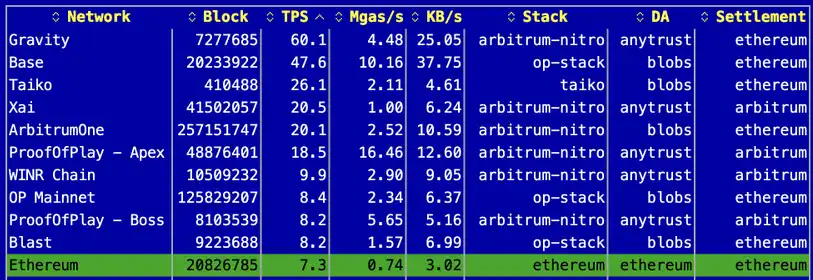
Although the high cost of on-chain operations may lead to a slight decrease in demand, Galxe's scaling trend indicates that demand may increase to two to three times the current level during peak hours. Additionally, with the inclusion of other use cases such as NFTs, token rewards, and future whole-chain tasks supported by zero-knowledge proofs, if Galxe were to fully on-chain, the throughput demand is expected to reach 50 million gas/s. Assuming that the application gas usage on the Gravity chain follows a Pareto distribution (similar to Uniswap always consuming 10% of Ethereum's gas), to meet the broader ecological needs such as cross-chain settlement, loyalty point transactions, and the NFT market, ideally, support for a throughput of 500 million gas/s is required. Therefore, to meet these potential demands, the blockchain must have a processing capacity of 1 gigagas per second to ensure it can adapt to the scaling of resource-intensive applications.
To achieve such high throughput, the key is to introduce a parallel EVM. We have developed Grevm, which is the fastest open-source parallel EVM execution system currently available. The specific performance can be seen in the following sections.
Sub-second Confirmation Time
Besides throughput, the confirmation speed of transactions is also crucial for user experience. Modern users are accustomed to almost instant responses similar to Web2, which is still a challenge for blockchain. Taking Galxe as an example, it is similar to fully on-chain games and has certain requirements for low latency. Currently, the transaction confirmation time of most EVM blockchains ranges from seconds to days, far from meeting this requirement. We have chosen the AptosBFT consensus algorithm to achieve sub-second confirmation time.
Although L2 Rollups theoretically can increase throughput, their challenge period can cause transaction delays, which is highly disadvantageous for applications requiring instant transaction confirmation (such as Galxe). While some DApps try to optimize this through trust models or external monitoring, it introduces additional complexity and risk, which is not ideal for critical applications. The Gravity SDK, by designing a five-stage pipeline, parallelizes the consensus and execution processes, closing the performance gap between L2 and L1 (see specific design details in the following sections).
PoS Security Based on Restaking
The Gravity SDK provides a secure way to scale Ethereum, not limited to L2 Rollups, but instead opting for an L1 architecture protected through restaking, balancing performance, interoperability, and security. The core module integrates restaking protocols such as EigenLayer and Babylon, providing economic trust support, safeguarding the construction of a robust proof-of-stake consensus.
With Ethereum's $450 billion staked assets and 850,000 validators, along with access to Bitcoin's $6 trillion assets through Babylon, Gravity can establish a strong security foundation from the outset, avoiding common launch issues and security vulnerabilities in new blockchains, while also reducing long-term systemic risks associated with a single asset.
Gravity Chain Architecture
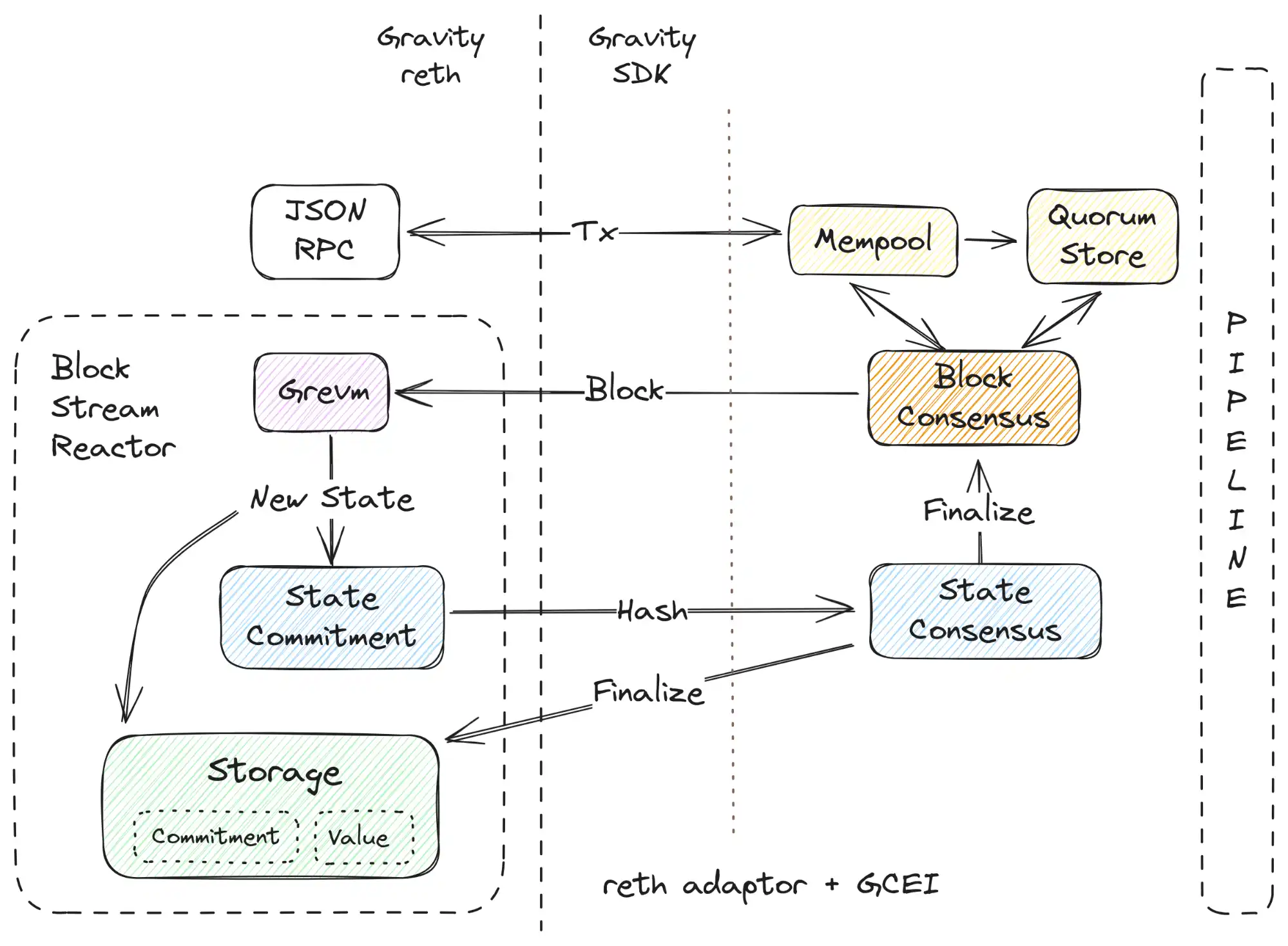
The Gravity Chain consists of two main components: the Gravity SDK and Gravity reth. The Gravity SDK is an enhanced blockchain framework based on the Aptos chain, Aptos being the most advanced PoS blockchain based on the HotStuff consensus algorithm family, with a pipeline architecture that significantly improves throughput and resource efficiency. Gravity reth, based on reth, operates as the execution layer in the form of a BlockStream Reactor (BSR) to receive proposed blocks from the consensus layer. By optimizing reth, Gravity reth achieves parallel execution, batch asynchronous state submission calculations, and storage efficiency improvements. These two components are closely integrated through the Gravity Consensus Engine Interface (GCEI) and reth adapter, dynamically managed by the pipeline controller to progress through each stage.
This design separates block execution from block consensus, with the execution layer consuming proposed blocks. Our optimizations of reth make it perfectly suited for the pipeline block proposal process managed by the BlockStream Reactor (BSR).
The transaction process of Gravity Chain is as follows:
1. The transaction is submitted through the Gravity Reth JSON RPC interface, which is fully compatible with Ethereum.
2. Subsequently, the transaction enters the memory pool of Gravity SDK and propagates in the network. Validators batch process the transactions and generate a Quorum Store (QS) certificate.
3. The leader of each round proposes a block, which includes block metadata and ordered transactions selected from the memory pool and QS.
4. Once the proposal is marked as ordered, it enters the execution layer.
5. The Grevm in the execution layer processes transactions in parallel, generates execution results, and passes the new state to the state management module.
6. The state module calculates the state root and passes it to the consensus engine to achieve state root consensus.
7. After the state root is finally confirmed, the storage module persists the state root and block data.
The following sections will detail each component.
Gravity SDK: Innovative Practice of Open-Source Pipeline Blockchain
Gravity SDK is a modular open-source blockchain framework based on production-ready Aptos blockchain development. Its goal is to modularize the architecture of Aptos, leveraging proven components such as Quorum Store and AptosBFT consensus engine to build the first pipeline blockchain SDK.
The reasons Gravity SDK chooses Aptos as the foundation include:
· Top-notch technical architecture: Aptos is an advanced PoS blockchain based on the HotStuff family of consensus.
· Ultimate performance: Aptos provides throughput of 160,000 transactions per second and finality in less than 1 second.
· Battle-tested reliability: Aptos has been validated in production environments, demonstrating outstanding stability and efficiency.
· Avoid reinventing the wheel: Leveraging the mature architecture of Aptos can avoid the complexity and potential risks of developing from scratch, while most attempts to surpass Aptos are mostly theoretical and lack practicality.
· Synergistic benefits: As Aptos continues to evolve, Gravity SDK can seamlessly integrate its new features, such as random number API, while also feeding back to Aptos through a modular architecture and innovative security mechanisms.
Blockchain based on the Gravity SDK interfaces with the Pipeline Consensus Engine through the Gravity Consensus Engine Interface (GCEI). Although GCEI is compatible with multiple execution layers, the Gravity SDK currently mainly supports Gravity Reth. More details about GCEI will be discussed in subsequent chapters.
Gravity Consensus Engine Interface (GCEI)
The GCEI (Gravity Consensus Execution Interface) protocol is a communication bridge between the consensus layer and the execution layer. It standardizes the interaction between the two layers, ensuring that consensus and execution processes remain synchronized through the Pipeline Controller.
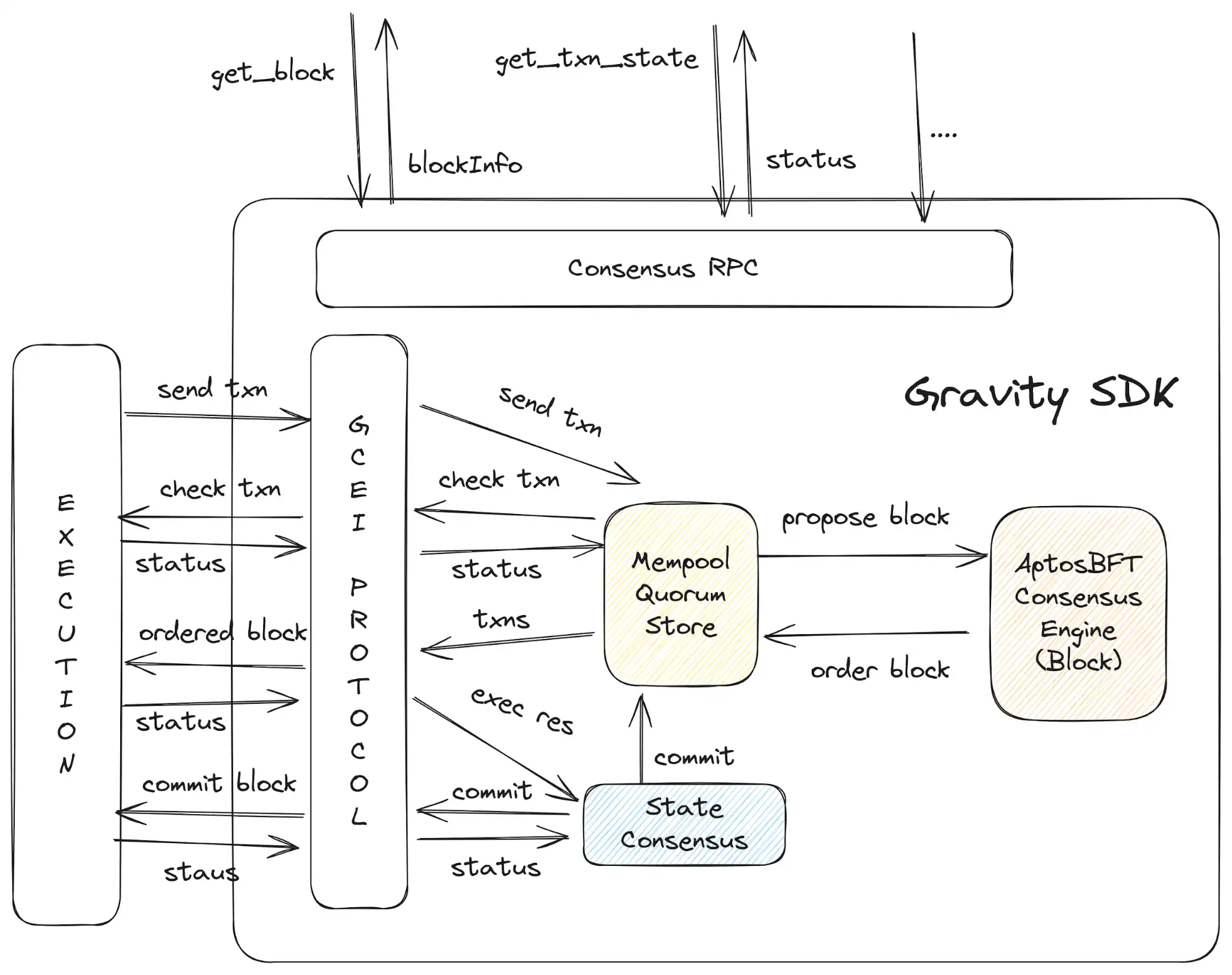
The main difference between a traditional blockchain SDK and the Gravity SDK lies in its pipelined consensus engine. The execution layer must be implemented as a Block Stream Reactor, meaning it needs to be able to continuously consume the proposed block stream, and the state commitment must be asynchronously computed from transaction execution. Additionally, the execution layer needs to provide backpressure signals to the consensus layer to dynamically adjust the pace of block proposals.
Furthermore, due to the pipelined nature of the Gravity SDK, the execution layer must be able to handle non-executable transactions in proposed blocks, as the mempool cannot strictly validate the validity of any transactions due to lack of access to the latest world state: the execution may not have completed. Also, the execution results should not block the generation of subsequent blocks because, with the parallelization of block consensus and state consensus in the Gravity SDK, the execution layer becomes a reactor to the proposed block stream, free to return execution results in subsequent stages.
The GCEI protocol defines two sets of APIs:
· Consensus Layer API: These APIs are implemented by the Gravity SDK and are used for the execution layer to respond to the consensus engine's proposed block and submit a state commitment.
· Execution Layer API: These APIs must be implemented by the execution layer. The consensus engine will use these APIs to attempt to validate, streamify the proposed block before turning transactions into blocks, and inform the execution layer of the final state commitment.
From a transaction lifecycle perspective, the GCEI protocol defines the following:
1. check_txn (Execution Layer API)
· Input: Receives a transaction (GTxn) as input.
· Output: Returns the sender's address, nonce, and gas limit of the transaction.
Purpose: This method is used by the consensus engine to perform best-effort validation before proposing the transaction to a block. This method can be called multiple times for the same transaction, such as when the transaction enters the mempool, before being proposed to a block, and when the state commitment is finally determined.
2. submit_txn (Consensus Layer API)
Input: Receives a transaction (GTxn) from the execution layer.
Output: Returns Result<()>, indicating whether the transaction was successfully added to the mempool.
Purpose: The execution layer can use this method to submit a transaction to the mempool. The consensus engine will then propagate the transaction over the network and form a Quorum Store upon receiving a batch of transactions.
3. recv_ordered_block (Execution Layer API)
Input: Receives an ordered_block (of type BlockBatch) containing sorted transactions and block metadata.
Output: Returns Result<()>, indicating whether the execution layer successfully received and accepted the block.
Purpose: Once the consensus engine proposes a block, it is sent to the execution layer for transaction execution. This method allows the execution layer to receive and process the proposed block.
4. update_state_commitment (Consensus Layer API)
Input: State commitment of a specific block number (StateCommitment).
Output: Returns Result<()>, indicating whether the state commitment was successfully accepted by the local consensus engine.
Purpose: After the execution layer computes the state commitment, it sends it to the consensus layer for finalization, achieving a lightweight consensus of 2f+1 with other validators. If the state commitment consensus is significantly behind the proposed block's progress, the pipeline controller will adjust the pace of block proposal.
5. commit_block_hash (Execution Layer API)
Input: Receive a vector of block_ids representing the blocks to be submitted.
Output: Return a Result<()> indicating the success or failure of the operation.
Purpose: When the state commitment is ultimately determined, the consensus layer will notify the execution layer to submit the block hashes to the blockchain storage.
Blockchain Pipeline
The Gravity SDK uses a five-stage pipeline architecture to maximize hardware resource utilization, achieving higher throughput and lower latency. The pipeline interleaves tasks between different blocks, and the pipeline manager uses feedback mechanisms to ensure the steady progress of the blockchain. The first three stages belong to the consensus layer, while the last two stages belong to the execution layer.
Each stage is explained as follows:
· Stage 1: Transaction Propagation: In this stage, transactions are efficiently propagated among validators to ensure timely and reliable inclusion of transactions during block construction. The design decouples transaction propagation from the consensus mechanism, following the ideas of Narwhal & Tusk and Aptos, where validators continuously share batches of transactions, leveraging all network resources to run concurrently. When a batch of transactions receives 2f+1 weight signatures (forming PoAv, i.e., availability proof), it ensures that the batch of transactions is stored by at least f+1 honest validators, allowing all honest validators to retrieve these transactions for execution.
· Stage 2: Block Metadata Ordering: In this stage, a consensus and universally recognized order of transactions and block metadata is established within the network. The consensus mechanism (AptosBFT) follows the double-chain rule to provide Byzantine fault-tolerant blocks. The blocks subsequently flow into the execution stage, ready for parallel processing.
· Stage 3 (BSR): Batched Sequential Transactions: This stage is part of the execution layer, where transactions are executed in parallel. The execution results are delivered to the state commitment stage.
· Stage 4: State Commitment: In this stage, the state changes caused by transaction execution are finalized, and block finality is prepared. State commitment and transaction execution are asynchronous computations, ensuring that the execution of the next block is not hindered by the current block's state commitment.
· Phase 5: State Persistence: This phase persists the committed state changes to the blockchain storage. The final state root and related data are stored in the Gravity Store, which utilizes a highly optimized storage engine designed for fast and reliable access. It also notifies the mempool and Quorum Store to clear transactions that can no longer be included in the future.
Staking and Restaking Module
Building a secure Proof of Stake (PoS) Layer 1 blockchain is a complex task, especially when relying solely on on-chain specific token staking. This approach may face issues of insufficient economic security in the early stages, such as token price volatility or limited validator participation. To address this challenge, the Gravity SDK provides a flexible Staking and Restaking module aimed at enhancing network security through on-chain and off-chain staking mechanisms.
One of the key strategies of the Gravity SDK is the introduction of protocols like EigenLayer and Babylon for Restaking. These protocols allow validators to restake assets from other mature networks (such as Ethereum and Bitcoin), leveraging their existing security. By enabling validators to stake assets from these chains, the Gravity SDK enhances the network's economic security without relying solely on the native token. This approach not only strengthens the network's resilience but also promotes diversity in the validator ecosystem. The design of the Staking module is centered around modularity, with the Restaking component being highly flexible to easily adapt to new Restaking protocols as the blockchain ecosystem evolves.
This module not only supports restaking assets but also enables staking custom ERC20 tokens on supporting chains, such as the G Token on Ethereum. Validators can participate in consensus by staking these permitted tokens, contributing to the network's security. Validator voting power is calculated based on their total staked value, including custom tokens and assets from Restaking protocols. This calculation is specific to each chain's configuration, ensuring that each chain can flexibly set staking and restaking rules based on its unique requirements.
The Epoch Manager in the Consensus Engine collaborates directly with the Staking module to calculate the weight of the next round's validator set. It ensures that the consensus process accurately reflects the latest staking dynamics by fetching stake values from the execution layer. In this architecture, cross-chain assets (such as staked assets from Ethereum) must first be bridged to the execution layer before they can be used to calculate the total validator stake. The implementation of the bridging mechanism is the responsibility of the execution layer, allowing for more flexibility in handling cross-chain communication. Possible solutions include a PoS bridge, zero-knowledge proofs of chain state, and embedded interchain message passing for bootstrapping.
More technical details, API designs, and a full explanation of the Staking and Restaking mechanisms will be elaborated on in upcoming documents.
Gravity Reth: Block Stream Reactor EVM Execution Layer
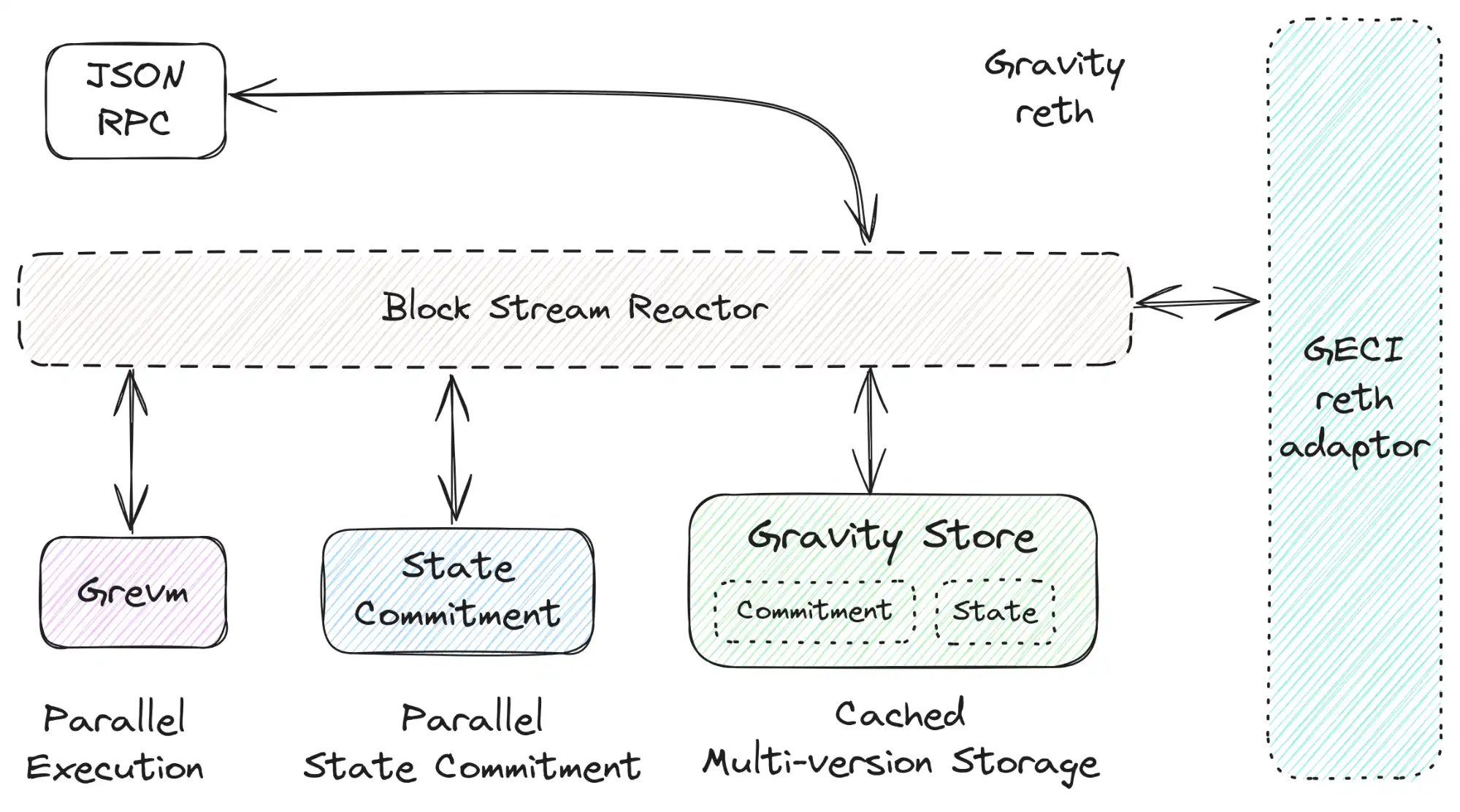
Integrating the Ethereum Virtual Machine (EVM) execution layer into the Gravity SDK architecture presents unique challenges, especially when fully leveraging its pipelined consensus engine capabilities. To seamlessly integrate and unlock the potential of this architecture, we need to make several key optimizations to the open-source Ethereum client, reth. These optimizations fundamentally transform reth into Gravity reth, a pipelined-optimized EVM execution layer tailored for the pipelined consensus engine.
Traditional blockchain architectures process blocks sequentially, ensuring that each block is fully validated and executed before proposing the next block. However, the Gravity SDK adopts a pipelined consensus mechanism that separates the block processing into various stages to enhance performance. This paradigm shift introduces complexities:
Out-of-order Transactions: In a pipelined chain, the latest world state may not be accessible in the mempool due to pending executions from previous blocks. Therefore, transactions included in the proposed block may not be executable at the time of proposal because their validity cannot be strictly verified without the latest state.
Non-Blocking Execution Results: To prevent pipeline stalls, the execution results should not block subsequent block generation. The execution layer must asynchronously handle proposed blocks and return execution results in a later stage without hindering the consensus process. For EVM, this entails redefining the blockhash and eliminating reliance on the stateRoot field in the block header.
To address these issues, we have introduced four key optimizations:
· Block Stream Reactor (BSR): The BSR aims to adapt reth for the pipeline block proposal flow of the Gravity SDK. It enables the execution layer to continuously consume the proposed block stream as a reactor for asynchronous block processing. The BSR establishes a dynamic feedback loop with the consensus engine, incorporating appropriate backpressure signals. These signals adjust real-time block proposal and state submission speeds based on the execution layer's throughput and latency. If the execution layer lags due to complex transactions or resource constraints, the backpressure mechanism reduces the block proposal rate to ensure system stability.
· State Submission and Transaction Execution Decoupling: The second optimization involves decoupling state submission computation from transaction execution. By decoupling these processes, we have achieved the asynchrony of state submission computation, allowing subsequent block execution to proceed without waiting for the completion of state submission in the current block. We have redefined the blockhash, eliminating reliance on the stateRoot field in the block header, ensuring that state root computation does not stall the generation of subsequent blocks.
· Storage Layer Optimization: In a pipeline architecture, efficient caching and persisting of multi-version state values and state submission are crucial. The third optimization focuses on enhancing the storage layer to meet these requirements without introducing bottlenecks. By optimizing the storage mechanism, we ensure that state data can be rapidly written and concurrently retrieved. This includes building a multi-version storage engine and supporting asynchronous I/O from the database to the storage API.
· Parallel EVM: The final optimization involves parallelizing transaction execution within the EVM. We have developed Grevm, a parallel EVM runtime that significantly accelerates transaction processing through concurrent transaction execution. Grevm leverages data dependency hints obtained from transaction simulation to optimize parallel execution, reducing transaction re-executions and increasing throughput.
Grevm (Gravity EVM) - Parallel EVM Execution
Grevm is an open-source project hosted on GitHub (if not open-sourced yet, it will be in the future). Please refer to its README for more information.
Grevm (Gravity EVM) is an open-source parallel EVM runtime based on revm. Grevm's algorithm is inspired by BlockSTM and is enhanced by introducing a transaction data dependency graph obtained from simulation results. This mechanism makes parallel execution scheduling more efficient, minimizing transaction re-executions.
In our benchmarking, Grevm is currently the fastest open-source parallel EVM implementation. For conflict-free transactions, Grevm is 4.13 times faster than sequential execution, achieving a speed of 26.50 gigagas/s. When simulating real-world 100 μs I/O latency, its speed is 50.84 times that of sequential execution, with a throughput of 6.80 gigagas/s. This performance leap is attributed to the integration of parallelized execution and asynchronous I/O operations—parallelization allows I/O operations to effectively overlap, further accelerating performance.
The core idea of Grevm is to leverage data dependencies between transactions to optimize parallel execution through speculative transaction read/write sets. Although not all hints are entirely accurate, these simulation-based hints are typically practical. For example, on the Ethereum mainnet, based on historical Gas usage, approximately 30% of transactions are simple Ether transfers, and another 25%-30% are ERC20 token transfers, which usually only involve reading from and writing to a limited number of accounts and storage slots. For these transactions, simulation results are consistently accurate.
Building on these insights, we developed a three-stage parallel execution framework for Grevm as a follow-up to the Block-STM model and integrated data dependency hints obtained from transaction simulation:
· Stage 1: Hint Generation and State Preloading—Simulate transactions to collect dependency hints and pre-warm the memory cache. This stage can be executed at different times depending on the blockchain's design. For example, when new transactions arrive in the mempool, simulation can be run immediately to prepare dependency hints in advance.
· Stage 2: Dependency Analysis—Convert the dependency hints collected during the simulation stage into a directed acyclic graph (DAG) representing the dependency relationships between transactions. This DAG is used to plan transaction scheduling for subsequent parallel execution.
· Stage 3: Parallel Execution Under Conflict Resolution—Utilize a modified version of the BlockSTM algorithm based on the dependency DAG to execute transactions in parallel. The scheduling order no longer strictly follows the sequence number of transactions in the block (e.g., 1, 2, 3, ..., n) but prioritizes transaction ordering based on the DAG to minimize conflicts and reduce the need for re-execution.

Asynchronous Batch State Commitment
State commitment generation remains a key bottleneck in the blockchain pipeline, stemming from the inherently sequential nature of Merkleization. The final state commitment cannot be generated until each subtree computation is completed, leading to significant delays. Although existing solutions (such as reth's account-level parallelism) have introduced some degree of parallelism, there is still ample optimization space. In the context of Gravity reth's Block Stream Reactor (BSR) execution layer, decoupling state commitment consensus from transaction execution allows for asynchronous deferred and batched state commitment computations without blocking execution.
In order to address these issues, the proposed framework introduces the following key innovations:
Asynchronous Batch Hashing: By decoupling state commitment from transaction execution, this framework achieves asynchronous computation of state commitment. State root updates are batched (e.g., computed every 10 blocks) to reduce the frequency of state root computation. This batch processing approach leverages aggregated shared dirty nodes for efficient hash calculation, minimizing the overhead of frequent updates and reducing overall computation costs. For small blocks, batch processing can significantly increase parallelism; for large blocks, it can reduce overall computation costs.
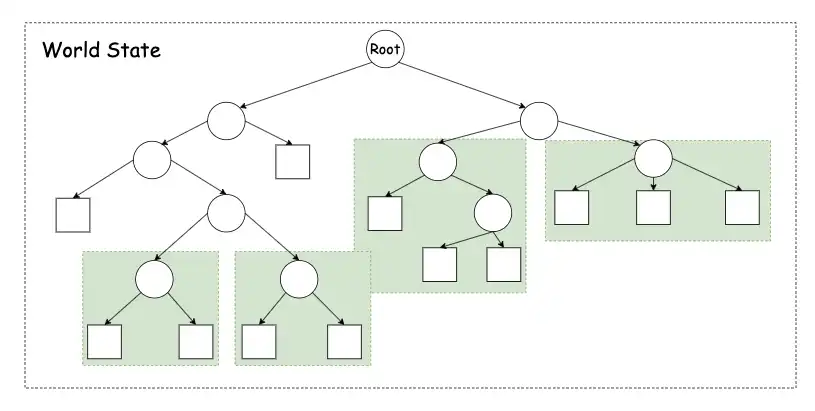
Full Parallelization: This framework extends parallelization to the entire state tree, not just individual account trees. For nodes flagged as "dirty," the framework employs a parallel state computation algorithm that partitions the tree into independent subtrees and processes these subtrees concurrently. The results are aggregated at the top level for efficient computation of the final root. This method ensures that large blocks with a high volume of transactions and state changes can fully utilize multi-threading, maximizing throughput.
Alternative Fast State Roots: To accommodate Ethereum's block header and BLOCKHASH opcode (which requires access to the state root of the most recent 256 blocks), we have redefined the state root. Unlike relying on a final state commitment (unavailable during transaction execution), we calculate the state root as a combination of the block's change set and the hash of the previous state root. This approach speeds up state root computation without waiting for a complete state commitment.
Gravity Store
To meet the scalability needs of high-performance blockchains for large-scale data management, Gravity Store has emerged as an optimized multi-version storage layer. Building on reth's design, which separated state commitment storage from state data storage to reduce state bloat and lower data read/write overhead, Gravity Store takes this further to support parallel processing and asynchronous state commitment, introducing additional technical requirements.
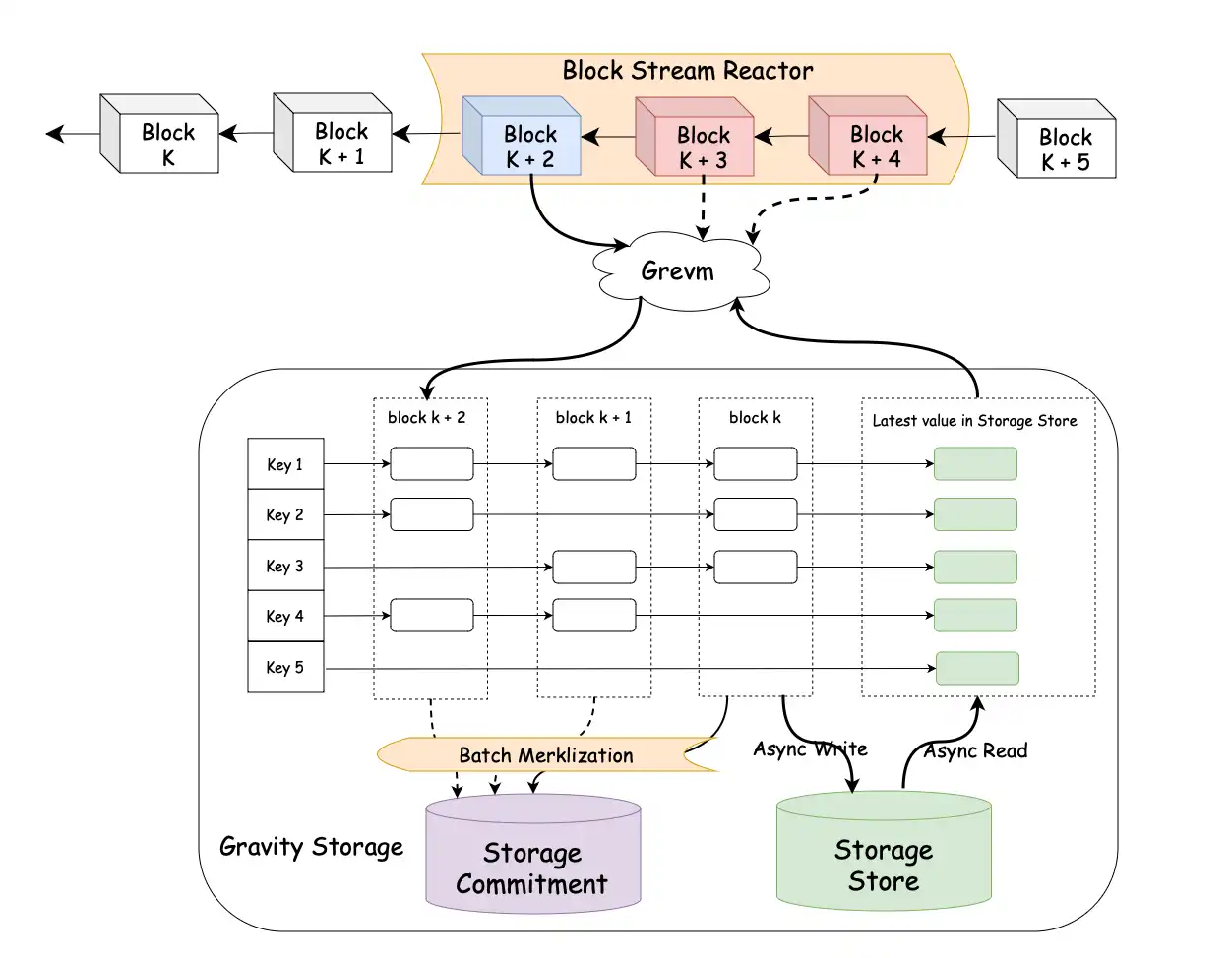
To address these challenges, Gravity Store presents an efficient multi-version tree structure tailored specifically for our BSR (Block Stream Reactor) architecture. This tree structure supports managing multi-version state updates. Unlike the traditional approach of immediately updating the hash value after a modification, Gravity Store marks the modified nodes as "dirty nodes," enabling deferred processing and batch execution of hash calculations. This design allows for the rapid creation of new versions, efficient querying of specific version data, and clean-up of old versions below a specified height, significantly improving blockchain state management performance.
We are also researching the independent development of the Gravity DB storage engine, which is designed to provide an optimized storage layer for blockchain applications and support fully asynchronous I/O operations. The design of this engine is inspired by LETUS, a high-performance log-structured general-purpose database engine for blockchain. Our Chief Developer, Richard, as one of the main authors of LETUS, will provide a detailed introduction to its design in an upcoming blog post.
Conclusion
Gravity Chain is a high-performance EVM-compatible Layer 1 blockchain designed to meet the scalability and performance needs of modern web3 applications. By combining the Gravity SDK, the pipelined AptosBFT PoS consensus engine, and the Block Stream Reactor execution layer driven by Grevm, Gravity achieves a transaction throughput of 1 gigagas per second, sub-second transaction confirmation times, and PoS security based on a re-delegation mechanism. The design of these technological components provides a solid foundation for web3 applications to create custom alternative L1 blockchains or more efficient L2 solutions, especially suitable for optimizing the use cases of EVM chains.
This article is contributed content and does not represent the views of BlockBeats
関連記事

コインデスク20のパフォーマンスアップデート:Uniswap (UNI) 1.5%下落し、インデックスは低調
Key Takeaways 最近のコインデスク20インデックスは2993.52で、前日比0.5%の下落を記録。 Uniswap (UNI)とHedera (HBAR)は主要な落後者で、それぞれ1.5%と1.4%の減少。 一方、SUIとPOLは上昇を見せ、特にSUIは週初から上昇を記録。 KuCoinは2025年に1.25兆ドルを超える取引量で市場シェアを記録。 WEEX Crypto News, 2026-01-07 14:49:40 コインデスク20インデックスの概要 コインデスク20は、仮想通貨市場において主要な暗号資産の動向を反映する指数であり、広範に取引されている資産を対象としています。このインデックスは、グローバルな視点で見ると様々なプラットフォームでの取引が行われており、市場の全体的なトレンドを把握するのに非常に有用です。特に2026年の1月の始まりにおいては、ユニスワップ(Uniswap、UNI)が1.5%の下落を記録し、継続的に注目されています。 最近の市場動向 コインデスク20は2993.52で推移しており、これは前日の火曜日午後4時に比べて0.5%、具体的には15.41ポイントの下落を示しています。この下落にはいくつかの要因が絡んでいますが、特にわかりやすいのは、主要な暗号資産の中でもユニスワップ(UNI)のように急激に価値が下がったものがあることです。これに対して、SUIやPOLといった資産はそれぞれ1.1%と0.8%の上昇を見せ、数少ない好調な動きを示しました。 UNIの下落は、市場の全体的な動きとリンクしていますが、その原因は複数にわたり、特に仮想通貨市場全体の不安定な動き、収益の確保が難しい状況、あるいはより大きな市場環境の変化が影響している可能性があります。…

Babylon Labsがa16z cryptoから$15Mを調達し、Bitcoinの担保インフラを開発
Key Takeaways Babylon Labsがa16z cryptoから1500万ドルを調達し、Bitcoin担保用インフラ「BTCVaults」の開発とスケールアップを進行中。 この資金は、Bitcoinをネイティブの形でチェーン上の担保として利用可能にするための技術と、外部アプリケーションとの統合を支援するために使用される。 BTCVaultsは、カストディアンやラップされたBitcoinを必要としない点で、市場に新たな可能性を提供。 既存の金融システムと連携することが可能で、Bitcoinを自己管理したまま担保として活用することを促進。 WEEX Crypto News, 2026-01-07 14:49:43 Babylon LabsがBitcoin担保インフラで切り開く未来 資金調達と今後の展望 2026年1月7日、Babylon Labsは、Bitcoin担保インフラである「BTCVaults」を開発するためにa16z…

Rumble、Tetherと提携して暗号ウォレットを導入し、BTC、USDT、XAUTでのサポートが可能に
Key Takeaways RumbleがTetherと協力して、視聴者がコンテンツ制作者にBTC、USDT、XAUTでチップを贈ることができる非カストディアルな暗号ウォレットを導入しました。 この新しいRumble Walletは、視聴者が銀行やクレジットカード会社を通さずに直接デジタル通貨でチップを贈ることができる機能を提供します。 Rumble WalletはTetherのWallet Development Kitを使用して構築されており、クリエイターに広告収入やサブスクリプション収入に依存しない新しい収入源を提供します。 TetherのCEOパオロ・アルドイーノは、このウォレットを「より多くの分散化された自由を守るツール」へのステップと位置付けています。 Rumbleの株価は、ウォレット発売後に若干上昇しましたが、前年同期比で依然50%低い水準です。 WEEX Crypto News, 2026-01-07 14:49:42 暗号ウォレットの登場とその背景 2026年1月現在、RumbleとTetherの共同プロジェクトである新しい暗号ウォレット「Rumble…

Filecoinの低下と仮想通貨市場の後退
Filecoin (FIL)は過去24時間で3.6%下落し、弱い仮想通貨市場全体の影響を受けています。 CoinDesk 20 Indexも3.6%下落し、Filecoinの価格変動に影響を与えています。 Filecoinの取引量は30日移動平均を30%上回りましたが、方向性の確証を示す閾値には到達しませんでした。 抵抗点$1.60付近での急激な反落が発生し、サポートは$1.52に確立されました。 価格はその後、$1.59-$1.60の抵抗ゾーンを複数回再試ししましたが、その間に参加は減少しました。 WEEX Crypto News, 2026-01-07 14:49:42 Filecoinと市場動向の詳細 Filecoinの最近の価格動向 仮想通貨市場全体が変動を見せる中で、特にFilecoin (FIL)の動きが注目されています。Filecoinは過去24時間で3.6%下落し、価格は$1.5399となりました。この動きは、CoinDesk 20…

ブラジルの元中央銀行役員が実利に連動した利回りシェア型ステーブルコイン発表
ブラジル・レアルに連動した新しいステーブルコイン「BRD」が発表されました このコインはブラジル国債を裏付け資産とし、15%に達する現地の高い利率を投資家に提供 外国投資家にとってのブラジルの利回り市場アクセスの障壁を取り除くことが狙い BRDは既存ステーブルコイン市場において差別化を図るため、政府の債務から得た利子をホルダーと共有 WEEX Crypto News, 2026-01-07 14:49:40 新しい資産クラスとしての利回りシェア型ステーブルコイン 2026年1月7日、ブラジルの元中央銀行役員であるトニー・ヴォルポン氏が新たなフィナンシャルプロダクト「BRD」を発表しました。BRDは、ブラジル・レアルに連動したステーブルコインであり、ブラジル国債を裏付け資産としてレアルとの交換性を維持するものです。この新しいトークンは、特に金利の高いブラジル市場に興味を持つ国際的な投資家にとってのアピールポイントとなっています。現在、ブラジル中央銀行が設定する基準金利は15%とされています。これに対して、アメリカ連邦準備制度理事会の目標金利はわずか3.5%から3.75%です。 ブラジルの高金利環境は長年国際投資家から注目されてきたが、その利回りにアクセスすることは規制や通貨の摩擦、そして国内のインフラによって制限されてきました。ヴォルポン氏はCNNブラジルの番組「クリプト・ナ・レアル」において、「ブラジルの金利でステーブルコイン保持者に報酬を与える能力は、特に機関投資家にとって大きな引力となります。」と述べています。また、このステーブルコインはブラジルの債務への需要を支え、投資家の基盤を拡大することによって、国内の借り入れコストを潜在的に下げる可能性があると付け加えました。 投資家のための新たな道を提供 BRDの狙いは、ブラジルの高利環境をより多くの外国人投資家に対して開かれたものにすることです。これまで、ブラジルの利率は多くの国際的な関心を引いてきましたが、規制や通貨摩擦、国内インフラによってこれらの利益にアクセスすることが難しい状況でした。 「ブラジルの金利を享受できるのは、特に機関投資家に対して大きな魅力」とヴォルポン氏は述べています。このようなステーブルコインの発行は、ブラジルの債務に対する需要を支えると同時に、より大きな投資家基盤を提供することで国内の借入コストを下げる可能性があります。 競争激化するステーブルコイン市場における差別化 BRDは、すでに存在するステーブルコイン市場に対抗するため、市場に出回る計画です。この市場は、すでにTransferoのBRZという185百万ドルの市場価値を持つコインや、51百万ドルのBBRL、そしてブラジルの取引所Mercado BitcoinやBitsoなどが関与するBRL1、CeloブロックチェーンネイティブのcREALといった競争者が存在しています。…

暗号市場の今日: Bitcoinの滑落、アジア主導の売却でaltcoinsに打撃
Key Takeaways Bitcoinは、$94,500を突破できず、アジアの取引時間中に価格が下落し、暗号市場全体を引き下げました。 Altcoin市場はBitcoinよりも大きな影響を受け、PENGUやXRPなどで特に大きな下落が見られました。 暗号先物市場での長ポジションの清算が活発で、現状の持続は牛市ポジショニングを示していますが、取引所間では未だに不透明な状況です。 DeFiセクターは、暗号資産の価格が下がる中でもポジティブな流入を示し、一部で回復の兆しがあります。 TRXは市場全体の下落に反して、過去24時間でわずかに上昇しました。 WEEX Crypto News, 2026-01-07 14:51:40 Bitcoinとその価格動向 2026年1月7日、Bitcoinはアジアの取引時間中に、価格が再び下落しました。これは、過去5週間で$94,500の水準を突破しようとした3度目の試みが失敗に終わったためです。この結果、市場は盛り上がりを見せていた価格帯から押し戻され、12月の変動を反映した状態に戻りました。Bitcoinは$91,530にまで下落し、それに伴い広範な暗号資産市場も大幅に下落しました。市場にはよりリスクを避ける動きが見られ、これが下げ圧力を増大させました。 取引に影響を与えたもう一つの要因は、アメリカの株先物が取引前に0.32%の下落を示したことです。このようなマクロ経済要因の影響は、Bitcoinを含む複数の暗号資産に波及し、投資家はリスク回避の姿勢を強めています。 Altcoin市場の急激な変動 今回の下落の中で、Bitcoinのあとに続いたのはさまざまなaltcoinでした。特にPENGUが6.5%の下落、XRPは3.5%の下落を見せました。これは、MemecoinやPrivacy Coinといったセクターが最も大きな影響を受けたためです。CoinDeskのMemecoin…

Ripple、再度IPOを否定、バランスシートが非公開を維持する余裕を提供
Key Takeaways Rippleは2025年11月に5億ドルを調達し、企業価値は400億ドルに達したが、IPOの計画はない。 現在も非公開会社であり続け、投資家からの有利な条件での資金調達が成されている。 2025年、4つの企業買収を完了し、企業向けデジタル資産インフラのプロバイダーになることを目指す。 Rippleの戦略は、従来の金融が安定したコインやトークン化資産を実社会で利用可能にするための製品開発に集中している。 WEEX Crypto News, 2026-01-07 14:51:41 RippleのIPO計画と現状 Rippleは、暗号通貨業界で多くの注目を集めている企業である。2025年11月に行われた資金調達では、Fortress Investment GroupやCitadel Securitiesを含む著名な投資家から5億ドルを調達し、その企業価値は400億ドルと評価されている。しかし、Rippleは依然としてIPO(新規株式公開)の予定はないと発表している。これは、同社の社長であるMonica Long氏が、Rippleの財務状況が公的市場に頼ることなく成長を支えるのに十分であると述べたことによる。 Rippleの資金調達戦略…
Strategy’s STRC perpetual preferred stock returns to $100 and may trigger increased Bitcoin buying
Key Takeaways: Strategyの永続優先株式STRCが、11月初旬以来初めて100ドルに到達。 この価格回復により、Strategyは市場で株式を発行し、ビットコイン購入資金を調達可能。 STRCは短期間高利回りのクレジットとして販売され、現行の年間配当率は11%。 STRCの配当率は1月の開始時に11%に引き上げられ、株価の安定化を図る。 WEEX Crypto News, 2026-01-07 14:51:41 STRCの価格回復と市場への影響 ビットコイン保有で著名な企業、Strategy(MSTR)が発行する永続優先株式であるSTRCが、11月初旬以来初めて100ドルのパー値を回復しました。この価格上昇は、同社が市場で株式を販売し、その資金を使ってさらなるビットコイン(BTC)を購入するための道を開く可能性があります。STRCは11月4日から13日の間の取引以来、90ドル近辺まで価格が下落していましたが、今回の回復は投資家にとって新たな可能性を提供します。 STRCの配当率と投資価値 STRCは短期間高利回りのクレジット商品として市場に登場しています。現行の配当率は11%で、毎月キャッシュで分配されます。この配当率は毎月リセットされ、株価を100ドル前後に保つことを目的としています。商品導入以来、STRCの価格は16%上昇しており、実質的な年間利回りは約11%に達しています。年間利回りは、現行配当をSTRCの株価で割って求められます。この値の上昇は、投資家に対して持続的な魅力を持たせる要因の一つとなっています。 STRCの配当率引き上げとその理由 1月の始まりに、MSTRはSTRCの配当率を11%まで引き上げました。これは、2026年から始まった年の初めに迎える五番目の配当引き上げとなります。この引き上げは主に投資家を引きつけ、株価の安定を図るために行われました。共に、この戦略が新たな投資家層を呼び込み、株式市場での動きを活性化させることを期待しています。STRCが示す安定した成果と配当率の引き上げは、投資家にとって潜在的な利益をもたらす可能性があります。 ビットコイン市場への波及効果…
年始の回復ラリー停滞:Crypto Daybook Americas
Key Takeaways マーケットの主要な仮想通貨であるBitcoin、XRP、Solanaは過去24時間で1.5%以上の下落を記録しました。 U.S.-listedのスポットBitcoin ETFでは、新年の取引初めの2日間で10億ドルを超える流入がありましたが、火曜日には2億4320万ドルの資金流出が見られました。 デリバティブ市場では、仮想通貨先物の累積オープンインタレストが2ヶ月ぶりの高水準に達し、リスクを取る投資家の意欲の再燃を示しています。 日本の長期国債の利回りは記録的な高値に達し、社会的な関心を引き起こしており、Bitcoinなどのリスク資産に影響を及ぼす可能性があります。 WEEX Crypto News, 2026-01-07 14:51:40 ビットコインと主要仮想通貨の動向 年始早々、Bitcoinをはじめとする主要な仮想通貨が市場で停滞感を示しています。例えば、Bitcoin(BTC)は過去24時間で1.66%の下落を見せ、価格は91,677.51ドルとなっています。同様に、Ethereum(ETH)も2.26%減少し、3,200.70ドルでの取引になっています。これらの動向は市場の不安定さを示しており、特に年初の勢いが失われ、上昇のモメンタムが鈍化していることを反映しています。 これに関連する要因として、人々はこの年始の市場の回復が本当に信念に基づく買い方によるものなのか、あるいは年明けの資金配分などの季節的な要因によるものかを疑問視しています。U.S.-listedのスポットBitcoin ETFにおいて、新年の取引初めの2日間で10億ドルを超える流入が注目されましたが、火曜日には2億4320万ドルが流出しており、市場には依然として不安定な要素が残っていることを示しています。 デリバティブ市場による支持 仮想通貨市場の進展のサインとして、デリバティブ分野での活動が再び活発化しています。仮想通貨先物のオープンインタレストは約2ヶ月ぶりの高水準に達し、投資家がリスクを取る意欲が再び高まりつつあることを示唆しています。また、ペイメントレート(取引所に支払う定常的な手数料)も改善しており、これは市場にとっての好材料です。「資金調達レートが一貫して0.01%以上であるとき、持続的な市場の上昇は起こりやすい」とのGlassnode社のリポートには、さらなるポジティブな見通しが書かれています。…

NikeがNFTとバーチャルスニーカーを売却:デジタルアート市場における関心の欠如を背景にした報告
Key Takeaways Nikeは、NFTおよびデジタルコレクティブル市場から撤退しつつも、物理的、デジタル、バーチャルな環境における新しい製品と体験に引き続き投資。 RTFKTの売却は、NFT市場の冷え込みが広がる中で行われ、業界全体が2021年の急成長からの縮小を経験。 NikeのRTFKT売却は、同社の新CEOエリオット・ヒルの下、スポーツ事業と卸売パートナーシップに再集中する戦略の一環。 NFT市場の収縮はNikeだけでなく、X2Y2やNFT Parisなどの業界イベントや企業にも影響を及ぼしている。 WEEX Crypto News, 2026-01-07 14:51:41 Nikeの新たな挑戦:NFTからの撤退 Nikeは、デジタルコレクティブルおよびNFT業界からの撤退を決定し、同社の注目製品として知られたRTFKTを売却しました。RTFKTは2021年のNFTブームの最中に購入され、デジタルスニーカーやブロックチェーンベースのプロダクトで知られるブランドです。この売却は昨年12月16日に行われましたが、買い手や取引の詳細は明らかにされておらず、Nikeはコメントを拒否しています。 この動きは、NFT市場全体の冷え込みに対する反応として位置づけられています。2021年の市場拡大期から一転し、取引量の急激な減少に伴い、多くのプラットフォームやイベントが運営を停止しています。たとえば、X2Y2は市場の停滞を受けて閉鎖を発表し、かつて業界のフラッグシップイベントであったNFT Parisも2026年のイベントをキャンセルしました。 RTFKTの歴史と価値 NikeがRTFKTを取得したのは、デジタルアート市場が最も活気づいていた時期であり、スポーツウェアの巨人であるNikeは、デジタルコレクティブルやバーチャルスニーカー、ブロックチェーンを基盤とする製品の領域に拡大しました。RTFKTはアーティストとのコラボレーションを通じて、何度も数千ドルで販売されるデジタルスニーカーをリリースし、すぐにNFT業界で最も注目されるブランドの一つとなりました。…

Barclays、トークン化されたインフラを進化させるStablecoin Settlement Firmに投資
Key Takeaways Barclaysが、米国のスタートアップUbyxに投資を行い、トークン化された決済インフラを支援する。 Ubyxは、発行者と金融機関間でトークン化された資金を移動させるための技術を開発中。 既存の金融規制内でのブロックチェーンベースの決済の基盤を確立するための動きが加速中。 2025年の市場動向としてKuCoinの取引量が急成長し、市場シェアを伸ばした。 ブラジルでは、国庫債務に裏付けられたリアルペッグのステーブルコインが発表された。 WEEX Crypto News, 2026-01-07 14:53:42 Barclaysの新たな金融戦略 英国の大手銀行Barclaysが、アメリカのスタートアップUbyxに資本投下を行ったことが話題を集めています。この投資は、銀行預金や規制されたStablecoinを含むトークン化されたお金のためのクリアリングシステムを開発するためのものです。このいわば「トークン化されたインフラ」は、発行者と金融機関の間でお金をデジタル形式で移送するための新たな道を開こうとしています。 Barclaysのこの動きは、既存の金融規制を遵守しつつ、ブロックチェーンを基盤とした決済システムを確立するための伝統的な銀行の関心が高まっていることを示しています。この流れの一環として、スイスのUBSやPostFinance、さらにはSygnum BankがEthereumを用いた概念実証を行い、一方でインターバンクメッセージングシステムのSwiftはオンチェーン決済のためのインフラを構築しています。 Ubyxの技術革新 Ubyxが開発している技術は、トークン化されたお金を発行者と金融機関の間で移動させるための共通の決済フレームワークを構築することを目的としています。このシステムは、ウォレットや銀行、支払いプラットフォームを通じて、名目価値でのトークン化された資金の交換と償還をサポートするよう設計されています。…

ヘッジファンドKaratage、IMCのベテランシェーン・オカラハン氏をシニアパートナーに任命
KaratageがShane O’Callaghan氏をシニアパートナーとして迎え、機関投資向け戦略の責任者に任命 O’Callaghan氏はIMCでの経験を活かし、革新的な戦略を推進 特殊技能を持つプロフェッショナルの加入により、Karatageの成長が加速される見込み ロンドンを拠点とするKaratageは、デジタル資産とブロックチェーン技術に重点を置いている WEEX Crypto News, 2026-01-07 14:53:41 Shane O’Callaghan氏の新たな役割 Shane O’Callaghan氏がロンドンを拠点とするヘッジファンドKaratageのシニアパートナーとして新たに加わることが発表されました。O’Callaghan氏は、これまでオランダのマーケットメイカーであるIMCで、機関投資向けのパートナーシップとデジタル資産の販売を統括していました。この経験を活かし、Karatageでは特に機関投資家向けの戦略を強化していく予定です。 彼の加入は、単なるポジションチェンジではなく、Karatageが次のステージに進むための重要な一歩です。Karatageの共同創設者でCEOのMarius Barnett氏は、「Shaneが安全を選んで我々に加わったわけではなく、内側から大胆で攻撃的かつ本当に革新的なものを作り上げる機会を得たからだ」と述べています。 ヘッジファンドのゾーン:Karatageの戦略 Karatageは2017年に設立され、デジタル資産、暗号資産に特化したファンドやブロックチェーン関連企業に投資を行っています。同社は、市場サイクルを通じて積極的に投資を行っており、特に構造的に金融や経済に大きな影響を与え得るテクノロジーとビジネスへ強力にサポートしています。…

Lloyds Bank Completes UK’s First Gilt Purchase Using Tokenized Deposits
Key Takeaways Lloyds Bank conducted the first gilt purchase in the UK using tokenized deposits, signifying a landmark…
Metplanetの評価がMSC Iの決定後、Bitcoin保有に対する3ヶ月ぶりの高値を記録
Key Takeaways Metplanetの評価は、前年10月の危機以来の高水準に戻った。 MSCIはデジタル資産を保有する企業をインデックスから除外しないと決定。 Strategy (MSTR)株はプレマーケットで5%上昇。 Metplanetは年初から20%の評価増を記録し、Bitcoin保有資産に対してプレミアム評価となっている。 WEEX Crypto News, 2026-01-07 14:53:41 DigitAsset企業に注目が集まる背景 Metplanetというデジタル資産を扱う企業が、MSCIというグローバルなインデックスを提供する会社の決定を受けて注目を集めています。MSCIは、デジタル資産を保有する企業をそのインデックスから除外しないと発表し、このニュースを起爆剤にMetplanetの評価は3か月ぶりの高値を記録しています。この背景には大きな不確実性の解消という要素があり、特にアメリカの同業他社にも好影響を与えています。こうした動きは一時的なものである可能性もありますが、デジタル資産保有企業への期待が高まる中で最も重要な出来事として位置づけられます。 MSCI決定による影響 Metplanetの評価が高まった主な理由のひとつは、MSCIの決定によるものでした。MSCIは、Bitcoinをはじめとするデジタル資産を保有する企業をそのグローバルインデックスから除外しないという方針を打ち出しました。この決定は、企業にとってのインデックス排除リスクを抑え、投資家に安心感を与えています。特に、昨年10月に見られたデジタル資産市場の急落以降、企業にとっては新たな不確実性の解消となります。 Metplanetとその評価 Metplanetは2026年に入り、株価が年初から20%も上昇しました。同社は現在、保有するBitcoinの価値以上に評価されており、mNAVは1.25と、前年の大きな市場変動以前に匹敵する高さにあります。これは、Bitcoinの保有比率に対する企業の評価が一時的な好材料で支えられていることを示しています。…

Morgan Stanleyの仮想通貨拡大:Ethereum Trustの登録申請
Key Takeaways Morgan StanleyはEthereum Trustの登録申請をSECに提出しました。 この動きは、ビットコインとソラナのETFの書類提出に続くものです。 同銀行は、2025年から仮想通貨へのアクセスを顧客に提供しています。 伝統的金融機関がデジタル資産を取り入れる動きが進行中です。 WEEX Crypto News, 2026-01-07 14:53:41 はじめに 2026年1月、金融の巨人Morgan Stanleyは、Ethereum Trustの登録申請を米国証券取引委員会(SEC)に提出しました。この動きは、ビットコインとソラナのETFの書類提出から数日後のことであり、同社の仮想通貨への関与がますます深まっています。これにより、伝統的な金融機関の間でデジタル資産の取り込みが広がっていることが窺えます。 伝統的金融機関と仮想通貨…

金と銀が市場キャップでトップに返り咲き
Key Takeaways 投資家は不確実性の中で、金と銀を「価値の保存」として選んでいます。 金の市場キャップは現在31.1兆ドルに達しており、依然としてトップの地位を保っています。 銀はNvidiaと2位を競い合っており、人工知能の需要増に伴うNvidiaの市場拡大も注目されています。 アメリカ連邦準備制度が今後、金利を引き下げる可能性があり、これが金属市場の価格をさらに押し上げる要因となっています。 WEEX Crypto News, 2026-01-07 14:55:44 新しい年が始まり、市場の不確実性が増す中、投資家は再び金と銀を「価値の保存」として選択し、一時的に市場キャップでのトップの座に返り咲きました。現在も金は市場キャップ31.1兆ドルで首位に立ち、銀はNvidiaと2位を争っています。この選択は、世界的な不安定性を背景に、安全資産への逃避行動の一環と見られています。 金と銀の歴史的役割 金と銀は長い歴史を持つ貴金属であり、金融不安や地政学的リスクが高まった際に価値を保つ能力が評価されています。特に金は、その希少性と普遍的価値により、過去数世紀にわたって通貨の基盤として利用されてきました。銀もまた工業用途のほか、ジュエリーや投資資産として根強い人気があります。 金融危機や経済的動揺のたびに、これらの金属に対する需要が高まります。最近では、アメリカの利上げによる市場の動揺もあって、再び投資家の注目が集まっています。 現在の市場動向 金および銀の市場キャップが上昇している背景には、アメリカ連邦準備制度(FRB)の動向が大きく影響しています。新しい議長の下で、利率の引き下げが予測されており、この政策変更は特に貴金属市場に強いインパクトを与えると考えられています。利下げ政策は、リスク資産への投資を促進する要因となる一方、インフレーションの恐れから安全資産として金と銀が選ばれるという現象も同時に引き起こします。 さらに、銀についてはNvidiaとの競争も見逃せません。Nvidiaは人工知能における技術の需要増によって、自社の市場キャップを拡大しており、これもまた投資家にとっての判断材料となっています。…

XRPがビットコインを上回る可能性:XRP/BTCチャートが2018年以来の珍しい一目均衡表のブレイクアウトを示す
XRPが重要なサポートを割り込み、価格が急落。その後、需要により価格が安定化。 XRPのXRP/Bitcoin比率が一目均衡表の雲を突き抜ける可能性があり、歴史的パターンがビットコインを上回る兆候として注目されている。 ショートタームでは、XRPの価格が再び上昇するための抵抗帯を確認しつつ、下降チャネル内に留まるかが焦点。 場合によって、XRPがビットコインのように積極的に市場に買い込まれる可能性も含め、相対的な強さの信号が投資家の注目を集めている。 WEEX Crypto News, 2026-01-07 14:55:44 暗号通貨市場において、XRPの動きは依然として揺れ動いています。特にXRPとBitcoinの関係性に注目が集まっており、XRPの一目均衡表(Ichimoku Cloud)を利用した技術的分析がその焦点となっています。この分析によれば、XRP/BTCの月次チャートが2018年以来初めて雲を上抜こうとしているとされ、この突破がビットコインを凌駕する可能性を秘めていると考えられています。このような市場動向は、投資家にとって非常に興味深いものとなっており、潜在的な価格の反発や市場の変化が期待されています。 価格動向の背景 最近の市場データでは、XRPが$2.39から$2.27まで減少し、重要な$2.32のサポートレベルを下回りました。この急落は大きな取引量を伴って行われ、最安値としては$2.21を記録しました。しかし、その急落は需要によって押し戻され、価格は一旦安定しました。市場では、この反発の動きが$2.31から$2.32の範囲を取り戻せるかどうかが注目されています。 この価格変動の中で、市場参加者は短期的な値崩れの可能性とXRP/BTCの長期的な強調の動向の二つを見極めており、特に一目均衡表がこれらの技術的な指標に影響を及ぼしています。 一目均衡表と市場シナリオ チャーティスト「The Great Mattsby」は、このXRP/BTCの一目均衡表のブレイクアウトを注視しています。このテクニカル分析において、月次の雲を突破することがXRPがビットコインを上回る前触れであると過去の事例から示唆されています。特に、クロスアセットの回転が再び浮上してきている市場の中で、こうした分析が再度価値を見出していると言えます。…

JPMorgan、JPM CoinをCanton Networkへ拡張へ
JPM CoinがCanton Networkでネイティブ展開され、新たなブロックチェーン環境に進出。 デジタル資産を含む参加者が迅速かつ安全な決済を可能にする仕組みを提供。 Canton Networkは、複数の資産クラスの同期決済を目指し、拡張可能なインフラを提供。 キネクシスとデジタルアセットが、技術およびビジネスの統合を2026年まで進める計画。 WEEX Crypto News, 2026-01-07 14:55:44 現在、仮想通貨とブロックチェーンテクノロジーは、金融業界の進化を加速させています。その中でも、JPMorganは独自のデジタル通貨「JPM Coin」を進化させ、Canton Networkへの統合を進めています。これにより、同社のデジタルトークンであるUSD JPM Coin(JPMD)が、公的でありながら安全性の高いインフラを通じて、より広範な環境での利用が促進されます。 JPM…
コインデスク20のパフォーマンスアップデート:Uniswap (UNI) 1.5%下落し、インデックスは低調
Key Takeaways 最近のコインデスク20インデックスは2993.52で、前日比0.5%の下落を記録。 Uniswap (UNI)とHedera (HBAR)は主要な落後者で、それぞれ1.5%と1.4%の減少。 一方、SUIとPOLは上昇を見せ、特にSUIは週初から上昇を記録。 KuCoinは2025年に1.25兆ドルを超える取引量で市場シェアを記録。 WEEX Crypto News, 2026-01-07 14:49:40 コインデスク20インデックスの概要 コインデスク20は、仮想通貨市場において主要な暗号資産の動向を反映する指数であり、広範に取引されている資産を対象としています。このインデックスは、グローバルな視点で見ると様々なプラットフォームでの取引が行われており、市場の全体的なトレンドを把握するのに非常に有用です。特に2026年の1月の始まりにおいては、ユニスワップ(Uniswap、UNI)が1.5%の下落を記録し、継続的に注目されています。 最近の市場動向 コインデスク20は2993.52で推移しており、これは前日の火曜日午後4時に比べて0.5%、具体的には15.41ポイントの下落を示しています。この下落にはいくつかの要因が絡んでいますが、特にわかりやすいのは、主要な暗号資産の中でもユニスワップ(UNI)のように急激に価値が下がったものがあることです。これに対して、SUIやPOLといった資産はそれぞれ1.1%と0.8%の上昇を見せ、数少ない好調な動きを示しました。 UNIの下落は、市場の全体的な動きとリンクしていますが、その原因は複数にわたり、特に仮想通貨市場全体の不安定な動き、収益の確保が難しい状況、あるいはより大きな市場環境の変化が影響している可能性があります。…
Babylon Labsがa16z cryptoから$15Mを調達し、Bitcoinの担保インフラを開発
Key Takeaways Babylon Labsがa16z cryptoから1500万ドルを調達し、Bitcoin担保用インフラ「BTCVaults」の開発とスケールアップを進行中。 この資金は、Bitcoinをネイティブの形でチェーン上の担保として利用可能にするための技術と、外部アプリケーションとの統合を支援するために使用される。 BTCVaultsは、カストディアンやラップされたBitcoinを必要としない点で、市場に新たな可能性を提供。 既存の金融システムと連携することが可能で、Bitcoinを自己管理したまま担保として活用することを促進。 WEEX Crypto News, 2026-01-07 14:49:43 Babylon LabsがBitcoin担保インフラで切り開く未来 資金調達と今後の展望 2026年1月7日、Babylon Labsは、Bitcoin担保インフラである「BTCVaults」を開発するためにa16z…
Rumble、Tetherと提携して暗号ウォレットを導入し、BTC、USDT、XAUTでのサポートが可能に
Key Takeaways RumbleがTetherと協力して、視聴者がコンテンツ制作者にBTC、USDT、XAUTでチップを贈ることができる非カストディアルな暗号ウォレットを導入しました。 この新しいRumble Walletは、視聴者が銀行やクレジットカード会社を通さずに直接デジタル通貨でチップを贈ることができる機能を提供します。 Rumble WalletはTetherのWallet Development Kitを使用して構築されており、クリエイターに広告収入やサブスクリプション収入に依存しない新しい収入源を提供します。 TetherのCEOパオロ・アルドイーノは、このウォレットを「より多くの分散化された自由を守るツール」へのステップと位置付けています。 Rumbleの株価は、ウォレット発売後に若干上昇しましたが、前年同期比で依然50%低い水準です。 WEEX Crypto News, 2026-01-07 14:49:42 暗号ウォレットの登場とその背景 2026年1月現在、RumbleとTetherの共同プロジェクトである新しい暗号ウォレット「Rumble…
Filecoinの低下と仮想通貨市場の後退
Filecoin (FIL)は過去24時間で3.6%下落し、弱い仮想通貨市場全体の影響を受けています。 CoinDesk 20 Indexも3.6%下落し、Filecoinの価格変動に影響を与えています。 Filecoinの取引量は30日移動平均を30%上回りましたが、方向性の確証を示す閾値には到達しませんでした。 抵抗点$1.60付近での急激な反落が発生し、サポートは$1.52に確立されました。 価格はその後、$1.59-$1.60の抵抗ゾーンを複数回再試ししましたが、その間に参加は減少しました。 WEEX Crypto News, 2026-01-07 14:49:42 Filecoinと市場動向の詳細 Filecoinの最近の価格動向 仮想通貨市場全体が変動を見せる中で、特にFilecoin (FIL)の動きが注目されています。Filecoinは過去24時間で3.6%下落し、価格は$1.5399となりました。この動きは、CoinDesk 20…
ブラジルの元中央銀行役員が実利に連動した利回りシェア型ステーブルコイン発表
ブラジル・レアルに連動した新しいステーブルコイン「BRD」が発表されました このコインはブラジル国債を裏付け資産とし、15%に達する現地の高い利率を投資家に提供 外国投資家にとってのブラジルの利回り市場アクセスの障壁を取り除くことが狙い BRDは既存ステーブルコイン市場において差別化を図るため、政府の債務から得た利子をホルダーと共有 WEEX Crypto News, 2026-01-07 14:49:40 新しい資産クラスとしての利回りシェア型ステーブルコイン 2026年1月7日、ブラジルの元中央銀行役員であるトニー・ヴォルポン氏が新たなフィナンシャルプロダクト「BRD」を発表しました。BRDは、ブラジル・レアルに連動したステーブルコインであり、ブラジル国債を裏付け資産としてレアルとの交換性を維持するものです。この新しいトークンは、特に金利の高いブラジル市場に興味を持つ国際的な投資家にとってのアピールポイントとなっています。現在、ブラジル中央銀行が設定する基準金利は15%とされています。これに対して、アメリカ連邦準備制度理事会の目標金利はわずか3.5%から3.75%です。 ブラジルの高金利環境は長年国際投資家から注目されてきたが、その利回りにアクセスすることは規制や通貨の摩擦、そして国内のインフラによって制限されてきました。ヴォルポン氏はCNNブラジルの番組「クリプト・ナ・レアル」において、「ブラジルの金利でステーブルコイン保持者に報酬を与える能力は、特に機関投資家にとって大きな引力となります。」と述べています。また、このステーブルコインはブラジルの債務への需要を支え、投資家の基盤を拡大することによって、国内の借り入れコストを潜在的に下げる可能性があると付け加えました。 投資家のための新たな道を提供 BRDの狙いは、ブラジルの高利環境をより多くの外国人投資家に対して開かれたものにすることです。これまで、ブラジルの利率は多くの国際的な関心を引いてきましたが、規制や通貨摩擦、国内インフラによってこれらの利益にアクセスすることが難しい状況でした。 「ブラジルの金利を享受できるのは、特に機関投資家に対して大きな魅力」とヴォルポン氏は述べています。このようなステーブルコインの発行は、ブラジルの債務に対する需要を支えると同時に、より大きな投資家基盤を提供することで国内の借入コストを下げる可能性があります。 競争激化するステーブルコイン市場における差別化 BRDは、すでに存在するステーブルコイン市場に対抗するため、市場に出回る計画です。この市場は、すでにTransferoのBRZという185百万ドルの市場価値を持つコインや、51百万ドルのBBRL、そしてブラジルの取引所Mercado BitcoinやBitsoなどが関与するBRL1、CeloブロックチェーンネイティブのcREALといった競争者が存在しています。…
暗号市場の今日: Bitcoinの滑落、アジア主導の売却でaltcoinsに打撃
Key Takeaways Bitcoinは、$94,500を突破できず、アジアの取引時間中に価格が下落し、暗号市場全体を引き下げました。 Altcoin市場はBitcoinよりも大きな影響を受け、PENGUやXRPなどで特に大きな下落が見られました。 暗号先物市場での長ポジションの清算が活発で、現状の持続は牛市ポジショニングを示していますが、取引所間では未だに不透明な状況です。 DeFiセクターは、暗号資産の価格が下がる中でもポジティブな流入を示し、一部で回復の兆しがあります。 TRXは市場全体の下落に反して、過去24時間でわずかに上昇しました。 WEEX Crypto News, 2026-01-07 14:51:40 Bitcoinとその価格動向 2026年1月7日、Bitcoinはアジアの取引時間中に、価格が再び下落しました。これは、過去5週間で$94,500の水準を突破しようとした3度目の試みが失敗に終わったためです。この結果、市場は盛り上がりを見せていた価格帯から押し戻され、12月の変動を反映した状態に戻りました。Bitcoinは$91,530にまで下落し、それに伴い広範な暗号資産市場も大幅に下落しました。市場にはよりリスクを避ける動きが見られ、これが下げ圧力を増大させました。 取引に影響を与えたもう一つの要因は、アメリカの株先物が取引前に0.32%の下落を示したことです。このようなマクロ経済要因の影響は、Bitcoinを含む複数の暗号資産に波及し、投資家はリスク回避の姿勢を強めています。 Altcoin市場の急激な変動 今回の下落の中で、Bitcoinのあとに続いたのはさまざまなaltcoinでした。特にPENGUが6.5%の下落、XRPは3.5%の下落を見せました。これは、MemecoinやPrivacy Coinといったセクターが最も大きな影響を受けたためです。CoinDeskのMemecoin…


 App
App