

South Korean Retail Investors: 14 Million-strong "Ant Army" Diving into Cryptocurrency with Leverage

Original Title: Wipeouts Threaten Korea Retail Army Chasing Riskiest Investments
Original Authors: Sangmi Cha, Haram Lim, Bloomberg
Original Translator: Luffy, Foresight News
At a textile company in Seoul, Tony Kim, a manager, goes all-in on a stock whenever he sees potential.
34-year-old Tony Kim has never held two stocks simultaneously in his 140 million KRW (approximately 98,500 USD) investment portfolio. The father of two says, "Koreans, including me, are obsessed with that dopamine rush feeling as if it's engraved in our genes."

Tony Kim
For many retail investors, this trading strategy may seem reckless or unusually resilient to pressure. But among around 14 million retail investors in Korea known as the "ant army," this is just a glimpse of their extreme eagerness for returns and continuously increasing risk appetite.
This eagerness has driven funds to pour into investment accounts at a near-record pace. Over the past five years, Korean retail investors have leveraged up, leading to a doubling of margin loan balances. They have heavily entered high speculative leveraged and inverse exchange-traded funds (ETFs), accounting for 40% of the total assets of some leveraged ETFs registered in the US. At the same time, trading volumes of high-risk cryptocurrencies have surged to historic levels.
These retail investors' frenzied trading has not only reshaped the market but also made them a significant political force. Their power and anxiety have been so intense that they have even forced the South Korean government to make policy reversals for the first time.
Currently, as the global market soars to historic highs due to the artificial intelligence infrastructure boom, highly leveraged Korean retail investors are in an extremely vulnerable position. Once market sentiment shifts suddenly, speculative positions could collapse instantly, and losses could be further amplified.
Such a reversal occurred just over a week ago. The escalation of the US-China trade dispute triggered a cryptocurrency crash, causing numerous altcoins to instantly go to zero. Korean retail investors are renowned for gambling on small-cap tokens. The prices of these tokens are highly volatile, with altcoins accounting for over 80% of the total trading volume on Korean cryptocurrency exchanges, while Bitcoin and Ethereum usually comprise over 50% of the global platform's trading volume, forming a stark contrast.
For many South Korean retail investors, all high-risk operations are aimed at one goal: accumulating enough wealth in the fiercely competitive market to buy their own home. South Koreans use the term "borrowed soul" to describe this struggle, a phrase that accurately reflects the emotion and economic pressure behind the dream of homeownership.
The recent policies of the South Korean government have further intensified retail investors' risky behavior. Measures such as the mortgage loan limit implemented by the new President Lee Jae-myung and the rise in rent caused by the lease market reform have made buying a home even more out of reach. Last week, the government introduced multiple measures to cool down the overheated real estate market, including tightening loan limits in the greater Seoul area and reducing the loan-to-value ratio of mortgaged properties.
"Our parents' generation accumulated wealth through the Han River miracle real estate boom, but our generation is not as lucky," said 36-year-old Kim Su-jin. She used to be a business consultant and started investing in cryptocurrencies with all her severance pay after resigning. "In my circle, about 30 people have already 'graduated'—meaning they have earned enough money and exited high-risk investments," she said. "I also hope to 'graduate' one day."

The Han River in Seoul
Buyer Beware
The momentum of South Korean retail investors chasing gains is evident in various markets. Since Donald Trump won the U.S. presidential election last year and began his second term, the trading volume of domestic cryptocurrency exchanges in South Korea has skyrocketed, at one point reaching 80% of the trading volume of the Korean benchmark stock index Kospi; stablecoins pegged to fiat currencies have also attracted a large amount of retail funds.
Investors have also been pouring into leveraged and inverse ETFs, products that amplify returns (and losses) by 2 to 3 times through derivatives. Due to strict regulations in South Korea, such as simulated trading drills and high margin requirements for these products, retail investors have turned to overseas markets and have now become significant participants in the global leveraged ETF market.
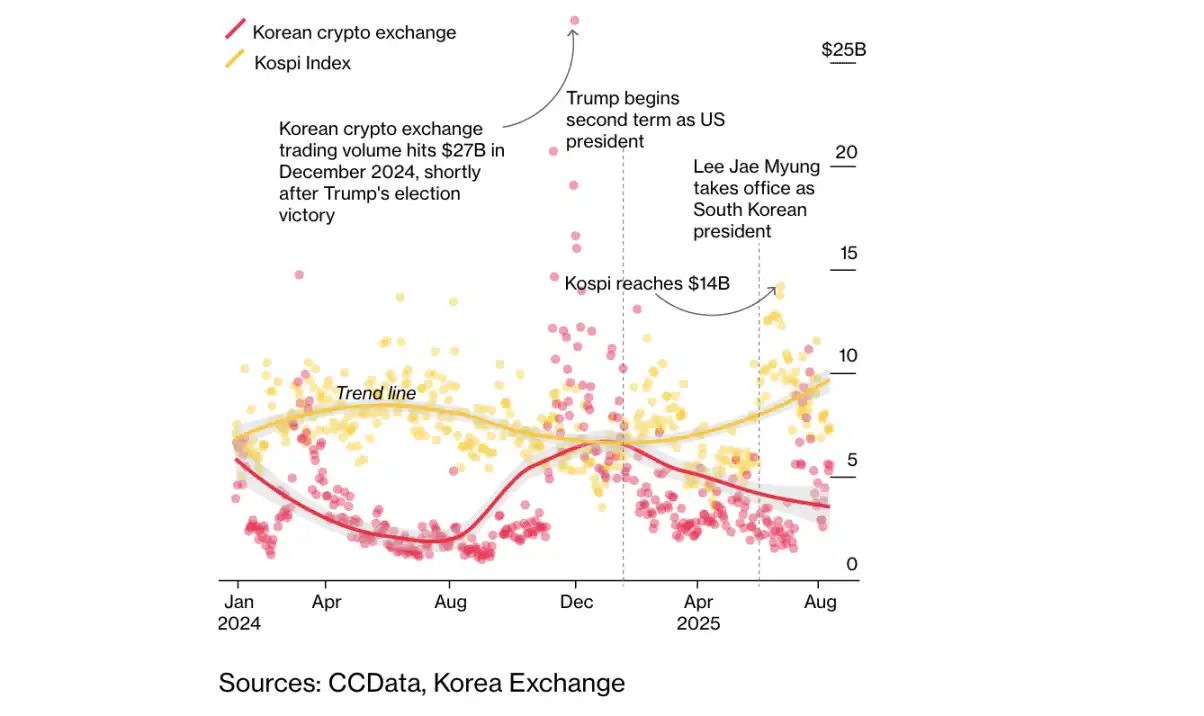
Comparison of South Korean cryptocurrency exchange trading volume and Kospi index trading volume
The high-risk behavior of South Korean retail investors not only puts household savings at risk but also puts pressure on the financial system, threatening overall economic stability. As investors flock to high-yield, high-risk assets, traditional financial instruments have gradually fallen out of favor, and banks' channels for funding have been squeezed. In the six weeks after July this year, major banks in South Korea lost nearly 40 trillion Korean won (approximately $281 billion) in deposits.
“In Korea, investment is often seen as gambling rather than long-term planning - almost as brutal as 'Squid Game',” said Choi Jae-won, an economics professor at Seoul National University. “Once the bubble bursts, individuals face a wealth backlash, leading to a worsening situation: personal loans crisis, decreased spending power, ultimately affecting the entire national economy.”
Regulatory agencies are also deeply concerned. “We worry that if the market collapses, it will have an impact on retail investors' assets and the overall economy,” said Lee Yoon-soo, a permanent commissioner at the Korea Securities and Futures Commission.
Psychiatrists point out that high-risk investments are increasingly taking a toll on individuals' mental health. “Without inherited wealth, an apartment in Gangnam (Seoul's affluent area) is a daydream,” said Park Jong-sik. Having lost around $250,000 due to investments, he now runs a clinic specializing in treating investment addiction patients. “In this anxiety-ridden society, even knowing the risks, people are still drawn to high-risk investments. It’s as if the whole system is pushing them forward, leading them into an anxiety-driven investment addiction cycle.”

Park Jong-sik
“Zeroed Overnight”
For some, the scars of an investment collapse are hard to heal. 35-year-old Han Jung-hoon went through the euphoria of “a 30-fold increase in the cryptocurrency wallet balance to 660 million Korean won,” but the Luna collapse in 2022 turned it all into nothing.
TerraUSD was a stablecoin project launched by South Korean Do Kwon, which ended in failure. In August of this year, Do Kwon pleaded guilty to fraud, and the project’s collapse wiped out about $40 billion in market value in just a few days.
“My 660 million won profit disappeared overnight, and in the end, I only got back less than 6 million won,” Han Jung-hoon said.
This collapse completely changed his life. Although he has not completely given up on cryptocurrency, he has moved away from high-risk investments, focusing on meditation, and even started a YouTube channel sharing his favorite breathing techniques. Today, he lives on the remote Jeju Island and occasionally goes on meditation trips to Bali.

Han Jung-hoon
Nevertheless, social media platforms like YouTube are still filled with bold investment success stories. Couples putting all their savings into Bitcoin, 27-year-old college students earning tens of thousands of dollars a month through high-frequency trading... These stories are exactly what attract investors like Tony Kim.
Tony Kim is currently fully invested in stocks of companies such as NVIDIA and Tesla. "I have made money through leverage, and that easy profit feeling got me hooked," he recalls. He remembers when he "made $13,000 overnight from $900," but lost all his gains in just three days. "You keep chasing that sensation of getting rich quick."
関連記事

マトリックスポートのビットコイン市場に関する見解が示唆する新たな動向
Key Takeaways マトリックスポートの最新報告では、ビットコイン市場が「下行受限」フェーズへ向かっていると指摘。 2025年末に向けて市場の感情が保守的になり、2026年には圧力が続く可能性。 ビットコインの価格変動は金融派生商品の影響を受けやすく、リスク管理が重要。 歴史的に年末は慎重な動きが多いが、新年には急速な感情転換の可能性も。 史上最大規模のビットコインオプションの到期が市場のプレッシャーやチャンスを示唆。 WEEX Crypto News, 26 December 2025 マトリックスポートによるビットコイン市場の分析 マトリックスポートはビットコインの最新動向を分析し、その市場が「下行受限」の段階に移行しつつあると報告しています。この段階では、ビットコインの下向きのリスクが相対的に抑えられ、多くの市場参加者はリスクに対してより慎重になる傾向があります。この分析は、2025年12月現在、マトリックスポートが提供する広範な金融サービスを活用した調査に基づいています。 市場環境とビットコインの圧力 2025年末に向けて、ビットコイン市場は保守的な動きを見せています。市場の参加者は慎重になり、特に金融市場の年末の特徴であるリスク回避の動きが鮮明です。この動きは、2026年にかけてビットコインがさらなる圧力下に置かれる可能性を示しています。過去のデータによれば、新しい年が始まると、資金の再編成とリスク予算の回復により市場感情が予期せぬ速さで変わることがあり、これが市場の活性化の鍵となる可能性があります。 ビットコインの価格変動と金融派生商品…

Crypto Derivatives Volume Explodes to $86T in 2025
Key Takeaways 仮想通貨デリバティブ取引量は2025年に86兆ドルに達し、1日あたり平均2650億ドルとなった。 Binanceは世界市場の約30%を占め、主要な取引所としての地位を確保。 OKX、Bybit、Bitgetも含み、トップ4の取引所で総市場シェアの62.3%を占めた。 デリバティブの複雑性が増し、機関投資家主導の市場へと進化。 極端な市場イベントがリスク管理を試すことになり、既存のマージンメカニズムや清算ルールが検証された。 WEEX Crypto News, 2025-12-26 10:06:42 仮想通貨デリバティブ市場の急成長 2025年、仮想通貨デリバティブ市場は過去に類を見ない成長を遂げ、その取引量は86兆ドルに到達しました。この成長は、1日あたり平均2650億ドルの取引を意味しています。Binanceはこの急増の中で市場をリードし、全体の約30%の取引量を占めることになりました。その結果、世界中で取引される100ドルのうち約30ドルが同取引所を経由していることになります。 Binanceの成功は、主にその効率的な取引メカニズムと包括的なサービス提供によるものであり、利用者は多様な金融商品を利用できます。その影響により、OKX、Bybit、Bitgetなどの他の主要取引所も市場の重要な位置を占めることになり、これらの取引所での年間取引量はそれぞれ8.2兆ドルから10.8兆ドルに及びました。これにより、これら4つの取引所が市場の約62.3%を占めています。 仮想通貨デリバティブの進化とその影響 2025年を通じて、仮想通貨デリバティブ市場は、これまでの小売主導のハイレバレッジを用いたバブルと崩壊のモデルから、証券取引所取引型ファンド(ETF)やオプション、コンプライアントな先物取引を通じて機関投資家主導の流れに移行しました。この変化は市場の安定性をもたらしましたが、それに伴いリスクも増大しました。 市場はより複雑になり、さまざまなリスク管理の枠組みが試されることになりました。特に、極端な市場イベントが発生した際には、既存のマージンメカニズムや清算ルールがその耐久性を試されました。このようなストレステストを経て、市場の強さと弱さがより明確になりました。…

Kraken IPOが暗号『中期段階』サイクルを再燃させる可能性
重要なポイント KrakenのIPO(新規株式公開)は、暗号通貨の成長を加速し、伝統的な金融(TradFi)から新たな資本を引き寄せる可能性があります。 Bitcoinは過去最高値を記録しましたが、その後の市場変動によって価格が下落しました。 一部の専門家は、2026年にBitcoinが下落の年になると予測していますが、他の専門家は長期的な上昇トレンドを主張しています。 市場の動向は、流動性や国家の採用といったマクロ経済的な要因によって左右されるようになっています。 WEEX Crypto News, 2025-12-26 10:06:43 Krakenと伝統的金融資本の相互作用 Krakenの新規株式公開(IPO)は、暗号通貨界における新たな潮流を生み出す可能性があります。これは特に、伝統的な金融制度(TradFi)からの新たな資本を呼び込む一助となるでしょう。この動きは、様々な暗号通貨企業が上場を目指す一大トレンドの一環でもあります。 Bitcoinは10月6日に過去最高値である126,000ドル以上を記録しましたが、その後の19億ドルに及ぶ清算イベントの影響を受けて現在は87,015ドル(記事執筆時点)の取引価格となっています。これにより、最近二週間で6%の減少を示していますが、50T Fundsの創設者兼CEOであるDan Tapieroは、「Bitcoinブル市場はまだ中期段階にある」と主張しています。彼は、KrakenのIPO及び増加するM&A(合併・買収)活動が、新たな資本を引き寄せる「追い風」を提供すると見ています。 Krakenは11月18日に20億ドルの評価額に達するために8億ドルの資金を調達し、同年11月初めに米国でのIPOを申請しました。これにより新たな市場の局面がどのように進展するか、注目されています。 Bitcoin市場の予測と見解の相違 しかし、すべてのアナリストが現行のブルサイクルの継続を信じているわけではありません。Fidelityのグローバルマクロ経済研究ディレクターであるJurrien…

Fed Q1 2026 Outlook: Bitcoinと仮想通貨市場への影響
Key takeaways Fedの金利引き下げの休止は仮想通貨に圧力をかける可能性があるが、「隠れ量的緩和」が下振れリスクを軽減するかもしれない。 流動性は金利引き下げ以上に重要であり、2026年第1四半期のBitcoinとETHの動向を形作る。 2025年には米連邦準備制度理事会(Fed)が三度の金利引き下げを実施したが、インフレ率によっては2026年初にはさらに下がる可能性がある。 軽微な供給施策が市場の方向性に影響を与え、特にETFの流入が投資家のリスク志向を支えると予想される。 WEEX Crypto News, 2025-12-26 10:06:42(today’s date,foramt: day, month, year) Fedの政策に対する仮想通貨市場の反応 2025年の米連邦準備制度理事会(Fed)は、経済の減速とインフレ圧力の緩和に対処するために金利引き下げを三回実施しました。特に、雇用の減少と消費者物価指数(CPI)の改善が見られる中、第4四半期に集中的に利下げが行われました。しかし、仮想通貨市場はこの養成政策に対して常識外の反応を見せました。Bitcoin(BTC)、Ethereum(ETH)などの主要な仮想通貨は、これまでの高値から1.45兆ドルを超える時価総額の減少を経験しました。 BitcoinとEthereumに対する金利引き下げ休止の影響…

Ethereum in 2026: Glamsterdam and Hegota Forks, L1 Scaling, and Beyond
新しいEthereumフォーク「Glamsterdam」は2026年にEthereumスケーリングの新たな一章を開く。 ガスリミットの200万への増加は、より大量の取引を同時に処理する能力をもたらす。 Zero-Knowledge( ZK )証明が進化し、Ethereum L1のスケーリングを加速させる。 新たなデータブロブを活用することで、Layer 2のネットワークが飛躍的に性能を向上させる。 「Heze-Bogota」フォークは、検閲への抵抗力を強化し、セキュリティ面での向上を目指す。 WEEX Crypto News, 2025-12-26 10:06:42 2026年には、Ethereumにとって重要な年となることが予想されています。この年、GlamsterdamフォークがEthereumブロックチェーンの処理能力を一段と向上させることが期待されています。特にガスリミットの大幅な引き上げやZero-Knowledge (ZK) 証明の普及が、Ethereumのスケーリングを新たなレベルへ引き上げる要因として注目されています。 Glamsterdamフォークの詳細とその影響…

量子コンピューティングと2026年における暗号の安全性
Key Takeaways 2026年に量子コンピュータがBitcoinなどの暗号通貨を破壊するリスクは低いが、現時点で準備が進んでいる。 量子コンピュータが暗号通貨に与える影響は「収集して後に解読」という待機戦略が懸念されている。 暗号通貨のセキュリティ脆弱性の多くは公開鍵暗号技術に依存しており、量子攻撃に備える必要がある。 専門家の間で議論が続いており、増え続けるデータセキュリティの意識が2026年に重要なテーマとなるだろう。 WEEX Crypto News, 2025-12-26 10:08:41 2026年に量子コンピューティングが暗号通貨に与える影響について、多くの思惑が交錯しています。「収穫して後で解読する」という手法が暗号通貨業界全体に動揺を与えており、近未来の量子技術の進展に備える必要性を強く感じる場面も増えています。しかし、そのリスクは実際にどれほど深刻なのでしょうか?そして2026年に本当に暗号通貨が危機にさらされるのか、専門家たちの見解を考えてみましょう。 暗号通貨に対する量子技術の脅威 量子コンピュータの登場は、長らく暗号通貨の世界において潜在的な脅威とされてきました。特にBitcoin(BTC)などのブロックチェーン技術を基本とした通貨は、公開鍵暗号技術に依存しています。公開鍵から秘密鍵を導出できるほどの量子コンピュータが実現されると、広範囲にわたって資金が盗まれるリスクが生じると指摘されています。 公開鍵暗号技術の脆弱性 Neil Puckrin氏など多くの専門家は、量子コンピュータによる暗号技術破壊のリスクを「現在のところほぼマーケティングであり、10%未満が実際の危険」としています。しかし、仮想通貨のセキュリティは公開鍵暗号技術に依存しており、この部分が量子攻撃の「最も弱い部分」とみなされています。特にアメリカ合衆国の規制当局である米国証券取引委員会(SEC)でも、量子コンピューティングが将来的に暗号通貨の保護を破る可能性があるとの警鐘が鳴らされています。 2026年に予測される状況…

トランプのWorld Liberty Financialトークン、2025年末に40%以上減少
Key Takeaways World Liberty Financialトークン(WLFI)は、2025年末に40%以上の減少を記録。 プロジェクトは、トークンセールや主要暗号資産の取得などで始まったが、その後の公募取引で値下がり。 トランプ家が両手に抱えるビジネスは、潜在的な利益相反の懸念を呼んでいる。 World Liberty Financialは、2026年1月にリアルワールドアセットを立ち上げる予定。 WEEX Crypto News, 2025-12-26 10:10:42 プロジェクトの背景と発展 2025年末にトランプ家の暗号資産プロジェクトであるWorld Liberty…

BlockchainはQuantumの脅威に備える中、Bitcoinはその対応を議論
Key Takeaways Altcoinブロックチェーンが量子の脅威に備えている一方で、Bitcoinコミュニティでは対応の方法とタイミングについて意見が分かれている。 QuantumコンピュータがまだBitcoinを破ることはできないが、将来的に可能性があるため、さまざまなブロックチェーンが準備を進めている。 EthereumのVitalik ButerinはQuantumコンピュータの脅威をエンジニアリングの問題として捉える重要性について説明している。 SolanaとAptosは、量子耐性を持つ取引や署名のサポートをテストまたは提案している。 Bitcoinにおける議論は信頼に関するものであり、多くの論者がリスクの過小評価を懸念している。 WEEX Crypto News, 2025-12-26 10:10:43 ブロックチェーンが静かに進める量子コンピューティングへの備え 今、量子コンピュータはBitcoinを破ることはできませんが、近い将来これが現実となるかもしれません。こうした背景から、複数のブロックチェーンは量子コンピューティングに対する備えを進めています。最近の動向を見ても、Aptosは量子耐性を持つ署名のサポートを提案し、Solanaは量子耐性のある取引のテストを行っています。一方で、Bitcoinのコミュニティでは、量子安全性を高めるための対応策について活発な意見交換が行われています。 これらの動きは、暗号資産界隈の不安感を示しています。投資家たちは、影響力のある声が量子のリスクを軽視することで、Bitcoinの価格が下がっていると主張しています。実際、Bitcoinの価格は過去3ヵ月で24%下落しました。しかし、Altcoinブロックチェーンがオプトインのアップグレードやテストネットを通じて量子耐性を実験している中で、Bitcoinは公開的にどのように、そしてどれほど緊急に量子リスクに対処すべきかについて分裂しています。 アラームを鳴らさずに進める量子コンピューティングの備え Ethereumは、量子コンピュータの影響を現実的なエンジニアリングの問題とみなす理由を明確にしています。Ethereumの共同創設者であるVitalik…
エルサルバドル、Bitcoinの野望が現実に直面【2025年】
Key Takeaways エルサルバドルは2021年にBitcoinを法定通貨として認めた初の国家であり、大きな注目を集めた。 International Monetary Fund(IMF)との対話が進む中で、Bitcoin採用戦略が調整を余儀なくされた。 国民へのBitcoin法の適用は限定的であり、具体的な採用には課題が残る。 一部の仮想通貨企業は、依然としてエルサルバドルの政策に魅力を感じている。 WEEX Crypto News, 2025-12-26 10:10:42(日付、形式: 日、月、年) エルサルバドルのBitcoin採用戦略:夢から現実へ エルサルバドルは、四年前の2021年に大きな一歩を踏み出し、Bitcoin(BTC)を法定通貨とした世界初の国として注目されました。当時の立法議会では、すべての商店や事業所でBitcoinを受け入れることを求める法案が可決され、多くの支持者はそれがBitcoin採用の波を導き、国内経済に貢献すると期待していました。しかし、2025年になり、その野望が経済的な現実と直面することになりました。 この野心的な採用計画には、「Bitcoin City」を建設するための債券発行も含まれていました。しかし、この計画の受け入れはサルバドール国民の間で冷ややかで、IMFからの懸念も影を落とすことになりました。…

Vitalikが語る、XのGrokによる真実性向上と課題
Ethereumの共同創業者であるVitalik Buterinは、GrokがXの真実性を高めると指摘。 Grokはユーザーの政治的偏見を確認するのではなく、それに対抗する回答を提供する。 Elon Muskの影響下にあるAIの調整に関する懸念も。 AIの偏りはシステム全体に拡散する可能性がある。 AIチャットボットの改善が必要とされる背景には、誤情報の拡散がある。 WEEX Crypto News, 2025-12-26 10:12:44 Xの真実性強化のためのGrokの貢献 Vitalik Buterinは、XプラットフォームにGrokというAIチャットボットの導入が真実性に有益であると述べています。このアプローチの主な特徴は、Grokがユーザーからの問い合わせに対し、予期しない答えを提供する能力にあります。ユーザーが偏った意見を確認しようとしても、Grokは彼らの期待に反した答えを出し、反対者の立場を示すことがよくあります。 Buterinによれば、この能力がXのプラットフォームにおける大きな進化を促していて、特に「コミュニティノート」の後にポジティブな影響を及ぼしていると言われています。このため、GrokはXの真実性強化において大きな役割を果たしているのです。 Elon MuskとGrokの影響…

ビットコインとアルトコインの価格の背後にある物語と現実
Key Takeaways ビットコインは、2024年の米国選挙後に56%上昇しましたが、スポット需要が伴わなかったため、強いトレンドを維持できませんでした。 ビットコインがスポットETFの流入に支えられて価格上昇した一方、流入が減少すると価格も停滞しました。 ステーブルコインの流入が50%減少したことで、買いの強さが減少し、物語主導のラリーが脆弱化しました。 WEEX Crypto News, 2025-12-26 10:12:44 2024年から2025年にかけて、仮想通貨市場は様々な要因によって多くの変動を見せました。その中でも中心的なテーマは「物語」と「現実」のバランスです。ここでは、ビットコイン(BTC)やアルトコインがどのようにその価格を決定しているのかについて掘り下げていきます。 仮想通貨市場の物語と価格形成 仮想通貨市場では、政治的な出来事や規制の動向、機関投資家の参入といった「物語」が価格に対する強い影響力を持っています。特に2024年の米国大統領選挙では、仮想通貨に友好的なリーダーシップの変化が迅速な価格再評価を引き起こしました。3月から10月にかけて、何度もビットコインについての強気な見出しがありましたが、価格は$50,000と$74,000の間で推移しました。しかし、この状況が第4四半期になると変化し、ドナルド・トランプ氏の選挙勝利の可能性が市場に織り込まれると、ビットコインは56%急上昇し、新たなマイルストーンの$100,000を突破しました。 この価格上昇は、特に先物のポジションの急増と連動しており、第4四半期にはオープンポジションが倍増しました。しかし、リアルな需要が追随しなかったため、価格上昇の勢いは持続しませんでした。ここから学ぶべきは、物語は主にポジショニングに影響を与えるものであって、資本の投入を伴うものではないということです。 スポットETFの流入が強い需要を示唆 ビットコインのスポットETFは、価格変動の重要な要因の一つとして注目されました。2024年にはアメリカのスポットETFが約350億ドルの純流入を記録し、ビットコインの価格はこれらの流入に密接に関連して推移しました。特に2024年第1四半期には130億ドル以上の流入が見られ、ビットコイン価格は$42,000から$73,000へ上昇しました。しかし第1四半期以降、流入が減少すると価格も長期的な調整に入りました。 2024年後半には再び需要の高まりがあり、10月から翌年1月にかけて220億ドルの流入があり、ビットコイン価格は$70,000から$102,000へと増加しました。しかし価格の下落期にはETFの流入が時折マイナスに転じ、流入が持続的でないと価格は再び停滞することが示されました。 流動性の支配的な役割…

暗号資産で今日起こったこと
Key Takeaways Doctor【WEEX Crypto News, 2025-12-26 10:12:44】 2025年のBitcoin市場の基礎は健全で、長期的な視点が重要とされています。 Canton CoinがDTCCのトークン化計画により27%急騰。この動きはBlockchainの注目すべきユースケースの広がりを示しています。 暗号資産デリバティブの市場取引量は2025年に急増し、日平均取引額は2650億ドルに達しました。 Binanceをはじめとする4つの主要取引所が市場の62.3%を支配しており、CMEもその地位を強めています。 WEEX Crypto News, 2025-12-26 10:12:44 Bitcoinの固有の強みと市場の展望…
Canton Tokenの高騰:DTCCのTokenized Treasury計画が背景に
Key Takeaways Canton Coinは最近の27%の上昇を見せ、暗号通貨市場で注目されています。 DTCCによる米国国債のトークン化計画が、この上昇の主要な要因です。 トークン化された実世界の資産(RWA)は、2025年にさらに大きな注目を集めています。 BlackRockをはじめとする主要な投資ファンドが、トークン化市場で重要な役割を果たしています。 WEEX Crypto News, 2025-12-26 10:14:44(today’s date,foramt: day, month, year) はじめに 近年、暗号通貨市場は多くの革新を経験しており、その中でも実世界の資産をトークン化する動きは特に注目されています。その中で、Canton…
ナラティブと現実: BTCとアルトコインの価格を動かすものは何か?
Key Takeaways 米国の選挙後、Bitcoinの価格は56%急騰しましたが、スポット市場の追随が不十分なため、上昇の持続性が限られていました。 スポットETFの流入が続くとBitcoinは上昇し、流入が減速またはマイナスになると価格停滞することが示されています。 ステーブルコインの取引所流入が50%減少し、ナラティブ主導のラリーを脆弱にしました。 WEEX Crypto News, 2025-12-26 10:15:08(today’s date,foramt: day, month, year) はじめに Bitcoinやaltcoinの価格変動はしばしば政治的な出来事や規制の発表といった外部のナラティブによって大きく動かされるとされます。しかし、この一年は流動性の条件やオンチェーンのデータなど、より測定可能な資本フローが価格の持続性を決定する主な要素となってきました。それでは、こうした市場の裏に潜む現実と、その現実がどのように市場動向に影響を与えているかを深掘りしていきます。 ナラティブ主導の急上昇は速やかだが持続性に欠ける 市場におけるナラティブは、Bitcoinやその他の暗号通貨の価格を急激に動かす要因となり得ますが、その効果は一時的であることが多く、結果として過剰なポジショニングが市場を不安定にすることがあります。例えば、2024年の米国の選挙における政治的な変化がBitcoinに対して再評価をもたらし、短期間で56%の急騰を引き起こしました。しかし、この上昇は長続きせず、115日の間に再び価格が下落しました。…
量子計算と2026年の暗号通貨:破滅の予兆ではなく備える時
量子計算の発展は2026年に暗号通貨を破壊することはないが、「今集めて、後で解読する」手法が業界に準備を迫っている。 多くの専門家は、量子計算の脅威は理論上のものと見ており、2026年の暗号破壊は現実味がないと考えている。 Bitcoin(BTC)などの暗号通貨は公開鍵暗号を利用しており、量子コンピュータがこれを破る可能性には懸念がある。 量子コンピュータが暗号を破る代わりに、現時点で攻撃者はデータ集積に注力している。 量子計算に対応するため、暗号コミュニティは量子耐性のあるウォレットへの移行を目指している。 WEEX Crypto News, 2025-12-26 10:15:09 暗号通貨への量子計算の影響とその準備について 2026年の量子コンピューティングを巡る話題は、暗号通貨業界に新たな波紋を広げています。量子計算がビットコインの暗号を破壊するという説は一時期囁かれましたが、現在の技術水準から判断するに、暗号界全体が直ちに危機にさらされることはありません。しかし、暗号コミュニティにとって重要なのは、量子コンピューティングの進展を背景に、どのようにこれに備えていくかです。 量子計算が暗号に与えるリスク 暗号通貨は、主に公開鍵暗号方式を利用しています。この方式は、秘密鍵を使ってトランザクションを署名し、公開鍵でその署名を検証する仕組みになっており、量子計算がこのアルゴリズムを破ることができれば、大量の資金が盗まれるリスクが浮上します。現時点では、米国の規制当局もこの問題に注目しており、脅威への対応を進めています。2023年9月には、米国証券取引委員会(SEC)の暗号タスクフォースが、量子計算が最終的にビットコインやその他のデジタル資産を保護する暗号技術を破る可能性について警告しました。 技術的な観点から見ても、暗号学者の間では、暗号署名が最も脆弱な部分であるとのコンセンサスがあります。特に、楕円曲線デジタル署名アルゴリズム(ECDSA)は、量子コンピュータによって攻撃されると脆弱です。それに対し、SHA-256のハッシュ関数は比較的に安全性が高いとされています。このため、暗号通貨のセキュリティにおいて、どのようにして安全性を確保するかが議論されています。 量子計算が及ぼす脅威の実態 量子計算自体は、まだ完全には普及しておらず、2026年までに急速に暗号学が崩壊する可能性は低いとされています。量子コンピュータが現在持つノイジーキュービットの数は数百から数千に過ぎず、ビットコインのような暗号を破るためには、これを数百万の物理キュービットにまで増やす必要があるとされています。これには、量子制御、材料科学、製造プロセスなどでのブレークスルーが不可欠です。この技術的課題は、解決に多大な時間と努力を要するもので、すぐに解決できるものではありません。 また、現状の量子計算のアプローチでは、ビットコインの暗号を破ることがありえないとする意見もあります。これまでの方式ではなく、根本的に新しいアルゴリズムが必要とされ、現在の技術では実現が難しいとされています。…
暗号通貨市場のセンチメントが14日連続で「極端な恐怖」を保持
Key Takeaways 暗号通貨市場全体が14日連続で「極端な恐怖」に陥っており、これは過去最長クラスの期間である。 2025年12月現在、暗号通貨の検索ボリュームは急激に落ち込み、投資家の関心も低迷している。 「crypto-native retail」が市場の後退に影響を与えたとされるが、それに反して「TradFi retail」は成長している。 米国のビットコインETFは、2025年に25億ドル以上の流入を記録している。 WEEX Crypto News, 2025-12-26 10:15:08 暗号通貨市場に広がる「極端な恐怖」 2025年12月26日、暗号通貨市場は「極端な恐怖」に覆われています。この状況は14日間続いており、その原因にはさまざまな要因が挙げられます。まず、2022年末にFTXが崩壊した際よりも低いレベルに「Crypto Fear & Greed…

トランプのWorld Liberty Financial、2025年末40%以上ダウン
Key Takeaways World Liberty Financial (WLFI)は2025年に40%以上の下落を記録。 プロジェクトはトランプ家が主導し、初期は強い開始を見せたが、後に混合した成果に直面。 主要な仮想通貨の取得により、一時的に市場での資産価値が上昇。 様々な論争と批判にもかかわらず、新しい資産と取引で前進。 WEEX Crypto News, 2025-12-26 10:15:08 割れる政策転換から始まったWLFI 2024年9月、ドナルド・トランプ氏が2024年の選挙活動中に発表したWorld Liberty Financialは、アメリカの仮想通貨政策における大きな転換を示すものとして注目されました。特にトランプ氏の息子であるドナルド・トランプ・ジュニアとエリック・トランプが主導したことが、大きな関心を集めました。…

ブロックチェーンの未来と量子コンピューティングの脅威に直面してBitcoinが抱える課題
長期的な量子コンピュータの脅威に備えるため、多くのブロックチェーンが新たな対策を検討中。 Ethereumの共同創設者、Vitalik Buterinが量子コンピューティングを差し迫った技術問題として捉える重要性を強調。 Bitcoinは量子リスクに対する対応方法についてコミュニティ内で意見が分かれている。 理論上では現行の公開鍵暗号が量子コンピュータに解読される可能性が懸念されている。 投資家は量子リスクを無視することがビットコインの価値に影響を与える可能性があると考えている。 WEEX Crypto News, 2025-12-26 10:15:08 量子コンピューティング技術の進展は、現在の暗号通貨市場に新たな懸念をもたらしています。この技術が公開鍵暗号を解読するようになったとき、大規模なパニックを引き起こす可能性があります。特にBitcoinは、量子リスクについてどのように対応すべきかについて長い間議論されてきました。 Ethereumと他のブロックチェーンの準備 Ethereumは、量子コンピューティングを仮説ではなく技術的課題として捉える必要性を早い段階で認識しました。Ethereumの共同創設者、Vitalik Buterinは、たとえその確率が低くとも、量子コンピュータが公開鍵暗号を解読可能になる前に準備を始めることの重要性を主張しています。予測モデルによれば、2030年までにその可能性は約20%とされていますが、2040年までにはより現実的なものになるとの見方もあります。 他の主要なブロックチェーンもこれに追随しています。Aptosは、量子耐性のある署名サポートをアカウントレベルで追加することを提案し、SolanaはプロジェクトElevenと提携し、量子耐性のある署名をテストする専用テストネットを展開しました。このような取り組みは、将来的な機能拡張に向けた基盤作りを目的とし、今すぐの脅威ではないことを強調しています。 Bitcoinにおける量子リスクに関する議論 Bitcoinにおける量子リスクの議論は、実際には信頼の問題に集約されます。Bitcoinは楕円曲線暗号に基づいており、これは公開鍵を通じて資金の所有権を証明します。しかし、量子コンピュータがこれを逆算してプライベートキーを見つけ出せるとなると、資金が不正に動かされる可能性があります。…
マトリックスポートのビットコイン市場に関する見解が示唆する新たな動向
Key Takeaways マトリックスポートの最新報告では、ビットコイン市場が「下行受限」フェーズへ向かっていると指摘。 2025年末に向けて市場の感情が保守的になり、2026年には圧力が続く可能性。 ビットコインの価格変動は金融派生商品の影響を受けやすく、リスク管理が重要。 歴史的に年末は慎重な動きが多いが、新年には急速な感情転換の可能性も。 史上最大規模のビットコインオプションの到期が市場のプレッシャーやチャンスを示唆。 WEEX Crypto News, 26 December 2025 マトリックスポートによるビットコイン市場の分析 マトリックスポートはビットコインの最新動向を分析し、その市場が「下行受限」の段階に移行しつつあると報告しています。この段階では、ビットコインの下向きのリスクが相対的に抑えられ、多くの市場参加者はリスクに対してより慎重になる傾向があります。この分析は、2025年12月現在、マトリックスポートが提供する広範な金融サービスを活用した調査に基づいています。 市場環境とビットコインの圧力 2025年末に向けて、ビットコイン市場は保守的な動きを見せています。市場の参加者は慎重になり、特に金融市場の年末の特徴であるリスク回避の動きが鮮明です。この動きは、2026年にかけてビットコインがさらなる圧力下に置かれる可能性を示しています。過去のデータによれば、新しい年が始まると、資金の再編成とリスク予算の回復により市場感情が予期せぬ速さで変わることがあり、これが市場の活性化の鍵となる可能性があります。 ビットコインの価格変動と金融派生商品…
Crypto Derivatives Volume Explodes to $86T in 2025
Key Takeaways 仮想通貨デリバティブ取引量は2025年に86兆ドルに達し、1日あたり平均2650億ドルとなった。 Binanceは世界市場の約30%を占め、主要な取引所としての地位を確保。 OKX、Bybit、Bitgetも含み、トップ4の取引所で総市場シェアの62.3%を占めた。 デリバティブの複雑性が増し、機関投資家主導の市場へと進化。 極端な市場イベントがリスク管理を試すことになり、既存のマージンメカニズムや清算ルールが検証された。 WEEX Crypto News, 2025-12-26 10:06:42 仮想通貨デリバティブ市場の急成長 2025年、仮想通貨デリバティブ市場は過去に類を見ない成長を遂げ、その取引量は86兆ドルに到達しました。この成長は、1日あたり平均2650億ドルの取引を意味しています。Binanceはこの急増の中で市場をリードし、全体の約30%の取引量を占めることになりました。その結果、世界中で取引される100ドルのうち約30ドルが同取引所を経由していることになります。 Binanceの成功は、主にその効率的な取引メカニズムと包括的なサービス提供によるものであり、利用者は多様な金融商品を利用できます。その影響により、OKX、Bybit、Bitgetなどの他の主要取引所も市場の重要な位置を占めることになり、これらの取引所での年間取引量はそれぞれ8.2兆ドルから10.8兆ドルに及びました。これにより、これら4つの取引所が市場の約62.3%を占めています。 仮想通貨デリバティブの進化とその影響 2025年を通じて、仮想通貨デリバティブ市場は、これまでの小売主導のハイレバレッジを用いたバブルと崩壊のモデルから、証券取引所取引型ファンド(ETF)やオプション、コンプライアントな先物取引を通じて機関投資家主導の流れに移行しました。この変化は市場の安定性をもたらしましたが、それに伴いリスクも増大しました。 市場はより複雑になり、さまざまなリスク管理の枠組みが試されることになりました。特に、極端な市場イベントが発生した際には、既存のマージンメカニズムや清算ルールがその耐久性を試されました。このようなストレステストを経て、市場の強さと弱さがより明確になりました。…
Kraken IPOが暗号『中期段階』サイクルを再燃させる可能性
重要なポイント KrakenのIPO(新規株式公開)は、暗号通貨の成長を加速し、伝統的な金融(TradFi)から新たな資本を引き寄せる可能性があります。 Bitcoinは過去最高値を記録しましたが、その後の市場変動によって価格が下落しました。 一部の専門家は、2026年にBitcoinが下落の年になると予測していますが、他の専門家は長期的な上昇トレンドを主張しています。 市場の動向は、流動性や国家の採用といったマクロ経済的な要因によって左右されるようになっています。 WEEX Crypto News, 2025-12-26 10:06:43 Krakenと伝統的金融資本の相互作用 Krakenの新規株式公開(IPO)は、暗号通貨界における新たな潮流を生み出す可能性があります。これは特に、伝統的な金融制度(TradFi)からの新たな資本を呼び込む一助となるでしょう。この動きは、様々な暗号通貨企業が上場を目指す一大トレンドの一環でもあります。 Bitcoinは10月6日に過去最高値である126,000ドル以上を記録しましたが、その後の19億ドルに及ぶ清算イベントの影響を受けて現在は87,015ドル(記事執筆時点)の取引価格となっています。これにより、最近二週間で6%の減少を示していますが、50T Fundsの創設者兼CEOであるDan Tapieroは、「Bitcoinブル市場はまだ中期段階にある」と主張しています。彼は、KrakenのIPO及び増加するM&A(合併・買収)活動が、新たな資本を引き寄せる「追い風」を提供すると見ています。 Krakenは11月18日に20億ドルの評価額に達するために8億ドルの資金を調達し、同年11月初めに米国でのIPOを申請しました。これにより新たな市場の局面がどのように進展するか、注目されています。 Bitcoin市場の予測と見解の相違 しかし、すべてのアナリストが現行のブルサイクルの継続を信じているわけではありません。Fidelityのグローバルマクロ経済研究ディレクターであるJurrien…
Fed Q1 2026 Outlook: Bitcoinと仮想通貨市場への影響
Key takeaways Fedの金利引き下げの休止は仮想通貨に圧力をかける可能性があるが、「隠れ量的緩和」が下振れリスクを軽減するかもしれない。 流動性は金利引き下げ以上に重要であり、2026年第1四半期のBitcoinとETHの動向を形作る。 2025年には米連邦準備制度理事会(Fed)が三度の金利引き下げを実施したが、インフレ率によっては2026年初にはさらに下がる可能性がある。 軽微な供給施策が市場の方向性に影響を与え、特にETFの流入が投資家のリスク志向を支えると予想される。 WEEX Crypto News, 2025-12-26 10:06:42(today’s date,foramt: day, month, year) Fedの政策に対する仮想通貨市場の反応 2025年の米連邦準備制度理事会(Fed)は、経済の減速とインフレ圧力の緩和に対処するために金利引き下げを三回実施しました。特に、雇用の減少と消費者物価指数(CPI)の改善が見られる中、第4四半期に集中的に利下げが行われました。しかし、仮想通貨市場はこの養成政策に対して常識外の反応を見せました。Bitcoin(BTC)、Ethereum(ETH)などの主要な仮想通貨は、これまでの高値から1.45兆ドルを超える時価総額の減少を経験しました。 BitcoinとEthereumに対する金利引き下げ休止の影響…
Ethereum in 2026: Glamsterdam and Hegota Forks, L1 Scaling, and Beyond
新しいEthereumフォーク「Glamsterdam」は2026年にEthereumスケーリングの新たな一章を開く。 ガスリミットの200万への増加は、より大量の取引を同時に処理する能力をもたらす。 Zero-Knowledge( ZK )証明が進化し、Ethereum L1のスケーリングを加速させる。 新たなデータブロブを活用することで、Layer 2のネットワークが飛躍的に性能を向上させる。 「Heze-Bogota」フォークは、検閲への抵抗力を強化し、セキュリティ面での向上を目指す。 WEEX Crypto News, 2025-12-26 10:06:42 2026年には、Ethereumにとって重要な年となることが予想されています。この年、GlamsterdamフォークがEthereumブロックチェーンの処理能力を一段と向上させることが期待されています。特にガスリミットの大幅な引き上げやZero-Knowledge (ZK) 証明の普及が、Ethereumのスケーリングを新たなレベルへ引き上げる要因として注目されています。 Glamsterdamフォークの詳細とその影響…
量子コンピューティングと2026年における暗号の安全性
Key Takeaways 2026年に量子コンピュータがBitcoinなどの暗号通貨を破壊するリスクは低いが、現時点で準備が進んでいる。 量子コンピュータが暗号通貨に与える影響は「収集して後に解読」という待機戦略が懸念されている。 暗号通貨のセキュリティ脆弱性の多くは公開鍵暗号技術に依存しており、量子攻撃に備える必要がある。 専門家の間で議論が続いており、増え続けるデータセキュリティの意識が2026年に重要なテーマとなるだろう。 WEEX Crypto News, 2025-12-26 10:08:41 2026年に量子コンピューティングが暗号通貨に与える影響について、多くの思惑が交錯しています。「収穫して後で解読する」という手法が暗号通貨業界全体に動揺を与えており、近未来の量子技術の進展に備える必要性を強く感じる場面も増えています。しかし、そのリスクは実際にどれほど深刻なのでしょうか?そして2026年に本当に暗号通貨が危機にさらされるのか、専門家たちの見解を考えてみましょう。 暗号通貨に対する量子技術の脅威 量子コンピュータの登場は、長らく暗号通貨の世界において潜在的な脅威とされてきました。特にBitcoin(BTC)などのブロックチェーン技術を基本とした通貨は、公開鍵暗号技術に依存しています。公開鍵から秘密鍵を導出できるほどの量子コンピュータが実現されると、広範囲にわたって資金が盗まれるリスクが生じると指摘されています。 公開鍵暗号技術の脆弱性 Neil Puckrin氏など多くの専門家は、量子コンピュータによる暗号技術破壊のリスクを「現在のところほぼマーケティングであり、10%未満が実際の危険」としています。しかし、仮想通貨のセキュリティは公開鍵暗号技術に依存しており、この部分が量子攻撃の「最も弱い部分」とみなされています。特にアメリカ合衆国の規制当局である米国証券取引委員会(SEC)でも、量子コンピューティングが将来的に暗号通貨の保護を破る可能性があるとの警鐘が鳴らされています。 2026年に予測される状況…


 App
App