

Vitalik's Vision for the Ideal Wallet: A Comprehensive Upgrade from Cross-chain Experience to Privacy Protection

Original Title: What I would love to see in a wallet
Original Author: Vitalik Buterin
Original Translation: DeepTech Techflow
Special thanks to Liraz Siri, Yoav Weiss, and the feedback and review from ImToken, Metamask, and OKX developers.
A key layer of the Ethereum infrastructure stack is the wallet, but it is often underestimated by core L1 researchers and developers. The wallet is the window between users and the Ethereum world, where users can only benefit from any decentralization, censorship resistance, security, privacy, or other properties provided by Ethereum and its applications if the wallet itself also possesses these properties.
Recently, we have seen Ethereum wallets make significant progress in improving user experience, security, and functionality. The purpose of this article is to provide my own views on some of the features an ideal Ethereum wallet should have. This is not an exhaustive list; it reflects my cypherpunk bias, which focuses on security and privacy, and it is almost certain that it is incomplete in terms of user experience. However, I believe a wishlist is more valuable in focusing on security and privacy attributes as optimizing for user experience can be more effective simply by deploying and iterating based on feedback.
User Experience for Cross-Layer-2 Transactions
There is now an increasingly detailed roadmap to improve the user experience for cross-Layer-2, with a short-term and long-term part. Here, I will discuss the short-term part: ideas that could theoretically still be implemented today.
The core idea is (i) built-in cross-Layer-2 sending, and (ii) chain-specific addresses and payment requests. Your wallet should be able to provide you with an address (following the style of this ERC draft) like this:

When someone (or some applications) provides you with an address in this format, you should be able to paste it into the wallet's "recipient" field and then click "send." The wallet should automatically handle the sent data in any way possible:
· If you already have enough of the required type of token on the target chain, send the token directly
· If you have the required type of token on another chain (or multiple other chains), use protocols like ERC-7683 to send the tokens (which is essentially a cross-chain DEX)
· If you have different types of tokens on the same chain or on another chain, use a decentralized exchange to convert them to the correct type of currency on the correct chain and send it. This should require the user's explicit permission: the user will see how much they are paying in fees and how much the recipient is receiving.
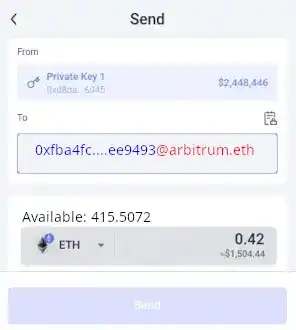
A model of a wallet interface that supports cross-chain addresses
The above content applies to the use case of "someone pays you after you copy-paste an address (or ENS, e.g., vitalik.eth@optimism.eth)." If a dapp requests a deposit (e.g., see this Polymarket example), the ideal process would be to extend the web3 API and allow the dapp to make chain-specific payment requests. Then, your wallet will be able to fulfill that request in any way necessary. To provide a good user experience, standardization of the getAvailableBalance request is also needed, and wallets need to carefully consider on which chains to default users' assets for the highest security and transfer convenience.
Chain-specific payment requests can also be embedded in a QR code, which can be scanned by a mobile wallet. In face-to-face (or online) consumer payment scenarios, the receiver will issue a QR code or a web3 API call indicating "I want X units of token Y Z on this chain, with reference ID or callback W," and the wallet can freely fulfill that request in any way. Another option is the claim link protocol, where a user's wallet generates a QR code or URL containing a claim authorization to retrieve a certain amount of funds from their on-chain contract, and the receiver's task is to figure out how to move these funds to their own wallet.
Another related topic is gas payment. If you receive assets on an L2 without ETH and need to send a transaction on that L2, the wallet should be able to automatically use a protocol (e.g., RIP-7755) to pay the on-chain Gas where you have ETH. If the wallet expects you to do more transactions on L2 in the future, it should also only use a DEX to send, for example. ETH worth millions of Gas, so that future transactions can spend Gas directly there (as it's cheaper).
Account Security
One way I conceptualize the challenge of account security is that a good wallet should serve two purposes simultaneously: (i) protecting users from wallet developers' hacks or malicious attacks and (ii) protecting users from their own missteps.
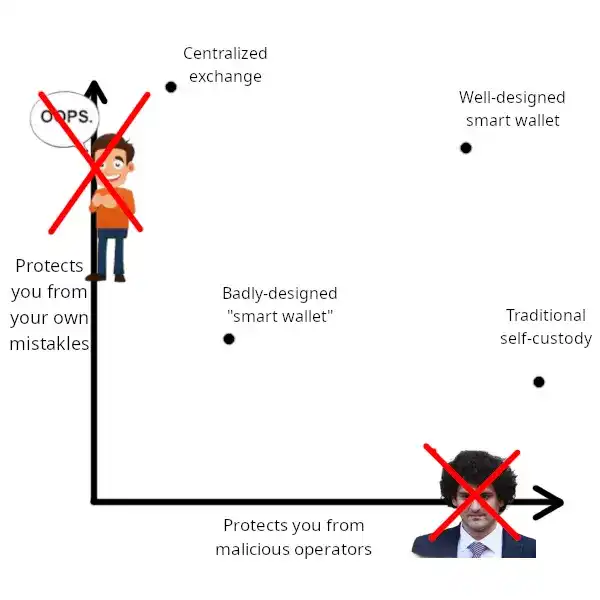
The "missteps" on the left are unintentional. However, when I saw it, I realized it fit the context very well, so I decided to keep it.
My preferred solution to this, for over a decade, has always been social recovery and multi-signature wallets with hierarchical access control. Users' accounts have two layers of keys: a master key and N guardians (e.g., N = 5). The master key is capable of low-value and non-financial operations. Most guardians need to perform either (i) high-value operations, such as sending all funds in the account, or (ii) changing the master key or any guardian. If needed, the master key can be allowed to perform high-value operations via a time lock.
The above is a basic design that can be expanded. Session keys and permission mechanisms like ERC-7715 can help support different balances between convenience and security for various applications. More intricate guardian structures, such as having multiple time-locked durations at different thresholds, can help maximize the chance of successfully recovering a legitimate account while minimizing the risk of theft.
The above is a basic design that can be expanded. Session keys and permission mechanisms like ERC-7715 can help support different balances between convenience and security for various applications. More intricate guardian structures, such as having multiple time-locked durations at different thresholds, can help maximize the chance of successfully recovering a legitimate account while minimizing the risk of theft.
Who or What Should Guardians Be?
For experienced cryptocurrency users in the community of experienced crypto users, a viable option is your friends and family's keys. If you request each person to provide you with a new address, then nobody needs to know who they are - in fact, your guardians don't even need to know each other. The likelihood of collusion is low as long as they do not gossip to you. However, this option might not be available for most new users.
The second option is institutional guardians: companies that provide services where they only sign transactions upon receiving additional confirmation information from you, e.g., confirmation codes, or video calls for high-value users. People have long tried to create these, e.g., I gave an introduction to CryptoCorp in 2013. However, so far, these companies have not been very successful.
The third option is multiple personal devices (such as phone, desktop, hardware wallet). This can work, but it is also challenging to set up and manage for inexperienced users. There is also a risk of multiple devices being lost or stolen, especially when they are in the same location.
Recently, we have started to see more universal key-based solutions. The keys can only be backed up on your devices, making it a personal device solution, or they can be backed up in the cloud, relying on a complex mix of password security, institutional and trusted hardware assumptions for security. In fact, keys are a valuable security gain for the average user, but relying solely on them is not enough to protect a user's life savings.
Fortunately, with ZK-SNARKs, we also have a fourth option: ZK-wrapped centralized ID. Examples of this type include zk-email, Anon Aadhaar, Myna Wallet, and more. Essentially, you can take various forms of centralized ID (corporate or governmental) and convert them into Ethereum addresses that can only be transacted by generating a proof of owning the centralized ID with ZK-SNARKs.
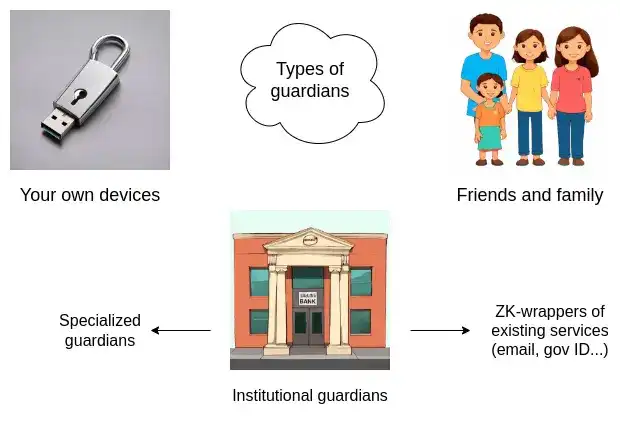
With this addition, we now have a wide range of options, and ZK-wrapped centralized IDs have a unique "user-friendliness" aspect.
To achieve this, it needs to be done through a simplified and integrated UI: you should be able to simply specify that you want "example@gmail.com" as a guardian, and it should automatically generate the corresponding zk-email Ethereum address under the hood. Advanced users should be able to input their email (and possibly a privacy salt stored in that email) into an open-source third-party app and confirm that the generated address is correct. This should be the case for any other supported guardian types as well.
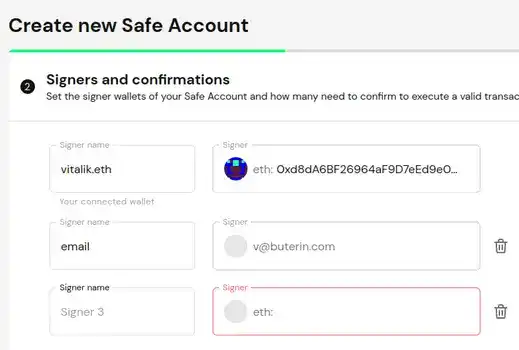
It is important to note that a practical challenge zk-email faces today is its reliance on DKIM signatures, which rotates keys every few months and these keys are not signed by any other authority. This means that zk-email today has a degree of trust requirement beyond the provider itself; if zk-email uses TLSNotary in trusted hardware to verify updated keys, it can mitigate this, but it's not ideal. Ideally, email providers should start signing their DKIM keys directly. Today, I would recommend a guardian to use zk-email, but I would not recommend it for most guardians: do not store funds in zk-email as compromise means you cannot access your funds.
New User and In-App Wallet
New users typically do not want to enter a large number of guardians during their initial registration. Therefore, the wallet should provide them with a very simple option. One natural approach is to use zk-email on their email address, a key stored locally on the user's device (potentially a universal key), and a backup key held by the provider, in a 2-of-3 setup. As users gain more experience or accumulate more assets, they should be prompted at certain points to add more guardians.
Wallet integration into the application is inevitable as apps trying to onboard non-crypto users do not want users to download two new apps at once (the app itself plus an Ethereum wallet), leading to a confusing user experience. However, users of many in-app wallets should be able to link all their wallets together so they only have to worry about one "access control issue." The simplest way is to adopt a layered scheme where there is a quick "linking" process that allows users to set their main wallet as the guardian of all in-app wallets. The Farcaster client Warpcast already supports this:
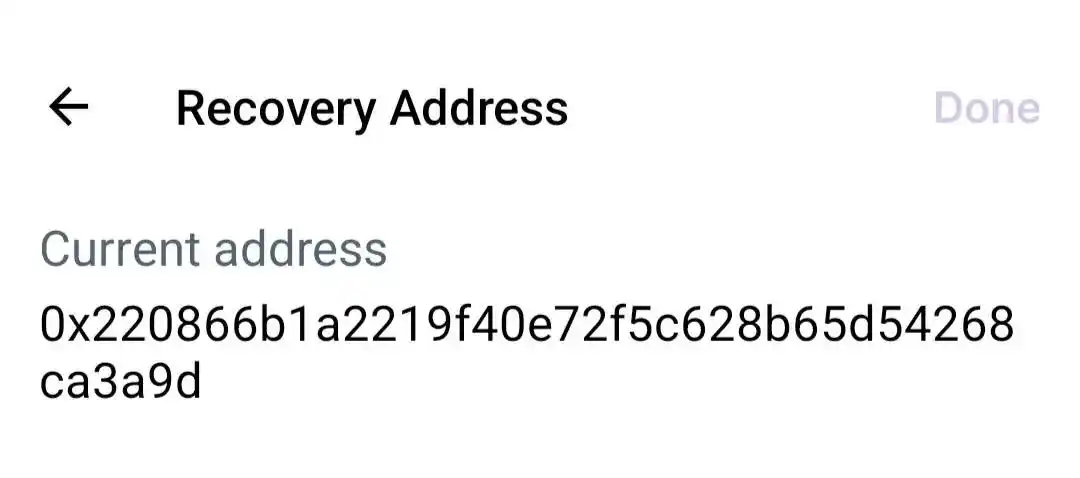
By default, your Warpcast account recovery is controlled by the Warpcast team. However, you can "claim" your Farcaster account and change the recovery to your own address.
Protecting Users from Scams and Other External Threats
In addition to account security, today's wallets have also put in a lot of work to identify fake addresses, phishing, scams, and other external threats, and strive to protect users from such threats. At the same time, many safeguards are still quite primitive: for example, requiring a click to send ETH or other tokens to any new address, whether you are sending $100 or $100,000. There is no one-size-fits-all solution here. It is a series of slow, continuous fixes and improvements targeting different threat categories. However, there is a lot of value in continuing to improve in this area.
Privacy
It is now time to take Ethereum's privacy more seriously. ZK-SNARK technology is now very advanced, privacy technologies that do not rely on backdoors to reduce regulatory risk (such as privacy pools) are becoming more mature, and second-layer infrastructures like Waku and ERC-4337 mempools are slowly becoming more stable. However, to date, conducting private transfers on Ethereum requires users to explicitly download and use a "privacy wallet," such as Railway (or Umbra for stealth addresses). This adds great inconvenience and reduces the number of people willing to transact privately. The solution is that private transfers need to be integrated directly into wallets.
A simple implementation is as follows. The wallet can store a portion of the user's assets as a "private balance" in a privacy pool. When a user initiates a transfer, they will first automatically exit the privacy pool. If the user needs to receive funds, the wallet can generate an invisible address.
In addition, the wallet can automatically generate a new address for each application the user interacts with (e.g., a DeFi protocol). Deposits will come from the privacy pool, and withdrawals will go directly into the privacy pool. This allows the user's activity in one application to be unlinkable from their activity in another application.
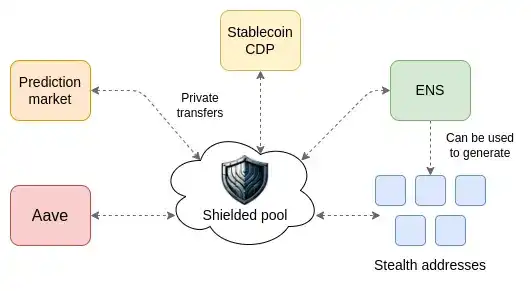
One advantage of this technology is that it not only serves as a natural pathway for preserving privacy in asset transfers but also as a natural pathway for preserving privacy in identity. Identity has already happened on-chain: any application using identity proof gating (e.g., Gitcoin Grants), any token-gated chat, Ethereum followings protocols, and so on are all on-chain identities. We want this ecosystem to preserve privacy as well. This means that a user's on-chain activity should not be aggregated in one place: each project should store separately, and the user's wallet should be the only thing with a "global view" that can simultaneously see all your proofs. A native ecosystem where each user has multiple accounts helps achieve this goal, as do off-chain proof protocols like EAS and Zupass.
This represents a pragmatic vision for Ethereum privacy in the midterm. While some features could be introduced on L1 and L2 to make privacy-preserving transactions more efficient and reliable, it can be achieved now. Some privacy advocates argue that the only acceptable thing is complete privacy for everything: encrypting the entire EVM. I think that might be the ideal long-term outcome, but it requires a more fundamental rethink of the programming model and is not yet mature enough to be deployed on Ethereum. We do need default privacy to obtain a large enough set of anonymity. However, focusing first on (i) transfers between accounts and (ii) identity and identity-related use cases (such as private proofs) is a practical first step, easier to achieve, and wallets can start using now.
Ethereum Wallets Also Need to Become Data Wallets
One consequence of any effective privacy solution is the need for users to store off-chain data, whether for payments, identity, or other use cases. This is evident in Tornado Cash, which requires users to hold a "note" representing a deposit of 0.1-100 ETH. More modern privacy protocols sometimes store encrypted data on-chain and decrypt it using a single private key. This is risky because if the key is leaked, or if quantum computers become feasible, the data becomes entirely public. Off-chain proof protocols like EAS and Zupass highlight the need for off-chain data storage.
A wallet not only needs to be software that stores on-chain access privileges but also software that stores your private data. The non-crypto world is also increasingly recognizing this, e.g., please refer to Tim Berners-Lee's recent work on personal data stores. All the issues we need to address regarding robustly ensuring access control, we also need to address regarding robustly ensuring data accessibility and non-leakage. Perhaps these solutions can be combined: if you have N guardians, use M-of-N secret sharing among these N guardians to store your data. Data is inherently harder to protect because you cannot revoke someone's data share, but we should propose as secure a decentralized hosting solution as possible.
Secure Chain Access
Today, wallets trust their RPC providers to inform them of any information about the chain. This is a vulnerability that has two aspects:
1. RPC providers may try to steal funds by providing them with false information, e.g., about market prices.
2. RPC providers can extract private information about the application the user is interacting with and other accounts.
Ideally, we want to plug both of these vulnerabilities. To address the first issue, we need standardized light clients for L1 and L2 that can directly validate blockchain consensus. Helios has done this for L1 and has been doing some groundwork to support some specific L2s. To properly cover all L2s, we need a standard, through which the configuration smart contract representing L2 (also used for chain-specific addresses) can declare a function that might include logic for getting the latest state root and verifying proofs formatted similarly to ERC-3668 and receipts against these state roots. This way, we can have a universal light client that allows wallets to securely verify any state or event on L1 and L2.
For privacy, the only realistic approach today is to run your full node. However, now L2s are entering the picture, running full nodes for everything is becoming increasingly difficult. The equivalent of a light client here is private information retrieval (PIR). PIR involves servers that hold all copies of the data and clients that send encrypted requests to the servers. The servers perform computations on all the data, return the required data to the client, and encrypt it to the client's key without revealing to the server which data the client accessed.
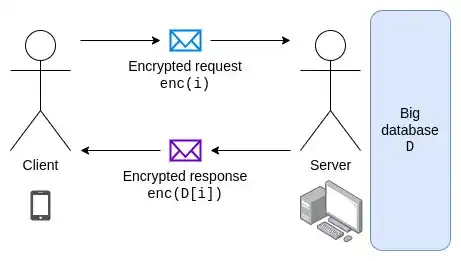
In order to maintain server honesty, each individual database project is a Merkle tree itself, allowing clients to verify them using a light client.
PIR (Private Information Retrieval) involves a very large amount of computation. There are several approaches to solving this problem:
· Brute Force: Improvements in algorithms or specialized hardware may make PIR run fast enough. These techniques may rely on precomputation: the server can store encrypted and shuffled data for each client, which the client can then query. The main challenge in the Ethereum environment is to adapt these techniques to rapidly changing datasets (similar to countries). This makes real-time computation costs lower but likely increases overall computation and storage costs.
· Relaxing Privacy Requirements: For example, limiting each lookup to only have 1 million 'mixins' so that the server knows a million possible values the client can access but not any finer granularity.
· Multi-Server PIR: If you use multiple servers and assume 1-of-N honesty between these servers, the PIR algorithm is usually faster.
· Anonymity Over Confidentiality: Requests can be sent through a mix network to hide the sender of the request rather than the content of the request. However, doing this effectively inevitably adds latency, worsening the user experience.
Identifying the right combination of technologies in the Ethereum environment to maximize privacy while maintaining usability is an open research problem, and I welcome cryptographers to attempt to do so.
Ideal Key Management Wallet
Aside from transaction and state access, another key workflow that needs to work seamlessly across L2 contexts is changing an account's verification configuration: whether changing its keys (e.g., recovery) or making deeper changes to the account's entire logic. Here are three layers of solutions, listed in increasing order of difficulty:
1. Replaying Updates: When a user changes their configuration, the message authorizing this change will be replayed on-chain for every chain where the wallet detects the user holds assets. It is possible that message formats and validation rules can be chain-agnostic, enabling automatic replay across as many chains as possible.
2.Key Store on L1: Configuration information is located on L1, and wallets on L2 use L1SLOAD to read it or remote static calls. This way, updating the configuration on L1 will automatically take effect.
3.Key Store on L2: Configuration information exists on L2, and wallets on L2 use ZK-SNARK to read it. This is similar to (2) except that key store updates may be cheaper but reads may be more expensive.
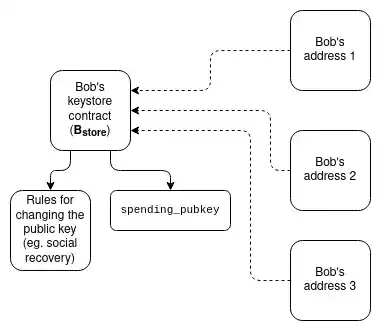
Solution (3) is particularly powerful as it can integrate well with privacy. In a typical "privacy solution," a user possesses a secret s, publishes a "leaf value" L on-chain, and proves L = hash(s, 1) and N = hash(s, 2) for some (never revealed) secret they control. An invalid symbol N is published ensuring that future spending from the same leaf will fail without revealing L, which relies on the security of user s. A recovery-friendly privacy solution would state: s is a location (e.g., an address and storage slot) on-chain, and the user must prove a state query: L = hash(sload(s), 1).
Dapp Security
The weakest link in user security is often the dapp. Most of the time, users interact with applications through websites, where the website implicitly downloads real-time user interface code from the server and then executes it in the browser. If the server is hacked, or DNS is compromised, users will receive a fake copy of the interface that may deceive them into performing arbitrary actions. Wallet features like transaction simulation are very helpful in mitigating risks, but they are far from perfect.
Ideally, we would transition the ecosystem to on-chain content versioning: users would access the dapp through their ENS name, which would contain the IPFS hash of the interface. Updating the interface would require an on-chain transaction from a multisig or DAO. The wallet would show users whether they are interacting with a more secure on-chain UI or a less secure Web2 UI. The wallet could also indicate if users are interacting with a secure chain (e.g., Phase 1+, multisig security audit).
For privacy-conscious users, wallets could also offer a paranoid mode, requiring users to click to allow HTTP requests, not just web3 operations:
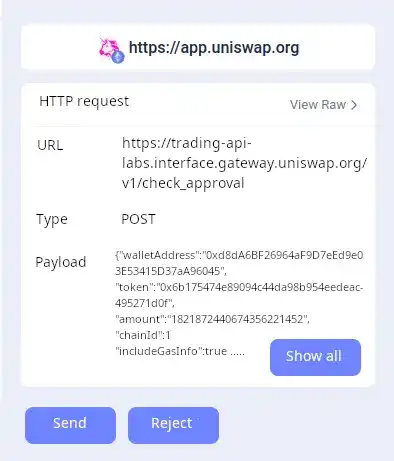
Paranoid Mode Possible Interface Model
A more advanced approach is to go beyond HTML + Javascript and write the dapp's business logic in a dedicated language (possibly a thin layer on top of Solidity or Vyper). Then, the browser can automatically generate any UI for the required functionality. OKContract has already been doing this.
Another direction is Encrypted Economic Information Defense: dapp developers, security firms, chain deployers, and others can create a bond that pays out to affected users (as determined by a on-chain arbitration DAO) if the dapp is hacked or harms users in a highly deceptive manner. Wallets can show users a score based on the size of the bond.
A Longer-Term Future
All of the above has taken place in the context of a traditional interface, where there is pointing, clicking on things, and inputting things into text fields. However, we are also at the cusp of a paradigm shift:
· Artificial Intelligence that may lead us from a click-type paradigm to a "say what you want to do, and the robot figures it out" paradigm.
· Brain-Machine Interfaces: There are both "gentle" methods like eye-tracking and more direct or even invasive technologies (see: this year's first Neuralink patient).
· Client-Side Active Defense: The Brave browser actively protects users from ads, trackers, and many other malign actors. Many browsers, extensions, and crypto wallets have whole teams actively working to shield users from various security and privacy threats. These "active guardians" will only grow stronger in the next decade.
These three trends together will lead to a deeper reimagining of how interfaces work. Through natural language input, eye tracking, or eventually more direct brain-machine interfaces, coupled with your history (perhaps including text messages, as long as all data is processed locally), a "wallet" can understand clearly and intuitively what you want to do. Then, AI can translate that intuition into a concrete "action plan": a series of on-chain and off-chain interactions to accomplish your intent. This can significantly reduce the need for third-party user interfaces. If users do engage with third-party apps (or other users), AI should engage in adversarial thinking on behalf of the user, identify any threats, and propose action plans to mitigate them. Ideally, these AIs should have an open ecosystem generated by different groups with varying biases and incentive structures.
These more radical ideas rely on technology that is very immature today, so I wouldn't put my assets into a wallet that depends on them today. However, similar things seem to be an obvious trend for the future, so it's worth starting to explore in this direction more actively.
関連記事

コインデスク20のパフォーマンスアップデート:Uniswap (UNI) 1.5%下落し、インデックスは低調
Key Takeaways 最近のコインデスク20インデックスは2993.52で、前日比0.5%の下落を記録。 Uniswap (UNI)とHedera (HBAR)は主要な落後者で、それぞれ1.5%と1.4%の減少。 一方、SUIとPOLは上昇を見せ、特にSUIは週初から上昇を記録。 KuCoinは2025年に1.25兆ドルを超える取引量で市場シェアを記録。 WEEX Crypto News, 2026-01-07 14:49:40 コインデスク20インデックスの概要 コインデスク20は、仮想通貨市場において主要な暗号資産の動向を反映する指数であり、広範に取引されている資産を対象としています。このインデックスは、グローバルな視点で見ると様々なプラットフォームでの取引が行われており、市場の全体的なトレンドを把握するのに非常に有用です。特に2026年の1月の始まりにおいては、ユニスワップ(Uniswap、UNI)が1.5%の下落を記録し、継続的に注目されています。 最近の市場動向 コインデスク20は2993.52で推移しており、これは前日の火曜日午後4時に比べて0.5%、具体的には15.41ポイントの下落を示しています。この下落にはいくつかの要因が絡んでいますが、特にわかりやすいのは、主要な暗号資産の中でもユニスワップ(UNI)のように急激に価値が下がったものがあることです。これに対して、SUIやPOLといった資産はそれぞれ1.1%と0.8%の上昇を見せ、数少ない好調な動きを示しました。 UNIの下落は、市場の全体的な動きとリンクしていますが、その原因は複数にわたり、特に仮想通貨市場全体の不安定な動き、収益の確保が難しい状況、あるいはより大きな市場環境の変化が影響している可能性があります。…

Babylon Labsがa16z cryptoから$15Mを調達し、Bitcoinの担保インフラを開発
Key Takeaways Babylon Labsがa16z cryptoから1500万ドルを調達し、Bitcoin担保用インフラ「BTCVaults」の開発とスケールアップを進行中。 この資金は、Bitcoinをネイティブの形でチェーン上の担保として利用可能にするための技術と、外部アプリケーションとの統合を支援するために使用される。 BTCVaultsは、カストディアンやラップされたBitcoinを必要としない点で、市場に新たな可能性を提供。 既存の金融システムと連携することが可能で、Bitcoinを自己管理したまま担保として活用することを促進。 WEEX Crypto News, 2026-01-07 14:49:43 Babylon LabsがBitcoin担保インフラで切り開く未来 資金調達と今後の展望 2026年1月7日、Babylon Labsは、Bitcoin担保インフラである「BTCVaults」を開発するためにa16z…

Rumble、Tetherと提携して暗号ウォレットを導入し、BTC、USDT、XAUTでのサポートが可能に
Key Takeaways RumbleがTetherと協力して、視聴者がコンテンツ制作者にBTC、USDT、XAUTでチップを贈ることができる非カストディアルな暗号ウォレットを導入しました。 この新しいRumble Walletは、視聴者が銀行やクレジットカード会社を通さずに直接デジタル通貨でチップを贈ることができる機能を提供します。 Rumble WalletはTetherのWallet Development Kitを使用して構築されており、クリエイターに広告収入やサブスクリプション収入に依存しない新しい収入源を提供します。 TetherのCEOパオロ・アルドイーノは、このウォレットを「より多くの分散化された自由を守るツール」へのステップと位置付けています。 Rumbleの株価は、ウォレット発売後に若干上昇しましたが、前年同期比で依然50%低い水準です。 WEEX Crypto News, 2026-01-07 14:49:42 暗号ウォレットの登場とその背景 2026年1月現在、RumbleとTetherの共同プロジェクトである新しい暗号ウォレット「Rumble…

Filecoinの低下と仮想通貨市場の後退
Filecoin (FIL)は過去24時間で3.6%下落し、弱い仮想通貨市場全体の影響を受けています。 CoinDesk 20 Indexも3.6%下落し、Filecoinの価格変動に影響を与えています。 Filecoinの取引量は30日移動平均を30%上回りましたが、方向性の確証を示す閾値には到達しませんでした。 抵抗点$1.60付近での急激な反落が発生し、サポートは$1.52に確立されました。 価格はその後、$1.59-$1.60の抵抗ゾーンを複数回再試ししましたが、その間に参加は減少しました。 WEEX Crypto News, 2026-01-07 14:49:42 Filecoinと市場動向の詳細 Filecoinの最近の価格動向 仮想通貨市場全体が変動を見せる中で、特にFilecoin (FIL)の動きが注目されています。Filecoinは過去24時間で3.6%下落し、価格は$1.5399となりました。この動きは、CoinDesk 20…

ブラジルの元中央銀行役員が実利に連動した利回りシェア型ステーブルコイン発表
ブラジル・レアルに連動した新しいステーブルコイン「BRD」が発表されました このコインはブラジル国債を裏付け資産とし、15%に達する現地の高い利率を投資家に提供 外国投資家にとってのブラジルの利回り市場アクセスの障壁を取り除くことが狙い BRDは既存ステーブルコイン市場において差別化を図るため、政府の債務から得た利子をホルダーと共有 WEEX Crypto News, 2026-01-07 14:49:40 新しい資産クラスとしての利回りシェア型ステーブルコイン 2026年1月7日、ブラジルの元中央銀行役員であるトニー・ヴォルポン氏が新たなフィナンシャルプロダクト「BRD」を発表しました。BRDは、ブラジル・レアルに連動したステーブルコインであり、ブラジル国債を裏付け資産としてレアルとの交換性を維持するものです。この新しいトークンは、特に金利の高いブラジル市場に興味を持つ国際的な投資家にとってのアピールポイントとなっています。現在、ブラジル中央銀行が設定する基準金利は15%とされています。これに対して、アメリカ連邦準備制度理事会の目標金利はわずか3.5%から3.75%です。 ブラジルの高金利環境は長年国際投資家から注目されてきたが、その利回りにアクセスすることは規制や通貨の摩擦、そして国内のインフラによって制限されてきました。ヴォルポン氏はCNNブラジルの番組「クリプト・ナ・レアル」において、「ブラジルの金利でステーブルコイン保持者に報酬を与える能力は、特に機関投資家にとって大きな引力となります。」と述べています。また、このステーブルコインはブラジルの債務への需要を支え、投資家の基盤を拡大することによって、国内の借り入れコストを潜在的に下げる可能性があると付け加えました。 投資家のための新たな道を提供 BRDの狙いは、ブラジルの高利環境をより多くの外国人投資家に対して開かれたものにすることです。これまで、ブラジルの利率は多くの国際的な関心を引いてきましたが、規制や通貨摩擦、国内インフラによってこれらの利益にアクセスすることが難しい状況でした。 「ブラジルの金利を享受できるのは、特に機関投資家に対して大きな魅力」とヴォルポン氏は述べています。このようなステーブルコインの発行は、ブラジルの債務に対する需要を支えると同時に、より大きな投資家基盤を提供することで国内の借入コストを下げる可能性があります。 競争激化するステーブルコイン市場における差別化 BRDは、すでに存在するステーブルコイン市場に対抗するため、市場に出回る計画です。この市場は、すでにTransferoのBRZという185百万ドルの市場価値を持つコインや、51百万ドルのBBRL、そしてブラジルの取引所Mercado BitcoinやBitsoなどが関与するBRL1、CeloブロックチェーンネイティブのcREALといった競争者が存在しています。…

暗号市場の今日: Bitcoinの滑落、アジア主導の売却でaltcoinsに打撃
Key Takeaways Bitcoinは、$94,500を突破できず、アジアの取引時間中に価格が下落し、暗号市場全体を引き下げました。 Altcoin市場はBitcoinよりも大きな影響を受け、PENGUやXRPなどで特に大きな下落が見られました。 暗号先物市場での長ポジションの清算が活発で、現状の持続は牛市ポジショニングを示していますが、取引所間では未だに不透明な状況です。 DeFiセクターは、暗号資産の価格が下がる中でもポジティブな流入を示し、一部で回復の兆しがあります。 TRXは市場全体の下落に反して、過去24時間でわずかに上昇しました。 WEEX Crypto News, 2026-01-07 14:51:40 Bitcoinとその価格動向 2026年1月7日、Bitcoinはアジアの取引時間中に、価格が再び下落しました。これは、過去5週間で$94,500の水準を突破しようとした3度目の試みが失敗に終わったためです。この結果、市場は盛り上がりを見せていた価格帯から押し戻され、12月の変動を反映した状態に戻りました。Bitcoinは$91,530にまで下落し、それに伴い広範な暗号資産市場も大幅に下落しました。市場にはよりリスクを避ける動きが見られ、これが下げ圧力を増大させました。 取引に影響を与えたもう一つの要因は、アメリカの株先物が取引前に0.32%の下落を示したことです。このようなマクロ経済要因の影響は、Bitcoinを含む複数の暗号資産に波及し、投資家はリスク回避の姿勢を強めています。 Altcoin市場の急激な変動 今回の下落の中で、Bitcoinのあとに続いたのはさまざまなaltcoinでした。特にPENGUが6.5%の下落、XRPは3.5%の下落を見せました。これは、MemecoinやPrivacy Coinといったセクターが最も大きな影響を受けたためです。CoinDeskのMemecoin…

Ripple、再度IPOを否定、バランスシートが非公開を維持する余裕を提供
Key Takeaways Rippleは2025年11月に5億ドルを調達し、企業価値は400億ドルに達したが、IPOの計画はない。 現在も非公開会社であり続け、投資家からの有利な条件での資金調達が成されている。 2025年、4つの企業買収を完了し、企業向けデジタル資産インフラのプロバイダーになることを目指す。 Rippleの戦略は、従来の金融が安定したコインやトークン化資産を実社会で利用可能にするための製品開発に集中している。 WEEX Crypto News, 2026-01-07 14:51:41 RippleのIPO計画と現状 Rippleは、暗号通貨業界で多くの注目を集めている企業である。2025年11月に行われた資金調達では、Fortress Investment GroupやCitadel Securitiesを含む著名な投資家から5億ドルを調達し、その企業価値は400億ドルと評価されている。しかし、Rippleは依然としてIPO(新規株式公開)の予定はないと発表している。これは、同社の社長であるMonica Long氏が、Rippleの財務状況が公的市場に頼ることなく成長を支えるのに十分であると述べたことによる。 Rippleの資金調達戦略…
Strategy’s STRC perpetual preferred stock returns to $100 and may trigger increased Bitcoin buying
Key Takeaways: Strategyの永続優先株式STRCが、11月初旬以来初めて100ドルに到達。 この価格回復により、Strategyは市場で株式を発行し、ビットコイン購入資金を調達可能。 STRCは短期間高利回りのクレジットとして販売され、現行の年間配当率は11%。 STRCの配当率は1月の開始時に11%に引き上げられ、株価の安定化を図る。 WEEX Crypto News, 2026-01-07 14:51:41 STRCの価格回復と市場への影響 ビットコイン保有で著名な企業、Strategy(MSTR)が発行する永続優先株式であるSTRCが、11月初旬以来初めて100ドルのパー値を回復しました。この価格上昇は、同社が市場で株式を販売し、その資金を使ってさらなるビットコイン(BTC)を購入するための道を開く可能性があります。STRCは11月4日から13日の間の取引以来、90ドル近辺まで価格が下落していましたが、今回の回復は投資家にとって新たな可能性を提供します。 STRCの配当率と投資価値 STRCは短期間高利回りのクレジット商品として市場に登場しています。現行の配当率は11%で、毎月キャッシュで分配されます。この配当率は毎月リセットされ、株価を100ドル前後に保つことを目的としています。商品導入以来、STRCの価格は16%上昇しており、実質的な年間利回りは約11%に達しています。年間利回りは、現行配当をSTRCの株価で割って求められます。この値の上昇は、投資家に対して持続的な魅力を持たせる要因の一つとなっています。 STRCの配当率引き上げとその理由 1月の始まりに、MSTRはSTRCの配当率を11%まで引き上げました。これは、2026年から始まった年の初めに迎える五番目の配当引き上げとなります。この引き上げは主に投資家を引きつけ、株価の安定を図るために行われました。共に、この戦略が新たな投資家層を呼び込み、株式市場での動きを活性化させることを期待しています。STRCが示す安定した成果と配当率の引き上げは、投資家にとって潜在的な利益をもたらす可能性があります。 ビットコイン市場への波及効果…
年始の回復ラリー停滞:Crypto Daybook Americas
Key Takeaways マーケットの主要な仮想通貨であるBitcoin、XRP、Solanaは過去24時間で1.5%以上の下落を記録しました。 U.S.-listedのスポットBitcoin ETFでは、新年の取引初めの2日間で10億ドルを超える流入がありましたが、火曜日には2億4320万ドルの資金流出が見られました。 デリバティブ市場では、仮想通貨先物の累積オープンインタレストが2ヶ月ぶりの高水準に達し、リスクを取る投資家の意欲の再燃を示しています。 日本の長期国債の利回りは記録的な高値に達し、社会的な関心を引き起こしており、Bitcoinなどのリスク資産に影響を及ぼす可能性があります。 WEEX Crypto News, 2026-01-07 14:51:40 ビットコインと主要仮想通貨の動向 年始早々、Bitcoinをはじめとする主要な仮想通貨が市場で停滞感を示しています。例えば、Bitcoin(BTC)は過去24時間で1.66%の下落を見せ、価格は91,677.51ドルとなっています。同様に、Ethereum(ETH)も2.26%減少し、3,200.70ドルでの取引になっています。これらの動向は市場の不安定さを示しており、特に年初の勢いが失われ、上昇のモメンタムが鈍化していることを反映しています。 これに関連する要因として、人々はこの年始の市場の回復が本当に信念に基づく買い方によるものなのか、あるいは年明けの資金配分などの季節的な要因によるものかを疑問視しています。U.S.-listedのスポットBitcoin ETFにおいて、新年の取引初めの2日間で10億ドルを超える流入が注目されましたが、火曜日には2億4320万ドルが流出しており、市場には依然として不安定な要素が残っていることを示しています。 デリバティブ市場による支持 仮想通貨市場の進展のサインとして、デリバティブ分野での活動が再び活発化しています。仮想通貨先物のオープンインタレストは約2ヶ月ぶりの高水準に達し、投資家がリスクを取る意欲が再び高まりつつあることを示唆しています。また、ペイメントレート(取引所に支払う定常的な手数料)も改善しており、これは市場にとっての好材料です。「資金調達レートが一貫して0.01%以上であるとき、持続的な市場の上昇は起こりやすい」とのGlassnode社のリポートには、さらなるポジティブな見通しが書かれています。…

NikeがNFTとバーチャルスニーカーを売却:デジタルアート市場における関心の欠如を背景にした報告
Key Takeaways Nikeは、NFTおよびデジタルコレクティブル市場から撤退しつつも、物理的、デジタル、バーチャルな環境における新しい製品と体験に引き続き投資。 RTFKTの売却は、NFT市場の冷え込みが広がる中で行われ、業界全体が2021年の急成長からの縮小を経験。 NikeのRTFKT売却は、同社の新CEOエリオット・ヒルの下、スポーツ事業と卸売パートナーシップに再集中する戦略の一環。 NFT市場の収縮はNikeだけでなく、X2Y2やNFT Parisなどの業界イベントや企業にも影響を及ぼしている。 WEEX Crypto News, 2026-01-07 14:51:41 Nikeの新たな挑戦:NFTからの撤退 Nikeは、デジタルコレクティブルおよびNFT業界からの撤退を決定し、同社の注目製品として知られたRTFKTを売却しました。RTFKTは2021年のNFTブームの最中に購入され、デジタルスニーカーやブロックチェーンベースのプロダクトで知られるブランドです。この売却は昨年12月16日に行われましたが、買い手や取引の詳細は明らかにされておらず、Nikeはコメントを拒否しています。 この動きは、NFT市場全体の冷え込みに対する反応として位置づけられています。2021年の市場拡大期から一転し、取引量の急激な減少に伴い、多くのプラットフォームやイベントが運営を停止しています。たとえば、X2Y2は市場の停滞を受けて閉鎖を発表し、かつて業界のフラッグシップイベントであったNFT Parisも2026年のイベントをキャンセルしました。 RTFKTの歴史と価値 NikeがRTFKTを取得したのは、デジタルアート市場が最も活気づいていた時期であり、スポーツウェアの巨人であるNikeは、デジタルコレクティブルやバーチャルスニーカー、ブロックチェーンを基盤とする製品の領域に拡大しました。RTFKTはアーティストとのコラボレーションを通じて、何度も数千ドルで販売されるデジタルスニーカーをリリースし、すぐにNFT業界で最も注目されるブランドの一つとなりました。…

Barclays、トークン化されたインフラを進化させるStablecoin Settlement Firmに投資
Key Takeaways Barclaysが、米国のスタートアップUbyxに投資を行い、トークン化された決済インフラを支援する。 Ubyxは、発行者と金融機関間でトークン化された資金を移動させるための技術を開発中。 既存の金融規制内でのブロックチェーンベースの決済の基盤を確立するための動きが加速中。 2025年の市場動向としてKuCoinの取引量が急成長し、市場シェアを伸ばした。 ブラジルでは、国庫債務に裏付けられたリアルペッグのステーブルコインが発表された。 WEEX Crypto News, 2026-01-07 14:53:42 Barclaysの新たな金融戦略 英国の大手銀行Barclaysが、アメリカのスタートアップUbyxに資本投下を行ったことが話題を集めています。この投資は、銀行預金や規制されたStablecoinを含むトークン化されたお金のためのクリアリングシステムを開発するためのものです。このいわば「トークン化されたインフラ」は、発行者と金融機関の間でお金をデジタル形式で移送するための新たな道を開こうとしています。 Barclaysのこの動きは、既存の金融規制を遵守しつつ、ブロックチェーンを基盤とした決済システムを確立するための伝統的な銀行の関心が高まっていることを示しています。この流れの一環として、スイスのUBSやPostFinance、さらにはSygnum BankがEthereumを用いた概念実証を行い、一方でインターバンクメッセージングシステムのSwiftはオンチェーン決済のためのインフラを構築しています。 Ubyxの技術革新 Ubyxが開発している技術は、トークン化されたお金を発行者と金融機関の間で移動させるための共通の決済フレームワークを構築することを目的としています。このシステムは、ウォレットや銀行、支払いプラットフォームを通じて、名目価値でのトークン化された資金の交換と償還をサポートするよう設計されています。…

ヘッジファンドKaratage、IMCのベテランシェーン・オカラハン氏をシニアパートナーに任命
KaratageがShane O’Callaghan氏をシニアパートナーとして迎え、機関投資向け戦略の責任者に任命 O’Callaghan氏はIMCでの経験を活かし、革新的な戦略を推進 特殊技能を持つプロフェッショナルの加入により、Karatageの成長が加速される見込み ロンドンを拠点とするKaratageは、デジタル資産とブロックチェーン技術に重点を置いている WEEX Crypto News, 2026-01-07 14:53:41 Shane O’Callaghan氏の新たな役割 Shane O’Callaghan氏がロンドンを拠点とするヘッジファンドKaratageのシニアパートナーとして新たに加わることが発表されました。O’Callaghan氏は、これまでオランダのマーケットメイカーであるIMCで、機関投資向けのパートナーシップとデジタル資産の販売を統括していました。この経験を活かし、Karatageでは特に機関投資家向けの戦略を強化していく予定です。 彼の加入は、単なるポジションチェンジではなく、Karatageが次のステージに進むための重要な一歩です。Karatageの共同創設者でCEOのMarius Barnett氏は、「Shaneが安全を選んで我々に加わったわけではなく、内側から大胆で攻撃的かつ本当に革新的なものを作り上げる機会を得たからだ」と述べています。 ヘッジファンドのゾーン:Karatageの戦略 Karatageは2017年に設立され、デジタル資産、暗号資産に特化したファンドやブロックチェーン関連企業に投資を行っています。同社は、市場サイクルを通じて積極的に投資を行っており、特に構造的に金融や経済に大きな影響を与え得るテクノロジーとビジネスへ強力にサポートしています。…

Lloyds Bank Completes UK’s First Gilt Purchase Using Tokenized Deposits
Key Takeaways Lloyds Bank conducted the first gilt purchase in the UK using tokenized deposits, signifying a landmark…
Metplanetの評価がMSC Iの決定後、Bitcoin保有に対する3ヶ月ぶりの高値を記録
Key Takeaways Metplanetの評価は、前年10月の危機以来の高水準に戻った。 MSCIはデジタル資産を保有する企業をインデックスから除外しないと決定。 Strategy (MSTR)株はプレマーケットで5%上昇。 Metplanetは年初から20%の評価増を記録し、Bitcoin保有資産に対してプレミアム評価となっている。 WEEX Crypto News, 2026-01-07 14:53:41 DigitAsset企業に注目が集まる背景 Metplanetというデジタル資産を扱う企業が、MSCIというグローバルなインデックスを提供する会社の決定を受けて注目を集めています。MSCIは、デジタル資産を保有する企業をそのインデックスから除外しないと発表し、このニュースを起爆剤にMetplanetの評価は3か月ぶりの高値を記録しています。この背景には大きな不確実性の解消という要素があり、特にアメリカの同業他社にも好影響を与えています。こうした動きは一時的なものである可能性もありますが、デジタル資産保有企業への期待が高まる中で最も重要な出来事として位置づけられます。 MSCI決定による影響 Metplanetの評価が高まった主な理由のひとつは、MSCIの決定によるものでした。MSCIは、Bitcoinをはじめとするデジタル資産を保有する企業をそのグローバルインデックスから除外しないという方針を打ち出しました。この決定は、企業にとってのインデックス排除リスクを抑え、投資家に安心感を与えています。特に、昨年10月に見られたデジタル資産市場の急落以降、企業にとっては新たな不確実性の解消となります。 Metplanetとその評価 Metplanetは2026年に入り、株価が年初から20%も上昇しました。同社は現在、保有するBitcoinの価値以上に評価されており、mNAVは1.25と、前年の大きな市場変動以前に匹敵する高さにあります。これは、Bitcoinの保有比率に対する企業の評価が一時的な好材料で支えられていることを示しています。…

Morgan Stanleyの仮想通貨拡大:Ethereum Trustの登録申請
Key Takeaways Morgan StanleyはEthereum Trustの登録申請をSECに提出しました。 この動きは、ビットコインとソラナのETFの書類提出に続くものです。 同銀行は、2025年から仮想通貨へのアクセスを顧客に提供しています。 伝統的金融機関がデジタル資産を取り入れる動きが進行中です。 WEEX Crypto News, 2026-01-07 14:53:41 はじめに 2026年1月、金融の巨人Morgan Stanleyは、Ethereum Trustの登録申請を米国証券取引委員会(SEC)に提出しました。この動きは、ビットコインとソラナのETFの書類提出から数日後のことであり、同社の仮想通貨への関与がますます深まっています。これにより、伝統的な金融機関の間でデジタル資産の取り込みが広がっていることが窺えます。 伝統的金融機関と仮想通貨…

金と銀が市場キャップでトップに返り咲き
Key Takeaways 投資家は不確実性の中で、金と銀を「価値の保存」として選んでいます。 金の市場キャップは現在31.1兆ドルに達しており、依然としてトップの地位を保っています。 銀はNvidiaと2位を競い合っており、人工知能の需要増に伴うNvidiaの市場拡大も注目されています。 アメリカ連邦準備制度が今後、金利を引き下げる可能性があり、これが金属市場の価格をさらに押し上げる要因となっています。 WEEX Crypto News, 2026-01-07 14:55:44 新しい年が始まり、市場の不確実性が増す中、投資家は再び金と銀を「価値の保存」として選択し、一時的に市場キャップでのトップの座に返り咲きました。現在も金は市場キャップ31.1兆ドルで首位に立ち、銀はNvidiaと2位を争っています。この選択は、世界的な不安定性を背景に、安全資産への逃避行動の一環と見られています。 金と銀の歴史的役割 金と銀は長い歴史を持つ貴金属であり、金融不安や地政学的リスクが高まった際に価値を保つ能力が評価されています。特に金は、その希少性と普遍的価値により、過去数世紀にわたって通貨の基盤として利用されてきました。銀もまた工業用途のほか、ジュエリーや投資資産として根強い人気があります。 金融危機や経済的動揺のたびに、これらの金属に対する需要が高まります。最近では、アメリカの利上げによる市場の動揺もあって、再び投資家の注目が集まっています。 現在の市場動向 金および銀の市場キャップが上昇している背景には、アメリカ連邦準備制度(FRB)の動向が大きく影響しています。新しい議長の下で、利率の引き下げが予測されており、この政策変更は特に貴金属市場に強いインパクトを与えると考えられています。利下げ政策は、リスク資産への投資を促進する要因となる一方、インフレーションの恐れから安全資産として金と銀が選ばれるという現象も同時に引き起こします。 さらに、銀についてはNvidiaとの競争も見逃せません。Nvidiaは人工知能における技術の需要増によって、自社の市場キャップを拡大しており、これもまた投資家にとっての判断材料となっています。…

XRPがビットコインを上回る可能性:XRP/BTCチャートが2018年以来の珍しい一目均衡表のブレイクアウトを示す
XRPが重要なサポートを割り込み、価格が急落。その後、需要により価格が安定化。 XRPのXRP/Bitcoin比率が一目均衡表の雲を突き抜ける可能性があり、歴史的パターンがビットコインを上回る兆候として注目されている。 ショートタームでは、XRPの価格が再び上昇するための抵抗帯を確認しつつ、下降チャネル内に留まるかが焦点。 場合によって、XRPがビットコインのように積極的に市場に買い込まれる可能性も含め、相対的な強さの信号が投資家の注目を集めている。 WEEX Crypto News, 2026-01-07 14:55:44 暗号通貨市場において、XRPの動きは依然として揺れ動いています。特にXRPとBitcoinの関係性に注目が集まっており、XRPの一目均衡表(Ichimoku Cloud)を利用した技術的分析がその焦点となっています。この分析によれば、XRP/BTCの月次チャートが2018年以来初めて雲を上抜こうとしているとされ、この突破がビットコインを凌駕する可能性を秘めていると考えられています。このような市場動向は、投資家にとって非常に興味深いものとなっており、潜在的な価格の反発や市場の変化が期待されています。 価格動向の背景 最近の市場データでは、XRPが$2.39から$2.27まで減少し、重要な$2.32のサポートレベルを下回りました。この急落は大きな取引量を伴って行われ、最安値としては$2.21を記録しました。しかし、その急落は需要によって押し戻され、価格は一旦安定しました。市場では、この反発の動きが$2.31から$2.32の範囲を取り戻せるかどうかが注目されています。 この価格変動の中で、市場参加者は短期的な値崩れの可能性とXRP/BTCの長期的な強調の動向の二つを見極めており、特に一目均衡表がこれらの技術的な指標に影響を及ぼしています。 一目均衡表と市場シナリオ チャーティスト「The Great Mattsby」は、このXRP/BTCの一目均衡表のブレイクアウトを注視しています。このテクニカル分析において、月次の雲を突破することがXRPがビットコインを上回る前触れであると過去の事例から示唆されています。特に、クロスアセットの回転が再び浮上してきている市場の中で、こうした分析が再度価値を見出していると言えます。…

JPMorgan、JPM CoinをCanton Networkへ拡張へ
JPM CoinがCanton Networkでネイティブ展開され、新たなブロックチェーン環境に進出。 デジタル資産を含む参加者が迅速かつ安全な決済を可能にする仕組みを提供。 Canton Networkは、複数の資産クラスの同期決済を目指し、拡張可能なインフラを提供。 キネクシスとデジタルアセットが、技術およびビジネスの統合を2026年まで進める計画。 WEEX Crypto News, 2026-01-07 14:55:44 現在、仮想通貨とブロックチェーンテクノロジーは、金融業界の進化を加速させています。その中でも、JPMorganは独自のデジタル通貨「JPM Coin」を進化させ、Canton Networkへの統合を進めています。これにより、同社のデジタルトークンであるUSD JPM Coin(JPMD)が、公的でありながら安全性の高いインフラを通じて、より広範な環境での利用が促進されます。 JPM…
コインデスク20のパフォーマンスアップデート:Uniswap (UNI) 1.5%下落し、インデックスは低調
Key Takeaways 最近のコインデスク20インデックスは2993.52で、前日比0.5%の下落を記録。 Uniswap (UNI)とHedera (HBAR)は主要な落後者で、それぞれ1.5%と1.4%の減少。 一方、SUIとPOLは上昇を見せ、特にSUIは週初から上昇を記録。 KuCoinは2025年に1.25兆ドルを超える取引量で市場シェアを記録。 WEEX Crypto News, 2026-01-07 14:49:40 コインデスク20インデックスの概要 コインデスク20は、仮想通貨市場において主要な暗号資産の動向を反映する指数であり、広範に取引されている資産を対象としています。このインデックスは、グローバルな視点で見ると様々なプラットフォームでの取引が行われており、市場の全体的なトレンドを把握するのに非常に有用です。特に2026年の1月の始まりにおいては、ユニスワップ(Uniswap、UNI)が1.5%の下落を記録し、継続的に注目されています。 最近の市場動向 コインデスク20は2993.52で推移しており、これは前日の火曜日午後4時に比べて0.5%、具体的には15.41ポイントの下落を示しています。この下落にはいくつかの要因が絡んでいますが、特にわかりやすいのは、主要な暗号資産の中でもユニスワップ(UNI)のように急激に価値が下がったものがあることです。これに対して、SUIやPOLといった資産はそれぞれ1.1%と0.8%の上昇を見せ、数少ない好調な動きを示しました。 UNIの下落は、市場の全体的な動きとリンクしていますが、その原因は複数にわたり、特に仮想通貨市場全体の不安定な動き、収益の確保が難しい状況、あるいはより大きな市場環境の変化が影響している可能性があります。…
Babylon Labsがa16z cryptoから$15Mを調達し、Bitcoinの担保インフラを開発
Key Takeaways Babylon Labsがa16z cryptoから1500万ドルを調達し、Bitcoin担保用インフラ「BTCVaults」の開発とスケールアップを進行中。 この資金は、Bitcoinをネイティブの形でチェーン上の担保として利用可能にするための技術と、外部アプリケーションとの統合を支援するために使用される。 BTCVaultsは、カストディアンやラップされたBitcoinを必要としない点で、市場に新たな可能性を提供。 既存の金融システムと連携することが可能で、Bitcoinを自己管理したまま担保として活用することを促進。 WEEX Crypto News, 2026-01-07 14:49:43 Babylon LabsがBitcoin担保インフラで切り開く未来 資金調達と今後の展望 2026年1月7日、Babylon Labsは、Bitcoin担保インフラである「BTCVaults」を開発するためにa16z…
Rumble、Tetherと提携して暗号ウォレットを導入し、BTC、USDT、XAUTでのサポートが可能に
Key Takeaways RumbleがTetherと協力して、視聴者がコンテンツ制作者にBTC、USDT、XAUTでチップを贈ることができる非カストディアルな暗号ウォレットを導入しました。 この新しいRumble Walletは、視聴者が銀行やクレジットカード会社を通さずに直接デジタル通貨でチップを贈ることができる機能を提供します。 Rumble WalletはTetherのWallet Development Kitを使用して構築されており、クリエイターに広告収入やサブスクリプション収入に依存しない新しい収入源を提供します。 TetherのCEOパオロ・アルドイーノは、このウォレットを「より多くの分散化された自由を守るツール」へのステップと位置付けています。 Rumbleの株価は、ウォレット発売後に若干上昇しましたが、前年同期比で依然50%低い水準です。 WEEX Crypto News, 2026-01-07 14:49:42 暗号ウォレットの登場とその背景 2026年1月現在、RumbleとTetherの共同プロジェクトである新しい暗号ウォレット「Rumble…
Filecoinの低下と仮想通貨市場の後退
Filecoin (FIL)は過去24時間で3.6%下落し、弱い仮想通貨市場全体の影響を受けています。 CoinDesk 20 Indexも3.6%下落し、Filecoinの価格変動に影響を与えています。 Filecoinの取引量は30日移動平均を30%上回りましたが、方向性の確証を示す閾値には到達しませんでした。 抵抗点$1.60付近での急激な反落が発生し、サポートは$1.52に確立されました。 価格はその後、$1.59-$1.60の抵抗ゾーンを複数回再試ししましたが、その間に参加は減少しました。 WEEX Crypto News, 2026-01-07 14:49:42 Filecoinと市場動向の詳細 Filecoinの最近の価格動向 仮想通貨市場全体が変動を見せる中で、特にFilecoin (FIL)の動きが注目されています。Filecoinは過去24時間で3.6%下落し、価格は$1.5399となりました。この動きは、CoinDesk 20…
ブラジルの元中央銀行役員が実利に連動した利回りシェア型ステーブルコイン発表
ブラジル・レアルに連動した新しいステーブルコイン「BRD」が発表されました このコインはブラジル国債を裏付け資産とし、15%に達する現地の高い利率を投資家に提供 外国投資家にとってのブラジルの利回り市場アクセスの障壁を取り除くことが狙い BRDは既存ステーブルコイン市場において差別化を図るため、政府の債務から得た利子をホルダーと共有 WEEX Crypto News, 2026-01-07 14:49:40 新しい資産クラスとしての利回りシェア型ステーブルコイン 2026年1月7日、ブラジルの元中央銀行役員であるトニー・ヴォルポン氏が新たなフィナンシャルプロダクト「BRD」を発表しました。BRDは、ブラジル・レアルに連動したステーブルコインであり、ブラジル国債を裏付け資産としてレアルとの交換性を維持するものです。この新しいトークンは、特に金利の高いブラジル市場に興味を持つ国際的な投資家にとってのアピールポイントとなっています。現在、ブラジル中央銀行が設定する基準金利は15%とされています。これに対して、アメリカ連邦準備制度理事会の目標金利はわずか3.5%から3.75%です。 ブラジルの高金利環境は長年国際投資家から注目されてきたが、その利回りにアクセスすることは規制や通貨の摩擦、そして国内のインフラによって制限されてきました。ヴォルポン氏はCNNブラジルの番組「クリプト・ナ・レアル」において、「ブラジルの金利でステーブルコイン保持者に報酬を与える能力は、特に機関投資家にとって大きな引力となります。」と述べています。また、このステーブルコインはブラジルの債務への需要を支え、投資家の基盤を拡大することによって、国内の借り入れコストを潜在的に下げる可能性があると付け加えました。 投資家のための新たな道を提供 BRDの狙いは、ブラジルの高利環境をより多くの外国人投資家に対して開かれたものにすることです。これまで、ブラジルの利率は多くの国際的な関心を引いてきましたが、規制や通貨摩擦、国内インフラによってこれらの利益にアクセスすることが難しい状況でした。 「ブラジルの金利を享受できるのは、特に機関投資家に対して大きな魅力」とヴォルポン氏は述べています。このようなステーブルコインの発行は、ブラジルの債務に対する需要を支えると同時に、より大きな投資家基盤を提供することで国内の借入コストを下げる可能性があります。 競争激化するステーブルコイン市場における差別化 BRDは、すでに存在するステーブルコイン市場に対抗するため、市場に出回る計画です。この市場は、すでにTransferoのBRZという185百万ドルの市場価値を持つコインや、51百万ドルのBBRL、そしてブラジルの取引所Mercado BitcoinやBitsoなどが関与するBRL1、CeloブロックチェーンネイティブのcREALといった競争者が存在しています。…
暗号市場の今日: Bitcoinの滑落、アジア主導の売却でaltcoinsに打撃
Key Takeaways Bitcoinは、$94,500を突破できず、アジアの取引時間中に価格が下落し、暗号市場全体を引き下げました。 Altcoin市場はBitcoinよりも大きな影響を受け、PENGUやXRPなどで特に大きな下落が見られました。 暗号先物市場での長ポジションの清算が活発で、現状の持続は牛市ポジショニングを示していますが、取引所間では未だに不透明な状況です。 DeFiセクターは、暗号資産の価格が下がる中でもポジティブな流入を示し、一部で回復の兆しがあります。 TRXは市場全体の下落に反して、過去24時間でわずかに上昇しました。 WEEX Crypto News, 2026-01-07 14:51:40 Bitcoinとその価格動向 2026年1月7日、Bitcoinはアジアの取引時間中に、価格が再び下落しました。これは、過去5週間で$94,500の水準を突破しようとした3度目の試みが失敗に終わったためです。この結果、市場は盛り上がりを見せていた価格帯から押し戻され、12月の変動を反映した状態に戻りました。Bitcoinは$91,530にまで下落し、それに伴い広範な暗号資産市場も大幅に下落しました。市場にはよりリスクを避ける動きが見られ、これが下げ圧力を増大させました。 取引に影響を与えたもう一つの要因は、アメリカの株先物が取引前に0.32%の下落を示したことです。このようなマクロ経済要因の影響は、Bitcoinを含む複数の暗号資産に波及し、投資家はリスク回避の姿勢を強めています。 Altcoin市場の急激な変動 今回の下落の中で、Bitcoinのあとに続いたのはさまざまなaltcoinでした。特にPENGUが6.5%の下落、XRPは3.5%の下落を見せました。これは、MemecoinやPrivacy Coinといったセクターが最も大きな影響を受けたためです。CoinDeskのMemecoin…


 App
App