
- Buy Crypto
- Markets
 Futures
- Spot
- Copy Trade
- Earn
- More
$100 Duel: Prediction Market vs Meme, Which Opportunity is Greater?

Original Article Title: Choosing Between Prediction Markets and Meme Coins.
Original Article Author: Baheet
Original Article Translation: Deep Tide TechFlow
In a recent post, I posed a question: with starting capital of only $100, which offers more opportunities for traders—trading Memecoin (via the Pumpfun platform) or prediction markets?
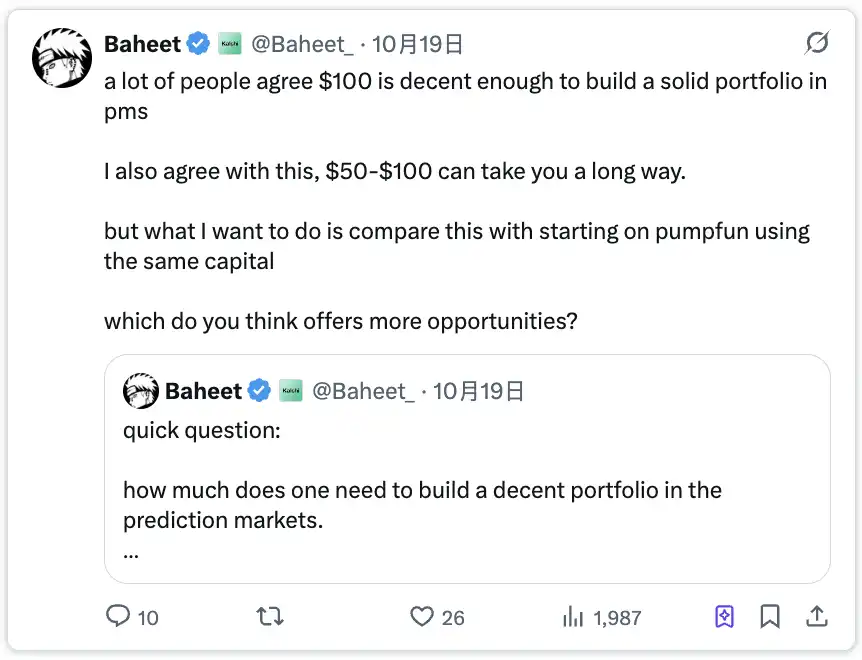
In my view, this is akin to comparing a game of chess to a casino slot machine: both may yield handsome returns, but one rewards strategy while the other relies on chaos and luck.
Next, we will delve into an analysis based on feasibility, risk, reward, advantages, and the impact of capital.
Market Mechanism
Prediction Markets
Prediction markets are structured prediction tools; top platforms like @Kalshi and @Polymarket allow users to trade based on the outcome of specific, verifiable events, such as election results, economic data releases, or specific price movements.
The price of contracts on prediction markets reflects the market's perception of the probability of a particular event occurring. For example, a contract priced at $0.80 indicates an 80% probability of the "yes" outcome.
Furthermore, these markets are highly regarded for their "wisdom of the crowd" effect, where the collective knowledge of participants leads to remarkably accurate predictions, something the Memecoin space cannot replicate.
The value of prediction market contracts is tied to verifiable real-world events. This underlying factor gives prediction markets a certain legitimacy, which is a core difference from Memecoin.
MemeCoin Trading on Pumpfun
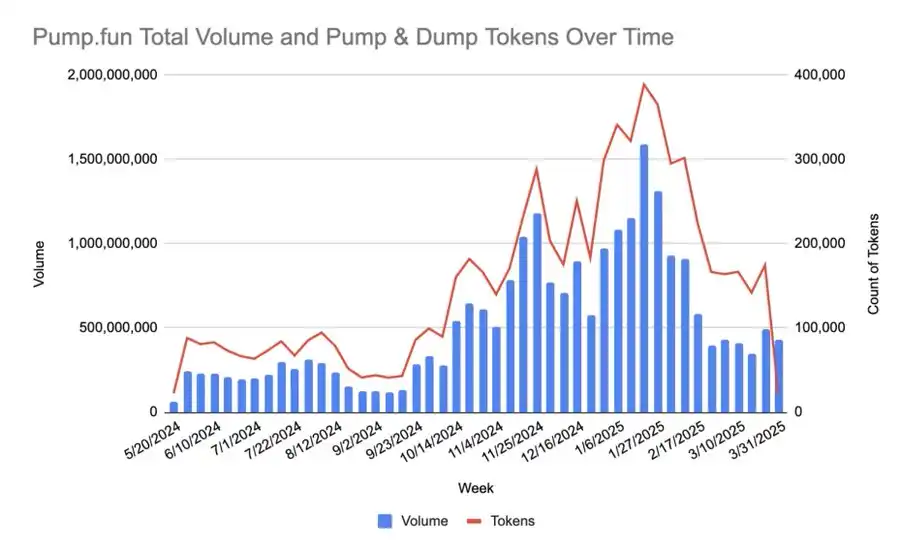
The Pumpfun platform allows users to swiftly create and trade new tokens via a bonding curve, causing prices to surge rapidly as more buyers join in. This low barrier to entry has attracted a plethora of untested new Meme projects.
The lifecycle of Memecoin typically follows a predictable yet chaotic pattern. After reaching a certain market cap, the token gets deployed to a decentralized exchange (such as @Raydium) and usually goes through an initial "pump" phase.
In fact, data from May 2025 shows that the majority of tokens fail after their initial issuance.
A report by @Solidus_Labs revealed that out of 7 million tokens launched on Pumpfun, 98.6% were classified as either "rug pulls" or manipulative projects.
Accessibility
Both markets are very friendly to small amounts of capital, with virtually no barriers to entry.
On the Polymarket platform, you can participate with as little as $10 in capital, for example, by betting on events such as elections or cryptocurrency price movements.
If you have $50-100, you can even diversify your investment across 5-10 events and optimize your bet sizing with a better strategy.
Pumpfun has a lower entry price, with the cost of creating a Memecoin being around 0.02 SOL (approximately $3 to $4 at current prices), and purchasing only requires loose change from your Solana wallet.
Initial trades typically happen at a smaller market cap, around $4,000, so $50 to $100 can get you a significant share early on.
Aside from network fees, there is no formal minimum requirement, making it ideal for "wild trading."
Risk, Reward, and Reality
Prediction markets are known for their quantifiable risks; the risk is explicit and tied to the outcome of an event. While a trader may lose their entire investment on a single contract, they can clearly understand the odds and event criteria from the start.
With thorough research, the potential rewards can be very high. Although these returns may not be as eye-catching as the price spikes of Memecoins, they are typically more sustainable and based on information-driven decisions.
Common risks in prediction markets include traders misjudging probabilities or insufficient market liquidity, but if only a small portion of the portfolio is wagered, full bankruptcy is contained and rare.
For most traders, a diversified prediction market investment portfolio offers a more structured way to engage in high-risk trading with more predictable outcomes.
Here is a quality article from @Predictifybot on how to diversify a prediction market investment portfolio:

Finally, due to the presence of the Commodity Futures Trading Commission (CFTC, responsible for regulating Kalshi), participants benefit from an additional layer of oversight and protection, reducing the risk of fraud and manipulation.
On the other hand, the Memecoin ecosystem is rife with scams, manipulation, and highly volatile price swings. Projects may exit scam, developers may rug pull liquidity, rendering the tokens in investors' hands worthless.
The value of a Memecoin is based on hype and social sentiment rather than any fundamental utility, making it highly susceptible to social media trends and "insider" trading.
While many people hope for significant, life-changing returns, the reality is that such success is very rare. Most participants either lose money or see minimal gains.
What Can $100 Do?
Effectively utilizing small capital (like $100) in prediction markets and Pumpfun requires highly specialized and fundamentally different strategies.
I believe the best strategy in prediction markets is to find events mispriced due to information asymmetry, but this is nearly impossible to apply to Pumpfun Memecoins.
Prediction Markets: Leveraging Information Asymmetry
A $100 capital cannot move the needle in prediction markets, so your strategy must act like a savvy analyst. Your advantage lies in discovering information the market collectively overlooks.
How It Works:
1. Identify Information Gaps: Market odds are based on the collective information of all traders. Low-volume markets may lack enough participants to truly function efficiently, offering an advantage to small capital traders.
2. Utilize Overlooked Expertise: If you possess specialized knowledge few in the market have, you can leverage that information. For example, in-depth understanding of local elections, specific technological developments, obscure legal cases, or match outcomes.
3. Focus on Low-Liquidity Markets: Larger liquidity markets are typically more efficient, but small capital can concentrate on smaller, less-traded markets where odds may not yet reflect all available information.
As a small-scale capital trader, your role is an information arbitrageur, and your goal is to find market inefficiencies caused by incomplete information.
Pumpfun: Survival of the Funnest
The concept of information asymmetry on Pumpfun is entirely different and more challenging to exploit. It involves less rational odds and relies more on insider information.
How It Works:
1. Insider Information is Key: In Pumpfun, information asymmetry is typically disadvantageous for regular traders. The creator of a Memecoin holds complete information and has many tools to manipulate trading.
2. Social and Emotional Leverage: The most potent "information" in this market is the viral potential of a cryptocurrency. Founders control the initial marketing, often relying on influencers and social media strategies to create FOMO.
3. Information Asymmetry: There is an advantage here. If you join the Solana meme community or seize an opportunity before a token's meteoric rise. However, the asymmetry is fleeting, with surges lasting from minutes to hours, and 97% of traders making less than $1,000 in profit.
Unlike prediction markets, there is no real probability here, only collective FOMO.
The strategy is simple: it's either serendipity or exit! Your Memecoin strategy involves only $100, as follows:
1. Seize Opportunities: DYOR (Do Your Own Research) and quickly get into new tokens, hoping to be part of the initial momentum.
2. Utilize Professional Tools: Many traders use bots to monitor new token listings and market activities to gain a few seconds of an edge.
3. Manage Risk Through Caution: Keep a close eye on price charts, spot signs of "developer dumps," and be ready to sell immediately.
On Pumpfun, your $100 is not used to exploit information asymmetry but is immersed in a market where information is weaponized by more powerful players. Your success has little to do with analysis and relies more on luck, timing, and avoiding falling victim to manipulative schemes.
Final Thoughts
At the end of the day, whether to engage in prediction markets or Memecoin trading on Pumpfun depends on the trader's risk preference.
While both offer the potential for high returns, they achieve this through fundamentally different mechanisms.
Prediction markets provide verifiable outcomes and potential regulatory oversight, offering a more structured and information-based approach to high-risk speculation.
On the other hand, Memecoin trading is more like gambling in a high-risk, unregulated casino where one may experience massive profits, but the risk of loss is significant due to scams and extreme volatility.
Here is an excellent post from @tradefoxintern discussing why prediction markets are poised to replace Memecoin:
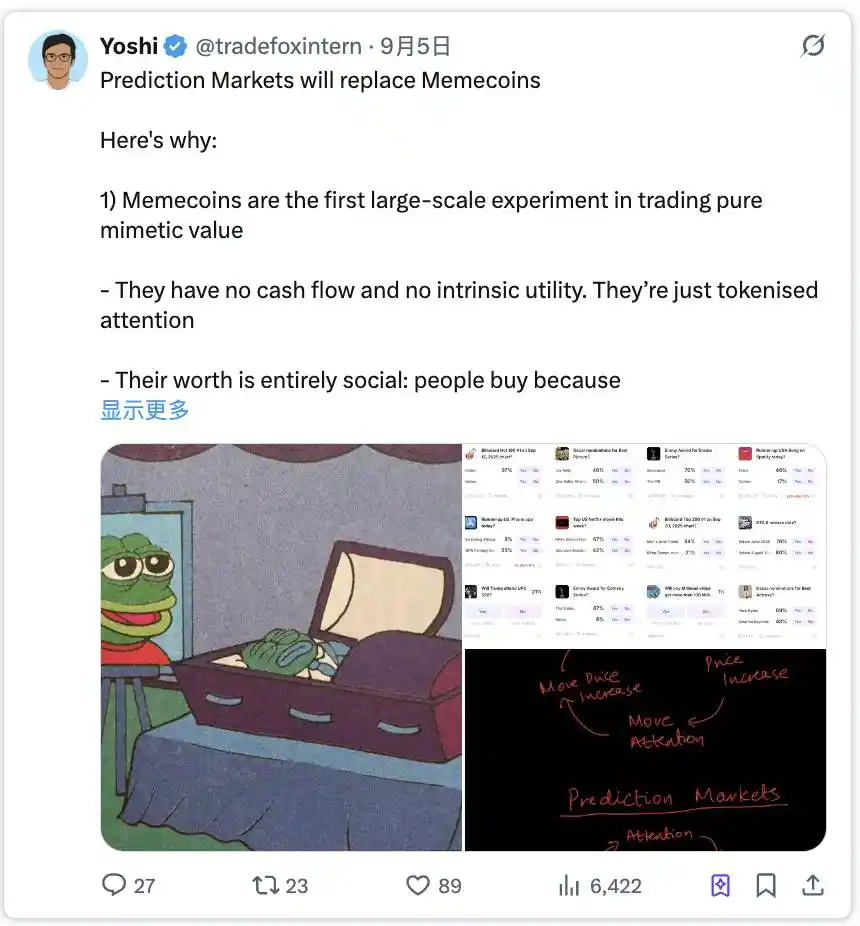
Therefore, for those who prefer a more calculated, research-driven approach, prediction markets are the clear choice.
For those seeking massive, lottery-like returns and willing to navigate through thousands of scams, Pumpfun remains an option.

John Wang: Remember my words, the scale of the prediction market will be 10 times that of Memecoin!
You may also like

Full text of the Federal Reserve's decision: Maintain interest rates unchanged and expect one rate cut within the year, with Governor Mulan casting a dissenting vote

Guarding billions in assets, yet unable to sustain itself: Tally bids a dignified farewell after five years

SEC’s Stance on Crypto Assets: Most Not Considered Securities
Key Takeaways: The SEC’s new interpretation categorizes most crypto assets as non-securities under federal law. This move aims…

South Korea’s New Crypto Seizure Guidelines After Asset Mismanagement Incidents
Key Takeaways: South Korea’s National Police Agency (KNPA) has drafted guidelines for crypto seizure, with a focus on…

Institutional Confidence in Crypto’s 2026 Growth Trajectory
Key Takeaways: A significant 73% of institutional investors plan to increase their crypto holdings by 2026. Exchange-traded products…

Ethereum Reduces Bridge Times by 98% with Fast Confirmation Rule
Key Takeaways: Ethereum introduces the Fast Confirmation Rule (FCR) aiming to cut bridge times from L1 to L2…

Crypto Firms Advocate DeFi Education in US Colleges
Key Takeaways: Twenty-one crypto organizations have called on US colleges to integrate decentralized finance (DeFi) into their curricula…

RedotPay Reorganizes Amidst Funding Tries and IPO Goals
Key Takeaways: RedotPay is facing leadership changes and concerns over its connections with mainland China while eyeing a…

Bitcoin ETF Streak Nears October Highs While Inflows Lag Behind
Key Takeaways: US spot Bitcoin ETFs have continued their inflow streak for seven straight days, accumulating $1.2 billion…
Connecticut Suspends Bitcoin Depot as Revenue Prospects for 2026 Worsen
Key Takeaways: Connecticut halts Bitcoin Depot’s operations, citing regulatory breaches related to the Money Transmission Act. Bitcoin Depot…

DAO Governance Platform Tally Shuts Down Due to Market Challenges
Key Takeaways: Tally, after operating for five years, is shutting down due to a lack of viable business…
Trump Memecoin Shows Volatility Amid Mar-a-Lago Event
Key Takeaways: TRUMP memecoin holders surpassed 83 wallets with over one million tokens after a luncheon announcement with…
Bitcoin Surge in Australian E-commerce Faces Banking Hurdles: In-depth Analysis
Key Takeaways: Cryptocurrency usage in Australia for purchasing goods and services doubled from 6% to 12% in 2026.…

Meta Shuts Down Horizon Worlds VR for Mobile-Centric Strategy
Key Takeaways: Meta is transitioning Horizon Worlds from a VR to a mobile-centric platform starting June 2026. The…

Bitcoin Exchange Inflows Surge Amidst $75,000 Resistance
Key Takeaways: Bitcoin inflows to exchanges have spiked to 6,100 BTC, hinting at potential selling pressure. The large…
Bitrefill Identifies Lazarus Group Behind Cyberattack and Stolen Funds
Key Takeaways: Bitrefill suffered a cyberattack on March 1, likely orchestrated by the infamous Lazarus Group using sophisticated…
Coin Center Advocates for Rulemaking Over No-Action Letters in Crypto Regulation
Key Takeaways: Coin Center challenges the SEC’s reliance on no-action letters, promoting a shift toward comprehensive rulemaking in…
On the eve of the Fed meeting, are traders starting to bet on a rate hike?
Full text of the Federal Reserve's decision: Maintain interest rates unchanged and expect one rate cut within the year, with Governor Mulan casting a dissenting vote
Guarding billions in assets, yet unable to sustain itself: Tally bids a dignified farewell after five years
SEC’s Stance on Crypto Assets: Most Not Considered Securities
Key Takeaways: The SEC’s new interpretation categorizes most crypto assets as non-securities under federal law. This move aims…
South Korea’s New Crypto Seizure Guidelines After Asset Mismanagement Incidents
Key Takeaways: South Korea’s National Police Agency (KNPA) has drafted guidelines for crypto seizure, with a focus on…
Institutional Confidence in Crypto’s 2026 Growth Trajectory
Key Takeaways: A significant 73% of institutional investors plan to increase their crypto holdings by 2026. Exchange-traded products…
Ethereum Reduces Bridge Times by 98% with Fast Confirmation Rule
Key Takeaways: Ethereum introduces the Fast Confirmation Rule (FCR) aiming to cut bridge times from L1 to L2…


 App
App