
- Buy Crypto
- Markets
- Futures
- Spot
- Copy Trade
 WE-Launch
Zeno's Digital Twin Paradigm and DeSci's Tech Democratization

Original Title: "Zeno's Digital Twinning Vision and DeSci's Technological Democratization"
Original Author: Eric, Foresight News
Over a week ago, DeSci platform Orama Labs successfully completed the OramaPad's first project, Zeno's token launch. This Zeno launchpad provided 500 million ZENO tokens, half of the total supply. OramaPad requires users to stake their PYTHIA tokens to participate, and this "opening act" attracted a total of $3.6 million in PYTHIA staking.
Orama Labs aims to address the inefficiencies in fund allocation and resource distribution in traditional scientific research. The solution is to fund scientific experiments, achieve intellectual property verification, solve data silos, and implement community governance, establishing a path from research to commercialization.
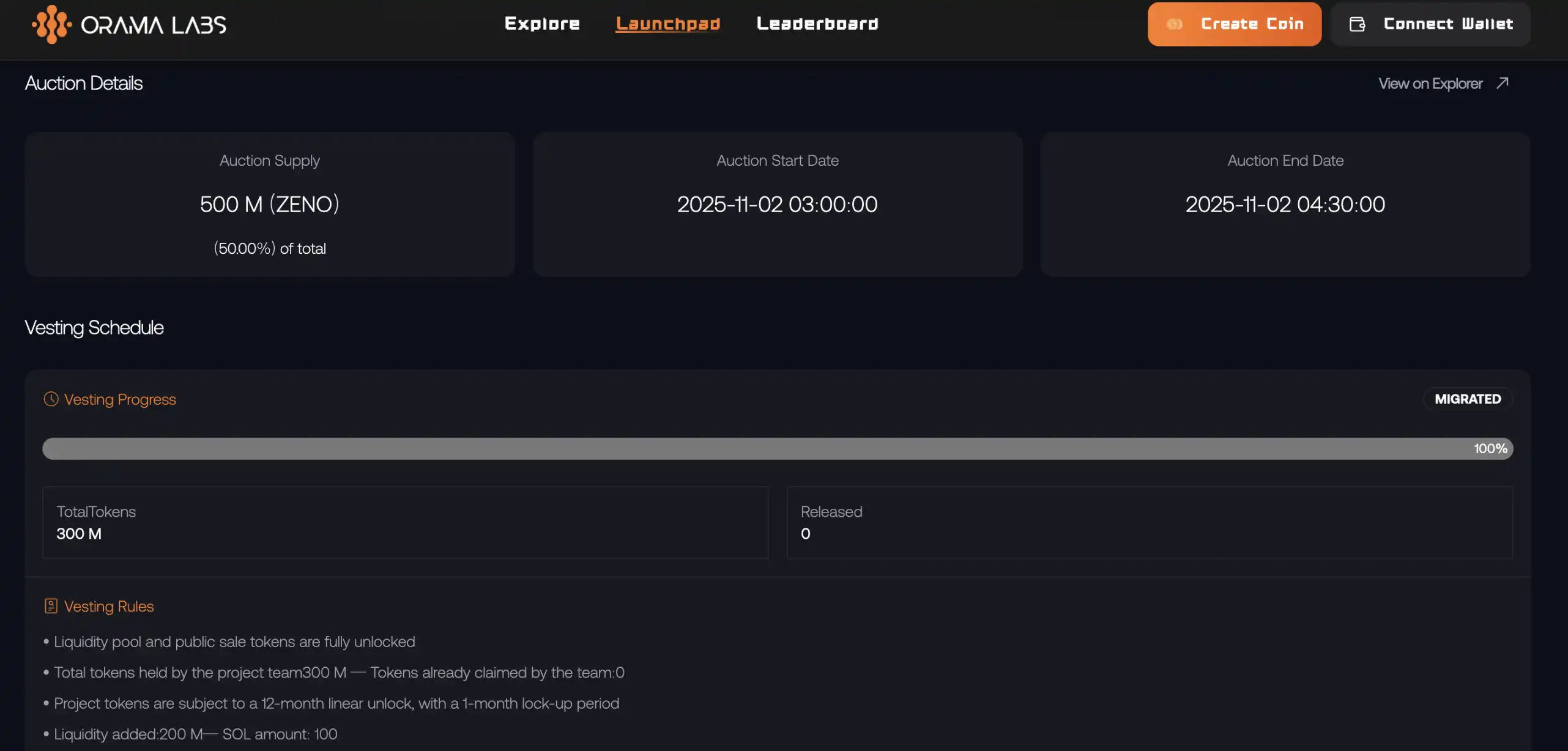
OramaPad's first project adopts the Crown model, where the project needs to have a sound business logic system and/or strong Web2 domain technical development capabilities. Additionally, its product must be highly practical, which Orama refers to as OCM (Onboarding Community Market). Unlike simple meme issuance, Orama essentially provides a replicable on-chain transformation path for Web2 enterprises or teams with mature business models and technical capabilities, and the first mover Zeno is no exception.
The Hardcore Tech of the Unreadable Document
Zeno is a project with a grand vision, so much so that if you only look at Zeno's documentation, you may not fully understand what the team is trying to achieve. It was only after the author communicated with the team that the full picture of this cyberpunk-style story became clear:
In short, Zeno aims to overlay a multi-layer virtual space for intelligent entities such as AI and robots in the physical space of human life, allowing all "intelligent entities," including humans, to live in the same space.
Imagine a scenario like this: One afternoon in the future, you are enjoying a leisurely time on the balcony in a lounge chair, with an AI butler connecting all the household appliances and a humanoid robot busy with household chores. Suddenly, feeling a bit bored, you want to play a virtual passing game with your other two brothers at home. So, you put on your VR/AR glasses, and in the world of glasses, the robot looks like a human, and the AI existing only in the network transforms into a humanoid. The robot sits on the sofa, and the AI sits on the floor. The three of you pass the virtual basketball while discussing what to eat tonight.
This is Zeno's ultimate vision, allowing carbon-based sentient beings and silicon-based intelligences to coexist in the same physical space.
The cyberspace many of us imagine may be a purely virtual space, such as the one depicted in the movie "Ready Player One," where people enter a new world through VR. Even our current interactions with AI, including the one with Zeno, are conducted through flat carriers like computers or smartphone screens. Zeno aims to directly bring these virtual spaces into real life, creating a state where the physical world and the digital world exist in an "overlay in the same spacetime." This integration allows digital content to be as "real and tangible" as physical existence, enabling humans, robots, and AI to achieve natural interaction in real scenes, building a mixed reality ecosystem where the virtual and the real coexist harmoniously.
Of course, the world we see may not be exactly the same as the one seen by robots and AI. For example, you may not want a robot to wander into your study room casually. In the world perceived by the robot, you can instead lock the door to the study room. Only when you "unlock" this "lock" would the robot be granted permission to enter.
Core to Spatial Anchors
Living under the same roof as Artificial Intelligence may sound very high-tech, but there is a significant premise: you need to establish a model of the real world in the virtual environment to achieve programmability.
First and foremost, you need to possess real-world reality data, a challenge currently being researched by many companies, including those in the autonomous driving sector. Take autonomous driving, for instance. With real-world map data of an entire city, autonomous driving AI does not need to roam the streets following cars to learn how to handle various situations. It can directly simulate on-road scenarios in the lab to evolve continuously.
Although the above does not represent what we call "spatial overlap," it is still a crucial application for building a model of the real world. Zeno's ultimate vision cannot be achieved in one step. The first thing to do is to collect real-world reality data.
Zeno has launched a program that allows users to use their everyday devices to help enter spatial data, supporting two types of devices: robots and glasses. As for smartphones, the team stated that Google's ARCore is mature enough and does not require secondary development. Users can directly use it with reference to compatible models. The data collected is used to build space algorithms developed independently by the Zeno team.
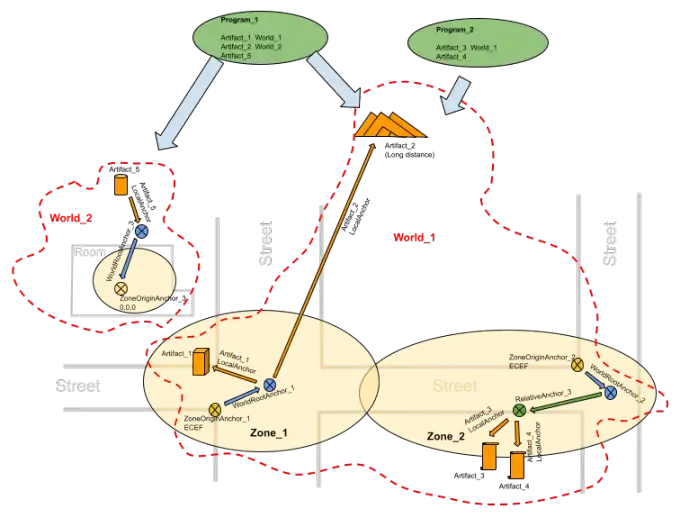
The core of building coexistence between the real world and the virtual world revolves around spatial anchors. From a technical realization perspective, the real world cannot be directly programmed. The connection between the real and virtual worlds is made by associating anchors in the real world and mapping out a virtual space based on physical space. In metaphorical terms, for robots and AI, the real world is like the ocean in the night, and these anchors are individual lighthouses that illuminate every area for silicon-based intelligences in the real world.
Zeno's first step in achieving its "ultimate goal" is to establish a full-stack platform. In addition to everyday electronic devices such as smartphones, the platform also utilizes professional equipment such as LiDAR, 360-degree cameras, and RGB cameras on mobile devices or XR headsets for data collection. The team stated that the Zeno platform will feature a powerful cloud-based visual world model and compute system capable of processing gigabytes of raw sensor data for large-scale areas (city-level / global-level) daily, building indexes for fast spatial queries. It will also parallel process data for small-scale areas (room-level / anchor-level) to achieve high-throughput real-time processing.
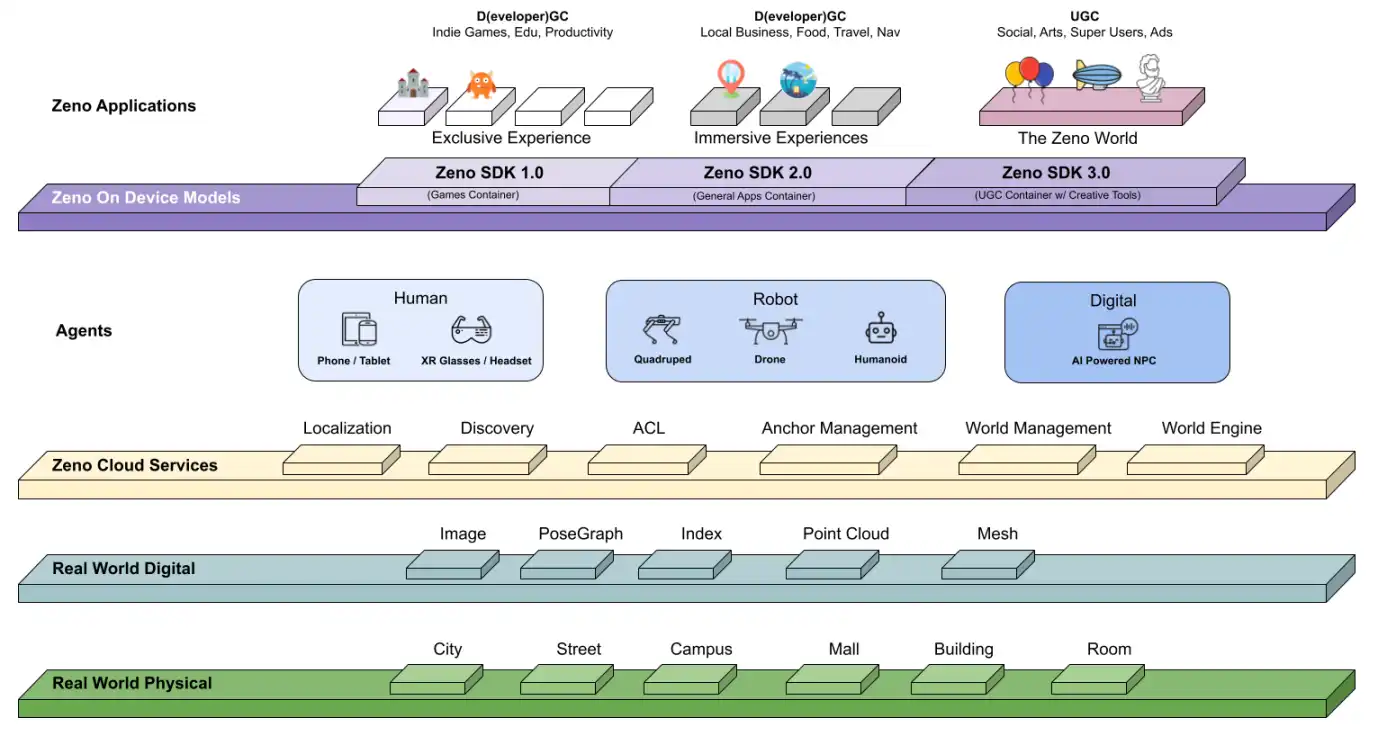
Furthermore, the system is equipped with self-learning capabilities to continually optimize through high-quality and third-party data. In the future, it will support hundreds of spatial queries per second, providing precise six degrees of freedom (6-DOF) positioning results, shared spatial anchor creation, rapid 3D visual reconstruction, real-time semantic segmentation, and other scene understanding functions. It is highly scalable and can be widely applied in various scenarios such as AR games, navigation, advertising, or productivity tools.
The validated spatial data and the built spatial intelligence infrastructure layer can be called by various decentralized applications for autonomous driving route planning, end-to-end model data training for robots, generating verifiable smart contracts for autonomous execution, spatial-form ad distribution, ultimately achieving spatial data-driven decision-making and higher-level applications.

Who is Behind Zeno?
Compared to some Web3 projects with vague visions, Zeno's goal, although sounding complex, is very practical. The reason why the technical implementation is described in such detail in the project documentation is that team members have been deeply involved in this field for many years.
Zeno's team members all come from DeepMirror, which is Chameleon Technology. If you are not familiar with Chameleon Technology, you may have heard of Pony.ai, a company listed on the Nasdaq with a market capitalization of $7 billion. Harry Hu, CEO of Chameleon Technology, was the former COO/CFO of Pony.ai.
Zeno's CEO, Yizi Wu, was an early member of Google X and was involved in the development of products such as Google Glass, Google ARCore, Google Lens, and the Google Developer Platform. At Chameleon Technology, he led the overall AI architecture and the development of the World Model.
The Zeno core team also includes Taoran Chen, who previously served as a research scientist at Horizon Robotics, holding dual doctoral degrees in mathematics from MIT and Cornell University, and Kevin Chen, who previously served as the CFO of Horizon Robotics and held executive positions at Fosun Group, JPMorgan Chase, and Morgan Stanley.
For the Zeno team, venturing into Web3 is more like a bold attempt by a tech-savvy Web2 team. The team described that the ZENO token will be used to incentivize users providing spatial data and teams or individuals adopting Zeno to build infrastructure development tools, applications, and games. In addition to the 5 billion tokens distributed in the launchpad, the team reserved 3 billion tokens, while the remaining 2 billion tokens will have liquidity pairs with 100 SOL obtained from the launchpad activity on Meteora.

Horizon Robotics' AR and game-integrated spatial application RealityGuard
When asked why they chose Web3 as their battlefield, Zeno told the author that spatial data itself is a highly decentralized digital asset that naturally fits into the Web3 environment. The spatial data collected by Zeno itself will also be securitized in the future and expanded through transactions using the ZENO token as currency within the ecosystem, with buyers being tech companies in need of spatial data. As for more applications of ZENO, they will be "further explored as the project progresses."
Through Zeno, it is believed that the DeSci platform has achieved concretization, where science is not necessarily an obscure and purely theoretical discipline, but rather a democratization of technology similar to Xiaomi, lowering the threshold for technology value investment, which is also one of the significant values of DeSci's existence.
You may also like

$50 to $1 Million: How to Survive in the Meme Battlefield with 'Wallet Tracking'

Paradigm's Tempo Project Launches Testnet, Is It Worth Checking Out?

When Everyone Uses AI Trading, Where Does Cryptocurrency Alpha Go in 2026?
In 2025, AI trading has become the default, but Alpha hasn’t disappeared — it’s been eroded by crowding, as similar data, models, and strategies cause traders to act in sync and lose their edge.
Real Alpha has shifted to harder-to-copy layers like behavioral and on-chain data, execution quality, risk management, and human judgment in extreme markets, where acting differently — or not acting at all—matters more than better predictions.

Without Narrative Power, Web3 Will Not Tap into the Vastness

Yield Farming at 86% APY? How to Use Bots to “Earn While You Sleep” on Polymarket
Key Takeaways Polymarket presents untapped opportunities for bot utilization, despite existing competition. A proprietary trading bot streamlines the…

The Eve of a Fed Pivot: Wall Street Girds for Rate Battle Without 'Powell'

After 500 Rejections, I Started Building a Product People Actually Use

BlockBeats 2025: Enabling 15 Million People to Witness Bitcoin's New All-Time High

Breaker Game Over Line: Why Are Young People Turning to Long-Termism?

Top US Journalist Minting on Base, Attention Completes Monetization Loop

Gate ETF Achieves $5 Billion Trading Volume Over 30 Days
Key Takeaways Gate ETF has reached approximately $5 billion in trading volume over the last 30 days, covering…

Billions Launches Official Profiles to Combat AI-Induced Trust Issues
Key Takeaways Billions has rolled out Official Profiles to address the growing problems of trust and fraud exacerbated…

RVV Token Surges as Astra Nova Gains Tier 1 Listing
Key Takeaways The Astra Nova ($RVV) token experienced a remarkable 56.33% increase in value within 24 hours. The…

AI Tool Users Advised to Guard Against Toxic Prompt Attacks
Key Takeaways SlowMist founder Yu Xian emphasizes the risk of toxic prompt attacks in AI tools, urging users…

SlowMist Warns of Return of Shai-Hulud 3.0 Supply Chain Attack
Key Takeaways SlowMist’s Chief Information Security Officer alerted the community about the resurgence of Shai-Hulud 3.0, an advanced…

Trust Wallet Investigates Browser Extension Security Incident
Key Takeaways A recent security incident in Trust Wallet’s browser extension has affected 2,596 wallets, leading to the…
Coinbase says three areas will dominate the crypto market in 2026
Key Takeaways: Coinbase Institutional emphasizes the shift from traditional boom-and-bust cycles to more structural forces in crypto markets,…
Coinbase Recognized as a Top Fintech Pick for 2026 by Clear Street
Key Takeaways: Coinbase has been identified as one of the top three fintech stock picks for 2026 by…
$50 to $1 Million: How to Survive in the Meme Battlefield with 'Wallet Tracking'
Paradigm's Tempo Project Launches Testnet, Is It Worth Checking Out?
When Everyone Uses AI Trading, Where Does Cryptocurrency Alpha Go in 2026?
In 2025, AI trading has become the default, but Alpha hasn’t disappeared — it’s been eroded by crowding, as similar data, models, and strategies cause traders to act in sync and lose their edge.
Real Alpha has shifted to harder-to-copy layers like behavioral and on-chain data, execution quality, risk management, and human judgment in extreme markets, where acting differently — or not acting at all—matters more than better predictions.
Without Narrative Power, Web3 Will Not Tap into the Vastness
Yield Farming at 86% APY? How to Use Bots to “Earn While You Sleep” on Polymarket
Key Takeaways Polymarket presents untapped opportunities for bot utilization, despite existing competition. A proprietary trading bot streamlines the…
The Eve of a Fed Pivot: Wall Street Girds for Rate Battle Without 'Powell'
Popular coins
Latest Crypto News


Customer Support:@weikecs
Business Cooperation:@weikecs
Quant Trading & MM:[email protected]
VIP Services:[email protected]
 App
App