
 Buy Crypto
- Markets
 Futures
- Spot
- Copy Trade
- Earn
- More
Dissecting the Monad 18-Page Sales Pitch: How Does the 0.16% Liquidity Chip Support a $25 Billion Fully Diluted Valuation?

Original Article Title: "How to View Monad's Liquidity Provision Arrangement? 18-Page Sales Document Conceals These Core Details"
Original Article Author: KarenZ, Foresight News
As the Monad (MON) token gears up for its Coinbase public sale, its released 18-page disclosure document has become the market's focus.
This document, provided by Monad Foundation subsidiary MF Services (BVI), Ltd., fully reveals the nature of Monad, from project architecture to funding status, token allocation to sale rules, and transparent liquidity provider information along with security risk warnings, providing investors with the key information necessary to make informed decisions and reflecting the project's transparent operational approach.
In addition to widely cited key data such as "25 Billion USD FDV," "Price of 0.025 USD," and "7.5% Public Sale Ratio," this document also systematically discloses significant details that cannot be ignored, such as legal pricing, token release schedule, liquidity provision arrangement, and risk warnings.
Of particular note, the document extensively lists multidimensional risks related to token sales, the Monad Foundation, the MON token, the Monad project, and its underlying technology. For users intending to participate in MONAD token investment, it is recommended to thoroughly study this document and make a rational investment choice.
Legal Structure
The Monad Foundation conducts its public sale on Coinbase through its subsidiary MF Services (BVI) Ltd. MF Services (BVI) Ltd. is a wholly-owned subsidiary of the Monad Foundation registered in the British Virgin Islands and is the seller of this token sale. The Monad Foundation is the sole director of MF Services (BVI).
Core Development Entity and $262 Million Funding Details
· The core contributors of Monad are the Monad Foundation and Category Labs, Inc. (formerly known as Monad Labs, Inc.).
· The Monad Foundation is a Cayman Islands foundation company dedicated to supporting the development, decentralization, security, and application promotion of the Monad network through a range of services, including community engagement, business expansion, developer and user education, and marketing services. Category Labs, headquartered in New York, provides core development services for the Monad client.
· The three co-founders of Monad are James Hunsaker (CEO of Category Labs), Keone Hon, and Eunice Giarta. The latter two serve as co-GMs of the Monad Foundation.
· The Monad Foundation is overseen by a board of directors, consisting of three directors: Petrus Basson, Keone Hon, and Marc Piano.
· Funding Timeline:
1. Pre-Seed: Raised $19.6 million from June to December 2022;
2. Seed Round: Raised $22.6 million from January to March 2024;
3. Series A: Raised $220.5 million from March to August 2024;
· In 2024, the Monad Foundation received a $90 million donation from Category Labs to cover operating expenses from 2024 to 2026. This donation is part of the $262 million raised by Monad Labs in various funding rounds.
Sale Terms Key Information
· Token Sale Date: November 17, 2025, 22:00 to November 23, 2025, 10:00.
· Token Sale Ratio: Up to 7.5 billion MON tokens (7.5% of the initial total supply). Sale Price: $0.025 per MON. If fully sold, it will raise $187.5 million.
· Minimum Subscription $100, Maximum $100,000 (Coinbase One members may have higher limits per platform terms).
· Fully Diluted Valuation: $25 billion
· Utilizing a "bottom-up" oversubscription allocation: To ensure widespread distribution and prevent whale domination, a mechanism called "bottom-up fill" is disclosed. In the event of oversubscription, a bottom-up fill allocation will be used to achieve as broad a distribution among sale participants as possible while limiting asset concentration for large buyers.
· Example Illustration: In a sale of 1,000 tokens: Three users (low / medium / high) apply for 100/500/1,000 tokens, in the first allocation round, each receives 100 tokens (leaving 700, fully satisfying the low user). In the second allocation round, the remaining 700 tokens are split evenly between medium / high users, each receiving 350 tokens. Final allocation: low receives 100 tokens, medium receives 450 tokens, high receives 450 tokens.
Token Distribution and Release Schedule
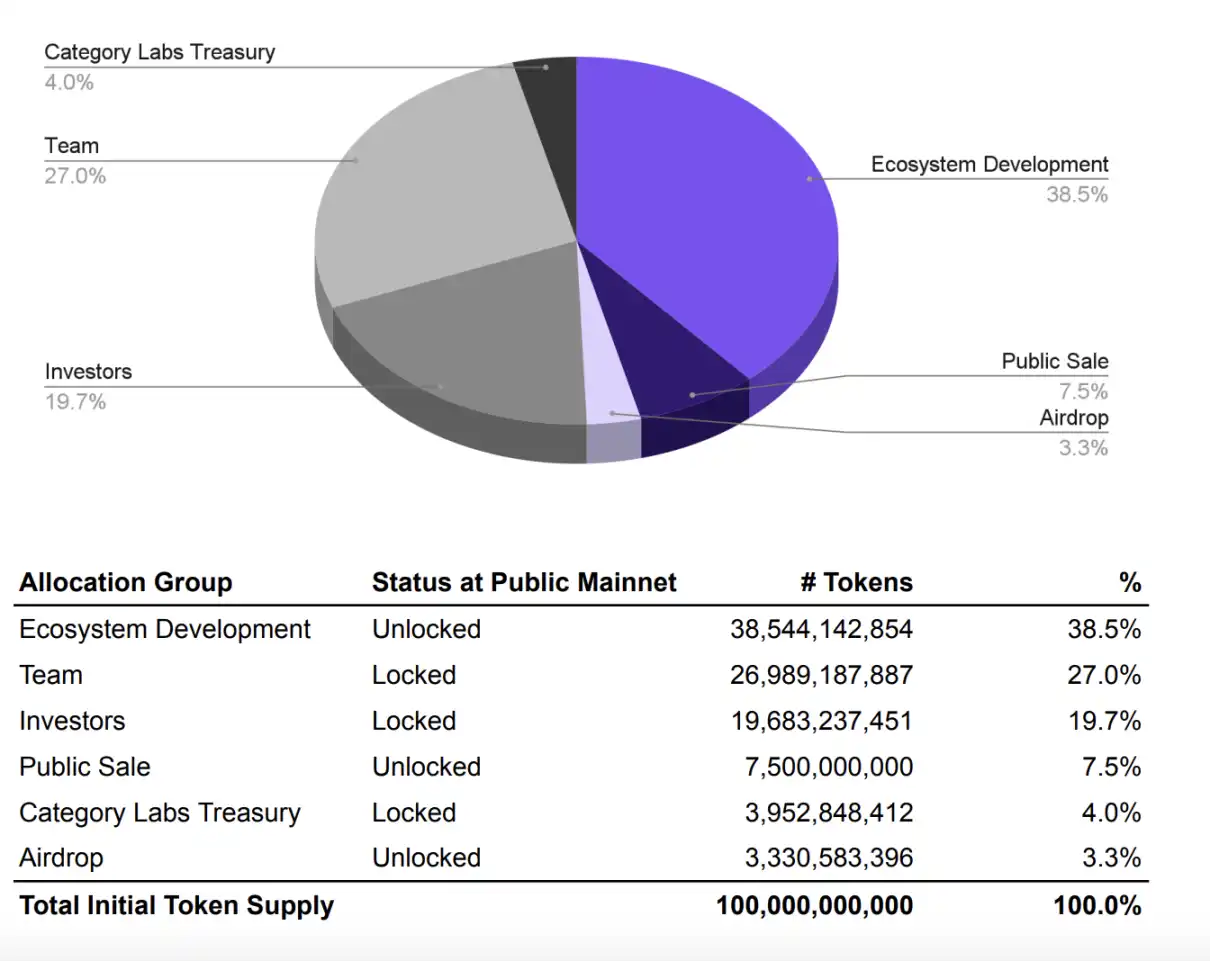
The MON Tokenomics model is as follows:
The following diagram illustrates the expected token release schedule:
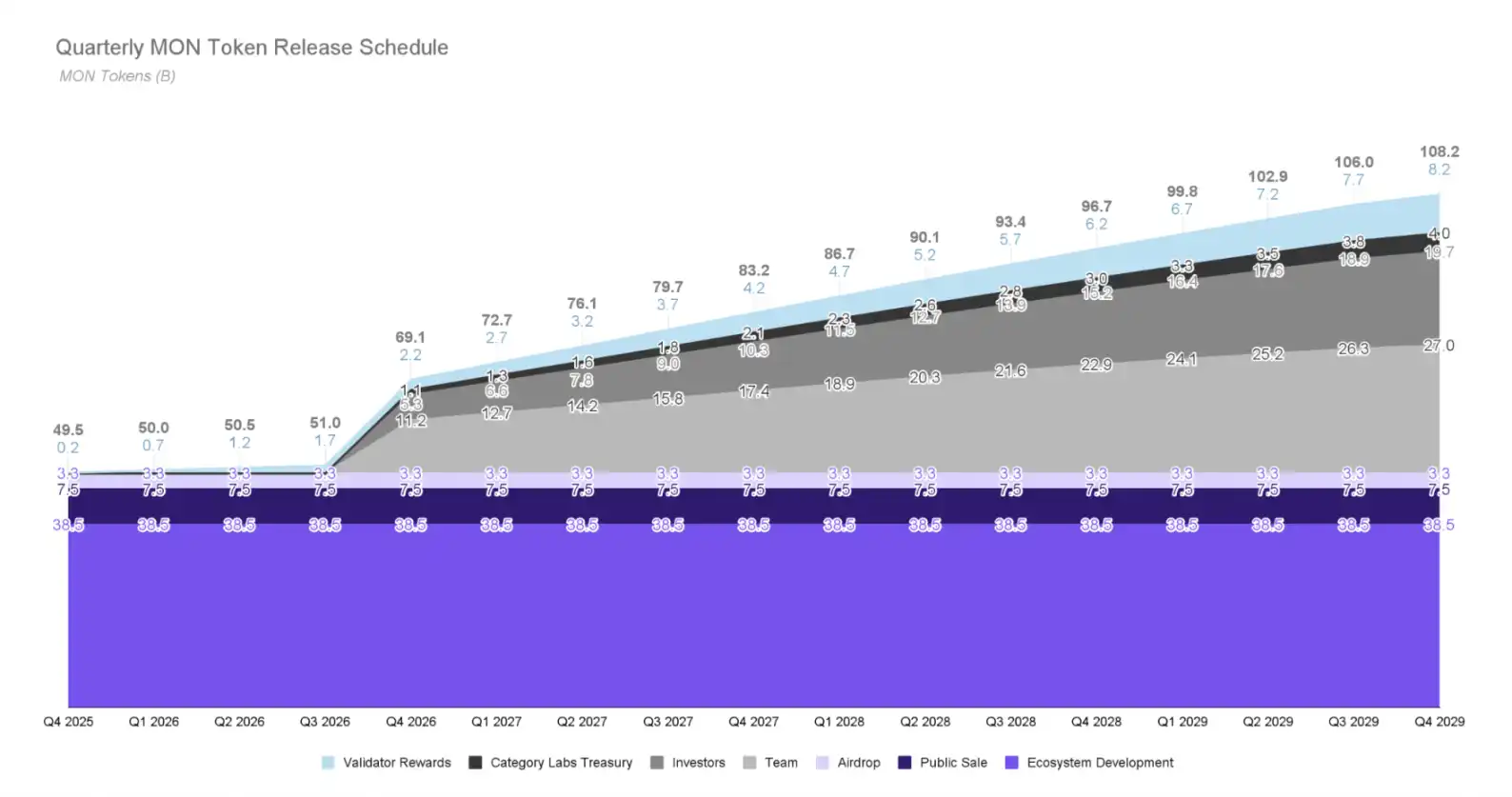
Overall, on the first day of the Monad mainnet public launch, approximately 49.4% of the total 1 trillion MON tokens were in an unlocked state. Of these, it is expected that around 108 billion MON tokens (10.8% of the initial total supply) will enter public circulation through public sales and airdrops during the Monad mainnet public launch, while about 385 billion MON tokens (38.5%) will be allocated to ecosystem development. These tokens, although unlocked, will be managed by the Monad Foundation and will be used to provide grants or incentives at a strategic level over the next few years and staked according to the Foundation's validator delegation plan.
Furthermore, all tokens held by investors, team members, and the Category Labs treasury will be locked on the first day of the Monad mainnet public launch and will follow a clear unlock and release schedule. These tokens will be locked for a minimum of one year. It is anticipated that all locked tokens from the initial token supply will be fully unlocked by the fourth anniversary of the Monad mainnet public launch (Q4 2029). Locked tokens cannot be staked.
It is worth noting that the documents indicate that in the future, following network launch, the Monad Foundation may continue with airdrops to incentivize the exploration and use of applications and protocols within the Monad network and ecosystem.
Future Supply: 2% Annual Inflation + Fee Burn
· Inflation: 25 MON is newly minted per block as a reward for validators/stakers, with an annualized inflation of approximately 2 billion tokens (2% of the initial total supply) designed to incentivize network participants and ensure network security.
· Deflation: The base transaction fees are entirely burned. This mechanism offsets some inflationary pressures by reducing the circulating supply.
Monad Market Making and Liquidity Arrangements
To ensure adequate liquidity post-token listing and transparency, MF Services (BVI) Ltd. has disclosed detailed market maker partnerships and liquidity support arrangements.
MF Services (BVI) Ltd. has entered into loan agreements with five market makers: CyantArb, Auros, Galaxy, GSR, and Wintermute, lending a total of 160 million MON tokens. Among them, CyantArb, Auros, Galaxy, and GSR have a loan term of 1 month (with monthly renewal options), while Wintermute has a loan term of 1 year. Additionally, the project has engaged a third-party entity, Coinwatch, to monitor the use of the loaned tokens to ensure the funds are utilized to enhance market liquidity rather than for any illicit activities.
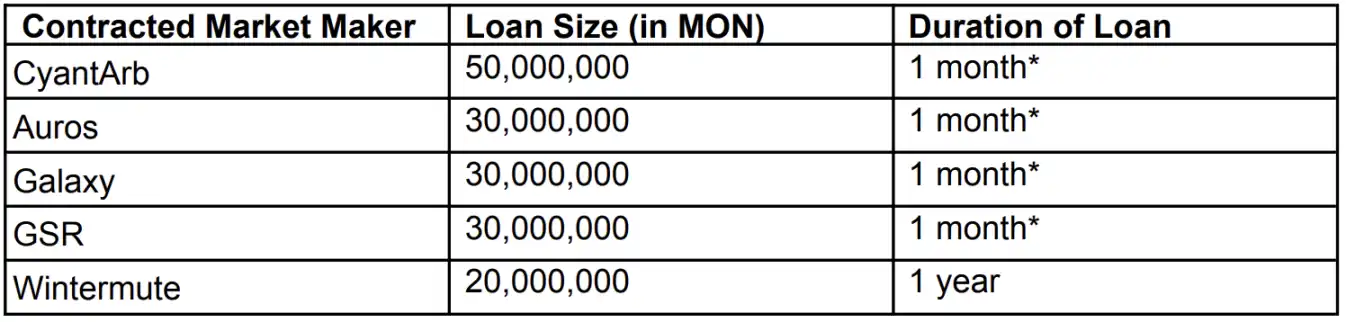
Furthermore, MF Services (BVI) may also deploy up to 0.2% of the initial MON token supply as the initial liquidity for a DEX pool.
How to Evaluate the Monad Market Making Arrangement?
Public Transparency
In the Web3 space, the transparency and fairness of market making arrangements have always been a core topic of market concern, as traditional projects often face investor trust crises due to undisclosed information about market makers. However, Monad's disclosure of market making details in the Coinbase ICO, with transparency at its core, has broken industry norms.
In addition, monitoring by Coinwatch will ensure to the greatest extent possible that the loaned tokens are genuinely used for market making, demonstrating the project's emphasis on regulatory compliance.
Careful Structural Design
The loans from the four market makers have a term of 1 month with monthly renewal, with only Wintermute providing a 1-year commitment. This structure reflects Monad's cautious approach:
· Flexibility: Short-term contracts allow the project to adjust the market making arrangement flexibly based on market conditions. If a particular market maker underperforms, the project can choose not to renew at the month's end.
· Risk Mitigation: Wintermute's 1-year commitment provides a stable long-term foundation for market liquidity.
This combination demonstrates that the project aims to ensure initial liquidity while avoiding excessive reliance on a single market maker or overly long commitments.
Restraint on Market Making Loan Size
Out of a total supply of 100 billion tokens, the 160 million tokens for market making loans represent only 0.16%. This proportion is very small, and the reasons may include:
· Avoiding excessive market intervention
· Control Token Dilution
· Marketization Considerations: Rely on real trading demand rather than excessive market making to maintain price stability.
In addition, the foundation will use up to 0.2% (2 billion tokens) for initial DEX liquidity provision, further confirming this prudence.
Potential Risks
However, from the Monad 18-page sales document, we can see that the project team has struck a very conservative, even slightly cautious balance between "initial price discovery" and "long-term decentralization."
At the current pre-market price of $0.0517, these liquidity lending funds are only worth $8.27 million. Compared to many projects with liquidity pools easily reaching 2-3% of the total token supply, this may not be sufficient to support liquidity in the face of significant sell pressure.
Furthermore, the foundation will use up to 0.2% (2 billion tokens) for initial DEX liquidity provision, stating "may" rather than "must." This magnitude can only ensure that there will be no massive initial sell-off at the opening, but it cannot support sustained depth. The official statement also hints at risks such as DEX and CEX liquidity, effectively providing a disclaimer in advance.
For investors, this means that if the MON token does not have sufficient natural trading depth and organic buying support after the opening, the price may experience high volatility. Therefore, besides focusing on the project's fundamentals and long-term vision when investing, it would be wise to remain vigilant about the market's initial liquidity condition and price discovery mechanism, especially in the early stages.
You may also like

Dialogue with BlackRock's Head of Digital Assets: How do tokenized stocks work?

Is the Middle East Conflict Really Coming to an End?

How to Rediscover Your Lost Creativity in the AI Age

How to Win at WEEX's Joker Returns 2026: Poker Card Strategy & Tips
Learn how to win at WEEX Joker Returns 2026 using poker-style card combos and Joker wildcard strategy. Discover how stronger hands improve multipliers and reward potential.
What Is A Joker Card In Poker? Rules, Role & How To Win It For 15,000 USDT
Master the Joker Card to win 15,000 USDT. Learn poker strategy for WEEX's Joker Returns crypto event (April 1-30, 2026). Turn deposits & trades into winning combos. Join now!

Cryptocurrency exchanges are launching a battle for VIP clients

PlanX launched with a 24-hour trading volume exceeding $12.9M: AI-driven on-chain execution begins to reshape trading paradigms, with the next day's trading volume surpassing $75M

95-year-old Buffett said 7 things: Now is not the time to buy the dip, nuclear weapons will eventually be used

BTC USD Price Forecast: Imminent Six-Month Red Pattern Decoded
Key Takeaways: Bitcoin is at risk of its first-ever seventh consecutive monthly price decline, contrasting heavily with past…

Ethereum Price Prediction: ETH Outpaced Bitcoin Last Month – Is Altcoin Season Here?
Key Takeaways: Ethereum saw a notable rise of 7% in March, leaving Bitcoin’s modest 1% gain in the…

XRP Investment Outlook: Ripple Versus Nvidia
Key Takeaways: XRP is experiencing a consolidation phase, trading at $1.32 and down 2.5% over 24 hours, while…
Solana Price Forecast: Institutional Heavyweights Back SOL, Shaping Future Prospects
Key Takeaways: Solana’s current price hovers around $84 with minimal movement amidst broader market variations. Institutional giants like…
Bitcoin Outlook Amid Iran Ceasefire and Market Dynamics
Key Takeaways: Bitcoin gains traction as Iran proposes conflict resolution, climbing back above $69,000. A market flux ensues…
US Labor Department Proposes Opening 401(k) Plans to Crypto
Key Takeaways: The U.S. Department of Labor’s proposal aims to introduce cryptocurrencies into 401(k) retirement accounts through a…
Dogecoin Price Prediction: Memecore Surpasses SHIB – Is DOGE Next?
Key Takeaways: MemeCore has surged to become the second-largest memecoin by market cap, surpassing Shiba Inu. Dogecoin’s price…

Cardano Price Forecast: Navigating the Midnight Shift – What Lies Ahead?
Key Takeaways: The recent launch of Cardano’s Midnight sidechain led to a 3.1% price decline for ADA, now…
Zcash Price Prediction: Exploring the Satoshi Plus Consensus and Future Scaling Layers
Key Takeaways: Zcash is trading around $248 after a 9% surge, influenced by market relief and geopolitical factors.…
KuCoin Directed to Prohibit US Traders and Settle $500,000 CFTC Fine
Key Takeaways: KuCoin’s parent company, Peken Global Limited, has been fined $500,000 by the CFTC. A permanent injunction…
Dialogue with BlackRock's Head of Digital Assets: How do tokenized stocks work?
Is the Middle East Conflict Really Coming to an End?
How to Rediscover Your Lost Creativity in the AI Age
How to Win at WEEX's Joker Returns 2026: Poker Card Strategy & Tips
Learn how to win at WEEX Joker Returns 2026 using poker-style card combos and Joker wildcard strategy. Discover how stronger hands improve multipliers and reward potential.
What Is A Joker Card In Poker? Rules, Role & How To Win It For 15,000 USDT
Master the Joker Card to win 15,000 USDT. Learn poker strategy for WEEX's Joker Returns crypto event (April 1-30, 2026). Turn deposits & trades into winning combos. Join now!


 App
App