
- Buy Crypto
- Markets
- Futures
- Spot
- Copy Trade
 Earn
Earn- More
Non-Public Company Equity Tokenization: Trillion-Dollar "Walled Garden" and Attention Stolen by Perpetual Contracts

Original Title: "Bitget Wallet Research: Unlisted Company Equity Tokenization: Trillion-dollar "Enclosure," and Attention Stolen by Perpetual Contracts"
Original Source: Bitget Wallet Research
1. Introduction
In the global asset landscape, unlisted company equity—especially that of rapidly growing unicorn companies—is an asset class that combines both concrete value and imagination. However, for a long time, this portion of value appreciation has been almost completely monopolized by professional institutions such as private equity (PE) and venture capital (VC), with only a few institutions and high-net-worth investors able to participate. Ordinary investors often can only watch the unicorn's growth story in the news.
Blockchain and tokenization are changing this landscape. By issuing tokens on-chain representing unlisted company equity or its economic interests, the market hopes to build a new type of secondary market that can be traded 24/7 within a compliance framework, enhance liquidity, reduce barriers to entry, and connect TradFi and DeFi on a larger scale.
Institutions have also set high expectations for this area. For example, Citigroup believes that private equity tokenization could grow by 80 times within a decade, approaching a scale of nearly $4 trillion. Against this narrative backdrop, unlisted company equity tokenization has naturally become one of the most attention-grabbing sub-tracks in RWAs, with its significance lying not only in technological innovation but also in the deep-seated transformation of asset participation mechanisms, exit methods, and revenue structures. Bitget Wallet Research will show you in this article how equity tokenization will help unlisted companies break through this wall.
2. Trillion-dollar "Enclosure": High-Value, Yet Difficult to Enter and Exit
From the asset side, unlisted company equity covers a range from startups to large private groups, with holders including founding teams, employee ESOP/RSUs, angel investors, VC/PE funds, and some long-term institutions. From the fund side, according to public data, the global PE management scale has approached nearly $6 trillion, with VC management scale around $3 trillion, totaling about $8.9 trillion. At the same time, by mid-2025, the total valuation of global unicorn companies is hovering in the range of $4.8–5.6 trillion, and this is only the tip of the pyramid of several thousand head enterprises. Tens of thousands of mature private companies that have not yet "reached the unicorn line" have not been fully counted.
If these numbers are put together, a very clear picture emerges—a huge pool of assets worth trillions, yet it is an enclosure with extremely poor liquidity. On the one hand, this market is inaccessible to the vast majority. Most major jurisdictions generally limit primary private placement opportunities to qualified investors and institutional investors, with the minimum investment amount often starting in the tens of thousands or even hundreds of thousands of dollars. The combination of wealth and institutional thresholds makes ordinary investors almost naturally insulated from this asset class. On the other hand, those inside the enclosure often find it difficult to get out. For employees, angels, VC/PE holders, the mainstream exit paths are almost only through IPOs or acquisitions. Unicorn companies commonly delay going public, and a ten-year lock-up period has become the norm, making it difficult to realize on-paper wealth in the long term. Although off-chain private equity secondary markets exist, they heavily rely on intermediary matchmaking, have opaque processes, high costs, long cycles, and are difficult to become a scalable liquidity exit.
The asymmetry between high-value assets and low-efficiency liquidity mechanisms has provided a clear entry point for the tokenization of non-listed company equity, that is, to reconstruct a new path for participation and exit without disrupting the regulatory and corporate governance order.
Three, What Tokenization Truly Changes
Under compliance, the value brought by tokenization lies not only in moving equity onto the blockchain but also in the reshaping of three core mechanisms.
Firstly, continuous secondary liquidity. Through tokenization and fractionalization, high-value equity can be divided into smaller shares, allowing more compliant investors to participate in targets that were originally only accessible to PE/VC with a lower amount. From an external investor's perspective, this enables ordinary people to buy a bit of companies like OpenAI/SpaceX; from the perspective of internal holders, it provides employees, early shareholders, and some LPs with a supplementary exit outside of IPO/M&A. Under a controllable threshold, phased realization can be achieved on a 24/7 blockchain market.
Secondly, more continuous price discovery and market value management. Traditional valuation of non-listed equity heavily relies on financing rounds, with prices being discrete and lagging, and can even be seen as intermittent pricing. If, under a compliance framework, part of the equity or economic interest is tokenized and enters continuous trading, the target company and primary investors can use more frequent market price signals to price subsequent financing, actively engaging in "quasi-public market" market value management, and alleviating the first and second level valuation gap.
Lastly, additional financing channels. For some high-growth companies, tokenization is not only a tool for the circulation of existing equity but can also be a tool for issuing incremental funds. Through paths such as Security Token Offering (STO), companies may be able to bypass expensive underwriting and lengthy IPO queues, raising funds directly from global compliant investors. For companies that have no short-term plans for listing but wish to optimize their capital structure and improve employee liquidity, this path is realistically attractive.
Four, Three Models: True Equity On-chain, Mirror Derivatives, and SPV Structure
Around the theme of tokenizing non-listed company equity, the market has roughly formed three implementation paths, with fundamental differences in legal attributes, investor rights, and compliance paths.
The first type is native cooperative true equity on-chain. This type of model is actively authorized and participated in by the target company, with equity registration, token issuance, and shareholder registry maintenance all completed within a regulatory framework. On-chain tokens represent equity in a legal sense, with holders having full shareholder rights such as voting rights and dividend rights. A typical example is Securitize, which has helped companies like Exodus and Curzio Research tokenize equity, subsequently traded on ATS platforms, and even further listed on the NYSE. The advantage lies in clear compliance and clear rights, but the premise is high issuer cooperation, and the implementation pace is relatively slow.
The second category is Synthetic Mirror Derivatives. In this type of project, the platform does not hold actual equity but instead, through contracts/notes, "indexes" the valuation of the underlying company and then issues perpetual contracts or debt-based tokens. Investors form a debt or contract relationship with the platform, not registered as shareholders of the underlying company, and their returns depend entirely on contract settlement. Ventuals is one of the representatives of this model, which is based on Hyperliquid's perpetual contract infrastructure, breaking down the valuation of non-public companies like OpenAI into tradable valuation units for users to long or short.
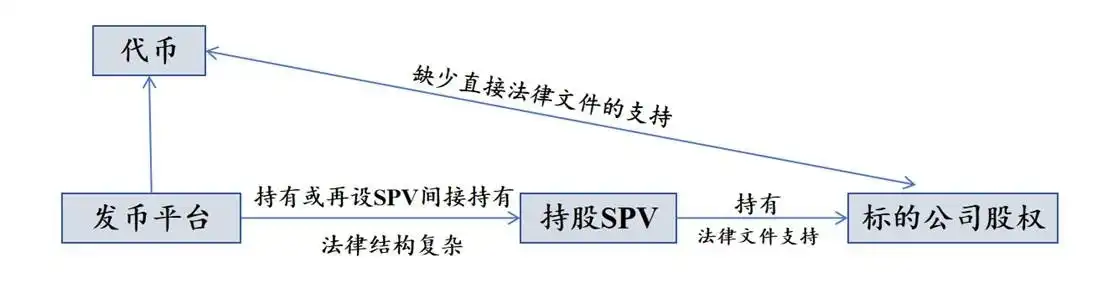
The third category is the most common SPV (Special Purpose Vehicle) indirect holding model in the current crypto scene. The issuing platform first establishes an SPV, through which the SPV acquires a small amount of the underlying company's equity in the traditional private secondary market, and then tokenizes the SPV's beneficial interests for external sale. Investors hold a contractual economic interest in the SPV, not a direct equity interest on the underlying company's shareholder register. The advantage of this model is practicality, meaning that even if the issuer is not cooperative, it can to some extent link real equity with on-chain capital. However, it naturally faces dual pressure from regulatory authorities and the legal departments of the underlying company. Transfer restrictions in shareholder agreements, the opacity of the SPV's information, and settlement arrangements could all become future areas of dispute.
Five, Derivative Matchup: When OpenAI is "On-Chain" via Perpetual Contracts
Recently, a new trend is reshaping the market's perception of Pre-IPO RWA: what many users want is not actually shareholder status but the ability to speculate on the rise and fall of unicorns like OpenAI and SpaceX at any time.
Hyperliquid has amplified this demand to the extreme. Through the HIP-3 programmable perpetual contract layer, any team can create a new perp market by staking enough HYPE; to reduce cold start pressure, Hyperliquid has also introduced Growth Mode, providing new markets with about a 90% taker fee discount, allowing tail-end assets to quickly accumulate depth and activity early on.
Just last week, Hyperliquid directly listed the OPENAI-USDH trading pair. This means that a company that has not yet gone public, whose valuation is entirely driven by the private market, has been brought into a 24/7, leveraged, globally accessible on-chain market, creating a dimensional attack on Pre-IPO RWA.
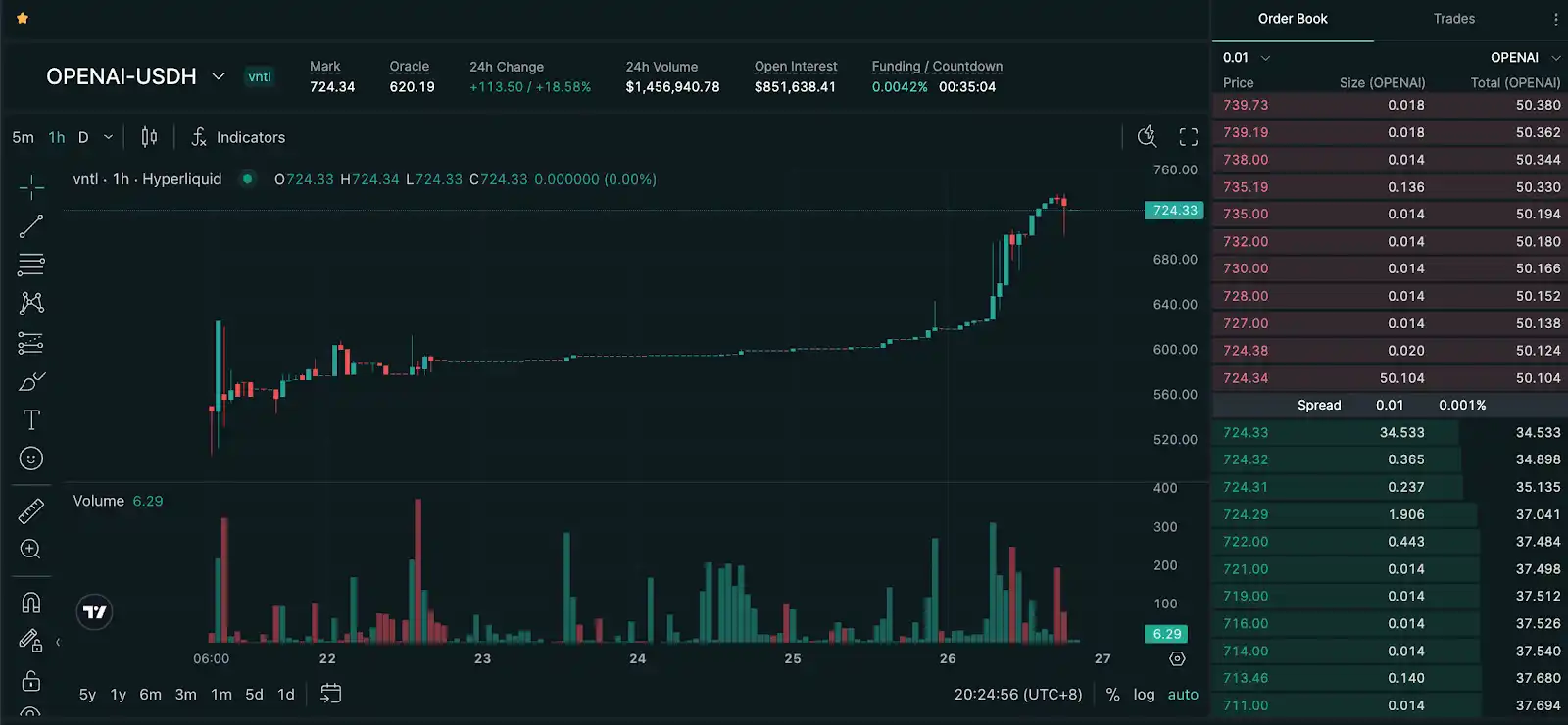
The expected impact is very clear: illiquid Pre-IPO equity tokens, which have not yet had a chance to mature, are already being marginalized by the depth and speed of the perpetual market. If this trend continues, the primary market of the future may even have to reference the on-chain price of perpetual markets for valuation, which will fundamentally change the price discovery logic of private placement assets.
Of course, questions arise: What does the price of OPENAI-USDH anchor to? The market value of unlisted companies does not have continuous off-chain quoting, while on-chain perpetual contracts operate 24/7, supported by a "soft anchoring" system possibly built from a combination of oracles, long-term valuation expectations, funding rates, and market sentiment.
For the Pre-IPO RWA track, there are two layers of real-world impact:
First is the demand-side squeeze. When retail investors only want to speculate on price and do not care about shareholder rights, dividends, and voting power, DEXs based on Hyperliquidity with perpetual contract often offer a simpler experience, higher liquidity, and richer leverage tools. In comparison, if Pre-IPO equity tokenization products only provide price exposure, they will struggle to compete with perp DEX in terms of user experience and efficiency.
Second is the contrast of narratives and regulatory logic. Equity tokenization must navigate back and forth with regulatory bodies such as the SEC and issuer legal frameworks, while perp DEXs are currently more in a regulatory gray area, capturing mindshare and trading volume with a lighter contract structure and global accessibility. For the average user, "first trade perpetual contracts, then consider if there is real equity ownership" is becoming a more natural path.
This does not mean the narrative of Pre-IPO RWA has failed, but it has sounded an alarm. If this track is to go further, it must find its own differentiating position between "real shareholder rights, long-term capital allocation, cash flow distribution" and "on-chain native liquidity."
Six, Conclusion: The Rewrite of Asset Structure and Market Structure is Beginning
The significance of non-listed company equity tokenization lies not in allowing more people to buy a piece of the unicorn but in touching the fundamental pain points of private placement assets: high participation thresholds, narrow exit paths, and lagging price discovery. Tokenization has shown people for the first time that these structural constraints could be redefined.
In this process, Pre-IPO RWA is both an opportunity and a stress test. On the one hand, it reveals real demands—employees, early shareholders, and investors are all seeking more flexible circulation methods; on the other hand, it also exposes regulatory friction, price anchoring, and insufficient market depth. Especially under the simplification impact of perp DEX, the industry more intuitively sees the speed and power of on-chain native liquidity.
But that doesn't mean tokenization will come to a halt. The transformation of asset structure, transaction structure, and market structure often does not rely on a single winning model but on issuers and infrastructure finding a sustainable middle ground between regulation and efficiency. The future is more likely to see a hybrid path that retains both the shareholder rights and governance structure under compliance frameworks and carries the continuous liquidity and global accessibility of on-chain markets.
As more assets are brought on-chain in a composable, tradable form, the boundaries of unlisted equity will be redefined: it will no longer be a scarce asset in a closed market but a node in the global capital network with liquidity.
This article is contributed and does not represent the views of BlockBeats.
You may also like

Delphi Digital's Top 10 Predictions for 2026: Perp DEX Eats Wall Street, AI Agents Usher in Era of Autonomous Trading

Layoffs of 30%, But Spending $250 Million to Buy a Company - What Is Polygon Thinking?

Cross-chain Collaboration: Tom Lee Invests $200 Million, Joins Forces with Global Top Streamer Mr. Beast

The Genius Stopping Law: Why Did Coinbase Backpedal at the Eleventh Hour?

Rumor has it that Coinbase is set to acquire Farcaster, still an Acquihire.

Former Star Public Blockchain Berachain in Crisis: Price Collapse, Layoffs, Developer Exodus

Coinbase CEO Raises Red Flags Regarding US Crypto Bill
Key Takeaways Coinbase CEO Brian Armstrong voices opposition to the proposed Senate crypto bill, citing significant concerns. The…

Transforming the Cryptocurrency Landscape: A 2026 Outlook
Key Takeaways Cryptocurrency systems have seen expansive growth and technological innovation. The introduction of new regulations has reshaped…
New ChatGPT Forecasts for XRP, Ethereum, and Solana by 2026
Key Takeaways ChatGPT predicts a potential bull market for XRP, Ethereum, and Solana by 2026, supported by the…

An Insight into the Dynamics of Crypto Market Trends
Key Takeaways The article provides a comprehensive look at the latest developments in the cryptocurrency market. Insight is…

Senate Crypto Bill Markup Rescheduled to January 27 Amid Legislative Momentum
Key Takeaways The Senate Agriculture Committee has rescheduled the release of the legislative text for crypto market structure…

Bitchat Downloads Surge in Uganda as Government Implements Internet Shutdown Before Elections
Key Takeaways: Uganda’s government enforced an internet blackout ahead of elections, pushing citizens to download Bitchat, a decentralized…
CLARITY Act Hearing Suddenly Postponed – Where Does the Disagreement Lie?
YO Protocol’s Automated Conversion Error Resolves $3.7 Million Shortfall
Key Takeaways YO Protocol, a decentralized finance platform, recently experienced an automated conversion operation error, resulting in a…
Sonic Labs Recovers and Redistributes Millions in Stolen Assets
Key Takeaways Sonic Labs has successfully recovered 5,829,196 stolen S tokens after a November 2025 exploit. These recovered…

Dolomite Surges with Prominent Integrations Boosting Market Value
Key Takeaways Dolomite (DOLO) has seen a significant 24.60% price increase in the last 24 hours, currently trading…

YO Protocol Suffers $3.7 Million Loss in Unfortunate Swap Incident
Key Takeaways YO Protocol experienced a $3.7 million loss due to a mistaken swap involving YoUSD. The incident…



 App
App