
- Buy Crypto
- Markets
 Futures
- Spot
- Copy Trade
- Earn
- More
Once the Coinbase+Base model matured, Bitpanda turned to Vision to provide the European answer.

It has been just over a month since the October 11th epic margin call in the cryptocurrency industry, and the aftershocks seem to be becoming clearer now. With on-chain hot money significantly shrinking, those who still have funds to play with are mostly participants with a stronger risk appetite and a more cautious strategy. The difficulty of market gameplay has also significantly increased as a result.
One key question on everyone's mind is whether the liquidity of the cryptocurrency market can return to its previous state after this round of events.
Interestingly, while retail sentiment was at its lowest, another type of capital did not pause. For example, JPMorgan Chase launched JPM Coin, a stablecoin representing U.S. dollar deposits for institutional clients, multiple cryptocurrency ETFs were approved, and cryptocurrency mining company stocks received high ratings. This signifies a structural shift in the market, where liquidity used to mainly come from retail traders willing to engage in high-frequency trading and high leverage, but now increasingly comes from institutions and companies that value audits, financial reporting, and accountability to shareholders.
Money is still flowing in, but the nature of the money has changed. And perhaps the first to feel this change were not the altcoin projects, but centralized exchanges.
The Crossroads of CEX Divergence: The Choice of a Top European Exchange
Over the past few years, centralized exchanges (CEXes) have been almost the most mature and clear business model in the cryptocurrency industry. Listing, trading, leverage, fees – the one with the largest asset size, deepest liquidity, and lowest fees gets the biggest slice of the pie in a bull market.
However, in the month following 10/11, more and more people have begun to intuitively feel that relying solely on listings and derivatives may no longer sustain the next growth curve.
As a result, the strategic paths of mainstream CEXes have begun to diverge significantly. Some continue to focus on high leverage and derivatives markets, strengthening their global liquidity footprint. Some are turning to the infrastructure level, building on public chains, wallets, and settlement networks, attempting to transform themselves into the "underlying architecture of DeFi." A small number are choosing to align closely with regulatory and banking systems, aiming to become the standard interface between traditional finance and Web3.
In the U.S., Coinbase has revealed its answer through Nasdaq listing and the Base public chain. In Asia, Binance has built a complete ecosystem with BNB and Binance Smart Chain. In Europe, however, there is one platform that is responding in a completely different way – Bitpanda and its Vision ecosystem.
For many Asian users, Bitpanda may not be a familiar name yet; but in Europe, it is almost the default choice in the digital asset investment field.
In 2014, Bitpanda was founded in Vienna, Austria. In its early development path, Bitpanda took a relatively conservative approach, avoiding the trend of explosive coin listings and ultra-high leverage, and instead spent nearly a decade sequentially applying for licenses and building a local team across European countries. Even before regulatory frameworks like MiCA were officially established, Bitpanda had long been engaging with regulatory bodies in various countries, honing its compliance genes and becoming familiar with the "regulatory language."
More importantly, Bitpanda did not position itself as a purely retail-oriented trading platform but more as a digital asset infrastructure company. On one hand, it provides buying, selling, custody, and investment products to retail customers, and on the other hand, it offers white-label digital asset services to banks and financial institutions.
It is this dual-track positioning that has allowed Bitpanda to establish deep cooperative relationships with traditional large banks such as Deutsche Bank, Societe Generale, and Raiffeisen Bank in Austria. For these institutions, outsourcing digital asset business to a locally licensed platform that is well-versed in regulatory logic is safer, more efficient, and more cost-effective than building systems from scratch.
With the implementation of MiCA, this compliance-focused identity suddenly became a significant first-mover advantage. Within this framework, Bitpanda logically had to do one thing, which is to no longer be satisfied with a centralized account system but to expand towards chains, protocols, and ecosystems, turning its obtained licenses and asset pools into a set of universal underlying capabilities. Vision was introduced under such a strategic approach.
Unlike crypto projects that traditionally start from a whitepaper, Vision has been grounded on a solid foundation of traditional finance from day one. With the support of Bitpanda's asset system and compliance moat, it is more like a fusion of centralized and decentralized finance attempting to build a bridge to the next-generation financial infrastructure between chains and protocols.
And, the narrative focus of Vision is not on "building a public chain with a high TVL" in the traditional sense but on how to enable more institutions, wallets, and applications to reuse Bitpanda's established banking channels, custody, and compliance interfaces; how to extend the trust and compliance that originally only existed in offline legal documents and banking systems along the chain to the broader Web3 space.
From this perspective, Vision's role is more like helping Bitpanda transition from a centralized account system to "chain + protocol + ecosystem."
On the other hand, Vision aims to provide a default technical and asset landing point for institutions in Europe looking to enter the digital asset, RWA, and compliant DeFi space. As the European Central Bank and various regulatory bodies continue to emphasize a cautious approach to foreign stablecoins and crypto services, an ecosystem native to the EU system inherently possesses a higher level of policy alignment and institutional trust.

TOKEN2049 Event Scene|Image Source: Vision
From Platform Points to Utility Tokens: The Design Logic of $VSN
Within the Vision ecosystem, the $VSN token serves as the core axis that runs through the entire system.
Whether enjoying fee discounts in the Bitpanda Broker, used for incentives and usage in Web3 products (such as DeFi Wallet, Vision Protocol), or even for future Launchpad participation eligibility, Vision Chain governance, and resource allocation, $VSN will permeate the entire ecosystem.
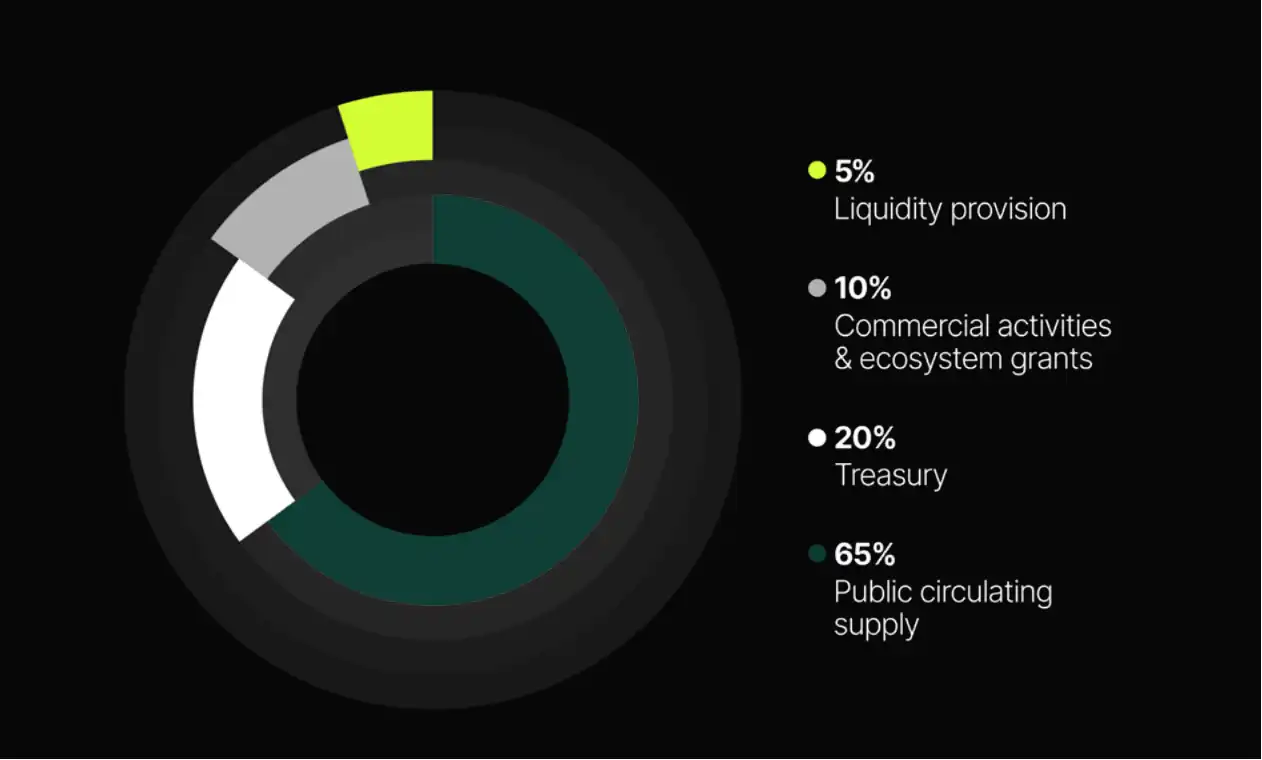
The underlying design philosophy behind this is Bitpanda's systemic thinking on the "compliant Web3 platform."
Vision's approach is more pragmatic; the platform has not rushed to integrate the token into partner ecosystems but has chosen to first build itself as a multi-chain liquidity and routing infrastructure through the Vision Protocol. It aims to become a foundational component connecting different chains and applications. As protocol usage grows, the generated fees will flow back to the foundation and $VSN, thus achieving a value loop.
This strategy continues the BNB model of consolidating ecosystem value through a single asset but on a broader scale, moving beyond just the exchange platform layer and delving into the chain and protocol layers. Vision's core logic is to first reduce partner usage costs through infrastructure and then bind external business and token value through a profit-sharing mechanism.
In the revenue model, $VSN adopts a combination mechanism of emission, protocol fee sharing, and buyback and burn. Users can stake $VSN on app.vision.now to earn rewards. Currently, the annualized return rate is approximately 10.5%, primarily coming from basic emission rewards and fee sharing from external ecosystems like Bitpanda.
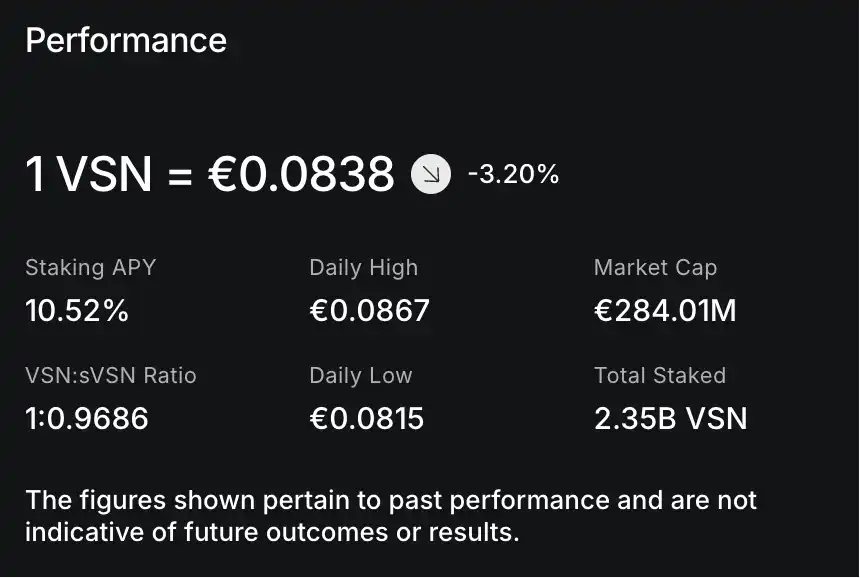
At the same time, while the foundation's business cash flow has not completely covered the release pressure, it will continue to participate in buyback and burn from its treasury to maintain the predictability of the token supply curve.
As the ecosystem develops, the usage rate of fee deductions, the routing transaction volume between DeFi Wallet and Vision Protocol, and the future on-chain fees of Vision Chain will all be key variables driving token value growth.
On November 27, Binance Alpha announced the listing of Vision (VSN), which means that beyond Bitpanda and the European licensing system, VSN is now accessing a broader global user base and on-chain liquidity through Binance Alpha. The narrative of Vision as a European compliant infrastructure is beginning to be priced and played out in a larger trading and distribution network.
Vision's Product Architecture and Third Path
Placing Vision back into the larger crypto and financial landscape, it aims to provide a third path that is different from the existing paradigms. This path is neither dominated by U.S. tech giants and offshore trading platforms nor confined to the pseudo-blockchains of traditional finance's private chain experiments. Instead, it starts with European licensed platforms and builds a layer on the public network that can interface with real assets, meet strict compliance requirements, and maintain open composability as a general infrastructure.
If this path is validated, the coordinates of RWA and compliant DeFi will be redrawn, assets can be issued and circulated in compliance with EU law, institutions and users can share infrastructure incrementally through a unified token, rather than being forced to battle individually between disparate platforms and fragmented bets on single-point projects.
On the product side, Vision's matrix radiates from the inside out, unfolding radially from near to far, and can be understood logically as "Entry—Routing—Issuance—Settlement":
· Vision App: The universal staking portal for $VSN, also a globally usable DeFi frontend.
· Bitpanda DeFi Wallet: An important gateway to the Bitpanda ecosystem, allowing participation in staking and XP points activities to receive future airdrops (currently unavailable in China and other regions, reflecting the project's cautious approach to compliance differences in different jurisdictions).
· Vision Protocol: The outward routing layer continuously connects to more DEXs and wallets, providing liquidity routing services in partner applications.
· Bitpanda Launchpad (Scheduled to launch in 2026): Facilitates the issuance of tokenized assets and participation eligibility.
· Vision Chain (Scheduled to launch in 2026): Embeds compliance interfaces at the chain level to provide a highly trusted execution and settlement environment for Real World Assets (RWA).
This coherent hierarchy enables Vision to internalize compliance as a native capability rather than an external add-on service. In other words, it transforms compliance costs into a trust dividend and channels the latter to participants actually using this infrastructure through the $VSN unified value-capture mechanism.
Conclusion
From a higher-dimensional perspective, Bitpanda's choice is not isolated but part of a larger strategy rewrite within the entire CEX industry.
As top-tier exchanges seek the "second curve," they have roughly diverged into three directions. One is the "Speed Faction," continuing to bet on high leverage, high-frequency trading, and their position as a global liquidity hub. This path has a relatively lower requirement for regulatory friendliness but demands extremely high risk tolerance from the platform itself.
The second type is the "Platform Faction," which enhances its compliance image through listings and leverages its proprietary blockchain and account system to position itself as an infrastructure gateway for mainstream users. Coinbase and its Base extensions are typical representatives of this category.
The third type is the "Infrastructure Faction," choosing to focus on specific regulatory jurisdictions, building service capabilities around banks, brokerages, and local institutions, striving to become the settlement and custodial layer of the digital asset world. Bitpanda is precisely following this path.
Within this framework, without Bitpanda's accumulation of experience over the past decade, it is challenging to truly grasp the necessity of Vision's emergence.
The potential ceiling of Vision is closely tied to Bitpanda's own depth of evolution. It is more like a long-term option on "Can Europe provide its own answer in the digital asset infrastructure?" Bitpanda is attempting to present its version through Vision. It may not rely on extreme leverage to amplify the narrative during a regulatory vacuum period like BNB did. Still, if Europe's compliance narrative eventually becomes part of global consensus, then the "slow engineering" that Bitpanda has built over a decade might be repriced by the market in the new order.
You may also like

Who's at the CFTC Table? A Rebalancing of American Fintech Discourse

AI Trading vs Human Crypto Traders: $10,000 Live Trading Battle Results in Munich, Germany (WEEX Hackathon 2026)
Discover how AI trading outperformed human traders in WEEX's live Munich showdown. Learn 3 key strategies from the battle and why AI is changing crypto trading.

Elon Musk's X Money vs. Crypto's Synthetic Dollars: Who Wins the Future of Money?
How do Synthetic Dollars work? This guide explains their strategies, benefits over traditional stablecoins like USDT, and risks every crypto trader must know.

The Israeli military is hunting a mole on Polymarket

Q4 $667M Net Loss: Coinbase Earnings Report Foreshadows Challenging 2026 for Crypto Industry?

BlackRock Buying UNI, What's the Catch?

Lost in Hong Kong

Gold Plunges Over 4%, Silver Crashes 11%, Stock Market Plummet Triggers Precious Metals Algorithmic Selling Pressure?

Coinbase and Solana make successive moves, Agent economy to become the next big narrative

Aave DAO Wins, But the Game Is Not Over
Coinbase Earnings Call, Latest Developments in Aave Tokenomics Debate, What's Trending in the Global Crypto Community Today?
ICE, the parent company of the NYSE, Goes All In: Index Futures Contracts and Sentiment Prediction Market Tool

On-Chain Options: The Crossroads of DeFi Miners and Traders

How WEEX and LALIGA Redefine Elite Performance
WEEX x LALIGA partnership: Where trading discipline meets football excellence. Discover how WEEX, official regional partner in Hong Kong & Taiwan, brings crypto and sports fans together through shared values of strategy, control, and long-term performance.

Best Crypto to Buy Now February 10 – XRP, Solana, Dogecoin
Key Takeaways XRP is set to revolutionize cross-border transactions, potentially reaching $5 by the end of Q2 with…
Kyle Samani Criticizes Hyperliquid in Explosive Post-Departure Market Commentary
Key Takeaways: Kyle Samani, former co-founder of Multicoin Capital, publicly criticizes Hyperliquid, labeling it a systemic risk. Samani’s…
Leading AI Claude Forecasts the Price of XRP, Cardano, and Ethereum by the End of 2026
Key Takeaways: XRP’s value is projected to reach $8 by 2026 due to major institutional adoption. Cardano (ADA)…
Bitcoin Price Prediction: Alarming New Research Cautions Millions in BTC at Risk of ‘Quantum Freeze’ – Are You Ready?
Key Takeaways Quantum Threat to Bitcoin: The rise of quantum computing presents a unique security challenge to Bitcoin,…
Who's at the CFTC Table? A Rebalancing of American Fintech Discourse
AI Trading vs Human Crypto Traders: $10,000 Live Trading Battle Results in Munich, Germany (WEEX Hackathon 2026)
Discover how AI trading outperformed human traders in WEEX's live Munich showdown. Learn 3 key strategies from the battle and why AI is changing crypto trading.
Elon Musk's X Money vs. Crypto's Synthetic Dollars: Who Wins the Future of Money?
How do Synthetic Dollars work? This guide explains their strategies, benefits over traditional stablecoins like USDT, and risks every crypto trader must know.


 App
App