
- Buy Crypto
- Markets
- Futures
- Spot
- Copy Trade
 WE-Launch
x402 V2 Release - What are the Key Highlights? 1. **Improved Performance**: The x402 V2 release brings significant performance enhancements, allowing for faster transaction processing and validation. 2. **Enhanced Security**: With new security featur...

Original Article Title: "What are the Key Features of x402 V2? Unified Payment Interface, Identity Authentication…"
Original Article Author: KarenZ, Foresight News
When the x402 protocol, led by Coinbase, was launched in May this year, the core idea was surprisingly simple: to reactivate the long-unused HTTP 402 status code, allowing payment logic to be directly embedded in network requests.
Although the x402-related token performance experienced a short-lived surge, in the past 6 months, x402 has processed over one billion payments, covering diverse scenarios such as API fee calls, AI agent on-demand resource purchase, and more.
While the architecture of V1 was concise, in practical applications, it exposed some limitations. Especially in terms of cross-chain support, scalability, identity authentication, duplicate payments, etc., the original design could not meet the increasingly complex payment needs.
Today, x402 has ushered in the V2 version upgrade. This update not only optimized the protocol itself but also underwent deep reconstruction around the issues discovered in actual usage.
What are the Key Highlights of x402?
Wallet Identity Access and "Reusable Sessions": Bid Farewell to Duplicate Payments
This is the most user and agent experience-enhancing transformation in V2. In V1, each API call might require a complete payment process, which appeared to be high-latency and costly in high-frequency scenarios (such as large language model LLM inference, multi-step agent tasks).
x402 V2 introduces support for wallet identity (such as Sign-In-With-X based on CAIP-122). Once the client validates identity through the wallet and completes the initial payment, the protocol allows for the creation of reusable sessions. This means that subsequent accesses to the same resource can directly skip the full on-chain payment process.
This can significantly reduce transaction latency, decrease round trips and on-chain costs, making x402 truly suitable for high-frequency workloads, providing a subscription-like or session-based access model for human users and autonomous agents.
Unified Payment Interface: Integration of Cross-Chain and Traditional Finance
x402 V2 has created a one-stop payment format, regardless of which chain an asset is on, or even if it is on-chain.
· Default Multi-Chain Support: The protocol natively supports stablecoins and tokens on Base, Solana, and other Layer 2 solutions, eliminating the need for developers to customize logic.
· Traditional Payment Compatibility: Through Facilitators, V2 can seamlessly integrate with traditional payment rails such as ACH, SEPA, or credit card networks.
· Dynamic payTo Routing: Enables payment routing at the request level, such as directing funds to a specific address, role, or callback logic. This feature is suitable for complex markets, multi-tenant APIs, and dynamic pricing based on input content.
Plugin Architecture and Developer-Friendly Extensibility
x402 V2 has modularized the protocol, providing clear separation between the protocol specification, SDK implementations, and Facilitators.
· Stable and Scalable: Adding a new chain or payment behavior can be done without modifying the core specification or reference SDK.
· Plugin-Driven SDK: Developers can register new chains, assets, and payment schemes like installing plugins without altering the SDK's internal code.
· Simplified Configuration: V2 significantly streamlines developers' configuration process while natively supporting Multi-Facilitator. The SDK will automatically select the best matching options based on business preferences (e.g., "Prefer Solana," "Avoid Mainnet," "USDC only").
Automatic Discovery Mechanism: Keeping Service Information Synchronized
x402 V2 introduces a "Discovery" extension, allowing services enabled by x402 to expose structured metadata for Facilitators to fetch.
· Zero-Touch Synchronization: Service pricing, routing, and metadata can autonomously update, enabling Facilitators to dynamically index available endpoints without manual updates or hardcoded directories.
· Enhanced Autonomy: Sellers only need to publish their API once, and the entire ecosystem stays in sync, laying the foundation for a more autonomous internet economy.
Different Participant Perspectives
The upgrade to x402 V2 has shifted payments from a technological friction point to an economic layer, essentially making the flow of value on the internet smoother and more intelligent. For different participants, this means addressing their respective pain points.
For end users, the core value of x402 V2 lies in seamless payments and efficiency improvements, making paid access to services more akin to logging in and using them, significantly reducing the cost and latency of repeat visits. While an initial visit requires a payment transaction, subsequent reuse of services within the same session or time period (such as multiple AI calls or accessing paid content) does not require on-chain payment if the purchased resources are already available, resulting in faster speed and lower costs. It feels like a form of "micro-subscription." Additionally, payment methods are more diverse and convenient.
Furthermore, as Facilitators can automatically retrieve the latest pricing and service information, ensuring that users see accurate and available prices and services, it eliminates the issue of outdated information. For users, it also becomes easier to discover and use services.
For developers and service providers, V2 addresses the pain points of V1 in terms of architecture and scalability, bringing greater flexibility and a lower code maintenance burden. For example, it transitions payment logic from "hardcoded" to "configurable and pluggable"; dynamic pricing based on API request inputs (such as data processing volume, model size) can be achieved, enabling the implementation of complex business models with ease; as the payment wall logic is extracted into a separate, customizable modular package, developers can more conveniently integrate with different payment backends and rapidly build and iterate on their paid services. Moreover, by simply declaring business preferences, the SDK will automatically choose the best payment path and coordinator. This reduces a significant amount of "glue code," allowing developers to focus on business logic.
For AI agents, the improvements in V2 are revolutionary, transforming AI from a mere "executor" into an "economic entity" capable of making autonomous decisions. An AI agent can be equipped with a wallet containing a budget. When it needs to call an API to perform a task or requires more powerful computing resources to run a model, it can "decide" and complete payments on its own, dynamically searching for the most cost-effective resources on the network.
Summary
The release of x402 V2 marks the transition of x402 from a "pay-per-use" tool to a flexible, universal economic layer. For users, payments become nearly invisible, enhancing the overall experience. For developers, the architecture is more flexible, enabling the rapid construction and iteration of complex business models. AI agents can also achieve low-latency, high-frequency autonomous consumption, unlocking advanced autonomous systems.
Through enhancing compatibility, simplifying the development process, and enabling innovative identity and payment models, x402 aims to become the infrastructure for future Internet payments. However, any technology, while bringing innovation, will inevitably face challenges and inherent shortcomings. While x402 V2 paints a rosy picture, realizing it requires overcoming many real-world obstacles, such as ecosystem adoption and maturity, risks of "modules," difficulties in refund and dispute resolution, regulatory uncertainties, and more.
You may also like

Matrixdock 2025: The Practical Path to Sovereign-Grade RWA of Gold Tokenization

$50 to $1 Million: How to Survive in the Meme Battlefield with 'Wallet Tracking'

Paradigm's Tempo Project Launches Testnet, Is It Worth Checking Out?
When Everyone Uses AI Trading, Where Does Cryptocurrency Alpha Go in 2026?
In 2025, AI trading has become the default, but Alpha hasn’t disappeared — it’s been eroded by crowding, as similar data, models, and strategies cause traders to act in sync and lose their edge.
Real Alpha has shifted to harder-to-copy layers like behavioral and on-chain data, execution quality, risk management, and human judgment in extreme markets, where acting differently — or not acting at all—matters more than better predictions.

Without Narrative Power, Web3 Will Not Tap into the Vastness

From Failures to Success: Building Crypto Products That Truly Matter
Key Takeaways Building infrastructure in crypto doesn’t guarantee success; understanding user needs is critical. Products aimed at younger…
UNI Burn Arbitrage Opportunity, Ondo Tokenized Stock Liquidity Debate, What’s the Overseas Crypto Community Talking About Today?
Key Takeaways The crypto market is buzzing with multi-threaded discussions, from macro trends to specific protocols and scams.…

“Elon Musk’s Nemesis Trade” Colossal ETH Short Sparks Debate in Crypto Circles
Key Takeaways A colossal short position was secured against Ethereum (ETH) worth approximately $106 million by a single…

Dragonfly Partner Foresees BTC Surpassing $150K by 2026 but Market Share Decline
Key Takeaways Bitcoin is anticipated to climb over $150,000 by the end of 2026, although its market dominance…

Elon Musk Liquidation Wall: Liquidates $106M Short Position, Faces $479K Loss
Key Takeaways A $106 million ETH short position was liquidated after just 15 hours, resulting in a $479,000…

Unstable Stablecoins: Understanding the Market’s Concerns and Dynamics
Key Takeaways Recent financial reports indicate concerns and instability in the stablecoin market. Circle, a leading stablecoin issuer,…
The Eve of a Fed Pivot: Wall Street Girds for Rate Battle Without 'Powell'
After 500 Rejections, I Started Building a Product People Actually Use

UNI Burn Arbitrage Opportunity, Ondo Tokenized Stock Liquidity Debate, What's the Overseas Crypto Community Talking About Today?

BlockBeats 2025: Enabling 15 Million People to Witness Bitcoin's New All-Time High

Breaker Game Over Line: Why Are Young People Turning to Long-Termism?

December 29th Market Key Intelligence, How Much Did You Miss?
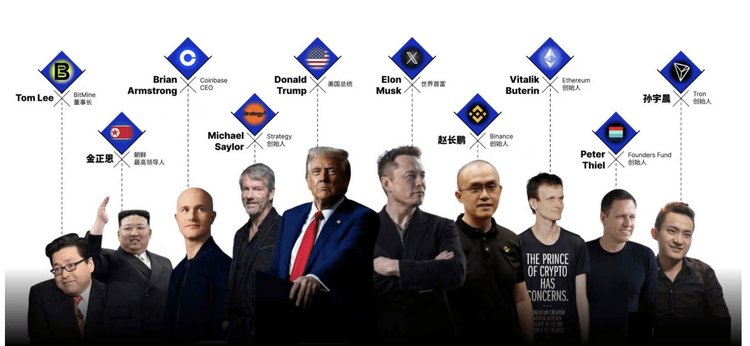
Ten People Redefining the Power Boundaries of Crypto in 2025
From Wall Street to the White House, from Silicon Valley to Shenzhen, a new power network is taking shape.
Matrixdock 2025: The Practical Path to Sovereign-Grade RWA of Gold Tokenization
$50 to $1 Million: How to Survive in the Meme Battlefield with 'Wallet Tracking'
Paradigm's Tempo Project Launches Testnet, Is It Worth Checking Out?
When Everyone Uses AI Trading, Where Does Cryptocurrency Alpha Go in 2026?
In 2025, AI trading has become the default, but Alpha hasn’t disappeared — it’s been eroded by crowding, as similar data, models, and strategies cause traders to act in sync and lose their edge.
Real Alpha has shifted to harder-to-copy layers like behavioral and on-chain data, execution quality, risk management, and human judgment in extreme markets, where acting differently — or not acting at all—matters more than better predictions.
Without Narrative Power, Web3 Will Not Tap into the Vastness
From Failures to Success: Building Crypto Products That Truly Matter
Key Takeaways Building infrastructure in crypto doesn’t guarantee success; understanding user needs is critical. Products aimed at younger…
Popular coins
Latest Crypto News


Customer Support:@weikecs
Business Cooperation:@weikecs
Quant Trading & MM:[email protected]
VIP Services:[email protected]
 App
App