
- Buy Crypto
- Markets
- Futures
- Spot
- Copy Trade
 WE-Launch
2025 Crypto Rich List: 12 Big Winners, Who Bet on the Money Maker?

Original Title: The top 12 crypto winners of 2025: who got it right this year?
Original Author: Oluwapelumi Adejumo, CryptoSlate
Original Translation: Saoirse, Foresight News
If 2024 was the year of crypto's 'recovery,' then 2025 was the year the industry's 'infrastructure finally got its due.'
This year, the nascent industry started with cautious optimism in January and ended with explicit federal regulatory support by December.
The result was a complete shift in the industry narrative from 'cryptocurrency equals a casino' to 'cryptocurrency is capital market infrastructure.'
During this time, volume moved on-chain, policymaking entered the White House's purview, and major asset management firms no longer hesitated—Vanguard's earlier stance shift this month being the clearest proof yet, allowing cryptocurrency ETFs on its platform.
Yet, in this year, despite record funding inflows and legislative victories, rewards were not evenly distributed among all participants.
The winners of 2025 were not just the assets that saw price rallies but also protocols, personalities, and products that have solidified their positions in the future financial landscape.
Based on CryptoSlate's analysis, here are the 12 clear winners of the year and their significance:
1. The United States and the Trump Administration
Discussing the 2025 cryptocurrency landscape is incomplete without acknowledging the profound impact of the U.S. stance shift. For years, the cryptocurrency industry had been in a state of 'ready to exit,' viewing Dubai or Singapore as potential safe havens.
However, in 2025, the U.S. closed this 'exit door' entirely, with all industry participants embracing this change. Therefore, this victory belongs to both the U.S. jurisdiction and the top-level power players driving this transformation.
In less than 12 months, the government led by the 47th U.S. President, Donald Trump, achieved many long-standing demands of the cryptocurrency industry, effectively 'pulling back the digital asset economy' to the homeland.
A series of executive orders supporting multiple digital assets has set the tone, with its strategic victories reflected in specific strategies:
The "GENIUS Act," signed on July 18, provided a federal-level definition for stablecoins for the first time;
The "Strategic Bitcoin Reserve" executive order released in March sent a clear signal to global sovereign wealth funds — digital assets have become a critical issue at the national security level.
Critically, by driving leadership changes at the U.S. SEC and CFTC, the Trump administration dispelled the fog of "regulation through enforcement."
Essentially, Trump's series of actions laid the groundwork for the U.S. to "become the global cryptocurrency center."
2026 Outlook: Consolidation of U.S. Hegemony
It is expected that the U.S. will actively promote its newly established industry standards. In addition, an executive order that took effect on January 1 also expressly prohibits the issuance of central bank digital currencies (CBDCs), clearing the way for private sector innovation: the future dollar will still move towards digitization, but the issuers will be Tether, Circle, various banks, rather than the Federal Reserve.
2. U.S. Spot ETF
(Represented by IBIT, including ETH, SOL, XRP ETF camps)
As the primary tool for institutions to enter the cryptocurrency market, cryptocurrency spot ETFs not only "passed the second-year survival period" in 2025 but also thrived even in the case of poor Bitcoin performance.
BlackRock's iShares Bitcoin Trust Fund (IBIT) became one of the top ten ETFs in terms of inflows in the U.S., with its inflow volume even surpassing traditional giants such as the Invesco QQQ Trust and the SPDR Gold Trust (GLD), providing the most direct evidence.
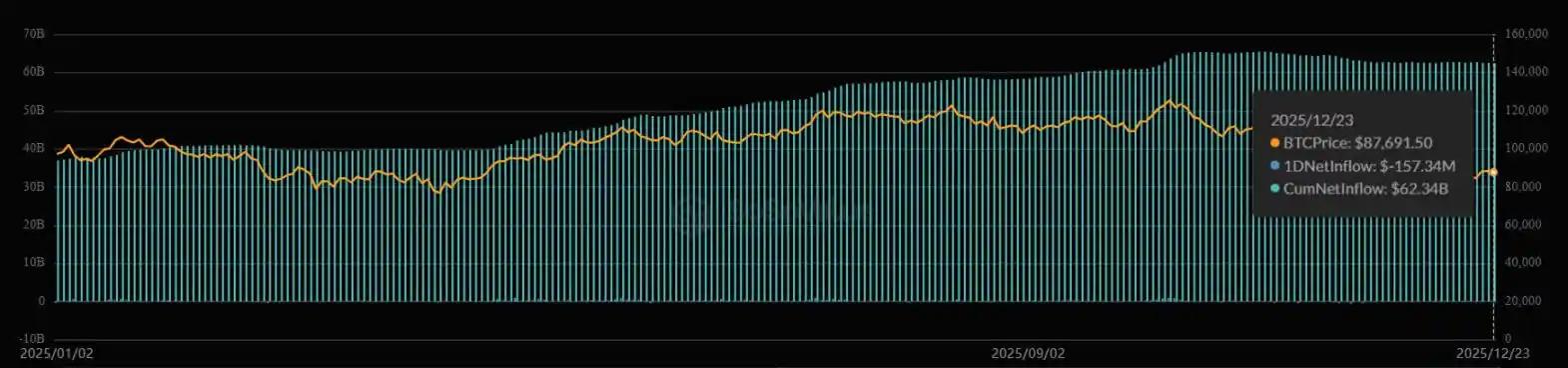
IBIT Cumulative Net Inflows (Source: SoSo Value)
In addition to Bitcoin, Ethereum spot ETF also solidified its position, becoming the "default entry channel" for wealth management institutions — making debates like "not your keys, not your assets" irrelevant among institutional investors.
September was a key turning point: the SEC approved the "Generic Listing Standards." This technical but crucial policy victory significantly streamlines the approval process for future products, no longer requiring a separate 19b-4 filing for each new code.
Subsequently, the market saw a plethora of new products focusing on other digital assets (such as Solana, XRP), all of which have also seen strong performance this year.
2026 Outlook: Product Diversification and Risk Reduction
With Vanguard Group opening the cryptocurrency ETF channel on December 1, a large number of "basket of assets ETFs" and "covered call options ETFs" are expected to emerge. A more robust options market will begin to lower realized volatility, ultimately making cryptocurrency as an asset class acceptable to conservative pension funds.
3. Solana (SOL)
In 2025, Solana completely shed the label of "high-risk beta asset," and the old narrative of "fast but buggy" is now history.
Meanwhile, Solana has also completed the most challenging transformation in the cryptocurrency industry this year: transitioning from a "Meme coin casino" to a "global market liquidity layer."
While maintaining its dominance in the cultural sector, CoinGecko data shows that Solana has been the world's most-watched blockchain ecosystem for two consecutive years (2024-2025).
The current Solana network is no longer only revolving around speculative tokens but has become a "hub of efficient capital."
According to Artemis data, Solana has become a core liquidity layer: its on-chain SOL-USD trading volume has exceeded the sum of SOL spot trading volumes on Binance and Bybit (two of the world's top three centralized exchanges by trading volume) for three consecutive months.
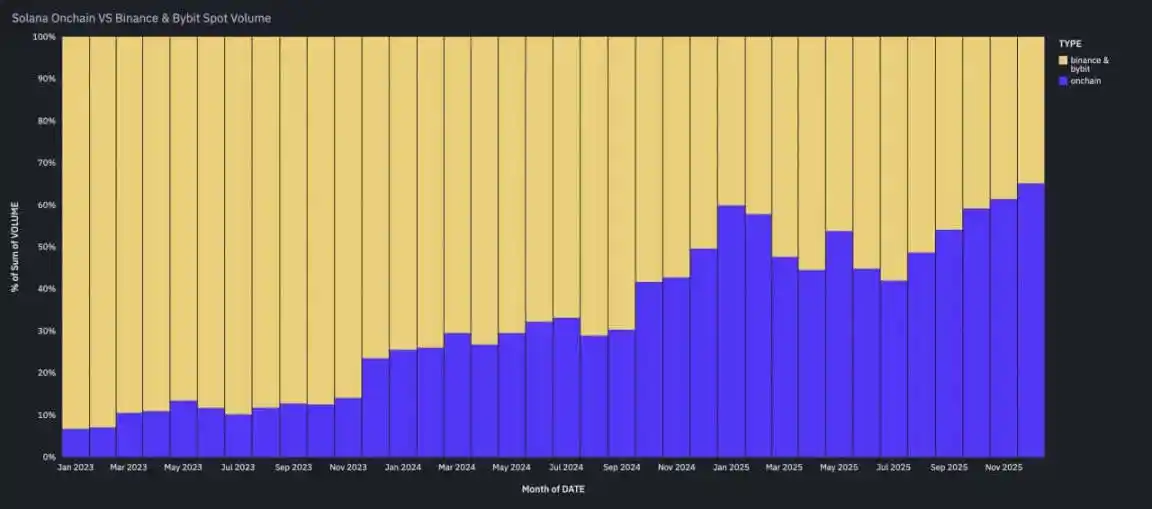
Solana's on-chain trading volume surpasses the spot trading volume on Binance and Bybit (Source: Artemis)
Essentially, Solana has positioned itself as the "primary venue for activities sensitive to transaction execution speed." Its competitors are no longer just Ethereum, but traditional financial market platforms like Nasdaq.
2026 Outlook: On-chain Price Discovery Goes Mainstream
This level of trading volume's "on-chain shift" marks a structural transformation: price discovery is shifting from centralized exchanges to on-chain. In 2026, Solana will no longer be a "high-risk beta network" but the primary venue for high-frequency, stablecoin-denominated trading.
4. Ethereum Layer 2 Network Base
If Solana's strength lies in "speed," then Coinbase's Ethereum Layer 2 network Base stands out due to its "user engagement capability."
By leveraging the vast existing user base of this American exchange platform, Base has become the "default choice for consumer apps and stablecoin experiments," with extremely high user stickiness.
Base's success proves that in the cryptocurrency industry of 2025, "user engagement" is more important than "novel encryption technology." It has become an "incubator for mainstream crypto applications" — these consumer fintech apps use cryptocurrency infrastructure on the backend, but users are completely unaware of this fact. It could be said that Base is the bridge connecting the chaotic on-chain world with Coinbase's compliant security system.
2026 Outlook: The Rise of "Wallet-native Business"
It is expected that Base will become the "core engine" for Coinbase's foray into the merchant payment field next year, and "wallet-native business" (business activities based on crypto wallets) may become a new industry trend.
5. Ripple and XRP
After years of legal troubles, 2025 finally became the year of Ripple and XRP's "regained freedom."
The long-standing legal battle between Ripple and the SEC finally came to an end with a final judgment, clearing the way for institutional adoption of XRP.
The result was that XRP's narrative transformed overnight from a "litigation-risk asset" to a "liquidity engine," driving its price up and paving the way for the launch of the first XRP spot ETF in November.
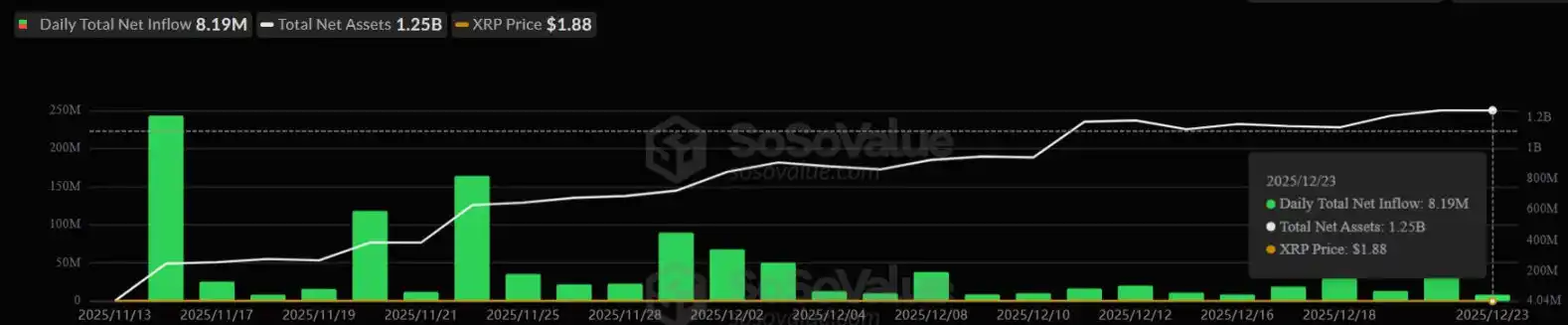
XRP Exchange-Traded Fund Daily Fund Flow (Source: SoSo Value)
Meanwhile, Ripple Inc. made significant acquisitions of traditional financial infrastructure this year: in just one year in 2025, Ripple invested over $4 billion in strategic acquisitions, the most notable of which included the acquisitions of the bulk broker Hidden Road, the asset management company GTreasury, and the stablecoin infrastructure provider Rail.
These moves effectively transform Ripple from a "payment company" into a "full-stack institutional giant."
2026 Outlook: Integrating Traditional Finance with the Crypto Ecosystem
The "ETF-ication" of XRP is just the beginning. With legal risks dissipating and Wall Street products landing, 2026 will be the "year of integration": Ripple's newly acquired asset management and brokerage business division is expected to start cross-promoting the RLUSD stablecoin to Fortune 500 companies, ultimately breaking down barriers between the Ripple ledger and corporate balance sheets.
6. Zcash and the Privacy Coin Space
The resurgence of Zcash and the entire privacy coin space was the most surprising "comeback story" of the 2025 cryptocurrency industry.
As the best-performing sector of 2025, privacy coins shed the stigma of "illicit use" and became darlings of the "post-surveillance economy era."
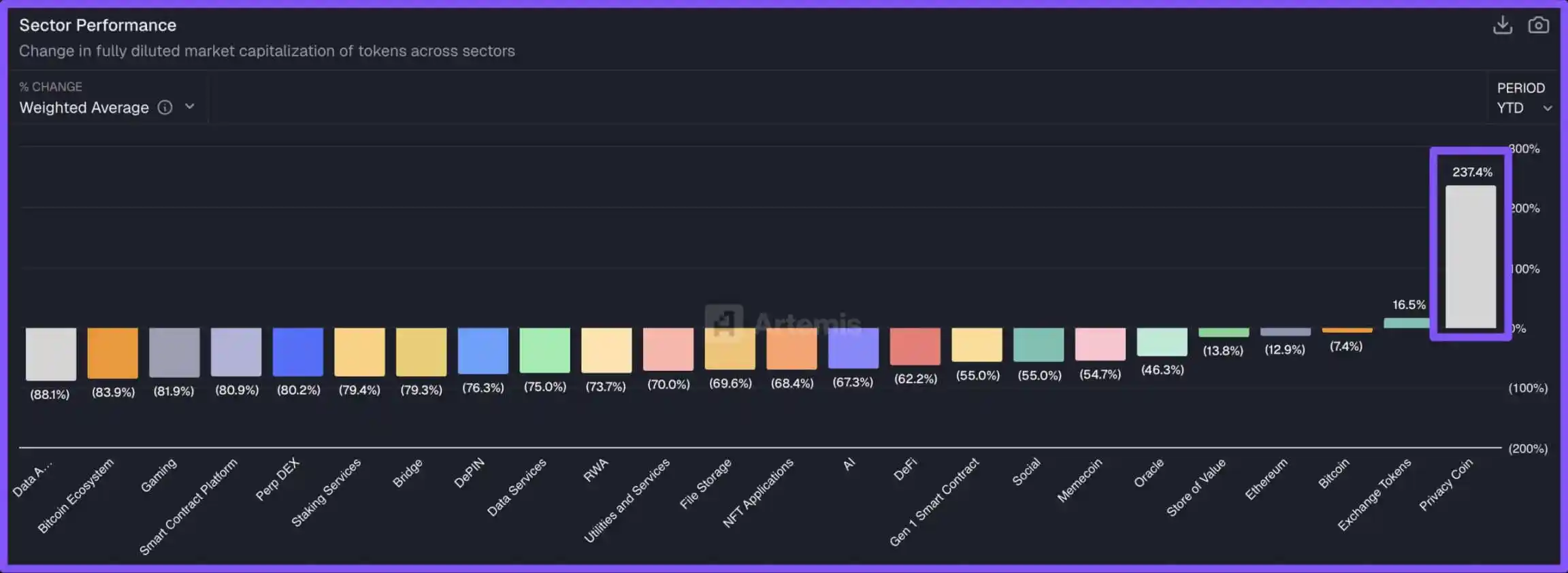
2025 Privacy Coin Performance (Source: Artemis)
While Zcash led this revival, the momentum covered the entire privacy coin space: Ethereum developers accelerated privacy-related initiatives, and other privacy solutions finally saw real-world applications.
Furthermore, the "thawing" of the regulatory environment was evident—SEC held its first official meeting with privacy protocol leads to discuss the establishment of compliance frameworks. Remember, this was entirely unimaginable a year ago.
2026 Outlook: Emergence of "Privacy DeFi"
The privacy coin space is expected to see "differentiation" in 2026: privacy will become a "premium feature" for compliant institutions. Wall Street will actively adopt these "selective disclosure tools" to prevent MEV (Maximal Extractable Value) frontrunning and safeguard the confidentiality of proprietary trading strategies.
7. Asset Tokenization (RWAs)
With strong support from a SEC-friendly attitude, Real-World Assets (RWAs) transitioned from "pilot projects" to the "core infrastructure" of the cryptocurrency industry.
The SEC no longer takes a hostile enforcement stance, allowing large institutions to confidently integrate these assets without fear of receiving a "Wells Notice" (SEC's precursor to enforcement investigations).
The BlackRock BUIDL Fund has been accepted by Binance as "off-chain collateral," marking a watershed event in the space — blurring the lines between Traditional Finance (TradFi) and the cryptocurrency market structure.
By December, the Asset Under Management (AUM) of tokenized money market funds and U.S. Treasuries had exceeded $8 billion, while the total Real World Asset (RWA) market size was about $20 billion.
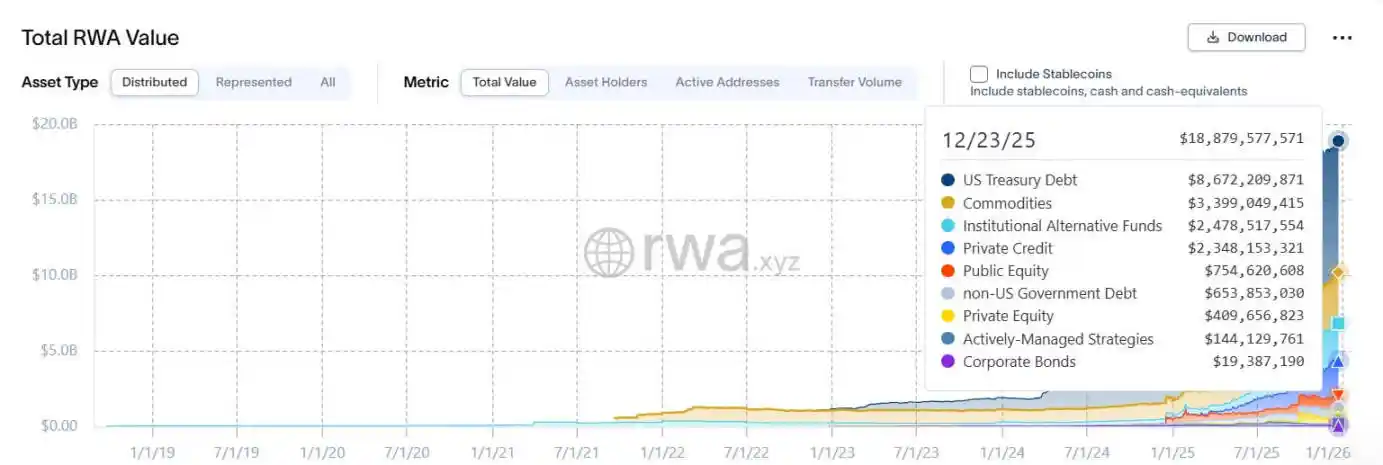
RWA Assets (Source: RWA.xyz)
Moreover, traditional financial giants such as BlackRock, JPMorgan Chase, Fidelity, Nasdaq, and the Depository Trust & Clearing Corporation (DTCC) are all optimistic about the RWA space, hoping to enhance transparency and efficiency in the traditional finance industry through it.
As SEC Chairman Paul Atkins put it, "The on-chain market will bring greater predictability, transparency, and efficiency to investors."
Outlook for 2026: Efficiency Gains in "Repo-Like" Transactions
As large banks like JPMorgan Chase and BNY Mellon continue to integrate RWA assets, a 24/7 collateral market is expected to gradually form, driving the asset management scale in this space towards $18 billion.
8. Stablecoins
The debate over the "cryptocurrency killer app" has settled: Stablecoins are the core infrastructure. In October 2025, the total market capitalization of stablecoins exceeded $300 billion; in September, the supply of stablecoins in the Ethereum ecosystem also hit a record high of $166 billion.
In fact, data from Token Terminal shows that the total number of stablecoin holders has reached a historical peak of about 200 million.
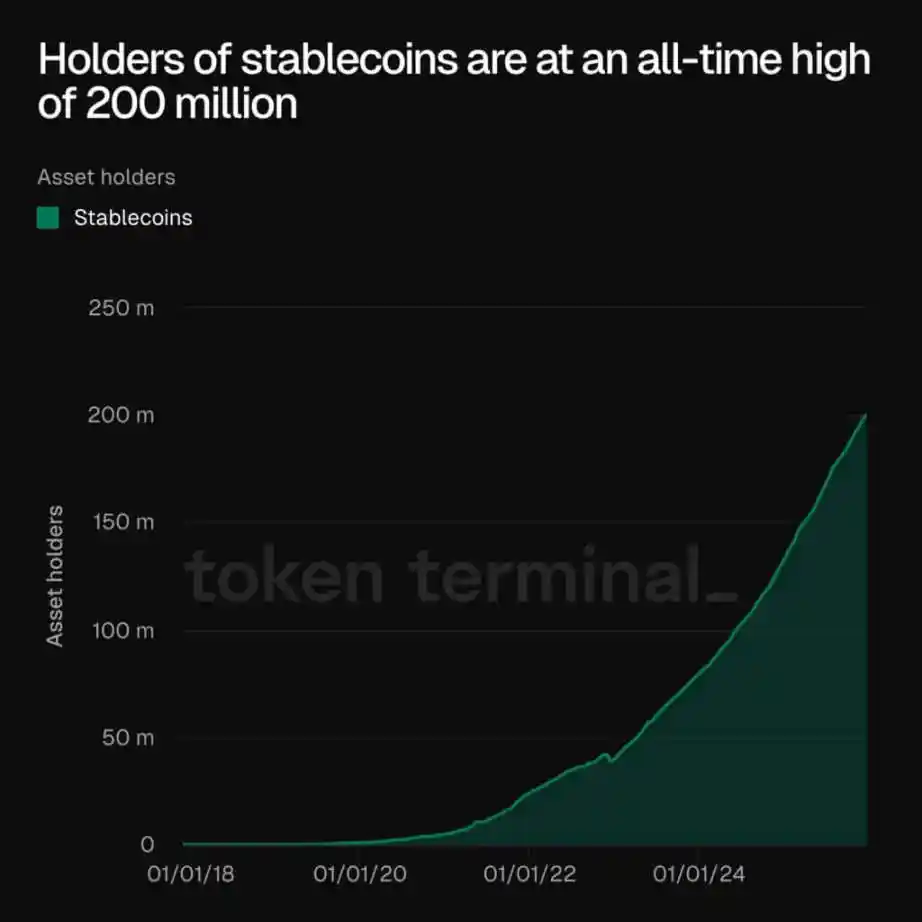
Stablecoin Holders (Source: Token Terminal)
This data indicates that the growth in the stablecoin space is driven by its core ability of "cross-border, 24/7, instant settlement."
Meanwhile, legislative progress in the United States, especially the passage of the "GENIUS Act," has provided legal certainty for banks to enter the stablecoin space.
Essentially, stablecoins are no longer just a "trading chip" but are evolving into a global financial technology "settlement layer." As Open Eden founder Jeremy NG puts it: "Stablecoins have transitioned from a cryptocurrency 'infrastructure accessory' to a 'financial infrastructure core.'"
2026 Outlook: Growth Driven by Yield
It is expected that "programmatic treasury investing" and "forex use cases" will be core drivers of stablecoin growth, with the total stablecoin market cap projected to reach a baseline level of $380 billion in 2026.
9. Perp DEXs
On-chain derivatives broke through the "credibility bottleneck" in 2025 — with monthly trading volumes hitting a record $12 trillion in October.
What has allowed this sector to emerge as a winner is its successful attraction of significant trading volume from centralized exchanges (CEXs): by offering "self-custody" features and more attractive incentive mechanisms, on-chain perpetual contract trading platforms have gained traders' favor.
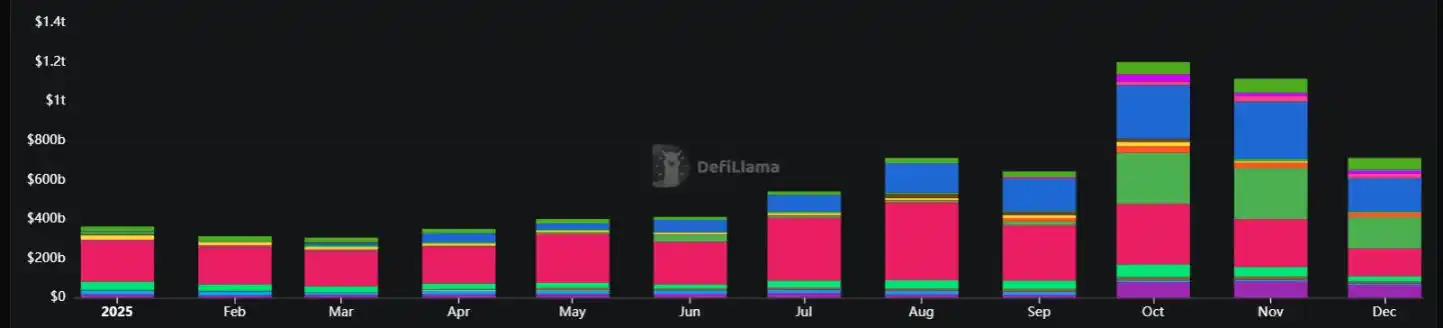
Decentralized perpetual contract exchange trading volume rising (Source: DeFiLlama)
The rise of on-chain perpetual contract decentralized exchanges (Perp DEXs) like Hyperliquid and Aster marks the maturation of the DeFi market structure. Today, traders are willing to take on smart contract risks amounting to billions of dollars in order to mitigate counterparty risks.
2026 Outlook: Intensified Fee Competition
On-chain open interest (OI) is becoming a legitimate macro risk indicator. However, the sector may witness fierce "fee wars" in 2026 — where protocols will engage in intense competition to capture a share of this $12 trillion monthly trading volume.
10. Prediction Markets
2025 was the year "event contracts" (the core product of prediction markets) entered the mainstream U.S. market: the two leading platforms in this sector, Kalshi and Polymarket, both saw record-level trading volumes.
But the most notable victory is that several traditional financial institutions and native crypto companies like Gemini and Coinbase have also joined the fray in this emerging field.
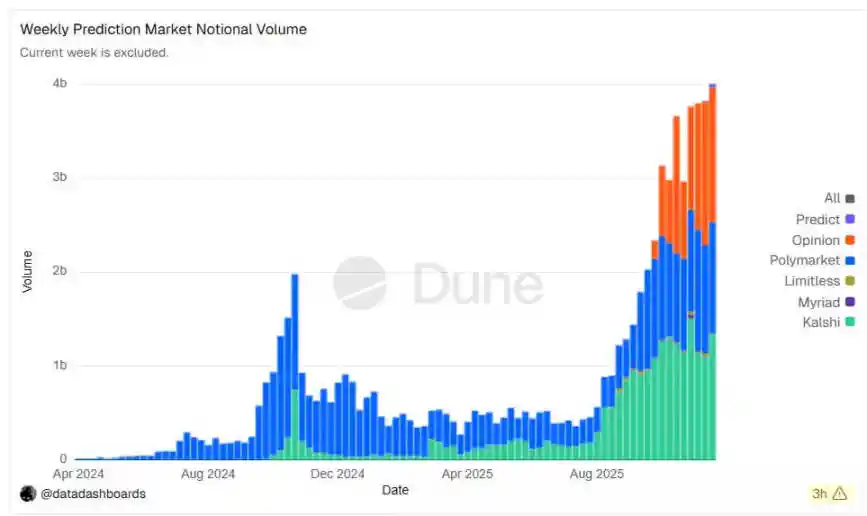
Weekly Trading Volume Prediction Market (Source: Dune Analytics)
The prediction market has emerged as a winner because it bridges the gap between 'gambling' and 'finance.' Furthermore, Polymarket has obtained a clear development path through a framework revised by the CFTC (Commodity Futures Trading Commission), transforming 'event contracts' from 'niche internet curiosities' into 'compliant hedging tools.'
2026 Outlook: Standardization and Scaling
Event contracts are becoming a standardized asset class. With 'outcome economics' (financial activities around event outcomes) expected to reach a scale of $600 billion in nominal value, crypto wallet infrastructure and USDC liquidity are poised for significant growth.
11. Hong Kong, China
While the United States focuses on legislation, Hong Kong, China has shifted its focus to 'execution advantage'—a fact supported by data. In the third quarter of 2025, Hong Kong's ETP (Exchange-Traded Products) market surpassed South Korea and Japan in terms of trading volume, becoming the world's third-largest ETP market with a daily average turnover of 37.8 billion HKD, a 150% year-on-year increase.
Hong Kong's strategy of 'attracting industry through clear regulation' has yielded tangible results in the exchange platform sector: the Virtual Asset Trading Platform (VATP) regime has evolved from a vague 'presumed licensed' state to a sound ecosystem.
By mid-2025, the Securities and Futures Commission of Hong Kong (SFC) had issued formal licenses to more global major exchange platforms, bringing the total number of licensed trading platforms to 11. This measure effectively integrates institutional liquidity within the region into a system that is 'compliant and connected to banking,' while isolating unregulated participants.
Simultaneously, the 'Stablecoin Ordinance' that took effect in Hong Kong on August 1st has created a 'high-quality sandbox'—as of the September application deadline, the sandbox had attracted over 30 applications.
2026 Outlook: Becoming Asia's Settlement Hub
With the first batch of stablecoin licenses expected to be issued in early 2026, Hong Kong is poised to become Asia's cryptocurrency settlement hub. By combining the 'world's top three ETP market' with 'licensed stablecoin infrastructure,' Hong Kong has successfully positioned itself as the 'key gateway for institutional liquidity in the Asia-Pacific region.'
12. Early Adopter (Crypto Investor)
The final spot on this list belongs to the "hodlers" — the early adopters of cryptocurrency.
Throughout the challenging years, early adopters have continuously heard the narrative that "cryptocurrency is a scam, a bubble, or a dead end." They experienced the industry crash of 2022, the regulatory crackdown of the Gensler era, and the industry lull of 2024. However, in 2025, their perseverance was finally vindicated. (Gensler era: referring to Gary Gensler's term as Chair of the U.S. SEC)
The significance of this year lies not only in the "asset price appreciation" but also in the "validation of core beliefs."
As a result, these early adopters successfully "ran ahead of the world's most renowned institutions." When BlackRock, Vanguard, and sovereign wealth funds dove into the cryptocurrency market this year, the assets they purchased were precisely those held by these early adopters during the industry's darkest days, based on unwavering conviction.
2026 Outlook: Transitioning from Investors to "Eco-Bankers"
As this cohort achieves "intergenerational wealth accumulation," they are not exiting the crypto ecosystem but are instead becoming the "bankers" of the ecosystem. It is expected that this group will become the primary liquidity providers (LPs) of the new decentralized capital markets, supporting the next wave of innovation that traditional banks have yet to grasp.
You may also like

Countdown to Midterm Elections: Will the US Crypto Bill Pass the Test?

「Macro Master」 Raoul Pal on 30x Growth Under Indexation: Bitcoin Will Eventually Surpass Gold

Uniswap Pay Dispute Escalates, Maple Finance Loan volume Hits All-Time High, What's the Overseas Crypto Community Talking About Today?

Why is the U.S. Embracing Crypto? The Answer May Lie in $37 Trillion Debt

Galaxy's 26 Predictions for Next Year: Bitcoin to Reach New ATH, Stablecoin Transaction Volume to Surpass ACH System

Key Market Information Discrepancy on December 25th - A Must-See! | Alpha Morning Report

Blockchains Quietly Prepare for Quantum Threat as Bitcoin Debates Timeline
Key Takeaways: Several blockchains, including Ethereum, Solana, and Aptos, are actively preparing for the potential threat posed by…
Three Signs that Bitcoin is Discovering its Market Bottom
Key Takeaways: Indicators suggest the selling pressure on Bitcoin is diminishing, hinting at a potential bottom. With improving…

Trump’s World Liberty Financial Token Ends 2025 Significantly Down
Key Takeaways World Liberty Financial, led by the Trump family, witnessed its token value drop by over 40%…

Former SEC Counsel Explains What It Takes to Make RWAs Compliant
Key Takeaways The SEC’s shifting approach is aiding the growth of Real-World Assets (RWAs), but jurisdictional and yield…

Kraken IPO and M&A Deals to Reignite Crypto’s ‘Mid-Stage’ Cycle
Key Takeaways: Kraken’s upcoming IPO may draw significant interest and capital from traditional finance (TradFi) investors, boosting the…

Extended Crypto ETF Outflows Indicate Institutional Pullback: Glassnode
Key Takeaways: Recent outflows from Bitcoin and Ether ETFs suggest a withdrawal of institutional interest. Institutional disengagement has…

HashKey Secures $250M for New Crypto Fund Amid Strong Institutional Interest
Key Takeaways HashKey Capital successfully secured $250 million for the initial close of its fourth crypto fund, showcasing…
How Ondo Finance plans to bring tokenized US stocks to Solana
Key Takeaways Ondo Finance aims to implement tokenized US stocks and ETFs on Solana by early 2026, enhancing…

JPMorgan Explores Cryptocurrency Trading for Institutional Clients
Key Takeaways JPMorgan Chase is considering introducing cryptocurrency trading services to its institutional clientele, marking a notable shift…

Trend Research Quietly Becomes One of Ethereum’s Largest Whales with Major ETH Acquisition
Key Takeaways Trend Research has acquired 46,379 ETH, boosting their total holdings to about 580,000 ETH. The company,…
El Salvador’s Bitcoin Dreams Faced Reality in 2025
Key Takeaways El Salvador’s ambitious Bitcoin strategy, introduced in 2021, faced significant challenges and revisions by 2025, particularly…

Price Predictions for 12/22: SPX, DXY, BTC, ETH, BNB, XRP, SOL, DOGE, ADA, BCH
Key Takeaways: Bitcoin’s recovery efforts are met with strong resistance, indicating potential bearish trends at higher levels. Altcoins…
Countdown to Midterm Elections: Will the US Crypto Bill Pass the Test?
「Macro Master」 Raoul Pal on 30x Growth Under Indexation: Bitcoin Will Eventually Surpass Gold
Uniswap Pay Dispute Escalates, Maple Finance Loan volume Hits All-Time High, What's the Overseas Crypto Community Talking About Today?
Why is the U.S. Embracing Crypto? The Answer May Lie in $37 Trillion Debt
Galaxy's 26 Predictions for Next Year: Bitcoin to Reach New ATH, Stablecoin Transaction Volume to Surpass ACH System
Key Market Information Discrepancy on December 25th - A Must-See! | Alpha Morning Report
Popular coins
Latest Crypto News


Customer Support:@weikecs
Business Cooperation:@weikecs
Quant Trading & MM:[email protected]
VIP Services:[email protected]
 App
App