
- Buy Crypto
- Markets
- Futures
- Spot
- Copy Trade
 WE-Launch
Compared to the Gas futures market, ETHGas is more interested in being a real-time execution layer

Original Article Title: "ETHGas Aims to Be More About Real-Time Execution Layer Than Gas Futures Market"
Original Article Author: Eric, Foresight News
On December 17, the Ethereum block space futures market ETHGas announced the completion of a $12 million financing round, led by Polychain Capital and with participation from Stake Capital, BlueYard Capital, Lafayette Macro Advisors, SIG DT, and Amber Group. Founder Kevin Lepsoe stated that ETHGas had previously raised an undisclosed Pre-Seed round of around $5 million in mid-2024.
Additionally, Lepsoe mentioned that Ethereum validators, block producers, and relayers have committed to providing around $800 million to support market and product development, not in cash investment but in the form of Ethereum block space liquidity to the ETHGas market.
While the project is defined as a block space futures market, its true vision is to achieve "Real-Time Ethereum."
Block Order
Ethereum co-founder Vitalik Buterin proposed the concept of a Gas futures market earlier this month, aimed at addressing Ethereum Gas volatility. Similar to the logic of traditional commodity futures markets, the key role of futures locking in future Gas costs is to make Gas costs predictable and controllable.
As a result, DApps can lock in Gas costs, for example, before events like user token airdrops, and design incentives for user activities. L2 can also buy futures when Gas fees are lower to reduce the cost of submitting data packets to L1, making transaction costs on L2 stable and predictable, serving businesses that require upfront cost calculations, such as tokenizing stocks.
According to the documentation, ETHGas will also launch a zero-code tool called Open Gas specifically for DApps to provide Gas subsidy plans, allowing users to claim back Gas fees spent while using a DApp on the ETHGas platform.
There is not much difficulty in the design and development of the Gas futures market; essentially, it requires establishing an on-chain futures trading market with sufficient liquidity. However, ETHGas's "killer move" is the block space auction market.
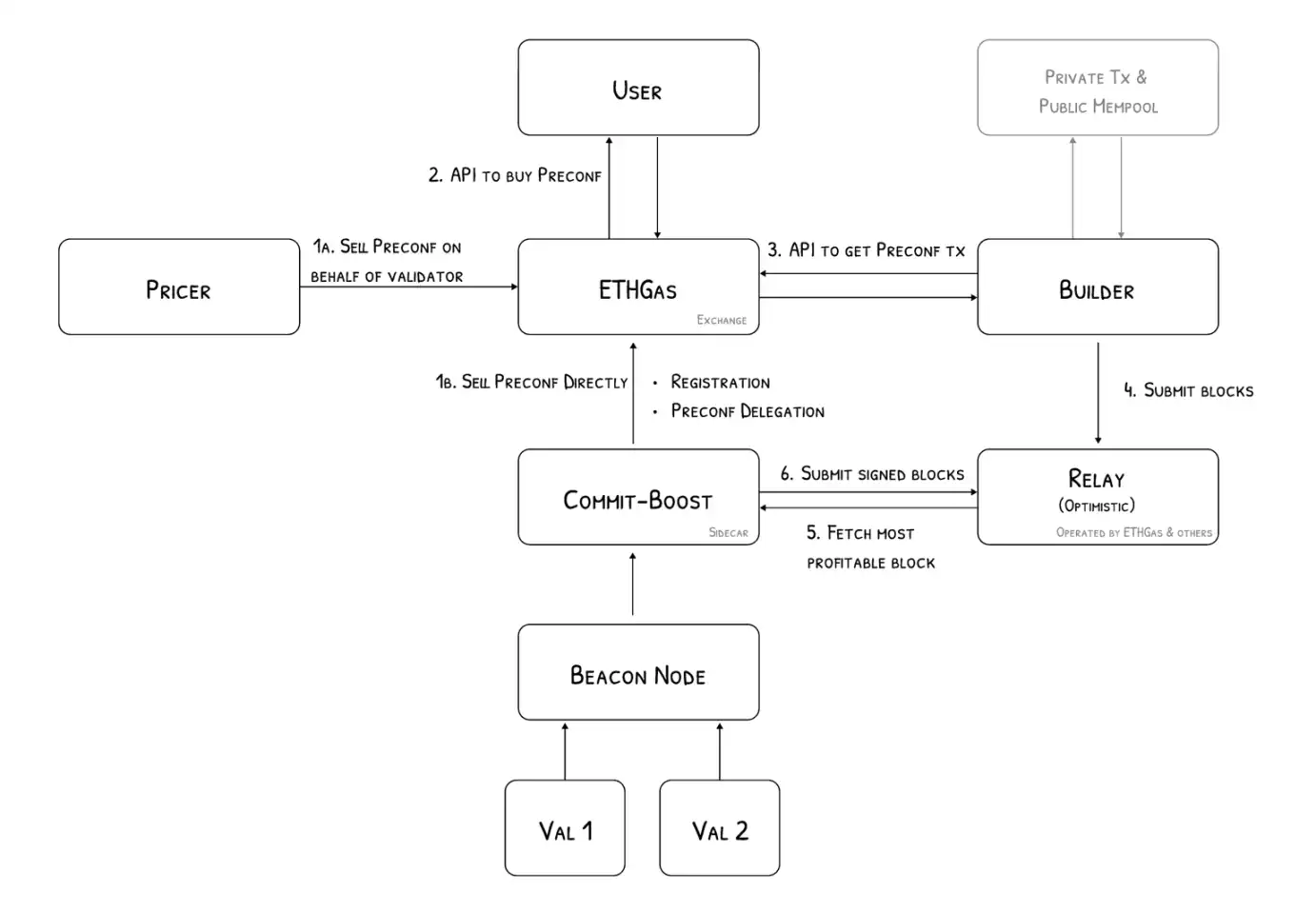
The auction market is called Blockspace, where Ethereum validators, block creators, and relay nodes can auction off space in upcoming blocks to ensure that the bidder's transaction will be included in the next block and to guarantee the transaction's execution efficiency. Furthermore, bidders can even bid for the entire next block to have it contain only their own transactions or transactions provided by others.
If we liken transactions to packages, ensuring a block's inclusion of transactions is like ensuring a package will definitely be loaded onto a transport plane, and ensuring transaction execution is like ensuring the package will be delivered to a specific recipient on time. Bidding for a complete block is akin to chartering a plane to transport your packages, but at the same time, you can sublease any excess space to other packages.
ETHGas' ultimate goal is to achieve Ethereum's "real-time transactions" through Blockspace. This real-time transaction can only be in quotes because the completion of transactions on the Ethereum mainnet must wait for the block to be finalized, but if a transaction can be guaranteed to be included in the next block, it can, to some extent, be considered "completed". We can think of ETHGas as an execution layer on top of Ethereum, but how real-time transactions will be reflected in the frontend still awaits ETHGas' answer.
The core of ETHGas is to establish an orderly block space, rather than the current chaotic bidding to compete for block space, which leads to numerous uncontrollable MEV transactions. By attracting infrastructure operators to join Blockspace through predictable earnings to create sufficient liquidity for achieving real-time transactions, the efficiency improvement attracts various DApps. DApps attract users through Open Gas, bringing more transaction volume into the ETHGas network, thereby increasing the earnings of infrastructure operators, creating a virtuous cycle.
Challenges Under the Good Vision
For a DApp about to conduct a token airdrop, it can estimate the number of transactions for claiming the airdrop, prebook a certain number of blocks after a specific time, and provide a Gas subsidy plan to achieve budget controllability without causing network congestion during the token claim activity.
Although such visions are ideal, allowing block space to be auctioned off may lead to many foreseeable issues.
First, if institutional users can freely auction block space, they may bid heavily for entire blocks and resell them to retail users. In this scenario, while validators' earnings are secure and stable, it actually raises transaction costs for retail users. In this case, retail users, due to their lack of technical ability, are unable to compete with institutional users, and even if retail users can participate in auctions or use futures markets to hedge against the increased Gas costs, it fundamentally raises transaction costs.
Furthermore, the futures market may also serve as a tool for market manipulation, where large holders intentionally generate a large number of on-chain transactions to increase Gas fees and profit in the futures market. However, this action may cause other users to experience a rise in transaction costs on the Ethereum mainnet. Additionally, as a DApp operator, being aware of specific times when certain actions may cause a surge in transaction volume, one can proactively benefit from operations in the futures market, turning the futures market into an arbitrage market for information advantage players, leading to unforeseen losses for regular users who solely rely on market hedging.
The emergence of a new trading market inevitably means that there will be arbitrage opportunities due to information asymmetry, affecting the market's ability to address the problems it aims to solve. For ETHGas, balancing this issue to prevent the "positive feedback loop" from turning into a "death spiral" may require some necessary regulatory measures.
You may also like

The Year Trump Embraced Cryptocurrency

IOSG: Port and New City, Two Cryptoverse Views of BNB Chain and Base

Key Market Intelligence as of December 31st, how much did you miss out on?

Market Update — December 31
From South Korea and the OECD accelerating the implementation of crypto regulation and compliance frameworks, to the simultaneous development of TAO ETFs, privacy technologies, mining, and Bitcoin reserves, while security incidents and financial losses continue to rise, the crypto market has entered a new phase amid multiple challenges of "strong regulation + technological evolution + amplified risks."

Lighter Token Distribution Sparks Controversy, Zama Launches USDT Private Transfers, What is the Overseas Crypto Community Talking About Today?

Can't Beat the Stock Market, Can't Outdo Precious Metals, Is Crypto Really Becoming the Bull Market for "Outsiders"?

Why Did the Prediction Market Take Nearly 40 Years to Explode?

Key Market Intelligence on December 30th, how much did you miss out on?

Matrixdock 2025: The Practical Path to Sovereign-Grade RWA of Gold Tokenization
Paradigm's Tempo Project Launches Testnet, Is It Worth Checking Out?
Caixin: Digital RMB Wallet Balances to Begin Earning Interest in 2026
Key Takeaways: Starting January 1, 2026, digital RMB wallets will earn interest on balances. The operational structure will…

Lighter Founder’s Latest Response on Token Launch Progress, What Was Said
Lighter’s Founder, Vladimir Novakovski, clarifies key concerns in an AMA, focusing on detecting and resolving bot account manipulations…

Lighter: Airdrop Successful and Token Trading Imminent
Key Takeaways: The Lighter Discord community recently announced the successful distribution of LIT tokens, marking the beginning of…
UNI Burn Arbitrage Opportunity, Ondo Tokenized Stock Liquidity Debate, What’s the Overseas Crypto Community Talking About Today?
Key Takeaways The crypto market is buzzing with multi-threaded discussions, from macro trends to specific protocols and scams.…
Announcement: The Fed to Release Minutes of its Monetary Policy Meeting Soon
Key Takeaways The Federal Reserve is anticipated to disclose the minutes from its latest monetary policy meeting, offering…

The Fed’s Monetary Policy Minutes and the Crypto Trading Insights
Key Takeaways The Federal Reserve is set to disclose the minutes from its recent monetary policy meeting, highlighting…
“Elon Musk’s Nemesis Trade” Colossal ETH Short Sparks Debate in Crypto Circles
Key Takeaways A colossal short position was secured against Ethereum (ETH) worth approximately $106 million by a single…

Dragonfly Partner Foresees BTC Surpassing $150K by 2026 but Market Share Decline
Key Takeaways Bitcoin is anticipated to climb over $150,000 by the end of 2026, although its market dominance…
The Year Trump Embraced Cryptocurrency
IOSG: Port and New City, Two Cryptoverse Views of BNB Chain and Base
Key Market Intelligence as of December 31st, how much did you miss out on?
Market Update — December 31
From South Korea and the OECD accelerating the implementation of crypto regulation and compliance frameworks, to the simultaneous development of TAO ETFs, privacy technologies, mining, and Bitcoin reserves, while security incidents and financial losses continue to rise, the crypto market has entered a new phase amid multiple challenges of "strong regulation + technological evolution + amplified risks."


 App
App