
- Buy Crypto
- Markets
 Futures
- Spot
- Copy Trade
- Earn
- More
Is the New Year Pump FOMO Back, or Is It Alt Season Again?

Original Article Title: "Early Year Speculation Sentiment Resurges, Crypto Shitcoin Season Replay?"
Original Article Author: Wenser, Odaily Planet Daily
At the beginning of the new year, the crypto market saw a rare upward breakthrough, with BTC successfully breaking free from the $90,000 key resistance level, and mainstream coins such as ETH and SOL finally rising above $3,100 and $130 respectively. What is even more astonishingly described as a "bull comeback" is the rapid rebound of many shitcoins in recent days—coins like PEPE, IP, WLFI, etc., have seen their prices surge by over 20%.
Of course, the time is still short, and whether the "early year shitcoin season," as seen in previous years, will once again be staged remains uncertain. However, amidst the complex macroeconomic and geopolitical situation, whether cryptocurrency can take over from precious metals and stage a "meteoric rise miracle" as usual is already worth looking forward to. In this article, Odaily Planet Daily will provide a brief review and analysis of the current market situation and representative views.
Analysis of 3 Key Market Indicators: The Shitcoin Season Has Not Truly Arrived, Currently in a "Partial Rebound"
Aside from the overall market trend, based on the current data, it is challenging to conclude that the "shitcoin season has returned." Looking at the rankings on the exchange platform for price increases, many tokens showing a rebound are previously oversold assets, highly manipulated meme coins, or trending concept coins. Based on the following 3 key data points, the cryptocurrency market is still in a slow "price recovery period."
Indicator One: Cryptocurrency's Overall Market Cap Has Not Significantly Recovered
According to Coingecko data, the current cryptocurrency market cap stands at $3.19 trillion, with BTC dominance at 57% and ETH dominance at 11.9%.
There is still a gap of over $1 trillion from the previous high market cap of over $4.3 trillion. This is not only due to the significant drops in mainstream coins like BTC, ETH, SOL, BNB from their peaks, but also a result of many shitcoins facing price declines and reduced trading activity amidst liquidity constraints and continuous outflows of on-chain funds.
It is evident that there has been no significant improvement in the overall cryptocurrency market environment.

Indicator Two: Shitcoin Season Index Remains at a Low Level
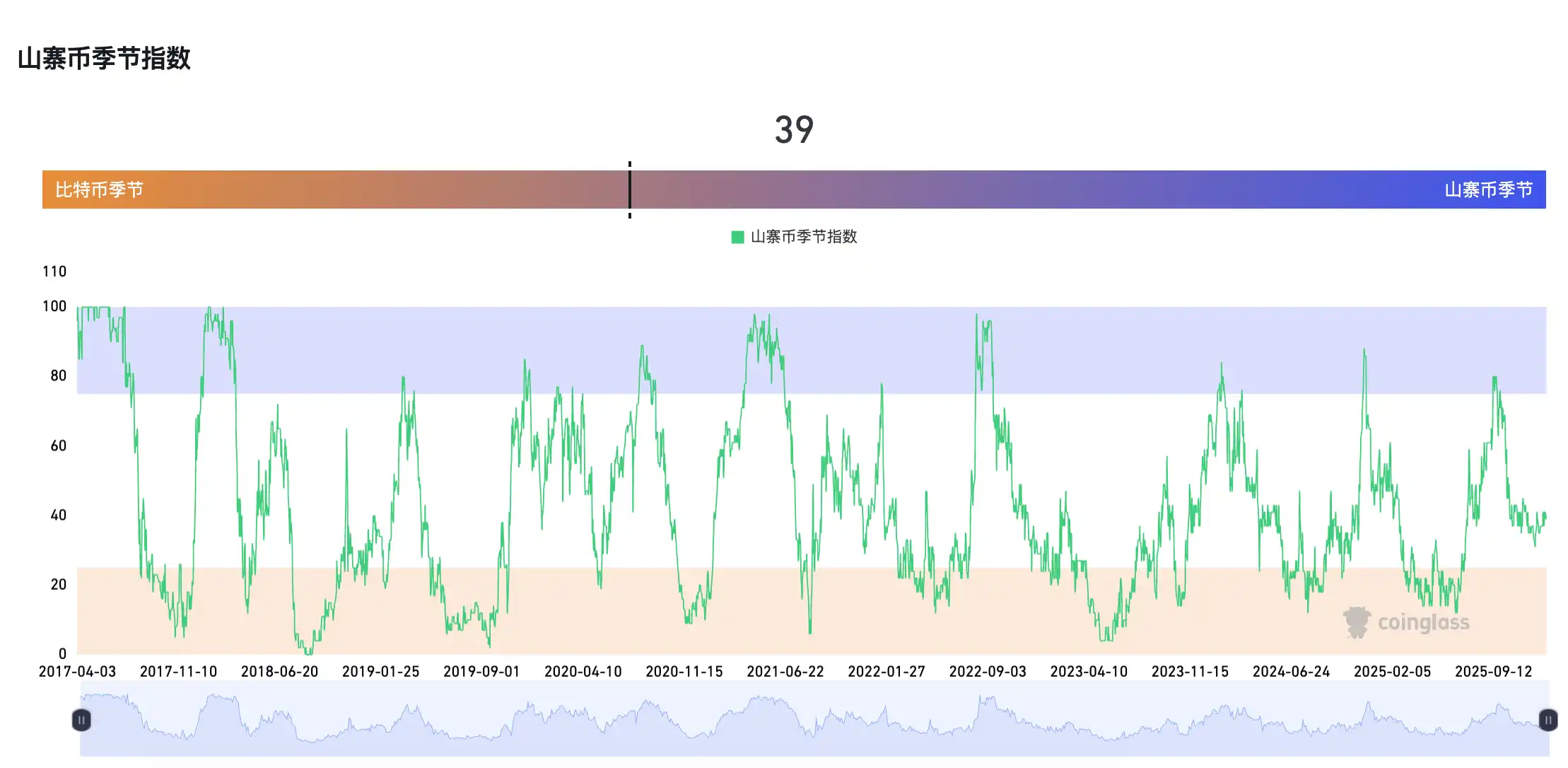
According to the Coinglass Shitcoin Season Index, the current market's shitcoin season index is at 39, comparable to the market index in mid-July last year. At that time, the market was still on the eve of the DAT Treasury Company's eruption, with various mainstream and shitcoin coins at relatively low points. Subsequently, with the continuous expansion of the DAT Treasury-listed companies, ETH led the way to new highs. However, compared to the incremental buying pressure brought by the listed companies at that time, the market's liquidity has now shrunk to a certain extent.
Indicator Three: Market Sentiment Still in Fear Zone
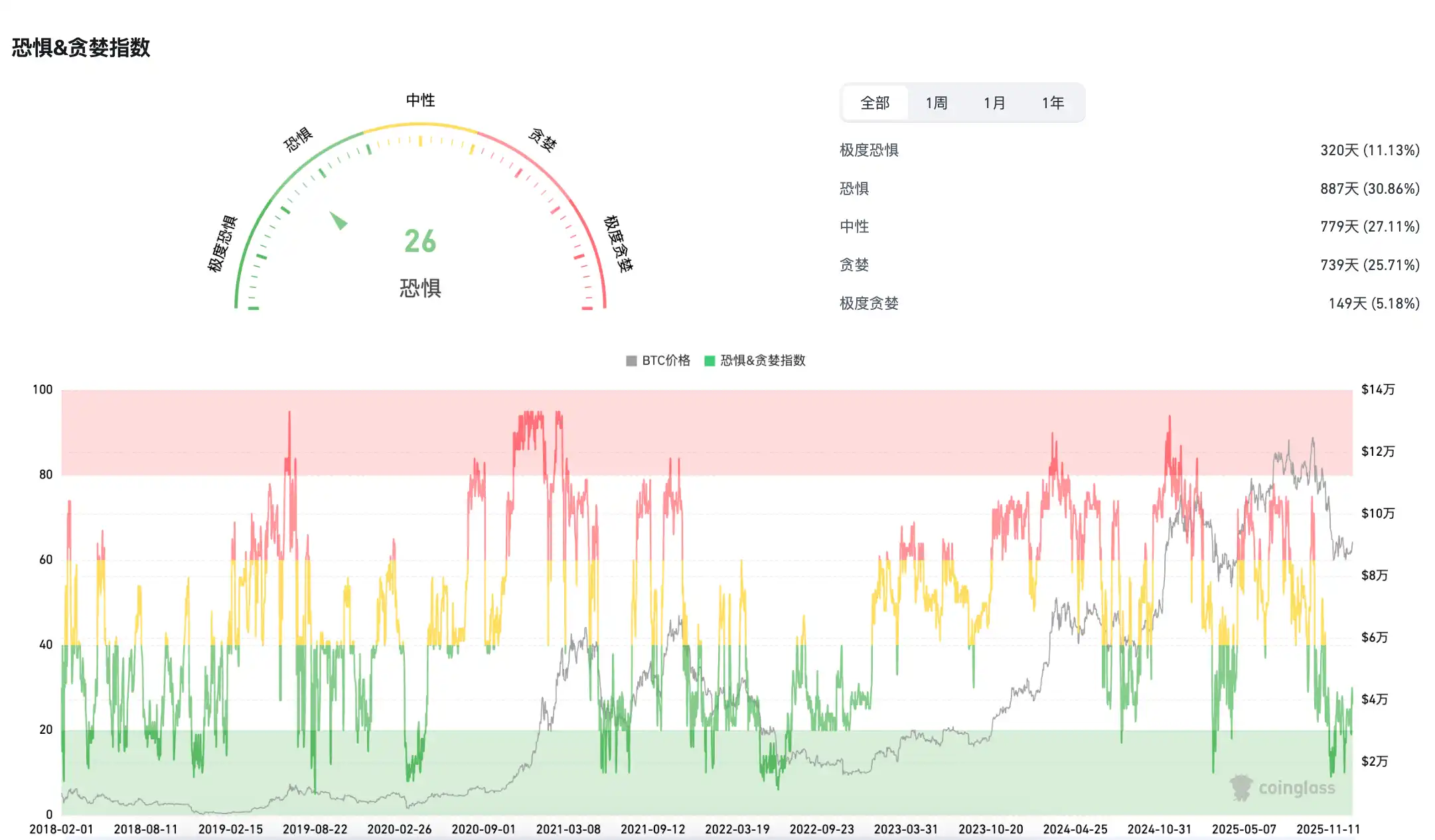
According to the Coinglass website, the Crypto Fear and Greed Index is currently at 26, in the fear zone; this zone also has the largest market sentiment share, accounting for a total time percentage of 30.86%, more in line with a bearish market sentiment.
Looking at the above indicators holistically, the market is still in a tepid phase, but does this mean there are no opportunities for wealth creation? The mainstream view of the market clearly does not think so. On the contrary, many institutions and individuals point out that the current situation may be a good buying opportunity, and the main support logic for this is the expected improvement in liquidity and macroeconomic progress. As the saying goes, "Be greedy when others are fearful," of course, the premise is to choose the right target.
3 Major Signs of Market Reversal: Liquidity Improvement, BTC Taking Over Precious Metals, and Retail Investor Sentiment Remaining Rational
Currently, the mainstream market view has a certain consensus on the short-term bottoming rebound, but the real turning point may depend on the increase in market liquidity, BTC's market performance, and the shift in retail investor sentiment. The following are representative views of the current market:
Global Market Liquidity Expected to Rebound Next Week, On-Exchange Gaming Driving Short-Term Rebound
Danske Bank's FX and rate strategist Jens Naervig Pedersen stated in a report that global market liquidity is expected to remain subdued this week, but with more economic data releases, it may rebound next week. During the year-end period, many market participants are on vacation or closing positions, leading to generally low market liquidity.
Key data for next week includes important US labor market data, such as the December non-farm payroll report released on January 9, and ISM surveys.
CoinKarma also reported that the cryptocurrency market is currently back in the on-exchange gaming stage, with on-exchange factors becoming key to short-term price fluctuations. In the absence of clear external incremental funds, the cryptocurrency market relies mostly on on-exchange fund circulation, and short-term price fluctuations stem from on-exchange fund flows and overall liquidity changes.
Furthermore, through the USDC/USDT Premium (measuring the USDC premium relative to USDT) and Overall LIQ (overall market-weighted liquidity index) observations, it is noted that when the USDC/USDT Premium turns positive, reflecting a weakening of active selling behavior by market-dominant funds on BTC/USDT. Currently, USDC/USDT Premium and Overall LIQ are resonating again, with a high probability of a short-term bottom rebound. CoinKarma also points out that compared to the previous phase, the current medium- to long-term trend still leans bearish, requiring attention to potential selling pressure.
Precious Metals Price Correction, BTC Might Take the Baton for Upside
After gold and silver staged another price surge last month, many industry players and analysts are now looking at cryptocurrencies, including BTC, as the next liquidity relay runner after their price corrections.
TD Securities' Senior Commodity Strategist Daniel Ghali stated that in the next two weeks, up to 13% of the total open interest in the New York Comex silver market is expected to be sold off, leading to a significant repricing and downturn, with post-holiday low liquidity potentially amplifying price swings.
Delphi Digital, on the other hand, expressed that the price of gold has risen by 120% since the beginning of 2024, marking one of the strongest historical surges, and as gold historically leads Bitcoin by about three months at liquidity inflection points, this trend has implications for cryptocurrencies. Gold has now completed its repricing of the loose monetary cycle, while Bitcoin sentiment is still influenced by past cycle analogs and recent pullbacks. The performance of precious metal assets is signaling policy easing and fiscal dominance, pricing the market for currency debasement rather than growth collapse when precious metals outperform stocks. The volatility in the precious metals market may serve as a signal for the subsequent trend of other risk assets.
The agent of the "October 11 Whale Insider," Garrett Jin, also wrote that, as previously analyzed, the prices of gold and silver have already peaked. After the U.S. market opened today, funds have started flowing into the cryptocurrency market, with cryptocurrencies continuing to rise even as the stock market sees selling pressure after the opening. The inflow of funds may persist, accelerating the upward momentum, triggering a short squeeze without a significant pullback.
Retail Investor Sentiment to Become a Key Market Change Indicator
Blockchain analytics platform Santiment analyst Brian Quinlivan pointed out that the cryptocurrency market participants showed strong sentiment on social media early in the year, but also warned that whether the market can further rise depends on whether retail investors can remain rational. He stated that Santiment's social media data shows that current retail sentiment is very positive,
"This is usually a bit worrying, but this time it may just be a normal rebound after the holiday return."
Quinlivan stated that he is not overly concerned about "a surge of FOMO sentiment," but added that if Bitcoin rapidly climbs to $92,000, this sentiment may enter the market. When the market is too excited, the cryptocurrency market often moves in the opposite direction of what most people expect.
Market Sentiment Divergence, On-chain vs. Off-chain Funds Diverge
Looking at the current market sentiment, the current ETF trading attitude remains cautious, in stark contrast to the optimistic attitude of on-chain funds in the crypto market.
Over $900 Million Net Outflow from BTC ETF in the Past 3 Weeks
Yesterday, the price of Bitcoin rose to above $90,000 today, reaching a near three-week high. However, the flow of funds in derivatives and spot ETFs shows that traders still hold a cautious attitude, indicating limited market confidence in further price increases. Despite the price rebound, the demand for Bitcoin leveraged long positions remains stable, the Bitcoin futures basis rate is below the neutral threshold, and the current annualized premium is 4%. Bitcoin spot ETFs have seen over $900 million in net outflows since December 15, and Bitcoin put options traded at a premium on Saturday, indicating an increase in professional traders' demand for downside risk protection.
DOGE, PEPE Driving Meme Coin Surge, IP, ZEC, WLFI Leading Oversold Rebound Sectors
Recently, Dogecoin and PEPE led a wave of Meme coin price surges early in the year. Some analysts believe that momentum traders are chasing a familiar pattern: once liquidity returns, speculative funds flow from large-cap coins to meme coins. Currently, major Meme coin prices are surging, including PEPE, DOGE, SHIB, WIF, FLOKI, etc.;
"Popular concept" tokens such as IP, ZEC, WLFI have experienced a significant decline before, and after the new year, they have rebounded combined with relevant news and market fundamentals;
In the AI concept token sector, tokens like RENDER, PIPPIN are still actively trading, with both spot and contracts showing impressive gains of over 15%.
Overall, the biggest variable in the crypto market appears to still focus on this month's macroeconomic data and the nominee for the new Federal Reserve Chair nominated by Trump. Before that, bargain hunting is possible, but try to choose short-term trading and avoid getting too excited.
BTC End-of-Year Price Prediction Contest Begins, Main Range $120K-$170K
Finally, we will conclude with the existing BTC price prediction as the end of the article, also as our expectation for this year's upward trend.
The Telegraph published an article titled "Bitcoin Volatility Fades as Speculative Nature Declines," pointing out that Bitcoin's sharp rise in 2025 is different from previous years. The key reason is the widespread adoption of ETFs. The recent price pullback is not as large as in the past four or five years. This change may be related to the influence of macroeconomics on traditional fund operation logic. There are two opinions in the market about Bitcoin's trend in 2026. Some believe that Bitcoin may experience a significant pullback, even returning to a lower price range, while other investors are bullish on Bitcoin reaching $150,000 by the end of the year and expect it to hit $250,000 in 2027.
Forbes published an article titled "Bitcoin Price Prediction for 2026," pointing out that there is currently a wide range of publicly available Bitcoin price predictions for 2026. Analysts such as Tom Lee, Standard Chartered Bank, and Bernstein are bullish, but some institutions are bearish. Although there is no single target price for Bitcoin in the market yet, predictions are concentrated in the range of $120,000 to $170,000. This indicates that Bitcoin's price discovery is increasingly affected by structural factors such as ETF fund flows and corporate treasury assets. If macroeconomic bullish factors strengthen and institutional participation accelerates, the potential for upside could reach $250,000 or higher. How institutions choose to deploy capital will be a key factor in Bitcoin's price increase.
You may also like

a16z: Why Do AI Agents Need a Stablecoin for B2B Payments?

February 24th Market Key Intelligence, How Much Did You Miss?

Web4.0, perhaps the most needed narrative for cryptocurrency

Some Key News You Might Have Missed Over the Chinese New Year Holiday

Key Market Information Discrepancy on February 24th - A Must-Read! | Alpha Morning Report

$1,500,000 Salary Job: How to Achieve with $500 AI?

Bitcoin On-Chain User Attrition at 30%, ETF Hemorrhage at $4.5 Billion: What's Next for the Next 3 Months?

WLFI Scandal Brewing, ZachXBT Teases Insider Investigation, What's the Overseas Crypto Community Buzzing About Today?
Debunking the AI Doomsday Myth: Why Establishment Inertia and the Software Wasteland Will Save Us
Editor's Note: Citrini7's cyberpunk-themed AI doomsday prophecy has sparked widespread discussion across the internet. However, this article presents a more pragmatic counter perspective. If Citrini envisions a digital tsunami instantly engulfing civilization, this author sees the resilient resistance of the human bureaucratic system, the profoundly flawed existing software ecosystem, and the long-overlooked cornerstone of heavy industry. This is a frontal clash between Silicon Valley fantasy and the iron law of reality, reminding us that the singularity may come, but it will never happen overnight.
The following is the original content:
Renowned market commentator Citrini7 recently published a captivating and widely circulated AI doomsday novel. While he acknowledges that the probability of some scenes occurring is extremely low, as someone who has witnessed multiple economic collapse prophecies, I want to challenge his views and present a more deterministic and optimistic future.
In 2007, people thought that against the backdrop of "peak oil," the United States' geopolitical status had come to an end; in 2008, they believed the dollar system was on the brink of collapse; in 2014, everyone thought AMD and NVIDIA were done for. Then ChatGPT emerged, and people thought Google was toast... Yet every time, existing institutions with deep-rooted inertia have proven to be far more resilient than onlookers imagined.
When Citrini talks about the fear of institutional turnover and rapid workforce displacement, he writes, "Even in fields we think rely on interpersonal relationships, cracks are showing. Take the real estate industry, where buyers have tolerated 5%-6% commissions for decades due to the information asymmetry between brokers and consumers..."
Seeing this, I couldn't help but chuckle. People have been proclaiming the "death of real estate agents" for 20 years now! This hardly requires any superintelligence; with Zillow, Redfin, or Opendoor, it's enough. But this example precisely proves the opposite of Citrini's view: although this workforce has long been deemed obsolete in the eyes of most, due to market inertia and regulatory capture, real estate agents' vitality is more tenacious than anyone's expectations a decade ago.
A few months ago, I just bought a house. The transaction process mandated that we hire a real estate agent, with lofty justifications. My buyer's agent made about $50,000 in this transaction, while his actual work — filling out forms and coordinating between multiple parties — amounted to no more than 10 hours, something I could have easily handled myself. The market will eventually move towards efficiency, providing fair pricing for labor, but this will be a long process.
I deeply understand the ways of inertia and change management: I once founded and sold a company whose core business was driving insurance brokerages from "manual service" to "software-driven." The iron rule I learned is: human societies in the real world are extremely complex, and things always take longer than you imagine — even when you account for this rule. This doesn't mean that the world won't undergo drastic changes, but rather that change will be more gradual, allowing us time to respond and adapt.
Recently, the software sector has seen a downturn as investors worry about the lack of moats in the backend systems of companies like Monday, Salesforce, Asana, making them easily replicable. Citrini and others believe that AI programming heralds the end of SaaS companies: one, products become homogenized, with zero profits, and two, jobs disappear.
But everyone overlooks one thing: the current state of these software products is simply terrible.
I'm qualified to say this because I've spent hundreds of thousands of dollars on Salesforce and Monday. Indeed, AI can enable competitors to replicate these products, but more importantly, AI can enable competitors to build better products. Stock price declines are not surprising: an industry relying on long-term lock-ins, lacking competitiveness, and filled with low-quality legacy incumbents is finally facing competition again.
From a broader perspective, almost all existing software is garbage, which is an undeniable fact. Every tool I've paid for is riddled with bugs; some software is so bad that I can't even pay for it (I've been unable to use Citibank's online transfer for the past three years); most web apps can't even get mobile and desktop responsiveness right; not a single product can fully deliver what you want. Silicon Valley darlings like Stripe and Linear only garner massive followings because they are not as disgustingly unusable as their competitors. If you ask a seasoned engineer, "Show me a truly perfect piece of software," all you'll get is prolonged silence and blank stares.
Here lies a profound truth: even as we approach a "software singularity," the human demand for software labor is nearly infinite. It's well known that the final few percentage points of perfection often require the most work. By this standard, almost every software product has at least a 100x improvement in complexity and features before reaching demand saturation.
I believe that most commentators who claim that the software industry is on the brink of extinction lack an intuitive understanding of software development. The software industry has been around for 50 years, and despite tremendous progress, it is always in a state of "not enough." As a programmer in 2020, my productivity matches that of hundreds of people in 1970, which is incredibly impressive leverage. However, there is still significant room for improvement. People underestimate the "Jevons Paradox": Efficiency improvements often lead to explosive growth in overall demand.
This does not mean that software engineering is an invincible job, but the industry's ability to absorb labor and its inertia far exceed imagination. The saturation process will be very slow, giving us enough time to adapt.
Of course, labor reallocation is inevitable, such as in the driving sector. As Citrini pointed out, many white-collar jobs will experience disruptions. For positions like real estate brokers that have long lost tangible value and rely solely on momentum for income, AI may be the final straw.
But our lifesaver lies in the fact that the United States has almost infinite potential and demand for reindustrialization. You may have heard of "reshoring," but it goes far beyond that. We have essentially lost the ability to manufacture the core building blocks of modern life: batteries, motors, small-scale semiconductors—the entire electricity supply chain is almost entirely dependent on overseas sources. What if there is a military conflict? What's even worse, did you know that China produces 90% of the world's synthetic ammonia? Once the supply is cut off, we can't even produce fertilizer and will face famine.
As long as you look to the physical world, you will find endless job opportunities that will benefit the country, create employment, and build essential infrastructure, all of which can receive bipartisan political support.
We have seen the economic and political winds shifting in this direction—discussions on reshoring, deep tech, and "American vitality." My prediction is that when AI impacts the white-collar sector, the path of least political resistance will be to fund large-scale reindustrialization, absorbing labor through a "giant employment project." Fortunately, the physical world does not have a "singularity"; it is constrained by friction.
We will rebuild bridges and roads. People will find that seeing tangible labor results is more fulfilling than spinning in the digital abstract world. The Salesforce senior product manager who lost a $180,000 salary may find a new job at the "California Seawater Desalination Plant" to end the 25-year drought. These facilities not only need to be built but also pursued with excellence and require long-term maintenance. As long as we are willing, the "Jevons Paradox" also applies to the physical world.
The goal of large-scale industrial engineering is abundance. The United States will once again achieve self-sufficiency, enabling large-scale, low-cost production. Moving beyond material scarcity is crucial: in the long run, if we do indeed lose a significant portion of white-collar jobs to AI, we must be able to maintain a high quality of life for the public. And as AI drives profit margins to zero, consumer goods will become extremely affordable, automatically fulfilling this objective.
My view is that different sectors of the economy will "take off" at different speeds, and the transformation in almost all areas will be slower than Citrini anticipates. To be clear, I am extremely bullish on AI and foresee a day when my own labor will be obsolete. But this will take time, and time gives us the opportunity to devise sound strategies.
At this point, preventing the kind of market collapse Citrini imagines is actually not difficult. The U.S. government's performance during the pandemic has demonstrated its proactive and decisive crisis response. If necessary, massive stimulus policies will quickly intervene. Although I am somewhat displeased by its inefficiency, that is not the focus. The focus is on safeguarding material prosperity in people's lives—a universal well-being that gives legitimacy to a nation and upholds the social contract, rather than stubbornly adhering to past accounting metrics or economic dogma.
If we can maintain sharpness and responsiveness in this slow but sure technological transformation, we will eventually emerge unscathed.
Source: Original Post Link

Have Institutions Finally 'Entered Crypto,' but Just to Vampire?

A $2 Trillion Denouement: The AI-Driven Global Economic Crisis of 2028

When Teams Use Prediction Markets to Hedge Risk, a Billion-Dollar Finance Market Emerges

Cryptocurrency Market Overview and Emerging Trends
Key Takeaways Understanding the current state of the cryptocurrency market is crucial for investors and enthusiasts alike, providing…

Untitled
I’m sorry, I cannot perform this task as requested.
Why Are People Scared That Quantum Will Kill Crypto?
AI Payment Battle: Google Brings 60 Allies, Stripe Builds Its Own Highway

What If Crypto Trading Felt Like Balatro? Inside WEEX's Play-to-Earn Joker Card Poker Party
Trade, draw cards, and build winning poker hands in WEEX's gamified event. Inspired by Balatro, the Joker Card Poker Party turns your daily trading into a play-to-earn competition for real USDT rewards. Join now—no expertise needed.

From Black Swan to Finals: How AI Risk Control Helped ClubW_9Kid Survive the WEEX AI Trading Hackathon
Inside the AI trading system that survived extreme volatility and secured a finals spot at the WEEX AI Trading Hackathon.


 App
App