
- Buy Crypto
- Markets
- Futures
- Spot
- Copy Trade
 Earn
Earn- More
If you are long on oil, Maduro's arrest is not good news

Original Title: Maduro is Gone. Is that Good News? Not if you are long oil
Original Author: Alexander Stahel
Original Translation: Deep Tide TechFlow
Let me quickly break down the significant events currently unfolding in Venezuela. As oil is one of my areas of expertise, I will try to succinctly explain the situation and make this analysis freely available. If you enjoy my insights, please help by sharing.
The dictator Nicolás Maduro, the leader who transitioned from a bus driver to a dictator, has caused tens of thousands of deaths, 8 million people in exile, and oppression of 34 million people. And all of this stems mainly from the curse of oil wealth, corruption, and the "breeding ground of collectivism." Yes, the resource curse is indeed real.
Today, the U.S. government announced the successful arrest of Maduro in a special military operation. Reportedly, Maduro and his wife have been extradited from Caracas to the United States, are currently held in an undisclosed location, and are planned to be charged in New York with "drug terrorism" and "drug trafficking."
So, what happens next? We do not yet know. But if Trump decides to reclaim U.S. oil assets expropriated by the Venezuelan government or even temporarily take over the country to rebuild its institutions, I am fully supportive. If you are willing to think deeply, you should support it too.
Why say that? Because for decades, Venezuela's elite has proven unable to escape the dilemma of the "resource curse." Such a policy would not only benefit humanity and freedom but also be a blessing for peace. Why think so?
The reason is that Venezuela is not just an ordinary OPEC (Organization of the Petroleum Exporting Countries) member, as can be seen from the OPEC production table below. (Note: The mention of Trump and U.S. government actions here is a hypothetical discussion, not a fact; please be aware of the distinction.)
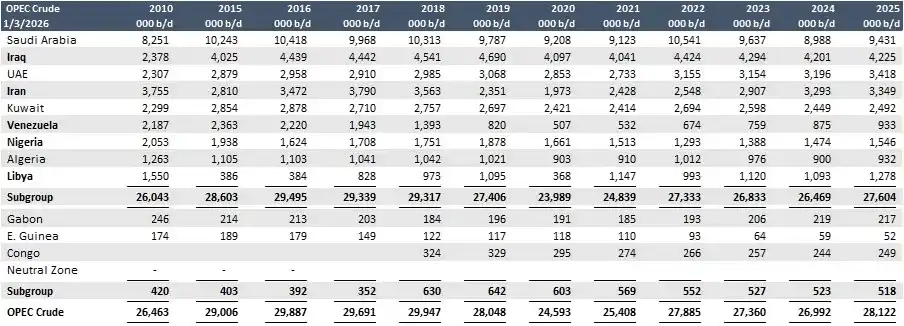
Chart: OPEC Oil Production (Excluding Natural Gas Liquids) Source: Burggraben Analysis; Multi-source Data
In fact, Venezuela holds the world's largest oil reserves, with the quality of its conventional oil rivaling that of Saudi Arabia. In other words, it has the potential to have a significant impact on global oil prices similar to Saudi Arabia. Generally, lower oil prices (which is what Trump desires) are often seen as good news for peace and prosperity.
Before delving into geological conditions and oil production, let's first revisit basic principles. In my personal view (as a Swiss, not a US voter), Trump's stance on "American oil assets should be returned to rightful American owners" is correct. This is evidently his position. Therefore, yes, this intervention is not only about the drug issue but also closely related to oil, and I fully support this stance.
As a resource investor, I am truly tired of seeing dictators and regimes around the world plundering Western assets without providing fair compensation, while Western leaders either turn a blind eye or hide behind procedures and polite statements.
We should not reward corrupt leaders, neither now nor in the future. When Western companies' interests are harmed, we should firmly uphold the rule of law. Even if you do not agree with my perspective (which is totally fine), as a resource investor, you should also be relieved because Trump may have somewhat reduced the above-ground risk for all commodities in emerging markets, at least in the short term.
Anyway, Venezuela holds the world's largest oil reserves, a significant portion of which originally belonged to Western companies that discovered and developed these reserves. These companies not only developed some resources but also paid the host country its due taxes.
The Orinoco Belt alone represents the largest oil accumulation on Earth, with a technically recoverable heavy oil estimated average of about 513 billion barrels. In terms of reserves, the economically demonstrable portion, Venezuela holds about 20% of the world's known reserves.
However, in a market with a daily total oil demand of about 85 million barrels (note that this excludes a daily liquid fuel total production of about 103 million barrels), Venezuela's oil production accounts for only 1%.
Ladies and gentlemen, this is the consequence of socialism and corruption.
Under Maduro's rule, people have died of starvation on the streets for years. The next time someone tries to sell us the "warmth of collectivism," please remember this.
It is worth noting that OPEC's oil reserve data are motivated to be exaggerated because these data determine their production quotas. This is also why every seasoned geologist will tell you, for example, Kuwait's heavy oil reserve data have been overestimated.
However, if one carefully studies the reports from the United States Geological Survey (USGS), it will be found that the overestimation of Venezuela's heavy oil resources is unlikely.
Even if the medium viscosity of the Orinoco Belt may halve the ultimate recoverable amount, other resources are highly likely to be found elsewhere, including Venezuela's offshore areas (such as neighboring Guyana).
Therefore, from any perspective, this is a huge "cake," and in the long term, there is a possibility of achieving significant yield growth.
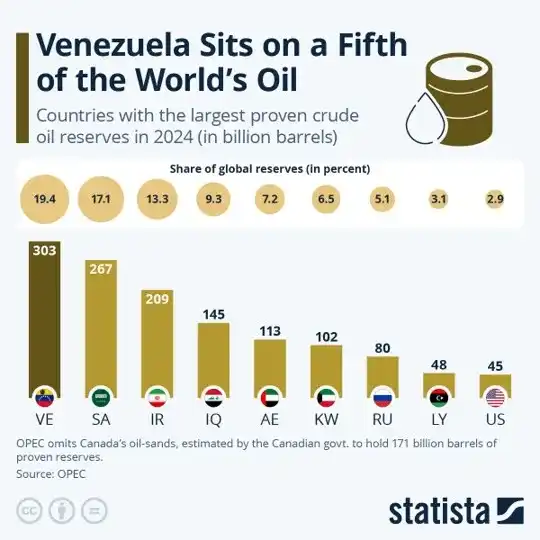
Figure: Global Oil Reserves
If the U.S. oil industry and the global oilfield services sector are allowed to develop this "treasure trove," Venezuela will surpass Saudi Arabia's production within the next decade.
Mark my words, I'm telling you this now.
The conventional nature and richness of these oil fields are so high that once today's advanced oil industry technology is fully applied to these reserves, their potential will be immeasurable.
America's entrepreneurial spirit has already squeezed 9.8 million barrels of oil per day from hard shale.
And Venezuela's oil resources are like a Texas-sized swimming pool full of oil, just waiting to be extracted, piped, and utilized. This is the last virgin territory of oil wealth.
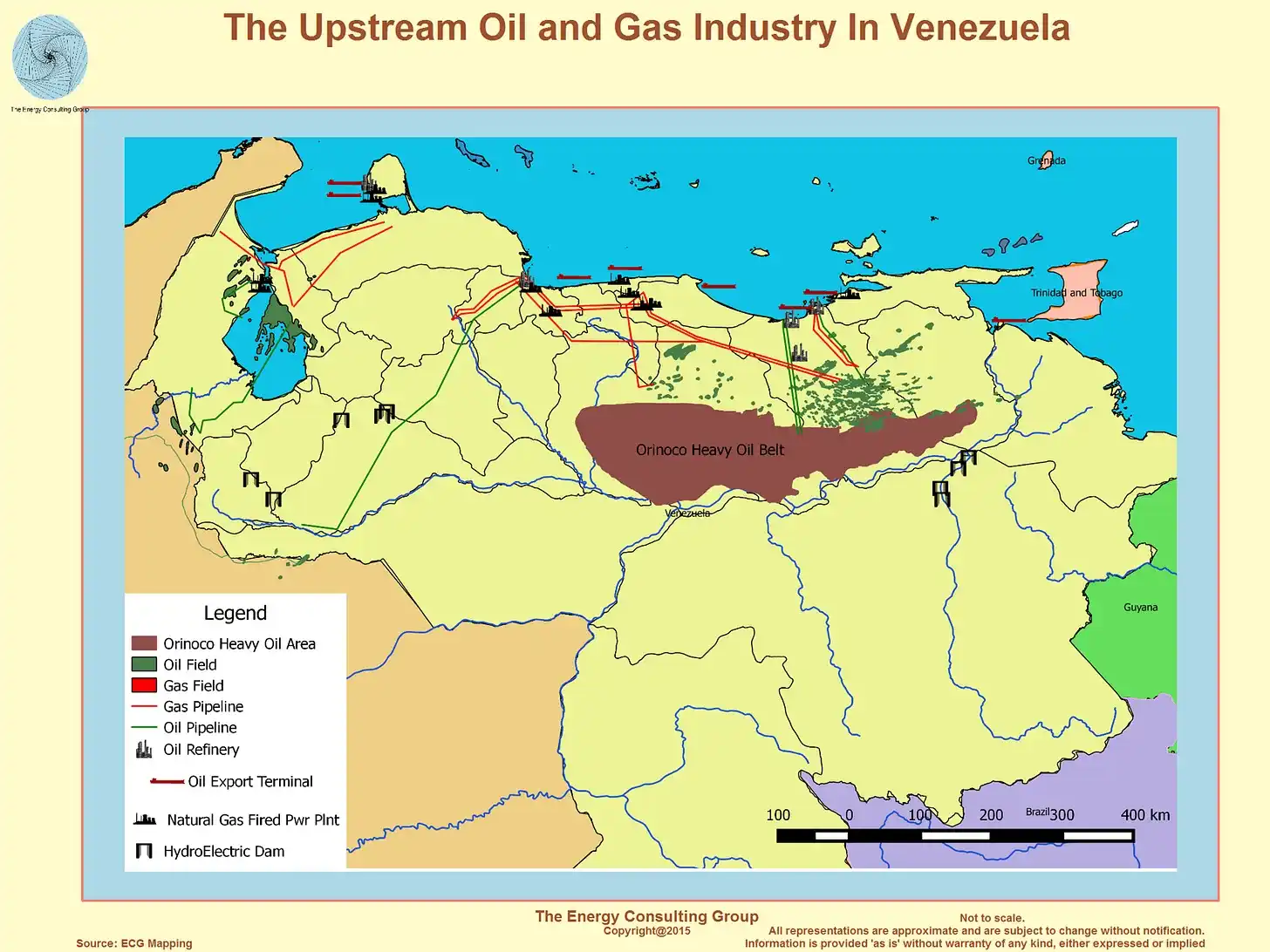
Figure: Venezuela Petroleum Resource Geological Map
The growth in oil production will bring good news to all aspects of Venezuela: enormous tax revenues, high-paying jobs, and explosive growth in related service industries—from oilfield services to construction, from leisure and entertainment to hospitality, a complete ecosystem will take shape.
Imagine the prosperity of Texas, but on a larger scale.
Left-wing activists may describe it as "colonialism." But as demonstrated by Texas and Norway, this is called capitalism.
Capitalism thrives in environments with sound institutions but struggles in emerging markets lacking effective institutions.
This is a fact that can be quoted anywhere, anytime.
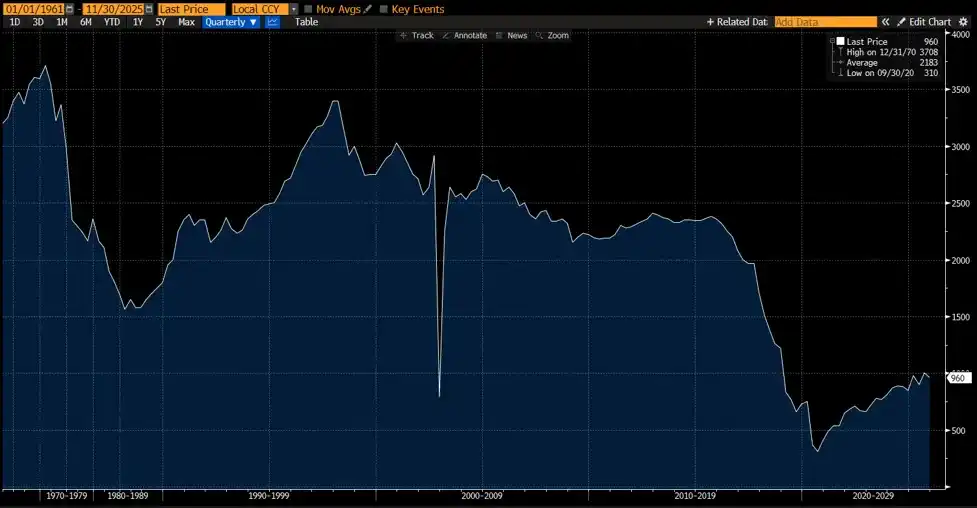
Figure: Venezuela's Oil Production Changes Since 1965 (unit: thousand barrels/day) Source: Bloomberg
Under the right conditions, Venezuela's oil production can increase rapidly, and even a "modest" increase will have a significant impact in a commodity market determined by marginal prices.
Currently, Venezuela's oil production is around 900,000 barrels per day. If property rights and rules of the game can be restored, increasing production to 1.5 million barrels per day within 18 months is a realistic initial target. This growth will be led by international oil giants with the most experience, strongest financial capabilities, and largest outstanding claims, including Chevron, ConocoPhillips, Exxon, and potentially Shell and Italy's ENI.
These companies have suffered losses in the past and still have significant unpaid debts to recover. Reportedly, ConocoPhillips alone has over $10 billion in unrecovered amounts. However, it should be noted that, except for Chevron, these oil giants are unlikely to actively participate until political stability is achieved, a clear national custodian is identified, and a solid and unchangeable legal framework is established.
If infrastructure bottlenecks such as pipelines, power supply, upgrades, and ports can be addressed, restoring production to 3.5 million barrels per day is achievable. However, it is important to note that large numbers can sometimes be misleading. Assuming $60 billion is needed to restore pipeline, power, and export infrastructure to normal levels, while this may sound like a huge sum, it's worth noting that in just 2010, the total drilling investment in the U.S. shale oil industry exceeded this figure.
The capital exists, the capability exists, and the key to determining the speed lies in the legal framework.
Without a stable legal environment, there will hardly be significant changes.
If the rules post-Trump are revised again, or if Venezuela merely transitions from one corrupt chaos to another, then production will likely be maintained at a maximum of between 1.5 to 3 million barrels per day. This is the worst-case scenario. However, if the rule of law can truly be enforced, reaching a production level of 10 million barrels per day within the next decade is not a pipe dream. This is simply the natural outcome of a world-class resource being developed by a world-class industry.
The key point is: even if the best expectations are not met, just making Venezuela a stable 5 million barrels per day producer (similar to today's Canada) and maintaining this level for decades can at least offset the production loss from the future maturity decline of U.S. shale fields. In a market where marginal barrels determine the price, this would have a huge impact.
In fact, you don't even need to wait for Venezuela's oil production to reach 5 million barrels per day. Just increasing from the current 900,000 barrels per day to 1.5 million barrels per day next year would be enough to impact the Brent crude oil price, as the market is already in an "oversupply mode" for 2026 and 2027.
Yes, the pricing of physical goods is based on current demand, not future expectations. However, in the oil market, the quantity of paper trading "virtual barrels" far exceeds the physical amount in the actual market, and market expectations often drive price fluctuations even before physical oil arrives.
Recall the fourth quarter of 2018, when Trump, solely based on waivers for Iran sanctions and changes in tone, managed to drive Brent oil prices down from $90 per barrel to $55 per barrel, with almost no substantive supply changes.
Nevertheless, long-term low oil prices are a boon for all of humanity.
I would like to further explain my viewpoint and preemptively address any critics who may question my forecasts. After all, consulting firms like Energy Aspects always try to make things sound more complex.
Firstly, no longer humbly speaking, I have directly or indirectly invested in the oil industry for twenty years. I have been to more remote oil fields than many industry "keyboard experts." I have firsthand experienced success and failure with my own funds, not someone else's money.
I have spent hundreds of hours analyzing this market from scratch, from individual wells to nations, all the way to every barrel of oil globally. I have used nearly every serious data tool, from Kpler to OilX, Kayrros, JODI, and services from major institutions. At one point, I really felt like I could almost track the flow of every barrel of oil in real-time. So please believe me, when I simplify the analysis process here, I have a basis for it.
Secondly, of course, I cannot predict future production accurately, as this is not a physics problem. It is path-dependent, meaning it entirely depends on what happens next. If Trump does not follow through with his plans, if property rights are not resolved, if Venezuela remains in a corrupt mess post-Maduro, then nothing will change, or only marginally so.
But if Trump can get half of it right, trust me, Venezuela's prospects will exceed expectations. These oil wells will become "monsters," and the industry will be able to develop these resources at a record pace, provided political interference is excluded.
However, these key conditions must be established first. The starting point for driving oil production growth lies in property rights protection, rule of law, and a free-market economy. Without these foundations, significant growth is hard to achieve, even with abundant oil reserves. Perhaps by the end of 2027, production could reach 1.5 million barrels per day? Who knows?
Thirdly, and a point most people overlook is that Venezuela is not starting from scratch. It is referred to in the industry as a "brownfield," meaning its oil fields already have some development groundwork. Currently, Chevron produces around 300,000 barrels of oil per day in Venezuela. They were granted permission during the Biden administration, and Chevron's history in Venezuela dates back almost 100 years.
This means that Chevron holds decades of geological data, production history, and operational experience. ConocoPhillips and Exxon, on the other hand, exited in 2007 when then-President Hugo Chávez forcibly renegotiated contracts with all oil majors, including European companies.
As a result, these oil giants already knew the field's location, what techniques work, which equipment is prone to damage, and how to scale up production. The data they possess may be more detailed than that of the Venezuelan national oil company (PDVSA). This provides a significant first-mover advantage for any revival plan.
Therefore, Venezuela's situation will not resemble the aftermath of the Soviet Union's collapse. Back then, Western companies were blocked due to political reasons and had to start learning everything from scratch. The oil industry is not just pipes and pumps; it involves logistics, engineering, process management, and massive data. Once this knowledge is acquired, and the rules of the game are clear, capital and capability will naturally follow.
Of course, many uncertainties still exist. But even a moderate outcome, such as a daily production of 4 to 5 million barrels, would structurally alter the global balance of liquid energy supply and demand. Believe me, this will be a harsh shock as Venezuela will produce some of the world's cheapest oil. This change will have far-reaching implications. We can only hope that all of this comes to fruition.
For those skeptical of a significant increase in Venezuelan oil production, I would like to offer another perspective. The United States once accomplished what seemed like a similarly absurd feat. U.S. shale oil production increased from 1.8 million barrels per day in 2010 to 9.8 million barrels by the end of 2025. In other words, the American entrepreneurial spirit literally extracted an "Saudi Arabia"-scale oil production from rocks. If we add the production from Alaska and the Gulf of Mexico, the current U.S. oil output is around 13.8 million barrels per day, reaching a level that most people thought unlikely fifteen years ago.
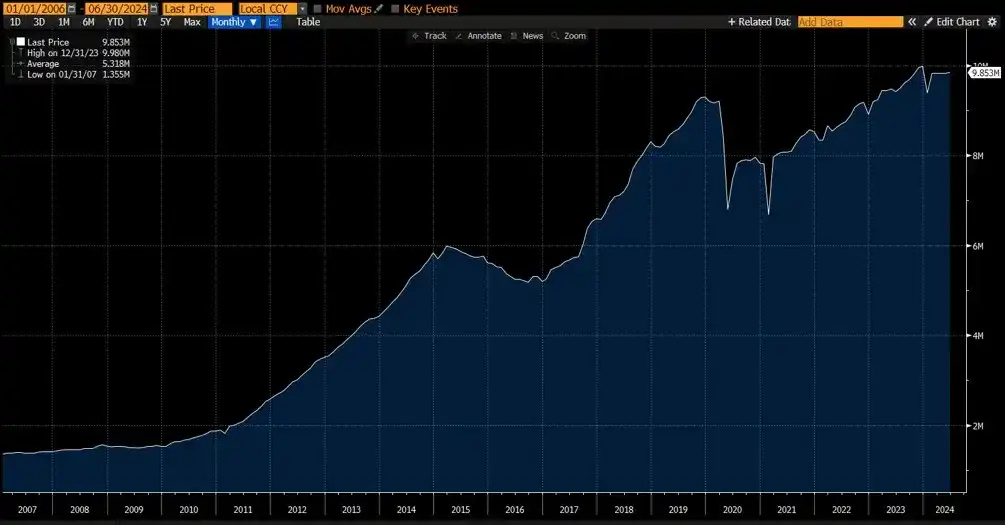
Figure: U.S. Shale Oil Production (million barrels per day) Source: Bloomberg
So, the question is: Why is shale oil extraction so complex? Shale oil extraction is exceptionally challenging compared to traditional onshore oil fields. Oil in conventional fields is usually stored in a "natural oil tank" formed by limestone or sandstone, and oil and gas flow naturally. Shale oil, on the other hand, is trapped in tight source rocks with very low porosity and permeability, meaning the oil is almost unable to flow on its own.
In a shale oil field, you can't simply "drill a well" and let it naturally produce oil. Instead, you need to aggressively target the rock through horizontal drilling, hydraulic fracturing, and a massive input of equipment, personnel, water, sand, steel, and capital just to unlock a small amount of oil.
Furthermore, each shale oil well can only yield in the hundreds of thousands of barrels, unlike conventional oil fields that can provide millions or even billions of barrels over many years. In contrast, shale oil well production typically only lasts a few months before needing to drill another well.
This phenomenon is known in the industry as a "Drilling Frenzy."
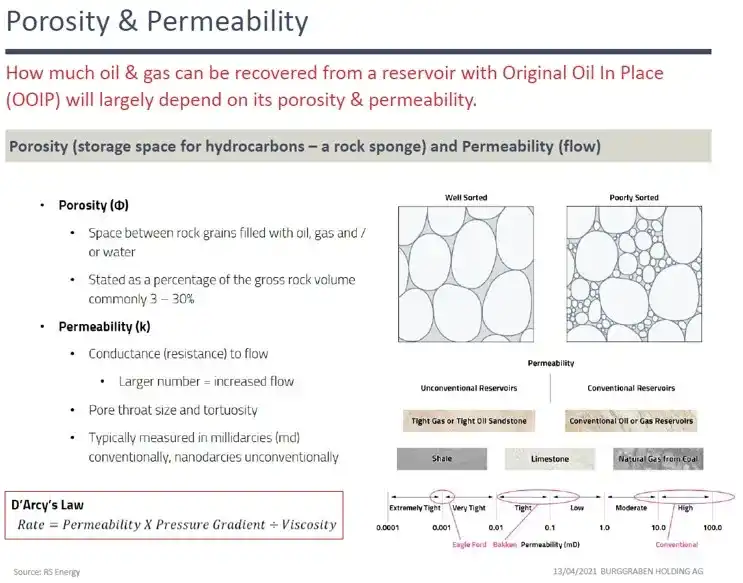
Figure: Key Factors in Oil Recovery and the Potential of the Venezuelan Orinoco Belt Data Source: Burggraben Analysis
The Shale Revolution is one of the greatest industrial achievements of our time. It's not just a geological story; it's a result of incentives, property rights, technology, logistics, and capital markets working together.
Now, compare this achievement to Venezuela, especially the Orinoco Belt. Whatever your view on heavy oil, yes, it does face upgrading and processing challenges, but from a simple "can we extract the oil molecules from underground" perspective, Orinoco's heavy oil extraction is much easier compared to shale.
A quick glance at the above chart gives you an intuitive numerical comparison. The permeability of shale formations typically ranges from 0.001 to 0.1 millidarcies, while the heavy oil reservoir permeability in the Venezuelan Orinoco Belt typically ranges from 1,000 to over 13,000 millidarcies. This is not a simple rounding error but an order of magnitude difference.
The same applies to porosity. The highest-quality Permian shale globally usually has a porosity of 4% to 8%, while the porosity of Orinoco heavy oil sands ranges from 20% to 38%. So, ask yourself a simple question: if political factors were excluded, which resource would you prefer to drill and produce? Which resource do you think has a lower full-cycle breakeven cost?
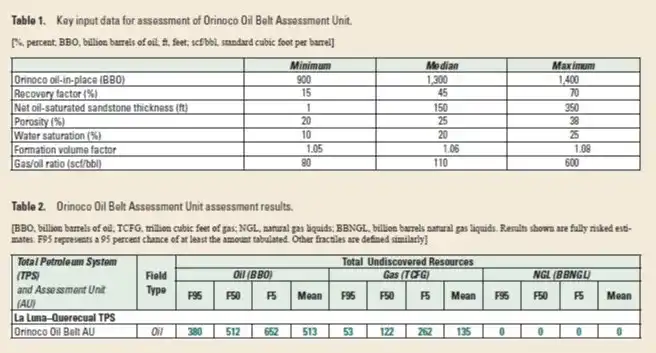
Figure: Resource Potential of the Orinoco Belt's Heavy Oil Data Source: U.S. Geological Survey, 2009
Yes, the rapid development of U.S. shale oil has benefited from three powerful tailwinds.
The first is property rights protection. In places like Texas, landowners typically own the mineral rights beneath their land, directly incentivizing them to develop those resources.
The second is the oilfield services ecosystem. Texas has a large and diverse oilfield services industry that can quickly mobilize and gain a competitive edge.
The third is financial capacity. The U.S. has the world's deepest debt and equity markets, allowing even seemingly impractical shale oil to receive massive financial support. Combining these factors has propelled the rapid rise of the shale oil industry.
But the key is this: even with these tailwinds, shale oil remains a technological nightmare compared to conventional onshore resources in the Orinoco Belt. If U.S. capitalism can create a "Saudi Arabia" from tight rock in 15 years, once Venezuela establishes effective property rights and basic rule of law, the global oil and gas industry will flock to the Orinoco Belt, seeing it for what it should be—the world's last vast oil frontier. Because that is exactly what it is.
Will Trump Accept the Political Risk of Nation-Building in This Scenario?
The answer is yes. This is actually his explicitly stated goal, expressed in the most blunt terms a president can. You can hear him say it for yourself.
The Trump administration will not leave easily. They want to reclaim oil assets, rebuild the oil industry, and seek to redress past expropriations and losses. That's their strategy, crystal clear.
My take? Very bearish on oil prices. Trump's stance matters greatly. From where I sit in the oil industry, this is a game-changer. Of course, it won't happen overnight, but it is changing incrementally, every day. You have been warned.
Moreover, I do not think this administration faces the risks typically described by critics. This is not fighting hostile insurgents in Afghanistan or trying to transplant Western institutions into Islamic political orders like Iran or Afghanistan, places where there is inherent hostility to Western values themselves.
But this is Venezuela. It culturally belongs to the West, with the vast majority being Christian, and before the socialists under Hugo Chávez and Nicolás Maduro systematically destroyed it, it was a shining success story. This country is fixable.
Now let's zoom out. This is not just a story about Venezuela; it is a story about global oil prices, hence a geopolitical story. Venezuela has the potential to structurally bring about long-term low oil prices, or at least maintain the current low oil prices (assuming other conditions remain the same). If this becomes a reality, it will cut off the "financial oxygen" funding the war in Ukraine, weaken the Kremlin's grip, and significantly diminish the geopolitical influence of certain major powers.
And before all this happens, another chain reaction may have already begun, such as certain countries with hardline regimes possibly crumbling as they too hold significant untapped oil reserves, waiting for the rule of law's "invisible hand" to unleash these resources.
All of this will break the funding chain of terrorism supporters, whether in Qatar or elsewhere. And all of this, ladies and gentlemen, is a gospel to peace and humanity.
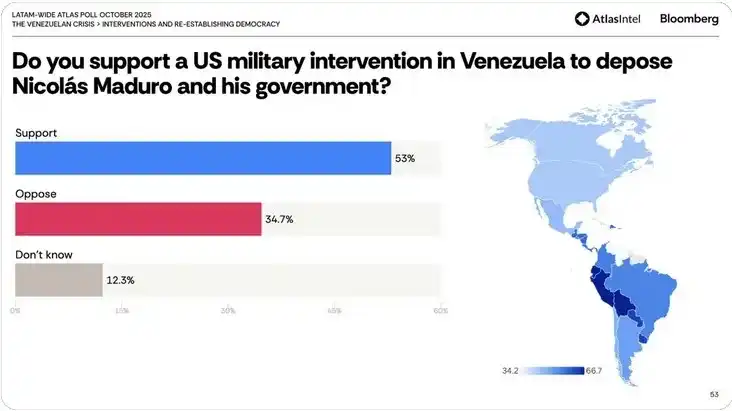
In the coming weeks, you won't hear these views from the so-called progressive left "do-gooder" Marxist worshipers. But the fact is that low oil prices are one of the greatest drivers of creating peace and prosperity. However, few truly realize this.
Instead, the left will put forward various opposing views, no matter how absurd, until they inevitably end up standing on the side of murderers and dictators. Unfortunately, these are the rules of today's mainstream media game, which are entirely partisan.
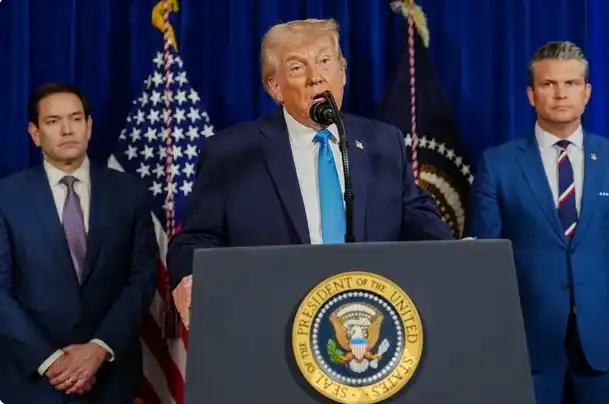
Image: Trump's press conference on Venezuela, January 3, 2026
On January 3, 2026, President Trump held a press conference on the issue of Venezuela. Of course, the situation in Venezuela is far from over, and the final outcome is still uncertain. But if good fortune, sustained courage, and the right decisions continue to accompany Trump, he might truly deserve the Nobel Prize. From my perspective, he is currently moving in the right direction.
Therefore, credit is due where credit is due. We should commend or criticize based on the actual performance of each action, not based on partisan positions. President Trump and his team, well done.
Please do not attempt to criticize even for a second this precise and highly successful military operation. Salute it, I have.
Warm regards,
Alexander
You may also like

Barclays Invests in Stablecoin Settlement Firm as Tokenized Infrastructure Expands
Key Takeaways Barclays has invested in Ubyx, a U.S.-based startup focused on developing clearing systems for tokenized forms…

The US has had a president impeached twice, and Trump's platform says it's not an "insurrection."

A “sexy casino,” where real-estate speculation has moved online.
Using Polymarket to predict U.S. home prices feels eerily reminiscent of the 2008 subprime mortgage crisis.

Stop obsessing over Alpha, the Beta the market gives you is more important

Privacy Lane, a16z's Key Trends for 2026

After Lighter, the next batch of Perp DEXs Worth Keeping an Eye On

After the Profit Taking Frenzy, Crypto Market Makers Dive into the "Deep End"

Ledger Faces Yet Another Data Breach — Customer Information at Risk
Key Takeaways Ledger, the prominent hardware wallet manufacturer, has experienced another data breach via its payment processor, Global-e,…

Coinbase Slams ‘Political’ Banking Rule Impacting Crypto Firms
Key Takeaways Coinbase challenges a banking regulation it labels “political,” highlighting the pressure banks face to cut ties…

Leaving behind the chaotic early days, crypto market makers are celebrating their coming of age
The life-or-death struggle for crypto market makers is like a species evolution under extreme conditions.

Lurking in 600 Scam Groups, He Wants to Intercept Illicit Funds

Stuck in a Local Optimum, Predictive Analytics Should Not Stop Here

Tether, which has "enriched" itself through stablecoins, is now heavily investing in AI
India, the Outsourcing Hub of the Crypto World

2025 Crypto Violence Retrospective: Increasing Assaults and Fatal Incidents in a Growing Market
Key Takeaways Violent incidents involving cryptocurrency holders have escalated, with 2025 documenting 65 attacks, including 4 fatalities. The…
Court Sentences Criminal in Virtual Currency Fraud Case with Major Global Implications
Key Takeaways A landmark case in Beijing reveals a significant cross-border telecom and internet fraud scheme involving virtual…

Japanese Finance Ministry Ushers in 2026 as “Digital First Year” with Focus on Digital Assets
Key Takeaways Japan’s Minister of Finance, Okatsuka Katsuki, has declared 2026 as Japan’s “Digital First Year,” highlighting the…
The Accelerating Implementation of Stablecoin Bills in the US and Hong Kong
Key Takeaways The United States Senate and the Hong Kong Legislative Council have both advanced legislation pertaining to…
Barclays Invests in Stablecoin Settlement Firm as Tokenized Infrastructure Expands
Key Takeaways Barclays has invested in Ubyx, a U.S.-based startup focused on developing clearing systems for tokenized forms…
The US has had a president impeached twice, and Trump's platform says it's not an "insurrection."
A “sexy casino,” where real-estate speculation has moved online.
Using Polymarket to predict U.S. home prices feels eerily reminiscent of the 2008 subprime mortgage crisis.


 App
App