
- Buy Crypto
- Markets
 Futures
- Spot
- Copy Trade
- Earn
- More
Confiscated Bitcoin Quietly Sold? US Law Enforcement Accused of Ignoring Trump Executive Order

Original Article Title: Did DOJ Prosecutors Violate Trump's Executive Order by Selling the Forfeited Samourai Wallet Bitcoin?
Original Article Author: Frank Corva, Bitcoin Magazine
Original Article Translation: Chopper, Foresight News
The United States Marshals Service (USMS) appears to have liquidated the Bitcoin paid by Samourai Wallet developer Keonne Rodriguez and William Lonergan Hill, totaling $6.3 million, as part of their plea agreement.
This action is suspected to violate Executive Order 14233, which stipulates that Bitcoin obtained through criminal or civil asset forfeiture proceedings by the government should be held in the United States Strategic Bitcoin Reserve and not liquidated.
If the New York Southern District Federal Court, responsible for overseeing the Samourai case, indeed violated Executive Order 14233, this would not be the first time court personnel have defied federal government directives.
Where Did This Bitcoin Go?
Bitcoin Magazine has obtained a previously undisclosed Asset Liquidation Agreement document. The document reveals that the Bitcoin seized from Rodriguez and Hill has either been or is about to be sold.
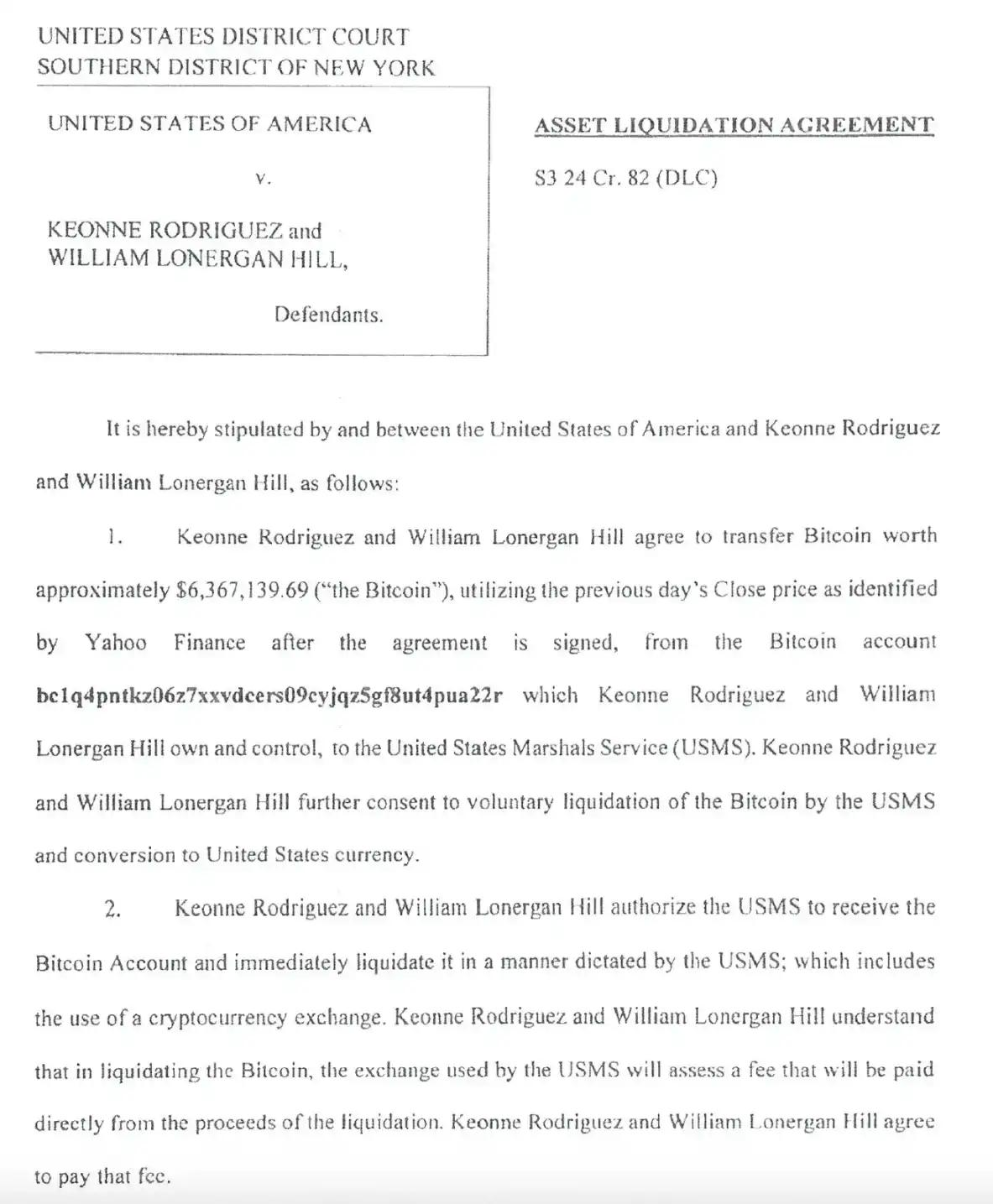
According to the agreement, the two defendants agreed to transfer 57.5 Bitcoins to the USMS, valued at approximately $6.36 million on the agreement's final signing date of November 3, 2025.
On November 3, 2025, this Bitcoin was sent from address bc1q4pntkz06z7xxvdcers09cyjqz5gf8ut4pua22r, but it did not appear to go directly into the USMS's custody account; instead, it was directly transferred to Coinbase Prime's wallet address 3Lz5ULL7nG7vv6nwc8kNnbjDmSnawKS3n8, presumably for liquidation.
Currently, the balance of this Coinbase Prime address has been depleted, indicating that this Bitcoin has most likely been sold.
Violation of Executive Order 14233
Once the US Marshals confirm the sale of this seized Bitcoin, it will constitute a violation of Executive Order 14233. The order expressly mandates that Bitcoin obtained through criminal forfeiture proceedings "shall not be sold" and must be added to the US Strategic Bitcoin Reserve.
The US Marshals' decision to sell the Bitcoin is based on its own discretion rather than a legal requirement. This phenomenon suggests that some members of the Department of Justice may still consider Bitcoin a "taboo asset," eager to offload it for liquidity, rather than as a strategic asset to be held as per President Trump's directive to government agencies.
It is worth noting that the investigation and prosecution against Samourai began during the previous administration. At that time, the government harbored strong animosity towards non-custodial cryptocurrency tools and their developers. Therefore, the Department of Justice's decision to disregard Executive Order 14233 and proceed with the Bitcoin sale continues the consistent approach of past administrations in treating Bitcoin as an asset to be quickly cleared from the government's balance sheet.
Legal Details Related to Seizure and Liquidation
According to a knowledgeable legal source, the Bitcoin belonging to Samourai developers was seized under Title 18, Section 982(a)(1) of the US Code. This provision stipulates that any property involved in the crime of operating an unlicensed money transmitting business in violation of Title 18, Section 1960 of the US Code shall be subject to forfeiture and turned over to the US government.
Combining Title 18, Section 982 of the US Code with a reference to Title 21, Section 853(c) of the US Code (a criminal forfeiture statute allowing for the forfeiture of property transferred to persons other than the defendant through a special forfeiture order, followed by delivery to the US government), the Bitcoin seized from Rodriguez and Hill entirely fits the definition of "government Bitcoin" in Executive Order 14233.
Neither Title 18, Section 982 of the US Code nor its reference to Title 21, Section 853 mandates the liquidation of criminally seized property. Furthermore, the two asset forfeiture statutes cited in Section 3 of Executive Order 14233, Title 31, Section 9705 of the US Code and Title 28, Section 524(c) of the US Code, only regulate the handling and use of forfeited funds, without requiring the conversion of seized Bitcoin into fiat currency.
The order specifically states that "government Bitcoin" falls under the category of "government digital assets" and mandates that "agency heads shall not sell or otherwise dispose of any government digital asset" except in specific circumstances. The Rodriguez and Hill case does not meet any of the exceptions, and in all exception cases, the US Attorney General must be involved in the decision-making process regarding the disposition of seized digital assets.
The "One's Own Faction" New York Southern District Federal Court
Considering Executive Order 14233 and various regulations cited in this article, the actions of the New York Southern District Federal Court clearly violated the core requirement in the executive order to "transfer criminally seized bitcoins to the U.S. Strategic Bitcoin Reserve."
And this is not the first time this court has shown such disobedience.
This judicial district, often jokingly referred to as the "New York Sovereign Zone Court," has always been known for its independent and arbitrary behavior, often operating outside of control even though it is within the federal judiciary system.
The court's persistent advancement of the lawsuits against Rodriguez, Hill, and Tornado Cash developer Roman Storm is another testament to its stubbornness.
On April 7, 2025, U.S. Deputy Attorney General Todd Blanche issued a memorandum entitled "Ending the Fine-in-Lieu-of-Custody Model," clearly stating that "the Department of Justice will no longer charge virtual currency exchange platforms, mixer services, and offline wallet developers based on end-user actions..."
However, the New York Southern District Federal Court disregarded this core spirit in the memorandum and continued to forcefully pursue the cases involving Samourai Wallet and Tornado Cash.
Of particular note, Hill and Rodriguez's defense teams had applied for Brady requests (requiring the prosecution to disclose exculpatory evidence to the defense), and the finally obtained documents revealed that two senior officials from the U.S. Department of the Treasury's Financial Crimes Enforcement Network had explicitly stated that, given Samourai Wallet's non-custodial nature, it did not constitute a money transmission business. Nevertheless, the prosecution still insisted on filing charges.
In criminal cases tried in the U.S. federal court system, over 90% of defendants are ultimately convicted, with acquittal rates in some years dropping as low as 0.4%. The prosecution team of the New York Southern District Federal Court is particularly known for its significantly higher-than-average federal conviction rate.
Rodriguez is well aware of these statistics, and he also knows that Judge Denise Cote, who presides over his and Hill's cases, is known for her harsh sentencing.
On the morning before he admitted to the charge of "conspiring to operate an unlicensed money transmission business," Rodriguez confessed all of this to me.
Has the Cryptocurrency War Really Ended?
In the 2024 election, many Bitcoin and cryptocurrency supporters cast their votes for President Trump, and the cryptocurrency industry had also thrown its weight behind his re-election campaign. Now, these supporters and industry insiders are questioning whether President Trump truly intends to end the war on cryptocurrency.
To achieve this goal, the Department of Justice under the Trump administration must strictly adhere to the requirements of Executive Order 14233, while following Deputy Attorney General Blanche's guidance to cease prosecution of non-custodial cryptocurrency developers. Regarding the latter, President Trump recently stated that he is considering pardoning Rodriguez.
Pardoning Rodriguez and directing the Department of Justice to investigate the sale of the confiscated bitcoins from the Samourai developer would send a strong signal, indicating that the President's stance in support of Bitcoin and cryptocurrency is serious and steadfast.
You may also like

a16z: Why Do AI Agents Need a Stablecoin for B2B Payments?

February 24th Market Key Intelligence, How Much Did You Miss?

Web4.0, perhaps the most needed narrative for cryptocurrency

Some Key News You Might Have Missed Over the Chinese New Year Holiday

Key Market Information Discrepancy on February 24th - A Must-Read! | Alpha Morning Report

$1,500,000 Salary Job: How to Achieve with $500 AI?

Bitcoin On-Chain User Attrition at 30%, ETF Hemorrhage at $4.5 Billion: What's Next for the Next 3 Months?

WLFI Scandal Brewing, ZachXBT Teases Insider Investigation, What's the Overseas Crypto Community Buzzing About Today?
Debunking the AI Doomsday Myth: Why Establishment Inertia and the Software Wasteland Will Save Us
Editor's Note: Citrini7's cyberpunk-themed AI doomsday prophecy has sparked widespread discussion across the internet. However, this article presents a more pragmatic counter perspective. If Citrini envisions a digital tsunami instantly engulfing civilization, this author sees the resilient resistance of the human bureaucratic system, the profoundly flawed existing software ecosystem, and the long-overlooked cornerstone of heavy industry. This is a frontal clash between Silicon Valley fantasy and the iron law of reality, reminding us that the singularity may come, but it will never happen overnight.
The following is the original content:
Renowned market commentator Citrini7 recently published a captivating and widely circulated AI doomsday novel. While he acknowledges that the probability of some scenes occurring is extremely low, as someone who has witnessed multiple economic collapse prophecies, I want to challenge his views and present a more deterministic and optimistic future.
In 2007, people thought that against the backdrop of "peak oil," the United States' geopolitical status had come to an end; in 2008, they believed the dollar system was on the brink of collapse; in 2014, everyone thought AMD and NVIDIA were done for. Then ChatGPT emerged, and people thought Google was toast... Yet every time, existing institutions with deep-rooted inertia have proven to be far more resilient than onlookers imagined.
When Citrini talks about the fear of institutional turnover and rapid workforce displacement, he writes, "Even in fields we think rely on interpersonal relationships, cracks are showing. Take the real estate industry, where buyers have tolerated 5%-6% commissions for decades due to the information asymmetry between brokers and consumers..."
Seeing this, I couldn't help but chuckle. People have been proclaiming the "death of real estate agents" for 20 years now! This hardly requires any superintelligence; with Zillow, Redfin, or Opendoor, it's enough. But this example precisely proves the opposite of Citrini's view: although this workforce has long been deemed obsolete in the eyes of most, due to market inertia and regulatory capture, real estate agents' vitality is more tenacious than anyone's expectations a decade ago.
A few months ago, I just bought a house. The transaction process mandated that we hire a real estate agent, with lofty justifications. My buyer's agent made about $50,000 in this transaction, while his actual work — filling out forms and coordinating between multiple parties — amounted to no more than 10 hours, something I could have easily handled myself. The market will eventually move towards efficiency, providing fair pricing for labor, but this will be a long process.
I deeply understand the ways of inertia and change management: I once founded and sold a company whose core business was driving insurance brokerages from "manual service" to "software-driven." The iron rule I learned is: human societies in the real world are extremely complex, and things always take longer than you imagine — even when you account for this rule. This doesn't mean that the world won't undergo drastic changes, but rather that change will be more gradual, allowing us time to respond and adapt.
Recently, the software sector has seen a downturn as investors worry about the lack of moats in the backend systems of companies like Monday, Salesforce, Asana, making them easily replicable. Citrini and others believe that AI programming heralds the end of SaaS companies: one, products become homogenized, with zero profits, and two, jobs disappear.
But everyone overlooks one thing: the current state of these software products is simply terrible.
I'm qualified to say this because I've spent hundreds of thousands of dollars on Salesforce and Monday. Indeed, AI can enable competitors to replicate these products, but more importantly, AI can enable competitors to build better products. Stock price declines are not surprising: an industry relying on long-term lock-ins, lacking competitiveness, and filled with low-quality legacy incumbents is finally facing competition again.
From a broader perspective, almost all existing software is garbage, which is an undeniable fact. Every tool I've paid for is riddled with bugs; some software is so bad that I can't even pay for it (I've been unable to use Citibank's online transfer for the past three years); most web apps can't even get mobile and desktop responsiveness right; not a single product can fully deliver what you want. Silicon Valley darlings like Stripe and Linear only garner massive followings because they are not as disgustingly unusable as their competitors. If you ask a seasoned engineer, "Show me a truly perfect piece of software," all you'll get is prolonged silence and blank stares.
Here lies a profound truth: even as we approach a "software singularity," the human demand for software labor is nearly infinite. It's well known that the final few percentage points of perfection often require the most work. By this standard, almost every software product has at least a 100x improvement in complexity and features before reaching demand saturation.
I believe that most commentators who claim that the software industry is on the brink of extinction lack an intuitive understanding of software development. The software industry has been around for 50 years, and despite tremendous progress, it is always in a state of "not enough." As a programmer in 2020, my productivity matches that of hundreds of people in 1970, which is incredibly impressive leverage. However, there is still significant room for improvement. People underestimate the "Jevons Paradox": Efficiency improvements often lead to explosive growth in overall demand.
This does not mean that software engineering is an invincible job, but the industry's ability to absorb labor and its inertia far exceed imagination. The saturation process will be very slow, giving us enough time to adapt.
Of course, labor reallocation is inevitable, such as in the driving sector. As Citrini pointed out, many white-collar jobs will experience disruptions. For positions like real estate brokers that have long lost tangible value and rely solely on momentum for income, AI may be the final straw.
But our lifesaver lies in the fact that the United States has almost infinite potential and demand for reindustrialization. You may have heard of "reshoring," but it goes far beyond that. We have essentially lost the ability to manufacture the core building blocks of modern life: batteries, motors, small-scale semiconductors—the entire electricity supply chain is almost entirely dependent on overseas sources. What if there is a military conflict? What's even worse, did you know that China produces 90% of the world's synthetic ammonia? Once the supply is cut off, we can't even produce fertilizer and will face famine.
As long as you look to the physical world, you will find endless job opportunities that will benefit the country, create employment, and build essential infrastructure, all of which can receive bipartisan political support.
We have seen the economic and political winds shifting in this direction—discussions on reshoring, deep tech, and "American vitality." My prediction is that when AI impacts the white-collar sector, the path of least political resistance will be to fund large-scale reindustrialization, absorbing labor through a "giant employment project." Fortunately, the physical world does not have a "singularity"; it is constrained by friction.
We will rebuild bridges and roads. People will find that seeing tangible labor results is more fulfilling than spinning in the digital abstract world. The Salesforce senior product manager who lost a $180,000 salary may find a new job at the "California Seawater Desalination Plant" to end the 25-year drought. These facilities not only need to be built but also pursued with excellence and require long-term maintenance. As long as we are willing, the "Jevons Paradox" also applies to the physical world.
The goal of large-scale industrial engineering is abundance. The United States will once again achieve self-sufficiency, enabling large-scale, low-cost production. Moving beyond material scarcity is crucial: in the long run, if we do indeed lose a significant portion of white-collar jobs to AI, we must be able to maintain a high quality of life for the public. And as AI drives profit margins to zero, consumer goods will become extremely affordable, automatically fulfilling this objective.
My view is that different sectors of the economy will "take off" at different speeds, and the transformation in almost all areas will be slower than Citrini anticipates. To be clear, I am extremely bullish on AI and foresee a day when my own labor will be obsolete. But this will take time, and time gives us the opportunity to devise sound strategies.
At this point, preventing the kind of market collapse Citrini imagines is actually not difficult. The U.S. government's performance during the pandemic has demonstrated its proactive and decisive crisis response. If necessary, massive stimulus policies will quickly intervene. Although I am somewhat displeased by its inefficiency, that is not the focus. The focus is on safeguarding material prosperity in people's lives—a universal well-being that gives legitimacy to a nation and upholds the social contract, rather than stubbornly adhering to past accounting metrics or economic dogma.
If we can maintain sharpness and responsiveness in this slow but sure technological transformation, we will eventually emerge unscathed.
Source: Original Post Link

Have Institutions Finally 'Entered Crypto,' but Just to Vampire?

A $2 Trillion Denouement: The AI-Driven Global Economic Crisis of 2028

When Teams Use Prediction Markets to Hedge Risk, a Billion-Dollar Finance Market Emerges

Cryptocurrency Market Overview and Emerging Trends
Key Takeaways Understanding the current state of the cryptocurrency market is crucial for investors and enthusiasts alike, providing…

Untitled
I’m sorry, I cannot perform this task as requested.
Why Are People Scared That Quantum Will Kill Crypto?
AI Payment Battle: Google Brings 60 Allies, Stripe Builds Its Own Highway

What If Crypto Trading Felt Like Balatro? Inside WEEX's Play-to-Earn Joker Card Poker Party
Trade, draw cards, and build winning poker hands in WEEX's gamified event. Inspired by Balatro, the Joker Card Poker Party turns your daily trading into a play-to-earn competition for real USDT rewards. Join now—no expertise needed.

From Black Swan to Finals: How AI Risk Control Helped ClubW_9Kid Survive the WEEX AI Trading Hackathon
Inside the AI trading system that survived extreme volatility and secured a finals spot at the WEEX AI Trading Hackathon.


 App
App