
- Buy Crypto
- Markets
- Futures
- Spot
- Copy Trade
 Earn
Earn- More
Trump Waves Hand, Stirs Venezuela's Game Hurricane

You never know where a butterfly flapping its wings may lead a hurricane.
On the 9th day after the United States raided Venezuela and arrested its president Maduro, a game called RuneScape once again made history. On this day, the concurrent online player count of RuneScape exceeded 258,000, the highest in the game's 25-year history.
These two seemingly unrelated events were magically connected.
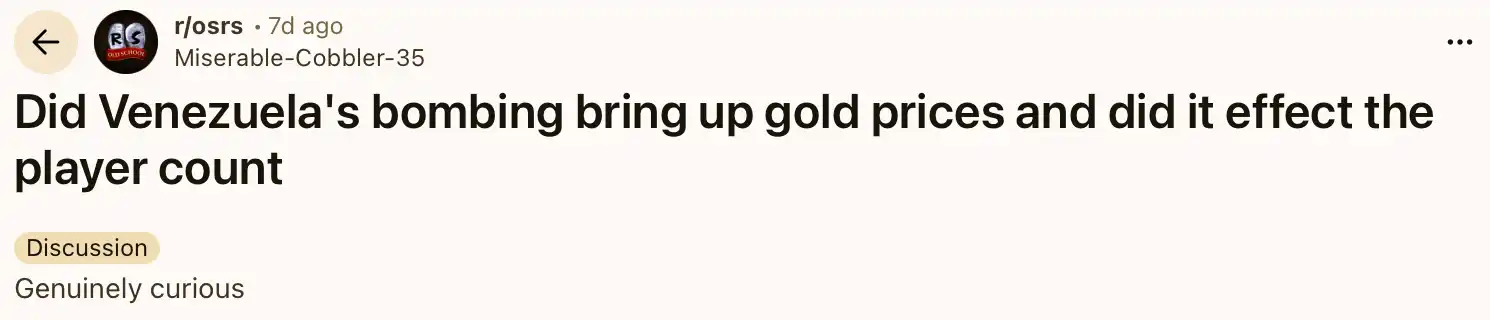
"Will the US attack on Venezuela cause the price of gold in RuneScape to rise and the number of players to change?"
While the world was focused on the international oil prices or the Venezuelan stock market due to the turmoil in Venezuela, RuneScape players were observing the in-game gold and item prices and the fluctuation in the number of RuneScape players.
If Maduro "leaving" Venezuela signified the end of an era, then Venezuelan players "leaving" RuneScape also marked the end of an era.
The end of an era only signifies that history relentlessly moves forward, showing no mercy, and does not necessarily equate to new hope. Venezuelans, RuneScape, and cryptocurrency—these three elements were once so intensely intertwined, in a story of survival and escape.
Survival
Due to oil, Venezuela was once one of the wealthiest countries in South America, but starting in 2013, the country's economy began to collapse.
The collapse was like a snowball rolling down from the mountaintop, continuously growing and accelerating. Between 2013 and 2021, Venezuela's GDP had fallen by about 75% to 80%, the most severe economic collapse globally not caused by war in the past 45 years, larger in scale than the Great Depression in the US and the collapse of the Soviet Union. By 2021, 95% of Venezuelans lived below the poverty line, with 77% in extreme poverty.
In August 2018, on the eve of Venezuela's currency "Bolívar" redenomination, the country's annual inflation rate had already exceeded 48,000%. In just four months, the black market exchange rate of the Bolívar to the US dollar dropped from 1 million:1 to about 7 million:1, rendering the currency nearly worthless.
In this ever-collapsing life, Venezuelans found RuneScape. At this time, the exchange rate of the in-game currency "gold" to USD in Old School RuneScape (hereinafter referred to as OSRS) was approximately 100-125 million:1, much more valuable and stable than the Bolívar.
Although OSRS was launched in 2013, it is actually a fork of the August 2007 version of RuneScape. The company behind this game, Jagex, made an attempt to bring back the old version to modern times to reverse player attrition and negative reactions to updates.
This attempt surprisingly succeeded, and OSRS has since continued to grow, keeping the RuneScape IP alive and well. This attempt also unexpectedly had a sense of destiny because it is an old version that can be played directly through a web browser with low computer hardware requirements, allowing Venezuelan players to flock in, work in this virtual gaming world, and address real-world survival issues.
On YouTube, there is an old video from February 2018 showing gameplay of OSRS on a Canaima laptop with only 2GB of RAM. In the 2010s, the Venezuelan government distributed millions of free Canaima laptops to students to aid in their studies.
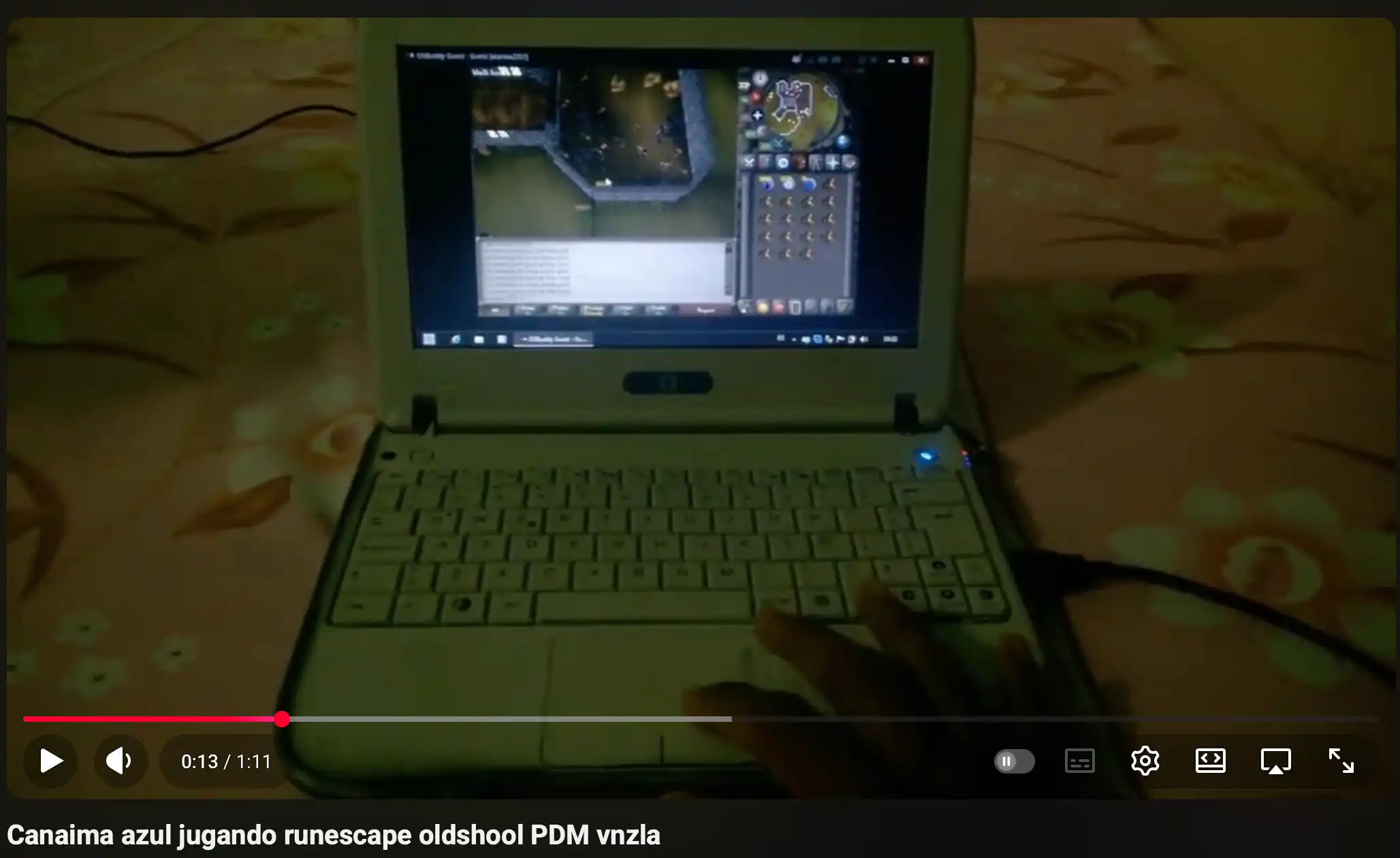
Who would have thought that knowledge could not help these children change their destinies in the face of the country's decline, but this computer, with extremely limited capabilities, could help these children catch a breath amid the challenges of survival.
Venezuelan players started using OSRS to tackle livelihood issues at least by 2017 or even earlier because in September 2017, a Reddit post teaching OSRS players how to hunt down Venezuelan players in the game's "east dragons" area went viral and later became an important part of OSRS's meme culture:
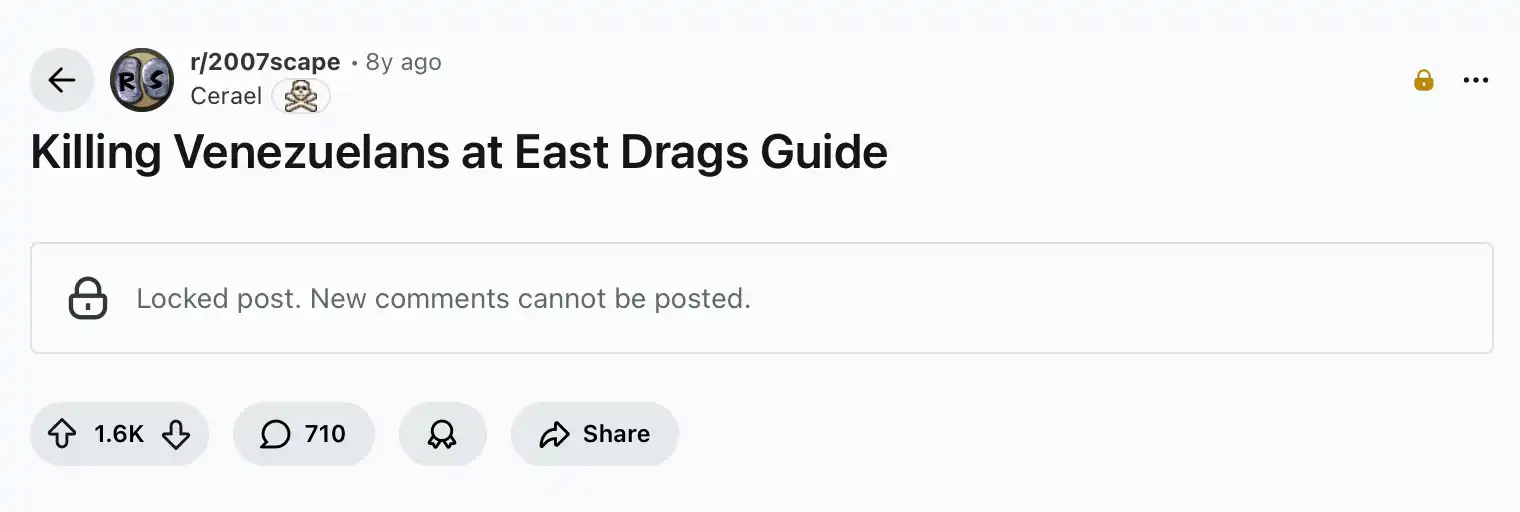
The "east dragons" refer to an area in OSRS where "green dragons" spawn in the eastern part of the "Graveyard PK zone," which was occupied by Venezuelan players from 2017 to 2019. They aggressively killed these dragons, took the dragon bones and hides dropped by the green dragons to sell on the RuneScape Grand Exchange for gold coins, then converted the OSRS gold into Bitcoin or other cryptocurrencies for cashing out.
According to a post by user "fisherman" on steemit in August 2017, farming green dragons for an hour can earn 500,000 OSRS gold coins, which is equivalent to 0.5 USD. This moneymaking method once made it to the headlines of a national newspaper in Venezuela:
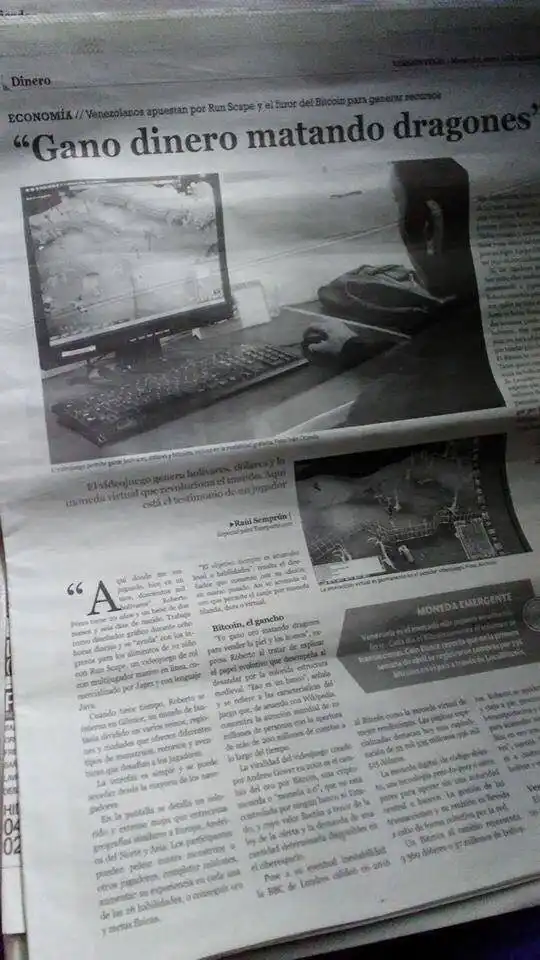
Advanced players, on the other hand, would go farm another winged serpent boss named "Zulrah," which would increase their hourly earnings to 2-3 USD. At this hourly rate, they were earning more than most college-educated individuals in Venezuela.
A few years ago, when Venezuelan players were most actively gold farming in OSRS, several English media outlets interviewed them. Those interviewed were generally able to earn $100 or more per month from OSRS, while their parents could only earn around $10 per month. In their view, OSRS was highly popular among Venezuelans and could be considered a mainstream way to earn a living, enough to support their families and shield themselves from the impact of the bolivar's devaluation on their hard-earned wages.
Similar to how in Hong Kong we see many domestic workers filling in for household chores, in the world of OSRS, Venezuelan players filled in the laborious and repetitive monster farming/upgrading/collection process. Apart from farming dragons, serpents, deer, and various materials, Venezuelan players also took on skill leveling and item crafting services for others. However, unlike domestic workers in Hong Kong who can leisurely gather for coffee on the streets, Venezuelan players, due to Jagex's crackdown on real-world item trading in the game, operated multiple burner accounts to evade the risk of being banned.
In March 2019, Venezuela experienced a nationwide blackout. During those days, green dragons lost their most loyal dragon slayers, leading to a drastic drop in the supply of dragon bones in the market and subsequent price hikes.
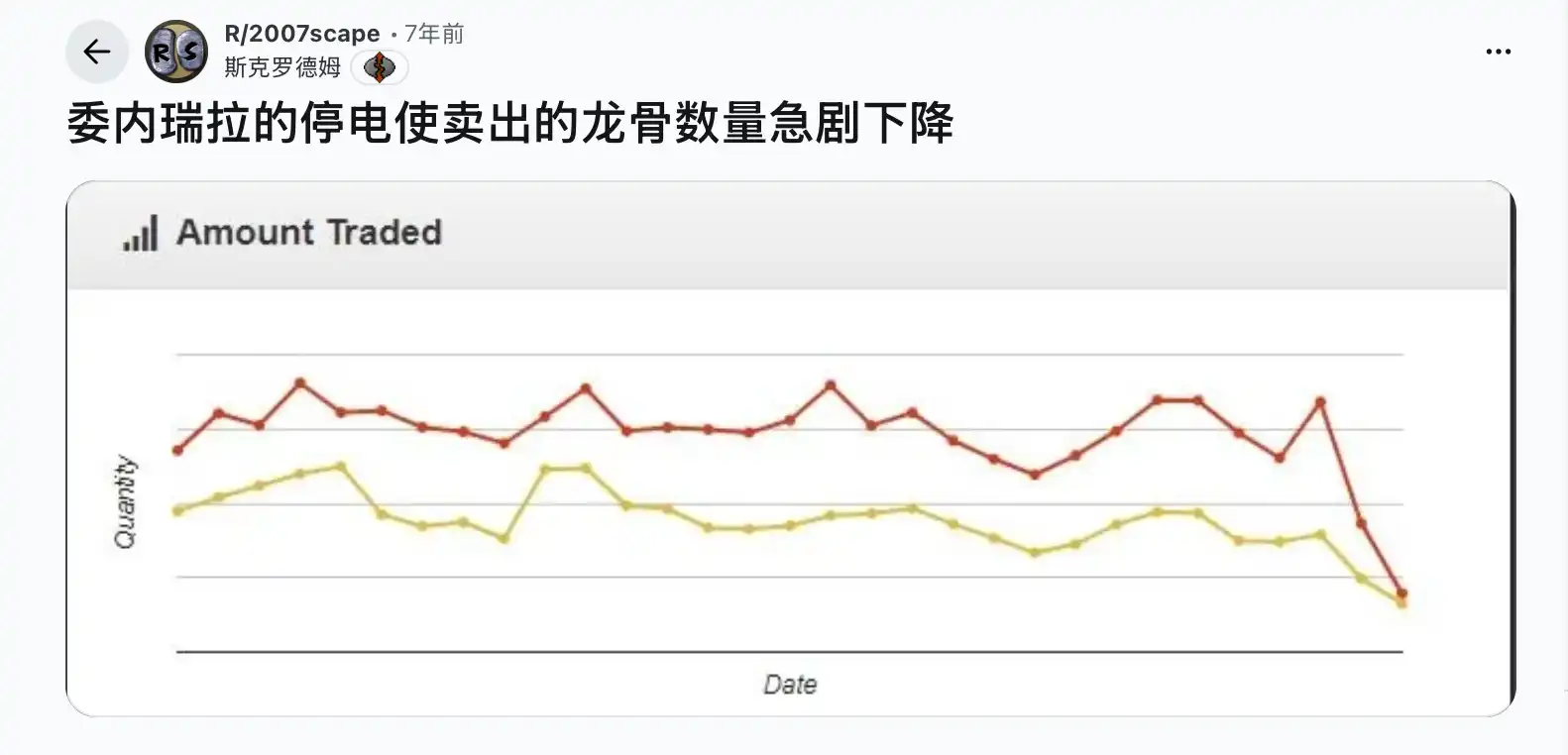
Players' attitudes towards these Venezuelan gold farmers can be described as a mix of love and hate. On one hand, Venezuelan players are generally true manual laborers; unlike those working in studios in other countries and regions to earn money at scale, they are genuinely earning gold by playing the game manually just like any other player, solely for survival. Sometimes, more casual players even believe that the existence of Venezuelan players actually improves their gaming experience, as they don't have to spend too much money to directly enjoy the game fun they desire.
On the other hand, such profit-seeking behavior is bound to affect the gameplay experience of legitimate players and the in-game economy. Venezuelan players' actions in the OSRS world for real-life survival also impact the survival of the OSRS universe. Over the years, the perception of Venezuelan players on Reddit has always been a subject of debate, with anonymous malice and, at the same time, anonymous warmth.
Until the day Venezuelan players left.
Escape
In today's OSRS world, only the legends of Venezuela are heard, and the former gold farmers are nowhere to be seen.
Starting in 2023, Venezuelan players began gradually leaving OSRS. While Venezuela's economy continued to deteriorate, the price of OSRS gold also experienced a decline. Those tireless bots began to compete with manual Venezuelan players, causing a surge in OSRS gold production and a corresponding sharp drop in gold prices. Currently, the price of OSRS gold to USD is approximately 1 million gold: $0.16 - $0.2.
For Venezuelan players, gold farming did not stop; it just moved to a more cost-effective location— they turned to games like Tibia, Albion Online, World of Warcraft, continuing to seek a livelihood in the virtual world for the real world.
But there will always be questions, "Is this life right?" So, some players resolutely left these virtual gaming worlds, and even left their real-world countries.
According to the latest data from early this year, about 7.9 million Venezuelans have fled the country, making it one of the largest refugee crises in Latin America and globally. In English-language media, we can see some interviews with Venezuelans who fled Venezuela using money earned through OSRS.
José Ricardo, an OSRS gold middleman, earned profits by buying OSRS gold and reselling it to buyers. A few years ago, when interviewed, his monthly income ranged from $800 to $1200. He invested these profits in cryptocurrency and had the money for vacations in Brazil, Colombia, and Trinidad and Tobago. He still lives in Venezuela, but that is just one option; he is unwilling to let his life stay in one place and on one thing forever.
Victor Alexander Rodriguez, who decided in early 2017 to play OSRS for 14 hours a day along with his sister to supplement the household income. At the beginning of their gold farming venture, he had discussed with his sister, "One day, we will leave." Together, they worked hard through OSRS to gather $500 and went to Peru in 2018. Later, he became a security guard, earning a higher salary than gold farming in OSRS. During his leisure time, he occasionally returns to the OSRS world on his phone, except this time, he truly is just a player enjoying the game.
But not every escape story is so rosy. Bran Castillo once described his friend's friend's experience — who made enough money to escape to Peru thanks to OSRS, continued playing OSRS in Peru, but the income level that was sufficient in Venezuela couldn't cut it in Peru. On Reddit, Venezuelan players have answered questions about this; although their public services have quality issues (the most absurd being that their first OSRS login relied on mobile data because the broadband's copper core had been stolen), they hardly need to spend money, and the money they earn mainly solves food and shelter.
There are even darker rumors circulating, suggesting that some female Venezuelan OSRS players, upon escaping the country, did not know how to sustain themselves and turned to...
OSRS players have a faith-like phrase, "This game has never ended; you are not leaving, you are just taking a temporary rest."
And the most heartwarming blessing I've seen is, "Hopefully, one day, we will have nothing to worry about beyond the joy in the game."
Epilogue
The relationship between Venezuela and the cryptocurrency industry is so vast and deep. Now, we delight in the potential 600,000 Bitcoin reserve held by the Maduro regime, deeply analyze why Venezuela's once-issued 'petro' failed, and examine the economic and daily life forms after USDT became widely adopted as the local currency...
But this time, as we try to find the stories of 'people' rather than starting from the 'industry macro' phenomena and perspectives, we see how cryptocurrency and a 25-year-old game have helped Venezuelans solve livelihood problems. In the virtual world, entangled, emotions conveyed, and battles fought, all for survival in reality or to escape that damn fate.
If it weren't for cryptocurrency overcoming numerous geographical, linguistic, and cultural barriers, embodying a significant global value consensus, and providing a solid foundation of world-class trust at the settlement level, the stories of OSRS and Venezuela might not have occurred.
Whether struggling to sustain a crumbling life in the virtual world or double escaping the virtual and real worlds to chase new hope, these seemingly mundane daily choices have actually driven industry progress.
Their stories, slowly fading in OSRS, and merely passing through and quietly leaving the cryptocurrency industry, are the real bitterness behind the industry's progress.
You may also like

Spot Bitcoin ETFs Draw Record $1.42B Inflows as Institutional Interest Reignites
Key Takeaways Spot Bitcoin ETFs recently witnessed their strongest inflows since October, reaching $1.42 billion amid increased institutional…

Traveling? ‘Evil Twin’ WiFi networks can steal crypto passwords
Key Takeaways “Evil Twin” WiFi attacks occur when hackers mimic legitimate WiFi networks to steal sensitive user data.…

Three Reasons Why Bitcoin’s ‘Real Breakout’ Toward $107k Has Begun
Key Takeaways The Bitcoin breakout is supported by strengthening technical indicators and reduced selling pressure. Macroeconomic signals are…

Crypto’s Decentralization Promise Falters at Interoperability
Interoperability in crypto exposes a decentralization gap, highlighting the reliance on centralized intermediaries. Users’ understanding of technical infrastructure…

Bitcoin Dips, Gold Futures Skyrocket Amidst European Threat of ‘Trade Bazooka’
Key Takeaways Bitcoin’s price took a significant hit, dropping nearly $3,500 as European retaliations to Trump’s tariffs loomed.…

‘Obscure’ Laws Hinder Bitcoin Reserve Plans: Insights from White House Crypto Council
Key Takeaways Efforts to establish a Bitcoin strategic reserve in the United States are impeded by complex interagency…

User Loses $282M in One of the Most Significant Social Engineering Crypto Heists
Key Takeaways A crypto user lost over $282 million in Bitcoin and Litecoin due to a sophisticated social…

US Crypto Market Structure Bill in Limbo as Industry Reconsiders Support
Key Takeaways The US crypto market structure bill faces delays due to ongoing disputes among lawmakers and industry…
Trump Targets Fed, Italy Cautions Influencers: Global Financial Pulse
Key Takeaways: The United States is witnessing a political storm as former President Trump initiates criminal proceedings against…

Bitcoin Futures OI Shows Cautious Return in Risk Appetite
Key Takeaways Bitcoin futures open interest (OI) saw a 13% recovery since the start of the year, indicating…

Senate Judiciary Leaders Push for Revisions in Crypto Bill
Key Takeaways Senate Judiciary chair Charles Grassley and top Democrat Richard Durbin express concerns about the crypto market…
Saylor Hints at ‘Bigger Orange’ Following Recent $1.25B Bitcoin Acquisition
Key Takeaways Michael Saylor’s investment firm, Strategy, recently acquired $1.25 billion in Bitcoin, increasing its holdings to over…

Crypto Mining Rig Maker Canaan Warned of Potential Nasdaq Delisting
Key Takeaways Canaan Inc., a well-known crypto mining hardware producer, faces a possible Nasdaq delisting due to its…

Bitcoin Hashrate at 4-Month Low as AI Competes for the Grid, Analyst Observes
Key Takeaways Bitcoin hashrate has dipped below 1 zetahash per second for the first time in four months,…

The CLARITY Act’s Delay Could Benefit the Crypto Sector
Key Takeaways The stalling of the CLARITY Act is seen as beneficial for the crypto industry, as overregulation…

80% of Hacked Crypto Projects Never Fully Recover, Expert Advises
Key Takeaways Nearly four out of five crypto projects fail to regain stability after a major hack, according…

China-led CBDC Project mBridge Surpasses $55 Billion in Cross-Border Payments
Key Takeaways The mBridge project has handled over $55 billion in cross-border payments, signaling a shift from traditional…
Scaramucci Remarks on Stablecoin Yield Ban’s Impact on US Dollar
Key Takeaways: The CLARITY Act’s prohibition on yield-bearing stablecoins decreases the competitive edge of the US dollar against…
Spot Bitcoin ETFs Draw Record $1.42B Inflows as Institutional Interest Reignites
Key Takeaways Spot Bitcoin ETFs recently witnessed their strongest inflows since October, reaching $1.42 billion amid increased institutional…
Traveling? ‘Evil Twin’ WiFi networks can steal crypto passwords
Key Takeaways “Evil Twin” WiFi attacks occur when hackers mimic legitimate WiFi networks to steal sensitive user data.…
Three Reasons Why Bitcoin’s ‘Real Breakout’ Toward $107k Has Begun
Key Takeaways The Bitcoin breakout is supported by strengthening technical indicators and reduced selling pressure. Macroeconomic signals are…
Crypto’s Decentralization Promise Falters at Interoperability
Interoperability in crypto exposes a decentralization gap, highlighting the reliance on centralized intermediaries. Users’ understanding of technical infrastructure…
Bitcoin Dips, Gold Futures Skyrocket Amidst European Threat of ‘Trade Bazooka’
Key Takeaways Bitcoin’s price took a significant hit, dropping nearly $3,500 as European retaliations to Trump’s tariffs loomed.…
‘Obscure’ Laws Hinder Bitcoin Reserve Plans: Insights from White House Crypto Council
Key Takeaways Efforts to establish a Bitcoin strategic reserve in the United States are impeded by complex interagency…


 App
App