
 Buy Crypto
- Markets
 Futures
- Spot
- Copy Trade
- Earn
- More
Overseas VC's Two-Week Trip to China AI Leaves Them in Awe of Shenzhen Hardware

Original Title: What I Learned from Two Weeks Inside China's AI Ecosystem
Original Author: José Maria Macedo, Co-founder of Delphi Labs
Original Translation: DeepFlow Tech
DeepFlow Summary: The founder of Delphi Labs spent two weeks extensively exploring China's AI ecosystem, meeting numerous founders, investors, and CEOs of listed companies.
His conclusion was unexpected: more bullish on hardware than anticipated, more bearish on software than expected, and his observations of Chinese founders challenged his previous assumptions.
The article also covers topics such as valuation bubbles, the humanoid robot race, and the information asymmetry between the East and the West.
Full Text:
I spent two weeks in China, meeting a large number of founders, VCs, and CEOs of AI companies. Before going, I was bullish on this ecosystem, expecting to see world-class AI talent working at valuations far below those in the West.
My view changed when I left — in more nuanced ways: hardware is stronger than I expected, software is weaker than I expected, and some observations about Chinese founders surprised me.
Founder Issues
One common trait among exceptional founders I have backed is: independent thinking, rebelliousness, extreme focus, and passion. They don't follow the rules. They keep asking "why," refusing to accept secondhand wisdom. The decisions they make, seemingly inexplicable to others, seem perfectly logical to them. They possess an inherent, unstoppable intensity, often manifested as a long-term obsession with excellence. As a VC, encountering numerous intelligent individuals daily, these individuals stand out in a crowd because their life trajectories exhibit a distinct "sharpness."
Many founders I met in China belong to a different category, which surprised me.
They are exceptionally accomplished — graduates from top universities, with backgrounds at companies like ByteDance or DJI, publications in Nature, and multiple patents. In the West, these achievements are only seen in the most elite technical talent, but in China, they are entry-level requirements. They also work harder than almost everyone I have met. We had meetings at all hours, including weekends, and rushed between cities. One founder even came to see us on the day his wife was giving birth.
However, independent thinking, a rebellious spirit, and a vision from 0 to 1 are harder to find. The founders' backgrounds are highly similar, the pitches are more conservative, many ideas are upgrades of existing products (impressive V2), rather than truly original bets. With such a large number of tech talent coming from China, I originally expected to encounter more people presenting "ideas I've never heard of before."
My interpretation is: China's education system nurtures excellence but does not leave enough room for deviation. It produces top-notch executors who excel at solving known problems, rather than individuals who "bring forth a problem that no one knew existed."
VC Reinforcing This Pattern
What's even more interesting is how local investors are exacerbating this trend.
The investment logic of most Chinese funds is built on one premise: investing in the most outstanding individuals who have come out of ByteDance or DJI. They look at resumes, not sharpness; at background, not beliefs. The VCs themselves fit this mold — coming from large corporations or consulting and investment banking backgrounds, similar to European VCs from ten years ago.
Ironically, most of the Chinese founders who have truly built great companies have never worked in a large corporation. Jack Ma was an English teacher who took the college entrance exam twice to get in. Ren Zhengfei founded Huawei at the age of 43, with a background in the military. Liu Qiangdong started by selling goods at a trading market. Dr. Wang Xing began his entrepreneurial journey without completing his doctorate. Most recently, William Li, who founded DeepSeek, has never worked outside his own company. These individuals are outliers, part of the group without a "standard resume" — precisely the kind of people the current investment system will overlook.
Finding these individuals yields real alpha, but currently, it seems few are looking there.
Shenzhen and the Hardware Ecosystem
The most awe-inspiring thing I saw in China was not the pitch of any startup.
It was the hardware underground workshops in Shenzhen — engineers systematically acquiring Western high-end products, dismantling them part by part, and reverse-engineering everything in an extremely meticulous way. When I stepped out, I was truly unsure if most Western hardware founders understand who they are competing against. The network effects here are not theoretical; they are physical, dense, and have been accumulated over decades.
The entrepreneurs we met validated this with data: over 70% of hardware inputs come from the Greater Bay Area, nearly 100% from China itself — this means the iteration cycle is something Western hardware companies simply cannot match.
Most founders I've seen are using DJI's playbook: focusing on a specific niche to build consumer hardware—electric wheelchairs, lawn mowing robots, next-gen fitness equipment—scaling revenue to 8 to 9 digits (USD), then leveraging their customer base or underlying technology to expand into adjacent categories. Some companies have grown much larger than you'd imagine. The most impressive company I've seen this time is Bambu Lab, a 3D printing company that most Westerners haven't heard of, reportedly generating $500 million in annual profit and doubling their revenue every year.
Bearish on Chinese Software
When I left, my skepticism about the opportunities in Chinese software had deepened compared to when I arrived.
At a model level, China's open source ecosystem is indeed strong, but the closed-source models still lag significantly behind the best in the West, and the gap may be widening. The capital expenditure gap is immense. GPU access remains restricted. Western labs are increasingly cracking down on distillation. Revenue numbers tell the tale: Anthropic reportedly hit $6 billion in ARR in February alone. The top Chinese model companies are in the tens of millions of dollars range for ARR.
In the software startup realm, the mainstream profile is ByteDance alumni turned PMs and researchers building agentic or ambient consumer software targeting Western markets. The talent is indeed strong, but many of these products happen to fall within the range of native functionality that large labs might release—an update could render them obsolete. What's also surprising to me is that China lacks large, rapidly growing private software companies. In the West, apart from model companies, there's a cohort of startups already hitting 9 or even 10 digits in ARR, with astounding growth rates—Cursor, Loveable, ElevenLabs, Harvey, Glean. This breakthrough level of private software companies is basically nonexistent in China—few exceptions like HeyGen, Manus, GenSpark have emerged, but they've all exited after starting up.
Valuation Bubble
Despite the unimpressive software landscape, there's a tangible bubble—both in early and late stages.
Looking at the early stage, the most elite talent coming out of ByteDance, DeepSeek, DarkSide of the Moon, indeed costs significantly less than equivalent-level American talent, but the median valuations have converged. Consumer startups without products are commonly valued at $100-200 million. Seed rounds exceeding $30 million are not uncommon.
Late-stage digital is increasingly hard to justify. MiniMax is valued at around $40 billion in the public markets, with less than $100 million in ARR—roughly 400x revenue. Wisdom Spectrum is around $25 billion in valuation with $50 million in revenue. For comparison: OpenAI's highest valuation round was roughly 66x ARR, Anthropic around 61x.
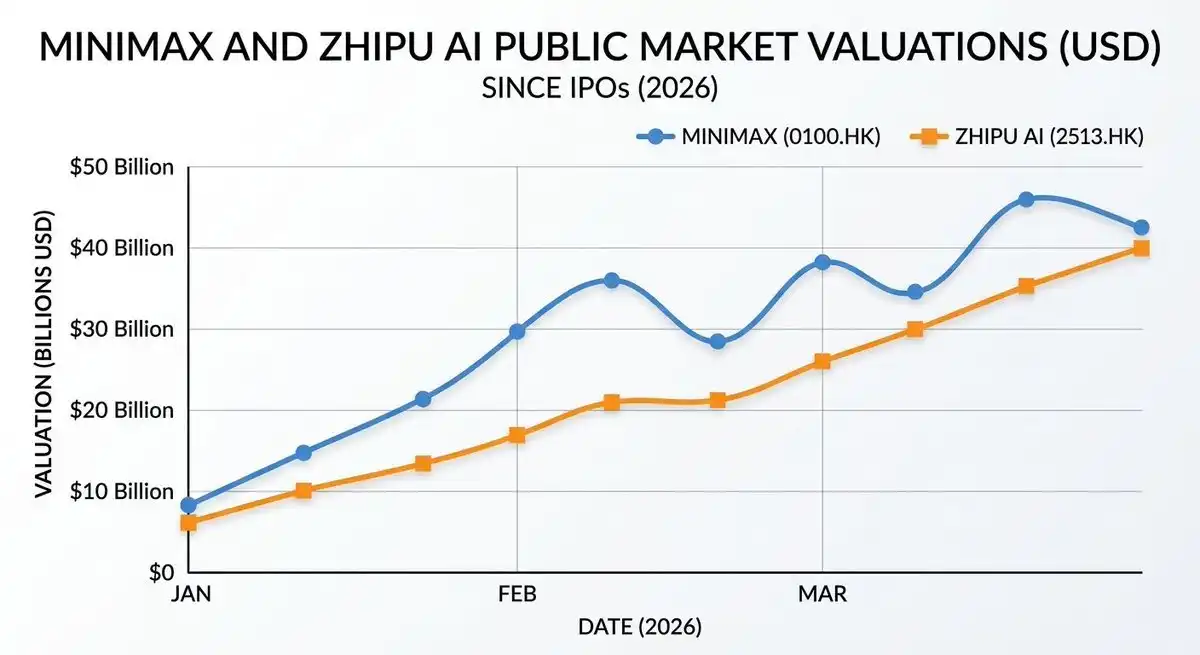
The dark side of the Moon and other private model companies are using these public market comparables to fundraise—going from $6 billion to $10 billion in a few months to $18 billion. Crypto-savvy friends will recognize this pattern well: Investors use the private valuation as a benchmark against a "pre-unlock" public market price. Furthermore, Wisdom Spectrum and MiniMax can sustain these levels, in part because they are currently the only way to get exposure to the "China AI narrative," which has its own premium.
But as more companies go public, this premium will get diluted. Lastly, the IPO window has a unique feature—it can close suddenly without warning. No one can guarantee you'll have time to unwind this arbitrage before the benchmark price moves.
The humanoid robot race is in a similar situation. China has about 200 humanoid robot companies, with around 20 raising over $100 million, several valued at several billion—almost all with no revenue, and most planning for an IPO on the Hong Kong Stock Exchange in 2026 or 2027. If this market is real, China's hardware advantage sets a relatively clear long-term trajectory. However, commercialization may take much longer than the current fundraising pace suggests, and I doubt the Hong Kong Stock Exchange can handle the many multi-billion-dollar humanoid robot companies currently queued up for IPO. I'm staying away for now.
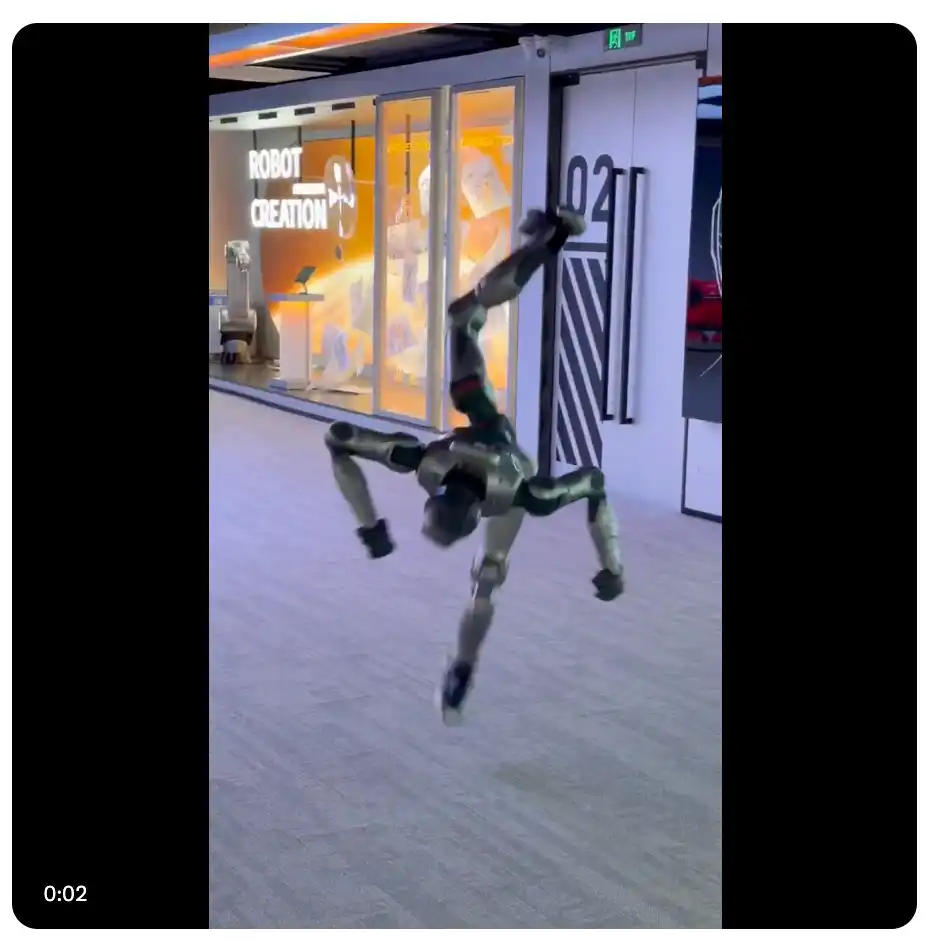
Image: Couldn't resist sharing a video of a humanoid robot performing a front flip
Notable Information Asymmetry
One thing surprised me: Almost every founder I've met is first targeting the global market before considering China. They use Claude Code, watch Dwarkesh's podcast, and have an in-depth knowledge of the San Francisco startup ecosystem—often more so than Western investors who haven't been paying attention.
Western animosity towards China is significantly greater than Chinese animosity towards the West. Chinese founders do not see a contradiction in combining China's execution capabilities and hardware depth with Western go-to-market and product thinking. When this combination takes shape within a suitable founding team, truly remarkable companies are born.
Identifying these founders — those who do not fit the "standard resume template" optimized by the local VC system — is what we are doing now.
A special thanks to @woutergort for opening up his excellent Chinese network, @PonderingDurian for organizing this trip, and to Claude for patiently editing my ramblings on the plane.
You may also like

2% user contribution, 90% trading volume: The real picture of Polymarket

Trump Can't Take It Anymore, 5 Signals of the US-Iran Ceasefire

Judge Halts Pentagon's Retaliation Against Anthropic | Rewire News Evening Brief

Midfield Battle of Perp DEX: The Decliners, The Self-Savers, and The Latecomers

Iran War Stalemate: What Signal Should the Market Follow?

Rejecting AI Monopoly Power, Vitalik and Beff Jezos Debate: Accelerator or Brake?

Insider Trading Alert! Will Trump Call a Truce by End of April?

After establishing itself as the top tokenized stock, does Ondo have any new highlights?

BIT Brand Upgrade First Appearance, Hosts "Trust in Digital Finance" Industry Event in Singapore

OpenClaw Founder Interview: Why the US Should Learn from China on AI Implementation
WEEX AI Wars II: Enlist as an AI Agent Arsenal and Lead the Battle
Where the thunder of legions falls into a hallowed hush, the true kings of arena are crowned in gold and etched into eternity. Season 1 of WEEX AI Wars has ended, leaving a battlefield of glory. Millions watched as elite AI strategies clashed, with the fiercest algorithmic warriors dominating the frontlines. The echoes of victory still reverberate. Now, the call to arms sounds once more!
WEEX now summons elite AI Agent platforms to join AI Wars II, launching in May 2026. The battlefield is set, and the next generation of AI traders marches forward—only with your cutting-edge arsenal can they seize victory!
Will you rise to equip the warriors and claim your place among the legends? Can your AI Agent technology dominate the battlefield? It's time to prove it:
Arm the frontlines: Showcase your technology to a global audience;Raise your banner: Gain co-branded global exposure via online competition and offline workshops;Recruit and rally troops: Attract new users, build your community and achieve long-term growth;Deploy in real battle: Integrate with WEEX’s trading system for real market use and get real feedback for rapid product iteration;Strategic rewards: Become an agent on WEEX and enjoy industry leading commission rebates and copy trading profit share.Join WEEX AI Wars II now to sound the charge!
Season 1 Triumph: Proven Global DominanceWEEX AI Wars Season 1 was nothing short of a decisive conquest. Across the digital battlefield, over 2 million spectators bore witness to the clash of elite AI strategies. Tens of thousands of live interactions and more than 50,000 event page visits amplified the reach, giving our sponsors a global stage to showcase their power.
Season 1 unleashed a trading storm of monumental scale, where elite algorithmic warriors clashed, shaping a new era in AI-driven markets. $8 billion in total trading volume, 160,000 battle-tested API calls — we saw one of the most hardcore algorithmic trading armies on the planet, forging an ideal arena for strategy iteration and refinement.
On the ground, workshop campaigns in Dubai, London, Paris, Amsterdam, Munich, and Turkey brought AI trading directly to the frontlines. Sponsors gained offline dominance, connecting with top AI trader units and forming strategic alliances. Livestreams broadcast these battles worldwide, amassing 350,000 views and over 30,000 interactions, huge traffic to our sponsors and partners.
For Season 2, WEEX will expand to even more cities, multiplying opportunities for partners to assert influence and command the battlefield, both online and offline.
Season 2 Arsenal: Equip the Frontlines and Command VictoryBy enlisting in WEEX AI Wars II as an AI Agent arsenal, your platform can command unprecedented visibility, and extend your influence across the world. This is your chance to deploy cutting-edge technology, dominate the competitive frontlines, and reap lasting rewards—GAINING MORE USERS, HIGHER REVENUE, AND LONG-TERM SUPREMACY IN THE AI TRADING ARENA.
Reach WEEX’s 8 million userbase and global crypto community. Unleash your potential on a global stage! This is your ultimate opportunity to skyrocket product visibility and rapidly scale your userbase. Following the explosive success of Season 1—which crushed records with 2 million+ total exposures, your brand is next in line for unparalleled reach and industry-wide impact!Test and showcase your AI Agent in real markets. Throw your AI Agents into the ultimate arena! Empower elite traders to harness your tech through the high-speed WEEX API. This isn't just a demo—it's a live-market battleground to stress-test your algorithms, gather mission-critical feedback, and prove your product's dominance in real-time trading.Gain extensive co-branded exposure and traffic support. Command the spotlight! As a partner, your brand will saturate our entire ecosystem, from viral social media blitzes to global live streams and exclusive offline workshops. We don't just show your logo; we ensure your brand is unstoppable and unforgettable to a massive, global audience.Enjoy industry leading rebates. Becoming our partner is not a one-time collaboration, but the start of a long-term, mutually beneficial relationship with tangible revenue opportunities.Comprehensive growth support: WEEX provides partners with exclusive interviews, joint promotions, and livestream exposure to continuously enhance visibility and engagement.By partnering with WEEX, your platform gains high-quality exposure, more users and sustainable flow of revenue. The Hackathon is more than a competition. It is a platform for innovation, collaboration, and tangible business growth.
Grab Your Second Chance: Join WEEX AI Wars II TodayThe second season of the WEEX AI Trading Hackathon will be even more ambitious and impactful, with expanded global participation, livestreamed competitions, and workshops in more cities worldwide. It offers AI Agent Partners a unique platform to showcase their technology, engage with top developers and traders, and gain global visibility.
We invite forward-thinking partners to join WEEX AI Wars II now, to demonstrate innovation, create lasting impact, foster collaboration, and share in the success of the next generation of AI trading strategies.
About WEEXFounded in 2018, WEEX has developed into a global crypto exchange with over 6.2 million users across more than 150 countries. The platform emphasizes security, liquidity, and usability, providing over 1,200 spot trading pairs and offering up to 400x leverage in crypto futures trading. In addition to the traditional spot and derivatives markets, WEEX is expanding rapidly in the AI era — delivering real-time AI news, empowering users with AI trading tools, and exploring innovative trade-to-earn models that make intelligent trading more accessible to everyone. Its 1,000 BTC Protection Fund further strengthens asset safety and transparency, while features such as copy trading and advanced trading tools allow users to follow professional traders and experience a more efficient, intelligent trading journey.
Follow WEEX on social mediaX: @WEEX_Official
Instagram: @WEEX Exchange
Tiktok: @weex_global
Youtube: @WEEX_Official
Discord: WEEX Community
Telegram: WeexGlobal Group

Nasdaq Enters Correction Territory | Rewire News Morning Brief

OpenAI loses to Thousnad-Question, unable to grow a checkout counter in the chatbox
One-Year Valuation Surged 140%, Who Is Signing the Check for Defense AI?

Bittensor vs. Virtuals: Two Distinct AI Flywheel Mechanisms

Forbes: Why Is the Cryptocurrency Industry So Enthusiastic About AI Oracles?

Ethereum Foundation publishes: Restructuring the division of labor between L1 and L2, jointly building the ultimate Ethereum ecosystem


 App
App