
- Buy Crypto
- Markets
- Futures
- Spot
- Copy Trade
 WE-Launch
A $500,000 Ticker Bought Out and "Rebranded by Force"? Hyperliquid's Trust Test

Hyperliquid is undoubtedly the shining star of the crypto world this year.
However, a recent dispute over "naming rights" has sparked considerable debate and controversy within the community.
If you spent $500,000 on Hyperliquid to acquire a token ticker, would you consider it yours by default? The recent action taken by the Hyperliquid team provides an answer: it belongs to you on-chain, but I control it on the web.
$500,000 for $MON, and it can be taken away?
The controversy stems from January of this year when the GameFi project Pixelmon, backed by the Mon Protocol, participated in Hyperliquid's HIP-1 spot listing auction to attract the Hyperliquid community.
Here, let's briefly explain Hyperliquid's spot listing mechanism. Unlike centralized exchanges' "listing fees" or "bribes," HL utilizes a Dutch auction listing. This is a permissionless process where projects bid and pay Gas fees in a bidding war to qualify for listing (initially using USDC, later switched to HYPE).
Source: https://data.asxn.xyz/dashboard/hl-auctions
At that time, Mon Protocol spent around $500,000, winning the auction at a high price, and successfully registered the $MON ticker on-chain.
At that time, in the early stages of the Hyperliquid spot market and before the launch of the spot bridging project Unit, besides high-market-cap assets like HYPE and PURR, other spot trading pairs generally lacked liquidity. The performance of Mon Protocol's token after listing was nearly equivalent to a rug pull.
Monad, as a much-anticipated "king-level project," also had a token called $MON. So when Monad landed on Hyperliquid, an awkward scene unfolded: the Hyperliquid team directly modified the frontend display, renaming Mon Protocol to "MONPRO" on the frontend, while Monad directly used the "MON" name.
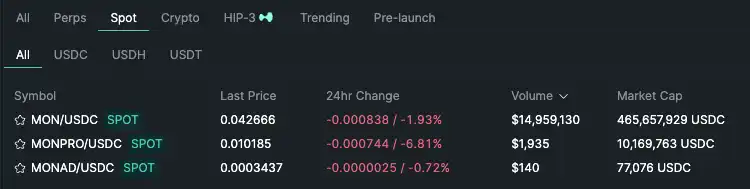
Although on-chain, Pixelmon's token code is still MON, Monad is actually UMON. But in the most direct frontend perceptible to users, Pixelmon's $500,000 "naming rights" were instantly stripped away.
User Security or Traffic First?
This action quickly ignited public opinion on Twitter. Trader Akku bluntly stated that this decision was "extremely disappointing."
"Pixelmon spent $500,000 to buy something on the frontend that can be arbitrarily overridden, while Monad (or Unit closely related to it) can obtain this visible name for free... Does this mean: you can buy the on-chain code, but we will decide what the frontend displays based on our relationships?"
Facing criticism, xulian, a core member of Hyperliquid, gave a very "Web2" explanation:
"The most important factor on the frontend is to protect the user. It is bad for everyone if the user buys the wrong token. As far as I know, all major exchanges changed MON to display as MONPRO a few weeks ago. The auction was the on-chain gas fee, and the Mon Protocol team still owns the MON ticker. Any other frontend can name it whatever they want."
This statement translates to: To prevent user confusion, we sacrificed the original Ticker owner's display rights.
Another party involved in this event, the Unit team closely related to Hyperliquid (responsible for the on-chain bridging of the Monad token on HL), was also embroiled in the controversy due to acquiring this name. Unit member Shadow (0xmev) was forced to come out and clarify:
"Protocol and App are two different things. Hyperliquid Labs has decision-making power over the App. This matter is clear: one project (Mon Protocol) designed to attract buying interest from the Hyperliquid community failed, resulting in the token price going to zero; while another project (Monad) with high visibility and trading volume entered. Labs felt that giving the name to the latter was a better display choice."
Community Outrage
While the official explanation may hold up logically (the frontend does indeed belong to Hyperliquid Labs), the community does not consider it acceptable on emotional or business ethics grounds.
Akku argued that the initial spot auction's marketing made everyone assume "spot listing = frontend display," and now playing a word game to claim it is "on-chain only" is nothing short of a marketing scam. He believes that if Monad does not want conflict, they should rename themselves instead of depriving the early comers of their rights.
Ramen's view represents the sentiment of the majority of onlookers:
"Displaying $MON for Monad to avoid confusion may be right, but forcibly renaming after someone has paid $500,000 is wrong. A refund seems to be the best course of action."
Of course, there are also voices supporting HL. Users aaalex.hl and altoshi insist that "the protocol is not the same as the frontend," "Hyperliquid is a business, not a charity," and believe that as long as the on-chain contract has not changed, it does not violate the decentralization principle.
“Arrogance” is a Byproduct of Success
Hyperliquid has done nothing wrong. They do have absolute control over the hyperliquid.xyz domain and have the right to adjust the display logic for the sake of user experience. Given Monad's scale and attention far exceeding Pixelmon, giving Monad the code MON not only aligns with the platform's interests but also protects unaware users from purchasing a low-liquidity token of the same name.
This seemingly reasonable "unilateral" action actually makes some ecosystem builders uneasy.
Absolute Interpretation Authority
In another story revealed by Unit team member Shadow in a reply, perhaps more thought-provoking than the renaming event itself:
"We built the entire brand (tradexyz) from scratch, precisely because we had no influence over Labs' frontend decisions. They ultimately decided to roll out HIP-3 on their official frontend immediately after we completed and announced the entire project—effectively destroying the competitive advantage we had spent a lot of time building. But we will not complain about it; we will continue to move forward."
If even a "core force" like Unit could be "blood-sucked" by the official front end at any time, how can those small-scale projects without background find a sense of security in such an ecosystem?
Rigid Handling
Hyperliquid's "arrogance" towards capital is a major factor in winning enthusiastic community support. They have rejected investment from top VCs, refused to pay listing fees to CEXs, and insisted on fair distribution.
However, as Akku pointed out, even if they were to refund the auction fee from that year or reach some kind of compensation agreement with the Pixelmon team in advance, it would make this matter much more decent. The current approach not only harms early supporters (even of a failed project), but also sends a signal to the outside world that "might makes right."
Hyperliquid is still one of the best Perp DEXs in the market, and its technical strength is beyond doubt. However, after reaching the top, how to avoid becoming the same kind of "arbitrary giant" they originally wanted to disrupt may be a question that the Hyperliquid team needs to consider.
Water can carry a boat, but it can also capsize it. The "arrogance" that the community likes is the resilience in the face of authority, not the capriciousness when facing rules.
You may also like

Hyperliquid Whales Shift Strategies: BTC Longs Decline, ETH Shorts Dominate
Key Takeaways A significant reduction in Bitcoin long positions has been observed on Hyperliquid, with large holders decreasing…

Three Titans Bet $17 Million, FIN Makes Strong Move into Cross-Border Payments
Stepping into the Stablecoin Craze After Six Years, He Sees the Shape of the Future of Payments

Uniswap Token Burn Proposal Approved, What Is the Overseas Crypto Community Talking About Today?

30 Predictions, Filtered for Five 2026 Crypto Consensus

World Cup of 'Oracles': How to Interpret Next Year's Prediction Market Growth Prospects?

Base App is now fully open! How was your experience?

Uniswap Pay Dispute Escalates, Maple Finance Loan volume Hits All-Time High, What's the Overseas Crypto Community Talking About Today?

Why is the U.S. Embracing Crypto? The Answer May Lie in $37 Trillion Debt
Web3 and DApps in 2026: A Utility-Driven Year for Crypto
Key Takeaways The transition to utility in the crypto sector has set a new path for 2026, emphasizing…

December 24th Market Key Intelligence, How Much Did You Miss?

Base's 2025 Report Card: Revenue Grows 30X, Solidifies L2 Leadership

The Trillion-Dollar Stablecoin Battle: Binance Decides to Step in Again

Aave Community Governance Drama Escalates, What's the Overseas Crypto Community Talking About Today?

Where Did $362 Million Go? Hyperliquid Counters FUD in Decentralization Showdown

Polymarket Announces In-House L2, Is Polygon's Ace Up?

2025 Whale Saga: Mansion Kidnapping, Supply Chain Poisoning, and Billions Liquidated

Coinbase Joins Prediction Market, AAVE Governance Dispute - What's the Overseas Crypto Community Talking About Today?
Over the past 24 hours, the crypto market has shown strong momentum across multiple dimensions. The mainstream discussion has focused on Coinbase's official entry into the prediction market through the acquisition of The Clearing Company, as well as the intense controversy within the AAVE community regarding token incentives and governance rights.
In terms of ecosystem development, Solana has introduced the innovative Kora fee layer aimed at reducing user transaction costs; meanwhile, the Perp DEX competition has intensified, with the showdown between Hyperliquid and Lighter sparking widespread community discussion on the future of decentralized derivatives.
This week, Coinbase announced the acquisition of The Clearing Company, marking another significant move to deepen its presence in this field after last week's announcement of launching a prediction market on its platform.
The Clearing Company's founder, Toni Gemayel, and the team will join Coinbase to jointly drive the development of the prediction market business.
Coinbase's Product Lead, Shan Aggarwal, stated that the growth of the prediction market is still in its early stages and predicts that 2026 will be the breakout year for this field.
The community has reacted positively to this, generally believing that Coinbase's entry will bring significant traffic and compliance advantages to the prediction market. However, this has also sparked discussions about the industry's competitive landscape.
Jai Bhavnani, Founder of Rivalry, commented that for startups, if their product model proves to be successful, industry giants like Coinbase have ample reason to replicate it.
This serves as a reminder to all entrepreneurs in the crypto space that they must build significant moats to withstand competition pressure from these giants.
Regulated prediction market platform Kalshi launched its research arm, Kalshi Research, this week, aimed at opening its internal data to the academic community and researchers to facilitate exploration of prediction market-related topics.
Its inaugural research report highlights Kalshi's outperformance in predicting inflation compared to Wall Street's traditional models. Kalshi co-founder Luana Lopes Lara commented that the power of prediction markets lies in the valuable data they generate, and it is now time to better utilize this data.
Meanwhile, Kalshi announced its support for the BNB Chain (BSC), allowing users to deposit and withdraw BNB and USDT via the BSC network.
This move is seen as a significant step for Kalshi to open its platform to a broader crypto user base, aiming to unlock access to the world's largest prediction market. Furthermore, Kalshi also revealed plans to host the first Prediction Market Summit in 2026 to further drive industry engagement and development.
The AAVE community recently engaged in heated debates around an Aave Improvement Proposal (AIP) titled "AAVE Tokenomics Alignment Phase One - Ownership Governance," aiming to transfer ownership and control of the Aave brand from Aave Labs to Aave DAO.
Aave founder Stani Kulechov publicly stated his intention to vote against the proposal, believing it oversimplifies the complex legal and operational structure, potentially slowing down the development process of core products like Aave V4.
The community's reaction was polarized. Some criticized Stani for adopting a "double standard" in governance and questioned whether his team had siphoned off protocol revenue, while others supported his cautious stance, arguing that significant governance changes require more thorough discussion.
This controversy highlights the tension between the ideal of DAO governance in DeFi projects and the actual power held by core development teams.
Despite governance disputes putting pressure on the AAVE token price, on-chain data shows that Stani Kulechov himself has purchased millions of dollars' worth of AAVE in the past few hours.
Simultaneously, a whale address, 0xDDC4, which had been quiet for 6 months, once again spent 500 ETH (approximately $1.53 million) to purchase 9,629 AAVE tokens. Data indicates that this whale has accumulated nearly 40,000 AAVE over the past year but is currently in an unrealized loss position.
The founder and whale's increased holdings during market volatility were interpreted by some investors as a confidence signal in AAVE's long-term value.
In this week's top article, Morpho Labs' "Curator Explained" detailed the role of "curators" in DeFi.
The article likened curators to asset managers in traditional finance, who design, deploy, and manage on-chain vaults, providing users with a one-click diversified investment portfolio.
Unlike traditional fund managers, DeFi curators execute strategies automatically through non-custodial smart contracts, allowing users to maintain full control of their assets. The article offered a new perspective on the specialization and risk management in the DeFi space.
Another widely circulated article, "Ethereum 2025: From Experiment to Global Infrastructure," provided a comprehensive summary of Ethereum's development over the past year. The article noted that 2025 is a crucial year for Ethereum's transition from an experimental project to global financial infrastructure. Through the Pectra and Fusaka hard forks, Ethereum achieved significant reductions in account abstraction and transaction costs.
Furthermore, the SEC's clarification of Ethereum's "non-securities" nature and the launch of tokenized funds on the Ethereum mainnet by traditional financial giants like JPMorgan marked Ethereum's gaining recognition from mainstream institutions. The article suggested that whether it is the continued growth of DeFi, the thriving L2 ecosystem, or the integration with the AI field, Ethereum's vision as the "world computer" is gradually becoming a reality.
The Solana Foundation engineering team released a fee layer solution called Kora this week.
Kora is a fee relayer and signatory node designed to provide the Solana ecosystem with a more flexible transaction fee payment method. Through Kora, users will be able to achieve gas-free transactions or choose to pay network fees using any stablecoin or SPL token. This innovation is seen as an important step in lowering the barrier of entry for new users and improving Solana network's availability.
Additionally, a deep research report on propAMM (proactive market maker) sparked community interest. The report's data analysis of propAMMs on Solana like HumidiFi indicated that Solana has achieved, or even surpassed, the level of transaction execution quality in traditional finance (TradFi) markets.
For example, on the SOL-USDC trading pair, HumidiFi is able to provide a highly competitive spread for large trades (0.4-1.6 bps), which is already better than the trading slippage of some mid-cap stocks in traditional markets.
Research suggests that propAMM is making the vision of the "Internet Capital Market" a reality, with Solana emerging as the prime venue for all of this to happen.
The competition in the perpetual contract DEX (Perp DEX) space is becoming increasingly heated.
In its latest official article, Hyperliquid has positioned its emerging competitor, Lighter, alongside centralized exchanges like Binance, referring to it as a platform utilizing a centralized sequencer. Hyperliquid emphasizes its transparency advantage of being "fully on-chain, operated by a validator network, and with no hidden state."
The community widely interprets this as Hyperliquid declaring "war" on Lighter. The technical differences between the two platforms have also become a focal point of discussion: Hyperliquid focuses on ultimate on-chain transparency, while Lighter emphasizes achieving "verifiable execution" through zero-knowledge proofs to provide users with a Central Limit Order Book (CLOB)-like trading experience.
This battle over the future direction of decentralized derivatives exchanges is expected to peak in 2026.
Meanwhile, discussions about Lighter's trading fees have surfaced. Some users have pointed out that Lighter charged as much as 81 basis points (0.81%) for a $2 million USD/JPY forex trade, far exceeding the near-zero spreads of traditional forex brokers.
Some argue that Lighter does not follow a B-book model that bets against market makers, instead anchoring its prices to the TradFi market, and the high fees may be related to the current liquidity or market maker balance incentives. Providing a more competitive spread for real-world assets (RWA) in the highly volatile crypto market is a key issue Lighter will need to address in the future.
Hyperliquid Whales Shift Strategies: BTC Longs Decline, ETH Shorts Dominate
Key Takeaways A significant reduction in Bitcoin long positions has been observed on Hyperliquid, with large holders decreasing…
Three Titans Bet $17 Million, FIN Makes Strong Move into Cross-Border Payments
Stepping into the Stablecoin Craze After Six Years, He Sees the Shape of the Future of Payments
Uniswap Token Burn Proposal Approved, What Is the Overseas Crypto Community Talking About Today?
30 Predictions, Filtered for Five 2026 Crypto Consensus
World Cup of 'Oracles': How to Interpret Next Year's Prediction Market Growth Prospects?
Popular coins
Latest Crypto News


Customer Support:@weikecs
Business Cooperation:@weikecs
Quant Trading & MM:[email protected]
VIP Services:[email protected]
 App
App