
- Buy Crypto
- Markets
- Futures
- Spot
- Copy Trade
 WE-Launch
Ether pumps to outsiders, dumps in-house. Can Tom Lee's team still be trusted?

Original Title: "Ethereum's External Bull Run vs Internal Report Bearishness, Can Tom Lee's Team Still be Trusted?"
Original Source: Wu Talk Blockchain
If there is one person to choose as the most representative figure of Ethereum's bullish narrative for 2025, it would often be Ethereum Treasury Company BitMine's Chairman and Fundstrat Co-Founder & Head of Research Tom Lee. In multiple public appearances, he has repeatedly emphasized the undervaluation of ETH. In a recent Binance Blockchain Week on December 4, he also referred to the $3000 Ethereum as "severely undervalued" and once gave a high target price prediction of "$15,000 ETH by the end of 2025." As a Wall Street veteran, known as the "Wall Street Oracle," actively engaged in media and institutional roadshows, Tom Lee's views are often seen by the market as a sentiment indicator.
However, when the market shifted its focus from the spotlight to internal institutional documents, a reversal occurred. In the latest internal-facing 2026 outlook and strategy advice from Tom Lee's Fundstrat, a different view was presented. The baseline prediction in this report suggests a significant pullback in the first half of 2026 for crypto assets, with the target range for ETH being $1800–2000. This difference in the portrayal of "publicly bullish" versus "internally bearish" has also put Tom Lee himself and his associated firm at the center of public opinion.
Fundstrat's "2026 Crypto Outlook" Core Predictions and Insights
The report was issued by Fundstrat's analyst Sean Farrell, who is currently the Director of Digital Asset Strategy responsible for cryptocurrency research and strategic insights. The report is primarily aimed at its internally subscribed clients, with a monthly subscription fee of $249.
The report paints a short-term market outlook for internal clients that is completely different from the public opinion, anticipating a significant pullback in the first half of 2026. It predicts Bitcoin may drop to $60,000–65,000, Ethereum to $1800–2000, and Solana to $50–75. It states that these pullback levels will be good opportunities to enter long positions. If the market does not experience the expected deep correction, the team also leans towards maintaining a defensive strategy, waiting for clear signals of trend reinforcement before re-entering.
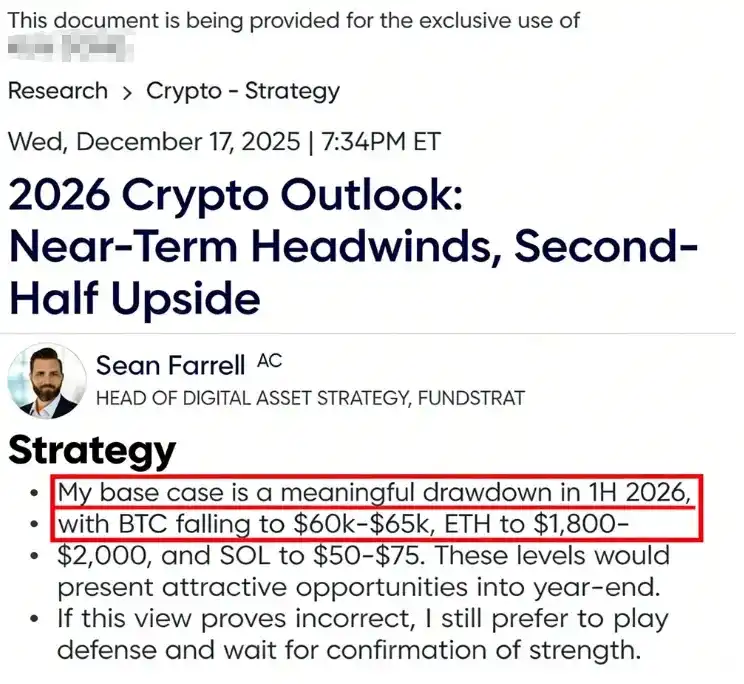
The report explains that the aforementioned pessimistic scenario is not a shift to a long-term bear market but a "strategic reset" risk management measure. Fundstrat highlights several short-term headwinds that may suppress the crypto market in early 2026, including a possible U.S. government shutdown, international trade policy uncertainty, waning confidence in AI investments, and policy uncertainties due to a change in the Fed chairmanship.
These macro factors, combined with high volatility, may trigger a valuation pullback of crypto assets in a tight liquidity environment. Fundstrat emphasizes that this adjustment is a "pullback rather than a collapse," suggesting that a sharp decline is often a prelude to a new uptrend. After digesting risks in the first half of the year, the second half is expected to see a renewed strength.
The report even provides an optimistic target for the end of 2026: Bitcoin at $115,000, Ethereum at $4,500. It specifically mentions that Ethereum may exhibit relative strength in this round of adjustment. The report points out that Ethereum has some structural advantages: there is no selling pressure from miners after transitioning to PoS consensus, unlike Bitcoin, which faces continuous selling pressure from miners; there are no potential selling pressure factors from large holders like MicroStrategy. Additionally, compared to Bitcoin, Ethereum has lower concerns about quantum computing threats.
These factors mean that Ethereum may be better able to resist selling pressure in the medium term. It is evident that the Fundstrat internal research report has a somewhat cautious tone. While still bullish in the long term, it advises internal clients to increase their cash and stablecoin holdings in the short term and patiently wait for better entry points.
Tom Lee's Publicly Optimistic Prediction for Ethereum in 2025
In sharp contrast to the internal report at Fundstrat, its co-founder Tom Lee has consistently played a "super-bull" role in public events throughout 2025, often releasing Bitcoin and Ethereum price expectations far above market reality:
Bullish at the beginning of the year on Bitcoin, as reported by CoinDesk, Tom Lee initially set a Bitcoin year-end target for 2025 at up to around $250,000. In July and August 2025, as the Ethereum price surged close to its historical high, Tom Lee publicly stated that Ethereum could hit $12,000–$15,000 by the end of 2025, calling it one of the most significant macro investment opportunities in the next 10–15 years.
In August, when he appeared on CNBC, he further raised the target price, stating that Ethereum is entering a critical turning point similar to Bitcoin in 2017. In 2017, Bitcoin started below $1,000 and, under the "digital gold" narrative, rose to $120,000, achieving a 120x increase. Due to the passage of the "Genius Bill," which paved the way for stablecoins, heralding the "ChatGPT Moment" for the crypto industry, and because the core advantages of smart contracts do not apply to Bitcoin, he predicted this was Ethereum's "2017 Moment," where a rise from $3,700 to $30,000 or higher is not out of the question.
Super Cycle Narrative: As we entered the autumn rally, Tom Lee continued to maintain an extremely optimistic stance. In a November 2025 interview, he stated, "We believe that ETH is embarking on a super cycle similar to Bitcoin's from 2017 to 2021," implying that Ethereum has the potential to replicate Bitcoin's hundredfold increase over the next few years.
Dubai Summit Speech: At the beginning of December 2025 during the Binance Blockchain Week, Tom Lee once again astonishingly proclaimed a bull market, predicting that Bitcoin could skyrocket to $250,000 in "a few months," and bluntly stated that the then price of Ethereum around $3,000 was "severely undervalued."
He pointed out through historical data comparisons that if the ETH/BTC ratio returns to its eight-year average level (around 0.07), the ETH price could reach $12,000; if it returns to the 2021 relative high point (around 0.16), then ETH could rise to $22,000; and in an extreme scenario, if the ETH/BTC ratio rises to 0.25, theoretically, the valuation of Ethereum could surpass $60,000.
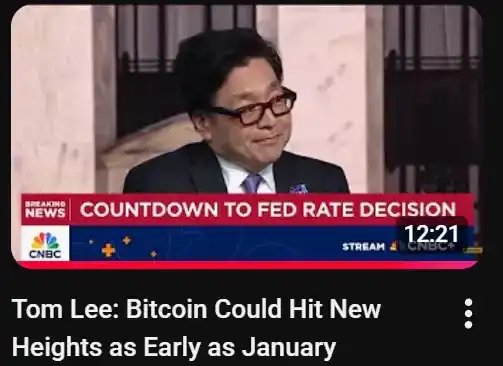
Short-Term All-Time High Expectation: Despite facing market volatility towards the end of the year, Tom Lee has not tempered his bullish rhetoric. In mid-December 2025, during an interview with CNBC, he stated, "I do not believe this upward trend has ended," and he bet on Bitcoin and Ethereum to reach a new all-time high by the end of January next year. At that time, Bitcoin had surpassed its 2021 high, while Ethereum was around $3,000, still about 40% below its $4,954 all-time high.
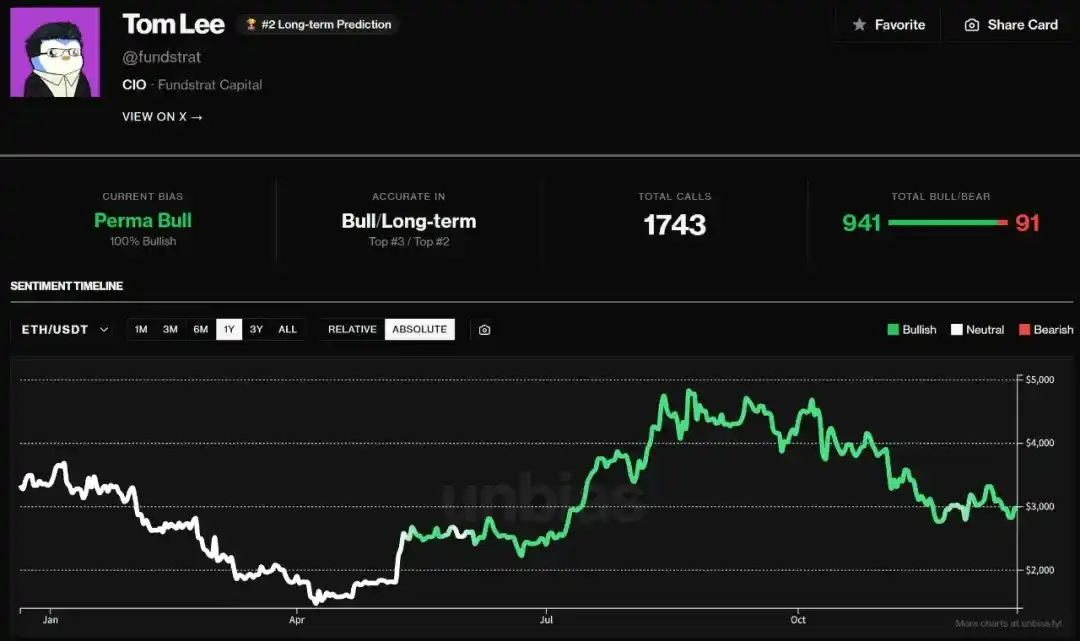
The above forecast list covers almost all major time points in 2025. On the unbiased Fundstrat analysis page, Tom Lee is labeled as a "Perma Bull," and every time he speaks, he sets higher price targets and more optimistic period outlooks for the market. However, these aggressive predictions are far from the actual trend. This series of facts has led the market to begin questioning the credibility of the "Wall Street Oracle" Tom Lee.
Who Is Tom Lee
Thomas Jong Lee, commonly known as Tom Lee, is a renowned American stock market strategist, research head, and financial commentator. He started on Wall Street in the 1990s, worked at Kidder Peabody and Salomon Smith Barney, joined J.P. Morgan in 1999, and became the Chief Equity Strategist in 2007.
In 2014, he co-founded the independent research firm Fundstrat Global Advisors and served as Head of Research, transitioning from a Wall Street strategist to a leader of an independent research firm, being considered one of the early Wall Street strategists to integrate Bitcoin into mainstream valuation discussions. In 2017, he released a report titled "A framework for valuing bitcoin as a substitute for gold," which first proposed that Bitcoin has the potential to partially replace gold as a store of value.
Due to the high media coverage of his research and viewpoints, Tom Lee is often seen in mainstream financial programs and events as the "Head of Research at Fundstrat" (including CNBC-related program/event pages and video content referencing his title). Since 2025, his influence has further extended to the "Ethereum Treasury" narrative: according to Reuters, after BitMine advanced Ethereum Treasury-related financing, Fundstrat's Thomas Lee joined the board to support its Ethereum-oriented treasury strategy. At the same time, Fundstrat continues to release market outlooks and opinion segments centered around Tom Lee through its own YouTube channel.
From Arrogance to Humility: Contrasting Publicly Bullish Calls with Internally Cautious Bearish Views
Tom Lee and his team's conflicting statements on different occasions have sparked industry discussions about their motivations and integrity. In response to recent controversies, Sean Farrell, Fundstrat's Head of Digital Asset Strategy, wrote a post stating that there are misconceptions about Fundstrat's research process.
He mentioned that Fundstrat has multiple analysts internally, each using an independent research framework and time horizon to serve different types of clients' objectives; Tom Lee's research is more geared towards traditional asset management firms and "low allocation" investors (typically allocating only 1%–5% of assets to BTC/ETH), emphasizing long-term discipline and structural trends, while he himself mainly serves portfolios with a higher proportion of crypto assets (around 20%+). However, when publicly making a bullish call on ETH, Tom Lee did not disclose that he was targeting the "1%–5% allocation to BTC/ETH" group.
Farrell further stated that their cautious baseline scenario for the first half of 2026 is part of risk management, not a shift to a bearish view on the long-term prospects of crypto. He believes the current market pricing leans towards being "almost perfect," but risks such as government shutdowns, trade volatility, uncertainty in AI capital expenditure, the change in the Fed Chair, among others, still exist. He also listed their historical performance, stating that their token portfolio has roughly tripled since mid-January 2023, while their crypto stock portfolio has risen about 230% since inception, with a relative BTC outperformance of about 40%. Within their respective lifespans, both have likely outperformed most liquid funds. However, this wording seems more like a way to address Bitmine's $3 billion paper loss and conflicting statements from the founder, hinting at a lack of transparency.
Epilogue: The Discrepancy Lies Not in the Issue Itself, But in Disclosure and Boundaries
The real point of contention here is not the existence of different frameworks within Fundstrat, but rather the lack of clear delineation and interest disclosure by the co-founder between public-facing communication and service-side.
Sean Farrell used the explanation of serving different types of clients to justify the contradictory statements, which may hold logically, but still raises three issues on the communication front:
1. When Tom Lee expresses strong optimism towards ETH in public videos and media interviews, the audience does not automatically assume that this is "only applicable to a small portion of a long-term portfolio discussion," nor do they inherently grasp the implied risk disclaimers, time horizons, and probability weighting. Tom Lee himself has not provided explicit clarification and scope on this.
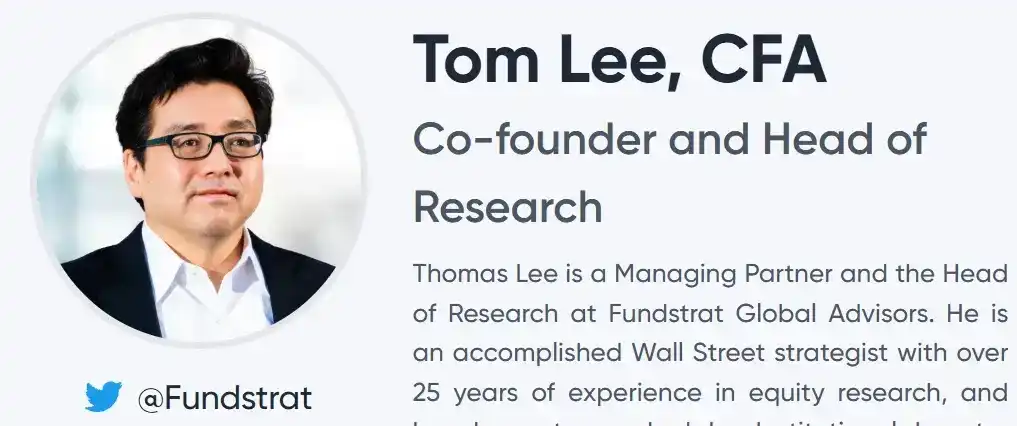
2. The nature of FS Insight/Fundstrat's subscription model is "research monetization," with subscription prompts like "Start Free Trial" directly on the website and featuring Tom Lee in promotions. Tom Lee is a key figure at Fundstrat, prominently labeled as "Tom Lee, CFA / Head of Research" on the FS Insight page. As more traffic and subscriptions come from Tom Lee's public interviews in the media, how does the company make the public believe that "this is just expressing personal opinions"?
3. Public information indicates that Tom Lee also serves as the Chairman of the Board at BitMine Immersion Technologies (BMNR), a company focusing ETH in its treasury strategies. In this dual role, his continuous public advocacy for "long ETH" would naturally be perceived by the market as closely aligned with the affiliated entity's interests. For CFA charterholders, professional ethics also emphasize making "full and clear disclosures" regarding matters that could affect independence and objectivity.
Such disputes often involve compliance issues: Anti-Fraud and Conflict of Interest Disclosure. In the context of U.S. securities laws, Rule 10b-5 is a typical anti-fraud provision that centers on prohibiting material false or misleading statements in connection with securities trading.
Furthermore, the organizational structure of Fundstrat adds complexity to the dispute: Fundstrat Global Advisors underscores in its terms and disclosure documents that it is a research company, "not a registered investment advisor, nor a broker-dealer," and the subscription research is "for client use only." However, simultaneously, Fundstrat Capital LLC explicitly functions as a "SEC-registered investment advisor (RIA)" offering advisory services.
Considering that public interviews and the operation of the Fundstrat YouTube channel effectively take on a "customer acquisition/marketing" function, it raises another question: which content belongs to individual research dissemination and which content belongs to company marketing. If an institution's public video channel continues to release "bullish segments," while the subscription service side releases "bearish for the first half of the year" forecasts, and does not synchronously present key qualification criteria and risk frameworks in public communication, then it would at least constitute a selective presentation under information asymmetry.

This may not necessarily violate the law, but it will continue to erode the public's trust in research independence and credibility, and blur the boundaries of "research — marketing — narrative mobilization." For a research institution where reputation is one of its commercial cores, this trust cost will ultimately backfire on the brand itself.
You may also like

December 24th Market Key Intelligence, How Much Did You Miss?

Base's 2025 Report Card: Revenue Grows 30X, Solidifies L2 Leadership

Venture Capital Post-Mortem 2025: Hashrate is King, Narrative is Dead

Are Those High-Raised 2021 Projects Still Alive?

Aave Community Governance Drama Escalates, What's the Overseas Crypto Community Talking About Today?

Key Market Information Discrepancy on December 24th - A Must-See! | Alpha Morning Report
Polymarket Announces In-House L2, Is Polygon's Ace Up?

2025 Whale Saga: Mansion Kidnapping, Supply Chain Poisoning, and Billions Liquidated

IOSG: From Compute to Intelligence, a Reinforcement Learning-Driven Decentralized AI Investment Map

Believing in the Capital Market - The Essence and Core Value of Cryptocurrency

Absorb Polymarket Old Guard, Coinbase Plunges Into Prediction Market Abyss

AI Trading Risks in Crypto Markets: Who Takes Responsibility When It Fails?
AI trading is already core market infrastructure, but regulators still treat it as a tool — responsibility always stays with the humans and platforms behind it. The biggest risk in 2025 is not rogue algorithms, but mass-adopted AI strategies that move markets in sync and blur the line between tools and unlicensed advice. The next phase of AI trading is defined by accountability and transparency, not performance — compliance is now a survival requirement, not a constraint.

Coinbase Joins Prediction Market, AAVE Governance Dispute - What's the Overseas Crypto Community Talking About Today?
Over the past 24 hours, the crypto market has shown strong momentum across multiple dimensions. The mainstream discussion has focused on Coinbase's official entry into the prediction market through the acquisition of The Clearing Company, as well as the intense controversy within the AAVE community regarding token incentives and governance rights.
In terms of ecosystem development, Solana has introduced the innovative Kora fee layer aimed at reducing user transaction costs; meanwhile, the Perp DEX competition has intensified, with the showdown between Hyperliquid and Lighter sparking widespread community discussion on the future of decentralized derivatives.
This week, Coinbase announced the acquisition of The Clearing Company, marking another significant move to deepen its presence in this field after last week's announcement of launching a prediction market on its platform.
The Clearing Company's founder, Toni Gemayel, and the team will join Coinbase to jointly drive the development of the prediction market business.
Coinbase's Product Lead, Shan Aggarwal, stated that the growth of the prediction market is still in its early stages and predicts that 2026 will be the breakout year for this field.
The community has reacted positively to this, generally believing that Coinbase's entry will bring significant traffic and compliance advantages to the prediction market. However, this has also sparked discussions about the industry's competitive landscape.
Jai Bhavnani, Founder of Rivalry, commented that for startups, if their product model proves to be successful, industry giants like Coinbase have ample reason to replicate it.
This serves as a reminder to all entrepreneurs in the crypto space that they must build significant moats to withstand competition pressure from these giants.
Regulated prediction market platform Kalshi launched its research arm, Kalshi Research, this week, aimed at opening its internal data to the academic community and researchers to facilitate exploration of prediction market-related topics.
Its inaugural research report highlights Kalshi's outperformance in predicting inflation compared to Wall Street's traditional models. Kalshi co-founder Luana Lopes Lara commented that the power of prediction markets lies in the valuable data they generate, and it is now time to better utilize this data.
Meanwhile, Kalshi announced its support for the BNB Chain (BSC), allowing users to deposit and withdraw BNB and USDT via the BSC network.
This move is seen as a significant step for Kalshi to open its platform to a broader crypto user base, aiming to unlock access to the world's largest prediction market. Furthermore, Kalshi also revealed plans to host the first Prediction Market Summit in 2026 to further drive industry engagement and development.
The AAVE community recently engaged in heated debates around an Aave Improvement Proposal (AIP) titled "AAVE Tokenomics Alignment Phase One - Ownership Governance," aiming to transfer ownership and control of the Aave brand from Aave Labs to Aave DAO.
Aave founder Stani Kulechov publicly stated his intention to vote against the proposal, believing it oversimplifies the complex legal and operational structure, potentially slowing down the development process of core products like Aave V4.
The community's reaction was polarized. Some criticized Stani for adopting a "double standard" in governance and questioned whether his team had siphoned off protocol revenue, while others supported his cautious stance, arguing that significant governance changes require more thorough discussion.
This controversy highlights the tension between the ideal of DAO governance in DeFi projects and the actual power held by core development teams.
Despite governance disputes putting pressure on the AAVE token price, on-chain data shows that Stani Kulechov himself has purchased millions of dollars' worth of AAVE in the past few hours.
Simultaneously, a whale address, 0xDDC4, which had been quiet for 6 months, once again spent 500 ETH (approximately $1.53 million) to purchase 9,629 AAVE tokens. Data indicates that this whale has accumulated nearly 40,000 AAVE over the past year but is currently in an unrealized loss position.
The founder and whale's increased holdings during market volatility were interpreted by some investors as a confidence signal in AAVE's long-term value.
In this week's top article, Morpho Labs' "Curator Explained" detailed the role of "curators" in DeFi.
The article likened curators to asset managers in traditional finance, who design, deploy, and manage on-chain vaults, providing users with a one-click diversified investment portfolio.
Unlike traditional fund managers, DeFi curators execute strategies automatically through non-custodial smart contracts, allowing users to maintain full control of their assets. The article offered a new perspective on the specialization and risk management in the DeFi space.
Another widely circulated article, "Ethereum 2025: From Experiment to Global Infrastructure," provided a comprehensive summary of Ethereum's development over the past year. The article noted that 2025 is a crucial year for Ethereum's transition from an experimental project to global financial infrastructure. Through the Pectra and Fusaka hard forks, Ethereum achieved significant reductions in account abstraction and transaction costs.
Furthermore, the SEC's clarification of Ethereum's "non-securities" nature and the launch of tokenized funds on the Ethereum mainnet by traditional financial giants like JPMorgan marked Ethereum's gaining recognition from mainstream institutions. The article suggested that whether it is the continued growth of DeFi, the thriving L2 ecosystem, or the integration with the AI field, Ethereum's vision as the "world computer" is gradually becoming a reality.
The Solana Foundation engineering team released a fee layer solution called Kora this week.
Kora is a fee relayer and signatory node designed to provide the Solana ecosystem with a more flexible transaction fee payment method. Through Kora, users will be able to achieve gas-free transactions or choose to pay network fees using any stablecoin or SPL token. This innovation is seen as an important step in lowering the barrier of entry for new users and improving Solana network's availability.
Additionally, a deep research report on propAMM (proactive market maker) sparked community interest. The report's data analysis of propAMMs on Solana like HumidiFi indicated that Solana has achieved, or even surpassed, the level of transaction execution quality in traditional finance (TradFi) markets.
For example, on the SOL-USDC trading pair, HumidiFi is able to provide a highly competitive spread for large trades (0.4-1.6 bps), which is already better than the trading slippage of some mid-cap stocks in traditional markets.
Research suggests that propAMM is making the vision of the "Internet Capital Market" a reality, with Solana emerging as the prime venue for all of this to happen.
The competition in the perpetual contract DEX (Perp DEX) space is becoming increasingly heated.
In its latest official article, Hyperliquid has positioned its emerging competitor, Lighter, alongside centralized exchanges like Binance, referring to it as a platform utilizing a centralized sequencer. Hyperliquid emphasizes its transparency advantage of being "fully on-chain, operated by a validator network, and with no hidden state."
The community widely interprets this as Hyperliquid declaring "war" on Lighter. The technical differences between the two platforms have also become a focal point of discussion: Hyperliquid focuses on ultimate on-chain transparency, while Lighter emphasizes achieving "verifiable execution" through zero-knowledge proofs to provide users with a Central Limit Order Book (CLOB)-like trading experience.
This battle over the future direction of decentralized derivatives exchanges is expected to peak in 2026.
Meanwhile, discussions about Lighter's trading fees have surfaced. Some users have pointed out that Lighter charged as much as 81 basis points (0.81%) for a $2 million USD/JPY forex trade, far exceeding the near-zero spreads of traditional forex brokers.
Some argue that Lighter does not follow a B-book model that bets against market makers, instead anchoring its prices to the TradFi market, and the high fees may be related to the current liquidity or market maker balance incentives. Providing a more competitive spread for real-world assets (RWA) in the highly volatile crypto market is a key issue Lighter will need to address in the future.
The Secret Centralization Landscape of Stablecoin Payments: 85% of Transaction Volume Controlled by Top 1000 Wallets

2025 Asset Review: Why Did Bitcoin Significantly Underperform Gold and US Stocks?

Why Did Market Sentiment Completely Collapse in 2025? Decoding Messari's Ten-Thousand-Word Annual Report
Twitter 上的「虚假流量」是指通过操纵关注者数量、喜欢和转发等指标来人为增加一条推文的影响力和可信度。下面是一些常见的制造虚假流量的方法: 1. <b>购买关注者:</b> 一些用户会通过购买关注者来迅速增加他们的关注者数量,从而让他们的账号看起来更受欢迎。 2. <b>使用机器人账号:</b> 制造虚假流量的另一种常见方法是使用机器人账号自动执行喜欢、转发和评论等互动操作,从而提高一条推文的互动量。 3. <b>推文交换:</b> 一些用户之间会进行推文交换,即互相喜欢、转发对方的推文...

Audiera Sees Massive Price Surge – Key Cryptocurrency Updates
Key Takeaways Audiera (BEAT) has witnessed significant growth, experiencing a 70.10% increase in the past week. Despite the…
December 24th Market Key Intelligence, How Much Did You Miss?
Base's 2025 Report Card: Revenue Grows 30X, Solidifies L2 Leadership
Venture Capital Post-Mortem 2025: Hashrate is King, Narrative is Dead
Are Those High-Raised 2021 Projects Still Alive?
Aave Community Governance Drama Escalates, What's the Overseas Crypto Community Talking About Today?
Key Market Information Discrepancy on December 24th - A Must-See! | Alpha Morning Report
Popular coins
Latest Crypto News


Customer Support:@weikecs
Business Cooperation:@weikecs
Quant Trading & MM:[email protected]
VIP Services:[email protected]
 App
App