
OKX & AiCoin Review | Who Earned the Most in Grid Trading Strategy? Unveiling the 6 Major AI Trading "Personalities"

By: blockbeats|2025/10/29 18:30:01
0
Share
copy
Source: OKX

Recently, the "AI Coin Trading Live Arena" launched by the startup team NOF1 has sparked a frenzy in the crypto and fintech community. This competition provided each AI model with $10,000 in real funds to autonomously trade in the crypto market, making AI's "financial IQ" a hot topic.

Beneath this wave of enthusiasm, a more practical question has emerged: Can ordinary users use AI to enhance already relatively mature fixed trading strategies? To explore the answer, OKX and AiCoin jointly initiated a special experiment: using the same GPT-5, Claude Sonnet 4.5, Gemini 2.5 Pro, DeepSeek V3.1, Qwen3 Max, and Grok-4 AI models (for ease of reading, the following will use the abbreviations of each AI), to provide parameters for the OKX BTC contract grid strategy. Through rigorous backtesting under uniform market conditions, the real level of these AI "traders" was evaluated.
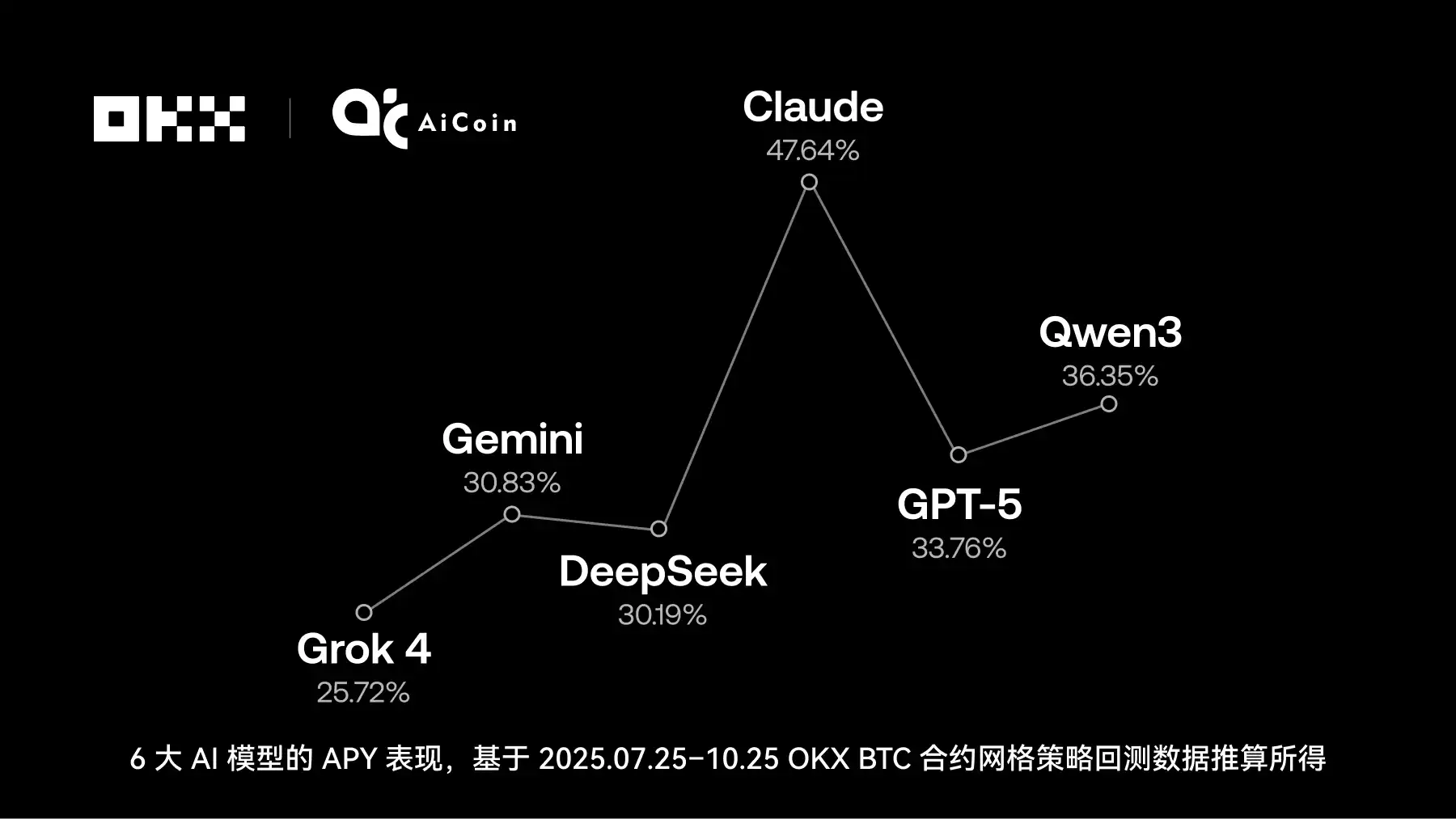
OKX & AiCoin Review | Who Earned the Most in Grid Trading Strategy? Unveiling the 6 Major AI Trading

Without considering transaction fees, in addition to the strategy's own returns, if we factor in the additional earnings from OKX's strategy's "Auto Earn" feature (earnings adjust in real-time with the market, previously reaching around 50%, currently at 3%), then Claude's highest APY in the OKX BTC contract grid strategy can reach 50.64%.

Users only need to upgrade the OKX App to version 6.141.0 or above to automatically enjoy the additional earnings from the "Auto Earn" feature, with funds remaining in the strategy account and available for margin use without increasing risk.

Methodology

Evaluation requirements: Each AI, based on OKX's BTC/USDT perpetual 1-hour chart, provides a set of parameters for an AI grid, including price range and number of grids, direction (long, short, neutral), and pattern (arithmetic progression, geometric progression). At the same time, following a uniform capital limit, the investment amount is $100,000 USDT, and all using 5x leverage.

After all parameters are submitted, validation will be conducted in a uniform backtesting environment: The target is the grid strategy of the BTC/USDT perpetual contract on OKX, with a 15-minute candlestick period (or with some deviation), and the backtesting period uniformly set to historical data from July 25, 2025, to October 25, 2025. Then, through AiCoin's platform's batch backtesting feature, a simulation validation will be carried out. This tool will automatically simulate order placement and execution processes based on the input grid parameters and output detailed trade data and profit statistics. The backtesting results will focus on key metrics such as total profit, return rate, win rate, maximum drawdown, and Sharpe ratio to ensure a fair and transparent comparison of each AI strategy under completely identical market conditions.

Strategy Parameter Analysis: AI "Personality" Differences

Comparing the key grid parameters of six major AI models reveals the core differences in their strategy designs:
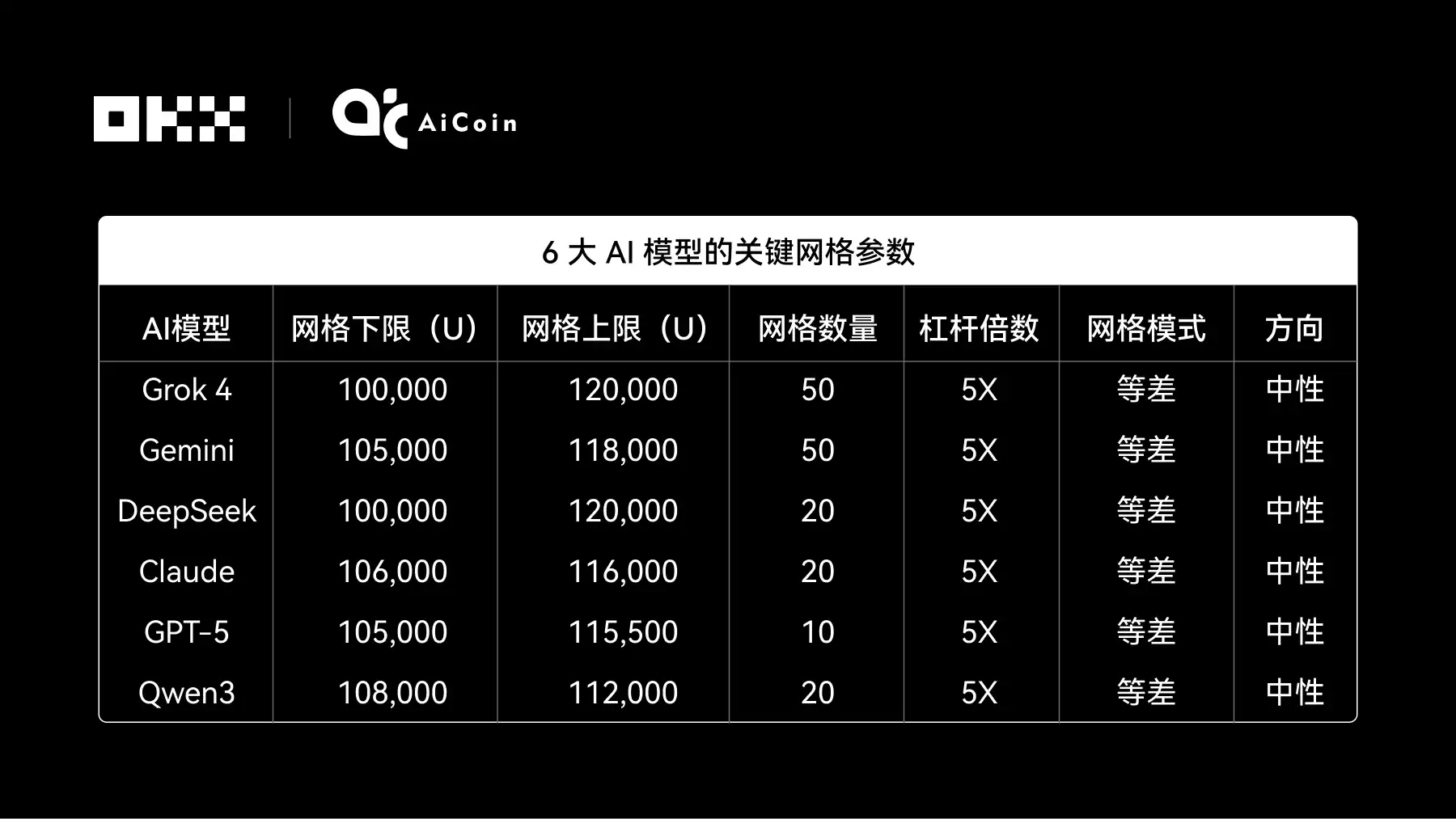
From the table above, it can be seen that all AIs have chosen an arithmetic, rather than a geometric, grid pattern; and a neutral grid strategy, meaning simultaneous arbitrage trading without the need to predict a one-sided trend. In addition, there are significant differences in the price ranges and grid densities provided by each AI:

1) Ultra-High-Frequency Small Amount Faction represented by Grok-4 and Gemini tends to accumulate tiny profits through high-density, high-frequency trading

Both of them use the highest 50-grid layout and the smallest single-grid capital. Gemini's single-grid price interval is the most price-sensitive among all strategies, aiming for ultimate high-frequency arbitrage; while Grok-4 combines a broader 20,000U range to pursue intensive order placement over a wider range. Due to the small single-grid capital, the security of these strategies is relatively higher, but they require the market to maintain a high-frequency oscillation.

2) Steady and Moderate Faction includes DeepSeek and Claude, which use medium-density grids and single-grid capital

Claude's 10,000U range and parameter settings are moderate and balanced. DeepSeek, on the other hand, opts for the widest 20,000U range, aiming to trade at a moderate frequency for more substantial single-trade returns in anticipation of large fluctuations.

3) Large Amount Low-Frequency Faction GPT-5 adopts an extreme "capture big, release small" strategy

It sets the minimum 10-grid layout and the highest single-grid capital, with the largest single-grid price interval, meaning its trading frequency is the lowest, but the single arbitrage profit is the most considerable. This strategy sacrifices profits from small oscillations, focusing on capturing large trend waves. Therefore, its win rate may be higher, but as the single-grid investment is large, once the price breaks out of the range, its liquidation (drawdown) risk is the highest among all strategies.

4) Narrow-Range High-Density Faction Qwen3 aims for efficient arbitrage within a limited range

It adopts the narrowest 4,000U price range among all models, combined with a medium 20-grid layout, making its single-grid price interval relatively small. This is an extremely concentrated strategy that focuses on high-density arbitrage within a specific narrow range. It requires a high level of prediction accuracy, and once the price moves out of the predefined range, the strategy will quickly become ineffective.

Comprehensive Performance Analysis: Claude Dominates, GPT-5 Holds Steady

Although AI is not subject to emotional interference, the final data shows that the performance of AI "traders" still highly depends on their data training and model design. Through a comprehensive comparison of metrics such as returns, risk control, and win rate, the strategies of various AI models exhibited significant differentiation under the same capital and leverage conditions, revealing the trade-offs of different AIs in the actual market conditions (Note: Backtesting does not guarantee future returns. While AI can select favorable market conditions, there is still inherent uncertainty in actual performance):
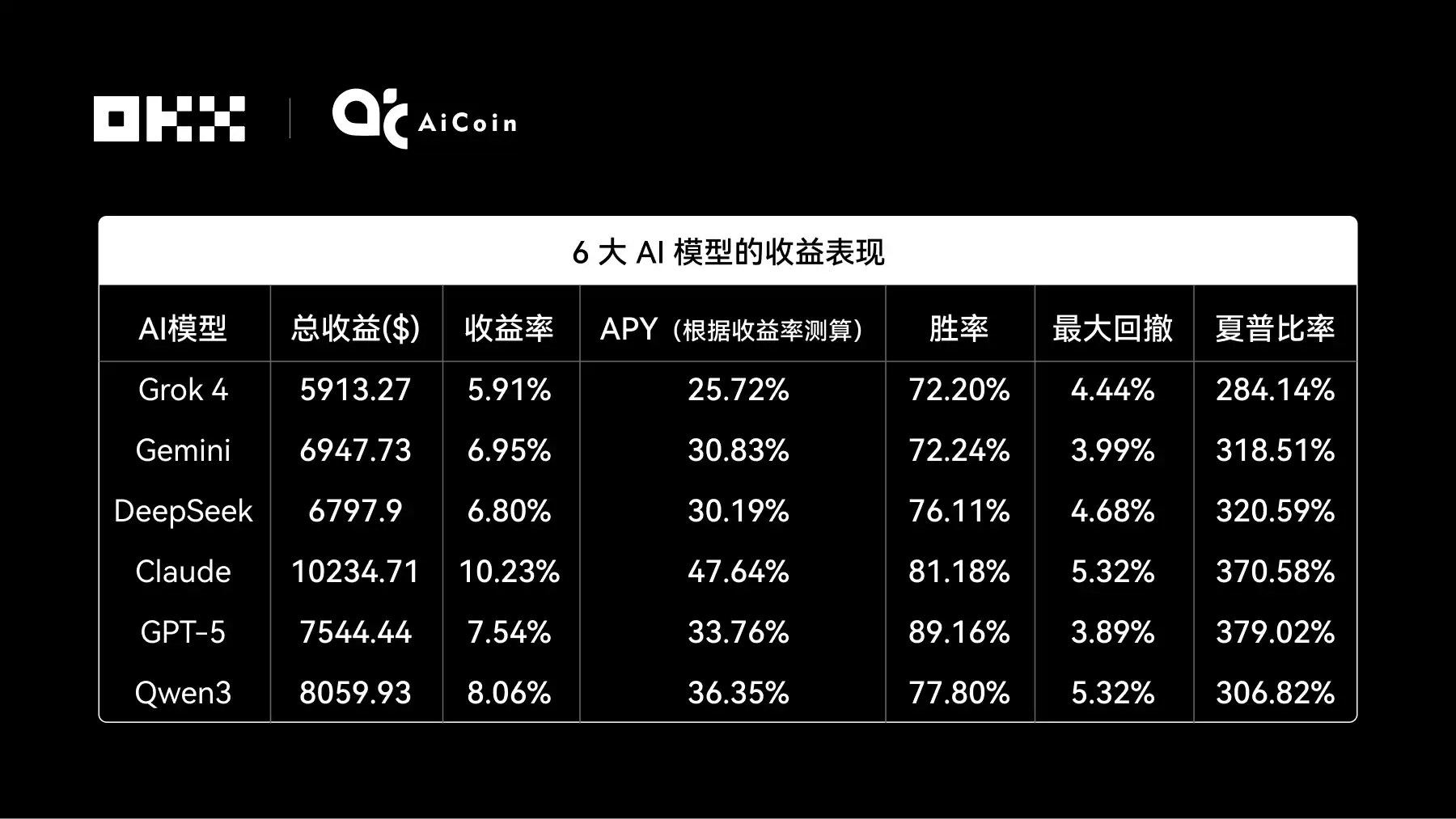
After a holistic evaluation of each model, who truly emerges as the "smart trader"?

1) Return Champion and Risk Taker: Claude

Total Return Leader: Claude stands far ahead with a 10.23% highest return rate, indicating that its combination of a robust range and a moderate grid successfully captured the major price swing range, showcasing the highest effectiveness of the strategy.

Risk and Reward: It also boasts a Sharpe ratio as high as 370.58%, second only to GPT-5, demonstrating excellent risk-adjusted returns. However, its 5.32% maximum drawdown suggests that its high returns are based on enduring larger floating loss volatility, showing a strategy with strong market adaptability and a certain level of risk-taking.

2) Risk Management Master and Efficiency Exemplar: GPT-5

Outstanding Risk Management: GPT-5 perfectly interprets the essence of "don't try to make every penny in the market" strategy. Its low-density grid strategy filters out a significant amount of market noise, resulting in the lowest 3.89% maximum drawdown.

High Efficiency Profits: It secures the top spot with the highest 89.16% win rate and the highest 379.02% Sharpe ratio, proving the robustness and efficiency of its large-scale, low-frequency strategy. GPT-5 is the best example of risk-adjusted returns, reflecting the advantage of reducing trade frequency and focusing on capturing larger volatility opportunities.

3) Strategy Divergence and the Dilemma of High-Frequency Trading

Arbitrage Specialist: Qwen3 ranks third with a 8.06% return rate, showing a decent performance. However, its highly concentrated 4,000U narrow range strategy heavily relies on high-density oscillations within that range. Its equally high 5.32% maximum drawdown, tied with Claude, confirms its high risk concentration—once the market surpasses the narrow range, the strategy faces rapid risk of failure.

High-Frequency Low-Efficiency: Grok-4 and Gemini Although they both employ a similar 50-grid high-density grid strategy, their performance lags behind (Grok-4 has the lowest yield at 5.91%). Their low win rate (around 72%) and lower Sharpe ratio (Grok-4 lowest at 284.14%) suggest that overly frequent small trades may erode profits due to transaction costs such as fees and slippage, failing to demonstrate the advantage of high-frequency trading.

Robust but Unremarkable: Gemini-2.5-Pro has the second-lowest maximum drawdown (3.99%), showing a robust performance, but its yield performance is average, positioning it as a moderate practitioner; DeepSeek-Chat demonstrates robust win rate and drawdown performance (76.11% win rate, 4.68% drawdown), falling between high-frequency and low-frequency strategies.

Key Takeaways: The market has validated that the low-frequency high-profit (GPT-5) and range-precise capture (Claude) strategies outperform the ultra-high-frequency small-profit (Grok-4/Gemini) strategies. GPT-5 emerges victorious with outstanding risk control and the highest Sharpe ratio, while Claude takes the lead with absolute return advantage, representing two successful endpoints of risk control and aggressive returns.

Inspiration and Risk Warning for Strategy Users

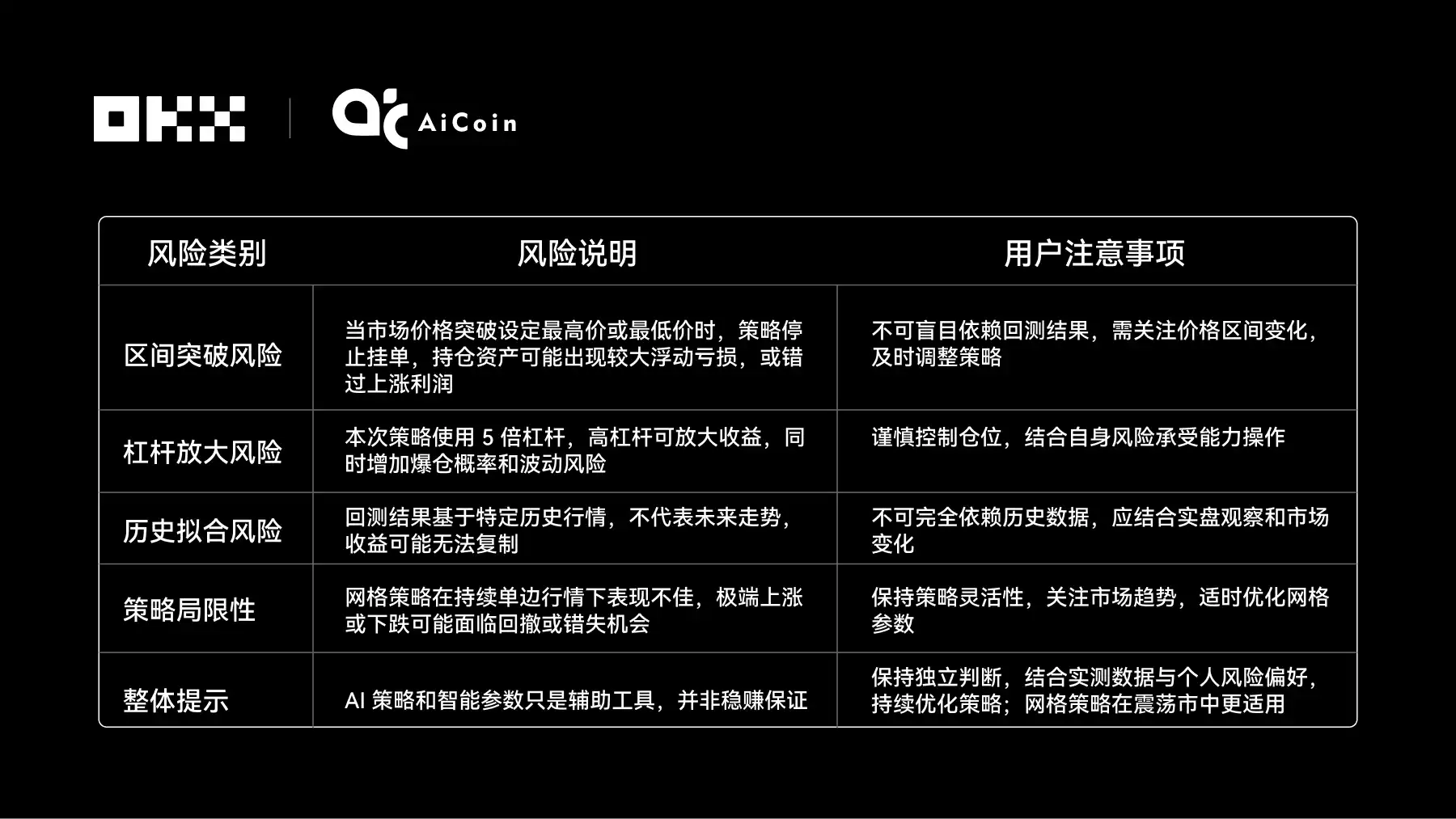
This AI grid trading showdown is not only a technical demonstration but also a vivid trading strategy "lesson." There is no universal strategy, only market-adapted strategies. The core insight from the segmentation of the strategies in this evaluation is that a strategy's success depends on its alignment with the current market conditions: GPT-5's success case clearly tells users that an excellent strategy should not only be profitable but also control drawdown. When setting up a grid, users must prioritize the importance of a high win rate and high Sharpe ratio over just a high yield and set a reasonable stop-loss based on their risk tolerance.

Furthermore, the combination of grid count and price ranges defines the strategy's "character," and users should choose based on their assessment of the market phase.

• Low-Frequency High-Profit vs. High-Frequency Small-Profit: GPT-5's low-density strategy has proven that in specific market conditions, filtering market noise and capturing large swings is more efficient. On the other hand, Grok-4/Gemini's high-density strategy, while trading frequently, fails to achieve the highest returns due to transaction costs, implying that high-frequency small-profit strategies have more stringent requirements based on market conditions.

• Precision Arbitrage: Both Claude's high-yield strategy and Qwen3's narrow-range strategy demonstrate the importance of accurately assessing market trends.

Users can combine the results of this review with OKX platform functionality to make reasoned adjustments.

• Novice or Conservative Users: Can refer to GPT-5's low-density, high-single-lot capital strategy to pursue stability, reduce trading frequency, and psychological pressure.

• Experienced or Return-Driven Users: Can refer to Claude's scheme, which, after accurately assessing the market, uses a medium-density grid to amplify returns, but be prepared to endure significant volatility.

• Using AI Tools to Assist Decision-Making and Adjustment: The parameter combinations provided by the AI model are based on backtesting optimization of historical market data. Users can refer to the parameter design concepts provided by the AI strategy feature of OKX platform for strategy trading but ultimately need to dynamically adjust them based on their own judgment of the currency's trend and volatility. For example: in the face of a one-sided market, they can narrow the range or reduce the grid, and to capture a major market movement, they can increase the range.

• Do Not Invest All Funds in a Single Strategy; Diversify Assets and Targets Reasonably: Utilize OKX's "Take Profit/Stop Loss" feature or regularly close positions to lock in profits, and set stop-loss orders outside the grid range to address losses in the event of a sharp trend reversal.
A Sneak Peek at the End: In addition to backtesting data, we are continuously collecting data on the real-time performance of the six major AI models on OKX BTC contract grid strategy. For more updates, please stay tuned to the official channels of OKX and AiCoin. Stay tuned!

Disclaimer:

This article is for reference only. The article represents the author's views and not those of OKX. This article is not intended to provide (i) investment advice or recommendations; (ii) an offer to buy, sell, or hold digital assets; (iii) financial, accounting, legal, or tax advice. We do not guarantee the accuracy, completeness, or usefulness of such information. Holding digital assets (including stablecoins and NFTs) involves high risks and may experience significant fluctuations. You should carefully consider whether trading or holding digital assets is suitable for you based on your financial situation. For your specific circumstances, please consult your legal/tax/investment professional. Please take responsibility for understanding and complying with local applicable laws and regulations.

This article is a contribution and does not represent the views of BlockBeats.

You may also like

From 0 to $1 Million: Five Steps to Outperform the Market Through Wallet Tracking

If you can grasp the system and see transactions as a byproduct of building a better life, then your chances of success will be much greater.

Token Cannot Compound, Where Is the Real Investment Opportunity?

The next chapter in the crypto industry will undoubtedly be written by Crypto-empowered Stocks.

February 6th Market Key Intelligence, How Much Did You Miss?

1. On-chain Flows: $508.2M USD inflow to Ethereum today; $390.8M USD outflow from Arbitrum 2. Biggest Gainers/Losers: $HBTC, $AIO 3. Top News: Current Bitcoin weekly RSI oversold signal comparable to June 2022

China's Central Bank and Eight Other Departments' Latest Regulatory Focus: Key Attention to RWA Tokenized Asset Risk


Foreword: Today, the People's Bank of China's website published the "Notice of the People's Bank of China, National Development and Reform Commission, Ministry of Industry and Information Technology, Ministry of Public Security, State Administration for Market Regulation, China Banking and Insurance Regulatory Commission, China Securities Regulatory Commission, State Administration of Foreign Exchange on Further Preventing and Dealing with Risks Related to Virtual Currency and Others (Yinfa [2026] No. 42)", the latest regulatory requirements from the eight departments including the central bank, which are basically consistent with the regulatory requirements of recent years. The main focus of the regulation is on speculative activities such as virtual currency trading, exchanges, ICOs, overseas platform services, and this time, regulatory oversight of RWA has been added, explicitly prohibiting RWA tokenization, stablecoins (especially those pegged to the RMB). The following is the full text:


To the people's governments of all provinces, autonomous regions, and municipalities directly under the Central Government, the Xinjiang Production and Construction Corps:


  Recently, there have been speculative activities related to virtual currency and Real-World Assets (RWA) tokenization, disrupting the economic and financial order and jeopardizing the property security of the people. In order to further prevent and address the risks related to virtual currency and Real-World Assets tokenization, effectively safeguard national security and social stability, in accordance with the "Law of the People's Republic of China on the People's Bank of China," "Law of the People's Republic of China on Commercial Banks," "Securities Law of the People's Republic of China," "Law of the People's Republic of China on Securities Investment Funds," "Law of the People's Republic of China on Futures and Derivatives," "Cybersecurity Law of the People's Republic of China," "Regulations of the People's Republic of China on the Administration of Renminbi," "Regulations on Prevention and Disposal of Illegal Fundraising," "Regulations of the People's Republic of China on Foreign Exchange Administration," "Telecommunications Regulations of the People's Republic of China," and other provisions, after reaching consensus with the Cyberspace Administration of China, the Supreme People's Court, and the Supreme People's Procuratorate, and with the approval of the State Council, the relevant matters are notified as follows:


  I. Clarify the essential attributes of virtual currency, Real-World Assets tokenization, and related business activities


  (I) Virtual currency does not possess the legal status equivalent to fiat currency. Virtual currencies such as Bitcoin, Ether, Tether, etc., have the main characteristics of being issued by non-monetary authorities, using encryption technology and distributed ledger or similar technology, existing in digital form, etc. They do not have legal tender status, should not and cannot be circulated and used as currency in the market.


  The business activities related to virtual currency are classified as illegal financial activities. The exchange of fiat currency and virtual currency within the territory, exchange of virtual currencies, acting as a central counterparty in buying and selling virtual currencies, providing information intermediary and pricing services for virtual currency transactions, token issuance financing, and trading of virtual currency-related financial products, etc., fall under illegal financial activities, such as suspected illegal issuance of token vouchers, unauthorized public issuance of securities, illegal operation of securities and futures business, illegal fundraising, etc., are strictly prohibited across the board and resolutely banned in accordance with the law. Overseas entities and individuals are not allowed to provide virtual currency-related services to domestic entities in any form.


  A stablecoin pegged to a fiat currency indirectly fulfills some functions of the fiat currency in circulation. Without the consent of relevant authorities in accordance with the law and regulations, any domestic or foreign entity or individual is not allowed to issue a RMB-pegged stablecoin overseas.


(II)Tokenization of Real-World Assets refers to the use of encryption technology and distributed ledger or similar technologies to transform ownership rights, income rights, etc., of assets into tokens (tokens) or other interests or bond certificates with token (token) characteristics, and carry out issuance and trading activities.


  Engaging in the tokenization of real-world assets domestically, as well as providing related intermediary, information technology services, etc., which are suspected of illegal issuance of token vouchers, unauthorized public offering of securities, illegal operation of securities and futures business, illegal fundraising, and other illegal financial activities, shall be prohibited; except for relevant business activities carried out with the approval of the competent authorities in accordance with the law and regulations and relying on specific financial infrastructures. Overseas entities and individuals are not allowed to illegally provide services related to the tokenization of real-world assets to domestic entities in any form.


  II. Sound Work Mechanism


  (III) Inter-agency Coordination. The People's Bank of China, together with the National Development and Reform Commission, the Ministry of Industry and Information Technology, the Ministry of Public Security, the State Administration for Market Regulation, the China Banking and Insurance Regulatory Commission, the China Securities Regulatory Commission, the State Administration of Foreign Exchange, and other departments, will improve the work mechanism, strengthen coordination with the Cyberspace Administration of China, the Supreme People's Court, and the Supreme People's Procuratorate, coordinate efforts, and overall guide regions to carry out risk prevention and disposal of virtual currency-related illegal financial activities.


  The China Securities Regulatory Commission, together with the National Development and Reform Commission, the Ministry of Industry and Information Technology, the Ministry of Public Security, the People's Bank of China, the State Administration for Market Regulation, the China Banking and Insurance Regulatory Commission, the State Administration of Foreign Exchange, and other departments, will improve the work mechanism, strengthen coordination with the Cyberspace Administration of China, the Supreme People's Court, and the Supreme People's Procuratorate, coordinate efforts, and overall guide regions to carry out risk prevention and disposal of illegal financial activities related to the tokenization of real-world assets.


  (IV) Strengthening Local Implementation. The people's governments at the provincial level are overall responsible for the prevention and disposal of risks related to virtual currencies and the tokenization of real-world assets in their respective administrative regions. The specific leading department is the local financial regulatory department, with participation from branches and dispatched institutions of the State Council's financial regulatory department, telecommunications regulators, public security, market supervision, and other departments, in coordination with cyberspace departments, courts, and procuratorates, to improve the normalization of the work mechanism, effectively connect with the relevant work mechanisms of central departments, form a cooperative and coordinated working pattern between central and local governments, effectively prevent and properly handle risks related to virtual currencies and the tokenization of real-world assets, and maintain economic and financial order and social stability.


  III. Strengthened Risk Monitoring, Prevention, and Disposal


  (5) Enhanced Risk Monitoring. The People's Bank of China, China Securities Regulatory Commission, National Development and Reform Commission, Ministry of Industry and Information Technology, Ministry of Public Security, State Administration of Foreign Exchange, Cyberspace Administration of China, and other departments continue to improve monitoring techniques and system support, enhance cross-departmental data analysis and sharing, establish sound information sharing and cross-validation mechanisms, promptly grasp the risk situation of activities related to virtual currency and real-world asset tokenization. Local governments at all levels give full play to the role of local monitoring and early warning mechanisms. Local financial regulatory authorities, together with branches and agencies of the State Council's financial regulatory authorities, as well as departments of cyberspace and public security, ensure effective connection between online monitoring, offline investigation, and fund tracking, efficiently and accurately identify activities related to virtual currency and real-world asset tokenization, promptly share risk information, improve early warning information dissemination, verification, and rapid response mechanisms.


  (6) Strengthened Oversight of Financial Institutions, Intermediaries, and Technology Service Providers. Financial institutions (including non-bank payment institutions) are prohibited from providing account opening, fund transfer, and clearing services for virtual currency-related business activities, issuing and selling financial products related to virtual currency, including virtual currency and related financial products in the scope of collateral, conducting insurance business related to virtual currency, or including virtual currency in the scope of insurance liability. Financial institutions (including non-bank payment institutions) are prohibited from providing custody, clearing, and settlement services for unauthorized real-world asset tokenization-related business and related financial products. Relevant intermediary institutions and information technology service providers are prohibited from providing intermediary, technical, or other services for unauthorized real-world asset tokenization-related businesses and related financial products.


  (7) Enhanced Management of Internet Information Content and Access. Internet enterprises are prohibited from providing online business venues, commercial displays, marketing, advertising, or paid traffic diversion services for virtual currency and real-world asset tokenization-related business activities. Upon discovering clues of illegal activities, they should promptly report to relevant departments and provide technical support and assistance for related investigations and inquiries. Based on the clues transferred by the financial regulatory authorities, the cyberspace administration, telecommunications authorities, and public security departments should promptly close and deal with websites, mobile applications (including mini-programs), and public accounts engaged in virtual currency and real-world asset tokenization-related business activities in accordance with the law.


  (8) Strengthened Entity Registration and Advertisement Management. Market supervision departments strengthen entity registration and management, and enterprise and individual business registrations must not contain terms such as "virtual currency," "virtual asset," "cryptocurrency," "crypto asset," "stablecoin," "real-world asset tokenization," or "RWA" in their names or business scopes. Market supervision departments, together with financial regulatory authorities, legally enhance the supervision of advertisements related to virtual currency and real-world asset tokenization, promptly investigating and handling relevant illegal advertisements.


  (IX) Continued Rectification of Virtual Currency Mining Activities. The National Development and Reform Commission, together with relevant departments, strictly controls virtual currency mining activities, continuously promotes the rectification of virtual currency mining activities. The people's governments of various provinces take overall responsibility for the rectification of "mining" within their respective administrative regions. In accordance with the requirements of the National Development and Reform Commission and other departments in the "Notice on the Rectification of Virtual Currency Mining Activities" (NDRC Energy-saving Building [2021] No. 1283) and the provisions of the "Guidance Catalog for Industrial Structure Adjustment (2024 Edition)," a comprehensive review, investigation, and closure of existing virtual currency mining projects are conducted, new mining projects are strictly prohibited, and mining machine production enterprises are strictly prohibited from providing mining machine sales and other services within the country.


  (X) Severe Crackdown on Related Illegal Financial Activities. Upon discovering clues to illegal financial activities related to virtual currency and the tokenization of real-world assets, local financial regulatory authorities, branches of the State Council's financial regulatory authorities, and other relevant departments promptly investigate, determine, and properly handle the issues in accordance with the law, and seriously hold the relevant entities and individuals legally responsible. Those suspected of crimes are transferred to the judicial authorities for processing according to the law.


 (XI) Severe Crackdown on Related Illegal and Criminal Activities. The Ministry of Public Security, the People's Bank of China, the State Administration for Market Regulation, the China Banking and Insurance Regulatory Commission, the China Securities Regulatory Commission, as well as judicial and procuratorial organs, in accordance with their respective responsibilities, rigorously crack down on illegal and criminal activities related to virtual currency, the tokenization of real-world assets, such as fraud, money laundering, illegal business operations, pyramid schemes, illegal fundraising, and other illegal and criminal activities carried out under the guise of virtual currency, the tokenization of real-world assets, etc.


  (XII) Strengthen Industry Self-discipline. Relevant industry associations should enhance membership management and policy advocacy, based on their own responsibilities, advocate and urge member units to resist illegal financial activities related to virtual currency and the tokenization of real-world assets. Member units that violate regulatory policies and industry self-discipline rules are to be disciplined in accordance with relevant self-regulatory management regulations. By leveraging various industry infrastructure, conduct risk monitoring related to virtual currency, the tokenization of real-world assets, and promptly transfer issue clues to relevant departments.


  IV. Strict Supervision of Domestic Entities Engaging in Overseas Business Activities


(XIII) Without the approval of relevant departments in accordance with the law and regulations, domestic entities and foreign entities controlled by them may not issue virtual currency overseas.


  (XIV) Domestic entities engaging directly or indirectly in overseas external debt-based tokenization of real-world assets, or conducting asset securitization activities abroad based on domestic ownership rights, income rights, etc. (hereinafter referred to as domestic equity), should be strictly regulated in accordance with the principles of "same business, same risk, same rules." The National Development and Reform Commission, the China Securities Regulatory Commission, the State Administration of Foreign Exchange, and other relevant departments regulate it according to their respective responsibilities. For other forms of overseas real-world asset tokenization activities based on domestic equity by domestic entities, the China Securities Regulatory Commission, together with relevant departments, supervise according to their division of responsibilities. Without the consent and filing of relevant departments, no unit or individual may engage in the above-mentioned business.


  (15) Overseas subsidiaries and branches of domestic financial institutions providing Real World Asset Tokenization-related services overseas shall do so legally and prudently. They shall have professional personnel and systems in place to effectively mitigate business risks, strictly implement customer onboarding, suitability management, anti-money laundering requirements, and incorporate them into the domestic financial institutions' compliance and risk management system. Intermediaries and information technology service providers offering Real World Asset Tokenization services abroad based on domestic equity or conducting Real World Asset Tokenization business in the form of overseas debt for domestic entities directly or indirectly venturing abroad must strictly comply with relevant laws and regulations. They should establish and improve relevant compliance and internal control systems in accordance with relevant normative requirements, strengthen business and risk control, and report the business developments to the relevant regulatory authorities for approval or filing.


  V. Strengthen Organizational Implementation


  (16) Strengthen organizational leadership and overall coordination. All departments and regions should attach great importance to the prevention of risks related to virtual currencies and Real World Asset Tokenization, strengthen organizational leadership, clarify work responsibilities, form a long-term effective working mechanism with centralized coordination, local implementation, and shared responsibilities, maintain high pressure, dynamically monitor risks, effectively prevent and mitigate risks in an orderly and efficient manner, legally protect the property security of the people, and make every effort to maintain economic and financial order and social stability.


  (17) Widely carry out publicity and education. All departments, regions, and industry associations should make full use of various media and other communication channels to disseminate information through legal and policy interpretation, analysis of typical cases, and education on investment risks, etc. They should promote the illegality and harm of virtual currencies and Real World Asset Tokenization-related businesses and their manifestations, fully alert to potential risks and hidden dangers, and enhance public awareness and identification capabilities for risk prevention.


  VI. Legal Responsibility


  (18) Engaging in illegal financial activities related to virtual currencies and Real World Asset Tokenization in violation of this notice, as well as providing services for virtual currencies and Real World Asset Tokenization-related businesses, shall be punished in accordance with relevant regulations. If it constitutes a crime, criminal liability shall be pursued according to the law. For domestic entities and individuals who knowingly or should have known that overseas entities illegally provided virtual currency or Real World Asset Tokenization-related services to domestic entities and still assisted them, relevant responsibilities shall be pursued according to the law. If it constitutes a crime, criminal liability shall be pursued according to the law.


  (19) If any unit or individual invests in virtual currencies, Real World Asset Tokens, and related financial products against public order and good customs, the relevant civil legal actions shall be invalid, and any resulting losses shall be borne by them. If there are suspicions of disrupting financial order and jeopardizing financial security, the relevant departments shall deal with them according to the law.


  This notice shall enter into force upon the date of its issuance. The People's Bank of China and ten other departments' "Notice on Further Preventing and Dealing with the Risks of Virtual Currency Trading Speculation" (Yinfa [2021] No. 237) is hereby repealed.


Former Partner's Perspective on Multicoin: Kyle's Exit, But the Game He Left Behind Just Getting Started

Kyle knew his game, so he decided to focus on playing the game he was good at and interested in.

Why Bitcoin Is Falling Now: The Real Reasons Behind BTC's Crash & WEEX's Smart Profit Playbook

Bitcoin's ongoing crash explained: Discover the 5 hidden triggers behind BTC's plunge & how WEEX's Auto Earn and Trade to Earn strategies help traders profit from crypto market volatility.

Popular coins

Latest Crypto News

Read more