
- Buy Crypto
- Markets
- Futures
- Spot
- Copy Trade
 WE-Launch
The Crypto Space's Ultimate Bull vs Bear Dialogue: Has the Four-Year Crypto Cycle Lost Its Effectiveness?
Original Article Title: Markets Are Broken: The Crypto Liquidity Crisis Explained
Original Article Author: Raoul Pal The Journey Man, Youtube
Translation: Peggy, BlockBeats
Editor's Note: The crypto market in 2025 is at a delicate turning point: the approval of a Bitcoin ETF, the intertwining of liquidity cycles and debt refinancing cycles, the AI boom diverting funds, traditional finance and tech giants accelerating their embrace of blockchain. Against this backdrop, market structure has become abnormal, there is a lack of buying interest in long-tail assets, high-performance public chains like Solana have shown weakness, and investor sentiment swings between extreme optimism and panic.
In this issue of "The Journey Man" dialogue, Raoul Pal (former global macro investor, Real Vision co-founder) and Chris Burniske (Placeholder partner) delve into market cycles, liquidity drivers, investment psychology, and industry structural changes.
Is the four-year cycle still effective? How does liquidity interact with the macro framework for crypto assets? How should investors build cognition and strategy in uncertainty? From Solana's unusual performance to the plight of long-tail assets, from the ETF effect to VC model transformation, the two guests not only share their respective biases but also reveal how to build a robust investment strategy in the face of divergence.
The program was recorded on November 13, here is the translated original text:

Current Market Status and Cycle Debate
Raoul Pal: Hello, everyone. I'm Raoul Pal, and welcome to my show, "The Journey Man." Here, we explore the intersection and understanding between the macroeconomy, cryptocurrency, and the era of tech indices. To be able to sit in this position, have these resources and network, and integrate this knowledge together is a rare privilege for me.
Today, I have invited one of my favorite guests to converse with, Chris Burniske. He is one of the most insightful thinkers in this field and has been a source of inspiration for me on how to navigate market fluctuations and investment decisions.
A valuable conversation lies not only in finding points of agreement but also in discussing differences. Chris and I have different views; he believes this cycle may have ended, while I believe it is still ongoing. We both think in terms of probability frameworks, without absolute certainty. Therefore, we will delve into these differences and how people can build their own cognitive frameworks when faced with differing viewpoints.
Chris has a deep understanding of investment psychology, knowing how to think and how to manage a portfolio to achieve survival and prosperity. Next, let's listen to Chris's insights.
Chris, great to see you again, my friend.
Chris Burniske: Thank you for having me again.
Raoul Pal: Yes, today is November 13th, and I guess this episode will air a week later. Well, right now, the market, cryptocurrency, Twitter, everything is in chaos, everyone is trying to figure out where we stand. So, I think let's start with this topic first, and then delve into some more interesting things, like what you've been seeing recently.
So, how are you thinking about where we are in the cycle, in the market, or their structure?
Chris Burniske: Alright. As of today, Bitcoin has dropped about 20% from its high, right? In traditional finance, this would be considered a bear market, right? Whereas in the crypto industry, this is either a "speed bump" or could drop deeper, right? I think we must maintain enough respect because Bitcoin has always been the gravitational center of other crypto assets.
So, there are many ways to look at this issue, and I think that's also where people are feeling the pain. You and I might discuss different viewpoints, and we both know that these viewpoints are probability-weighted in our minds, and we are both prepared to accept that we might be wrong, right? And this is the subtle difference lost online because people either want you to be bullish or bearish. But I think every professional asset manager is always somewhat bullish and bearish, or bullish and paranoid, or bearish and paranoid, or some other combination.
Raoul Pal: Yes, generally, if you have a very strong view, then your whole job is to be paranoid about that view. That's how I understand it.
Chris Burniske: Right. So, in the simplest framework, if you follow the four-year cycle framework, then Bitcoin is now forming a top if you believe in this four-year framework, right? And then you would expect a bottom to arrive about 12 months later. You could say this is due to the halving; I think as Bitcoin's inflation rate drops, this argument becomes increasingly suspect. Especially when you really think about the core of the halving argument and the amount of coins paid to miners, proof of work, the cost of producing Bitcoin, and so on.
So, there is the halving argument, and there is the liquidity argument, and you have done an excellent job in educating everyone to understand the liquidity aspect. Bitcoin aligns with a four-year business cycle, and on top of the business cycle, there is a liquidity cycle. But the problem lies here because right now Bitcoin is somewhat deviating from the liquidity cycle, right?
So I think we have to acknowledge that this is a point that makes me a little anxious. I would think, hey, the liquidity cycle suggests that Bitcoin should perform well at some point, but right now it's struggling a bit. However, I'm also not too confident in this view because if I'm underallocated during an upturn and the liquidity dynamics suddenly come into play, I might get caught off guard.
Overall, I started signaling some caution after the October 10th crash because the market felt heavy to me. Someone commented on crypto Twitter saying that they see the market more as an organism rather than fixating on specific indicators. I'm not particularly focused on a single point myself, nor have I had the in-depth market detail training you have. So I try to take a step back, view the market as a whole, synthesize various variables, and see what the combination of these variables implies.
For me, the market started to turn weird when Solana didn't receive significant buying interest leading up to the expected ETF launch. You see, Bitcoin's DAT buying drove the market, then shifted to Ethereum's DAT buying, along with Bitcoin and Ethereum ETFs, which were very favorable for BTC and ETH. In theory, similar events should also benefit Solana since it's the high-risk asset I chose for this cycle. But that didn't materialize.
Raoul Pal: I've also looked at Solana before and switched later on, but the logic is the same.
Chris Burniske: Yes, we've all been looking at high-performance Layer 1s, strong core engineering, and interesting ecosystems. But when Solana showed weakness during the data expectations and ETF announcement period, I felt something was off. It indicated a lack of buying interest in the market and instead a significant amount of selling pressure.
Then came the crash on October 10th, and the only time I've seen something similar was during the pandemic crash in March 2020. I looked at my portfolio back then, and some assets dropped by 60% to 90% in a single day, which was insane. I don't like this situation because throughout this cycle, there has been anxiety in the market about long-tail assets: Where is the buying interest for these assets? What is their fundamental value? How should we value them? These are issues we've long expected to be addressed, such as the professionalization of crypto asset valuation, and both you and I have explored early on in this regard. Now, that professionalization is arriving, but long-tail assets still lack buying interest. In addition, there's an AI bubble.
And the crash on October 10th revealed the true buying interest levels for many assets. My concern is, do we have to revisit those crash lows? Because some of those lows suggest bear market levels, especially on long-tail assets.
Raoul Pal: Yeah, it depends on which low point you're looking at. If you use Binance's low point, then it's pretty bad; if you use Coinbase's low point, many assets are now basically back to that level.
Chris Burniske: Absolutely right. That's also a subtle difference. There are other signals, such as the ones you mentioned about Binance and Coinbase. The Coinbase premium has disappeared, and now the prices of assets on Coinbase are generally lower than those on Binance, indicating that the buying pressure from the U.S. is not as strong as before. We also see some very aggressive pricing in venture capital trades, although the crypto space does not really have a venture capital bubble.
Raoul Pal: Chris, back to that flash crash liquidation event, who was really hit hard in it? Because someone definitely suffered heavy losses, but it's still not clear who. Most U.S. users are not highly leveraged.
Chris Burniske: Yes, it's clear that people were liquidated, but I don't think we've seen the full answer to where the real damage is. I don't want to spread rumors; I believe everyone has seen some rumors on Crypto Twitter, but I don’t have concrete information. However, there are indeed doubts about certain market makers.
Raoul Pal: What about retail investors? Were they liquidated, or were they just watching in horror? I'm wondering if this has caused some kind of psychological trauma for people, or if it's just like a flash crash in the stock market, leaving people puzzled?
Chris Burniske: I think anyone using leverage was hurt, especially those who leveraged based on Binance's price and suffered heavy losses for sure. So, some retail investors were indeed affected.
But the more significant damage is that the buying pressure for tail-end assets was already paused, and this event made that pause even more severe. Because suddenly, even though there are price differences between exchanges, people still ask: where is the buying pressure for tail-end assets? Then this catastrophic event occurs, showing some extreme low points, which really make people question if those low points are indeed the real buying levels. This is a psychological shock.
Raoul Pal: There's another question that I think is very important but many people haven't realized: is it because everyone believed in the "four-year cycle," and as a result, everyone together turned it into reality?
Chris Burniske: Yes, this is indeed a tricky question. My usual principle is, "This time won't be different unless there is a strong enough reason to make it different." We have seen this pattern in many scenarios because human nature has not changed, and that's something you and I both know.
But this time there are indeed many reasons that could make the situation different, such as the clarification of legislation and regulation in the United States, traditional financial and tech giants massively embracing stablecoins and blockchain technology, the ETF entering the market for the first time, and liquidity coming our way.
So, there are many signs indicating that we may be on the brink of a turning point. I am also prepared, for example, BTC is now at 98000, ETH just passed 3000, Solana is at 140. I am fully prepared for the market to reverse from here; this is not impossible.
Raoul Pal: Yeah, remember 2021 was also a crazy year, Bitcoin dropped by 50%, then quickly rebounded; that wasn't easy.
Chris Burniske: Yes, now BTC has dropped 20% from the peak, ETH has dropped by about 40%, and Solana has dropped around 50% from its high in December last year. I think this washout may be enough. If we bounce from here, I can imagine it would be very painful for many.
This is also an issue I've seen on Crypto Twitter: the sentiment is too extreme, either going all-in or completely cashing out. In contrast, about a month ago, I shared my allocation; roughly 39% in cash and 61% in long-term hold of capitalist assets, which includes a basket of assets, with cryptocurrency naturally being part of it.
So, I am still mostly positioned for capitalism, as capitalism's design is to grow capital. Then, as the market improves, gradually increase cash, deploying cash when the price is attractive enough. Currently, the money market fund's yield is higher than inflation, so slowly accumulate purchasing power. Although not a groundbreaking strategy, I really recommend that everyone, if feeling anxious about the market now, think in a more probabilistic and incremental manner.
Raoul Pal: The issue is, your entry point is very good, so you can take money out early even when Solana hasn't hit a new all-time high, which is actually your advantage. I would classify this as 'paranoia' because apart from Bitcoin, almost all assets have not hit a new high, and the entire market basically peaked in January, which is very strange for this year.
But the problem is, most people have not seen significant gains because they never buy at the bottom. Both you and I were loudly advocating at the bottom, but most people bought in 2023 or 2024 times, and are now basically flat.
Yes, this is psychologically very difficult. Because when you are flat, accepting a 'downsizing' psychologically is very challenging, especially when all your hopes and dreams are riding on this trade. I can understand why everyone is struggling because it is really tough.
Raoul Pal: Yeah, people tend to overlook your venture capital entry, but many of your positions were actually bought in the public markets.
How to Establish the Right Investment Framework in the Crypto Space?
Investor Psychology
Raoul Pal: Right, for example, your Solana, was bought in the public markets, and it was openly operated in front of everyone.
Chris Burniske: Yes, I always tell those who are just entering the crypto market that if they break even at the end of the first cycle, it's actually a victory because they have learned a lot during this process and have experienced painful fluctuations.
So, if someone is not making a profit now, just breaking even but has learned a lot, that's a victory. Of course, if they break even at this price point, I can understand how frustrating that can be.
Lately, I have been encouraging my friends to use a framework for thinking. These friends all have their own investment portfolios, and when we chat, I share some of the best practices, as I see them.
The framework is as follows: Suppose you sell now, how happy would you be if the price drops? How upset would you be if the price rises? Now, suppose you don't sell, how happy would you be if the price rises? How upset would you be if the price drops?
Use this four-quadrant model to compare emotional responses in different scenarios, anticipate future feelings in advance, and avoid making foolish decisions.
Raoul Pal: I think this method is very helpful for rational investors, especially those who seriously think about how to accumulate wealth. But the problem is, young investors can't buy a house; they will feel that this is the only opportunity, the opportunity to change their destiny.
This emotion is too strong; they put all their hopes and dreams on one trade, which is obviously not the right way to invest. But they cannot bear the pain of missing out on the rise, nor can they bear the risk of a fall. These two forces intertwined are truly maddening.
Chris Burniske: Yes, that's true. However, I would like to add a point about the need for instant gratification. Because when I entered the industry as a professional in 2014, I had less than $10,000 to my name, no savings, and the industry was completely different, with different opportunities.
I started with buying some very small positions, gradually learning, and accumulating step by step. Later, in late 2016, due to a hack, my assets were almost completely wiped out. At that time, I had just started writing crypto-related articles and then entered 2017.
Raoul Pal: By the way, how did you mentally adapt to it?
Chris Burniske: That was terrible. I was one of the early victims of a SIM card swap attack. They first shut down my account with one carrier, then opened a new account with another carrier, used that account to reset my Gmail, then used Gmail to reset my Apple account, and finally, all my devices were wiped clean, and I was completely locked out.
It was a very bad experience. My security measures are much better now, and I am grateful for that, but at that time, it was really painful. The feeling of being mentally wiped out is like having your sail completely blown off. And when you experience a cyber attack, it's hard to determine if those people have truly left your "digital house." If someone breaks into your physical house, you easily know when they are gone, but in the digital world, that sense of security is hard to come by.
However, every cloud has a silver lining. I learned a lot about cybersecurity from it.
Raoul Pal: So how did you adjust your mindset and bounce back? Because I think that's a great piece of advice for a lot of people, learning how to rebuild after failure.
Chris Burniske: I think failure is the best teacher and can make you grow more than success. For me, there was no choice. You can sit there and complain, blame others, or you can say, "Yes, this happened to me, it's awful."
Some things were fate, some were my responsibility. I had to improve on my part of the responsibility, and then roll up my sleeves and start over. This is what I want to say to young people: Yes, the world is tough now, and I feel the anxiety, but in many ways, modern life is much easier than the past. It's really tough mentally, but you have to keep moving forward.
Raoul Pal: You lost everything, and then you could only say, "Well, I have to keep living." After that, did you change your trading style and become more conservative? How did that affect you psychologically in rebuilding wealth? Because we see many people go through liquidation, whether it's a hack, investment error, or leveraged liquidation. Someone might be sitting in front of their computer now, 26 years old, just lost $50,000 in this cycle, and they might be wondering, "How do I start over?"
Chris Burniske: I consider myself lucky because Ethereum was in a downturn after the DAO attack at that time. The DAO attack happened in the summer of 2016, if I remember correctly, and then Ethereum fell all the way to the end of the year. So I was able to buy back a lot of ETH. Looking back now at the value of these things, I lost the most on ETH because my entry into ETH was very early, whereas with Bitcoin, it was relatively not as early. As a young person, my purchasing power was more significant in ETH because ETH was only a few dollars at that time, while Bitcoin was already in the hundreds of dollars. So I accumulated some ETH again, which helped me a lot in 2017.
Then we went through the ICO craze, and I invested in almost every ICO, but in terms of ETH, I lost money. You would feel like you were making money, everything seemed wonderful, and in 2017, everything you touched was profitable. However, by 2018 and 2019, everything came crashing down again. Looking back at those trades, I would think, "Oh my, I lost so much ETH, thought I was a genius, but I was actually foolish."
So, I have been through many instances of being foolish and then recovering.
Raoul Pal: I even set a rule for myself: to only allow a maximum of 10% of my portfolio to go into those "silly" high-risk investments, such as meme coins or other extremely high-risk things because sometimes you just want to participate, otherwise, I hardly do any short-term trading. Recently, I checked and found that every investment in this high-risk portion of my portfolio has been losing money.
Chris Burniske: Haha, yes.
Raoul Pal: Every single one is a loss. I actually did this on purpose because I wanted to prove to myself that most of the time, these investments result in losses. If I had just held Solana or made some reasonable rebalancing, the outcome would have been much better.
Chris Burniske: Totally agree. So, the process of getting back up is actually about continuous learning and adjustment. You just reminded me of an article written by Lyn Alden titled "Most Investments Are Bad Investments." If you have been liquidated, perhaps it is an opportunity to get rid of a bunch of bad investments, learn a lesson, and then concentrate your funds on truly high-quality assets.
Because the history of cryptocurrency asset investment tells us that there are only a few true winners, and assets that can continue to grow across multiple cycles are even fewer. Most other things are "one-time miracles" that will eventually become noise. If you did not time these "one-time miracles" well, you would lose money. Therefore, in the long run, you should focus on accumulating your top assets and ensure that their performance can prove that they are creating value. In other words, the chart should show that it can maintain higher lows in each bear market, with an overall upward trend.
Embracing Long Tail Assets
Raoul Pal: Another issue is long-tail assets.
Chris Burniske: Yes, the long tail is getting longer because there is too much supply. People always think that long-tail assets are where they will achieve hundredfold or thousandfold returns, only to miss out on the main trades.
The most significant trend in the past three years has actually been Solana, and the reasoning behind this is very clear: high on-chain activity, a thriving developer ecosystem, and obvious opportunities. However, many people missed out because they wanted to go further out on the risk curve. Now the long-tail assets are oversaturated, there are too many tokens, to the point where even a power-law distribution can't measure it due to the sheer volume.
Raoul Pal: I completely agree. The current issuance is coming from the VC industrial complex, along with a plethora of meme coins; we are literally inundated with tokens.
Chris Burniske: If we look back at the entire cycle, most assets bottomed around December 2022, and then 2023 saw relatively muted performance until October.
From October 2023 to the end of the fourth quarter, the market saw a strong uptrend, which was the "altcoin season" for most tokens. Then, in the first quarter of 2024, the Bitcoin ETF was approved, Bitcoin performed well, and the overall market sentiment was optimistic. Everyone thought, "Oh my, everything is going to happen again just like last time." But that was actually the peak, occurring at the end of the first quarter of 2024.
It was also around that time that meme coins gained popularity, issuance surged, and then people started worrying about FDV (Fully Diluted Valuation) and VC dumping. I think it's a good thing; it shows that people are educating themselves. As a result, from the peak of the first quarter of 2024, most assets entered a painful bear market and kept falling.
Now, I believe we are in a consolidation phase where everyone needs to rebalance their portfolios, take the necessary losses, and realize that many people assume you and I never lose money, but the reality is, we often do. The key is how you manage those losses, offset them against gains, settle your annual returns, pay your taxes, and start afresh.
I understand that many people are starting with only $500, $1,000, $5,000, or $10,000, which can make progress feel slow. But I want to say that the accumulation of wealth through compounding is a tedious process. Take Buffett, for example; he's not the most thrilling person in the world, but he's one of the wealthiest due to his stable, consistent, step-by-step approach. In contrast, Musk is the other extreme—high risk, bold—many young people admire Musk.
However, the issue is, many young people have grown up immersed in a culture of gaming and adrenaline, with the internet filled with dopamine, so they naturally get drawn to traders on Twitter. Those traders post screenshots of buys, sells, and 10x returns, making it all seem very exhilarating.
But we all know that very few traders can truly make money in the long run; trading is extremely difficult. People are attracted because they see someone making a 10x profit on a certain coin and they want the same result. But in reality, gradual accumulation is the way to go. Extending your time horizon, doing nothing at all, actually makes it less likely to make mistakes. Especially if you hold a large-scale Layer1, the probability of making a big mistake is very low.
Raoul Pal: I completely agree. And I think there is an issue in trading culture where everyone likes to show off their profits, which leads people to have unrealistic profit expectations. I even suspect that many of these displays are fake; it's too easy to forge screenshots using Photoshop or AI. So, this false information is also mixed in. I even want to say that for most people who are just entering the crypto market, at least 50% of their portfolio should be allocated to Bitcoin, and then the remaining 50% can be used to try other assets.
If you buy Bitcoin at the right time, such as near the 200-week moving average, you can basically achieve a "never sell" strategy, holding it for the long term as an anchor asset. This way, you will always be bullish on the industry, able to stay calm, follow the cycle's fluctuations, and continue learning.
If Bitcoin returns to the 200-week moving average, you can buy more, and then consider other assets like Solana, Ethereum, Sui, etc. When the market overheats, you can reduce your holdings, accumulate cash, wait until Bitcoin approaches the 200-week moving average again or faces pressure before buying back in.
Raoul Pal: I have always been teaching everyone a principle—don't mess things up. Specifically, holding only a small percentage of tail assets. If you use the barbell strategy, with 50% allocated to Bitcoin, you won't go wrong; then take 10% to experiment and learn. You may have one successful experience that makes you feel like a genius, but most of the time, you will learn some painful lessons.
The mid-tier should not take on too much risk either; you can choose some slightly higher-risk but still fundamentally sound assets, like ETH, Solana, but don't go too far because that will bring a lot of regrets. The portfolio with the least regret is: mostly Bitcoin, a little tail, and some intermediate assets that have both growth potential and no survival risk.
Chris Burniske: Yes, if you anchor with Bitcoin, you can maintain a stable mindset in each cycle, know where you stand, what your exposure is, and whether the market is at a low point or a high point. So, I hope everyone can do this. Of course, Bitcoin also has some complementary assets, such as the recent strong performance of Zcash.
Raoul Pal: Okay, let's get back to what we were discussing earlier. You are now looking at the market structure, overall sentiment, subtle differences, and you feel that the trading conditions are not good, some things don't add up, and there may even be some kind of "self-fulfilling" four-year cycle effect, causing everyone to drive this result together. We see some OGs selling coins, because why not? They bought at $10 and are now selling at $100,000, which is a round number, and they have always sold at this time in the past, and it has always worked. Plus, the structural collapse in October may have caused more damage than what we currently see.
Chris Burniske: Yes, so from a probability perspective, we may be near a top. Right now, opinions in the market are almost split down the middle, with half believing we have reached the top and the other half thinking we haven't.
Raoul Pal: Yes, and this is not a euphoric top, it's more like a 'distribution top'.
Chris Burniske: Exactly.
Raoul Pal: There's also a strange aspect, if we go back to what you mentioned as the 'paranoia point,' I find it very interesting. The opposite view of your perspective is: we haven't seen new all-time highs, gold is surging, liquidity is tapering off, but most assets peaked in January, not at year-end. These are the things that make me paranoid about your point of view.
Chris Burniske: Yes, that's also my concern. Even though Bitcoin hit new highs in the second half of the year, it's the first time this scenario has played out where other markets didn't follow suit.
Raoul Pal: If that's true, this would be the first time this structural divergence has occurred.
Chris Burniske: Yes, but we also have to remember that each cycle breaks some old rules. For example, in the previous bear market, Bitcoin broke above the previous bull market's high for the first time, which had never happened in history. So, there are always subtle differences that invalidate old patterns.
When I think about whether ETH and Solana can return to their previous highs, my conclusion is that the entire market is now focused on 'fundamentals.' Here, by fundamentals, I don't mean valuation, but rather cash flow, buybacks, and the structure supporting asset valuations.
So, the current market's obsession with fundamentals has led projects like Hype to perform well because of their strong buyback and earnings potential. But people fail to realize that this obsession not only hurts long-tail assets but also affects ETH and Solana. In 2021, ETH and Solana were completely exempt from fundamental considerations, but if you look at ETH now, in terms of fee multiples, it's much more expensive than in 2021.
Raoul Pal: We've discussed this before. I believe Layer1 can be exempt because they follow Metcalfe's Law, where value doesn't come from protocol-layer cash flow but from economic activity on the network. When I apply this logic backward, I find the valuation more reasonable. But for DeFi, measuring with fee multiples is completely justified.
Chris Burniske: I think ultimately everything comes down to yield. These staked assets will eventually be like the digital equivalent of a country's bonds; the yield market will price based on real fees rather than inflation rewards. I believe, with the widespread use of stablecoins, this model will become more stable, reducing drastic cyclical fluctuations.
My expectation is that if Ethereum, as a more mature and widely used network, can provide a 5% real staking yield (from fees, not inflation), then I hope Solana can provide at least 7%, and Sui at least 9%. Asset prices will readjust to match these yield levels. This is the simplest logic; ultimately, asset value is determined by holders' yield expectations, and these holders are stakers in all cases.
Raoul Pal: That makes sense, but it feels like we're not at that stage yet; the market is still unable to stabilize pricing.
Chris Burniske: I think we're approaching that stage. If we really enter a bear market, this would be a kind of "reckoning"; low-cap assets have been in a bear market for a long time, starting from the first quarter of 2024. This is the canary in the coal mine. I believe valuation pressure will quickly transmit to assets like ETH, Solana, BNB, Sui, and others. The more mature the asset, the more it will be priced as a "digital sovereign bond," with yield being increasingly important.
Raoul Pal: If we really enter a bear market, what do you think the probability is? For example, conventionally, we might go through a 12-month downturn cycle; what probability would you assign to this scenario?
Chris Burniske: Around 65% to 70%.
Raoul Pal: Okay, so you basically consider this possibility quite high. In your framework, then, would this bear market be as deep as before?
Chris Burniske: No.
Raoul Pal: Oh, that's very interesting.
Chris Burniske: Yes, that's what makes the situation more complex. If I look at Bitcoin, its 200-week moving average is around $55,000, which is an extreme level I'm watching closely. Bitcoin respected this average in 2015, 2019, and during the pandemic crash. It briefly dipped below during the FTX crash, but overall, the 200-week average is a good reference point.
If it drops to $55,000, that means a 56% retracement from the high of $125,000, much smaller than previous retracements. The previous retracements were about 80% and 85%. So, this time could be shallower; I can even see a 50% retracement, around $62,500, or $70,000 to $75,000, basically holding the previous local bottom. If it holds that level, it's only a 40% retracement, which is barely a bear market for crypto.
Raoul Pal: Yes, don't forget, in past cycles, we have experienced seven 30% pullbacks.
Chris Burniske: Right, if we bounce from this level, you could even say that Bitcoin is still in a bull market. The frustrating part is, whether you are bullish or bearish really depends on the time frame.
If you give me a 10-year time frame, I am certainly bullish. But if you ask me about the opportunity from the past month to the next 3 to 9 months, I would be slightly more cautious, but that doesn't mean I am completely bearish.
So, I am closely watching the bottoming action of ETH and Solana, and how they perform relative to their previous lows.
Raoul Pal: This cycle has a strange aspect as well, Bitcoin's dominance hasn't shifted as much as usual.
Chris Burniske: Yes, that's also a puzzling factor. It's not a case of "this time is different," but there are many structural differences. While the logic of the four-year cycle still holds, most of the structure has changed, which is also possible. We always encounter these situations, but it does make me feel strange.
My current setup is this: Remember 2021? Back then, everyone was saying Bitcoin was the "pet rock," no one believed in it because of its relatively lackluster performance in 2021.
From the 2017 high to the 2021 high, Bitcoin only increased by 3 times, while from the bear market low to the 2021 high, it increased by about 20 times. But this time is different, Bitcoin is now very popular, and it may even underperform in the next cycle. If it follows a more gradual logarithmic channel, the returns will significantly decrease.
My concern is that people are over-allocated to Bitcoin in this bear market because they think "Bitcoin is the safe choice." I still believe that if you're in the crypto market, you should hold a significant amount of Bitcoin, but we have to consider another possibility: that MicroStrategy or some Bitcoin-related structure has issues, leading to Bitcoin underperforming ETH, MicroStrategy, or other assets.
So, I think there is a possibility that Bitcoin goes from the "market darling" to the "fallen favorite," and the real high returns may come from some unexpected crypto assets.
Raoul Pal: Let me share my framework, which is one of my most significant lessons: every time I let emotions override my macro framework, the results have been very bad. 2009 was my worst year because I made this mistake. So I have built a very robust framework called the "Everything Code," which is also probabilistic because I acknowledge there are many other possible outcomes.
However, I discovered an interesting phenomenon: ISM (Institute for Supply Management), which has always followed a perfect four-year cycle, suddenly stopped working recently. I thought, what happened? Why is this cycle no longer effective? Later, upon recalculating, I found it to be a debt maturity cycle.
After the 2008 financial crisis, we underwent a debt "reset," where everyone postponed interest payments for three to five years and restructured their debt, creating a three to five-year cycle. This is the origin of the Bitcoin halving cycle. Then suddenly it stopped.
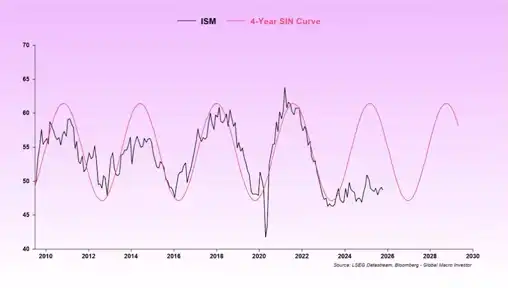
Upon my recalculation, I found that in 2021 and 2022, due to interest rates returning to zero, the cycle extended to around 5.4 years. So when I placed it back into a sine wave model, everything made sense again. We are currently still in the trough of the cycle, and we should soon enter the expansion phase of the business cycle because we have yet to see real growth.
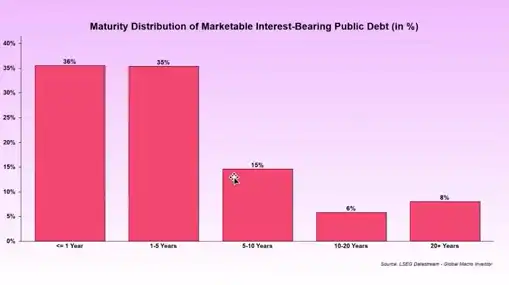
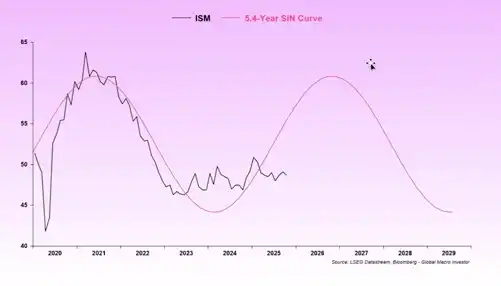
Then I used liquidity as the core driving factor as it determines debt financing. Here is the maturity of interest payments, and here is the liquidity that matches it. This is the total U.S. liquidity, including Federal Reserve net liquidity, banks, and M2. I found that financial conditions (USD, interest rates, commodities) lead total liquidity by six months, and total liquidity, in turn, leads ISM by three to six months. So we have a leading indicator of nine months, suggesting that liquidity should rise, and the business cycle will also rise. This is the framework I have always used, and it is very effective.
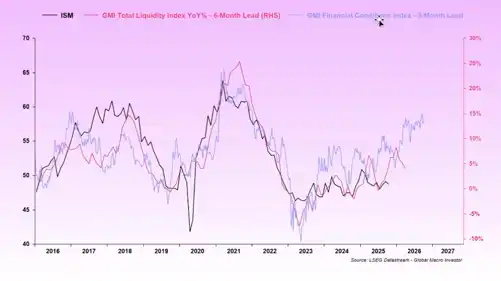
When I compared the Bitcoin trend with ISM, they almost perfectly aligned. This tells us that Bitcoin is currently weak because the business cycle is weak. And the reason the business cycle is weak is that this year is not a debt reset year, but next year is. Therefore, the debt reset year is the key factor.
Then I looked at global liquidity, which is highly correlated with the total market capitalization of the crypto market (excluding Bitcoin), with a correlation of 90% to 97.5%. This means that liquidity is the strongest macro factor historically, primarily driven by the debt refinancing cycle, with the business cycle being just one component of it.
So the question is: will liquidity rise due to the debt reset? If it does rise, then ignoring this factor would be ignoring the strongest historical macro driver, rendering any prediction ineffective. Coupled with fiscal stimulus, election factors, where the government needs to make "Main Street" money, not just Wall Street, it means the business cycle must recover, corporate profits and household incomes must rise, not just the "Big Seven."
This is why I find it hard to give up on this framework, even though I also see the poor market structure, weak trading, and the issues you mentioned.
Chris Burniske: Yes, this is your "conviction point," and my conviction point is exactly the opposite.
Raoul Pal: This is also why I wanted to chat with you because I need to hear that voice whispering in my mind: "Raoul, you might be wrong." That's the most important voice.
Chris Burniske: I think you might be right, just a little early on the timing. For example, your framework is based on the debt refinancing cycle, and the real peak of debt refinancing is in 2026.
Raoul Pal: Yes, that's my view. So, I find it hard to believe we will enter a deep bear market unless all liquidity is sucked away, like into other areas such as the AI bubble.
Chris Burniske: I understand what you mean. The problem is that the pace of Crypto Twitter is too fast, which is one of the reasons I recently reduced my Twitter usage. It is not only unhealthy for me personally, but it also affects my investment judgment because when you seem to be "wrong," even if it's just a timing mismatch, the pressure is enormous. I went through this in 2021 when the market was crazy, but I didn't do much risk-taking because I felt the valuations were too high. As a result, I endured a lot of pressure, and some even questioned if I was still in the market, if I still had "influence."
But in reality, my choice was correct, it just didn't show until the end of 2022, a full two years. And when I was ready to buy Solana at the end of 2022, those who questioned me in 2021 didn't have the courage to buy at the bottom. That's the issue, Twitter is the worst because anyone can comment as they please, and this pressure can lead you away from making the right long-term decisions.
Raoul Pal: Yes, it is really tough. I often come under attack for trying to help others. You see, I guess your investment style has a preference, that you are more likely to reduce your holdings early but also buy early at the bottom because the bottom is easier to grasp than the top. I feel this is your structural bias.
Chris Burniske: You are right.
Raoul Pal: It's actually not easy to do this. For me, I am better at buying at the bottom rather than selling at the top. It's really difficult to grasp the top, so I'd rather reduce my holdings early to relieve psychological pressure.
Chris Burniske: I understand what you mean, I have some structural biases. For example, I have two friends who are very skilled traders, and their strategy is to only chase "above the bull market shoulder" and "below the bear market knee."
In other words, instead of trying to time the top and bottom, it is sufficient to sell at a relatively high position during a bull market and buy at a relatively low position during a bear market. If you can sell ETH between $3500 and $5000, and you bought in between $1000 and $2000, that is already very good, and this logic can be applied to other assets as well.
Another example is when my partner Joel reminded me that JP Morgan was once asked, "How did you achieve such success in life?" His answer was, "By selling too early." This statement left a deep impression on me because he went through many market booms and crashes. I am sure that when he sold, he faced a lot of questioning, with others saying, "I made so much money, why didn't you participate?" But he kept cashing out during others' fervor, accumulating cash so that when the market turned sour, he had funds to reallocate. This is actually a very simple yet effective strategy.
I have had similar experiences myself. For instance, during the crazy ETH price surge when Tom Lee announced a $200 billion OTC trading facility, it was last summer, a very hectic time. I would take a step back and remind myself, "Wow, I feel great, people around me feel great, and people on Twitter are even more excited." This is the signal that it's time to take profits. Of course, if I shared this view on Twitter, people would curse at me saying, "Are you stupid? ETH is going to $20,000!" But you have to withstand that pressure.
Asset Rotation: Zcash and Privacy Coins
Raoul Pal: If you had looked at the liquidity chart at that time, you would have reached the same conclusion: liquidity was not rapidly increasing, and the market could not continue to accelerate.
Chris Burniske: Yes, that's the inflection point you showed, where the price exceeded liquidity support.
Raoul Pal: Exactly, because starting from July, the M2 chart decoupled, all indicators decoupled. At that time, we were thinking, "What's going on?" Later we found out that the explanation was that the Treasury started to rebuild the TGA (Treasury General Account), which sucked out liquidity, and the reverse repo didn't have room to release more. So there was suddenly a significant event, coupled with the government shutdown, which caused the market to lose momentum.
Your intuition was very accurate at that moment because the price had reached the top of the range but had no fuel to continue rising, resulting in a crash, similar to what happened with Solana. If not for these factors, we might have just continued rotating within the crypto market, like a game of musical chairs. Now I am wondering whether Zcash's rise is just part of this rotation or a truly meaningful signal? It's really hard to judge.
Chris Burniske: The recent surge of Zcash is indeed interesting, but it's not just Zcash; old-school privacy coins like Dash, Monero, and Decred are also on the rise, with Zcash leading the pack in terms of gains. This indicates that it has a certain differentiation advantage, but overall, the privacy coin sector is active. I've heard some Bitcoin OGs say that some whales may use these privacy coins at the end of a cycle to conceal profits or seek additional gains. While I don't have concrete data on such rumors and don't participate, this may explain why every cycle end sees a collective surge in privacy coins.
However, the real signal will only be clear when the bear market arrives. If privacy coins like Dash, Monero, and Decred all retreat to their previous lows during a bear market, and Zcash manages to hold a significantly higher low, that would be a strong positive signal. What I'm currently watching is its 50-week moving average, which is around $50.
Raoul Pal: If your assumption is wrong, and the cycle hasn't ended but continues to rise, what would you do? For example, if you firmly believe that Zcash is a long-term major opportunity, where its market cap share should gradually increase as the demand for privacy grows, a logic I completely understand. But if the market keeps rising, how would you proceed? Would you continue to hold long-term, or adjust your strategy?
Chris Burniske: Here's what I would do: I have a portion of my Zcash holdings that is "never sell," just like my attitude towards Bitcoin. History tells us that only those who bought Bitcoin at $1, $10, $100 and held it long term achieved astonishing returns. So, I would consider some of my Zcash as a long-term hold, never to be sold. As for other holdings, I would decide based on Bitcoin's trend. If Bitcoin confirms a bottom, I would consider adding to my positions in other high-quality assets, including Zcash.
I would make decisions based on Bitcoin's trend. This also goes back to the logic of "anchoring in Bitcoin" that I mentioned earlier. Bitcoin is the tide; the tide must turn first before other assets follow. Perhaps a better analogy is ocean currents: the macro environment is like deep-sea currents, Bitcoin is the mainstream cutting through the reefs, and the market's microstructure consists of those small eddies and undercurrents. So, you must first focus on the macro, then observe Bitcoin's changes within it, and finally consider other assets' opportunities.
I'm also monitoring some risks, such as leverage being mostly cleared out but still present. For example, we previously discussed Digital Asset Trusts (DATs), and we don't know how they will perform in a bear market, especially when they trade at a steep discount. Another risk is those "yield-bearing stablecoins." We've already seen them de-peg on Binance, which concerns me because we've seen this story before. I estimate that the major players combined may have a scale of around $18 billion, fundamentally acting as risk arbitrage funds, but they are not prominent in the market, which makes me cautious. If someone theoretically has a lot of leverage or positions but isn't visible in the market, that's a red flag.
Raoul Pal: Yes, we have seen this situation before.
Chris Burniske: I now even lean more towards calling them "yield instruments" rather than stablecoins. I think if the industry can refer to them as "stable yet risky yield instruments" instead of "stablecoins," it would be better because that implies the risk involved.
Raoul Pal: Okay, one last question. My argument is that we have hardly seen any inflow of funds from VCs or hedge funds into the crypto space; the only inflow has been from ETFs, with almost no other channel. Why is that? I know the AI frenzy absorbed a lot of funds, but why couldn't crypto attract capital like it used to? You guys in the VC space were always overwhelmed before, but now hardly anyone is fundraising.
Chris Burniske: First of all, the bubble did indeed form in AI, which absorbed all the hot money. I think this is healthy for the overall crypto industry. At the same time, we have previously discussed the issue of token oversupply. I think the "token-industrial complex" has reached its limit, and people are starting to realize how it operates and its problems. I, too, was a bit naive before and now have to adjust that thinking.
Now, the valuation alarm has sounded, and everything must prove its rationality. This is not just a valuation issue but also involves fund flows. For example, I often discuss with the Celestia team; they need to do this: as unlockings are completed and inflation decreases, their inflation rate could drop to 0.25%. If the demand for data availability is significant enough, it can form structural buying pressure. BNB has performed well over multiple cycles because it has structural buying pressure, as has Hype, Bitcoin, and Ethereum. So, the focus in the future is to look for assets with structural fund flows.
Returning to VC, many crypto VCs in the past were betting on new concepts and new models, but now these models are facing structural selling pressure due to token distribution issues. So, everyone has to go back to the drawing board and rethink the models. For example, should issuances be done at lower valuations? I have always advocated for issuances at lower valuations. Or, in a better regulatory environment, can 100% of the supply be made circulating from day one, as Solana did at the end of 2020? They unlocked about 80% of the supply in one day, and since then, Solana has had a crazy year as the market achieved true price discovery.
Overall, I believe the crypto token VC model that has been popular over the past decade is now under pressure, and everyone must redesign. We will see more investments in "truly profitable companies," such as in the stablecoin sector, or in more mature "tokenized" sectors, or in investments at a smaller, lower valuation scale. Another important trend is that the distribution channels of blockchain technology are being monopolized by big tech and big finance companies because they have tens of millions or even hundreds of millions of users who can directly flow into these protocols.
We were originally expecting native crypto distributors, but in reality, there are only a few such as Coinbase, Robinhood, MetaMask, Phantom, etc., with limited scale. Now, the distribution advantage is shifting to big tech and big finance, squeezing out opportunities for crypto VCs.
Raoul Pal: So, will these intermediary projects be acquired? For instance, you invest early at a $20 million valuation, and in the end, they might be acquired for $100 million or $200 million, rather than the tens of billions as seen before. Just like how Coinbase recently acquired Kobe's project.
Chris Burniske: Yes, this scenario will happen. I saw Arthur Hayes recently raising a fund that looks like a fund specifically for acquiring distressed assets. I'm not sure, but I guess his logic is that there are many mid-sized companies in the market that don't make enough money, can be acquired cheaply, and then integrated or repackaged for traditional finance. This might introduce a kind of "crypto version of private equity," specializing in acquiring distressed assets.
Undoubtedly, the season has changed, and so has the strategy. I now lean towards building large positions in liquid, high-performing crypto assets. Venture capital can indeed bring amazing multiples, but in terms of cash returns, the biggest gains often come from buying and selling large liquid assets at the right time, concentrated within a very short time window. My long-term view has always been that if you can time it right, the returns on liquid assets can be even higher than venture capital, and the cycles are shorter.
Raoul Pal: I completely agree, and this opportunity is open to everyone. But the issue is that people have to accept one fact: this strategy is quite "boring." For example, Bitcoin is already a high-risk asset for those who are not part of Gen Z or the millennial generation. So, holding Bitcoin and a few of its friends to slowly compound value over time is the best strategy.
I think the key is always maintaining a certain Bitcoin exposure while dynamically adjusting the cash proportion based on market opportunities to establish a cash buffer that can be adjusted at any time.
I've tried both ways. I've gone through the entire cycle before. For instance, in the 2013 cycle, I held all the way to the peak, then the drop back to the low, and continued to hold until 2017. That time, I reduced my position too early, really too early — I sold when Bitcoin was at $2,000, and it kept rising to $20,000. In the previous cycle, I hardly reduced my position and instead aggressively bought the dip at the low point, which worked out very well this time.
This cycle, I might reduce some of my position, but I will never sell most of it because my time frame is long, and I believe Bitcoin is the best wealth compounding tool that must not be messed up.
You may also like

Gainers
Latest Crypto News
USPD Protocol Under Attack: Hacker Mints 98 Million Tokens and Steals 232 stETH
A new address withdrew 13,308 ETH from FalconX, approximately $41.47 million
Italian Companies and Exchange Commission: Crypto Asset Service Providers Must Obtain MiCAR Authorization by December 30 or Face Shutdown
ZachXBT: UK Hacker Danny Suspectedly Arrested, $18.58 Million in Crypto Assets Seized
Yesterday, the US Ethereum Spot ETF saw a net outflow of $41.5 million


Customer Support:@weikecs
Business Cooperation:@weikecs
Quant Trading & MM:[email protected]
VIP Services:[email protected]
 App
App