
Twilight of the Titans: How Has the Rise of Stablecoin Newcomers Eroded the Empires of Tether and Circle?
Original Title: Apps and Chains, Not Issuers: The Next Wave of Stablecoin Economics Belongs to DeFi
Original Author: Simon, Delphi Digital
Original Translator: DingDang, Odaily Planet Daily
Tether and Circle's Moats Are Being Eroded: Distribution Channels Trump Network Effects. The stablecoin market share held by Tether and Circle may have peaked in relative terms, even as the overall stablecoin supply continues to grow. By 2027, the total market value of stablecoins is expected to surpass 1 trillion USD, but the gains from this expansion will not primarily flow to existing giants as they did in the last cycle. Instead, an increasing share will flow to "ecosystem-native stablecoins" and "white label issuance" strategies as blockchain and applications begin to internalize revenue and distribution channels.
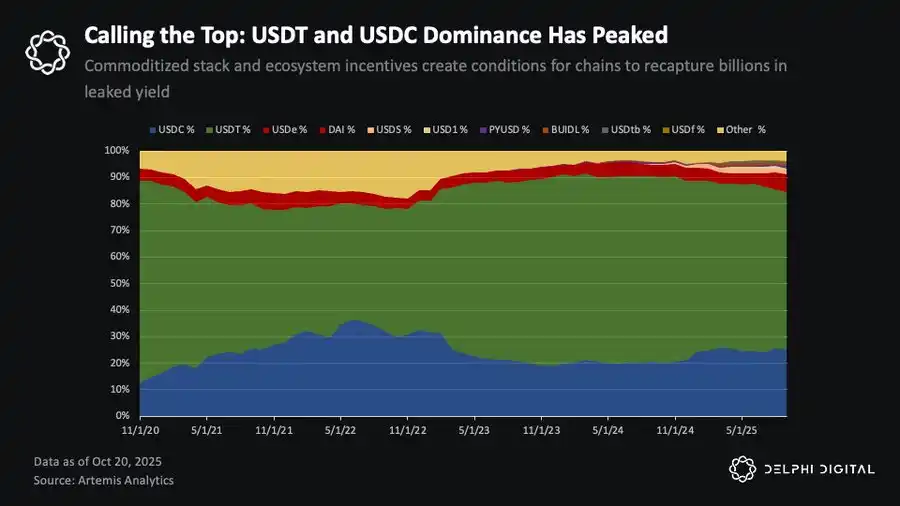
Currently, Tether and Circle hold approximately 85% of the circulating stablecoin supply, totaling around 265 billion USD.
Background data is as follows: reportedly, Tether is being valued at 500 billion USD, raising 20 billion USD, with a circulation of around 185 billion USD, and Circle is valued at around 35 billion USD with a circulation of around 80 billion USD.
The network effects that supported their monopolistic positions are weakening. Three forces are driving this change:
Firstly, the importance of distribution channels has surpassed the so-called network effects. The relationship between Circle and Coinbase illustrates this well. Coinbase obtains 50% of the residual yield from Circle's USDC reserves and monopolizes the revenue from all USDC on its platform. In 2024, Circle's reserve yield was around 1.7 billion USD, with approximately 908 million USD paid to Coinbase. This demonstrates that distribution partners of stablecoins can capture most of the economic benefits, explaining why players with strong distribution capabilities are now more inclined to issue their own stablecoins rather than continue to benefit the issuer.
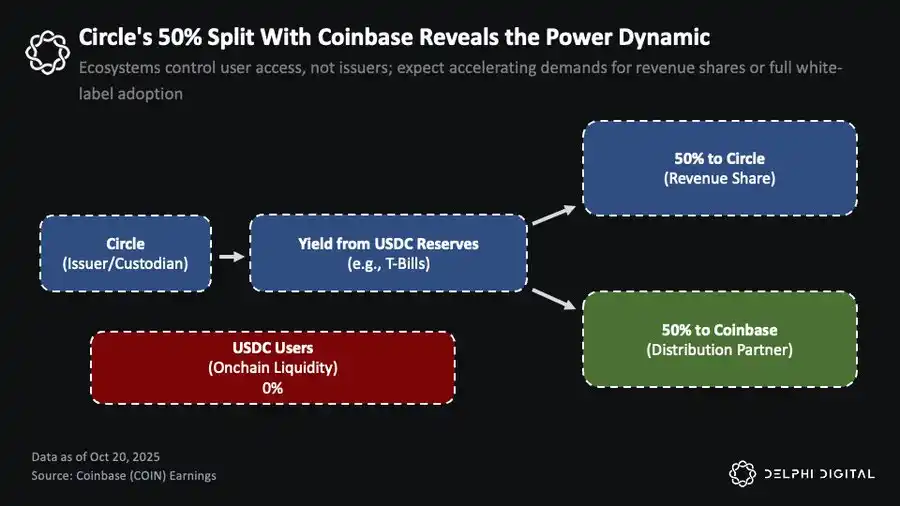
Coinbase receives 50% of the interest from Circle's USDC reserve and exclusively captures the USDC interest held on the platform.
Secondly, cross-chain infrastructure makes stablecoins interchangeable. The official bridging upgrades of mainstream Layer 2, the general message passing protocol launched by LayerZero and Chainlink, and the maturity of smart routing aggregators have made stablecoin swaps between on-chain and cross-chain nearly costless and with a native user experience. Today, which stablecoin you use is no longer important as you can quickly switch based on liquidity demands. Not long ago, this was still a cumbersome process.
Thirdly, regulatory clarity is eliminating entry barriers. Legislation such as the GENIUS Act has established a unified framework for onshore stablecoins in the United States, reducing risks for infrastructure providers holding reserves. Meanwhile, an increasing number of white-label issuers are driving down the issuance fixed costs, and the treasury yields are providing a strong incentive for "float capital monetization." The result is that the stablecoin stack is being commoditized and is becoming increasingly homogeneous.
This commoditization has blurred the structural advantage of incumbents. Today, any platform with effective distribution capabilities can choose to "internalize" the stablecoin economy—instead of paying out interest to others. Early movers include fintech wallets, centralized exchanges, and an increasing number of DeFi protocols.
DeFi is where this trend is most evident and has the most profound impact.
From "Leakage" to "Yield": DeFi's New Stablecoin Playbook
This shift is already becoming apparent in the on-chain economy. Compared to Circle and Tether, many public chains and applications with stronger network effects (from product-market fit, user stickiness, distribution efficiency, among other metrics) are starting to adopt white-label stablecoin solutions to fully leverage their existing user base and capture the revenue that originally belonged to traditional issuers. For on-chain investors who have long overlooked stablecoins, this change is creating new opportunities.
Hyperliquid: The First "Defection" Within DeFi
This trend first emerged in Hyperliquid. At that time, approximately $5.5 billion in USDC was deposited on the platform—meaning that about $220 million in additional annual revenue flowed to Circle and Coinbase, rather than staying within Hyperliquid itself.
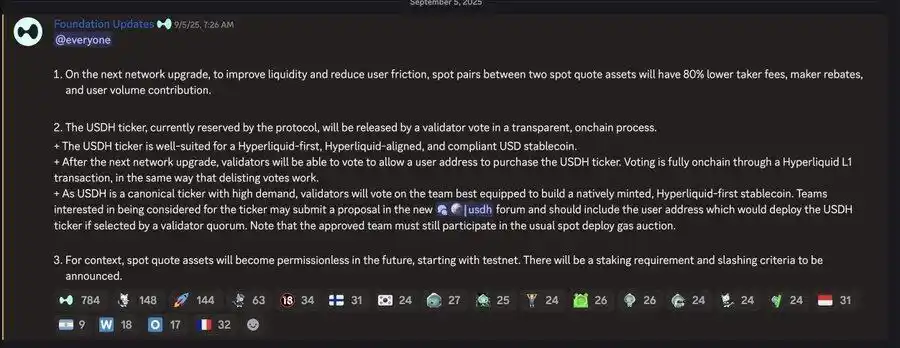
Prior to the validator vote determining USDH's code ownership, Hyperliquid announced the launch of a native, self-core issued asset.
For Circle, being the primary trading pair on various Hyperliquid core markets has brought significant revenue. They directly benefited from the exchange's explosive growth but hardly contributed value back to the ecosystem itself. For Hyperliquid, this meant a substantial loss of value to third parties with little to no contribution, severely contradicting its community-first, ecosystem-collaborative ethos.
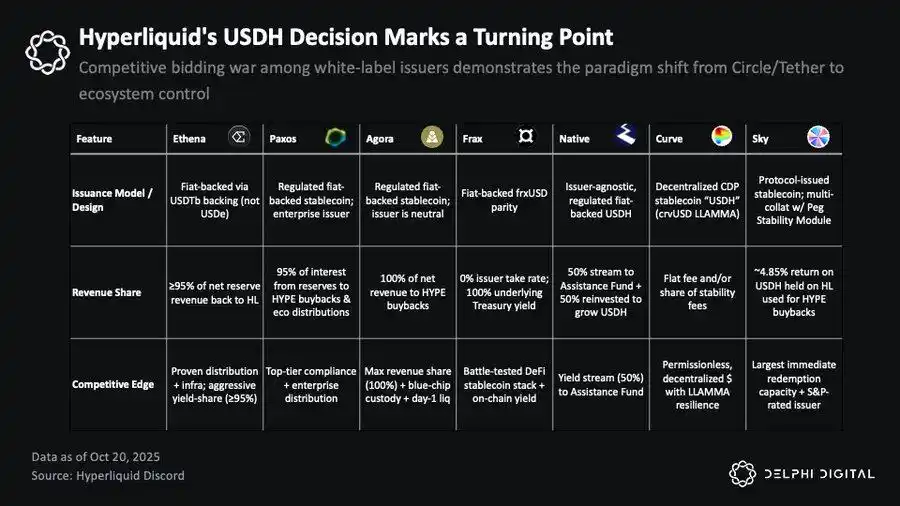
During the USDH bidding process, nearly all major white-label stablecoin issuers participated, including Native Markets, Paxos, Frax, Agora, MakerDAO (Sky), Curve Finance, and Ethena Labs. This marked the first large-scale competition at the application layer of the stablecoin economy, signaling a redefinition of the value of "distribution rights."
Ultimately, Native won the issuance rights for USDH—their proposal aligned more closely with the Hyperliquid ecosystem incentives. This model features issuer neutrality and compliance, with reserves managed offline by BlackRock and on-chain support provided by Superstate. Crucially, 50% of reserve earnings will be directly injected into Hyperliquid's relief fund, with the remaining 50% used to expand USDH liquidity.
While USDH will not replace USDC in the short term, this decision reflects a deeper power shift: in the DeFi space, moats and revenue are gradually moving towards applications and ecosystems with stable user bases and strong distribution capabilities, rather than traditional issuers like Circle and Tether.
White-Label Stablecoin Proliferation: Rise of the SaaS Model
Over the past few months, an increasing number of ecosystems have adopted the "white-label stablecoin" model. Ethena Labs' proposed "Stablecoin-as-a-Service" solution is at the forefront of this trend—on-chain projects like Sui, MegaETH, and Jupiter are either using or planning to issue proprietary stablecoins through Ethena's infrastructure.
The appeal of Ethena lies in its protocol that will directly reward holders. USDe's earnings come from basis trading. Although with a total supply exceeding $12.5 billion, the yield has compressed to about 5.5%, it is still higher than the U.S. Treasury bond yield (about 4%), and much better than the zero-yield status of USDT and USDC.
However, as other issuers start directly passing on Treasury bond yields to users, Ethena's relative advantage is decreasing—the Treasury-backed stablecoins are more attractive in terms of risk-reward ratio. If the rate-cut cycle continues, the basis trade spread will widen again, strengthening the appeal of such a "yield-driven model."
You might ask, does this violate the "GENIUS Act," which prohibits stablecoin issuers from directly paying yield to users? In fact, this restriction may not be as strict as imagined. The act does not explicitly prohibit third-party platforms or intermediaries from distributing rewards to stablecoin holders—as long as the source of the funds is provided by the issuer. This gray area has not been fully clarified, but many believe this "loophole" still exists.
Regardless of how regulation evolves, DeFi has always operated in a permissionless, edgy state and is likely to continue to do so in the future. What is more important than legal text is the economic reality behind it.
Stablecoin Tax: Earnings Drain on Mainstream Public Chains
Currently, about $30 billion of USDC and USDT is idle on Solana, BSC, Arbitrum, Avalanche, and Aptos. Based on a 4% reserve yield, this can generate approximately $1.1 billion in interest income for Circle and Tether annually. This number is about 40% higher than the total transaction fee income of these public chains. This also highlights a reality: Stablecoins are becoming the largest but not yet fully monetized value layer in L1, L2, and various applications.
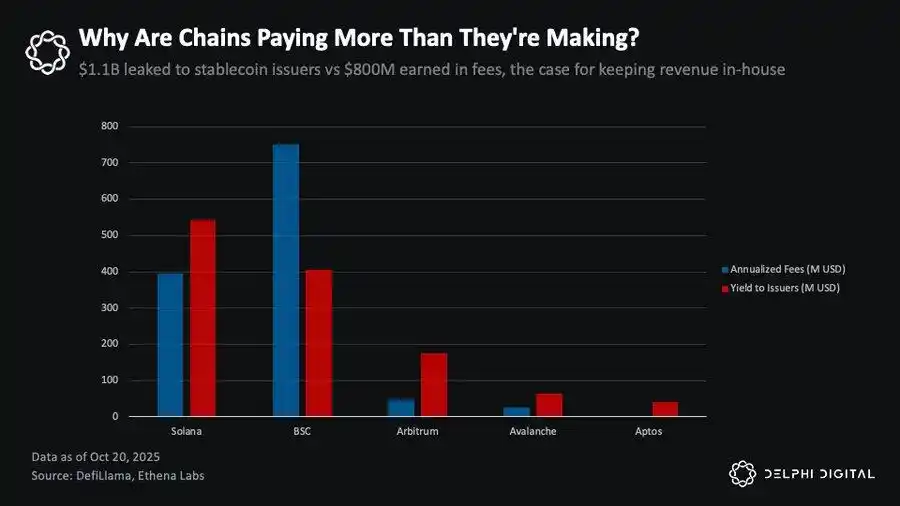
Taking Solana, BSC, Arbitrum, Avalanche, and Aptos as examples, Circle and Tether earn about $1.1 billion in annual revenue, while these ecosystems only earn $800 million in transaction fees.
In simple terms, these ecosystems are losing hundreds of millions of dollars in stablecoin revenue every year. Even if only a small part of it is left on-chain to capture on its own, it is enough to reshape its economic structure—providing a public chain with a more robust, countercyclical income base than transaction fees.
What is preventing them from reclaiming these revenues? The answer is: nothing. In fact, there are many paths to take. They can negotiate revenue sharing with Circle, Tether (as Coinbase did); they can initiate a competitive bidding process with white-label issuers like Hyperliquid; or they can launch a native stablecoin through "Stablecoin-as-a-Service" platforms like Ethena.
Of course, each path has its trade-offs: partnering with a traditional issuer can maintain the familiarity, liquidity, and stability of USDC or USDT, assets that have withstood multiple market cycles and maintained trust in extreme stress tests; issuing a native stablecoin increases control and potential revenue but faces a cold start problem. Both approaches have their corresponding infrastructure, and each chain can choose a path based on its priorities.
Redefining Public Blockchain Economics: Stablecoins as a New Revenue Engine
Stablecoins have the potential to become the primary source of revenue for certain public blockchains and applications. Today, when the blockchain economy relies solely on transaction fees, growth faces a structural limit—network revenue can only increase when users "pay more fees," which conflicts with the goal of "lowering barriers to use."
The USDm project of MegaETH is a response to this. By partnering with Ethena to issue a white-label stablecoin USDm, with BlackRock's on-chain treasury bond product BUIDL as the reserve asset, MegaETH can operate a sequencer at cost and reinvest the revenue into community initiatives by internalizing USDm revenue. This model gives the ecosystem a sustainable, low-cost, and innovation-friendly economic structure.
The top DEX aggregator on Solana, Jupiter, is pursuing a similar strategy through JupUSD. It plans to deeply integrate JupUSD into its product suite—from the collateral assets of Jupiter Perpetual Contracts (Jupiter Perps) (where the approximately $750 million stablecoin reserve will gradually be replaced) to the liquidity pools of Jupiter Lend. Through this strategy, Jupiter aims to have the stablecoin revenue flow back into its ecosystem, whether it is used to reward users, buy back tokens, or fund incentive programs. The value accumulation brought by these revenue streams far outweighs handing over all revenue to external stablecoin issuers.
This is the core shift happening right now: Those who used to passively contribute to the old issuer's revenue are now applying it to actively recapture value on the public chain.
Mismatched Valuations Between Applications and Public Chains
As all of this unfolds, I believe that both public chains and applications are embarking on a path toward generating more sustainable income, which will gradually move away from the "Internet capital market" and on-chain speculative activities' cyclical fluctuations. If so, they may finally find rationality for the often-questioned "out-of-touch with reality" high valuations.
The valuation frameworks most people still use mainly view these two levels from the perspective of "the total economic activity happening on top of them." In this model, on-chain fees represent the total cost borne by users, and the chain's revenue is the portion of these fees flowing to the protocol itself or token holders (e.g., through mechanisms like burning, treasury inflows, etc.). However, this model has had issues from the start—it assumes that as long as there is activity, the public chain will inevitably capture value, even if the actual economic benefits have already flown elsewhere.
Today, this model is starting to shift, led by the application layer. The most straightforward example is the two star projects of this cycle: Pump.fun and Hyperliquid. Both of these applications allocate almost 100% of their revenue (note, not fees) towards buying back their own tokens, while their valuation multiples are significantly lower than the primary infrastructure layer. In other words, these applications are generating real and transparent cash flow, not imaginary implicit returns.
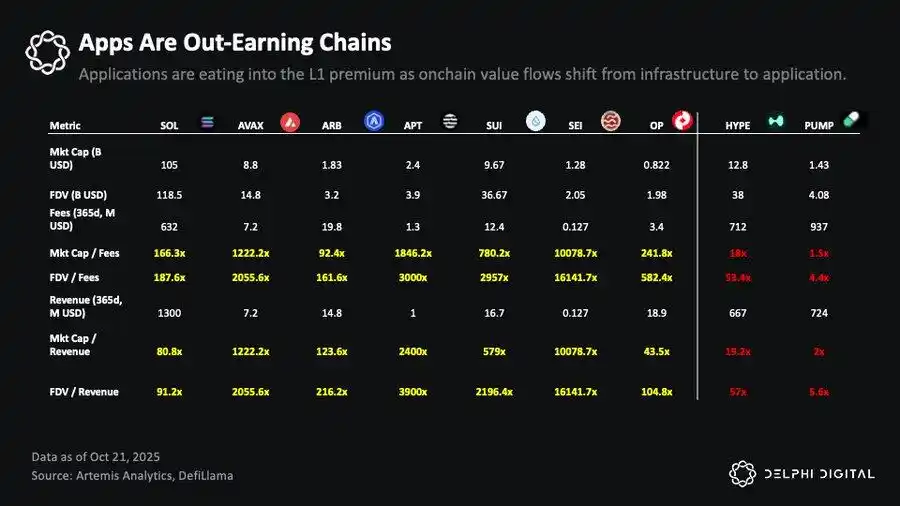
In contrast, the market-to-sales ratios of most mainstream public chains still reach hundreds or even thousands, while leading applications achieve higher returns at lower valuations.
Take Solana, for example. In the past year, the chain's total fees were around $632 million, revenue around $1.3 billion, market cap around $105 billion, and fully diluted valuation (FDV) around $118.5 billion. This means Solana's market cap to fee ratio is around 166x, market cap to revenue ratio around 80x—this is already a relatively conservative valuation for a large L1. Many other public chains have FDV valuation multiples reaching even thousands.
In comparison, Hyperliquid created $667 million in revenue, FDV of $38 billion, corresponding multiples of 57x based on FDV and only 19x based on circulating market cap. Pump.fun's revenue is $724 million, FDV multiples are only 5.6x, and market cap multiples are just 2x. Both of these demonstrate: Applications highly aligned with the product and strong distribution capabilities are creating significant income at multiples much lower than the base layer.
This is an ongoing power shift. The valuation of applications is increasingly dependent on the real revenue they generate and return to the ecosystem, while the base layer is still struggling to find the rationale behind its valuation. The continuously diminishing L1 premium is the clearest signal.
Unless the base layer can find a way to "internalize" more value from within the ecosystem, these inflated valuations will continue to be compressed. "White-label stablecoins" may be the first step public chains take to reclaim some of that value—turning what was once a passive "monetary channel" into an active revenue layer.
Coordination Problem: Why Some Public Chains Move Faster
The shift towards a "stablecoin aligned with the ecosystem's interests" is already underway; the significant differences in advancement speed between various public chains stem from their coordination capabilities and execution urgency.
For example, Sui—although its ecosystem is far less mature than Solana's—is moving at a rapid pace. Sui is collaborating with Ethena to introduce both sUSDe and USDi stablecoins simultaneously (the latter similar to the BUIDL-supporting stablecoin mechanism being explored by Jupiter and MegaETH). This is not a spontaneous action at the application layer but a strategic decision at the base layer: to internalize the stablecoin economy early, before path dependence sets in. Although these products are expected to launch officially in Q4, Sui is the first mainstream public chain to actively pursue this strategy.
In contrast, Solana faces a more complex and painful situation. Currently, there are around $15 billion in stablecoin assets on the Solana blockchain, with over $10 billion being USDC. These funds generate approximately $500 million in interest income for Circle annually, with a significant portion flowing back to Coinbase through profit-sharing agreements.
And where does Coinbase use these profits?—To subsidize Base, one of Solana's direct competitors. Part of Base's liquidity incentives, developer grants, ecosystem investments, and other funds come from the $10 billion in USDC on Solana. In other words, Solana is not only losing income but is also providing blood transfusions to its competitors.
This issue has long been a topic of strong interest within the Solana community. For example, Helius founder @0xMert_ called for Solana to launch a stablecoin tied to the ecosystem's interests and suggested using 50% of the revenue for SOL buybacks and burns. Senior members of some stablecoin issuers (such as Agora) have also proposed similar solutions, but compared to Sui's proactive approach, the Solana official response has been relatively lukewarm.
The reason is actually not very complicated: as regulatory frameworks such as the GENIUS Act have gradually become clearer, stablecoins have become more and more "commoditized." Users don't care whether they hold USDC, JupUSD, or any other compliant stablecoin—just as long as the price is pegged stable and there is sufficient liquidity. So, why default to using a stablecoin that is funneling profits to a competitor?
One reason Solana seems hesitant on this issue is that it wants to maintain "trusted neutrality." This is particularly important as the foundation strives for institutional legitimacy—after all, the only ones currently truly recognized in this regard are Bitcoin and Ethereum. To attract heavyweight issuers like BlackRock, this "institutional endorsement" not only brings in real capital but also grants asset "commoditization" status in the eyes of traditional finance—Solana must keep a certain distance from ecosystem politics. If it publicly supports a specific stablecoin, even if it's "eco-friendly," Solana may run into trouble in its journey to this level, or even be seen as favoring certain ecosystem participants.
Additionally, the scale and diversity of the Solana ecosystem make the situation even more complex. Hundreds of protocols, thousands of developers, tens of billions in TVL. At this scale, coordinating the entire ecosystem to "abandon USDC" becomes exponentially more challenging. Yet, this complexity ultimately becomes a feature, reflecting the maturity of the network and the depth of its ecosystem. The real issue is: inaction also comes at a cost, and that cost will continue to grow.
Path dependence accumulates daily. Every new user defaulting to USDC is increasing the future switching costs. Every protocol optimizing liquidity around USDC makes it harder for alternative solutions to launch. From a technical perspective, migrating existing infrastructure can be done almost overnight—the real challenge lies in coordination.
Currently within Solana, Jupiter is taking the lead by introducing JupUSD, committing to channel profits back into the Solana ecosystem, deeply integrating it into its product suite. The question now is: will other leading applications follow suit? Will platforms like Pump.fun also adopt a similar strategy, internalizing stablecoin earnings? At what point will Solana have no choice but to intervene from the top down, or will it simply let the applications built on top of it collect these profits themselves? From a public chain perspective, if apps can retain stablecoin economic benefits, although not the most ideal outcome, it's still better than having those benefits flow off-chain or even to enemy camps.
Ultimately, from the perspective of a public blockchain or a wider ecosystem, this game requires collective action: protocols need to tilt their liquidity towards a common stablecoin, treasuries need to make thoughtful allocation decisions, developers should change the default user experience, and users must use their own funds to "vote." The $500 million annual subsidy that Solana provides to Base will not disappear due to a foundation's mere statement; it will only truly disappear at the moment when ecosystem participants "refuse to continue funding competitors."
Conclusion: Power Shift from Issuer to Ecosystem
The next phase of stablecoin economics will no longer depend on who issues the token, but on who controls the distribution channels, and who can coordinate resources and capture market share at a faster pace.
Circle and Tether were able to build massive business empires relying on "first-mover advantage" and "liquidity bootstrapping." However, as the stablecoin stack gradually commodifies, their moats are being eroded. Cross-chain infrastructure allows for almost seamless interchangeability between different stablecoins; regulatory clarity reduces entry barriers; white-label issuers drive down issuance costs. Most importantly, platforms with the strongest distribution capabilities, high user stickiness, and mature monetization models have begun internalizing revenue—no longer paying interest and profits to third parties.
This change is already underway. Hyperliquid, by pivoting to USDH, is reclaiming the $220 million annual revenue stream that used to flow to Circle and Coinbase; Jupiter is deeply integrating JupUSD liquidity into its entire product suite; MegaETH is operating its sequencer at near cost using stablecoin revenue; Sui, before path dependence sets in, collaborated with Ethena to launch an ecosystem-aligned stablecoin. These are just the trailblazers. Today, every public chain bleeding hundreds of millions of dollars annually to Circle and Tether has a replicable template to follow.
For investors, this trend provides a new perspective for ecosystem evaluation. The key question is no longer: "How much activity is happening on this chain?" but rather: "Can it overcome coordination challenges, achieve liquidity pool monetization, and capture stablecoin yields at scale?" As public chains and applications begin to "capture" hundreds of millions of dollars in annualized revenue into their systems, used for token buybacks, ecosystem incentives, or protocol fees, market participants can directly "leverage" these cash flows through these platforms' native tokens. Protocols and applications capable of internalizing this portion of revenue will have more robust economic models, lower user costs, and a more aligned interest with the community; while projects that fail to do so will continue to pay the "stablecoin tax," watching their valuations being compressed.
The most interesting opportunity in the future lies not in holding equity in Circle, nor in betting on those high Market Cap Issuer Tokens. The real value is in: identifying which chains and applications can accomplish this transition, turning the "passive financial pipeline" into an "active revenue engine". Distribution is the new moat. Those who control the "flow of funds", rather than just laying down the "funds channel", will define the landscape of the next phase of the stablecoin economy.
You may also like

From 0 to $1 Million: Five Steps to Outperform the Market Through Wallet Tracking

Token Cannot Compound, Where Is the Real Investment Opportunity?

February 6th Market Key Intelligence, How Much Did You Miss?

China's Central Bank and Eight Other Departments' Latest Regulatory Focus: Key Attention to RWA Tokenized Asset Risk
Foreword: Today, the People's Bank of China's website published the "Notice of the People's Bank of China, National Development and Reform Commission, Ministry of Industry and Information Technology, Ministry of Public Security, State Administration for Market Regulation, China Banking and Insurance Regulatory Commission, China Securities Regulatory Commission, State Administration of Foreign Exchange on Further Preventing and Dealing with Risks Related to Virtual Currency and Others (Yinfa [2026] No. 42)", the latest regulatory requirements from the eight departments including the central bank, which are basically consistent with the regulatory requirements of recent years. The main focus of the regulation is on speculative activities such as virtual currency trading, exchanges, ICOs, overseas platform services, and this time, regulatory oversight of RWA has been added, explicitly prohibiting RWA tokenization, stablecoins (especially those pegged to the RMB). The following is the full text:
To the people's governments of all provinces, autonomous regions, and municipalities directly under the Central Government, the Xinjiang Production and Construction Corps:
Recently, there have been speculative activities related to virtual currency and Real-World Assets (RWA) tokenization, disrupting the economic and financial order and jeopardizing the property security of the people. In order to further prevent and address the risks related to virtual currency and Real-World Assets tokenization, effectively safeguard national security and social stability, in accordance with the "Law of the People's Republic of China on the People's Bank of China," "Law of the People's Republic of China on Commercial Banks," "Securities Law of the People's Republic of China," "Law of the People's Republic of China on Securities Investment Funds," "Law of the People's Republic of China on Futures and Derivatives," "Cybersecurity Law of the People's Republic of China," "Regulations of the People's Republic of China on the Administration of Renminbi," "Regulations on Prevention and Disposal of Illegal Fundraising," "Regulations of the People's Republic of China on Foreign Exchange Administration," "Telecommunications Regulations of the People's Republic of China," and other provisions, after reaching consensus with the Cyberspace Administration of China, the Supreme People's Court, and the Supreme People's Procuratorate, and with the approval of the State Council, the relevant matters are notified as follows:
(I) Virtual currency does not possess the legal status equivalent to fiat currency. Virtual currencies such as Bitcoin, Ether, Tether, etc., have the main characteristics of being issued by non-monetary authorities, using encryption technology and distributed ledger or similar technology, existing in digital form, etc. They do not have legal tender status, should not and cannot be circulated and used as currency in the market.
The business activities related to virtual currency are classified as illegal financial activities. The exchange of fiat currency and virtual currency within the territory, exchange of virtual currencies, acting as a central counterparty in buying and selling virtual currencies, providing information intermediary and pricing services for virtual currency transactions, token issuance financing, and trading of virtual currency-related financial products, etc., fall under illegal financial activities, such as suspected illegal issuance of token vouchers, unauthorized public issuance of securities, illegal operation of securities and futures business, illegal fundraising, etc., are strictly prohibited across the board and resolutely banned in accordance with the law. Overseas entities and individuals are not allowed to provide virtual currency-related services to domestic entities in any form.
A stablecoin pegged to a fiat currency indirectly fulfills some functions of the fiat currency in circulation. Without the consent of relevant authorities in accordance with the law and regulations, any domestic or foreign entity or individual is not allowed to issue a RMB-pegged stablecoin overseas.
(II)Tokenization of Real-World Assets refers to the use of encryption technology and distributed ledger or similar technologies to transform ownership rights, income rights, etc., of assets into tokens (tokens) or other interests or bond certificates with token (token) characteristics, and carry out issuance and trading activities.
Engaging in the tokenization of real-world assets domestically, as well as providing related intermediary, information technology services, etc., which are suspected of illegal issuance of token vouchers, unauthorized public offering of securities, illegal operation of securities and futures business, illegal fundraising, and other illegal financial activities, shall be prohibited; except for relevant business activities carried out with the approval of the competent authorities in accordance with the law and regulations and relying on specific financial infrastructures. Overseas entities and individuals are not allowed to illegally provide services related to the tokenization of real-world assets to domestic entities in any form.
(III) Inter-agency Coordination. The People's Bank of China, together with the National Development and Reform Commission, the Ministry of Industry and Information Technology, the Ministry of Public Security, the State Administration for Market Regulation, the China Banking and Insurance Regulatory Commission, the China Securities Regulatory Commission, the State Administration of Foreign Exchange, and other departments, will improve the work mechanism, strengthen coordination with the Cyberspace Administration of China, the Supreme People's Court, and the Supreme People's Procuratorate, coordinate efforts, and overall guide regions to carry out risk prevention and disposal of virtual currency-related illegal financial activities.
The China Securities Regulatory Commission, together with the National Development and Reform Commission, the Ministry of Industry and Information Technology, the Ministry of Public Security, the People's Bank of China, the State Administration for Market Regulation, the China Banking and Insurance Regulatory Commission, the State Administration of Foreign Exchange, and other departments, will improve the work mechanism, strengthen coordination with the Cyberspace Administration of China, the Supreme People's Court, and the Supreme People's Procuratorate, coordinate efforts, and overall guide regions to carry out risk prevention and disposal of illegal financial activities related to the tokenization of real-world assets.
(IV) Strengthening Local Implementation. The people's governments at the provincial level are overall responsible for the prevention and disposal of risks related to virtual currencies and the tokenization of real-world assets in their respective administrative regions. The specific leading department is the local financial regulatory department, with participation from branches and dispatched institutions of the State Council's financial regulatory department, telecommunications regulators, public security, market supervision, and other departments, in coordination with cyberspace departments, courts, and procuratorates, to improve the normalization of the work mechanism, effectively connect with the relevant work mechanisms of central departments, form a cooperative and coordinated working pattern between central and local governments, effectively prevent and properly handle risks related to virtual currencies and the tokenization of real-world assets, and maintain economic and financial order and social stability.
(5) Enhanced Risk Monitoring. The People's Bank of China, China Securities Regulatory Commission, National Development and Reform Commission, Ministry of Industry and Information Technology, Ministry of Public Security, State Administration of Foreign Exchange, Cyberspace Administration of China, and other departments continue to improve monitoring techniques and system support, enhance cross-departmental data analysis and sharing, establish sound information sharing and cross-validation mechanisms, promptly grasp the risk situation of activities related to virtual currency and real-world asset tokenization. Local governments at all levels give full play to the role of local monitoring and early warning mechanisms. Local financial regulatory authorities, together with branches and agencies of the State Council's financial regulatory authorities, as well as departments of cyberspace and public security, ensure effective connection between online monitoring, offline investigation, and fund tracking, efficiently and accurately identify activities related to virtual currency and real-world asset tokenization, promptly share risk information, improve early warning information dissemination, verification, and rapid response mechanisms.
(6) Strengthened Oversight of Financial Institutions, Intermediaries, and Technology Service Providers. Financial institutions (including non-bank payment institutions) are prohibited from providing account opening, fund transfer, and clearing services for virtual currency-related business activities, issuing and selling financial products related to virtual currency, including virtual currency and related financial products in the scope of collateral, conducting insurance business related to virtual currency, or including virtual currency in the scope of insurance liability. Financial institutions (including non-bank payment institutions) are prohibited from providing custody, clearing, and settlement services for unauthorized real-world asset tokenization-related business and related financial products. Relevant intermediary institutions and information technology service providers are prohibited from providing intermediary, technical, or other services for unauthorized real-world asset tokenization-related businesses and related financial products.
(7) Enhanced Management of Internet Information Content and Access. Internet enterprises are prohibited from providing online business venues, commercial displays, marketing, advertising, or paid traffic diversion services for virtual currency and real-world asset tokenization-related business activities. Upon discovering clues of illegal activities, they should promptly report to relevant departments and provide technical support and assistance for related investigations and inquiries. Based on the clues transferred by the financial regulatory authorities, the cyberspace administration, telecommunications authorities, and public security departments should promptly close and deal with websites, mobile applications (including mini-programs), and public accounts engaged in virtual currency and real-world asset tokenization-related business activities in accordance with the law.
(8) Strengthened Entity Registration and Advertisement Management. Market supervision departments strengthen entity registration and management, and enterprise and individual business registrations must not contain terms such as "virtual currency," "virtual asset," "cryptocurrency," "crypto asset," "stablecoin," "real-world asset tokenization," or "RWA" in their names or business scopes. Market supervision departments, together with financial regulatory authorities, legally enhance the supervision of advertisements related to virtual currency and real-world asset tokenization, promptly investigating and handling relevant illegal advertisements.
(IX) Continued Rectification of Virtual Currency Mining Activities. The National Development and Reform Commission, together with relevant departments, strictly controls virtual currency mining activities, continuously promotes the rectification of virtual currency mining activities. The people's governments of various provinces take overall responsibility for the rectification of "mining" within their respective administrative regions. In accordance with the requirements of the National Development and Reform Commission and other departments in the "Notice on the Rectification of Virtual Currency Mining Activities" (NDRC Energy-saving Building [2021] No. 1283) and the provisions of the "Guidance Catalog for Industrial Structure Adjustment (2024 Edition)," a comprehensive review, investigation, and closure of existing virtual currency mining projects are conducted, new mining projects are strictly prohibited, and mining machine production enterprises are strictly prohibited from providing mining machine sales and other services within the country.
(X) Severe Crackdown on Related Illegal Financial Activities. Upon discovering clues to illegal financial activities related to virtual currency and the tokenization of real-world assets, local financial regulatory authorities, branches of the State Council's financial regulatory authorities, and other relevant departments promptly investigate, determine, and properly handle the issues in accordance with the law, and seriously hold the relevant entities and individuals legally responsible. Those suspected of crimes are transferred to the judicial authorities for processing according to the law.
(XI) Severe Crackdown on Related Illegal and Criminal Activities. The Ministry of Public Security, the People's Bank of China, the State Administration for Market Regulation, the China Banking and Insurance Regulatory Commission, the China Securities Regulatory Commission, as well as judicial and procuratorial organs, in accordance with their respective responsibilities, rigorously crack down on illegal and criminal activities related to virtual currency, the tokenization of real-world assets, such as fraud, money laundering, illegal business operations, pyramid schemes, illegal fundraising, and other illegal and criminal activities carried out under the guise of virtual currency, the tokenization of real-world assets, etc.
(XII) Strengthen Industry Self-discipline. Relevant industry associations should enhance membership management and policy advocacy, based on their own responsibilities, advocate and urge member units to resist illegal financial activities related to virtual currency and the tokenization of real-world assets. Member units that violate regulatory policies and industry self-discipline rules are to be disciplined in accordance with relevant self-regulatory management regulations. By leveraging various industry infrastructure, conduct risk monitoring related to virtual currency, the tokenization of real-world assets, and promptly transfer issue clues to relevant departments.
(XIII) Without the approval of relevant departments in accordance with the law and regulations, domestic entities and foreign entities controlled by them may not issue virtual currency overseas.
(XIV) Domestic entities engaging directly or indirectly in overseas external debt-based tokenization of real-world assets, or conducting asset securitization activities abroad based on domestic ownership rights, income rights, etc. (hereinafter referred to as domestic equity), should be strictly regulated in accordance with the principles of "same business, same risk, same rules." The National Development and Reform Commission, the China Securities Regulatory Commission, the State Administration of Foreign Exchange, and other relevant departments regulate it according to their respective responsibilities. For other forms of overseas real-world asset tokenization activities based on domestic equity by domestic entities, the China Securities Regulatory Commission, together with relevant departments, supervise according to their division of responsibilities. Without the consent and filing of relevant departments, no unit or individual may engage in the above-mentioned business.
(15) Overseas subsidiaries and branches of domestic financial institutions providing Real World Asset Tokenization-related services overseas shall do so legally and prudently. They shall have professional personnel and systems in place to effectively mitigate business risks, strictly implement customer onboarding, suitability management, anti-money laundering requirements, and incorporate them into the domestic financial institutions' compliance and risk management system. Intermediaries and information technology service providers offering Real World Asset Tokenization services abroad based on domestic equity or conducting Real World Asset Tokenization business in the form of overseas debt for domestic entities directly or indirectly venturing abroad must strictly comply with relevant laws and regulations. They should establish and improve relevant compliance and internal control systems in accordance with relevant normative requirements, strengthen business and risk control, and report the business developments to the relevant regulatory authorities for approval or filing.
(16) Strengthen organizational leadership and overall coordination. All departments and regions should attach great importance to the prevention of risks related to virtual currencies and Real World Asset Tokenization, strengthen organizational leadership, clarify work responsibilities, form a long-term effective working mechanism with centralized coordination, local implementation, and shared responsibilities, maintain high pressure, dynamically monitor risks, effectively prevent and mitigate risks in an orderly and efficient manner, legally protect the property security of the people, and make every effort to maintain economic and financial order and social stability.
(17) Widely carry out publicity and education. All departments, regions, and industry associations should make full use of various media and other communication channels to disseminate information through legal and policy interpretation, analysis of typical cases, and education on investment risks, etc. They should promote the illegality and harm of virtual currencies and Real World Asset Tokenization-related businesses and their manifestations, fully alert to potential risks and hidden dangers, and enhance public awareness and identification capabilities for risk prevention.
(18) Engaging in illegal financial activities related to virtual currencies and Real World Asset Tokenization in violation of this notice, as well as providing services for virtual currencies and Real World Asset Tokenization-related businesses, shall be punished in accordance with relevant regulations. If it constitutes a crime, criminal liability shall be pursued according to the law. For domestic entities and individuals who knowingly or should have known that overseas entities illegally provided virtual currency or Real World Asset Tokenization-related services to domestic entities and still assisted them, relevant responsibilities shall be pursued according to the law. If it constitutes a crime, criminal liability shall be pursued according to the law.
(19) If any unit or individual invests in virtual currencies, Real World Asset Tokens, and related financial products against public order and good customs, the relevant civil legal actions shall be invalid, and any resulting losses shall be borne by them. If there are suspicions of disrupting financial order and jeopardizing financial security, the relevant departments shall deal with them according to the law.
This notice shall enter into force upon the date of its issuance. The People's Bank of China and ten other departments' "Notice on Further Preventing and Dealing with the Risks of Virtual Currency Trading Speculation" (Yinfa [2021] No. 237) is hereby repealed.

Former Partner's Perspective on Multicoin: Kyle's Exit, But the Game He Left Behind Just Getting Started
Why Bitcoin Is Falling Now: The Real Reasons Behind BTC's Crash & WEEX's Smart Profit Playbook
Bitcoin's ongoing crash explained: Discover the 5 hidden triggers behind BTC's plunge & how WEEX's Auto Earn and Trade to Earn strategies help traders profit from crypto market volatility.

Wall Street's Hottest Trades See Exodus

Vitalik Discusses Ethereum Scaling Path, Circle Announces Partnership with Polymarket, What's the Overseas Crypto Community Talking About Today?

Believing in the Capital Markets - The Essence and Core Value of Cryptocurrency

Polymarket's 'Weatherman': Predict Temperature, Win Million-Dollar Payout
$15K+ Profits: The 4 AI Trading Secrets WEEX Hackathon Prelim Winners Used to Dominate Volatile Crypto Markets
How WEEX Hackathon's top AI trading strategies made $15K+ in crypto markets: 4 proven rules for ETH/BTC trading, market structure analysis, and risk management in volatile conditions.

A nearly 20% one-day plunge, how long has it been since you last saw a $60,000 Bitcoin?

Raoul Pal: I've seen every single panic, and they are never the end.

Key Market Information Discrepancy on February 6th - A Must-Read! | Alpha Morning Report

2026 Crypto Industry's First Snowfall

The Harsh Reality Behind the $26 Billion Crypto Liquidation: Liquidity Is Killing the Market

Why Is Gold, US Stocks, Bitcoin All Falling?

Key Market Intelligence for February 5th, how much did you miss out on?
From 0 to $1 Million: Five Steps to Outperform the Market Through Wallet Tracking
Token Cannot Compound, Where Is the Real Investment Opportunity?
February 6th Market Key Intelligence, How Much Did You Miss?
China's Central Bank and Eight Other Departments' Latest Regulatory Focus: Key Attention to RWA Tokenized Asset Risk
Foreword: Today, the People's Bank of China's website published the "Notice of the People's Bank of China, National Development and Reform Commission, Ministry of Industry and Information Technology, Ministry of Public Security, State Administration for Market Regulation, China Banking and Insurance Regulatory Commission, China Securities Regulatory Commission, State Administration of Foreign Exchange on Further Preventing and Dealing with Risks Related to Virtual Currency and Others (Yinfa [2026] No. 42)", the latest regulatory requirements from the eight departments including the central bank, which are basically consistent with the regulatory requirements of recent years. The main focus of the regulation is on speculative activities such as virtual currency trading, exchanges, ICOs, overseas platform services, and this time, regulatory oversight of RWA has been added, explicitly prohibiting RWA tokenization, stablecoins (especially those pegged to the RMB). The following is the full text:
To the people's governments of all provinces, autonomous regions, and municipalities directly under the Central Government, the Xinjiang Production and Construction Corps:
Recently, there have been speculative activities related to virtual currency and Real-World Assets (RWA) tokenization, disrupting the economic and financial order and jeopardizing the property security of the people. In order to further prevent and address the risks related to virtual currency and Real-World Assets tokenization, effectively safeguard national security and social stability, in accordance with the "Law of the People's Republic of China on the People's Bank of China," "Law of the People's Republic of China on Commercial Banks," "Securities Law of the People's Republic of China," "Law of the People's Republic of China on Securities Investment Funds," "Law of the People's Republic of China on Futures and Derivatives," "Cybersecurity Law of the People's Republic of China," "Regulations of the People's Republic of China on the Administration of Renminbi," "Regulations on Prevention and Disposal of Illegal Fundraising," "Regulations of the People's Republic of China on Foreign Exchange Administration," "Telecommunications Regulations of the People's Republic of China," and other provisions, after reaching consensus with the Cyberspace Administration of China, the Supreme People's Court, and the Supreme People's Procuratorate, and with the approval of the State Council, the relevant matters are notified as follows:
(I) Virtual currency does not possess the legal status equivalent to fiat currency. Virtual currencies such as Bitcoin, Ether, Tether, etc., have the main characteristics of being issued by non-monetary authorities, using encryption technology and distributed ledger or similar technology, existing in digital form, etc. They do not have legal tender status, should not and cannot be circulated and used as currency in the market.
The business activities related to virtual currency are classified as illegal financial activities. The exchange of fiat currency and virtual currency within the territory, exchange of virtual currencies, acting as a central counterparty in buying and selling virtual currencies, providing information intermediary and pricing services for virtual currency transactions, token issuance financing, and trading of virtual currency-related financial products, etc., fall under illegal financial activities, such as suspected illegal issuance of token vouchers, unauthorized public issuance of securities, illegal operation of securities and futures business, illegal fundraising, etc., are strictly prohibited across the board and resolutely banned in accordance with the law. Overseas entities and individuals are not allowed to provide virtual currency-related services to domestic entities in any form.
A stablecoin pegged to a fiat currency indirectly fulfills some functions of the fiat currency in circulation. Without the consent of relevant authorities in accordance with the law and regulations, any domestic or foreign entity or individual is not allowed to issue a RMB-pegged stablecoin overseas.
(II)Tokenization of Real-World Assets refers to the use of encryption technology and distributed ledger or similar technologies to transform ownership rights, income rights, etc., of assets into tokens (tokens) or other interests or bond certificates with token (token) characteristics, and carry out issuance and trading activities.
Engaging in the tokenization of real-world assets domestically, as well as providing related intermediary, information technology services, etc., which are suspected of illegal issuance of token vouchers, unauthorized public offering of securities, illegal operation of securities and futures business, illegal fundraising, and other illegal financial activities, shall be prohibited; except for relevant business activities carried out with the approval of the competent authorities in accordance with the law and regulations and relying on specific financial infrastructures. Overseas entities and individuals are not allowed to illegally provide services related to the tokenization of real-world assets to domestic entities in any form.
(III) Inter-agency Coordination. The People's Bank of China, together with the National Development and Reform Commission, the Ministry of Industry and Information Technology, the Ministry of Public Security, the State Administration for Market Regulation, the China Banking and Insurance Regulatory Commission, the China Securities Regulatory Commission, the State Administration of Foreign Exchange, and other departments, will improve the work mechanism, strengthen coordination with the Cyberspace Administration of China, the Supreme People's Court, and the Supreme People's Procuratorate, coordinate efforts, and overall guide regions to carry out risk prevention and disposal of virtual currency-related illegal financial activities.
The China Securities Regulatory Commission, together with the National Development and Reform Commission, the Ministry of Industry and Information Technology, the Ministry of Public Security, the People's Bank of China, the State Administration for Market Regulation, the China Banking and Insurance Regulatory Commission, the State Administration of Foreign Exchange, and other departments, will improve the work mechanism, strengthen coordination with the Cyberspace Administration of China, the Supreme People's Court, and the Supreme People's Procuratorate, coordinate efforts, and overall guide regions to carry out risk prevention and disposal of illegal financial activities related to the tokenization of real-world assets.
(IV) Strengthening Local Implementation. The people's governments at the provincial level are overall responsible for the prevention and disposal of risks related to virtual currencies and the tokenization of real-world assets in their respective administrative regions. The specific leading department is the local financial regulatory department, with participation from branches and dispatched institutions of the State Council's financial regulatory department, telecommunications regulators, public security, market supervision, and other departments, in coordination with cyberspace departments, courts, and procuratorates, to improve the normalization of the work mechanism, effectively connect with the relevant work mechanisms of central departments, form a cooperative and coordinated working pattern between central and local governments, effectively prevent and properly handle risks related to virtual currencies and the tokenization of real-world assets, and maintain economic and financial order and social stability.
(5) Enhanced Risk Monitoring. The People's Bank of China, China Securities Regulatory Commission, National Development and Reform Commission, Ministry of Industry and Information Technology, Ministry of Public Security, State Administration of Foreign Exchange, Cyberspace Administration of China, and other departments continue to improve monitoring techniques and system support, enhance cross-departmental data analysis and sharing, establish sound information sharing and cross-validation mechanisms, promptly grasp the risk situation of activities related to virtual currency and real-world asset tokenization. Local governments at all levels give full play to the role of local monitoring and early warning mechanisms. Local financial regulatory authorities, together with branches and agencies of the State Council's financial regulatory authorities, as well as departments of cyberspace and public security, ensure effective connection between online monitoring, offline investigation, and fund tracking, efficiently and accurately identify activities related to virtual currency and real-world asset tokenization, promptly share risk information, improve early warning information dissemination, verification, and rapid response mechanisms.
(6) Strengthened Oversight of Financial Institutions, Intermediaries, and Technology Service Providers. Financial institutions (including non-bank payment institutions) are prohibited from providing account opening, fund transfer, and clearing services for virtual currency-related business activities, issuing and selling financial products related to virtual currency, including virtual currency and related financial products in the scope of collateral, conducting insurance business related to virtual currency, or including virtual currency in the scope of insurance liability. Financial institutions (including non-bank payment institutions) are prohibited from providing custody, clearing, and settlement services for unauthorized real-world asset tokenization-related business and related financial products. Relevant intermediary institutions and information technology service providers are prohibited from providing intermediary, technical, or other services for unauthorized real-world asset tokenization-related businesses and related financial products.
(7) Enhanced Management of Internet Information Content and Access. Internet enterprises are prohibited from providing online business venues, commercial displays, marketing, advertising, or paid traffic diversion services for virtual currency and real-world asset tokenization-related business activities. Upon discovering clues of illegal activities, they should promptly report to relevant departments and provide technical support and assistance for related investigations and inquiries. Based on the clues transferred by the financial regulatory authorities, the cyberspace administration, telecommunications authorities, and public security departments should promptly close and deal with websites, mobile applications (including mini-programs), and public accounts engaged in virtual currency and real-world asset tokenization-related business activities in accordance with the law.
(8) Strengthened Entity Registration and Advertisement Management. Market supervision departments strengthen entity registration and management, and enterprise and individual business registrations must not contain terms such as "virtual currency," "virtual asset," "cryptocurrency," "crypto asset," "stablecoin," "real-world asset tokenization," or "RWA" in their names or business scopes. Market supervision departments, together with financial regulatory authorities, legally enhance the supervision of advertisements related to virtual currency and real-world asset tokenization, promptly investigating and handling relevant illegal advertisements.
(IX) Continued Rectification of Virtual Currency Mining Activities. The National Development and Reform Commission, together with relevant departments, strictly controls virtual currency mining activities, continuously promotes the rectification of virtual currency mining activities. The people's governments of various provinces take overall responsibility for the rectification of "mining" within their respective administrative regions. In accordance with the requirements of the National Development and Reform Commission and other departments in the "Notice on the Rectification of Virtual Currency Mining Activities" (NDRC Energy-saving Building [2021] No. 1283) and the provisions of the "Guidance Catalog for Industrial Structure Adjustment (2024 Edition)," a comprehensive review, investigation, and closure of existing virtual currency mining projects are conducted, new mining projects are strictly prohibited, and mining machine production enterprises are strictly prohibited from providing mining machine sales and other services within the country.
(X) Severe Crackdown on Related Illegal Financial Activities. Upon discovering clues to illegal financial activities related to virtual currency and the tokenization of real-world assets, local financial regulatory authorities, branches of the State Council's financial regulatory authorities, and other relevant departments promptly investigate, determine, and properly handle the issues in accordance with the law, and seriously hold the relevant entities and individuals legally responsible. Those suspected of crimes are transferred to the judicial authorities for processing according to the law.
(XI) Severe Crackdown on Related Illegal and Criminal Activities. The Ministry of Public Security, the People's Bank of China, the State Administration for Market Regulation, the China Banking and Insurance Regulatory Commission, the China Securities Regulatory Commission, as well as judicial and procuratorial organs, in accordance with their respective responsibilities, rigorously crack down on illegal and criminal activities related to virtual currency, the tokenization of real-world assets, such as fraud, money laundering, illegal business operations, pyramid schemes, illegal fundraising, and other illegal and criminal activities carried out under the guise of virtual currency, the tokenization of real-world assets, etc.
(XII) Strengthen Industry Self-discipline. Relevant industry associations should enhance membership management and policy advocacy, based on their own responsibilities, advocate and urge member units to resist illegal financial activities related to virtual currency and the tokenization of real-world assets. Member units that violate regulatory policies and industry self-discipline rules are to be disciplined in accordance with relevant self-regulatory management regulations. By leveraging various industry infrastructure, conduct risk monitoring related to virtual currency, the tokenization of real-world assets, and promptly transfer issue clues to relevant departments.
(XIII) Without the approval of relevant departments in accordance with the law and regulations, domestic entities and foreign entities controlled by them may not issue virtual currency overseas.
(XIV) Domestic entities engaging directly or indirectly in overseas external debt-based tokenization of real-world assets, or conducting asset securitization activities abroad based on domestic ownership rights, income rights, etc. (hereinafter referred to as domestic equity), should be strictly regulated in accordance with the principles of "same business, same risk, same rules." The National Development and Reform Commission, the China Securities Regulatory Commission, the State Administration of Foreign Exchange, and other relevant departments regulate it according to their respective responsibilities. For other forms of overseas real-world asset tokenization activities based on domestic equity by domestic entities, the China Securities Regulatory Commission, together with relevant departments, supervise according to their division of responsibilities. Without the consent and filing of relevant departments, no unit or individual may engage in the above-mentioned business.
(15) Overseas subsidiaries and branches of domestic financial institutions providing Real World Asset Tokenization-related services overseas shall do so legally and prudently. They shall have professional personnel and systems in place to effectively mitigate business risks, strictly implement customer onboarding, suitability management, anti-money laundering requirements, and incorporate them into the domestic financial institutions' compliance and risk management system. Intermediaries and information technology service providers offering Real World Asset Tokenization services abroad based on domestic equity or conducting Real World Asset Tokenization business in the form of overseas debt for domestic entities directly or indirectly venturing abroad must strictly comply with relevant laws and regulations. They should establish and improve relevant compliance and internal control systems in accordance with relevant normative requirements, strengthen business and risk control, and report the business developments to the relevant regulatory authorities for approval or filing.
(16) Strengthen organizational leadership and overall coordination. All departments and regions should attach great importance to the prevention of risks related to virtual currencies and Real World Asset Tokenization, strengthen organizational leadership, clarify work responsibilities, form a long-term effective working mechanism with centralized coordination, local implementation, and shared responsibilities, maintain high pressure, dynamically monitor risks, effectively prevent and mitigate risks in an orderly and efficient manner, legally protect the property security of the people, and make every effort to maintain economic and financial order and social stability.
(17) Widely carry out publicity and education. All departments, regions, and industry associations should make full use of various media and other communication channels to disseminate information through legal and policy interpretation, analysis of typical cases, and education on investment risks, etc. They should promote the illegality and harm of virtual currencies and Real World Asset Tokenization-related businesses and their manifestations, fully alert to potential risks and hidden dangers, and enhance public awareness and identification capabilities for risk prevention.
(18) Engaging in illegal financial activities related to virtual currencies and Real World Asset Tokenization in violation of this notice, as well as providing services for virtual currencies and Real World Asset Tokenization-related businesses, shall be punished in accordance with relevant regulations. If it constitutes a crime, criminal liability shall be pursued according to the law. For domestic entities and individuals who knowingly or should have known that overseas entities illegally provided virtual currency or Real World Asset Tokenization-related services to domestic entities and still assisted them, relevant responsibilities shall be pursued according to the law. If it constitutes a crime, criminal liability shall be pursued according to the law.
(19) If any unit or individual invests in virtual currencies, Real World Asset Tokens, and related financial products against public order and good customs, the relevant civil legal actions shall be invalid, and any resulting losses shall be borne by them. If there are suspicions of disrupting financial order and jeopardizing financial security, the relevant departments shall deal with them according to the law.
This notice shall enter into force upon the date of its issuance. The People's Bank of China and ten other departments' "Notice on Further Preventing and Dealing with the Risks of Virtual Currency Trading Speculation" (Yinfa [2021] No. 237) is hereby repealed.
Former Partner's Perspective on Multicoin: Kyle's Exit, But the Game He Left Behind Just Getting Started
Why Bitcoin Is Falling Now: The Real Reasons Behind BTC's Crash & WEEX's Smart Profit Playbook
Bitcoin's ongoing crash explained: Discover the 5 hidden triggers behind BTC's plunge & how WEEX's Auto Earn and Trade to Earn strategies help traders profit from crypto market volatility.