
- Buy Crypto
- Markets
- Futures
- Spot
- Copy Trade
 WE-Launch
When the Prediction Market Shifts from 'Predicting' to 'Revealing the Truth': Delphi Officially Launches Prediction Market Coverage

For a long time, we have understood prediction markets as a very “rational” activity: people bet on the future based on public information, and market prices reflect consensus. However, over the past year, we have increasingly realized one thing: many prediction markets are not about “predicting the future” but about preemptively exposing those “results already known to a few.”
When an outcome is already certain but not yet public, the prediction market becomes an extremely brutal entity: it doesn't need leaks, anonymous tips, or even a single word. The flow of funds itself is the leak.
The Prediction Market is Changing the Nature of “Secrecy”:
Imagine a few scenarios:
· A hit TV show has finished filming, will the main character die?
· The selection process for a gaming award has mostly concluded, but the results are not yet announced
· An AI company is about to release crucial product or acquisition news
· Regulatory outcomes for a Crypto protocol, listing times, governance vote direction
In the traditional world, these are called “inside information.” But with the advent of prediction markets, they face a new challenge: as long as someone knows and can place a bet, it is challenging for the secret to avoid market capture. You don't need to know “who said what,” you just need to look at:
· Which options are disproportionately staked
· Which addresses are consistently betting at key times
· Which accounts repeatedly “correctly bet early” in similar events
This is not a conspiracy theory; it is a natural outcome of probability and incentives.
From “Content Reporting” to “Result Stress Testing”
This is also why we are starting to rethink the traditional news model. The previous content logic was: event occurs → a few know → report (publish) → public knows
However, the prediction market brings another path: event occurs → someone knows → someone bets → price starts to deviate → the world already “knew in advance”
There is even a more extreme path: event occurs → someone knows → someone bets → price starts to deviate → leading to a change in the event
Regarding this path, I can provide a classic example: at the end of Coinbase's (Nasdaq: COIN) Q3 2025 earnings call, CEO Brian Armstrong said a seemingly offhand remark:
“I got a bit sucked into a prediction market. I've been tracking a prediction market on what we would say on this earnings call... So, I have to get these words in before the call ends: Bitcoin, Ethereum, blockchain, staking, and Web3.”
These words were not random but were part of a prediction market where people bet on whether certain words would be mentioned during this earnings call. After Armstrong said this sentence, the relevant prediction markets settled immediately, and those who bet on the words being spoken correctly profited. Reportedly, there was around $80,000 in bets settled instantly on platforms like Kalshi and Polymarket.
In other words, without these bets, in another parallel universe, Brian Armstrong would have just gone through the earnings call process normally without intentionally saying these words. This is the "reality-distortion field" of prediction markets, where the act of betting itself has the power to alter reality. This phenomenon is common in sports betting, where outcomes are often manipulated due to insider control to favor the least bet-upon option. However, whether it's words spoken during a Coinbase earnings call or a football match, these events have minimal impact on our world. But with platforms like Polymarket and Kalshi growing, these topics will be closer to our everyday lives, and this "reality-distortion field" of prediction markets will increasingly affect our lives.
In the future, content will no longer be the starting point for information but a tool for validation and interpretation. In extreme cases, content can even change reality. This is what the BlockBeats prediction market report is doing: it's not a "prediction market guide" or a mere recounting of what happened on Polymarket and Kalshi.
What we truly care about are three things:
· Which events show odds changes that are not primarily driven by emotion or public information?
· Are there addresses consistently heavily betting on the "winning" outcome before results, with an unusually high historical accuracy rate?
· Do these behaviors point to some "known but undisclosed" facts?
We achieve this through analyzing:
· Topics and option odds in prediction markets
· Bettors' on-chain addresses and their associated behaviors
· Similar betting patterns in past events
to do one thing: treat the prediction market as a "covert stress-tester" rather than a mere opinion poll.
Currently, we are focusing on several key areas:
· Macro policy directions and geopolitics that can impact the capital markets
· AI Industry: Product release timings, acquisitions, key personnel changes
· Crypto Industry: Token Generation Events, regulations, governance outcomes, significant protocol changes
The Future of the Content Industry:
The real challenge of prediction markets is not accuracy, but rather that they are undermining a long-standing default order in the content industry and regulation: only information allowed to be spoken out will become "common knowledge." When everything is open for betting, secrets are will no longer be constrained by institutions, professional ethics, or news censorship but will instead continue to battle against the price discovery mechanism.
In a mild scenario, this means that the endings of TV series, award recipients, and business decisions will be known in advance by the market; while in an extreme scenario, it may even involve war and geopolitical conflicts: people can obtain "military intelligence" level information through bets made by soldiers on the war frontlines, directly influencing the course of the war. When the outcome is already known to a few, and the market allows betting around the outcome, the price itself may become an undeniable signal of reality.
The first time I felt awe towards the financial industry was when I read a story in college about Ray Dalio, the founder of Bridgewater Associates, who had helped McDonald's hedge chicken futures in his early years; in the United States, large restaurant chains almost always hedge their core raw materials synchronously with futures to withstand the drastic price fluctuations, ensuring that consumers can enjoy consistent quality and price-controlled McNuggets at any time. What made me awe-inspiring is not the later achievements of Dalio, but the first time I clearly realized: the original intention of the financial market's birth was never for trading itself, but to make the real world operate more stably and predictably.
The futures market helps people hedge commodity price risks, the stock market helps socially valuable enterprises finance and develop more efficiently; in this process, the participation of traders and speculators provides liquidity, farmers lock in future revenue in advance, and companies obtain a stable cost structure. Although market participants take what they need, the overall system is a long-term positive-sum game.
This also forces us to return to a more fundamental question: when such massive speculative liquidity as Polymarket already exists, is it possible to guide it towards more directions that truly generate positive EV? If an event, once it occurs, will have a significant impact on individuals' lives, assets, or decisions, do we have the opportunity to leverage the liquidity of prediction markets, and even evolve in the form of a combination of multiple markets into an "event insurance"-like product, similar to the "flight delay insurance" we have in our lives now, which, although cannot compensate for our flight delay losses, can provide people with some psychological comfort.
Prediction markets are not challenging a particular media outlet, but are questioning a larger issue: when the world begins to be bet on, who still has the power to decide "what can be known?" and "when can it be known?" We will continue to explore this path. In addition, the BlockBeats Prediction Market Analysis team has also been established, if you also love content and are curious about prediction markets, you are always welcome to join us. (Resumes can be sent to [email protected] or HR telegram @Jhy10vewh0 with the note "Prediction Market") We also welcome startup teams in the prediction market and AI-related fields to discuss with us. BlockBeats is committed to giving excellent startup teams maximum exposure to the best of its ability, contact email [email protected]
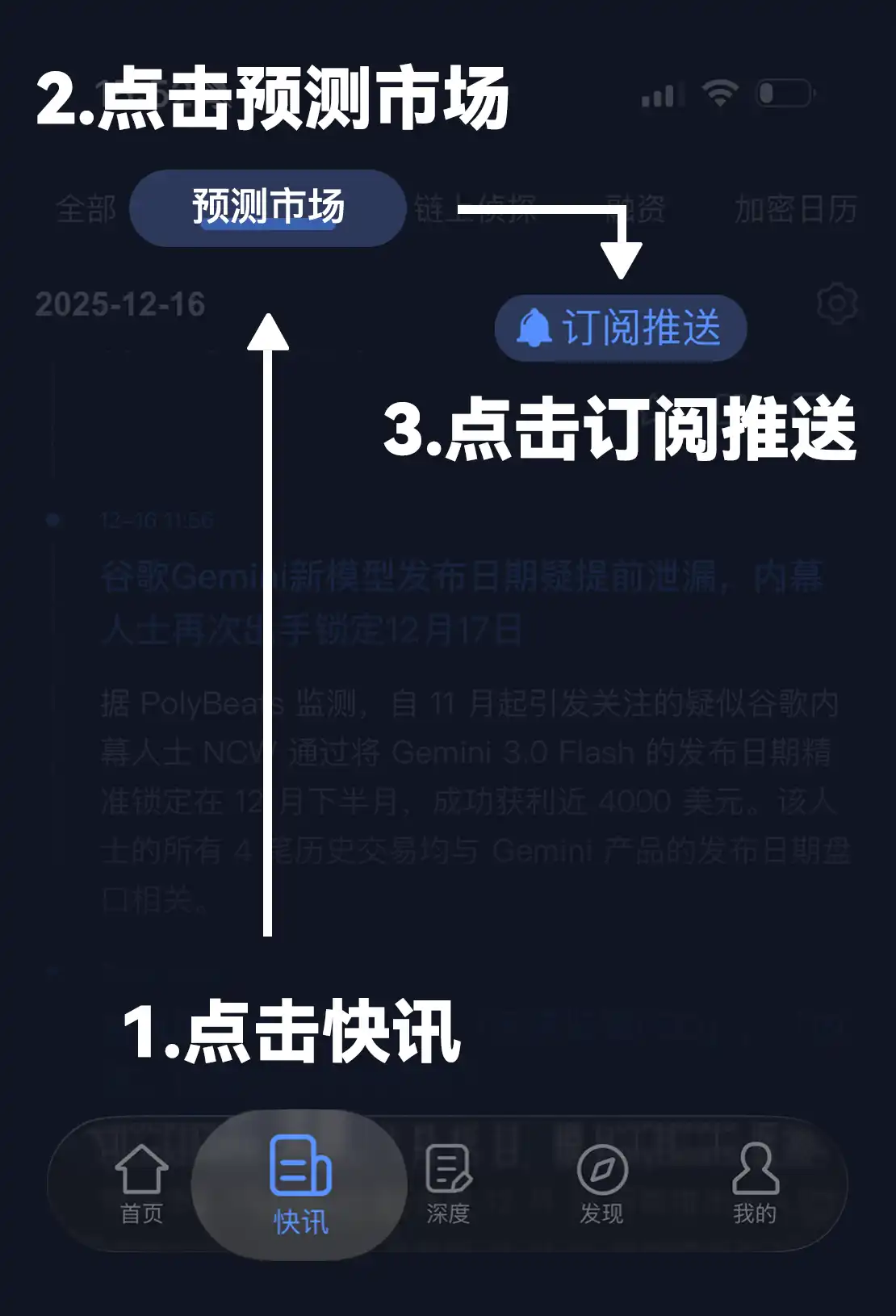
Finally, if you would like to receive timely updates on the prediction market news we uncover, you can subscribe on the Lydian APP. After subscribing, you will receive real-time prediction market news via in-app notifications. The specific steps are as shown in the image below (please make sure your APP is up to date).
You may also like

Cryptocurrency people who use candlestick charts for fortune telling
When fortune telling is depicted on candlestick charts and placed within the context of the cryptocurrency world, its explosive popularity stems not from the accuracy of its mystical claims, but from the fact that traders' collective anxiety about uncertainty has finally found an outlet.
Holiday Season Markets: Understanding Low Liquidity and Trading Conditions
At WEEX, we recognize that the holiday season often brings a different trading experience for many users. As market participation slows, price behavior can feel less predictable and familiar trading rhythms may shift. For traders following AI news today or using AI trading tools, this period often highlights how market structure can influence model performance and short-term signals. Approaching these periods with clear expectations and a disciplined mindset can help traders better navigate seasonal market conditions.

Lido DAO’s Increased Development and Market Dynamics Elevate LDO Price
Key Takeaways Lido DAO’s development activities have surged by 690%, signifying substantial growth. The Lido DAO token (LDO)…

Hyperliquid Whales Shift Strategies: BTC Longs Decline, ETH Shorts Dominate
Key Takeaways A significant reduction in Bitcoin long positions has been observed on Hyperliquid, with large holders decreasing…

December 26th Market Key Intelligence, How Much Did You Miss?

Crypto Christmas Heist: Over $6 Million Lost, Trust Wallet Chrome Extension Wallet Hacked Analysis
Trust Wallet Browser Extension Security Incident Leads to Losses
Key Takeaways Trust Wallet identified a significant security breach in its browser extension version 2.68. Approximately over $6…
Bitcoin Surges Toward $90,000 as $27 Billion Crypto Options Expire
Key Takeaways Bitcoin’s price is nearing the $90,000 mark amid increased market activity following the holiday lull. The…

Bitcoin Options Set to Expire, Potentially Altering Price Beyond $87,000 Range
Key Takeaways A historic Bitcoin options expiry event, valued at $236 billion, is set to occur, potentially impacting…
Ethereum Price Prediction: Whales Accumulate as Market Awaits Key Break
Key Takeaways Ethereum’s price remains in a “no-trade zone” between $2,800 and $3,000 amid low market activity. Whale…

Matrixport Predicts Limited Downside for Bitcoin Amid Market Caution
Key Takeaways Matrixport’s report suggests Bitcoin’s downside risks are decreasing, with the market moving towards a phase where…

Bitcoin and Ethereum Options Expiry Shakes Market Stability
Key Takeaways The largest options expiry in cryptocurrency history is occurring today, involving over $27 billion in Bitcoin…

Trust Wallet Hack Results in $3.5 Million Loss for Major Wallet Holder
Key Takeaways A significant Trust Wallet hack led to the theft of $3.5 million from an inactive wallet.…

PancakeSwap Launches LP Rewards on Base Network
Key Takeaways PancakeSwap has introduced liquidity provider (LP) rewards for 12 v3 pools on the Base network, facilitated…

BDXN Wallets Deposit $400,000 in Tokens to Multiple Exchanges
Key Takeaways BDXN project wallets have transferred approximately $400,000 worth of tokens to various exchanges. The transfers involve…

Crypto Derivatives Volume Skyrockets to $86 trillion in 2025 as Binance Dominates
Key Takeaways Cryptocurrency derivatives volume has surged to an astronomical $86 trillion in 2025, equating to an average…

Ethereum in 2026: Glamsterdam and Hegota Forks, Layer 1 Scaling, and More
Key Takeaways Ethereum is poised for crucial developments in 2026, particularly with the Glamsterdam and Hegota forks. Glamsterdam…

Social Engineering in the Crypto Universe: Safeguarding Your Assets in 2025
Key Takeaways Social engineering, a psychological manipulation tactic, has been the leading cause of crypto asset theft in…
Cryptocurrency people who use candlestick charts for fortune telling
When fortune telling is depicted on candlestick charts and placed within the context of the cryptocurrency world, its explosive popularity stems not from the accuracy of its mystical claims, but from the fact that traders' collective anxiety about uncertainty has finally found an outlet.
Holiday Season Markets: Understanding Low Liquidity and Trading Conditions
At WEEX, we recognize that the holiday season often brings a different trading experience for many users. As market participation slows, price behavior can feel less predictable and familiar trading rhythms may shift. For traders following AI news today or using AI trading tools, this period often highlights how market structure can influence model performance and short-term signals. Approaching these periods with clear expectations and a disciplined mindset can help traders better navigate seasonal market conditions.
Lido DAO’s Increased Development and Market Dynamics Elevate LDO Price
Key Takeaways Lido DAO’s development activities have surged by 690%, signifying substantial growth. The Lido DAO token (LDO)…
Hyperliquid Whales Shift Strategies: BTC Longs Decline, ETH Shorts Dominate
Key Takeaways A significant reduction in Bitcoin long positions has been observed on Hyperliquid, with large holders decreasing…
December 26th Market Key Intelligence, How Much Did You Miss?
Crypto Christmas Heist: Over $6 Million Lost, Trust Wallet Chrome Extension Wallet Hacked Analysis
Popular coins
Latest Crypto News


Customer Support:@weikecs
Business Cooperation:@weikecs
Quant Trading & MM:[email protected]
VIP Services:[email protected]
 App
App