
- Buy Crypto
- Markets
- Futures
- Spot
- Copy Trade
 WE-Launch
Arkstream Capital: When Cryptocurrency Returns to 'Financial Logic' by 2025

Original Article Title: "Arkstream Capital: 2025 When Cryptocurrency Returns to 'Financial Logic'"
Original Source: Arkstream Capital
TL;DR
* 2025 Core Change: Pricing Framework "Externalization." No longer primarily reliant on a single on-chain cycle/narrative self-loop but jointly led by policy and compliance + macro liquidity/risk appetite + leverage and risk control; price elasticity depends on where funds come in from, what assets are bought, and how they exit under pressure
* Fund inflows shift from "on-chain leverage single channel" to multi-channel parallel: ETFs (standardized allocation) + Stablecoin USD Base (on-chain settlement/circulation) + DAT (corporate financing capability → spot demand function) + Listing Pathway (IPO) (mapping licensing/custody/clearing/institutional service capabilities to investable stock cash flows)
* Industry Evolution: Transition from "Narrative-Driven" to "Product Line-Driven" — stablecoin layering (cash layer vs. yield-efficient tools, the latter more cyclical), on-chain perpetual moving towards infrastructure and moving towards share warfare, prediction markets expanding from crypto-native to event contract markets, industry rhythm more easily coupled with macro/political variables
* Listing Pathway/IPO: 9 crypto-related companies complete IPO by 2025, raising a total of ~$7.74 billion; valuation coverage ~$1.8 billion–$23 billion; initial circulating supply ~7.6%–26.5%
* 2026 Potential IPO Candidates: Anchorage Digital, Upbit, OKX, Securitize, Kraken, Ledger, BitGo, Tether, Polymarket, Consensus (about 10 companies)
* Observable Fund Inflows: Stablecoin total supply ~2,050 billion → ~3,000 billion+ (breakdown: USDT ~186.7 billion, USDC ~77 billion); IBIT net inflows ~$25.4 billion in the year; DAT adopted by hundreds of companies, total positions in the hundreds of billions; on-chain perpetual trading volume in the past 30 days ~$10.81 trillion, OI ~$15.4 billion; prediction market 2025 full-year trading volume ~$44 billion; USDe ~$15 billion → ~$8.5 billion → ~$6–7 billion
In 2025, the main theme of the cryptocurrency market no longer revolves around a single blockchain's technical cycle or on-chain narrative self-loop but enters a deepening stage dominated by "external variable pricing and financial gateway competition." Policy and compliance frameworks determine the long-term capital access boundaries, macro liquidity and risk appetite determine whether trends can continue, derivatives leverage and platform risk control mechanisms reshape volatility patterns and drawdown speeds at key junctures. More importantly, a main theme repeatedly validated by the market in 2025 is: what determines price elasticity is no longer just the "on-chain narrative intensity" but rather how funds enter through which gateways, land on what investable assets, and exit under pressure. The combined force of external variables and internal evolution drove the transformation of the cryptocurrency industry in 2025 and further solidified two clear paths for the future development of the cryptocurrency industry.
Institutionalization Acceleration and Securitization Breakthrough: The Era of External Variables Dominance in the 2025 Crypto Market
2025 saw a structural shift in "financialization." The entry of funds is no longer limited to on-chain native leverage but has differentiated into multiple parallel, layered, and distinct channels. Crypto allocation has evolved from a single "asset exposure (spot/ETF)" to a dual-track structure of "asset exposure + equity in the industry," and market pricing has transitioned from a unidirectional narrative of "position-leverage" to a comprehensive framework of "institution-fund flow-financing capacity-risk transmission."
On the one hand, standardized products (such as ETFs) have incorporated crypto assets into portfolio risk budgets and passive allocation frameworks; stablecoin supply expansion has solidified the on-chain USD settlement base, enhancing the market's endogenous settlement and turnover capabilities; corporate treasury (Distributed Autonomous Treasury) strategies have expanded the financing capacity and balance sheet of publicly listed companies, directly translating into spot demand functions. On the other hand, crypto companies have "securitized" licensing, custody, trading, clearing, and institutional service capabilities through IPOs into publicly listed company stocks, allowing institutional funds for the first time to buy into the cash flow and compliant moat of crypto financial infrastructure in a familiar manner, and introducing a clearer benchmarking system and exit mechanism.
In the fund structure, IPOs play the role of "buying industry, buying cash flow, buying compliance capability," a path that rapidly opened up in 2025, becoming one of the preferred choices for leading crypto companies and an external variable for the crypto industry.
In the previous five years, this path was not clear, not because the public market had formally closed the door to crypto company listings, but because IPOs had long been in a state of "high barriers, difficult pricing, difficult underwriting" at the practical level:
On the one hand, unclear regulatory guidance compounded by high-intensity enforcement required core businesses such as trading, brokerage, custody, and issuance to endure higher-density legal uncertainty disclosures and risk discounts in the prospectus (e.g., the SEC's 2023 lawsuit against Coinbase, accusing it of operating as an unregistered exchange/ broker/clearinghouse, strengthening the uncertainty that "the nature of the business may be retrospectively identified").
On the other hand, accounting and auditing standards tightening the capital and liability for custody-type businesses has also increased compliance costs and institutional collaboration thresholds (e.g., SAB 121 put forward stricter asset/liability disclosure requirements for "custody of customer's crypto assets," widely seen as significantly increasing the financial burden and audit friction for financial institutions engaging in crypto custody business).
Simultaneously, industry credit shocks combined with macro tightening have led to an overall contraction of the US stock market IPO window. Many projects, even if they wanted to tap into the public market, are more inclined to delay or pivot (as seen with Circle terminating its SPAC merger in 2022 and Bullish halting its SPAC listing plan in 2022). More importantly, from a primary market execution perspective, this uncertainty will be magnified into real "underwriting friction": underwriters in the project initiation phase need to navigate internal compliance and risk committees to pressure-test whether the business boundaries could be retroactively identified, if key revenues could be reclassified, if custody and client asset segregation would introduce additional balance sheet burdens, and if potential enforcement/litigation issues would trigger significant disclosure and liability risks. Once these issues become hard to standardize, it leads to significantly increased due diligence and legal costs, longer risk factor sections in the prospectus, unstable order quality, ultimately reflected in a more conservative valuation range and higher risk discount. For issuing companies, this directly alters their strategic choices: rather than pushing forward in an environment of "high cost of explanation, suppressed pricing, and uncontrollable post-listing volatility," it is better to postpone the IPO, turn to private funding, or seek M&A/other routes. All these constraints together determine that at that stage, an IPO is more like a "multiple-choice question" for a few companies rather than a sustainable funding and pricing mechanism.
The key change in 2025 is precisely a more explicit "relief/easing" of the aforementioned resistance, enabling the public listing path to regain continuity expectations. One of the most representative signals is the SEC's issuance of SAB 122 in January 2025 and the revocation of SAB 121 (effective that month), directly removing the most controversial and "heavy balance sheet burden" accounting obstacles when institutions engage in custody and related activities. This enhances the scalability of the banking/custody chain, reduces the structural burdens and uncertainty discounts of related companies at the IPO prospectus level. During the same period, the SEC established a cryptocurrency asset working group and signaled progress towards a clearer regulatory framework, reducing the uncertainty premium of "will the rules change, will they be retroactive" on an anticipatory basis; and legislative progress in the stablecoin field further provides "framework-level" certainty, making it easier for stablecoins, clearing, and institutional services to be traditionally capitalized in an auditable and benchmarkable manner.
These changes will rapidly propagate along the primary market execution chain: for underwriters, it becomes easier to transition from "inexplicable, unpriceable" to "disclosable, measurable, benchmarkable" compliance conditions—those that can be included in the prospectus and compared horizontally by buyers, making it easier for the underwriting syndicate to provide a valuation range, grasp the issuance pace, and allocate research coverage and distribution resources. For issuing companies, this means the IPO is no longer just a "funding action" but a process that engineering income quality, client asset protection, internal controls, and governance structures into an "investable asset." Furthermore, although the US stock market lacks a clear "cornerstone investor" system like the Hong Kong stock market, anchor orders and long-term accounts (large mutual funds, sovereign wealth funds, some crossover funds) during the bookbuilding stage play a similar role in function: when regulatory and accounting frictions ease, and industry credit risks dissipate, high-quality demand is more likely to return to the order book, helping stabilize pricing and achieve a more continuous issuance, thus making an IPO more likely to transition from an "opportunistic window" back to a "sustainable funding and pricing mechanism."
Ultimately, the marginal improvement of policy and accounting standards will be reflected through the primary market and the capital allocation chain, specifically mapping onto the rhythm of the annual market and fund flows. Looking at the annual development in 2025, the aforementioned structural changes appear more like a relay-style explicitation.
Early in 2025, regulatory discount convergence drove institutional expectation reassessment, with the core assets benefiting first from clearer allocation paths; subsequently, the market entered a period of repeated confirmation of macro hard boundaries, where the interest rate path and fiscal policy embedded cryptocurrency assets more deeply into the global risk asset (especially US equity growth stock) volatility model. Moving into the mid-year, DAT reflexivity gradually became more explicit: the number of publicly traded companies adopting treasury-like strategies increased to the scale of hundreds, with a total holding size reaching the billion-dollar level, and balance sheet expansion became an important marginal demand source; at the same time, ETH-related treasury allocations heated up, expanding the transmission of "balance sheet expansion - spot demand" not only around BTC. By the third and fourth quarters, with multiple channels in parallel and funds rebalancing between different entries, the valuation center of the public market and issuance conditions began to more directly influence the fund allocation of the crypto track: whether the issuance was smooth, whether the pricing was accepted, gradually becoming a benchmark for measuring the "industry financing ability and compliance premium," and indirectly transmitting through fund reallocation between "buying coins/buying stocks" to spot pricing. With exchanges like Circle providing a "valuation anchor," and more companies advancing IPO filings and preparations, the IPO has evolved further from a "pricing reference" to a core variable affecting fund structure: ETFs mainly address the question of "can they be included, how to be included" in the portfolio, while IPOs further address the questions of "what to include, how to benchmark, how to exit," driving some funds from high-frequency trading in the on-chain leverage ecosystem toward longer-term industrial equity allocations.
More importantly, this "entry competition" is not just limited to an explanatory framework but can be directly observed in fund data and market behavior. Stablecoins, as the on-chain USD settlement base, saw their 2025 supply scale rise from around $2.05 trillion to the $3 trillion range and stabilize near the end of the year, providing a thicker settlement and liquidity buffer for on-chain transaction expansion and deleveraging processes; ETF fund flows solidified as an explicit pricing factor, in the face of macro volatility and institutional rebalancing disruptions, IBIT still achieved around $25.4 billion in net inflows for the year, enhancing the explanatory power of "net flows/rebalancing rhythm" on price elasticity; DAT scaling made publicly traded company balance sheets begin to directly influence the spot supply-demand structure, strengthening trend expansion in the upward period and potentially triggering reverse transmission due to valuation premium shrinkage and financing constraints in the downward period, thereby coupling the volatility of traditional capital markets with the crypto market. At the same time, IPOs also provided another set of quantitative evidence: In 2025, a total of 9 crypto/crypto-related companies completed IPOs, with a combined financing of approximately $7.74 billion, indicating that the public market financing window not only exists but also has real carrying capacity.
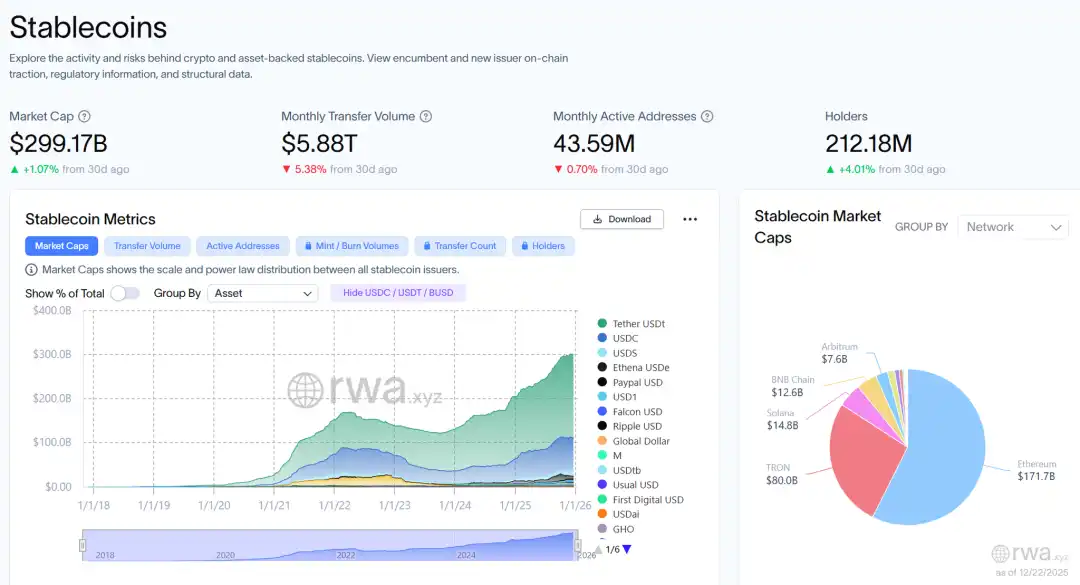
Source: rwa.xyz / Stablecoin's 2025 Growth
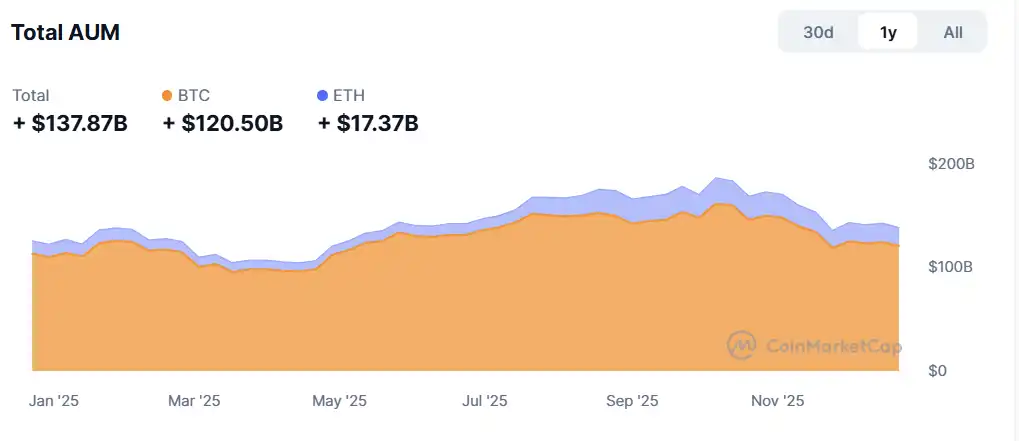
Source: CoinMarketCap / ETF Fund Yearly Data
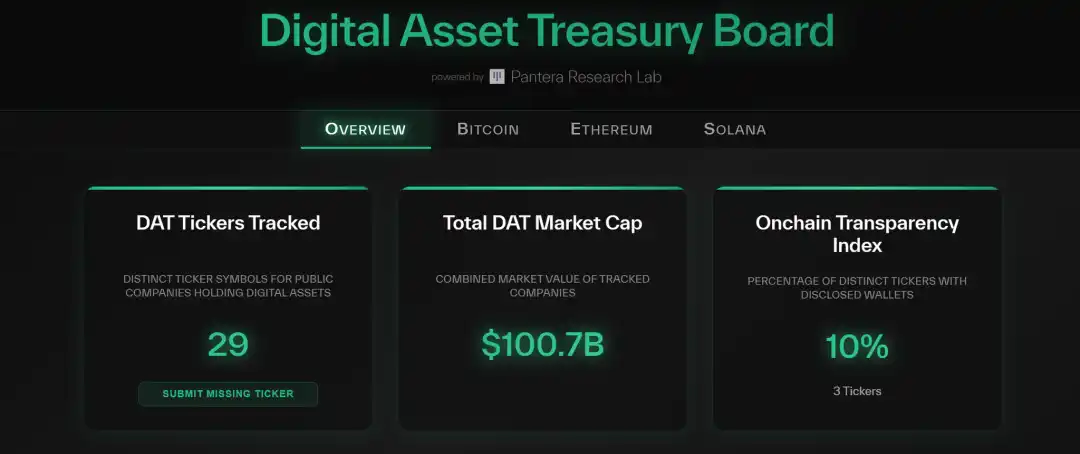
Source: Pantera Research Lab / DAT Data
In this context, IPO has become an "external structural variable" of the 2025 crypto market: it has, on the one hand, expanded the range of compliant funds that can be allocated to targets, provided a public market valuation anchor and benchmarking system for stablecoins, trading/settlement, brokerage, and custody, and changed the holding period and exit mechanism of funds in the form of "stocks"; on the other hand, its marginal increment is not linear and will still be constrained by macro risk appetite, secondary market valuation centralization, and issuance window.
Overall, throughout the year, 2025 can be summarized as a combination year of "institutional acceleration, strengthened macro constraints, and securitization restart": the advancement of institutional and compliance pathways has increased the allocatability of crypto assets, expanding the fund's entry from a single-chain structure to a parallel system of ETFs, stablecoin bases, DAT, and IPO; meanwhile, interest rates, tariffs, and fiscal friction continue to shape liquidity boundaries, making the market more akin to "macro-driven volatility" of traditional risk assets. The resulting track differentiation and the return of "publicly listed company vehicles" will set the stage for 2026.
IPO Window Heating Up: From Narrative Premium to Financial Vernacular
In 2025, the U.S. stock IPO window for crypto-related companies significantly heated up, evolving from a "conceptual window opening" to a quantitatively testable set of public market samples: a total of 9 crypto/crypto-related companies completed IPOs during the year according to sample scope, raising a total of approximately $7.74 billion, indicating that the public market's capacity to absorb financing for "compliant-accessible digital financial assets" has returned to a substantial scale of funding acceptance rather than a symbolic small amount. In terms of valuation, this group of IPOs covered a valuation range of approximately $1.8 billion to $23 billion, fundamentally covering stablecoins and digital financial infrastructure, compliant trading platforms and trading/settlement infrastructure, regulated brokerage channels, as well as on-chain credit/RWA and other key links, allowing the industry to start owning a traceable, benchmarkable equity asset sample pool; this not only provides valuation anchors for the "stablecoin-trading-brokerage-institutional service-on-chain credit/RWA" chain but also systematically shifts the market's pricing language towards a financial institution framework (with a stronger emphasis on compliance and licensing, risk control and operational resilience, revenue quality, and sustainable profit). In terms of market performance, the 2025 samples generally exhibited the common feature of "strong initial offering phase, followed by rapid differentiation": in terms of issuance structure, the initial circulating supply of many companies was relatively tight (approximately in the range of 7.6%-26.5%), making short-term price discovery more elastic when the risk appetite window opens; the secondary market was generally strong on the first day, with some targets experiencing doubling-level repricing, while the rest mostly saw double-digit positive returns, and many companies continued to show strength in the first week and first month, reflecting that buyers in the window period have a "continuous acceptance" of such assets rather than a one-time pricing; however, differentiation significantly increased from 1 to 6 months later, and became closer to the logic of traditional risk assets that are more macro and quality-focused — companies more focused on retail and trading businesses are more sensitive to risk appetite switching and experience faster retracements, while assets more focused on upstream infrastructure and institutional adoption capacity are more likely to receive sustained re-ratings.
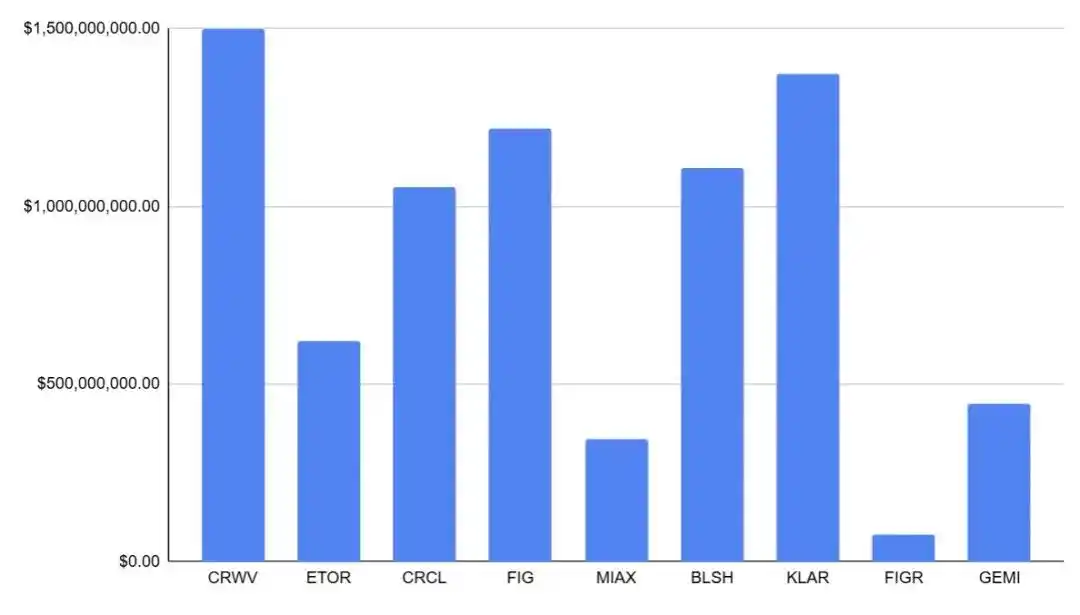
Source: nasdaq.com / 2025 Full Year US Stock Crypto Company IPO Amount
More importantly, the reason why the US Stock Crypto Company IPO is so popular is that it simultaneously satisfies the three most important things the public market cares about during a window period: Availability, Comparability, Exitability.
First, it has transformed the previously hard-to-access "cryptofinancial infrastructure cash flow" into stock assets that traditional accounts can directly hold, naturally fitting into the long-term funds' compliance and risk control framework, such as mutual funds, pension funds, sovereign funds, etc.;
Second, the IPO allows the industry to have a batch of equity samples that can be benchmarked horizontally for the first time. Buyers no longer have to rely solely on "narrative intensity/trading volume extrapolation" to estimate valuation but can use the language familiar to financial institutions for stratification—compliance costs and licensing barriers, risk reserves and internal control governance, customer structure and retention, revenue quality and capital efficiency—when the pricing method becomes more standardized, buyers are more willing to provide a higher certainty premium during the window period;
Third, the IPO has shifted the exit mechanism from the "on-chain liquidity and sentiment cycle" part to "public market liquidity + market making/research coverage + index and institutional rebalancing," which allows funds to provide stronger order quality during the issuance stage (including more stable long-term demand and anchor orders), thereby strengthening the repricing momentum in the primary market. In other words, the enthusiasm comes not only from risk appetite but also from the decrease in risk premium brought about by "institutionalized accessibility": when assets become easier to audit, compare, and incorporate into risk budgets, the public market is more willing to pay a premium for them.
Among these, Circle is the most representative case of the "Stablecoin Track Equity Valuation Anchor": its IPO was priced at $31, raising approximately $1.054 billion, corresponding to an IPO valuation of approximately $6.45 billion. The secondary market repriced it strongly during the window period—approximately +168.5% on the first day, approximately +243.7% in the first week, approximately +501.9% in the first month, surging to a peak of $298.99, corresponding to a maximum increase of approximately +864.5%, and still around +182.1% at the half-year sample point. The significance of Circle lies not in the "price increase itself" but in the fact that it priced the "Stablecoin" for the first time in a publicly equitized manner as a "financial infrastructure cash flow" that can be audited, benchmarked, and included in a risk budget: compliance moats and settlement network effects are no longer just concepts but are directly reflected in the rise in valuation through the issuance pricing and continuous secondary market participation. At the same time, Circle also validated the typical "buying behavior" of the US stock for such assets—when the window opens, the combination of a small float and high-quality buyer demand amplifies price elasticity; but as the window narrows, valuations will more quickly revert to fundamental realization, cycle sensitivity, and differentiation in profit quality. This also forms the core reason for our somewhat optimistic view of US Stock Crypto Company IPOs: the public market will not indiscriminately inflate valuations, but it will stratify more quickly and clearly. Once quality assets establish a benchmarkable valuation anchor in the public market, their cost of capital will decrease, refinancing and M&A currency will be stronger, and the positive cycle of growth and compliance investment will be easier to run—this is more important than short-term price fluctuations.
Looking ahead to 2026, the market's focus will shift from "whether the window exists" to "whether subsequent listing projects can continue to advance and form a more continuous issuance rhythm." According to current market expectations, potential candidates include Anchorage Digital, Upbit, OKX, Securitize, Kraken, Ledger, BitGo, Tether, Polymarket, Consensus, and others, totaling about 10 companies, covering a more complete industry chain from custody and institutional compliance entry points, trading platforms and brokerage channels, stablecoins and settlement infrastructure, asset tokenization and compliance issuance infrastructure, to hardware security and new information markets. If these projects can continue to land on the public market and receive relatively stable funding, their significance will not only be "a few more rounds of funding," but will standardize investors' logic for backing crypto companies further: they will be more willing to pay a premium for compliance moats, risk management and governance, revenue quality, and capital efficiency, and will also be quicker to filter through valuation centers and secondary performance in macro headwinds or weakening issuance conditions. Overall, we are optimistic about the directional trend of U.S. stock market crypto company IPOs: in 2025, the public market's capacity to support was validated by quantity, financing size, and market repricing; and if 2026 can continue this trend of "continuous issuance + stable support," IPOs will be more like a sustainable capital cycle—further pushing the industry from a "narrative-driven phase" to "public market sustainable pricing," and allowing companies that truly have compliance and cash flow quality to expand their leading advantages at lower capital costs.
Industry Structure Diversification and Product Line Maturation: Internal Evolution of the Crypto Industry
To determine whether this path of the public market can continue and which companies are more likely to be "backed by the market," the key is not to once again talk about "whether the window exists," but to go back to the structural evolution that has already occurred within the industry in 2025: growth is shifting from a single-point narrative to multiple sustainable product lines and forming a volatility and differentiation mechanism more akin to traditional risk assets under macro and regulatory constraints—it is within this mechanism that the capital market will determine what kind of business model deserves a more stable valuation center and lower capital costs.
In 2025, the structural changes within the crypto industry were clearer than ever before: market growth no longer mainly relies on a single narrative-driven risk appetite overflow but is collectively driven by several more sustainable "product lines"—trading infrastructure becomes more specialized, application forms closer to mainstream finance, fund access more compliant, and gradually forms a closed loop between on-chain and off-chain. At the same time, fund behavior and pricing rhythms are more deeply integrated into the global risk asset framework: volatility is more like a "risk budget rebalancing under a macro window" rather than the relatively independent market movements mainly driven by on-chain narratives and internal liquidity cycles. For practitioners, this means that the focus of discussion has shifted from "which narrative will break out" to "which products can consistently generate trading, retain liquidity, and withstand pressure tests from macro fluctuations and regulatory constraints".
Within this framework, the traditional "crypto four-year cycle" is further weakened in 2025. The cyclical logic has not disappeared, but its explanatory power has been significantly diluted: channels such as ETFs, stablecoins, corporate treasuries, etc., bring a larger volume of funds into an observable, rebalancable asset allocation system; at the same time, interest rates and the US dollar liquidity boundary have become more stringent constraints, making risk budgets, leverage pricing, and deleveraging paths more akin to traditional markets. As a result, the upside increasingly relies on a resonance between "macro risk appetite + net inflows," while the downside is more easily amplified in "liquidity tightening + deleveraging" scenarios. The performance of various tracks throughout the year looks more like a coordinated evolution: what truly drives structural upgrades is not a single narrative eruption, but the continuous thickening of the funding gateway and trading scenarios by underlying financialized products such as stablecoin expansion, deepening of derivatives, event contracts, etc., simultaneously strengthening risk transmission.
Stablecoins in 2025 present two concurrently advancing but asynchronously paced storylines: one is "compliance-driven certainty uplift," and the other is "cyclical volatility of yield-based models." The key to the former is that with the emergence of regulatory frameworks and more comparable market samples, stablecoin business models are more easily priced by mainstream funds based on cash flow and risk attributes; the latter is manifested as yield-based/synthetic dollars being highly sensitive to basis, hedging costs, and risk budgets, with a noticeable contraction post-expansion. Taking Ethena's USDe as an example, its supply reached a high of nearly $150 billion in early October, fell to around $85 billion in November, and briefly deviated from its peg during a deleveraging window in mid-October. The industry-level implication is: yield-based stablecoins are closer to an "amplifier of macro and basis"—contributing liquidity in favorable times, amplifying volatility and risk repricing in adverse times.
Trading infrastructure upgrades in 2025 accelerated with on-chain derivatives at the core. Platforms like Hyperliquid continued to approach centralized exchanges in depth, matching, capital efficiency, and risk control experience, with a monthly trading volume of around $300 billion by mid-year, indicating that on-chain derivatives have the foundation for scalable throughput. Meanwhile, newcomers like Aster, Lighter, etc., entered through product structure, fees, and incentive systems, driving the track from "single-platform dividends" to "market share competition." The essence of the competition lies not in short-term trading volume but in whether usable depth, clearing order, and stable risk frameworks can be maintained in extreme market conditions; and derivative expansion has made volatility more "macroscopic"—deleveraging on-chain and off-chain often more synchronized and faster when interest rates and risk appetite switch.
Prediction markets in 2025 expanded from native crypto applications to a more broad-based event contract market, becoming a new incremental trading scenario. Platforms like Polymarket saw a significant increase in participation and trading volume in event contracts; the monthly trading volume grew from less than $100 million in early 2024 to over $13 billion in November 2025, with sports and politics becoming the main categories. Its deeper significance lies in: event contracts transform macro and public issues into tradable probability curves, naturally aligning with media dissemination and information distribution, making it easier to form cross-layer user entry points, further reinforcing the coupling between crypto and macro variables (even political variables).
Overall, the 2025 structural upgrade is shifting the industry from "narrative-driven price discovery" to "product-driven fund organization". The layering of stablecoins, infrastructure development of on-chain derivatives, and the contextualization of event-based contracts have collectively expanded fund inflows and transaction scenarios, accelerating risk transmission in a more systematic way; against the backdrop of enhanced macro and interest rate constraints, the market cycle structure further converges towards mainstream risk assets, with the explanatory power of the four-year cycle continuing to weaken.
The Dual Themes of Stablecoins: Compliance Certainty and Yield-Cycle
In 2025, stablecoins have upgraded from on-chain transactional media to the crypto ecosystem's USD settlement layer and fund base, with a clear bifurcation: USDT/USDC continue to form the mainstream fiat stablecoin "cash layer," providing a liquidity network covering global transactions and settlements; yield-generating/synthetic dollars such as USDe/USDF are more like "efficiency tools" being preference and spread-driven, exhibiting significant periodicity in expansion and contraction.
The most direct signal throughout the year is a substantial thickening of the on-chain dollar base: the total stablecoin supply has expanded from around $2.05 trillion to over $3 trillion, highly concentrated at the top (around $186.7 billion USDT and around $77 billion USDC near the end of the year); the issuers collectively hold around $155 billion US Treasury bonds, making stablecoins closer to a combination of "tokenized cash + short-duration government bonds" infrastructure. The usage side is also strengthened: stablecoins account for approximately 30% of on-chain crypto transaction volume, with on-chain activity accumulating over $4 trillion throughout the year, and the scale of payment-type on-chain transactions is estimated to be in the range of $20-30 billion per day, continuously driving the real demand for cross-border settlement and fund transfers.
On the institutional front, the GENIUS Act, implemented in July, incorporates payment-type stablecoins into licensed issuance, 1:1 reserves, redemption, disclosure requirements, and establishes an admission path for foreign issuers, institutionalizing the "compliance premium" and pricing: USDC benefits more from compliance and institutional availability strengthening, while USDT should not simply be classified as a compliant stablecoin under the US framework; its advantage lies in the global liquidity network, but the accessibility to the US market will depend more on implementation details and channel compliance.
The yield track has completed its repositioning: taking USDe from Ethena as an example, the supply has dropped from a high of around $14.8 billion in early October to around $6-7 billion by the end of the year, validating its structured property of "expansion in favorable conditions and contraction in adverse conditions."
Looking ahead to 2026, stablecoins remain on the most certain growth trajectory: Competition among mainstream fiat-backed stablecoins will shift from scale to channels and settlement networks, yield-bearing products will continue to offer tailwind liquidity but will be more rigorously priced through stress testing and redemption resilience.
On-Chain Derivatives Platform Upgrades and Share Wars
In 2025, on-chain perpetual swaps transitioned from being "available products" to the infrastructure phase of "capable of supporting mainstream trading": Matchmaking and latency, margin and liquidation mechanisms, risk parameters and risk control coordination are closer to the engineering standards of centralized trading platforms, and on-chain derivatives begin to have the ability to partially divert mainstream trades and participate in price discovery during certain periods. At the same time, fund and risk transmission becomes more "macro": In the window of U.S. stock risk preference and interest rate expectation switch, the volatility and deleveraging pace of on-chain perpetual swaps are more easily in sync with traditional risk assets, and the market's sensitivity to the "macro liquidity-risk budget" significantly increases.
A "derivatives on-chain plate" with sustainable tracking has been formed at the scale end. As of the end of 2025, on-chain perpetual swaps had a 30-day trading volume of approximately $1.081 trillion, with the total market's open interest at around $15.4 billion, reflecting that this track has the capacity to routinely handle large-scale trades and risk exposure. Leading platforms still hold the core mindset of "depth and risk control," but the competitive logic underwent a substantial change in 2025: Share competition no longer primarily relies on subsidies and listing speed but leans more towards depth, open interest accumulation, and the stability of liquidation order in extreme market conditions. Taking Hyperliquid as an example, its open interest at the sample point was about $6.88 billion, with a 30-day trading volume of around $180.4 billion, showcasing "stronger risk exposure accumulation + relatively stable trading volume."
What's even more fortunate is that newcomers in the second half of 2025 are no longer just conceptual challengers but have joined the competition with quantifiable data to reshape market share: Lighter had a 30-day trading volume of about $233.2 billion, a total trading volume of around $1.272 trillion, and open interest of about $1.65 billion; Aster had a 30-day trading volume of about $194.4 billion, a total trading volume of around $811.7 billion, and open interest of about $2.45 billion. In terms of open interest ranking, Hyperliquid, Aster, and Lighter are already in the top three positions (around $6.88 billion / $2.41 billion / $1.60 billion), indicating that the track has entered a mature stage of "multi-platform parallel competition."
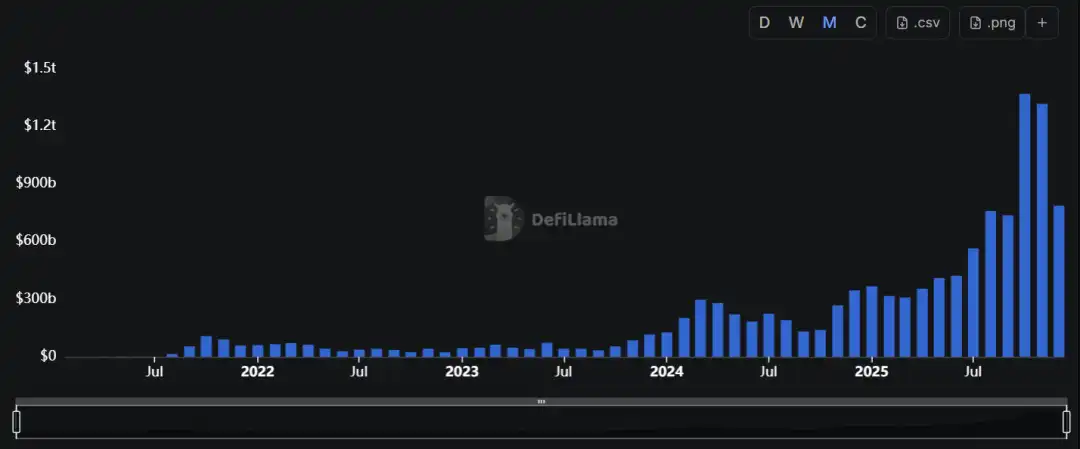
Source: DeFiLlama / On-Chain Perpetual Contract Trading Volume
For the industry, by 2025, on-chain perpetual contracts have entered the "Quality and Resilience Pricing" stage—where trading volume can be amplified by short-term incentives, but the scale of open interest, the sustainability of fees/revenue, and risk management performance during extreme market conditions better reflect real fund residence and platform stickiness.
Looking ahead to 2026, the race is likely to evolve along two lines simultaneously:
One, the on-chain derivatives' penetration rate continues to rise;
Two, under fee compression and elevated risk control thresholds, the market further consolidates toward a few platforms that can sustain depth and liquidation order in the long term.
Whether a new platform can transition from a scale sprint to stable retention largely depends on its capital efficiency and risk framework under stress testing, rather than just a single-stage trading volume performance.
Prediction Markets Transitioning from Crypto-Native to Event-Based Markets
In 2025, the prediction markets completed the upgrade from the phase-specific flashpoint to a more independent, sustainable trading scenario based on the "event contract (probability pricing)" validated during the 2024 U.S. presidential election: it no longer mainly relies on short-term traffic brought by a single political event but solidifies "probability trading" into more stable trading demand and user habits through high-frequency/reusable contract categories such as sports, macro, and policy nodes. Due to the natural externalization of event contracts (macro data, regulatory bills, elections, and sports schedules, etc.), the activity of prediction markets and the linkage with U.S. stock risk appetite and interest rate expectations have significantly strengthened. The industry application layer's pace has further shifted from the "crypto internal narrative cycle" to the "macro uncertainty × event density × risk budget" function.
On the data side, the prediction market track saw exponential growth in 2025: with a total annual trading volume of about $44 billion, where Polymarket around $21.5 billion and Kalshi around $17.1 billion, the scale of leading platforms is sufficient to support stable market-making and category expansion. The growth exhibited a significant event-driven peak within the year: monthly nominal trading volume surged from less than $100 million in early 2024 to over $13 billion in a single month in 2025 (represented by November), demonstrating a high-resilience to high-attention event windows. Structurally, the prediction market has evolved from being "politically driven" to "sports high-frequency retention + multi-category event expansion": Kalshi had a trading volume of around $5.8 billion in November 2025, with approximately 91% coming from sports; the platform disclosed that its trading volume has exceeded $1 billion weekly and claimed a growth of over 1000% compared to 2024, reflecting its established normalized trading foundation.
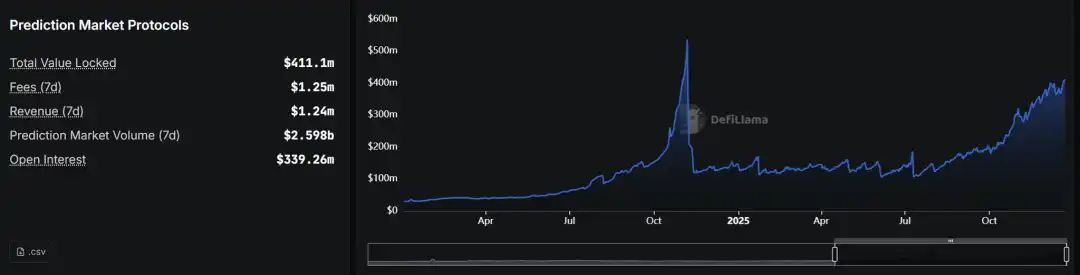
Source: DeFiLlama / Prediction Market Data Overview
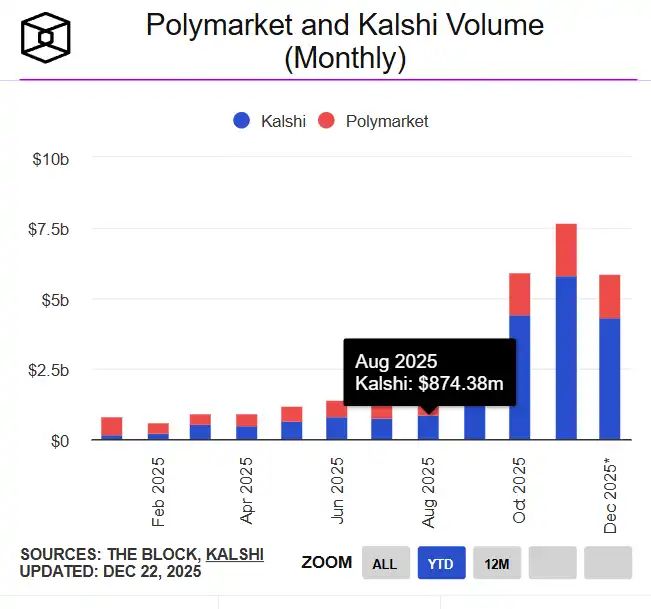
Source: theblock.co / Trading Volume on Polymarket and Kalshi Markets
Building on the aforementioned shift in capital structure and industry transformation driven by crypto company IPOs, the prediction market track has rapidly upgraded from "crypto entrepreneurship" to "financial infrastructure/data assets": Kalshi completed a $1 billion funding round in December with a valuation of approximately $11 billion, having previously raised $300 million at a valuation of around $5 billion within the preceding two months; meanwhile, traditional market infrastructure players have also begun entering with heavy capital commitments, with ICE (parent company of NYSE) reportedly looking to invest up to $2 billion in Polymarket with a pre-money valuation of around $8 billion. The common thread in such transactions is that event contracts are not only seen as "trading products" but also as integrable market data, sentiment indicators, and risk pricing interfaces.
Looking ahead to 2026, prediction markets are more likely to become one of the structurally incremental layers of the crypto application stack with higher certainty: growth is driven by event density and information uncertainty, commercialization leaning closer to a combination of "transaction fees + data products + distribution channels." If compliance pathways, distribution channels, and dispute resolution standards become further clarified, prediction markets are poised to evolve from episodic hits to a more normalized event risk trading and hedging tool; their long-term ceiling mainly depends on three key metrics: real depth (ability to handle large amounts), reliable settlement and dispute governance, and manageable compliance boundaries.
Conclusion
Reflecting on 2025, the core features of the crypto market were externalization of pricing frameworks and deepening channel competition: capital inflows shifted from on-chain leverage and narrative-driven endogenous cycles to a multi-channel system composed of ETFs, stablecoin-denominated bases, corporate treasuries, and securitization channels (crypto companies' IPOs in the stock market). Channel expansion increased asset configurability and strengthened macro boundary conditions—market trends became more reliant on net inflows and financing windows coordination, while drawdowns became more easily concentrated releases within deleveraging and liquidation chains.
The further evolution of the industry's internal structure has further confirmed this migration: Stablecoins are layered between the "cash layer" and "efficiency tools," on-chain derivatives have entered the stage of scaled capacity and market share competition, and prediction markets and event contracts have formed more independent trading scenarios. More importantly, the return of IPOs has "securitized" the cryptographic financial infrastructure into auditable, benchmarkable, and exitable equity assets, allowing mainstream funds to participate in a more familiar way and driving the valuation system towards "compliance moats, risk management, income quality, and capital efficiency" convergence — which is the core reason we are optimistic about this direction.
Looking ahead to 2026, the industry's slope is more likely to depend on three variables: whether institutionalized channels can continue, whether fund deposition is sustainable, and the resilience of leverage and risk management under stress scenarios. Among them, if US stock-exchange-listed cryptocurrency companies' IPOs can maintain more continuous progress and stable reception, they will continue to provide valuation anchors and financing flexibility, strengthening the industry's migration to public market sustainable pricing.
You may also like

Decode Stock on Chain: Why Are Crypto Enthusiasts Investing in US Stocks While Wall Street Is Going Blockchain Unfriendly?

Key Market Intelligence as of December 31st, how much did you miss out on?

DeFi 2.0 Explosion Post-Disorderly Restructuring in 2026

Lighter Token Distribution Sparks Controversy, Zama Launches USDT Private Transfers, What is the Overseas Crypto Community Talking About Today?

The Fed’s Monetary Policy Minutes and the Crypto Trading Insights
Key Takeaways The Federal Reserve is set to disclose the minutes from its recent monetary policy meeting, highlighting…

Unstable Stablecoins: Understanding the Market’s Concerns and Dynamics
Key Takeaways Recent financial reports indicate concerns and instability in the stablecoin market. Circle, a leading stablecoin issuer,…
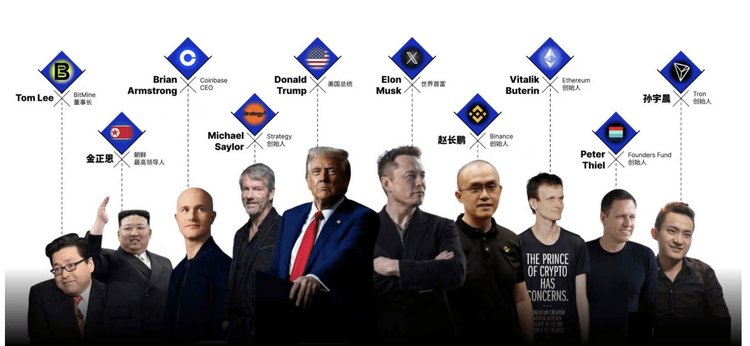
Ten People Redefining the Power Boundaries of Crypto in 2025
From Wall Street to the White House, from Silicon Valley to Shenzhen, a new power network is taking shape.
Whale Trader Reaps Significant Profits from Ethereum Sales
Key Takeaways A whale, identified as address “0xa339”, has executed a large sale of 50,623 ETH. The total…

HYPE Token Unlocks Ignite Investor Interest
Key Takeaways Significant HYPE Token unlock scheduled today at 3:30 PM Beijing Time, releasing 9.92 million tokens valued…

ZEROBASE Surges Dramatically as High-Yield Ecosystem and Institutional Confidence Drive Growth
Key Takeaways ZEROBASE (ZBT) experienced a significant 58.95% price increase in the past 24 hours, reaching a peak…

Whale Executes Major Position with $1.8 Million USDC on HyperLiquid
Key Takeaways A significant crypto whale has deposited $1.8 million USDC into HyperLiquid. The whale used the funds…

Whale Deposits 1.81 Million USDC in HyperLiquid for Leveraged LIT Position
Key Takeaways A significant investor has deposited 1.81 million USDC into HyperLiquid. The investor utilized a 3x leverage…

Coinbase Recognized as a Top Fintech Pick for 2026 by Clear Street
Key Takeaways: Coinbase has been identified as one of the top three fintech stock picks for 2026 by…

Circle Platform Promising Tokenized Gold, Silver Swaps Is a ‘Fake,’ Company Says
Key Takeaways: A fraudulent press release claimed that Circle had introduced a platform called CircleMetals for trading tokenized…

133 Transactions, $8.6 Billion: Who Bought the Crypto Industry in 2025
Flow Chain Rollback Sparks Outrage, Whale Starts Lighter Rebalancing, Mainstream Ecosystem Update Overview

ETHPanda Talk | From Nethermind to Ethereum Foundation: Tomasz's Ethereum Core Development Journey

Hyperliquid Whales Shift Strategies: BTC Longs Decline, ETH Shorts Dominate
Key Takeaways A significant reduction in Bitcoin long positions has been observed on Hyperliquid, with large holders decreasing…
Decode Stock on Chain: Why Are Crypto Enthusiasts Investing in US Stocks While Wall Street Is Going Blockchain Unfriendly?
Key Market Intelligence as of December 31st, how much did you miss out on?
DeFi 2.0 Explosion Post-Disorderly Restructuring in 2026
Lighter Token Distribution Sparks Controversy, Zama Launches USDT Private Transfers, What is the Overseas Crypto Community Talking About Today?
The Fed’s Monetary Policy Minutes and the Crypto Trading Insights
Key Takeaways The Federal Reserve is set to disclose the minutes from its recent monetary policy meeting, highlighting…
Unstable Stablecoins: Understanding the Market’s Concerns and Dynamics
Key Takeaways Recent financial reports indicate concerns and instability in the stablecoin market. Circle, a leading stablecoin issuer,…


 App
App