
- Buy Crypto
- Markets
- Futures
- Spot
- Copy Trade
 WE-Launch
**Military Lockdown Shakes Up South Korean Crypto Market: $33 Billion Sell-Off Wave and Native Project Exoduses**

Original Article Title: Martial law in South Korea and the crypto market outlook
Original Source: Tiger Research Reports
Original Translation: Deep Tide TechFlow
Key Points Summary:
· Market Volatility: The announcement of martial law triggered a massive sell-off on South Korean cryptocurrency exchanges, with a total sell-off amounting to around 33.3 billion USD. The price of Bitcoin dropped to 62,300 USD, with the local market recording the highest trading volume globally at one point.
· Investor Exodus: Due to price fluctuations and system failures in local exchanges, South Korean investors are expected to pivot to overseas exchanges and DeFi platforms.
· Industry Contraction: Political instability is prompting South Korean blockchain projects to move overseas. Key legislation, such as the Virtual Asset User Protection Law, may be delayed as a result.
1. Introduction

Source: Yonhap News
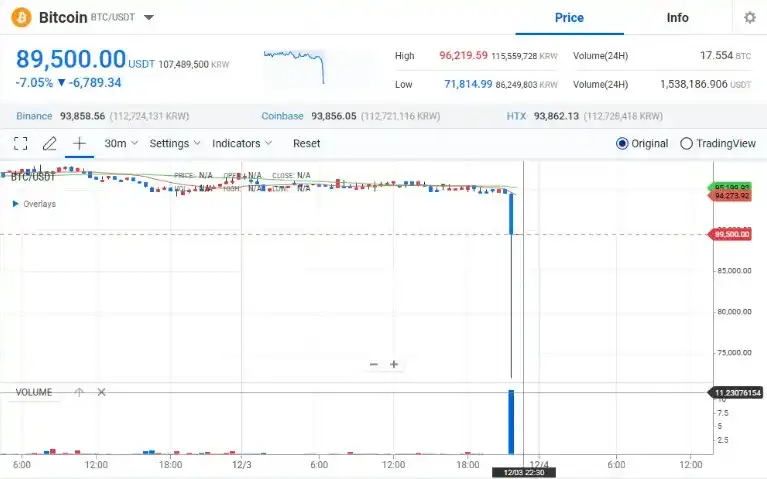
Last night, President Yoon Suk-yet suddenly announced and lifted martial law, causing a shock to South Korea's cryptocurrency market. Bitcoin's price on South Korea's largest exchange Upbit dropped to 62.3K USD. Upbit and Bithumb, the two major South Korean exchanges, saw 24-hour trading volumes of 26.9 billion USD and 6.4 billion USD, respectively, reaching their highest levels this year. This reflects the large-scale sell-off by South Korean investors following the declaration of martial law. During this period, South Korean exchanges briefly became the highest-volume market globally, highlighting the extreme volatility of its market.
2. Decline in Trust in the Won Assets and Rise in Cryptocurrency Demand

The martial law event severely eroded trust in won-denominated assets. With foreign capital exiting, the stock and bond markets may become even more volatile. As a result, investors are gradually shifting their focus to decentralized assets such as cryptocurrency.
Against the backdrop of rising geopolitical risks, investors are turning to cryptocurrency to protect their assets. Major cryptocurrencies like Bitcoin are garnering attention for being beyond government control. In past crises such as the Hong Kong protests and the Russia-Ukraine conflict, cryptocurrency has been seen as a safe-haven asset.
3. The Double-Edged Sword of Stringent Regulation and the Acceleration of Exchange Exodus
South Korean cryptocurrency exchanges maintain high security through strict travel rules and KYC regulations. The enactment of designated financial transaction information reporting and usage laws has strengthened anti-money laundering (AML) measures and enhanced investor protection. These efforts have positioned South Korea as a leader in regulatory compliance.
Source: Upbit
However, the market crash revealed the double-edged sword effect of stringent regulation. The strict rules have sustained a Kimchi Premium, widened the price gap with global markets, and made it difficult for investors to make rational decisions.
The significant price fluctuations and system instability of local exchanges have eroded investor trust. With overnight trading volumes reaching $33.3 billion, servers of Upbit and Bithumb experienced crashes. Unlike overseas exchanges, this instability has made local exchanges appear unreliable.
These issues are expected to accelerate South Korean investors' shift to overseas exchanges and DeFi platforms. Binance and Coinbase provide a stable trading environment and diverse financial products, making them the preferred choice for South Korean investors.
4. Acceleration of South Korean Blockchain Project Exodus
Due to political instability, the investment environment for South Korean blockchain projects has been affected. Many large projects have already moved overseas, and this trend is expected to continue. Nexon's blockchain division Nexpace has relocated to Abu Dhabi, Klaytn and LINE Finschia's Kaia Foundation have moved to Singapore, and Wemade's Wemix has shifted to Dubai. These companies have chosen blockchain-friendly countries to avoid South Korea's regulatory uncertainty and political risk. More projects are expected to move to Singapore and the UAE, where regulations remain clear and stable.
The overseas migration of blockchain startups has raised concerns about talent drain. This trend could weaken South Korea's competitiveness in the blockchain field. Against the backdrop of rapid development in Web3 and blockchain technology, talent outflow may have a long-term negative impact on South Korea's technological advantage. This brain drain has intensified the industry's sense of crisis.
Furthermore, the impeachment issue may delay the progress of key legislation. Laws such as the Virtual Asset User Protection Act currently being discussed in the National Assembly may face delays. These delays could further hinder the institutionalization process of South Korea's cryptocurrency market.
5. Conclusion
The martial law incident exposed structural weaknesses in the South Korean cryptocurrency market. Overnight, $333 billion in value vanished from sight, with major exchanges’ servers crippled. The market experienced extreme price volatility, with significant price discrepancies compared to global exchanges. These events underscored political risks in the market and the fragility of the current trading system under pressure.
In the short term, market instability is expected to persist. However, with appropriate institutional improvements and system enhancements, this crisis could also serve as a turning point. These efforts will help strengthen the stability of the South Korean cryptocurrency ecosystem and drive its globalization. The future trajectory is worth close monitoring.
You may also like

From Wuhan to Silicon Valley, Manus did it in just nine months.
You may call it a “wrapper,” but it wrapped its way all the way to Meta.
How AI Helps Crypto Traders Analyze Markets, Manage Risk, and Trade Smarter
Crypto trading is no longer just about having a good idea—it is about executing consistently in a market that never stops. As data volumes and market speed increase, traditional manual analysis reaches its limits. AI helps traders move beyond these limits by transforming how markets are analyzed, how sentiment is interpreted, and how risk is controlled. This article explores how AI is reshaping crypto trading — and what that means for traders today.

WEEX × LALIGA: Seven Stars That Represent a Shared Standard of Excellence
True excellence in football is never accidental. It is built on discipline, consistency, and the ability to deliver under pressure — season after season. The same principles apply in professional trading, where long-term performance matters more than short-lived momentum. As an official regional partner of LALIGA, WEEX highlights seven outstanding players who embody the league’s competitive spirit and global appeal. Each brings a unique style to the pitch, yet all share values that closely align with WEEX’s commitment to stability, precision, and professional execution. This partnership is built on shared standards — where consistency and control define performance under pressure.

Arkstream Capital: When Cryptocurrency Returns to 'Financial Logic' by 2025

The Year Trump Embraced Cryptocurrency

IOSG: Port and New City, Two Cryptoverse Views of BNB Chain and Base

WEEX Partners with LALIGA to Expand Global Reach and Integrate Crypto into Mainstream Sports Culture
Hong Kong, Jan. 1, 2026. WEEX has entered into a new partnership with LALIGA, as an official regional partner of LALIGA in Taiwan and Hong Kong. The agreement brings WEEX into LALIGA’s network of regional collaborators and opens the door to new ways of engaging both fans and traders during the season.

Perpetual Contract Genesis: Pricing Liquidity with a Magic Formula, Transparency Prevents it from Reaching its Full Potential

Decode Stock on Chain: Why Are Crypto Enthusiasts Investing in US Stocks While Wall Street Is Going Blockchain Unfriendly?

Key Market Intelligence as of December 31st, how much did you miss out on?

Long-standing domestic public blockchain NEO sees feud between two co-founders, with opaque finances as the core reason

Hong Kong Virtual Asset Trading Platform New Regulations (Part 2): New Circular Issued, Has the Boundary of Virtual Asset Business Been Redefined?

DeFi 2.0 Explosion Post-Disorderly Restructuring in 2026
Fed's Latest Meeting Minutes: Divergence Persists, But "Most" Officials Advocate Continued Rate Cuts
AI Trading in Crypto: How Traders Actually Apply AI in Real Crypto Markets
Artificial intelligence has moved beyond experimentation in crypto markets. In 2025, AI-driven trading tools are increasingly used by traders who want better discipline, faster execution, and more structured decision-making in volatile markets. This guide explains how AI is actually used in crypto trading, step by step — with a focus on how these strategies are executed in real trading environments.
The first large-scale adoption of a "yield-bearing stablecoin" was in China

Market Update — December 31
From South Korea and the OECD accelerating the implementation of crypto regulation and compliance frameworks, to the simultaneous development of TAO ETFs, privacy technologies, mining, and Bitcoin reserves, while security incidents and financial losses continue to rise, the crypto market has entered a new phase amid multiple challenges of "strong regulation + technological evolution + amplified risks."

Lighter Token Distribution Sparks Controversy, Zama Launches USDT Private Transfers, What is the Overseas Crypto Community Talking About Today?
From Wuhan to Silicon Valley, Manus did it in just nine months.
You may call it a “wrapper,” but it wrapped its way all the way to Meta.
How AI Helps Crypto Traders Analyze Markets, Manage Risk, and Trade Smarter
Crypto trading is no longer just about having a good idea—it is about executing consistently in a market that never stops. As data volumes and market speed increase, traditional manual analysis reaches its limits. AI helps traders move beyond these limits by transforming how markets are analyzed, how sentiment is interpreted, and how risk is controlled. This article explores how AI is reshaping crypto trading — and what that means for traders today.
WEEX × LALIGA: Seven Stars That Represent a Shared Standard of Excellence
True excellence in football is never accidental. It is built on discipline, consistency, and the ability to deliver under pressure — season after season. The same principles apply in professional trading, where long-term performance matters more than short-lived momentum. As an official regional partner of LALIGA, WEEX highlights seven outstanding players who embody the league’s competitive spirit and global appeal. Each brings a unique style to the pitch, yet all share values that closely align with WEEX’s commitment to stability, precision, and professional execution. This partnership is built on shared standards — where consistency and control define performance under pressure.


 App
App