
- Buy Crypto
- Markets
- Futures
- Spot
- Copy Trade
 WE-Launch
「Zero Fee」 Illusion: Lighter Nodes Shifted Costs with High Latency

Original Article Title: Lighter's "0% Fees" Are Actually 5-10x More Expensive Than Other Exchanges
Original Article Author: @PerpetualCow, Crypto Influencer
Original Article Translation: AididiaoJP, Foresight News
There's a saying in the market: If a product is free, then you are the product.
Lighter DEX is currently promoting "zero fees" to retail traders. It sounds too good to be true, and indeed it is.
However, what Lighter didn't prominently display is the toll structure behind these "free" trades.
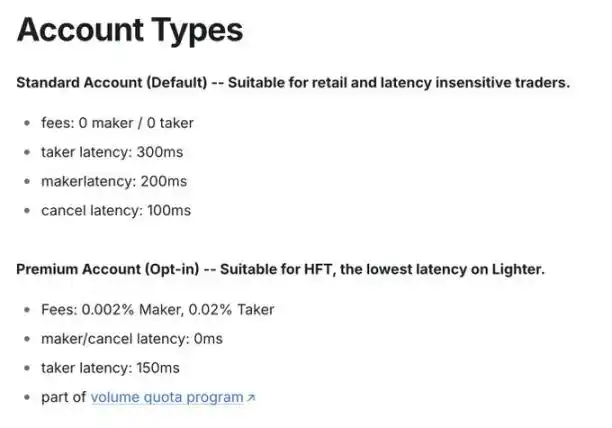
Lighter offers two account types: once you understand how the toll structure works, you'll realize that the 0% fee is actually the most expensive tier on the platform.
That 200-300 millisecond delay is the crux of their business model.
What Does 300 Milliseconds Really Mean?
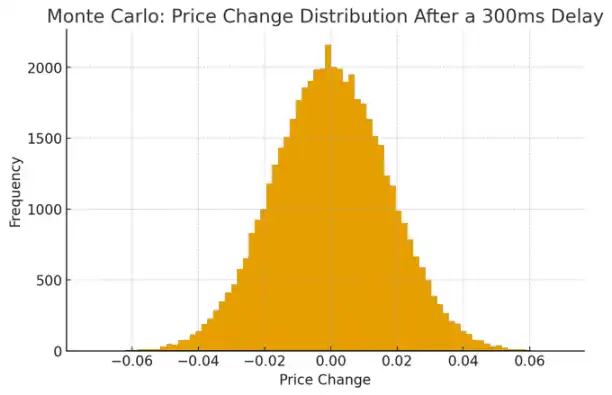
An average human blink takes about 100-150 milliseconds. By the time you blink twice, faster traders have already captured price movements, adjusted positions, and engaged in a trade against you.
The crypto market is highly volatile, with typical volatility levels (50-80% annualized), causing prices to move about 0.5 to 1 basis point per second.
This means that within 300 milliseconds, market noise alone can cause prices to move on average 0.15-0.30 basis points.
The True Cost of "Free"
If we quantify it:
Academic research on adverse selection costs (Glosten & Milgrom, Kyle's Lambda, etc.) indicates that the informational advantage of informed traders is usually 2-5 times the magnitude of price random walk.
If the random slippage within 300 milliseconds is about 0.2 basis points, then adverse selection would add an additional 0.4-1.0 basis points.
For active traders and liquidity providers, the actual costs are roughly as follows:
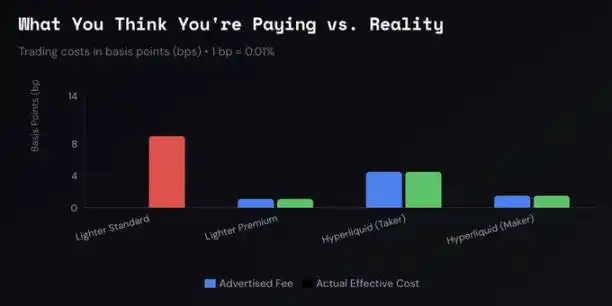
· Standard Account Actual Cost: 6–12 basis points (0.06%–0.12%) per transaction
· Advanced Account Actual Cost: 0.2–2 basis points (0.002%–0.02%) per transaction
The cost of a "free" account is 5–10 times higher than that of a paid account.
Zero transaction fee is just a marketing number; the real cost is hidden in the latency.
The advanced account is actually more cost-effective, without a doubt
In any case, the standard account (0% fee) is not the preferable choice.
It is not suitable for small retail investors, large holders, scalpers, day traders, or even passive investors. Especially not for liquidity providers, or anyone, for that matter.
"I am just a small retail investor; I don't need an advanced infrastructure."
Wrong.
Small retail investors are more vulnerable to slippage. If you trade with $1,000 and lose 10 basis points per trade, it is like losing $1 each time. After 50 trades, 5% of your account will silently disappear.
"I don't trade frequently; latency doesn't affect me."
Also wrong.
If you don't trade frequently, the cost of an advanced account is negligible anyway.
Yet even in a few trades, the execution price you receive is still worse. Since the cost of avoiding such losses is almost zero, why accept any disadvantage?
Directly upgrade to an advanced account.
This model has a precedent
The traditional financial markets have long witnessed this tactic, known as payment for order flow.
@RobinhoodApp once attracted retail investors with "commission-free trading," then routed orders to liquidity providers, allowing them to profit by trading against the uninformed orders of retail investors, thus popularizing this model.
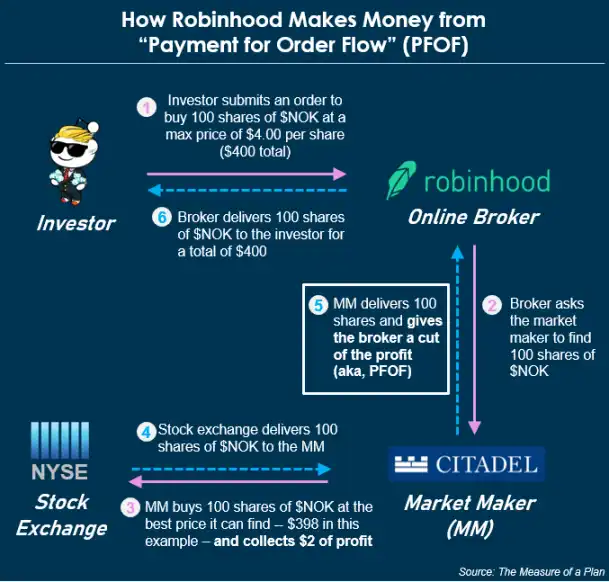
Lighter's model is structurally similar to this. Standard accounts do not receive free trades; they receive slower trades. This latency is transformed into profit by faster participants.
The trading platform does not need to charge you a fee because you are actually paying with execution quality.
What Lighter Did Right and Wrong
Lighter did not conceal latency data, as it was clearly stated in the documentation.
However, transparency does not equal clarity.
By highlighting "0% Fee" in the headline but burying "300ms Latency" in the fine print, Lighter employed a strategy focused on registration conversion rates rather than user understanding.
Most retail traders do not understand the implications of latency, are unaware of adverse selection, and naturally cannot calculate the equivalent actual cost.
Lighter is clear about this.
Advanced accounts are more cost-effective in every way compared to the standard "zero-fee" account—there is no debate about this.
You may also like
How AI Helps Crypto Traders Analyze Markets, Manage Risk, and Trade Smarter
Crypto trading is no longer just about having a good idea—it is about executing consistently in a market that never stops. As data volumes and market speed increase, traditional manual analysis reaches its limits. AI helps traders move beyond these limits by transforming how markets are analyzed, how sentiment is interpreted, and how risk is controlled. This article explores how AI is reshaping crypto trading — and what that means for traders today.

WEEX Partners with LALIGA to Expand Global Reach and Integrate Crypto into Mainstream Sports Culture
Hong Kong, Jan. 1, 2026. WEEX has entered into a new partnership with LALIGA, as an official regional partner of LALIGA in Taiwan and Hong Kong. The agreement brings WEEX into LALIGA’s network of regional collaborators and opens the door to new ways of engaging both fans and traders during the season.

Long-standing domestic public blockchain NEO sees feud between two co-founders, with opaque finances as the core reason

Hong Kong Virtual Asset Trading Platform New Regulations (Part 2): New Circular Issued, Has the Boundary of Virtual Asset Business Been Redefined?

Fed's Latest Meeting Minutes: Divergence Persists, But "Most" Officials Advocate Continued Rate Cuts
AI Trading in Crypto: How Traders Actually Apply AI in Real Crypto Markets
Artificial intelligence has moved beyond experimentation in crypto markets. In 2025, AI-driven trading tools are increasingly used by traders who want better discipline, faster execution, and more structured decision-making in volatile markets. This guide explains how AI is actually used in crypto trading, step by step — with a focus on how these strategies are executed in real trading environments.

4 Years of Web3 Entrepreneurship: 7 Key Takeaways

$50 to $1 Million: How to Survive in the Meme Battlefield with 'Wallet Tracking'
Paradigm's Tempo Project Launches Testnet, Is It Worth Checking Out?

Without Narrative Power, Web3 Will Not Tap into the Vastness

Caixin: Digital RMB Wallet Balances to Begin Earning Interest in 2026
Key Takeaways: Starting January 1, 2026, digital RMB wallets will earn interest on balances. The operational structure will…
From Failures to Success: Building Crypto Products That Truly Matter
Key Takeaways Building infrastructure in crypto doesn’t guarantee success; understanding user needs is critical. Products aimed at younger…

Cryptocurrency Trends and Insights: Navigating the 2025 Landscape
Key Takeaways Cryptocurrency continues to evolve rapidly, with new trends reshaping the market. Blockchain technology’s applications extend beyond…

Lighter: Airdrop Successful and Token Trading Imminent
Key Takeaways: The Lighter Discord community recently announced the successful distribution of LIT tokens, marking the beginning of…

The Eve of a Federal Pivot: Evaluating the Looming Change in the U.S. Central Bank
Key Takeaways Investors are gearing up for potential changes in Federal Reserve policy, with concerns about independence and…

6-Week, 3-Auditor Swap Sees Trump Crypto Firm Alt5 Sigma Mired in Financial Turbulence
Key Takeaways Alt5 Sigma, linked to the Trump family, faces financial reporting chaos and potential delisting risks due…

Yield Farming at 86% APY? How to Use Bots to “Earn While You Sleep” on Polymarket
Key Takeaways Polymarket presents untapped opportunities for bot utilization, despite existing competition. A proprietary trading bot streamlines the…

6-Week, 3-Auditor Switch Undermines Trump-Led Crypto Firm Alt5 Sigma
Key Takeaways Alt5 Sigma, tied to the Trump family, faces financial and operational turmoil marked by rapid auditor…
How AI Helps Crypto Traders Analyze Markets, Manage Risk, and Trade Smarter
Crypto trading is no longer just about having a good idea—it is about executing consistently in a market that never stops. As data volumes and market speed increase, traditional manual analysis reaches its limits. AI helps traders move beyond these limits by transforming how markets are analyzed, how sentiment is interpreted, and how risk is controlled. This article explores how AI is reshaping crypto trading — and what that means for traders today.
WEEX Partners with LALIGA to Expand Global Reach and Integrate Crypto into Mainstream Sports Culture
Hong Kong, Jan. 1, 2026. WEEX has entered into a new partnership with LALIGA, as an official regional partner of LALIGA in Taiwan and Hong Kong. The agreement brings WEEX into LALIGA’s network of regional collaborators and opens the door to new ways of engaging both fans and traders during the season.
Long-standing domestic public blockchain NEO sees feud between two co-founders, with opaque finances as the core reason
Hong Kong Virtual Asset Trading Platform New Regulations (Part 2): New Circular Issued, Has the Boundary of Virtual Asset Business Been Redefined?
Fed's Latest Meeting Minutes: Divergence Persists, But "Most" Officials Advocate Continued Rate Cuts
AI Trading in Crypto: How Traders Actually Apply AI in Real Crypto Markets
Artificial intelligence has moved beyond experimentation in crypto markets. In 2025, AI-driven trading tools are increasingly used by traders who want better discipline, faster execution, and more structured decision-making in volatile markets. This guide explains how AI is actually used in crypto trading, step by step — with a focus on how these strategies are executed in real trading environments.


 App
App