
- Comprar cripto
- Mercados
- Futuros
- Spot
- Copy Trade
 WE-Launch
History Repeating Itself: Grayscale Report Reveals New Safe Haven Logic Amid Tariff Storm

Original Article Title: Market Byte: Tariffs, Stagflation, and Bitcoin
Original Article Author: Zach Pandl
Original Article Translation: Asher, Odaily Planet Daily
Editor's Note: This article analyzes the recent impact of the United States' global tariff policy changes on the financial markets, particularly focusing on Bitcoin's unique performance during this process; discusses the long-term effects of tariffs on the economy, especially in stagflation periods and the asset allocation choices, as well as the performances of Bitcoin and gold in this environment; analyzes the current trade tensions' impact on the US dollar and potential adoption of Bitcoin, and finally provides an outlook on the economic prospects for the coming years, pointing out that scarce commodities like Bitcoin and gold may receive more attention and demand in a high inflation environment.
Since the announcement of the new global tariff policy by the United States on April 2, global asset prices have seen a significant decline, only gradually recovering until this morning's announcement of tariff suspension by Trump (excluding China). However, the initial tariff announcement nearly affected all assets, and during this time, looking at risk-adjusted benchmarks, Bitcoin's decline was relatively small. Therefore, if the Bitcoin-to-stock market return correlation is 1:1, the S&P 500's decline should have meant a 36% drop in Bitcoin price. However, in reality, Bitcoin only fell by 10%, highlighting that even during a deep market retreat, holding Bitcoin as part of a portfolio can still bring significant diversification benefits.
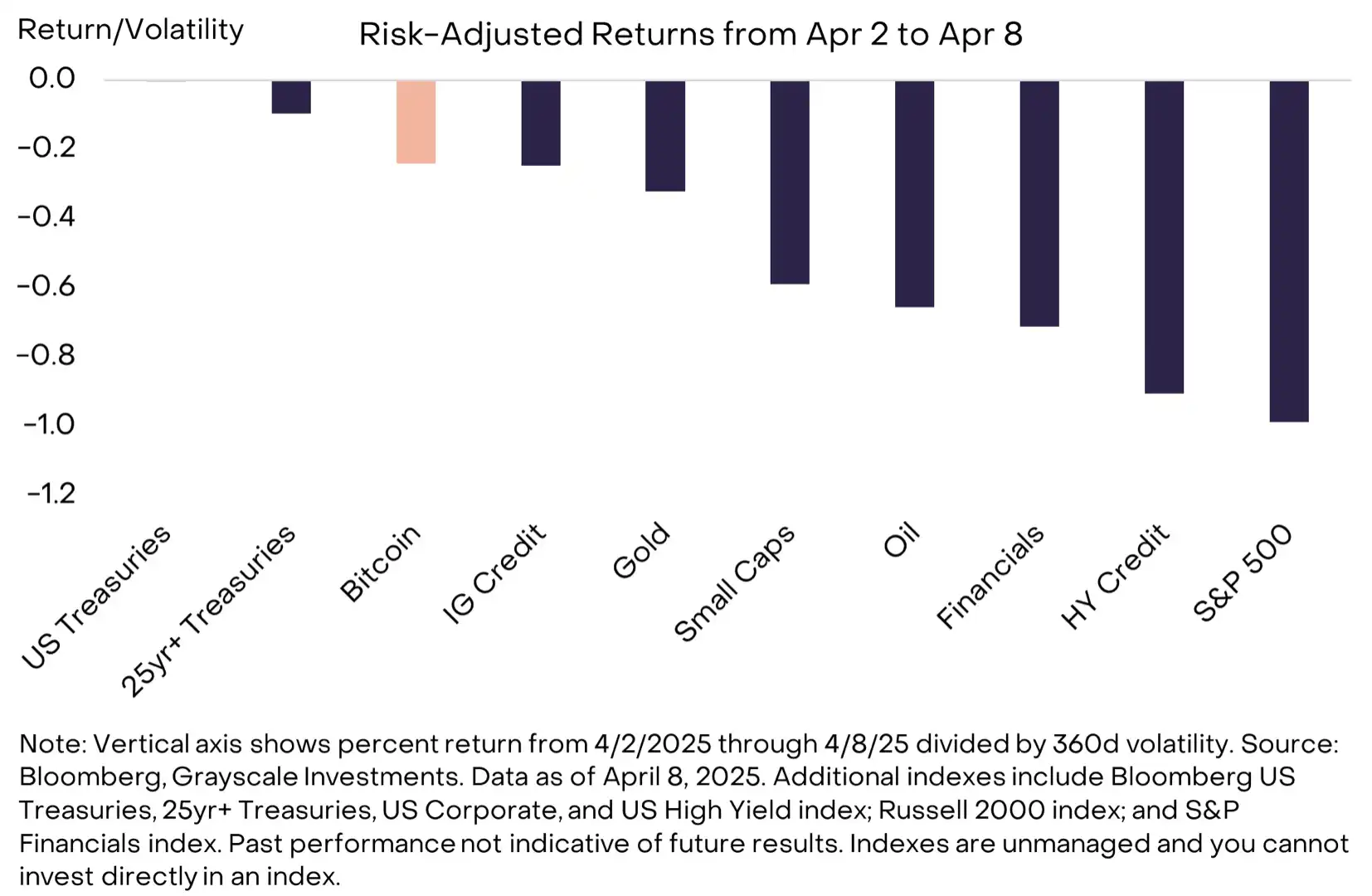
After risk adjustment, Bitcoin's price decline was relatively small
In the short term, the global market outlook may depend on the trade negotiations between the White House and other countries. While negotiations could lead to tariff reductions, setbacks in negotiations could also trigger more retaliatory actions. The actual volatility of traditional markets, both realized and implied, remains high and it is difficult to predict how trade conflicts will unfold in the coming weeks. Therefore, investors should cautiously adjust their positions in a high-risk market environment. In addition, Bitcoin's price volatility has increased much less than that of stocks, and several indicators show that speculative traders in the cryptocurrency market have relatively low positions. If macro risks ease in the next few weeks, the cryptocurrency market capitalization is expected to rebound.
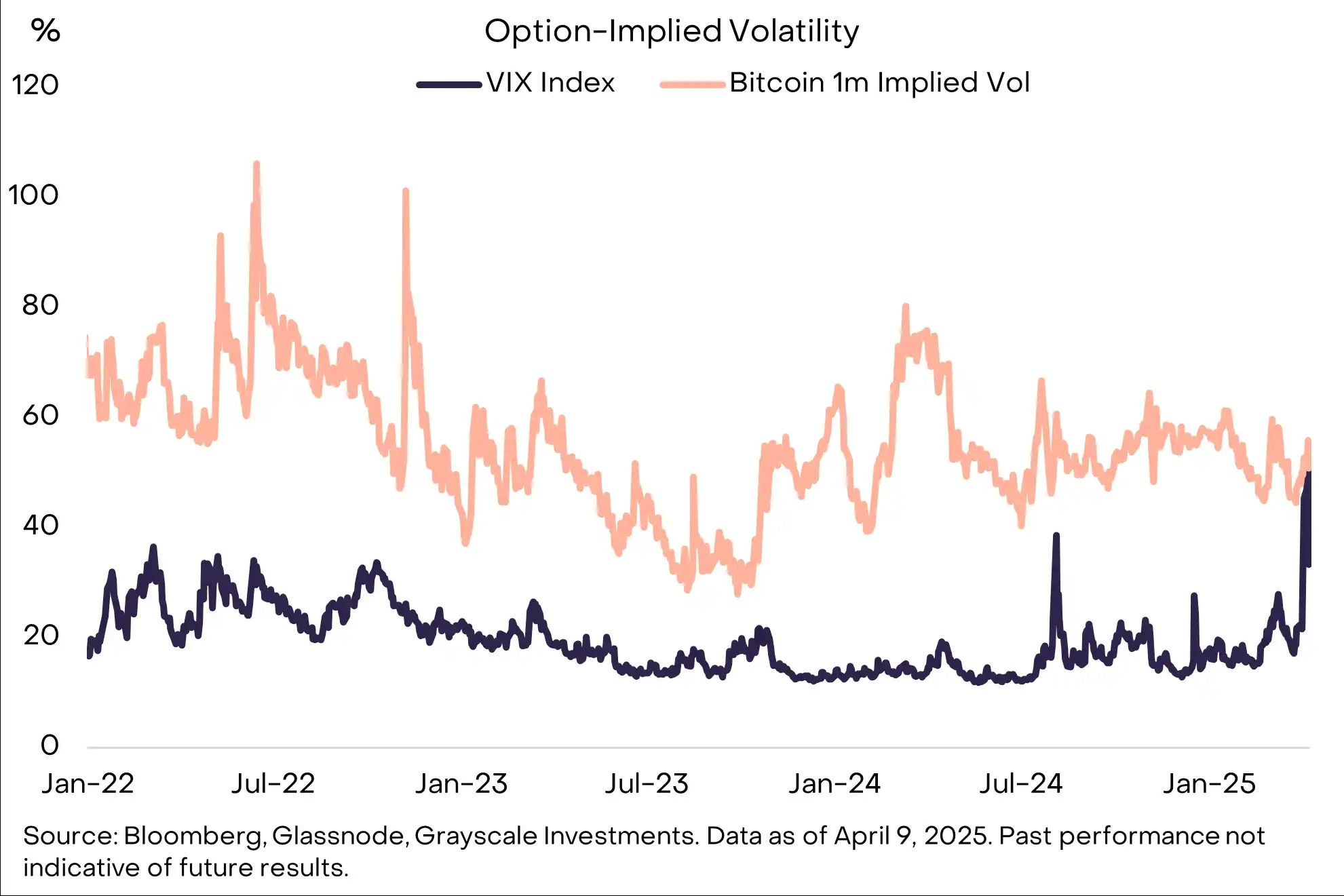
Stocks' implied volatility is close to Bitcoin's
Regarding Bitcoin, despite its price decline over the past week, from a longer-term perspective, the impact of higher tariffs on Bitcoin will depend on its effect on the economy and international capital flows. Tariffs (and changes in related non-tariff trade barriers) may lead to "stagflation" and could result in a structurally weaker dollar demand, so in this scenario, tariff increases and changes in the global trade pattern may be a positive factor for Bitcoin adoption in the medium to long term.
Asset Allocation in Stagflation
Stagflation refers to an economic state where growth is slow/sluggish while the inflation rate is high/accelerating. Tariffs increase the prices of imported goods, therefore causing inflation to rise (at least in the short term). Additionally, tariffs may slow down economic growth due to reduced real incomes for residents and adjustment costs for businesses. Over the long term, this impact may be partially offset by increased domestic manufacturing investment, and most economists expect these new tariffs to continue to drag on the economy for at least the next year.
From a historical perspective, the asset returns of the 1970s vividly demonstrated the impact of stagflation on financial markets (Bitcoin has been around for too short a time to backtest its performance). During that decade, the annualized returns of U.S. stocks and long-term bonds were both around 6%, below the average inflation rate of 7.4% at the time. In contrast, the price of gold had an annualized increase of around 30%, far surpassing the inflation rate.
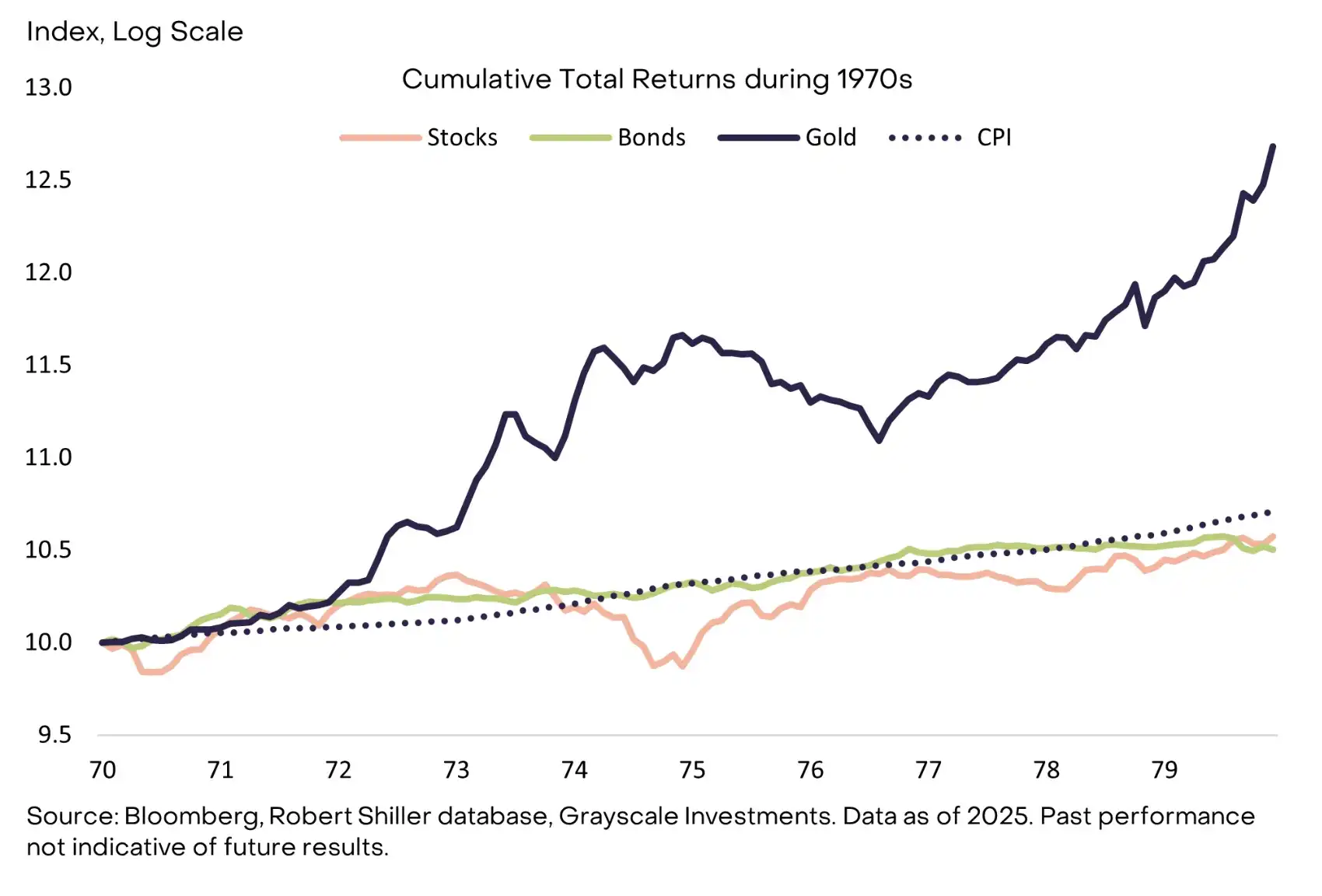
Traditional assets had negative real returns in the 1970s
Generally, extreme stagflation periods are rare, but their impact on asset returns remains largely consistent over time. The chart below shows the average annual returns of U.S. stocks, government bonds, and gold in different economic growth and inflation cycles from 1900 to 2024.
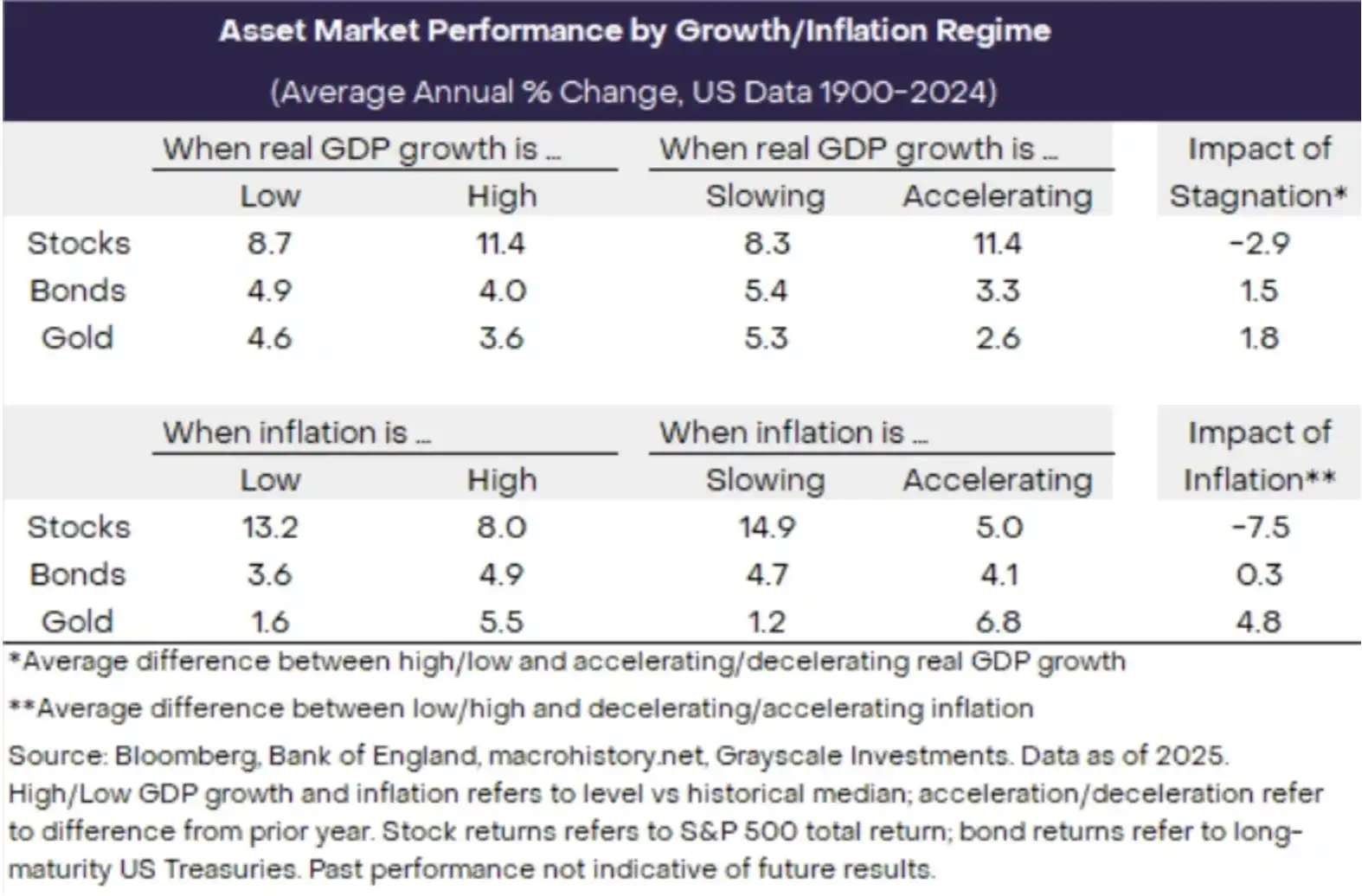
Stagflation reduces stock returns and increases gold returns
Historical data reveals three key points:
When GDP is high or accelerating and inflation is low or decelerating, stock market returns usually increase. Therefore, during stagflation, stock market returns are expected to decline, and investors may need to reduce their equity allocation;
When economic growth is sluggish and inflation is rising, gold often performs well, especially during stagflation. Gold becomes a primary hedge against inflation. This suggests that in this environment, gold is usually a more attractive investment choice;
Bond performance is closely related to inflation changes. When inflation is low, bond yields usually perform well, but when inflation rises, bond performance usually lags. Therefore, during periods of rising inflation, bond investors may face the risk of declining returns.
In summary, different assets perform differently during the economic cycle, and investors should adjust their asset allocation based on the macroeconomic environment. The stagflation period is particularly important as it often has a negative impact on stocks while gold may see growth.
Bitcoin and the US Dollar
Tariffs and trade tensions may drive the adoption of Bitcoin in the medium term, partly due to pressure on the US dollar. Specifically, if overall trade volumes with the US decline and much of the trade is dollar-denominated, the demand for the dollar in transactions will decrease. Additionally, if tariff impositions also lead to conflicts with other major countries, they may weaken the demand for the dollar as a store of value.
The share of the dollar in global foreign exchange reserves far exceeds the US's share in global economic output. There are many reasons for this, but network effects play a significant role: countries engage in trade with the US, borrow in the dollar market, and often price their exports of commodities in dollars. If trade tensions lead to a weakening of ties with the US economy/dollar-based financial markets, countries may accelerate the diversification of foreign exchange reserves.
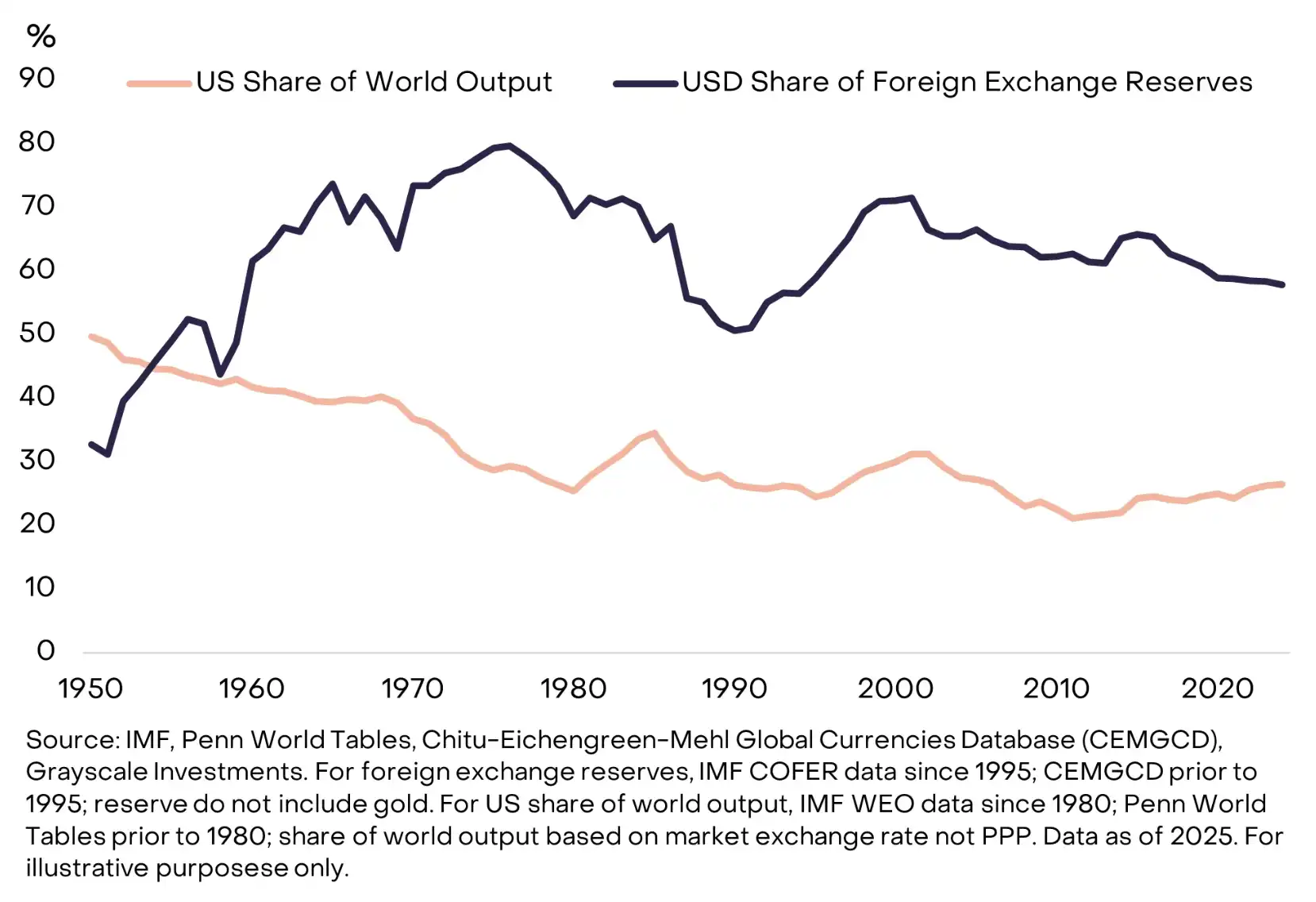
The share of the dollar in global reserves far exceeds the US's share in the global economy
Many central banks have increased their gold purchases after Russia faced Western sanctions. It is understood that besides Iran, no other country's central bank currently holds Bitcoin on its balance sheet. However, the Czech National Bank has started exploring this option, the US has also established a strategic Bitcoin reserve, and some sovereign wealth funds have publicly announced investments in Bitcoin. In our view, disruptions to the dollar-centric international trade and financial system could lead central banks to further diversify reserves, including investing in Bitcoin.
A moment in US history most similar to former President Trump's "Liberation Day" declaration may be the "Nixon Shock" on August 15, 1971. That night, President Nixon announced a comprehensive 10% tariff and ended the gold standard for the dollar—an arrangement that had supported the global trade and financial system since the end of World War II. This action triggered diplomatic activities between the US and other countries, eventually leading to the Smithsonian Agreement in December 1971, where other countries agreed to revalue their currencies against the dollar. The dollar eventually devalued by 27% between the second quarter of 1971 and the third quarter of 1978. Over the past 50 years, there have been several instances of (partially negotiated) dollar weakening following trade tensions.
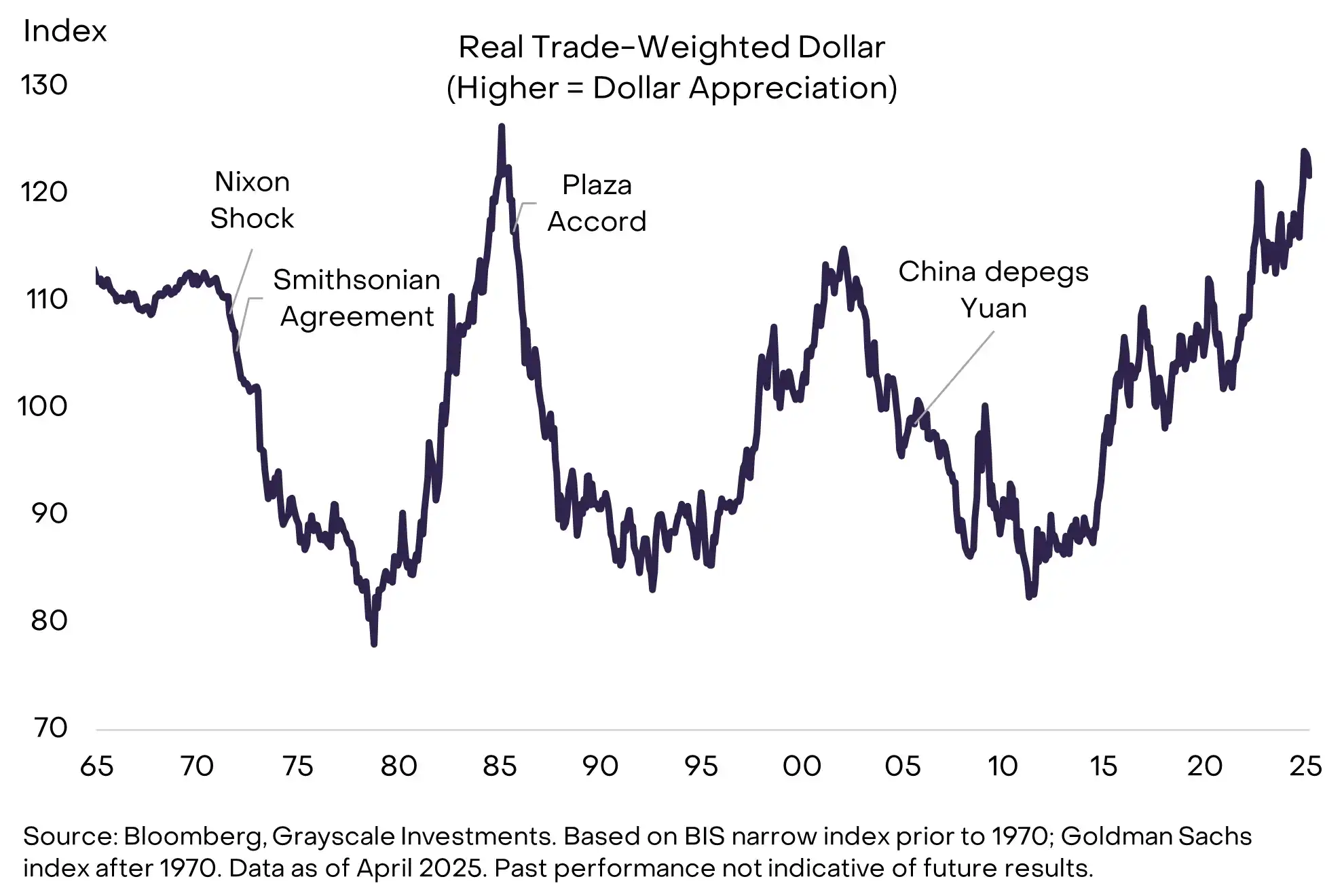
The expected recent trade tension is once again set to result in continued weakness of the U.S. dollar. According to relevant indicators, the U.S. dollar is already overvalued, the Federal Reserve has room to lower interest rates, and the White House aims to reduce the U.S. trade deficit. Although tariffs will alter effective import and export prices, dollar depreciation may gradually achieve trade flow rebalancing through market mechanisms, thereby achieving the desired effect.
Son of the Era - Bitcoin
The U.S. trade policy's shift is causing adjustments in the financial markets, which will have a short-term negative impact on the economy. However, the market conditions of the past week are unlikely to become the norm for the next four years. The Trump administration is implementing a series of policy measures that will have different impacts on GDP growth, inflation, and the trade deficit. For example, while tariffs may reduce economic growth and increase inflation (i.e., stagflation), certain types of deregulation may enhance growth and reduce inflation (i.e., reduce stagflation). The ultimate outcome will depend on the extent to which the White House pursues its policy agenda in these areas.
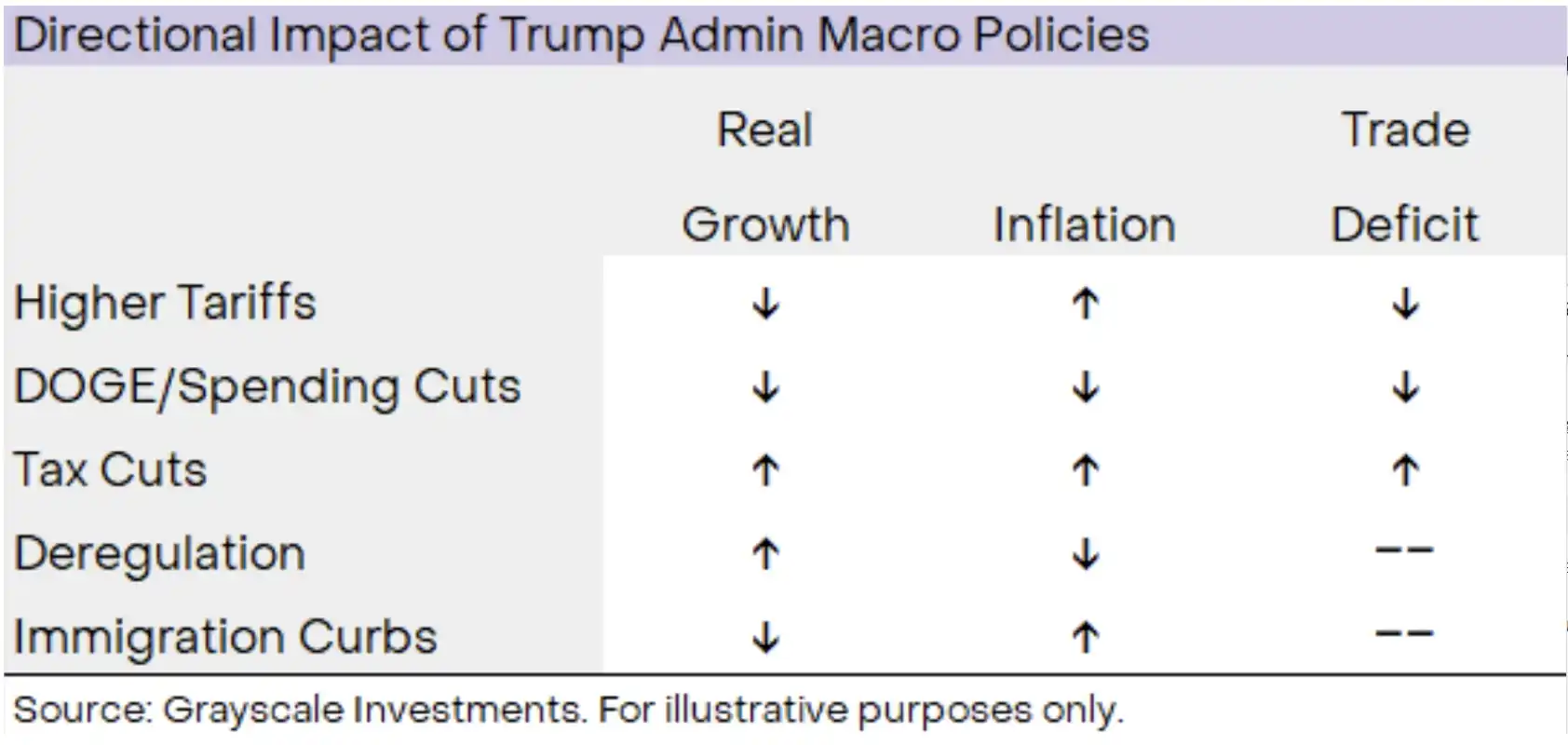
U.S. macroeconomic policies will have a series of impacts on growth and inflation
Despite uncertainties in the outlook, the best guess is that U.S. government policies will lead to sustained dollar weakness and overall above-target inflation in the next 1 to 3 years. Tariffs themselves may slow growth, but this impact may be partially offset by tax cuts, deregulation, and dollar depreciation. If the White House also actively pursues other growth-promoting policies, GDP growth may still remain relatively robust despite the initial impact of tariffs. Regardless of whether actual growth is strong, history suggests that a period of sustained inflationary pressure may be favorable for scarce commodities such as Bitcoin and gold.
Furthermore, much like gold in the 1970s, Bitcoin now has rapidly improving market structure — which is supported by U.S. government policy changes. Throughout this year, the White House has implemented a wide range of policy changes that should support investment in the digital asset industry, including dismissing a series of lawsuits, ensuring asset suitability for traditional commercial banks, and permitting regulated entities (such as custodians) to offer cryptocurrency services. This has, in turn, sparked a wave of mergers and other strategic investments. The new tariffs are a short-term negative factor for the valuation of digital assets like Bitcoin, but the Trump administration's cryptocurrency-specific policies have consistently supported the industry. Overall, the rising demand for scarce commodities assets in the macroeconomy and the improvement in the investor operating environment could be a potent combination for widespread Bitcoin adoption in the coming years.
Você também pode gostar

WEEXPERIENCE Whales Night: Inteligência Artificial, Crypto Community & Crypto Market Insights
Em 12 de dezembro de 2025, a WEEX sediou a WEEXPERIENCE Whales Night, uma reunião da comunidade offline projetada para reunir membros da comunidade local de criptomoedas. O evento combinou compartilhamento de conteúdo, jogos interativos e apresentações de projetos para criar uma experiência offline relaxada e envolvente.
Riscos de negociação de IA em criptomoedas: Por que melhores estratégias de negociação de criptomoedas podem gerar maiores perdas?
O risco já não reside principalmente em má tomada de decisão ou erros emocionais. Vive cada vez mais na estrutura de mercado, caminhos de execução e comportamento coletivo. Entender essa mudança é mais importante do que encontrar a próxima estratégia “melhor”.
Agentes de IA estão substituindo a pesquisa de criptografia? Como a IA autônoma está reformulando o Crypto Trading
A IA está passando de auxiliar os comerciantes para automatizar todo o processo de pesquisa até execução nos mercados de criptomoedas. A vantagem mudou de insights humanos para tubulações de dados, velocidade e sistemas de IA prontos para execução, tornando os atrasos na integração de IA uma desvantagem competitiva.

Bots de negociação de IA e Copy Trading: Como estratégias sincronizadas reformulam a volatilidade do mercado de criptomoedas
Os comerciantes de criptomoedas de varejo enfrentam há muito os mesmos desafios: má gestão de risco, entradas atrasadas, decisões emocionais e execução inconsistente. As ferramentas de negociação AI prometeram uma solução. Hoje em dia, sistemas de negociação de cópia e bots de breakout apoiados por IA ajudam os comerciantes a dimensionar posições, definir paradas e agir mais rápido do que nunca. Além da velocidade e precisão, essas ferramentas estão silenciosamente reformulando os mercados - os traders não estão apenas negociando mais inteligentemente, eles estão se movendo em sincronia, criando uma nova dinâmica que amplifica tanto o risco quanto as oportunidades.
Trading de IA em Crypto Explicado: Como a negociação autónoma está reformulando os mercados de criptomoedas e as bolsas de criptomoedas
O AI Trading está rapidamente transformando a criptografia. As estratégias tradicionais lutam para acompanhar a volatilidade sem parar da criptomoeda e a complexa estrutura de mercado, enquanto a IA pode processar dados maciços, gerar estratégias adaptativas, gerenciar riscos e executar operações de forma autónoma. Este artigo orienta os usuários da WEEX pelo que é o trading de IA, por que a criptografia acelera sua adoção, como a indústria está evoluindo para agentes autônomos e por que a WEEX está construindo o ecossistema de negociação de IA da próxima geração.
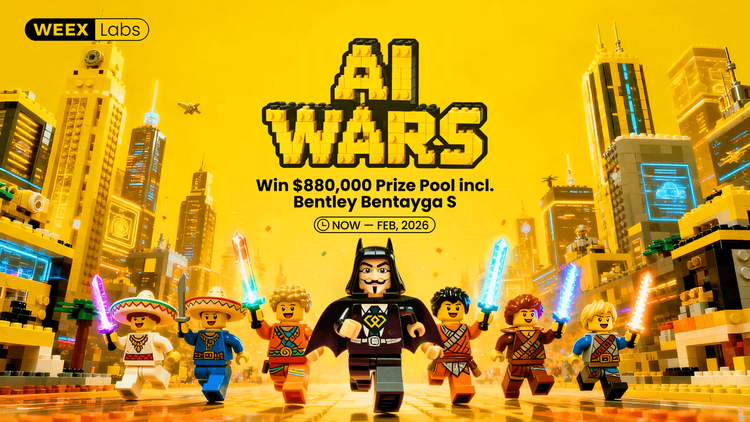
Call to Join AI Wars: WEEX Alpha Awakens — Competição Global de Negociação de IA com $880,000 Prize Pool
Agora, estamos chamando comerciantes de IA de todo o mundo para se juntarem a AI Wars: WEEX Alpha Awakens, uma competição global de negociação de IA com um pool de prêmios de US$ 880.000.

Negociação de IA em Mercados de Cripto: De robôs de negociação automatizados a estratégias algoritmicas
O comércio impulsionado por IA está mudando a criptomoeda da especulação de varejo para a concorrência de nível institucional, onde a execução e a gestão de risco importam mais do que a direção. À medida que as negociações de IA aumentam, o risco sistêmico e a pressão regulatória aumentam, tornando o desempenho a longo prazo, sistemas robustos e conformidade os principais diferenciais.

Análise de sentimentos de IA e volatilidade de criptomoedas: O que move os preços de criptomoedas
O sentimento da IA está influenciando cada vez mais os mercados de criptomoedas, com mudanças nas expectativas relacionadas à IA se traduzindo em volatilidade para os principais ativos digitais. Os mercados de criptomoedas tendem a amplificar as narrativas de IA, permitindo que os fluxos impulsionados pelo sentimento superem os fundamentos a curto prazo. Compreender como o sentimento da IA se forma e se espalha ajuda os investidores a antecipar melhor os ciclos de risco e posicionar oportunidades em todos os ativos digitais.
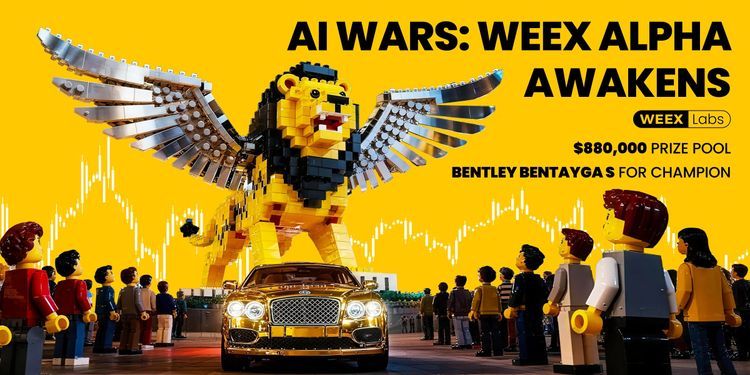
Guerras da IA: Guia do participante
Nesta batalha final, os melhores desenvolvedores, analistas quantitativos e traders de todo o mundo irão lançar seus algoritmos em batalhas no mercado real, competindo por um dos maiores prêmios da história do trading de criptomoedas com IA: 880.000 dólares, incluindo um Bentley Bentayga S para o campeão. Este guia irá guiá-lo por todas as etapas necessárias, desde a inscrição até o início oficial da competição.
Segunda semana do Banco Central e volatilidade do mercado de criptomoedas: Como as decisões de taxa de juros moldam as condições de negociação na WEEX
As decisões de juros de grandes bancos centrais como a Reserva Federal são eventos macroeconômicos significativos que afetam os mercados financeiros globais, influenciando diretamente as expectativas de liquidez do mercado e o apetite de risco. À medida que o mercado de criptomoedas continua a se desenvolver e sua estrutura de negociação e participantes amadurecem, o mercado de criptomoedas está sendo gradualmente incorporado ao sistema de preços macroeconômicos.
Teste da API WEEX: Guia Oficial para Hackathon de Negociação de IA e APIs de Crypto Trading
WEEX API Testing é projetado para garantir que cada participante pode transformar a lógica de negociação em execução real. Todas as interações API ocorrem no sistema de negociação ao vivo da WEEX, permitindo que os participantes trabalhem em condições de mercado autênticas em vez de simulações. Com um requisito de entrada baixo, a tarefa é acessível tanto para desenvolvedores experientes e iniciantes motivados, enquanto ainda valida habilidades técnicas essenciais.
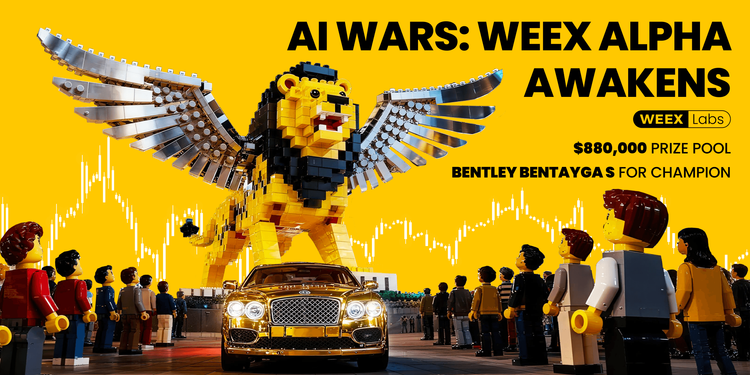
Guerras da IA: WEEX Alpha Awakens | Guia do processo de teste do WEEX Global Hackathon API
AI Wars: O registro do WEEX Alpha Awakens está agora aberto. e este guia descreve como acessar o teste da API e concluir com sucesso o processo.
O que é o WEEX Alpha Awakens e como participar? Um guia completo
Para acelerar os avanços na interseção de IA e criptografia, a WEEX está lançando o primeiro hackathon global de negociação de IA – AI Wars: Alpha despertou.
Juntar-se a AI Wars: WEEX Alpha despertou!Global Call for AI Trading Alphas
AI Wars: WEEX Alpha Awakens é um hackathon global de negociação de IA em Dubai, chamando equipes de quantidade, traders algoritmicos e desenvolvedores de IA para lançar suas estratégias de negociação de criptomoedas de IA em mercados ao vivo por uma parte de um pool de prêmios de US $ 880,000.
WEEX revela o comércio para ganhar: Até 30% de reembolso instantâneo + $2M WXT Buyback
A WEEX tem o prazer de anunciar o lançamento do nosso programa Trade to Earn, que automaticamente concede até 30% de desconto nas taxas de negociação. Todas as recompensas são creditadas diretamente à sua conta spot em $WXT - apoiado pelo nosso plano de compra de $2.000.000 WXT que alimenta o valor de token a longo prazo.

Novo: Preço estimado de liquidação no app candlestick gráficos
WEEX introduziu um novo preço de liquidação estimado (Est. Liq. Preço) recurso no gráfico do candlestick para ajudar os traders a gerenciar melhor o risco e identificar intervalos seguros para suas posições.
WEEX AI Hackathon Guia: Encontre o seu WEEX UID e registe
De agora até fevereiro de 2026, a WEEX lança AI Wars: WEEX Alpha Awakens, o primeiro hackathon mundial de negociação de criptomoedas AI. Venha o seu UID e registre-se para o WEEX Global AI Trading Hackathon.
Novembro de 2025 Revisão do Mercado de Cripto: Correção de Preços, Redempções de ETFs e Evolução da Blockchain
Novembro de 2025 viu volatilidade pronunciada e uma correção estrutural dentro do ecossistema blockchain mais amplo, impulsionado principalmente por previsões macroeconômicas flutuantes e dinâmicas específicas de fluxo de capital.
WEEXPERIENCE Whales Night: Inteligência Artificial, Crypto Community & Crypto Market Insights
Em 12 de dezembro de 2025, a WEEX sediou a WEEXPERIENCE Whales Night, uma reunião da comunidade offline projetada para reunir membros da comunidade local de criptomoedas. O evento combinou compartilhamento de conteúdo, jogos interativos e apresentações de projetos para criar uma experiência offline relaxada e envolvente.
Riscos de negociação de IA em criptomoedas: Por que melhores estratégias de negociação de criptomoedas podem gerar maiores perdas?
O risco já não reside principalmente em má tomada de decisão ou erros emocionais. Vive cada vez mais na estrutura de mercado, caminhos de execução e comportamento coletivo. Entender essa mudança é mais importante do que encontrar a próxima estratégia “melhor”.
Agentes de IA estão substituindo a pesquisa de criptografia? Como a IA autônoma está reformulando o Crypto Trading
A IA está passando de auxiliar os comerciantes para automatizar todo o processo de pesquisa até execução nos mercados de criptomoedas. A vantagem mudou de insights humanos para tubulações de dados, velocidade e sistemas de IA prontos para execução, tornando os atrasos na integração de IA uma desvantagem competitiva.
Bots de negociação de IA e Copy Trading: Como estratégias sincronizadas reformulam a volatilidade do mercado de criptomoedas
Os comerciantes de criptomoedas de varejo enfrentam há muito os mesmos desafios: má gestão de risco, entradas atrasadas, decisões emocionais e execução inconsistente. As ferramentas de negociação AI prometeram uma solução. Hoje em dia, sistemas de negociação de cópia e bots de breakout apoiados por IA ajudam os comerciantes a dimensionar posições, definir paradas e agir mais rápido do que nunca. Além da velocidade e precisão, essas ferramentas estão silenciosamente reformulando os mercados - os traders não estão apenas negociando mais inteligentemente, eles estão se movendo em sincronia, criando uma nova dinâmica que amplifica tanto o risco quanto as oportunidades.
Trading de IA em Crypto Explicado: Como a negociação autónoma está reformulando os mercados de criptomoedas e as bolsas de criptomoedas
O AI Trading está rapidamente transformando a criptografia. As estratégias tradicionais lutam para acompanhar a volatilidade sem parar da criptomoeda e a complexa estrutura de mercado, enquanto a IA pode processar dados maciços, gerar estratégias adaptativas, gerenciar riscos e executar operações de forma autónoma. Este artigo orienta os usuários da WEEX pelo que é o trading de IA, por que a criptografia acelera sua adoção, como a indústria está evoluindo para agentes autônomos e por que a WEEX está construindo o ecossistema de negociação de IA da próxima geração.
Call to Join AI Wars: WEEX Alpha Awakens — Competição Global de Negociação de IA com $880,000 Prize Pool
Agora, estamos chamando comerciantes de IA de todo o mundo para se juntarem a AI Wars: WEEX Alpha Awakens, uma competição global de negociação de IA com um pool de prêmios de US$ 880.000.
Populares
Últimas notícias sobre cripto


Atendimento ao cliente:@weikecs
Parcerias comerciais:@weikecs
Quant trading e MM:[email protected]
Serviços VIP:[email protected]
 App
App