
- Купить крипто
- Рынки
- Фьючерсы
- Спот
- Копитрейдинг
 Earn
Earn- Еще
Pacific Water Drop Network Webinar Series Selection: Unlocking the Wealth Code of Cryptographic Quantitative Arbitrage

In the ever-changing cryptocurrency market, quantitative arbitrage strategy has gradually become a sought-after wealth code by investors due to its stability and risk control. In this issue of the webinar, Pacific Droplet has invited two partners, Allen and Leon, from Hashflow Asset Management. The webinar is hosted by Xiaozhou, Executive Director of Taiping Asset Management Hong Kong, to explore the core logic of this strategy and its market potential together with the audience.
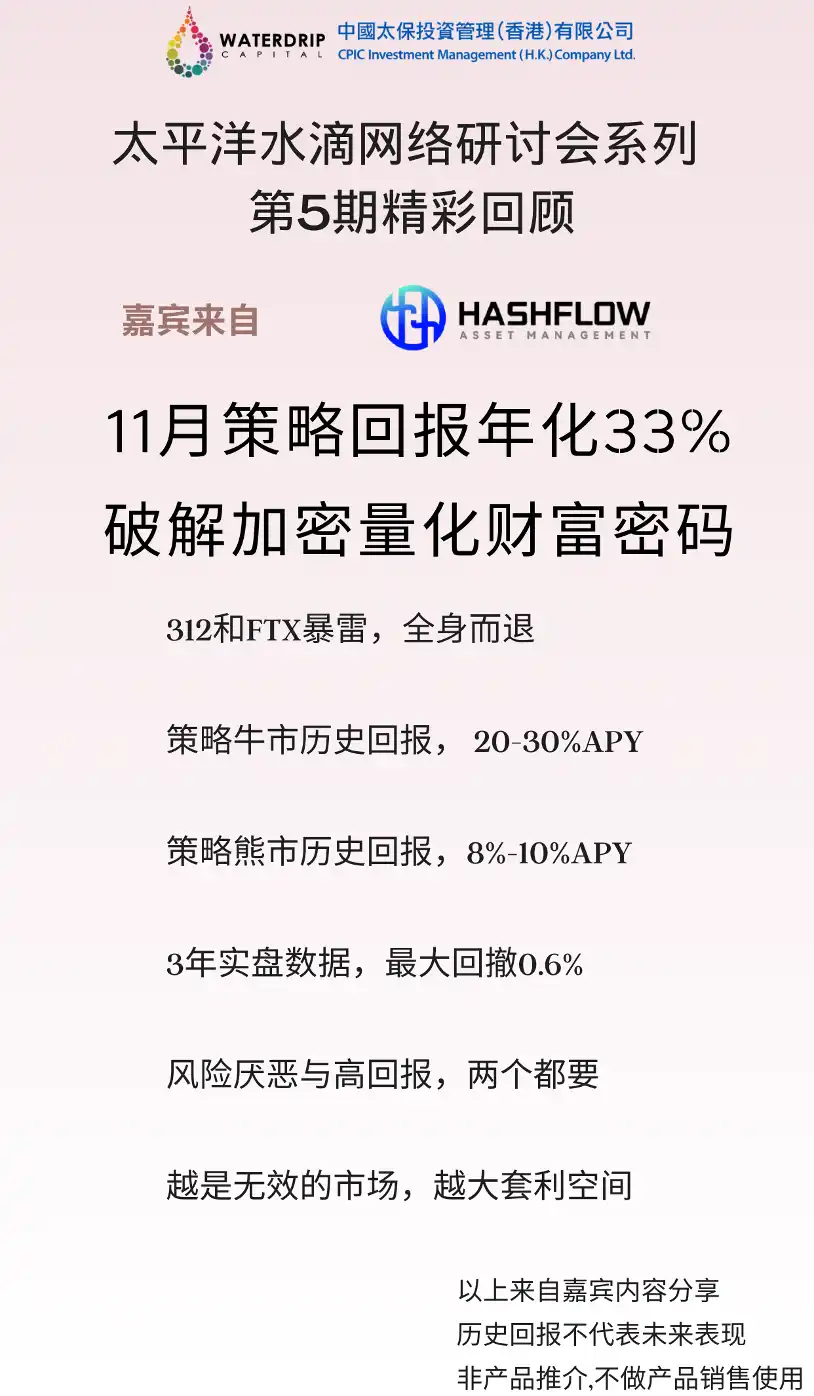
Guest Introduction
· Allen: Coming from a traditional finance background, Allen has previously worked extensively in areas such as stocks and futures. In 2018, he transitioned into the cryptocurrency market, pioneering the introduction of traditional market quantitative models into crypto trading. With over six years of digital asset quantitative trading experience, his led crypto asset quant team successfully hedged against crises in both the 2020 3/12 event and the 2022 FTX flash crash.
· Leon: With years of experience in hedge funds and risk management, Leon has previously worked at Citibank and top domestic hedge funds. Since 2018, he has been focusing on quantitative arbitrage strategies in the cryptocurrency market.
· Host: Xiaozhou, currently the Executive Director of Taiping Asset Management Hong Kong, has long been dedicated to the field of fixed income investments.
Exciting Q&A Content
Opening: The Birth and Background of Quantitative Arbitrage Strategy
Xiaozhou: Allen and Leon, both of you were originally senior professionals in the traditional finance field. What prompted you to enter the cryptocurrency market and make quantitative arbitrage your main focus?
Allen: "In traditional finance, algorithmic trading is already very mature. However, when we entered the cryptocurrency market in 2018, we found that the market's volatility, retail investor proportion, and overall immaturity were very suitable for the application of quantitative strategies. The cryptocurrency market's unique mechanisms, such as perpetual contracts and funding rates, also brought us brand-new arbitrage opportunities."
Leon: "At that time, we saw many trading mechanisms in the crypto market similar to the traditional market, but due to lower liquidity and insufficient market participant expertise, quantitative arbitrage had significant room. Coupled with our team's deep experience in algorithmic trading, we quickly identified opportunities."
Question 1: Please provide a specific introduction to the operational logic and revenue source of quant arbitrage?
Allen: "The essence of quant arbitrage is to profit from the spread between spot and perpetual contracts. We buy spot and simultaneously short perpetual contracts. Since holding a long position in perpetual contracts incurs funding rates, this cost ultimately becomes the arbitrageur's source of income."
Leon: "The core advantage of this strategy is that through the hedge between spot and futures, we can achieve market neutrality. Regardless of whether the market is up or down, the portfolio will not be affected by price fluctuations."
Key Points Summary:
· Funding Rate: Settled every 8 hours, with an annualized return of 20%-30% in a bull market and still maintaining 8%-10% in a bear market.
· Risk Neutrality: Hedging between spot and futures ensures stable returns, avoiding market volatility.
Question 2: With high market volatility and complexity in operations, how does quant arbitrage ensure long-term stability?
Allen: "We utilize a unified margin account, integrating fund management between spot and futures to avoid cross-account fund risks. Additionally, we rely on the deep liquidity of blue-chip coins (such as BTC, ETH) for fundamental security."
Leon: "Furthermore, our dynamic rotation mechanism is another key point. We monitor funding rates of all mainstream coins daily and adjust the portfolio based on returns and risks to maximize profits and minimize risks."
Key Points Summary:
· Unified Margin Account: Simplifying fund flow, reducing settlement risks.
· Dynamic Rotation: Real-time allocation adjustments to optimize returns and risks.
Question 3: If the market spread suddenly widens or funding rates turn negative, how do you deal with these potential risks?
Allen: "When the spread widens, we will timely reduce positions or reconfigure based on real-time monitored retracement data. Additionally, the deep liquidity of blue-chip coins ensures that the spread quickly reverts."
Leon: "As for negative funding rate, we have established a strict stop-loss mechanism. If a certain asset experiences a negative funding rate for 5 consecutive days, we will remove it from the portfolio."
Key Takeaways:
· Risk Management: Reduce position, rebalance, or lower leverage.
· Stop-Loss Mechanism: Asset removed if negative funding rate persists for more than 5 days.
Question 4: For some investors, holding BTC directly may seem more attractive. So why choose quantitative arbitrage?
Leon: "The returns from holding the asset directly are entirely dependent on market price fluctuations, posing high risks. Quantitative arbitrage, on the other hand, offers a low-risk, stable return option. For risk-averse investors, this balance is crucial."
Allen: "For portfolio management, we also recommend combining asset holding with quantitative arbitrage to achieve enhanced returns. Holding assets captures upside potential, while arbitrage strategies mitigate volatility risks."
Key Takeaways:
· Low-Risk Stability: Suitable for risk-averse investors.
· Portfolio Advantage: Combination of asset holding and arbitrage for enhanced returns.
Question 5: How long can the cryptocurrency market's bull run last? How long can the high-yield phase of arbitrage strategies be sustained?
Allen: "Based on historical cycles, the cryptocurrency market experiences a halving event approximately every four years. We anticipate that the high-yield phase of the bull market may continue for the next 6 months, until the market enters the early stages of a bear market."
Leon: "Even in a bear market, quantitative arbitrage remains a preferred strategy. Through precise management and diversified asset allocation, we can continue to maintain low drawdowns and stable returns."
Key Takeaways:
· Bull Market Phase: High-yield period expected to last 6 months.
· Bear Market Advantage: Strategy has a small drawdown and can still provide steady returns.
Question 6: Many viewers are interested in the specific operation of quantitative arbitrage, such as what the actual process would be with $1 million?
Allen: "We would use spot and perpetual contracts for arbitrage. For example, $1 million can be used to buy $2 million worth of spot and simultaneously short an equivalent amount of perpetual contracts. This involves moderate leverage, usually kept within two times. This operation ensures that the profit comes from funding rates rather than market fluctuations."
Leon: "Furthermore, current trading platforms support unified margin accounts, which greatly simplifies the operational process. In the past, we needed to constantly rebalance between spot and contract accounts, but now all operations can be completed within the same account, reducing fund transfer risk and improving efficiency."
Key Points Summary:
· Leverage Control: Moderate leverage amplifies profits while reducing risk.
· Unified Account: Simplifies operational processes, reducing fund flow risks.
Question 7: Quantitative arbitrage seems to have low drawdown but still carries risks. Could you explain in detail what potential risks there are and how to manage these risks?
Allen: "Main risks include:
· Spread Fluctuation: The spread at the time of establishing a position may widen in the short term, leading to unrealized losses.
· Negative Funding Rate: Although the funding rate is mostly positive in the long term, it can also turn negative in the short term."
To counter these risks, we have established strict stop-loss rules. If a currency has a negative funding rate for 5 consecutive days, we will remove it from the portfolio. Additionally, through multi-currency allocation, we have reduced the impact of single currency volatility."
Leon: "The recovery of drawdown mainly depends on two points:
· Spread Reversion: Market spreads will eventually return to normal ranges."
· Funding Rate Recovery: Long-term positive returns will gradually offset short-term negative returns.
Key Points Summary:
· Spread Volatility and Negative Funding Rate: Main sources of risk, but effectively controlled through multi-currency allocation and strict stop-loss.
· Drawdown Recovery Mechanism: Relies on spread regression and funding rate recovery.
Question 8: In extreme market conditions, such as sudden large price swings, how does quantitative arbitrage respond?
Leon: "We have taken various measures:
· Position Diversification: The allocation of a single currency does not exceed 5%.
· Dynamic Rebalancing: When the spread widens, positions are reduced to lower risk. If the spread is deemed to be at its limit, we will add to the position in the opposite direction to capture gains."
Allen: "The team's technology and processes are also crucial. For example, during the 3/12 Event (March 12, 2020), many trading platforms experienced downtime, but our system was able to issue alerts promptly and quickly increase positions after system recovery, ultimately profiting."
Key Points Summary:
· Diversified Allocation: Reducing single currency risk.
· Technical Safeguards: Addressing extreme events through alerts and rapid response systems.
Question 9: How does the performance of quantitative arbitrage differ in a bull market versus a bear market? Is there a significant difference in returns?
Allen: "In a bull market, funding rates are higher, and arbitrage returns are usually between 20%-30% annualized. In a bear market, funding rates decrease, and annualized returns are around 8%-10%. Even in a bear market, arbitrage strategies can still provide steady returns because risks and volatility have been hedged."
Leon: "In a bear market, we pay more attention to funding rate rotation, ensuring maximum returns by selecting the optimal currency. For example, in past bear markets, through optimized currency allocation, we kept the overall drawdown to less than 0.6%."
Key Points Summary:
· Bull Market Returns: Up to 30%.
· Bear Market Returns: Approximately 8%-10%, very low risk.
Question 10: I understand that a quantitative arbitrage strategy is somewhat like a cash management enhancement tool in traditional finance. Is it more suitable to switch from traditional bonds or money market funds to this strategy rather than directly engaging in high-risk assets?
Allen: "Your understanding is very accurate! The characteristic of a quantitative arbitrage strategy is stable low risk. It is more like an upgraded version of a cash management tool. Compared to bonds or money market funds, our annualized returns are higher, while the risk remains at an extremely low level."
Leon: "Indeed. For the conservative portion of asset allocation, quantitative arbitrage is a very ideal choice. Especially for institutional investors or high-net-worth clients, traditional cash management tools have lower yields in the current interest rate environment, while our strategy can achieve a significant enhancement."
Key Points Summary:
· Cash Management Tool Upgrade: Higher returns, very low risk.
· Asset Allocation Recommendation: Suitable for investors transitioning from bonds or money market funds.
Question 11: If the spot price continues to rise and we short perpetual swaps, will our returns be affected due to high funding rates?
Allen: "That's a very good question. In a unified account, the P&L of spot and perpetual swaps is calculated together. Even if the funding rate rises, our returns mainly come from spread fluctuations and positive funding rate income. Additionally, our system will automatically adjust margin to ensure the stability of the overall position and avoid one-sided risk."
Leon: "The advantage of a unified account structure is that it can manage the assets of spot and contracts together, reducing liquidity issues and margin top-ups, while ensuring the stability of the overall strategy."
Key Points Summary:
· Unified Account: Comprehensive calculation of PnL to ensure overall revenue.
· Funding Rate Risk Management: Revenue mainly comes from spreads and positive funding rates.
Question 12: In an extreme market environment, such as the 3·12 Event in 2020, how does quantitative arbitrage respond?
Leon: "In extreme events like 3·12, we immediately reduce our position to ensure risk control. At the same time, our technical systems will alert us quickly to help adjust our strategy. Additionally, we focus on trading in large-cap coins with high liquidity, such as BTC and ETH, to avoid losses due to insufficient liquidity in small-cap coins."
Allen: "Such extreme volatility may also present opportunities for us. For example, post-market recovery, by quickly increasing our position to capture spread income, we achieved excess returns after the 3·12 event." Extreme market volatility is both a challenge and an opportunity for us.
Key Takeaways:
· Risk Control: Timely position reduction, focus on large-cap coins.
· Technical Support: Alert system and rapid adjustment mechanism.
The above is the full content of this seminar. We invite you to continue following the Pacific Water Drop Network Webinar.
This article is contributed content and does not represent the views of BlockBeats.
Вам также может понравиться

Крипто и ИИ: скрытый цифровой серый рынок Сяньюй
Crypto and AI: На Сяньюй можно купить все что угодно.

What’s Driving Crypto Markets in Early 2026: Рыночные качели, торговля искусственным интеллектом и потоки ETF?
Представьте, что вы проверяете цены на биткоины и эфириум за день — одна минута вверх на 5%, другая вниз на 4%. Резкие движения, быстрый разворот и чувствительность к макросигналам ознаменовали первую неделю 2026 года. После ралли в начале года оба актива откатились назад, так как рынки перенастроили ожидания вокруг денежно-кредитной политики и институциональных потоков США. Для трейдеров, в том числе для тех, кто опирается на ИИ или автоматизированные системы, этот период стал ярким напоминанием: обильные сигналы не гарантируют ясности. Держаться дисциплинированно при исполнении - часто настоящая задача.

Начинается Глобальный торговый хакатон ИИ WEEX: Призовой фонд $1,88 млн. Силы нового поколения чемпионов по торговле ИИ
WEEX Labs, инновационное подразделение WEEX, ведущей мировой криптобиржи, обслуживающей более 6,2 млн пользователей из 150+ стран, собирается начать предварительный раунд своего флагманского глобального торгового хаката ИИ AI Wars: WEEX Alpha Awakens, 12 января 2026 года. При мощной поддержке спонсоров мирового уровня, включая Amazon Web Services (AWS), общий призовой фонд резко вырос с $880 000 до беспрецедентных $1 880 000, что делает AI Wars одним из крупнейших торговых хакатонов ИИ в криптоиндустрии. На вершине таблицы лидеров ждет внеочередной приз чемпиона — Bentley Bentayga S, уже находящийся в резерве в Дубае, на который готов претендовать конечный победитель в торговле искусственным интеллектом.

Aster Coin: Перспективы и Анализ Токена в 2026 Году
Представьте, что вы только что наткнулись на токен, который занимает 43-е место по рыночной капитализации среди тысяч криптовалют,…

Запуск Wyoming’s FRNT Stablecoin — Первый стабильник поддерживаемый штатом выходит на рынок
Key Takeaways Wyoming стал первым штатом США, запустившим стабильный токен FRNT, полностью подкрепленный фиатными средствами. Стабильник поддерживается 100%…

Solana Прогноз Цены: Morgan Stanley Подал Заявку на SOL ETF — Это Начало Следующего Помешательства Уолл-стрит на Криптовалюте?
Ключевые выводы Morgan Stanley объявил о запуске Solana ETF, что укрепляет доверие к этому альткойну и стимулирует рост…

Прогноз цены Ondo Finance – Ожидаемое падение стоимости ONDO до $ 0.331411 к 12 января 2026 года
Ключевые выводы: Цена Ondo Finance на момент написания составляет $0.424949, ожидается снижение на 22.89% к $0.331411 в течение…

Binance запускает регулируемые Gold и Silver бессрочные фьючерсы, расчёты в USDT
Ключевые выводы: Новая услуга именуется как TradFi Perpetual Contracts и позволяет трейдерам круглосуточно получать доступ к традиционным активам…
Потоки капитала в Bitcoin иссякли, утверждает CEO CryptoQuant
Ключевые выводы: Потоки капитала в Bitcoin уменьшились до минимума, цены стабилизировались вокруг отметки $94,000. Институциональные держатели, такие как…

От теории к живым рынкам: Двухмозговая система AOT Matrix в WEEX AI Trading Hackathon
На крипторынках — одной из самых неумолимых нестационарных систем — провал стратегии редко бывает вызван слишком простыми моделями. Это происходит потому, что большинство стратегий никогда по-настоящему не подвержены давлению живого рынка. Именно эту проблему призван решить WEEX AI Trading Hackathon — сместить акцент с теоретических инноваций на реальную развертываемость, реальное исполнение и реальную производительность. Среди участвовавших групп AOT Matrix выделялась развитыми количественными возможностями, обусловленными искусственным интеллектом. Благодаря своей двухмозговой архитектуре V4.4 система достигла сквозной оптимизации — от основной логики до исполнения, что отражает двойной акцент платформы на инновациях и производительности в реальном мире.

Доля акций Rumble растет на 5% после запуска крипто-кошелька с помощью Tether
Key Takeaways Rumble вводит новый некостодиальный Rumble Wallet, позволяющий зрителям поддерживать создателей контента через Bitcoin, USDT и XAUT.…

Обновление производительности CoinDesk 20: Uniswap (UNI) падает на 1,5%, индекс торгуется ниже
Key Takeaways: Uniswap (UNI) и Hedera (HBAR) попали в число аутсайдеров с падением в 1,5% и 1,4% соответственно.…

Babylon Labs привлекает $15 миллионов от a16z crypto для разработки инфраструктуры Bitcoin
Основные выводы Babylon Labs получила финансирование в размере $15 миллионов от a16z crypto для разработки системы BTCVaults. BTCVaults…

Filecoin падает, пока криптовалютные рынки отступают
Key Takeaways Filecoin (FIL) снизился на 3.6% за последние 24 часа, синхронизируясь с общим падением криптовалютного рынка. Поддержка…

Бывший чиновник Центробанка Бразилии представил стабильную монету, привязанную к реалу, с распределением доходов
Key Takeaways Бывший директор Центрального банка Бразилии Тони Волпон представил стабильную монету BRD, связанную с бразильской валютой и…

Криптовалютные рынки сегодня: Bitcoin снижается из-за распродажи на азиатских рынках, что оказывает давление на альткоины
Ключевые моменты Спад Bitcoin в азиатские торговые часы после неудачных попыток преодолеть отметку в $94,500 привел к снижению…

Ripple снова исключает IPO, ссылаясь на достаточность баланса для оставания частной компанией
Ключевые выводы: Ripple предпочитает оставаться частной компанией и не планирует IPO, считая, что у нее достаточно средств для…
Начало года: Ралли восстановления замедляется — Crypto Daybook Americas
Ключевые выводы Основные криптовалюты, такие как Bitcoin и XRP, потеряли более 1,5% за последние 24 часа, что подчеркивает…
Крипто и ИИ: скрытый цифровой серый рынок Сяньюй
Crypto and AI: На Сяньюй можно купить все что угодно.
What’s Driving Crypto Markets in Early 2026: Рыночные качели, торговля искусственным интеллектом и потоки ETF?
Представьте, что вы проверяете цены на биткоины и эфириум за день — одна минута вверх на 5%, другая вниз на 4%. Резкие движения, быстрый разворот и чувствительность к макросигналам ознаменовали первую неделю 2026 года. После ралли в начале года оба актива откатились назад, так как рынки перенастроили ожидания вокруг денежно-кредитной политики и институциональных потоков США. Для трейдеров, в том числе для тех, кто опирается на ИИ или автоматизированные системы, этот период стал ярким напоминанием: обильные сигналы не гарантируют ясности. Держаться дисциплинированно при исполнении - часто настоящая задача.
Начинается Глобальный торговый хакатон ИИ WEEX: Призовой фонд $1,88 млн. Силы нового поколения чемпионов по торговле ИИ
WEEX Labs, инновационное подразделение WEEX, ведущей мировой криптобиржи, обслуживающей более 6,2 млн пользователей из 150+ стран, собирается начать предварительный раунд своего флагманского глобального торгового хаката ИИ AI Wars: WEEX Alpha Awakens, 12 января 2026 года. При мощной поддержке спонсоров мирового уровня, включая Amazon Web Services (AWS), общий призовой фонд резко вырос с $880 000 до беспрецедентных $1 880 000, что делает AI Wars одним из крупнейших торговых хакатонов ИИ в криптоиндустрии. На вершине таблицы лидеров ждет внеочередной приз чемпиона — Bentley Bentayga S, уже находящийся в резерве в Дубае, на который готов претендовать конечный победитель в торговле искусственным интеллектом.
Aster Coin: Перспективы и Анализ Токена в 2026 Году
Представьте, что вы только что наткнулись на токен, который занимает 43-е место по рыночной капитализации среди тысяч криптовалют,…
Запуск Wyoming’s FRNT Stablecoin — Первый стабильник поддерживаемый штатом выходит на рынок
Key Takeaways Wyoming стал первым штатом США, запустившим стабильный токен FRNT, полностью подкрепленный фиатными средствами. Стабильник поддерживается 100%…
Solana Прогноз Цены: Morgan Stanley Подал Заявку на SOL ETF — Это Начало Следующего Помешательства Уолл-стрит на Криптовалюте?
Ключевые выводы Morgan Stanley объявил о запуске Solana ETF, что укрепляет доверие к этому альткойну и стимулирует рост…


 App
App