
- Купити крипту
- Ринок
- Ф’ючерси
- Спот
- Копітрейдинг
 WE-Launch
Is the Discrepancy in CEX Liquidity Data Signaling a Larger Issue?

Original Title: Liquidations, liquidations everywhere!
Original Author: threesigmaxyz Original Translation: zhouzhou, BlockBeats
Editor's Note: This article explores the significant discrepancy between the liquidation data reported by centralized exchanges (CEX) and actual liquidation activities. By comparing Hyperliquid's transparent liquidation data with CEX reported data, it reveals that CEX may underreport liquidation data to mask market volatility or manage public perception. The article also emphasizes the importance of transparency in understanding market risk and systemic risk, and points out that exchanges like Bybit are taking more open approaches to releasing liquidation data, driving the industry towards greater transparency.
Below is the original content (reorganized for easier reading comprehension):
Traders getting liquidated, billions evaporating. But what if the actual liquidation figures were 19 times higher than reported? We dug into the data, and the results are worse than you might think.
1. Liquidation
The world of trading has become increasingly accessible to the average person, whether through the glamorous courses of so-called "gurus" or as an alternative to traditional work, trading offers the temptation of earning a substantial income from the comfort of one's home, through a computer.
However, this is far from easy, and if it were that simple, everyone would succeed. In fact, most people who enter trading end up losing money and eventually blowing up their accounts. So, what causes these losses? Usually, all of this boils down to a pivotal event that every trader fears: liquidation.
Liquidation is a key mechanism in leveraged trading, where a trader's margin is insufficient to cover the losses of an open position, resulting in liquidation. In this scenario, the exchange will intervene, automatically closing the position to ensure that the trader or platform no longer incurs further losses.
Depending on the severity of the margin shortfall and the platform's risk management mechanisms, liquidation can take different forms. These forms can be roughly divided into two types:
· Partial Liquidation: Involves reducing part of the trader's position, while the remaining part remains active. This allows the trader to stay in the market, while reducing the associated risk.
· Full Liquidation: The entire position is liquidated, completely eliminating the trader's exposure risk. Full liquidation is more common in high leverage environments, as in such environments, even slight price movements can completely wipe out a trader's margin.
The Key Factors Behind Liquidation
There are multiple factors contributing to liquidation, all revolving around the delicate balance between risk and margin:
· Leverage: Leverage allows traders to control larger positions with less capital, but this potential for amplified profits comes with higher risk. The higher the leverage, the smaller the price swing needed to trigger liquidation. For example, with 50x leverage, a price movement of just 2% against the position would lead to the complete loss of margin. This underscores the critical importance of risk management in leveraged trading.
· Maintenance Margin: Every exchange sets a minimum margin requirement that traders must maintain to keep a position open, serving as a safety buffer. When losses cause the margin to fall below this threshold, the exchange will liquidate to prevent further losses. Ignoring or failing to monitor these requirements can quickly lead to forced liquidation.
· Market Volatility: Sudden and extreme price swings are a trader's greatest enemy, especially in highly leveraged positions. Volatility can rapidly deplete available margin, leaving traders with little time to react. Moreover, periods of high volatility often trigger a cascade of liquidations, where one liquidation sets off a series of others, further driving prices in the wrong direction.

Squeeze
A squeeze is one of the most intense and rapid triggering factors for liquidation, usually occurring during sharp price movements that force counter-traders in the market to close their positions. These events are typically driven by high leverage and low liquidity, forming a snowball effect that accelerates price swings and exacerbates market volatility.
When prices surge rapidly, traders holding short positions find themselves in trouble as their margin is insufficient to support the trade. To avoid further losses, they are forced to buy back assets to close their positions, adding more upward pressure on the price. This dynamic often quickly evolves into a series of liquidation events, where one trader's closure drives the price up, forcing others to liquidate as well.
Conversely, when prices suddenly plummet, traders with long positions also face the same risk. As their margin shrinks, they are forced to sell off their positions to meet maintenance margin requirements, further intensifying the downward momentum. This selling pressure amplifies the price drop, triggering more liquidation events and forming a downward spiral.
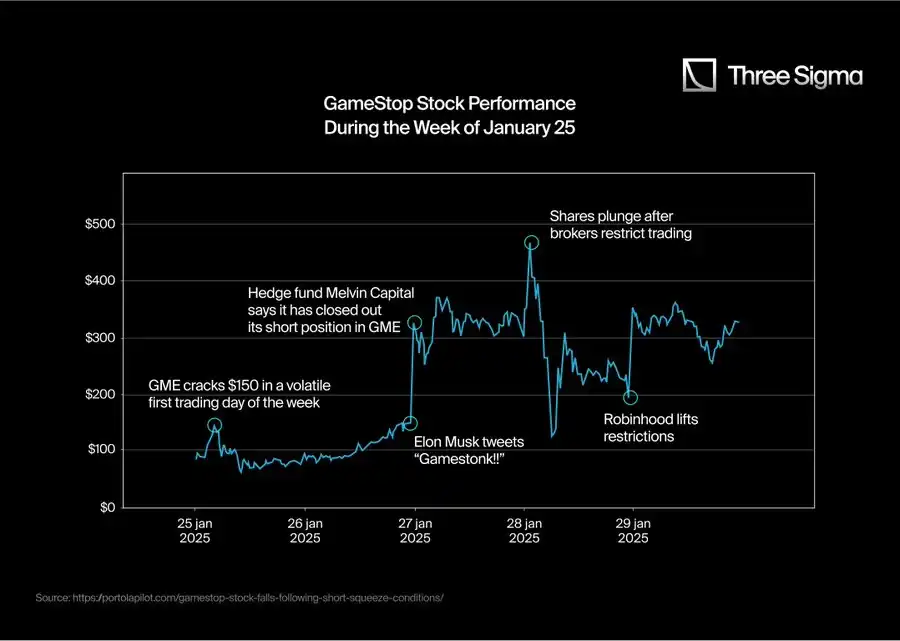
However, coordinated retail buying, especially initiatives like the one seen on Reddit's WallStreetBets community, caused stock prices to unexpectedly soar. As the price rose, short sellers were forced to buy back the stock, driving the price higher and further fueling the upward momentum.
This feedback loop eventually evolved into a historic event, with GameStop's stock price soaring from around $20 in early January 2021 to an intraday high of $483 by the end of the month. This squeezing event led to many institutional investors who were in short positions losing billions of dollars.
2. API and Liquidation Events
In the cryptocurrency space, there have been several notable liquidation events in history. However, the most memorable and impactful ones often occur during a bear market's "short squeeze." These events are larger in scale and have a more profound impact on traders and the market.
Here are some of the biggest liquidation events in cryptocurrency history:
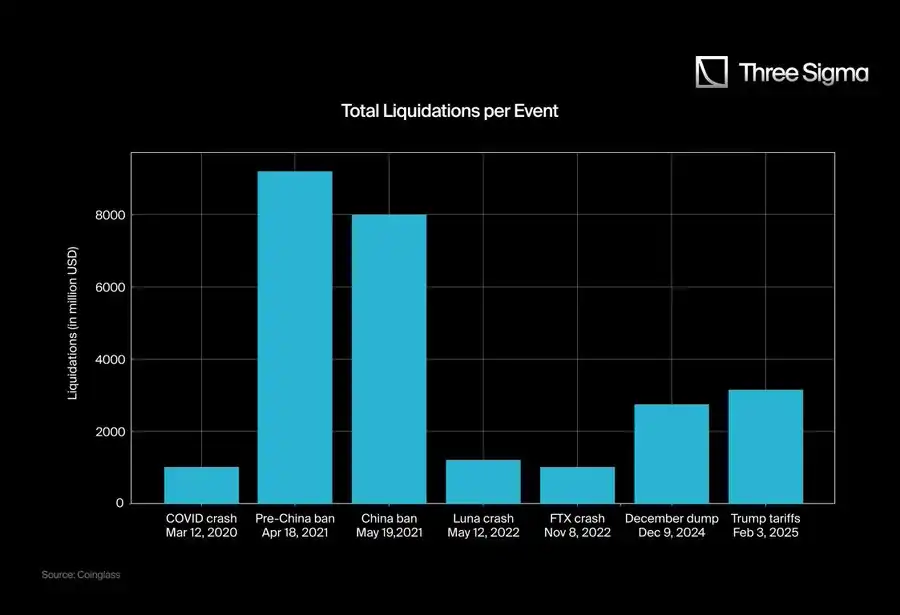
Notice anything unusual, anon? Do you think the FTX collapse or Luna crash did more damage than the liquidation events we've seen this year? Well, you're not wrong.
Behind the recent liquidation events being more severe than the FTX or Luna collapses are three key factors:
Total Market Capitalization
In March 2020, the total market cap reached $2.66 trillion, and by 2025, the peak market cap had reached $3.71 trillion. To truly understand the scale of these liquidation events, we should consider the ratio of liquidations to market cap rather than just looking at the absolute numbers of liquidations. Raw numbers can make recent liquidations seem more severe than they actually are.
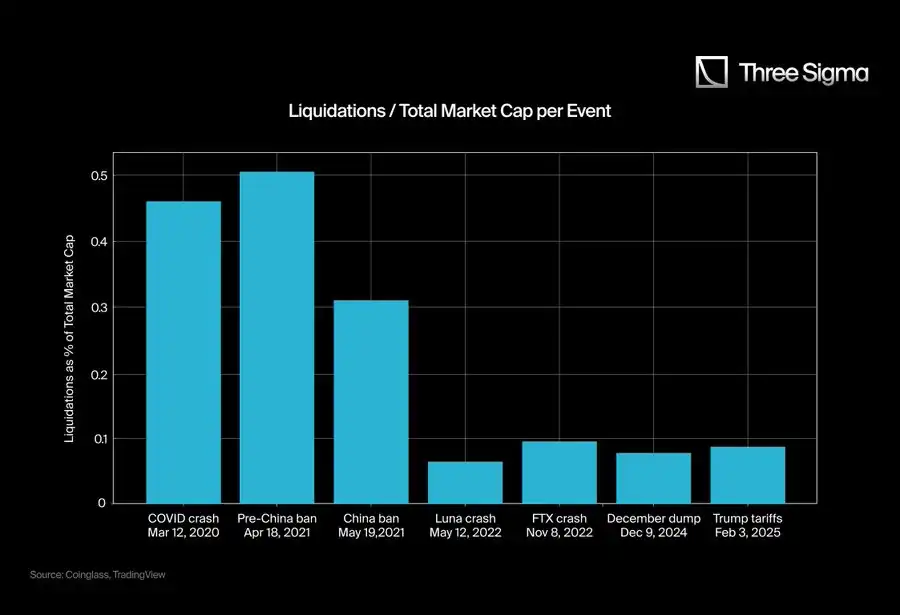
This chart helps us see the scale and impact of liquidations more clearly, but there's still some data that isn't quite accurate; this leads to the second issue.
CEX WebSocket API Limitations
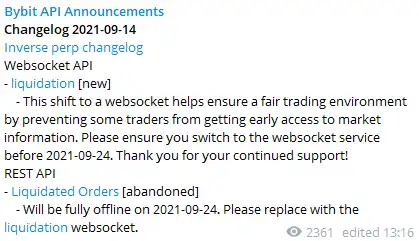
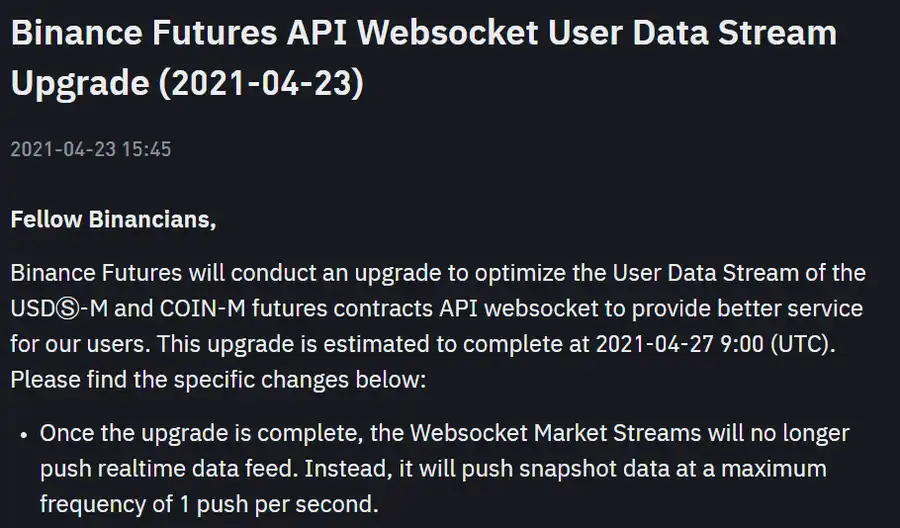
Until the second quarter of 2021, most centralized exchanges (CEX) provided accurate liquidation data via their APIs, reporting each liquidation. However, starting in 2021, they introduced limitations, restricting liquidation data to one per second, regardless of how many actual liquidations occurred.
This change significantly reduced the reported liquidation numbers, making the data from late 2021 appear smaller and less impactful compared to before 2021.
@K33Research has written a research article explaining this situation and illustrated it through two simple yet powerful charts:
In the first chart, you can see that after the API changes, the number of liquidations has significantly slowed down, even though the total market value is much higher than in 2021, the liquidation data remains at a lower level.
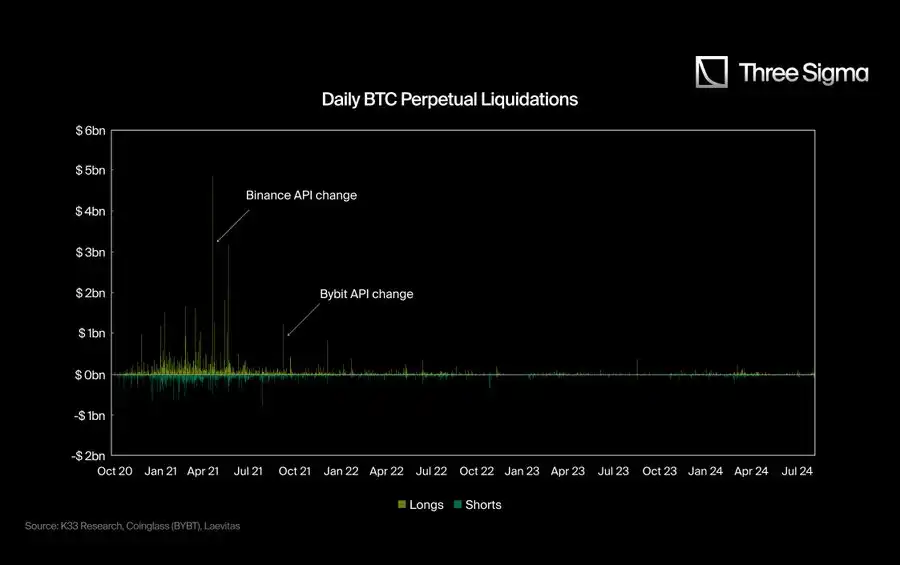
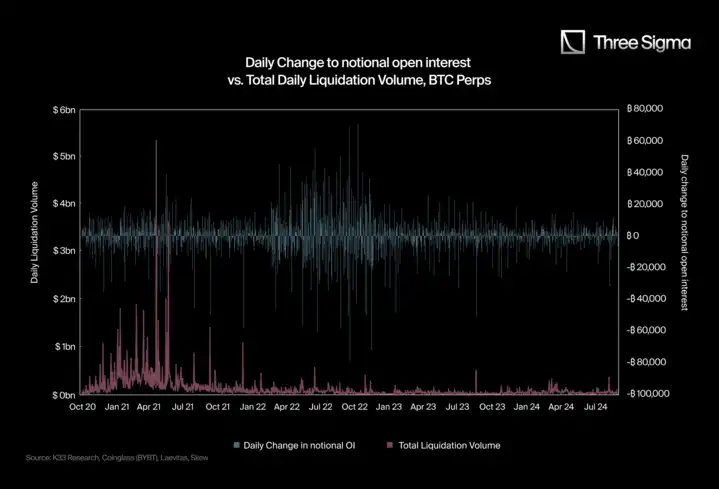
In the second chart, the author compares the total liquidation amount with the daily nominal Open Interest (OI) change.
The substantial intraday fluctuations in Open Interest usually trigger a large number of liquidations, but as we can see in the chart, after the second quarter of 2021, on days with such significant OI fluctuations, there was no notable increase in liquidations.
The official reasons behind these API changes are: "to provide a 'fair trading environment' (Bybit, September 2021) and to 'optimize user data flow' (Binance, April 2021)," but some believe that this is actually just for PR reasons to avoid causing excessive panic while also retaining genuine data.
Hyperliquid as a Genuine Platform
Hyperliquid is the first Layer 1 blockchain perpetual DEX to reach sufficient trading volume to compete with CEX. Unlike CEX, Hyperliquid provides fully transparent and unrestricted reporting of all liquidation events since its data is public.
This creates a unique environment where, on one hand, CEX's liquidation data is limited (due to reporting restrictions), while on the other hand, Hyperliquid's data is unrestricted. As a result, the reported total liquidation data has significantly increased, benefiting from Hyperliquid's transparency.
This transparency has a significant impact on the broader trading ecosystem. In traditional centralized exchanges, liquidation data is often selectively reported or summarized, limiting traders' ability to analyze market dynamics in real-time. Hyperliquid ensures that every liquidation event is publicly visible, providing a more accurate and comprehensive understanding of leverage trading activities.
For traders, this means a better understanding of the market situation, enabling them to identify potential squeeze scenarios, monitor risk levels, or gauge market sentiment. Researchers and analysts have also benefited from unfiltered on-chain liquidation data, providing valuable insights into volatility patterns, risk behavior, and market reactions to liquidations.
This unrestricted access to data has promoted a more equitable, efficient trading environment where all participants have equal access to information. By setting new transparency standards for perpetual trading, Hyperliquid has not only challenged the opacity of CEXs but has also enhanced the overall reliability of liquidation data, allowing traders to operate with greater trust and deeper market insights.
3. Real Liquidation Data
3.1 Calculating the Hyperliquid Ratio
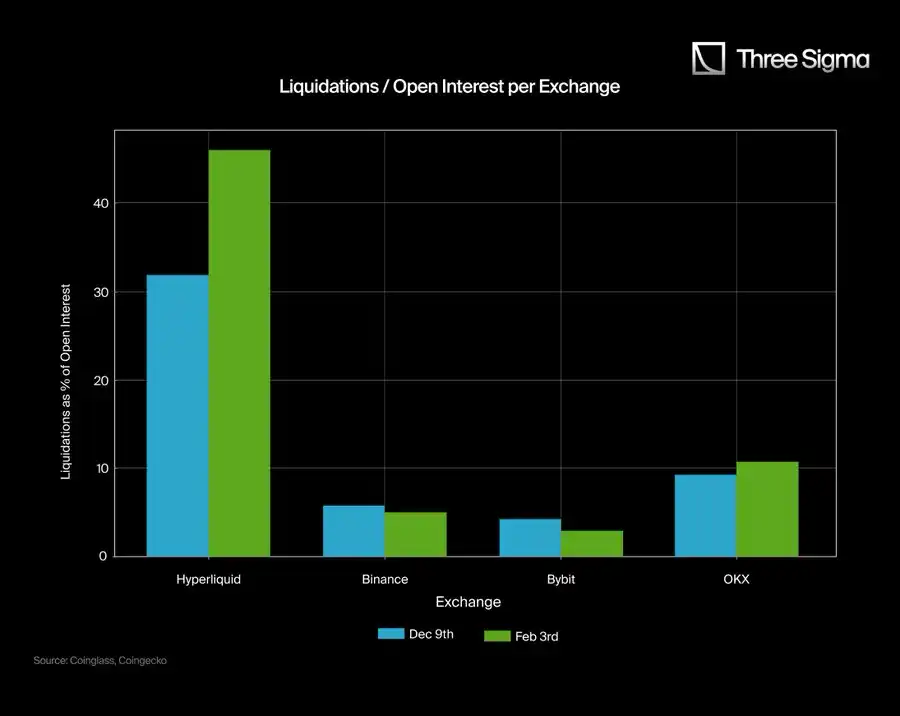
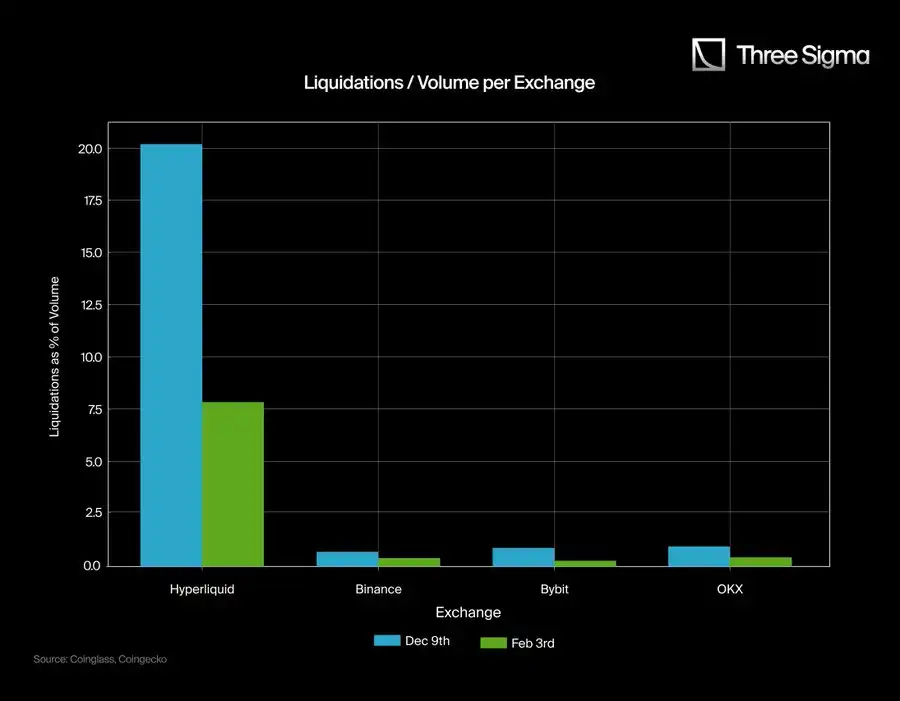
Hyperliquid's transparency and comprehensive metrics allow us to see what has been happening over an extended period, whereas the derivative segments of CEXs have not been able to report real-aligned figures due to API limitations. The data discrepancies seen in the charts further confirm this issue, showing that despite CEXs having much larger open interest contracts and volumes compared to Hyperliquid, their reported liquidation figures are still unrealistically low.
Thanks to Hyperliquid, we now have a verifiable and accurate dataset to compare the distortion in CEX liquidation reports.
The data provided to the media often presents an incomplete picture as they are based on limited APIs, failing to capture the full extent of liquidation events. In contrast, Hyperliquid's unrestricted reporting offers transparent and detailed records of all liquidation events, proving that CEX liquidation activity may be significantly higher than publicly disclosed figures.
3.2 Adjusting CEX Liquidation Data Using the Hyperliquid Ratio
To estimate CEX's "true" liquidation figures, we used Hyperliquid's liquidation/trading volume ratio and liquidation/open interest ratio as benchmarks. We then compared these ratios to the data reported by CEXs on two specific dates (December 9 and February 3), resulting in an adjustment factor.
Calculate Hyperliquid's Average Ratios:
Liquidation / Open Interest (Hyperliquid)
Dec 9: 1.07B / 3.37B ≈ 0.3175
Feb 3: 1.42B / 3.08B ≈ 0.461
Average ≈ 0.389 (38.9%)
Liquidation / Trading Volume (Hyperliquid)
Dec 9: 1.07B / 5.30B ≈ 0.2021
Feb 3: 1.42B / 18.0B ≈ 0.0789
Average ≈ 0.14 (14%)
We use these percentages (38.9% and 14%) as reference points to assess what the liquidation data might look like if other exchanges were to follow a similar ratio to Hyperliquid.
Applying These Ratios to Binance, Bybit, and OKX:
For each CEX, we calculate two "adjusted" liquidation data:
Using Hyperliquid's Liquidation/Trading Volume Ratio
Using Hyperliquid's Liquidation/Open Interest Ratio
Then, we take the average of these two adjusted results for each date.
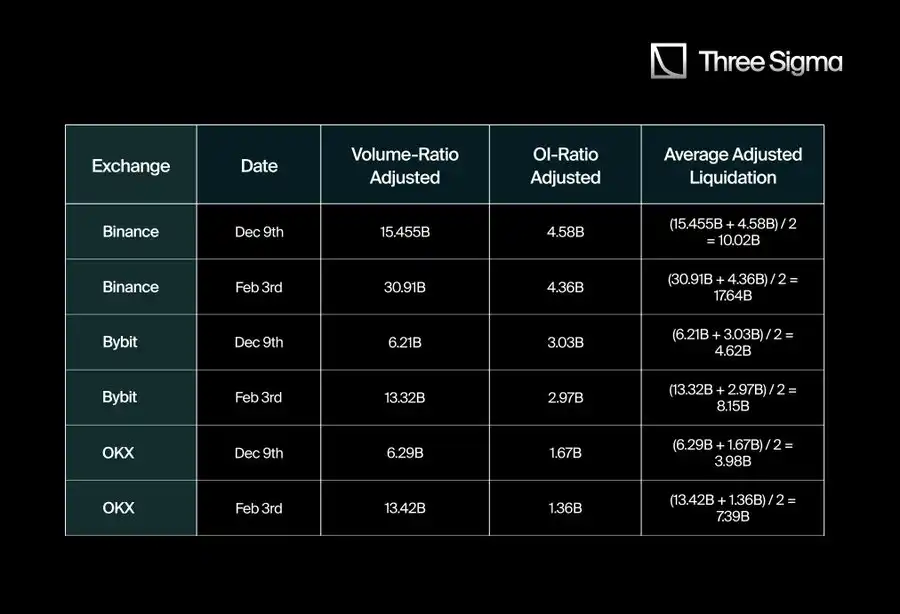
Therefore, the CEX-reported liquidation data (often in the range of billions of dollars) is significantly lower than the implied billion-dollar range based on the Hyperliquid ratios.
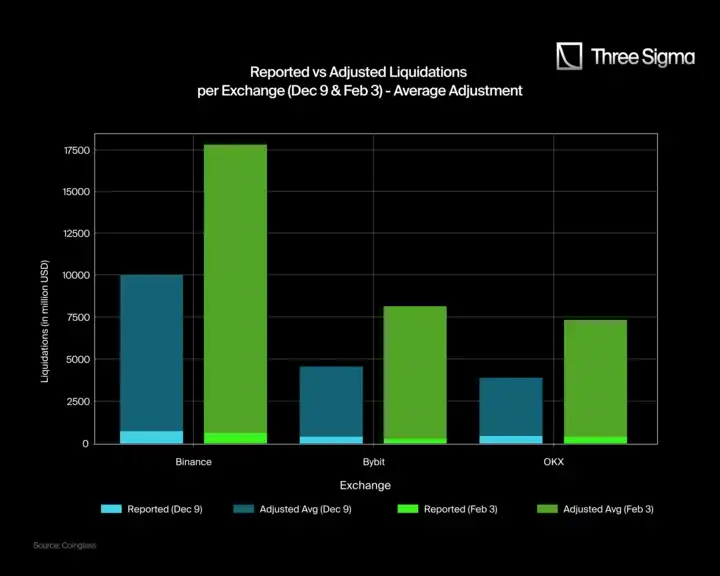
Below are the reports and adjusted liquidation data charts for Dec 9 and Feb 3. Each exchange has two bar graphs, with light blue and light green representing the reported liquidation data and dark blue and dark green representing the adjusted liquidation data.
The adjusted values are calculated by taking the average of the Liquidation/Trading Volume ratio and the Liquidation/Open Interest ratio from Hyperliquid as the baseline. While this provides a clearer perspective on potential liquidation data differences, variations may still exist due to differences in exchange market structure, retail participation, liquidity provider activity, etc.
Key Insights:
Liquidation data from Binance, Bybit, and OKX is significantly underreported: The reported liquidation data (light blue/light green) is much lower than the adjusted data (dark blue/dark green), indicating that the actual liquidation data may be much higher than publicly disclosed numbers.
Binance should report approximately 17,640M in liquidation data: The adjusted data suggests that Binance's actual liquidation data on February 3 should be close to 17,640M, rather than the reported 611M, highlighting a significant discrepancy. On December 9, Binance should report 10,020M instead of 739M.
Bybit and OKX follow a similar pattern: Bybit's adjusted liquidation data on February 3 is 8,150M, not 247M as reported; on December 9, it is 4,620M instead of 370M. OKX also shows significant differences, with adjusted liquidation data of 7,390M on February 3 and 3,980M on December 9, compared to reported figures of 402M and 425M, respectively.
3.3 Major Liquidation Events and their "True" Estimates
After comparing Hyperliquid's liquidation data with the limited data reported by major CEXs, we found significant variances. To quantify this difference, we collected reported data from Binance, Bybit, and OKX on December 9 and February 3, specifically analyzing their liquidation/trading volume and liquidation/open interest ratios.
To estimate the true liquidation data, we calculated the average ratio of Hyperliquid's liquidation/trading volume and then applied these ratios to CEX data. We did not use a simple arithmetic average but instead calculated the liquidation ratios weighted by the proportion of each exchange's trading volume on each date. This method offers a more accurate reflection of overall market liquidation activity.
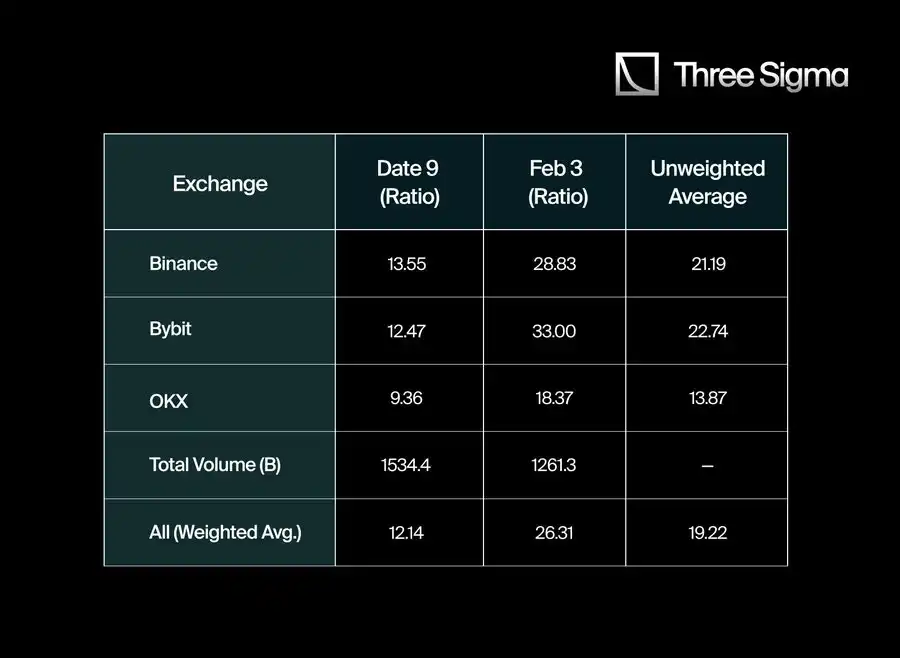
When we initially calculated the adjustment factors for each exchange (Binance: 21.19, Bybit: 22.74, OKX: 13.87), a simple average yielded a global adjustment factor of 19.27x. However, considering the weighted differences in exchange volumes, the more precise weighted average is 19.22x.
This indicates that the actual settlement data from CEXs may be roughly 19 times higher than what is officially reported, or at least 19 times higher than the data disclosed through their restrictive APIs.
With this 19.22x adjustment factor in mind, we analyzed some significant settlement events in the history of crypto to estimate how much their actual settlement data might be if they had the same level of transparency as Hyperliquid. The table below compares common settlement amounts to the values adjusted by the 19.22x factor:
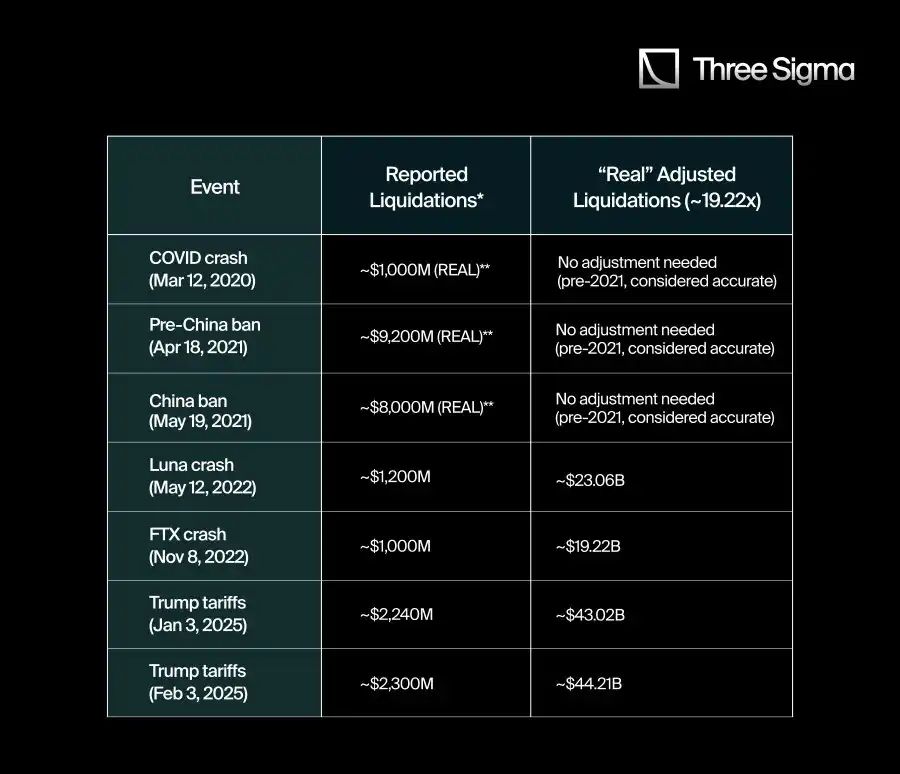
“Reported” refers to the figures published on aggregators, social media, or limited APIs.
For events prior to Q2 2021, settlement data is much more reliable due to the absence of API restrictions.
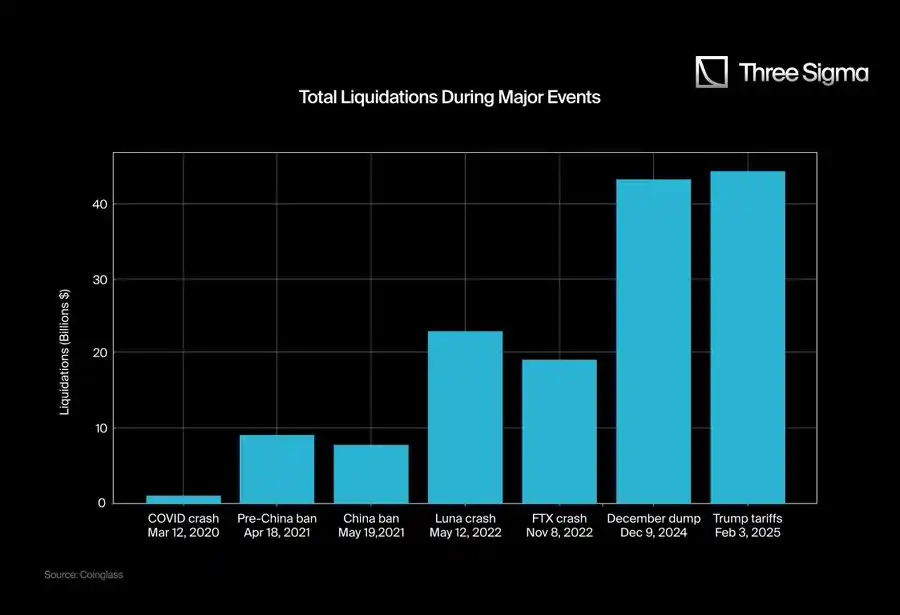
As highlighted in this chart, the settlement figures derived from data sources reported post-2021 may significantly underestimate the true picture. By applying the multiplier derived from Hyperliquid's full transparency, the settlement scales of these events are much larger than what the official figures assume.
3.4. Comparing Settlement to Total Market Cap
To provide more context, we compare the total “true” settlements of these events to the total market cap at the time. The ratio calculation formula is: (Settlement Amount / Market Cap) × 100.
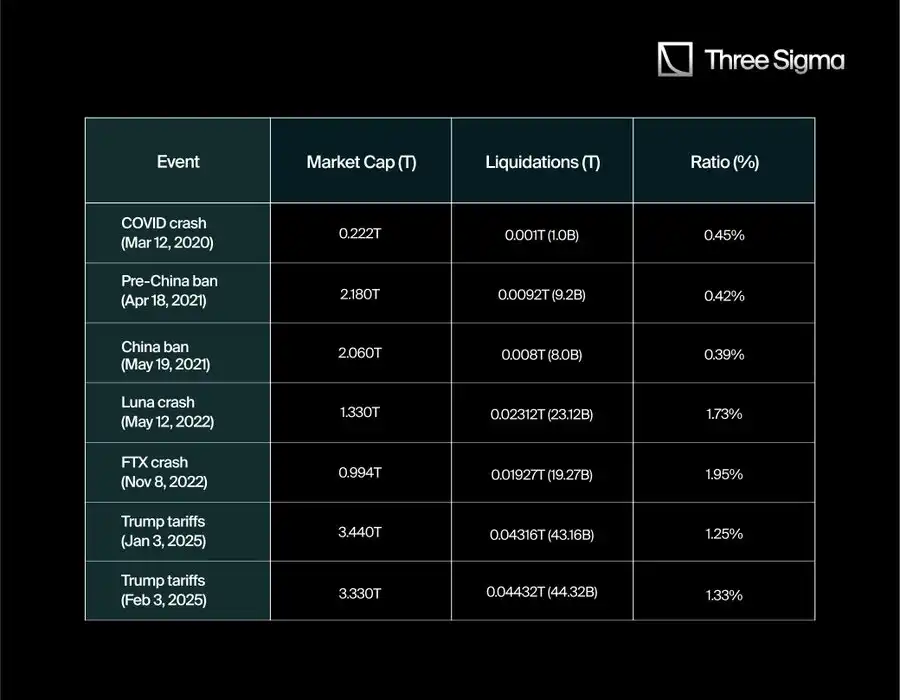

By comparing the “true” settlement data to the broader cryptocurrency market cap, we can gain a deeper understanding of the impact of each event on market dynamics. This not only demonstrates the scale of capital that vanished in a short period but also reflects how market sentiment drastically changed when leverage effects were unwound.
In many cases, the ratio becomes more pronounced after adjustment, indicating that participants may have been exposed to greater systemic risks than initially apparent. Therefore, understanding these settlement-to-market cap ratios can provide a clearer perspective to help us grasp how market psychology and liquidity conditions shift during periods of extreme volatility.
4. Conclusion
From all the preceding data and comparisons, a pattern emerges clearly: the figures reported in CEX public disclosures are often significantly lower than the "true" settlement activity. When adjusted to match the Hyperliquid transparent ratio, events like the Luna and FTX collapses have revealed a larger impact than what official data suggests, further reinforcing the view that CEXs may underreport settlement data to mask volatility or manage public perception.
This contrast becomes even more pronounced when looking at historical events: the COVID crash of 2020, while a major market event at the time, now appears relatively minor precisely because there were fewer leveraged participants then. With the mainstreaming of leverage, settlement's absolute and relative scale continues to grow, but the constraints of official data flows may give traders and analysts a distorted view of systemic risk.
Furthermore, exchanges often cite "optimizing data flow" or "ensuring fair trading conditions" as reasons, but it is not hard to see that restricting the real-time release of settlement data can serve broader interests. Underreporting settlement data can reduce the fear of new retail investors while also allowing exchanges to gain exclusive insights into market-wide risk exposure.
While these measures may help narrow the gap between reported data and actual settlement activity, Hyperliquid's reliance on on-chain, unrestricted reporting still highlights how crucial true transparency is for anyone looking to navigate leveraged crypto trading.
Вам також може сподобатися

WEEXPERIENCE Ніч китів: ШІ-торгівля, криптоспільнота та аналітика крипторинку
12 грудня 2025 року WEEX провела WEEXPERIENCE Whales Night, офлайн-зустріч спільноти, призначену для об'єднання членів місцевої криптовалютної спільноти. Захід поєднував обмін контентом, інтерактивні ігри та презентації проектів, щоб створити невимушений, але водночас захопливий офлайн-досвід.
Ризик торгівлі криптовалютою за допомогою штучного інтелекту: Чому кращі стратегії криптовалютної торгівлі можуть призвести до більших збитків?
Ризик більше не полягає переважно в поганих рішеннях чи емоційних помилках. Воно дедалі більше проявляється в ринковій структурі, шляхах виконання та колективній поведінці. Розуміння цього зрушення важливіше, ніж пошук наступної «кращої» стратегії.
Чи замінюють агенти штучного інтелекту криптодослідження? Як автономний штучний інтелект змінює криптовалютну торгівлю
Штучний інтелект переходить від допомоги трейдерам до автоматизації всього процесу від дослідження до виконання на криптовалютних ринках. Перевага змістилася від людського розуміння до конвеєрів даних, швидкості та систем штучного інтелекту, готових до виконання, що робить затримки в інтеграції штучного інтелекту конкурентним недоліком.

Торговельні боти на основі штучного інтелекту та копіювання торгівлі: Як синхронізовані стратегії змінюють волатильність крипторинку
Роздрібні криптотрейдери вже давно стикаються з тими ж проблемами: погане управління ризиками, пізні входи, емоційні рішення та непослідовне виконання. Інструменти торгівлі на основі штучного інтелекту обіцяли рішення. Сьогодні системи копіювальної торгівлі на базі штучного інтелекту та боти для проривів допомагають трейдерам визначати розмір позицій, встановлювати стоп-стопи та діяти швидше, ніж будь-коли. Окрім швидкості та точності, ці інструменти непомітно змінюють ринки — трейдери не просто торгують розумніше, вони рухаються синхронно, створюючи нову динаміку, яка посилює як ризик, так і можливості.

Пояснення торгівлі криптовалютою за допомогою штучного інтелекту: Як автономна торгівля змінює крипторинки та криптобіржі
ШІ-трейдинг швидко змінює криптоландшафт. Традиційні стратегії намагаються встигати за безперервною волатильністю криптовалют та складною структурою ринку, тоді як штучний інтелект може обробляти величезні обсяги даних, генерувати адаптивні стратегії, керувати ризиками та виконувати угоди автономно. Ця стаття розповідає користувачам WEEX, що таке торгівля на основі штучного інтелекту, чому криптовалюта прискорює її впровадження, як галузь розвивається в напрямку автономних агентів і чому WEEX створює екосистему торгівлі на основі штучного інтелекту наступного покоління.

Заклик до участі у AI Wars: WEEX Alpha Awakens — Глобальні змагання зі штучного інтелекту з призовим фондом $880 000
Зараз ми закликаємо трейдерів, що використовують штучний інтелект, з усього світу приєднатися до AI Wars: WEEX Alpha Awakens — глобальні змагання з торгівлі на основі штучного інтелекту з призовим фондом у 880 000 доларів.

Торгівля на криптовалютних ринках за допомогою штучного інтелекту: Від автоматизованих торгових ботів до алгоритмічних стратегій
Торгівля на основі штучного інтелекту переводить криптовалюту з роздрібної спекуляції в конкуренцію інституційного рівня, де виконання та управління ризиками важливіші за напрямок. Зі зростанням торгівлі на базі штучного інтелекту зростають системні ризики та регуляторний тиск, що робить довгострокову ефективність, надійні системи та відповідність вимогам ключовими відмінними рисами.
Аналіз настроїв за допомогою ШІ та волатильність криптовалюти: Що впливає на ціни на криптовалюту
Настрої щодо штучного інтелекту дедалі більше впливають на криптовалютні ринки, а зміни в очікуваннях, пов'язаних зі штучним інтелектом, призводять до волатильності основних цифрових активів. Крипторинки схильні посилювати наративи штучного інтелекту, дозволяючи потокам, зумовленим настроями, переважати фундаментальні фактори в короткостроковій перспективі. Розуміння того, як формуються та поширюються настрої щодо ШІ, допомагає інвесторам краще передбачати цикли ризику та можливості позиціонування цифрових активів.

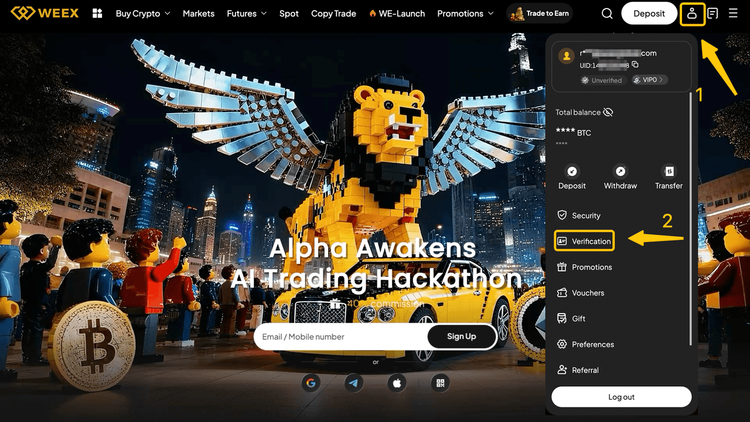
AI Wars: посібник учасника
У цьому фінальному протистоянні провідні розробники, квантові аналітики та трейдери з усього світу використають свої алгоритми в реальних ринкових битвах, змагаючись за один з наймасштабніших призових фондів в історії ШІ-криптотрейдингу: 880 000 дол. США, зокрема Bentley Bentayga S для чемпіона. Цей посібник проведе вас через кожен необхідний крок від реєстрації до офіційного початку змагань.
Тиждень центрального банку та волатильність криптовалютного ринку: Як рішення щодо процентних ставок формують умови торгівлі на WEEX
Рішення щодо процентних ставок, прийняті основними центральними банками, такими як Федеральна резервна система, є значними макроекономічними подіями, що впливають на світові фінансові ринки, безпосередньо впливаючи на очікування ліквідності ринку та схильність до ризику. У міру того, як ринок криптовалют продовжує розвиватися, а його торгова структура та учасники стають зрілими, крипторинок поступово інтегрується в макроекономічну систему ціноутворення.

Тестування WEEX API: Офіційний посібник з хакатону зі штучним інтелектом та API для криптовалютної торгівлі
Тестування API WEEX розроблено для того, щоб кожен учасник міг перетворити торговельну логіку на реальне виконання. Усі взаємодії API відбуваються в системі живої торгівлі WEEX, що дозволяє учасникам працювати в реальних ринкових умовах, а не в симуляціях. Завдяки низьким вступним вимогам, це завдання доступне як для досвідчених розробників, так і для мотивованих новачків, водночас підтверджуючи необхідні технічні навички.
Війни ШІ: Тест для учасників
Частина 1: Рекомендований метод (хмарні сервери)
Для найкращої стабільності ми наполегливо рекомендуємо використовувати хмарний сервер зі статичною публічною IP-адресою та підтримкою цілодобової безперебійної роботи, наприклад: AWS (Amazon Web Services), Alibaba Cloud та Tencent Cloud.
**Частина 2:** Альтернативний метод (локальний комп’ютер)
Якщо ви вирішите запускати свого торгового бота з персонального комп’ютера або домашньої мережі, ви **повинні** підтвердити, що ваша вихідна IP-адреса є статичною. Зміна IP-адреси призведе до проблем із підключенням.
У вас є два основні варіанти для забезпечення стабільної вихідної IP-адреси:
Використовуйте статичну IP-адресу, надану вашим інтернет-провайдером (ISP).Використовуйте VPN або проксі-сервіс з фіксованою вихідною IP-адресою (і переконайтеся, що VPN/проксі постійно ввімкнено без перемикання серверів).Кроки для пошуку вашої локальної публічної IP-адреси:
Вимкніть усі VPN або залиште лише ту VPN, IP-адресу якої ви плануєте додати до білого списку.Відвідайте whatismyip.com у вашому браузері.На сторінці буде відображено вашу публічну IPv4-адресу.Скопіюйте цю IP-адресу та додайте її до білого списку.Примітка: Більшість домашніх широкосмугових IPv4-адрес є динамічними та можуть періодично змінюватися. Наполегливо рекомендується використовувати хмарне серверне середовище, щоб уникнути збоїв з’єднання під час змагань.
1.3 Бракує інформації? Ми будемо стежити за ситуацієюПісля того, як ви надішлете свою BUIDL, команда WEEX розгляне вашу заявку на основі вимог конкурсу. Процес перевірки зазвичай триває один робочий день.
Якщо якась інформація відсутня або потребує уточнення, наша команда зв’яжеться з вами одним із наступних каналів:
Система обміну повідомленнями DoraHacksОфіційна система повідомлень WEEXВаша зареєстрована контактна інформація (Telegram, X тощо)Будь ласка, тримайте свої контактні дані активними та доступними.
Після схвалення вашого BUIDL ви отримаєте свій аккаунт для участі в змаганнях та ексклюзивний ключ API, який дозволить вам перейти до наступного етапу: Тестування API та інтеграція моделей.
. Будь ласка, уважно прочитайте офіційну документацію WEEX API: https://www.weex.com/api-doc/ai/intro
2. Підключіться до хмарного сервера та запустіть код нижче. Ви повинні отримати відповідь, яка підтверджує, чи ваше мережеве з’єднання працює належним чином.
curl -s --max-time 10 "https://api-contract.weex.com/capi/v2/market/time"{"epoch":"1765423487.896","iso":"2025-12-11T03:24:47.896Z","timstamp":1765423487896
2. Підключіться до хмарного сервера та запустіть код нижче. Ви повинні отримати відповідь, яка підтверджує, чи ваше мережеве з’єднання працює належним чином.
import time import hmac import hashlib import base64 import requests api_key = "" secret_key = "" access_passphrase = "" def generate_signature_get(secret_key, timestamp, method, request_path, query_string): message = timestamp + method.upper() + request_path + query_string signature = hmac.new(secret_key.encode(), message.encode(), hashlib.sha256).digest() return base64.b64encode(signature).decode() def send_request_get(api_key, secret_key, access_passphrase, method, request_path, query_string): timestamp = str(int(time.time() * 1000)) signature = generate_signature_get(secret_key, timestamp, method, request_path, query_string) headers = { "ACCESS-KEY": api_key, "ACCESS-SIGN": signature, "ACCESS-TIMESTAMP": позначка часу, "ACCESS-PASSPHRASE": пароль_доступу, "Content-Type": "додаток/json", "локалізація": "uk-US" } url = "https://api-contract.weex.com/" # Будь ласка, замініть фактичною адресою API if method == "GET": response = requests.get(url + request_path+query_string, headers=headers) return response def assets(): request_path = "/capi/v2/account/assets" query_string = "" response = send_request_get(api_key, secret_key, access_passphrase, "GET", request_path, query_string) print(response.status_code) print(response.text) if __name__ == '__main__': assets()
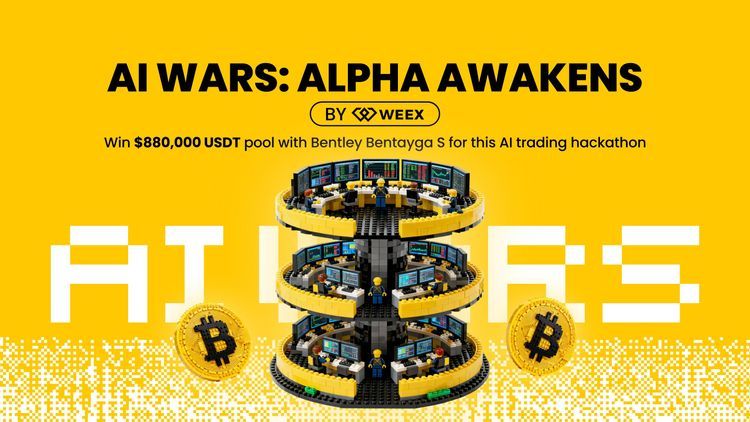
Чому WEEX Alpha Awakens – найкраще змагання з торгівлі на основі штучного інтелекту 2025 року? Все, що вам потрібно знати
Щоб пришвидшити прориви на перетині штучного інтелекту та криптовалют, WEEX запускає перший у світі глобальний хакатон з торгівлі на основі штучного інтелекту — AI Wars: Альфа пробуджується. Призовий фонд заходу перевищує 880 000 доларів США, включаючи Bentley Bentayga S для абсолютного чемпіона.

Війни ШІ: WEEX Alpha Awakens | Посібник з процесу тестування API WEEX Global Hackathon
Війни ШІ: Реєстрація на WEEX Alpha Awakens вже відкрита, і в цьому посібнику описано, як отримати доступ до тестування API та успішно завершити процес.

Що таке WEEX Alpha Awakens і як взяти участь? Повний посібник
Щоб пришвидшити прориви на перетині штучного інтелекту та криптовалют, WEEX запускає перший у світі глобальний хакатон з торгівлі на основі штучного інтелекту — AI Wars: Альфа пробуджується.

Приєднуйтесь до війн штучного інтелекту: WEEX Альфа пробуджується!Глобальний заклик до альфа-версій торгівлі зі штучним інтелектом
Війни ШІ: WEEX Alpha Awakens – це глобальний хакатон з торгівлі на основі штучного інтелекту в Дубаї, який запрошує квантові команди, алгоритмічних трейдерів та розробників штучного інтелекту розкрити свої стратегії торгівлі на основі штучного інтелекту в криптовалюті на реальних ринках та виграти частину призового фонду в розмірі 880 000 доларів США.

WEEX представляє платформу «Торгуй, щоб заробляти»: Миттєвий ребейт до 30% + викуп WXT на суму $2 млн
WEEX рада оголосити про запуск нашої програми «Trade to Earn», яка автоматично надає вам знижку на торговельні комісії до 30%. Усі винагороди зараховуються безпосередньо на ваш спотовий рахунок у $WXT, що підтримується нашим планом викупу WXT на суму $2 000 000, який сприяє довгостроковому зростанню вартості токенів.

Нове: Орієнтовна ціна ліквідації на графіках свічок у додатку
WEEX представила нову **Очікувану ліквідаційну ціну** (Est. Liq. Ціна) на графіку свічок, щоб допомогти трейдерам краще керувати ризиками та визначати безпечні діапазони для своїх позицій.
WEEXPERIENCE Ніч китів: ШІ-торгівля, криптоспільнота та аналітика крипторинку
12 грудня 2025 року WEEX провела WEEXPERIENCE Whales Night, офлайн-зустріч спільноти, призначену для об'єднання членів місцевої криптовалютної спільноти. Захід поєднував обмін контентом, інтерактивні ігри та презентації проектів, щоб створити невимушений, але водночас захопливий офлайн-досвід.
Ризик торгівлі криптовалютою за допомогою штучного інтелекту: Чому кращі стратегії криптовалютної торгівлі можуть призвести до більших збитків?
Ризик більше не полягає переважно в поганих рішеннях чи емоційних помилках. Воно дедалі більше проявляється в ринковій структурі, шляхах виконання та колективній поведінці. Розуміння цього зрушення важливіше, ніж пошук наступної «кращої» стратегії.
Чи замінюють агенти штучного інтелекту криптодослідження? Як автономний штучний інтелект змінює криптовалютну торгівлю
Штучний інтелект переходить від допомоги трейдерам до автоматизації всього процесу від дослідження до виконання на криптовалютних ринках. Перевага змістилася від людського розуміння до конвеєрів даних, швидкості та систем штучного інтелекту, готових до виконання, що робить затримки в інтеграції штучного інтелекту конкурентним недоліком.
Торговельні боти на основі штучного інтелекту та копіювання торгівлі: Як синхронізовані стратегії змінюють волатильність крипторинку
Роздрібні криптотрейдери вже давно стикаються з тими ж проблемами: погане управління ризиками, пізні входи, емоційні рішення та непослідовне виконання. Інструменти торгівлі на основі штучного інтелекту обіцяли рішення. Сьогодні системи копіювальної торгівлі на базі штучного інтелекту та боти для проривів допомагають трейдерам визначати розмір позицій, встановлювати стоп-стопи та діяти швидше, ніж будь-коли. Окрім швидкості та точності, ці інструменти непомітно змінюють ринки — трейдери не просто торгують розумніше, вони рухаються синхронно, створюючи нову динаміку, яка посилює як ризик, так і можливості.
Пояснення торгівлі криптовалютою за допомогою штучного інтелекту: Як автономна торгівля змінює крипторинки та криптобіржі
ШІ-трейдинг швидко змінює криптоландшафт. Традиційні стратегії намагаються встигати за безперервною волатильністю криптовалют та складною структурою ринку, тоді як штучний інтелект може обробляти величезні обсяги даних, генерувати адаптивні стратегії, керувати ризиками та виконувати угоди автономно. Ця стаття розповідає користувачам WEEX, що таке торгівля на основі штучного інтелекту, чому криптовалюта прискорює її впровадження, як галузь розвивається в напрямку автономних агентів і чому WEEX створює екосистему торгівлі на основі штучного інтелекту наступного покоління.
Заклик до участі у AI Wars: WEEX Alpha Awakens — Глобальні змагання зі штучного інтелекту з призовим фондом $880 000
Зараз ми закликаємо трейдерів, що використовують штучний інтелект, з усього світу приєднатися до AI Wars: WEEX Alpha Awakens — глобальні змагання з торгівлі на основі штучного інтелекту з призовим фондом у 880 000 доларів.
Популярні монети
Останні новини криптовалют


Підтримка клієнтів:@weikecs
Співпраця:@weikecs
Кількісна торгівля та маркетмейкінг:[email protected]
VIP-послуги:[email protected]
 App
App