

On-chain Liquidity Migration: A Rollercoaster Ride of 15 Months, Who Will Stand Tall Post-Hype?

Original Title: Where is Onchain Volume Rotating? (Jan24-Mar25)
Original Author: Stacy Muur
Original Translation: Tim, PANews
Over the past 15 months, the liquidity landscape of DeFi has been reshaped across chains, with projects primarily driven by hype gradually exiting the stage as liquidity quietly consolidates in places with strong fundamentals rather than market speculation.
Key Insights
After hitting a historical high of $380 billion in January 2025, DEX trading volume dropped by 35% in the following two months, suggesting that January may have formed a short-term top. Currently, the top ten DEXs account for nearly 80% of the total trading volume; only Uniswap and PancakeSwap together hold about 40% of the market share. Solana-based DEXs have quietly taken the lead in the rankings, with 5 out of the top 10 positions, and their market share growth is mainly driven by the trading volume brought by the Meme coin craze. Hyperliquid has completely transformed the landscape of the perpetual contract sector, rising from a newcomer in the industry to occupying over 60% of the market share by March 2025.
All insights in the article are based on public data. Special thanks to DefiLlama for consistently providing high-quality statistics.
A Cycle Defined by Surges and Slowdowns
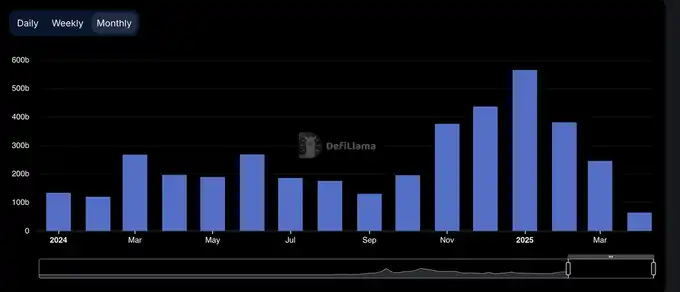
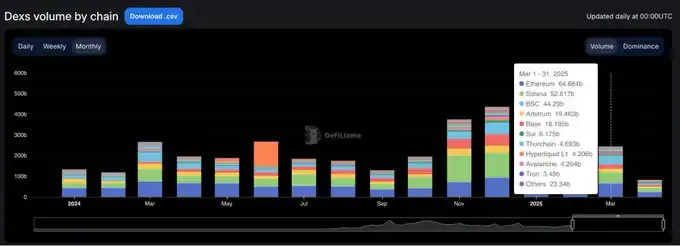
In early 2024, DEX trading volume showed strong performance in March and May, gradually slowing down before mid-year.
The situation took a dramatic turn in the fourth quarter, with trading volume surging in November and December. This momentum continued into January 2025, reaching an explosive peak of $380 billion.
However, this rebound was short-lived. By February, market trading volume had plummeted to $245 billion, marking a 35% cliff-like drop that put an end to the three-month vertical surge. This retreat laid the groundwork for a more cautious second quarter.
DEX Dominance: Top Protocols Hold Sway
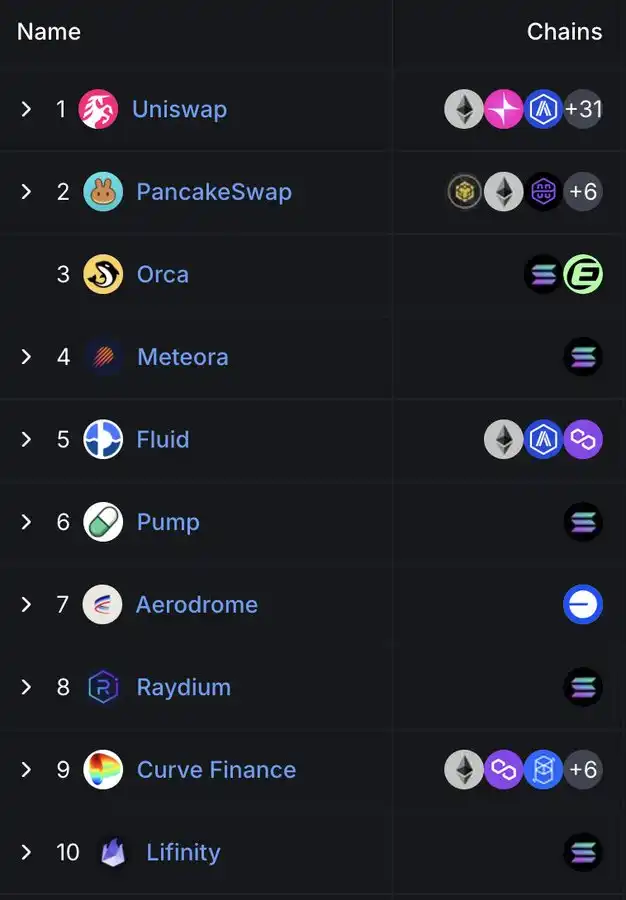
The market structure of DEXs remains highly concentrated. Currently, the top ten protocols account for 79.5% of the daily trading volume, with only the top five holding 59.1%.
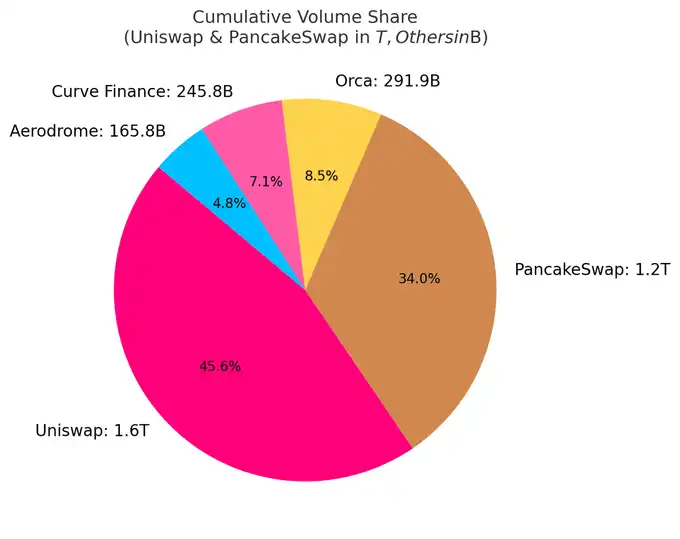
Uniswap and PancakeSwap account for approximately 40% of DEX trading volume, making them the only two platforms to date with a cumulative trading volume surpassing one trillion USD. Their leading position is due to first-mover advantage, extensive support for multi-chain ecosystems, and deep liquidity.
Uniswap Labs has also launched Unichain, which is an Ethereum Layer 2 network built on the Optimism Superchain. The chain aims to achieve fast, low-cost transactions through native multi-chain interoperability.
The Quiet Rise of Solana
Notably, Solana's position in the DEX space is becoming increasingly prominent. Among the current top ten DEXs, five are based on Solana: including Orca, Meteora, Raydium, Lifinity, and Pump.fun.
Orca (8.02%) and Meteora (6.70%) alone account for about 15% of global decentralized exchange platform activity. This growth is attributed to low gas fees, fast block times, and the Solana meme coin frenzy. Pump.fun's surge into the top ten is a clear testament to this hype.
Emerging Protocols: Fluid and Aerodrome
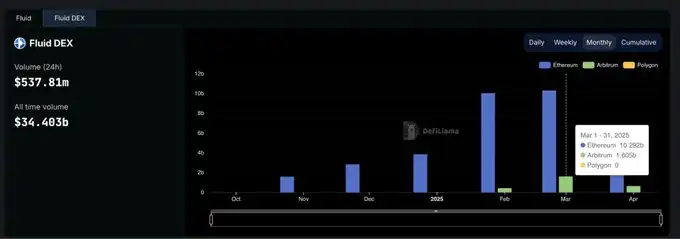
Fluid (7.09%) is the most capital-efficient platform among the top five DEXs. The protocol is active on Ethereum, with monthly settlement volumes exceeding $100 billion. Its performance has been particularly impressive following the launch on the Arbitrum ecosystem: the trading volume surged from $426 million in February to $1.6 billion in March, demonstrating speeds far above the industry average.
Aerodrome, as an original project of Base, demonstrates the continued growth of liquidity on the Base L2. While Hyperliquid does not rank high in the spot market, it holds a dominant position in the perpetual contract market, with a market share exceeding 60%.
DEX Market Share Across Chains: Easy Growth, Hard Retention
The past 15 months have clearly shown a phenomenon: most blockchain projects can attract attention, but only a few can maintain that traction. From January 2024 to March 2025, the market share of chain-level decentralized exchange platforms has changed rapidly, with only a very few projects truly exhibiting user stickiness.
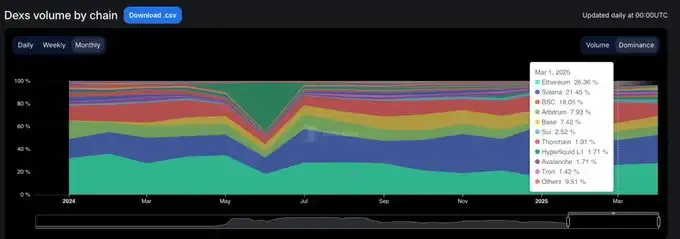
Solana has made the most significant breakthrough. It steadily rose in 2024, driven by the TRUMP and MELANIA Meme coin craze, reaching a peak market share of 45.8% in January 2025. However, by March, its market share had been halved to 21.5%, but still maintained the top position among public chains with an average share of 25.1%.
· Ethereum, on the other hand, had the opposite trajectory. Starting around 32% market share in early 2024, it dropped to 15.3% in January 2025, then rebounded to 26.4% in March. Even though Ethereum lost momentum, its ecosystem resilience remains.
· Base can be considered the most robust follower. Starting from 3% market share in March 2024, growing steadily to 12.4% by December, falling back to 7.4% in March 2025, maintaining an average share of 6.6% during this period. Without hype, only slow but sticky growth.
· BNB Chain maintained a stable 14.7% average share. Without major surges or drops, it consistently maintained stable retail fund flows.
· Arbitrum started strong (16% share) but lost momentum, sliding to 4.8% by January 2025, being surpassed by Base and Solana.
· Blast reached a peak market share of 42.3% in June 2024 but disappeared the following month. This is a clear example of incentive-driven transaction volume with zero user retention.
Summary: The dominance of DEXs on various public chains exhibits strong volatility. Solana once rose rapidly, Ethereum achieved value restoration, Base gradually expanded its ecosystem, and the market hype cycle showed significant fluctuations. The ultimate leading public chain is not necessarily the one with the largest volume but the network with the highest actual usage.
Centralized Exchanges Still Dominate Spot Trading Volume
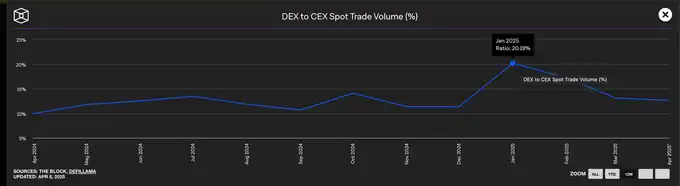
Despite the explosive growth of DEXs in early 2025, centralized exchanges still dominate spot market trading volume. Even in January, when DEX trading volume peaked, CEXs still accounted for nearly 80% of the total volume.
Although the dominance of centralized exchanges declined from 90% in early 2024 to a low of 79%, a broader trend is evident: DEXs continue to grow, but CEXs remain the default choice for most traders.
Perpetual Protocol Market Share
The landscape of on-chain perpetual contracts underwent a fundamental shift in 2024.
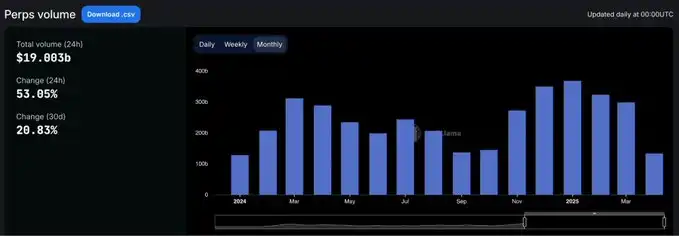
After dYdX firmly held the throne of perpetual contract trading for over two years, Hyperliquid emerged out of nowhere, redefining what it means to be dominant. The platform first topped the charts in February, briefly surpassed by SynFutures in the mid-year, and then reclaimed the top spot in August, leaving all competitors far behind. As of March 2025, Hyperliquid has captured nearly 59% of the total perpetual contract trading volume, solidifying its position as the platform of choice for professional traders.
This rapid rise has attracted significant market attention, with its product experience closer to that of centralized exchanges than any previous decentralized trading platform. In contrast, dYdX's market share has plummeted rapidly. From holding a 13.2% market share at the beginning of 2024, it has dropped to only 2.7% by March 2025, as users flock to faster, more user-friendly, and more modern alternatives.
Jupiter's perpetual contracts took a different path, leveraging Solana's native liquidity and the redirecting role of its spot DEX to rise to second place with an 8.8% market share. Despite its rapid ascent, it lacked staying power and ultimately settled behind Hyperliquid. Other projects such as SynFutures, Vertex Protocol, and Paradex have also briefly shown promise.
Perpetual Contract Chains: Execution Layer Undergoes Restructuring in One Cycle
The most significant change in the perpetual contract infrastructure space over the past year has not been which protocols users prefer but rather which chains they trust to execute transactions.
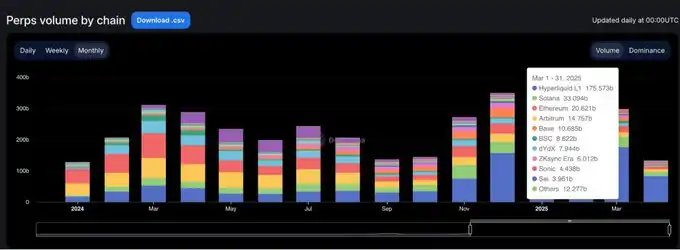
By March 2025, Ethereum and Arbitrum's share of perpetual contract trading volume had plummeted to 11.8%, a stark contrast to their combined market dominance of over 65% in January 2024, with newer and faster execution layers now fully in control.
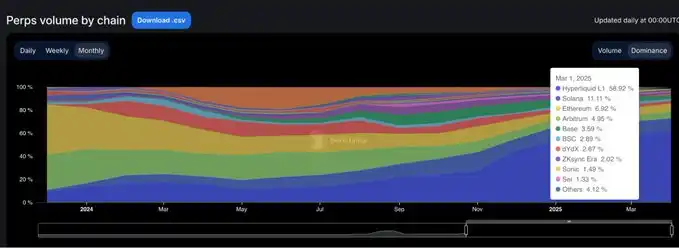
The key driving force behind this shift is Hyperliquid's blockchain, developed in-house. During the same period, the chain saw its market share surge from 13.6% to 58.9%, overtaking various Layer1 and Layer2 solutions that once set the industry standard in less than a year, becoming the default execution environment for perpetual contract trading. Its advantages are not only reflected in faster transaction speeds but, more importantly, in providing the reliability and low-latency guarantees demanded by professional traders.
Solana also experienced a strong uptrend, driven by the Jupiter and Phoenix projects at the end of 2024, with its market share peaking at nearly 16%. However, it eventually stabilized in the 10-11% range, unable to sustain its breakthrough growth momentum. While the Base and ZKsync ecosystems showed vitality (reaching a market share peak of 6-7%), they still did not break into the top-tier public chain ranks.
Meanwhile, Blast became a cautionary tale: this flash-in-the-pan project reached an 18.8% market share in June 2024, only to disappear at an equally astonishing speed. In a field driven by product quality and user retention, mere hype is unsustainable. The new industry standard is clear: performance-centric public chains have redefined the competitive benchmark, and traditional infrastructure no longer enjoys default advantages.
The future of DeFi lies not in multi-chain scaling but with those protocols that can transform industry narratives into user habits.
猜你喜欢
总统「官媒」发币、市场表现「脱敏」,特朗普的加密帝国没有新意
Gate.io MemeBox正式接入Solana生态,链上资产交易快人一步
盘点10大新兴Launchpad平台,谁能完成对Pump.fun的颠覆?
GoRich正式上线:链上交易零门槛,新手也能抓住100x Meme币
专访AllianceDAO合伙人qw:Crypto创业者正逃向AI,90%的Crypto+AI都是伪命题
稳定币争霸战:六路新锐杀出,市场格局生变?
从Cantor到Securitize,币圈买下华盛顿
4月27日市场关键情报,你错过了多少?
本周回顾 | 特朗普将为TRUMP持有者举办晚宴;马斯克与美国财政部长在白宫爆发激烈争吵
4月27日关键市场信息差,一定要看!|Alpha早报
加密市场情绪回暖,MCP成为AI赛道新标向


 App
App