

Perhaps tariffs only scratched the surface -- what are the challenges in the Chinese market?

Original Title: When it comes to tariffs, China is a special case
Original Author: @stevesi
Original Translation: zhouzhou, BlockBeats
Editor's Note: This article discusses the significant challenges U.S. tech companies face in China. Despite the attractiveness of the Chinese market to foreign businesses, issues such as inadequate intellectual property protection, heavy government intervention, and rampant piracy make conducting business in China exceptionally difficult. Companies like Microsoft have tried various approaches but have consistently struggled to break through the complex barriers of the Chinese market. The article emphasizes that while tariffs are obvious, the true issues in China lie in soft restrictions, regulatory mazes, and cultural differences, calling for a deeper understanding and discussion of the challenges in the Chinese market.
The following is the original content (slightly reorganized for better readability):
There has been much discussion about how the United States can benefit from China's powerful manufacturing sector, with tariffs often being the focus of international trade debates. However, what is often overlooked is how difficult it is for U.S. companies to enter the Chinese market and establish a sustainable business—especially in the service and intellectual property sectors.
Tariffs are just the tip of the iceberg. Beneath the surface lies a vast and intricate network of "soft barriers," regulatory requirements, and cultural differences, making it nearly impossible for U.S. companies to enter this market in a fair and sustainable manner.
Having worked at Microsoft for 15 years and having lived and worked in China, I have personally witnessed all of this. These experiences have been more challenging and enlightening than any tariff dispute.
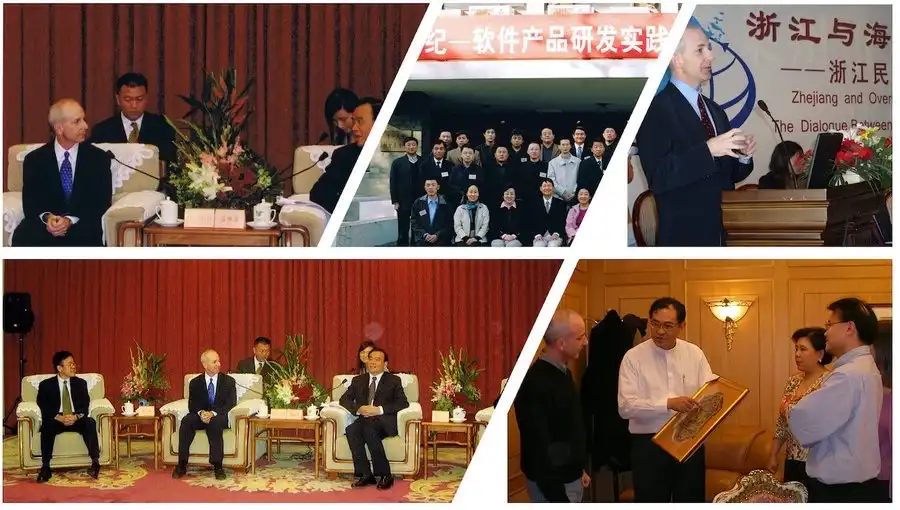
Over the years, I have participated in many events in China related to cooperation and piracy.
Microsoft's first attempt in Asia was to enter the Japanese market in the late 1980s. This was not easy. We faced some technical barriers, such as the absence of a UNICODE standard, a strong local preference for domestic products, and government policies that overtly or covertly favored Japanese companies. In many ways, this was not so different from the "Buy American" policies seen in the United States.
However, through perseverance, respect for local customs, and significant investment in product localization, we eventually succeeded. Japan's deeply rooted respect for intellectual property played a crucial role. By the mid-1990s, Microsoft Office was one of the most profitable businesses in Japan, with both corporate users and ordinary consumers loving the product, the distribution approach we tailored for the Japanese market, and the software experience we provided.
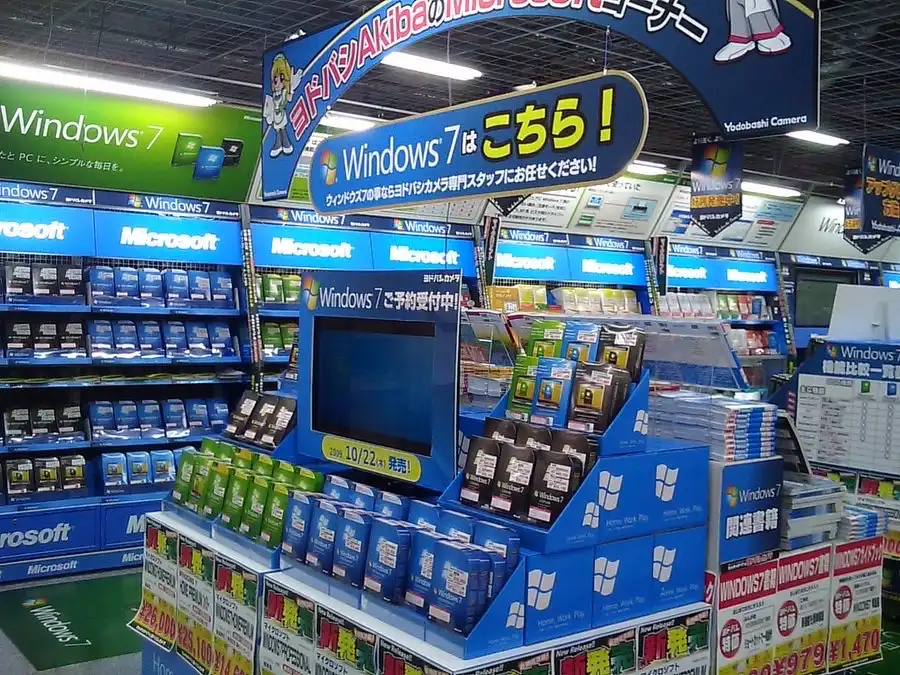
Windows 7 Released in Japan.
However, the situation in China was completely different.
From the beginning, we encountered a series of complex issues. An early version of Windows was even completely banned from sale because some of the localization work was done in Taiwan. And that was just the beginning. We responded sincerely time and time again: we established a large local development team, developed a popular Input Method Editor, built advanced research and development centers, and strictly complied with all regulations for doing business in China—even hiring locals as CCP representatives in our office.
Despite our efforts, we still hit a wall time and time again.
Software piracy was the most obvious and frustrating challenge. Although software piracy is a global issue, the scale in China was shocking. Around 90% of Microsoft products in China were pirated. Imagine, a country with 200 million personal computers, yet the revenue generated was similar to Italy, which has only a quarter of the number of computers and a "mere" 50% piracy rate.
In the past, we often consoled ourselves, believing that while these users were using our products for free now, they would be willing to pay for them in the future because they liked our products, and as soon as the government truly started valuing intellectual property, our revenue would increase.
Take a stroll through those bustling computer markets, and this problem would become even more apparent. There were five or more floors filled with computers—from pre-built systems to DIY kits, everything you could think of. You could choose a system, and they would assemble it for you on the spot.
After assembly, they would give you a software menu, and once you made your selection, you'd soon receive a custom-made CD containing all the software suites you wanted—Windows, Office, Photoshop—along with a serial number in a text file in the root directory, sometimes even throwing in a few pirated movies. The whole package cost only 100 RMB, roughly $12 at the time.
Time and time again, we pled with government officials in meetings. Through countless banquets and numerous toasts with baijiu, we discussed collaboration, innovation, and the value of intellectual property rights. But the response remained consistent: the government always used poverty as an excuse, claiming they couldn't afford genuine software, while they themselves drove around in black Mercedes and indulged in luxurious meals at the high-end Ferrari showroom upstairs.
Eventually, some officials began to express their attitude more openly: "We do not agree with your so-called concept of intellectual property," they told us, "we believe knowledge should be disseminated and shared."
In theory, this is a noble idea—open-source advocates also hold similar views—but in reality, it is merely a rationalization for plagiarizing and reselling our work without any compensation.
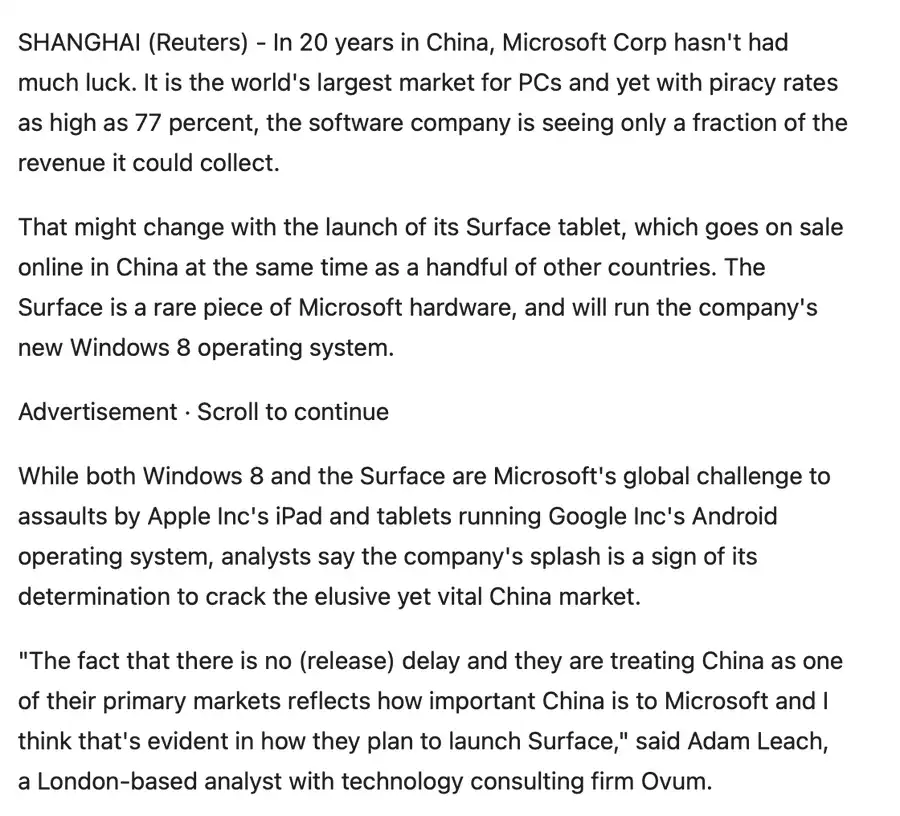
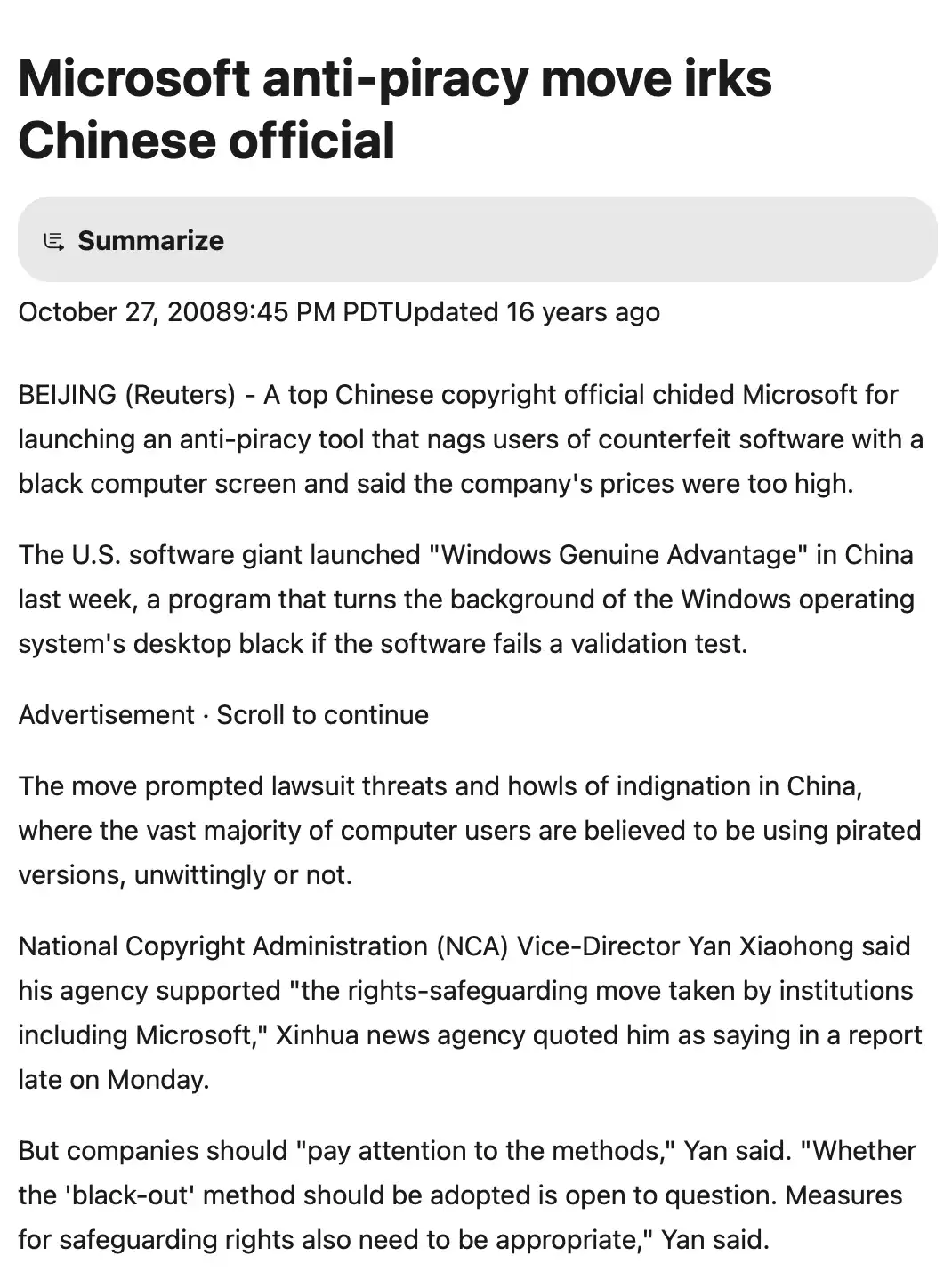
In Windows (later in Office), we gradually introduced more robust "anti-piracy" measures, but we soon found that users simply turned to using older versions of the software that were easier to crack—versions that were not only more easily pirated but also more vulnerable to hacking. We would showcase the design and related plans to the government before release, but still faced strong resistance from them. They told us that our "approach" did not meet market demand—such as a simple registration wizard program.
So you would see, on the airport flight information screens, warnings of "Windows not being registered." The cash registers at my supermarket still ran on Windows XP released a decade ago, simply because they were unwilling to pay for the newer version. PC manufacturers started shipping without pre-installed Windows, even openly claiming that they were doing so to comply with U.S. antitrust laws.
Moreover, the issue is not just limited to software. Companies in various industries in the U.S. and Europe—including pharmaceuticals, fashion, and publishing—all face similar dilemmas. I remember visiting a large pharmaceutical factory on the outskirts of Shanghai. Those in the tech industry may be more familiar with Foxconn and device manufacturers, but the pharmaceutical industry is actually larger in scale. Officials said these factories were producing for Western companies, but everyone knows that some of the products will be resold in the local market, and the enterprises that developed these products would receive no compensation.
Even consumer goods were not immune. Once, while trekking in the rain with my Microsoft China colleagues, I noticed that each of them was wearing the same North Face jacket as me. However, while my clothes remained dry, theirs were already soaked—turns out, they were wearing knockoffs manufactured in the same factory, with an identical logo, but using inferior materials.
I once firmly believed that we could find a successful path in China. I advocated for expanding local R&D, gave speeches everywhere, led teams to expand, and always held hope, believing that we could, like in Japan, eventually achieve difficult but genuine success. However, as time passed, I gradually realized: compromises have no end, and a truly sustainable long-term business model simply does not exist.
We are not alone. Google has exited China, and Meta is nearly completely blocked. Even in this era of cloud computing and subscription software, which are harder to pirate, Microsoft's revenue from China is still less than 1% of its global total revenue. Even Apple — one of the few American success stories in China — faces significant pressure from government intervention and local competition. Automakers like Ford have already retreated from the market, and BMW and Volkswagen's market share is only half of what it was a few years ago.
When it comes to fair trade, people often easily focus on tariffs. Tariffs are visible, quantifiable, and politically convenient. However, in China, tariffs are far from the biggest obstacle. The real challenges are much harder to quantify: soft restrictions, regulatory mazes, cultural differences, and the constantly evolving definitions of fairness and property rights.
Yes, every country has its form of protectionism — including the United States. The relationship between the European Union and U.S. tech companies is also fraught with friction. But over the past few decades, we have found solutions in many regions. Yet, in China, after 25 years of effort, we are still waiting for a substantial breakthrough for the tech industry to operate here.
So, when we discuss international trade, let's not just focus on tariffs. The real story — especially in China — is much more complex and much more important.
猜你喜欢
中本聪也得给财神爷磕一个
风水成了最后的心理防线

代币VS股权,Aave纷争的来龙去脉

12月26日市场关键情报,你错过了多少?

加密圣诞劫:损失超600万美元,Trust Wallet扩展钱包被黑分析

三巨头下注1700万美元,FIN强势入局跨境支付

加密货币当圣诞礼物?Z 世代正在重新权衡

在风险与希望之间:ETH Cali与哥伦比亚以太坊社区
踏进稳定币浪潮六年,他看到的支付未来雏形
超600万美元被盗:Trust Wallet源码遭攻击,官方版本为何成黑客后门?

3天后TGE,Lighter和大户的电话会透露了哪些细节

IOSG创始人: 2025年加密表现「糟糕」,但却是新周期的起点

Uniswap代币销毁理提案通过,海外币圈今天在聊啥?
在 K 线图里算命的币圈人
当算命被画成 K 线并放进币圈语境时,它爆火的原因不在于玄学有多准,而在于交易者对不确定性的集体焦虑终于找到了一个出口。

30份预测,筛出五个2026年的加密共识

中期选举倒计时,美国加密法案能否闯关成功?

世界杯「大考」,如何解读明年的预测市场发展前景?

2025加密「造富榜」:12大赢家,谁押对了宝?

「宏观大师」Raoul Pal谈指数增长下的30倍空间:比特币终将超越黄金
中本聪也得给财神爷磕一个
风水成了最后的心理防线


 App
App