

Web3 New Tale of Two Cities: Stablecoins and Money Market Funds

Original Article Title: Stablecoins and the parallels with Money Market Funds
Original Article Authors: @shawnwlim, @artichokecap Founders
Original Article Translation: zhouzhou, BlockBeats
Editor's Note: The regulatory dispute over stablecoins bears resemblance to the experience of Money Market Funds (MMFs) half a century ago. MMFs were initially designed for corporate cash management but faced criticism due to lack of deposit insurance and vulnerability to runs, impacting bank stability and monetary policy. Nevertheless, MMF assets now exceed $7.2 trillion. The 2008 financial crisis led to the collapse of the Reserve Fund, and in 2023, the SEC is still pushing for MMF regulatory reform. The history of MMFs suggests that stablecoins may face similar regulatory challenges but could ultimately become a crucial part of the financial system.
The following is the original content (slightly edited for readability):
Stablecoins are exciting, and the upcoming stablecoin legislation in the US represents a rare opportunity to upgrade the existing financial system. Those studying financial history will notice parallels between it and the invention and development of Money Market Funds about half a century ago.
Money Market Funds were invented in the 1970s as a cash management solution, primarily for corporates. At that time, US banks were prohibited from paying interest on balances in checking accounts, and corporations were often unable to maintain savings accounts. If a business wanted to earn interest on idle cash, they had to buy US Treasuries, engage in repurchase agreements, invest in commercial paper, or certificates of deposit. Managing cash was a cumbersome and operationally intensive process.
The design of Money Market Funds was to maintain a stable share value, with each share pegged at $1. The Reserve Fund, Inc. was the first MMF. Launched in 1971, it was introduced as "a convenient alternative for investing temporary cash balances," which would typically be placed in money market instruments like Treasuries, commercial paper, bank acceptances, or CDs, with an initial asset size of $1 million.
Other investment giants quickly followed suit: Dreyfus (now part of BNYglobal), Fidelity, Vanguard_Group. In the 1980s, almost half of Vanguard's legendary mutual fund business growth was attributable to its Money Market Fund.

During his tenure as Chairman of the Federal Reserve from 1979 to 1987, Paul Volcker was highly critical of Money Market Funds (MMFs). He continued his criticism of MMFs as late as 2011.
Today, many of the criticisms raised by policymakers against stablecoins echo those from half a century ago against Money Market Funds:
· Systemic Risk and Banking Safety Concerns: MMFs lack deposit insurance and a lender of last resort mechanism, unlike insured banks. Because of this, MMFs are susceptible to rapid runs, which could exacerbate financial instability and lead to contagion. There are also concerns that deposits shifting from insured banks to MMFs could weaken the banking sector as banks lose their low-cost and stable deposit base.
· Unfair Regulatory Arbitrage: MMFs provide bank-like services, maintaining a stable $1 share price, but without rigorous regulatory oversight or capital requirements.
· Weakening of Monetary Policy Transmission Mechanism: MMFs could weaken the Fed's monetary policy tools, as traditional monetary policy instruments like bank reserves are less effective when funds flow from banks to MMFs.
Today, MMFs have financial assets exceeding $7.2 trillion. For reference, M2 (excluding MMF assets) is $21.7 trillion.
In the late 1990s, the rapid growth in MMF assets was a result of financial deregulation (the Gramm-Leach-Bliley Act repealed the Glass-Steagall Act, fueling a wave of financial innovation), while the prosperity of the internet facilitated better electronic and online trading systems, speeding up fund inflows into MMFs.
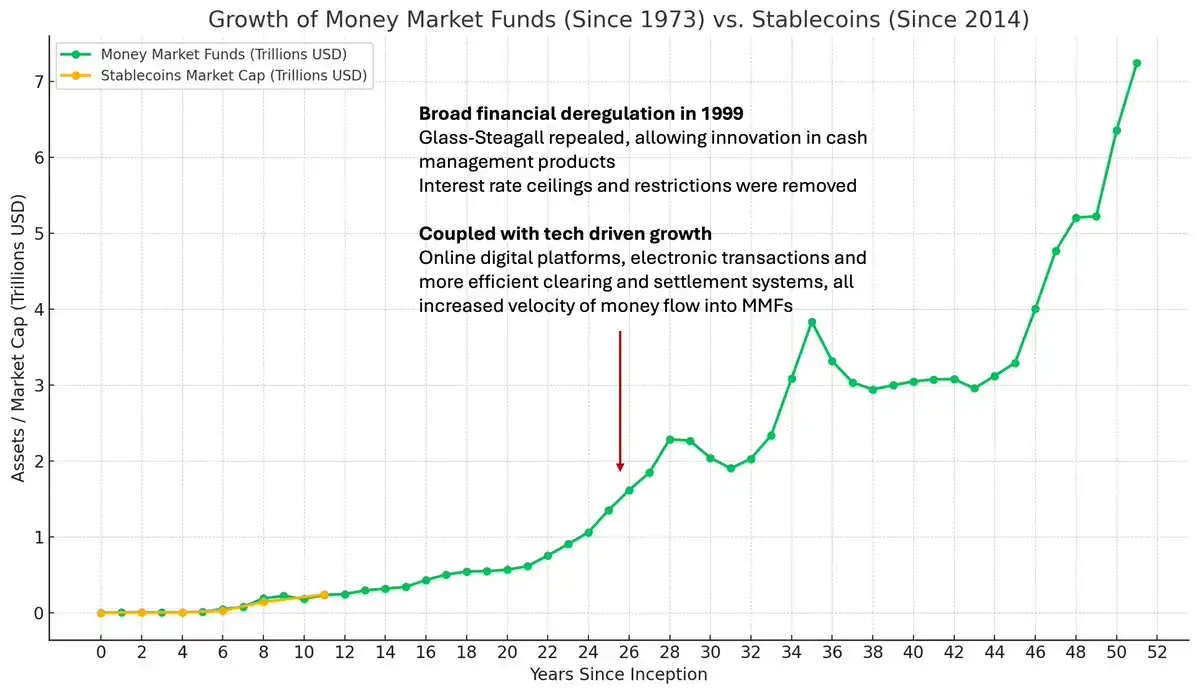
Do you see a pattern here? (I would like to point out that even half a century later, the regulatory struggle around MMFs is far from over. The SEC adopted MMF reforms in 2023, including raising minimum liquidity requirements and removing fund manager restrictions on investor redemptions.)
Unfortunately, the Reserve Fund met its end after the 2008 financial crisis. It held some Lehman Brothers debt securities, which were written down to zero, leading to the fund's breaking of the buck event and significant redemptions.
猜你喜欢

中本聪也得给财神爷磕一个
风水成了最后的心理防线

代币VS股权,Aave纷争的来龙去脉

12月26日市场关键情报,你错过了多少?

加密圣诞劫:损失超600万美元,Trust Wallet扩展钱包被黑分析

三巨头下注1700万美元,FIN强势入局跨境支付

加密货币当圣诞礼物?Z 世代正在重新权衡

在风险与希望之间:ETH Cali与哥伦比亚以太坊社区
踏进稳定币浪潮六年,他看到的支付未来雏形
超600万美元被盗:Trust Wallet源码遭攻击,官方版本为何成黑客后门?

3天后TGE,Lighter和大户的电话会透露了哪些细节

IOSG创始人: 2025年加密表现「糟糕」,但却是新周期的起点

Uniswap代币销毁理提案通过,海外币圈今天在聊啥?

在 K 线图里算命的币圈人
当算命被画成 K 线并放进币圈语境时,它爆火的原因不在于玄学有多准,而在于交易者对不确定性的集体焦虑终于找到了一个出口。

30份预测,筛出五个2026年的加密共识

中期选举倒计时,美国加密法案能否闯关成功?

世界杯「大考」,如何解读明年的预测市场发展前景?

2025加密「造富榜」:12大赢家,谁押对了宝?

「宏观大师」Raoul Pal谈指数增长下的30倍空间:比特币终将超越黄金
中本聪也得给财神爷磕一个
风水成了最后的心理防线


 App
App