

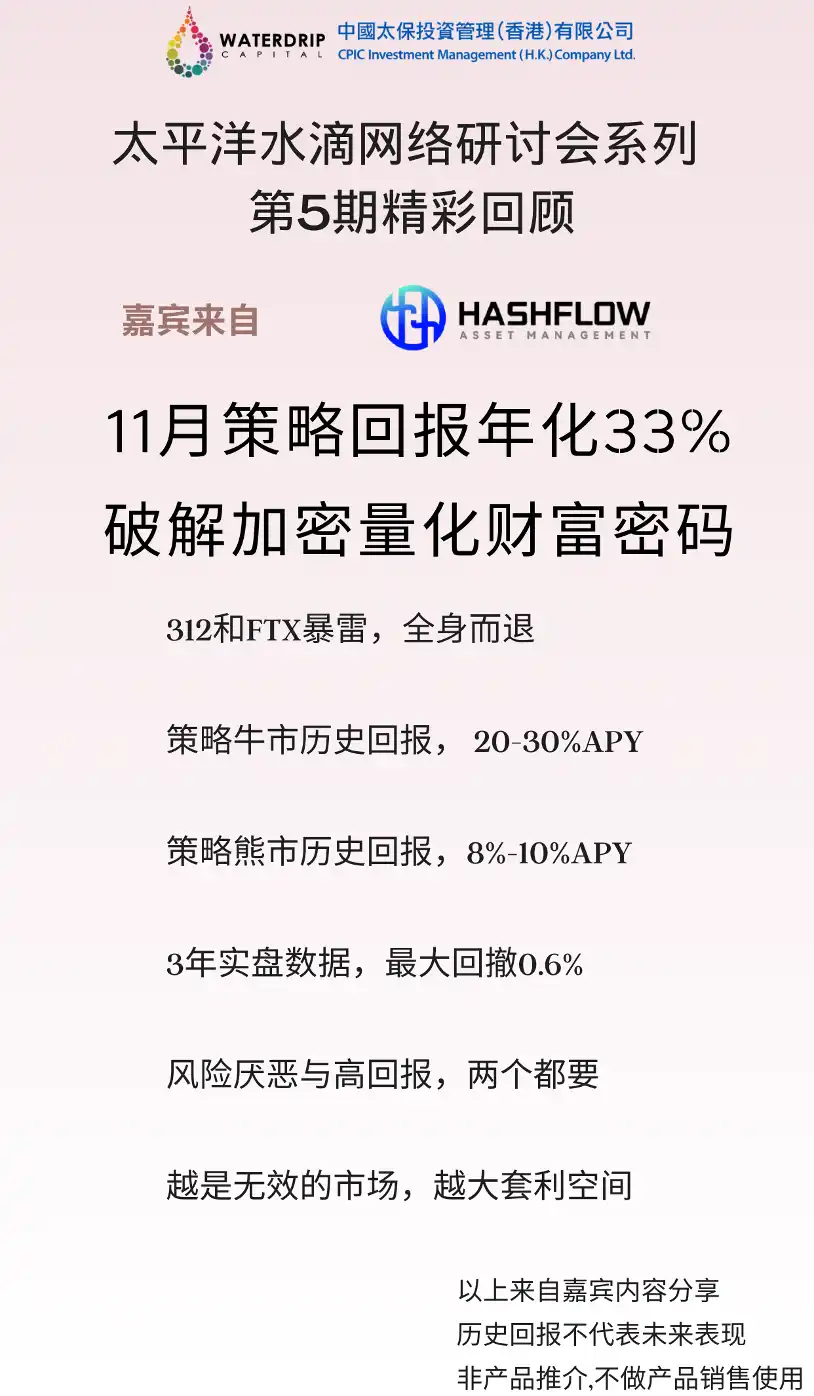
Pacific Water Drop Network Webinar Series Selection: Unlocking the Wealth Code of Cryptographic Quantitative Arbitrage

In the ever-changing cryptocurrency market, quantitative arbitrage strategy has gradually become a sought-after wealth code by investors due to its stability and risk control. In this issue of the webinar, Pacific Droplet has invited two partners, Allen and Leon, from Hashflow Asset Management. The webinar is hosted by Xiaozhou, Executive Director of Taiping Asset Management Hong Kong, to explore the core logic of this strategy and its market potential together with the audience.
Guest Introduction
· Allen: Coming from a traditional finance background, Allen has previously worked extensively in areas such as stocks and futures. In 2018, he transitioned into the cryptocurrency market, pioneering the introduction of traditional market quantitative models into crypto trading. With over six years of digital asset quantitative trading experience, his led crypto asset quant team successfully hedged against crises in both the 2020 3/12 event and the 2022 FTX flash crash.
· Leon: With years of experience in hedge funds and risk management, Leon has previously worked at Citibank and top domestic hedge funds. Since 2018, he has been focusing on quantitative arbitrage strategies in the cryptocurrency market.
· Host: Xiaozhou, currently the Executive Director of Taiping Asset Management Hong Kong, has long been dedicated to the field of fixed income investments.
Exciting Q&A Content
Opening: The Birth and Background of Quantitative Arbitrage Strategy
Xiaozhou: Allen and Leon, both of you were originally senior professionals in the traditional finance field. What prompted you to enter the cryptocurrency market and make quantitative arbitrage your main focus?
Allen: "In traditional finance, algorithmic trading is already very mature. However, when we entered the cryptocurrency market in 2018, we found that the market's volatility, retail investor proportion, and overall immaturity were very suitable for the application of quantitative strategies. The cryptocurrency market's unique mechanisms, such as perpetual contracts and funding rates, also brought us brand-new arbitrage opportunities."
Leon: "At that time, we saw many trading mechanisms in the crypto market similar to the traditional market, but due to lower liquidity and insufficient market participant expertise, quantitative arbitrage had significant room. Coupled with our team's deep experience in algorithmic trading, we quickly identified opportunities."
Question 1: Please provide a specific introduction to the operational logic and revenue source of quant arbitrage?
Allen: "The essence of quant arbitrage is to profit from the spread between spot and perpetual contracts. We buy spot and simultaneously short perpetual contracts. Since holding a long position in perpetual contracts incurs funding rates, this cost ultimately becomes the arbitrageur's source of income."
Leon: "The core advantage of this strategy is that through the hedge between spot and futures, we can achieve market neutrality. Regardless of whether the market is up or down, the portfolio will not be affected by price fluctuations."
Key Points Summary:
· Funding Rate: Settled every 8 hours, with an annualized return of 20%-30% in a bull market and still maintaining 8%-10% in a bear market.
· Risk Neutrality: Hedging between spot and futures ensures stable returns, avoiding market volatility.
Question 2: With high market volatility and complexity in operations, how does quant arbitrage ensure long-term stability?
Allen: "We utilize a unified margin account, integrating fund management between spot and futures to avoid cross-account fund risks. Additionally, we rely on the deep liquidity of blue-chip coins (such as BTC, ETH) for fundamental security."
Leon: "Furthermore, our dynamic rotation mechanism is another key point. We monitor funding rates of all mainstream coins daily and adjust the portfolio based on returns and risks to maximize profits and minimize risks."
Key Points Summary:
· Unified Margin Account: Simplifying fund flow, reducing settlement risks.
· Dynamic Rotation: Real-time allocation adjustments to optimize returns and risks.
Question 3: If the market spread suddenly widens or funding rates turn negative, how do you deal with these potential risks?
Allen: "When the spread widens, we will timely reduce positions or reconfigure based on real-time monitored retracement data. Additionally, the deep liquidity of blue-chip coins ensures that the spread quickly reverts."
Leon: "As for negative funding rate, we have established a strict stop-loss mechanism. If a certain asset experiences a negative funding rate for 5 consecutive days, we will remove it from the portfolio."
Key Takeaways:
· Risk Management: Reduce position, rebalance, or lower leverage.
· Stop-Loss Mechanism: Asset removed if negative funding rate persists for more than 5 days.
Question 4: For some investors, holding BTC directly may seem more attractive. So why choose quantitative arbitrage?
Leon: "The returns from holding the asset directly are entirely dependent on market price fluctuations, posing high risks. Quantitative arbitrage, on the other hand, offers a low-risk, stable return option. For risk-averse investors, this balance is crucial."
Allen: "For portfolio management, we also recommend combining asset holding with quantitative arbitrage to achieve enhanced returns. Holding assets captures upside potential, while arbitrage strategies mitigate volatility risks."
Key Takeaways:
· Low-Risk Stability: Suitable for risk-averse investors.
· Portfolio Advantage: Combination of asset holding and arbitrage for enhanced returns.
Question 5: How long can the cryptocurrency market's bull run last? How long can the high-yield phase of arbitrage strategies be sustained?
Allen: "Based on historical cycles, the cryptocurrency market experiences a halving event approximately every four years. We anticipate that the high-yield phase of the bull market may continue for the next 6 months, until the market enters the early stages of a bear market."
Leon: "Even in a bear market, quantitative arbitrage remains a preferred strategy. Through precise management and diversified asset allocation, we can continue to maintain low drawdowns and stable returns."
Key Takeaways:
· Bull Market Phase: High-yield period expected to last 6 months.
· Bear Market Advantage: Strategy has a small drawdown and can still provide steady returns.
Question 6: Many viewers are interested in the specific operation of quantitative arbitrage, such as what the actual process would be with $1 million?
Allen: "We would use spot and perpetual contracts for arbitrage. For example, $1 million can be used to buy $2 million worth of spot and simultaneously short an equivalent amount of perpetual contracts. This involves moderate leverage, usually kept within two times. This operation ensures that the profit comes from funding rates rather than market fluctuations."
Leon: "Furthermore, current trading platforms support unified margin accounts, which greatly simplifies the operational process. In the past, we needed to constantly rebalance between spot and contract accounts, but now all operations can be completed within the same account, reducing fund transfer risk and improving efficiency."
Key Points Summary:
· Leverage Control: Moderate leverage amplifies profits while reducing risk.
· Unified Account: Simplifies operational processes, reducing fund flow risks.
Question 7: Quantitative arbitrage seems to have low drawdown but still carries risks. Could you explain in detail what potential risks there are and how to manage these risks?
Allen: "Main risks include:
· Spread Fluctuation: The spread at the time of establishing a position may widen in the short term, leading to unrealized losses.
· Negative Funding Rate: Although the funding rate is mostly positive in the long term, it can also turn negative in the short term."
To counter these risks, we have established strict stop-loss rules. If a currency has a negative funding rate for 5 consecutive days, we will remove it from the portfolio. Additionally, through multi-currency allocation, we have reduced the impact of single currency volatility."
Leon: "The recovery of drawdown mainly depends on two points:
· Spread Reversion: Market spreads will eventually return to normal ranges."
· Funding Rate Recovery: Long-term positive returns will gradually offset short-term negative returns.
Key Points Summary:
· Spread Volatility and Negative Funding Rate: Main sources of risk, but effectively controlled through multi-currency allocation and strict stop-loss.
· Drawdown Recovery Mechanism: Relies on spread regression and funding rate recovery.
Question 8: In extreme market conditions, such as sudden large price swings, how does quantitative arbitrage respond?
Leon: "We have taken various measures:
· Position Diversification: The allocation of a single currency does not exceed 5%.
· Dynamic Rebalancing: When the spread widens, positions are reduced to lower risk. If the spread is deemed to be at its limit, we will add to the position in the opposite direction to capture gains."
Allen: "The team's technology and processes are also crucial. For example, during the 3/12 Event (March 12, 2020), many trading platforms experienced downtime, but our system was able to issue alerts promptly and quickly increase positions after system recovery, ultimately profiting."
Key Points Summary:
· Diversified Allocation: Reducing single currency risk.
· Technical Safeguards: Addressing extreme events through alerts and rapid response systems.
Question 9: How does the performance of quantitative arbitrage differ in a bull market versus a bear market? Is there a significant difference in returns?
Allen: "In a bull market, funding rates are higher, and arbitrage returns are usually between 20%-30% annualized. In a bear market, funding rates decrease, and annualized returns are around 8%-10%. Even in a bear market, arbitrage strategies can still provide steady returns because risks and volatility have been hedged."
Leon: "In a bear market, we pay more attention to funding rate rotation, ensuring maximum returns by selecting the optimal currency. For example, in past bear markets, through optimized currency allocation, we kept the overall drawdown to less than 0.6%."
Key Points Summary:
· Bull Market Returns: Up to 30%.
· Bear Market Returns: Approximately 8%-10%, very low risk.
Question 10: I understand that a quantitative arbitrage strategy is somewhat like a cash management enhancement tool in traditional finance. Is it more suitable to switch from traditional bonds or money market funds to this strategy rather than directly engaging in high-risk assets?
Allen: "Your understanding is very accurate! The characteristic of a quantitative arbitrage strategy is stable low risk. It is more like an upgraded version of a cash management tool. Compared to bonds or money market funds, our annualized returns are higher, while the risk remains at an extremely low level."
Leon: "Indeed. For the conservative portion of asset allocation, quantitative arbitrage is a very ideal choice. Especially for institutional investors or high-net-worth clients, traditional cash management tools have lower yields in the current interest rate environment, while our strategy can achieve a significant enhancement."
Key Points Summary:
· Cash Management Tool Upgrade: Higher returns, very low risk.
· Asset Allocation Recommendation: Suitable for investors transitioning from bonds or money market funds.
Question 11: If the spot price continues to rise and we short perpetual swaps, will our returns be affected due to high funding rates?
Allen: "That's a very good question. In a unified account, the P&L of spot and perpetual swaps is calculated together. Even if the funding rate rises, our returns mainly come from spread fluctuations and positive funding rate income. Additionally, our system will automatically adjust margin to ensure the stability of the overall position and avoid one-sided risk."
Leon: "The advantage of a unified account structure is that it can manage the assets of spot and contracts together, reducing liquidity issues and margin top-ups, while ensuring the stability of the overall strategy."
Key Points Summary:
· Unified Account: Comprehensive calculation of PnL to ensure overall revenue.
· Funding Rate Risk Management: Revenue mainly comes from spreads and positive funding rates.
Question 12: In an extreme market environment, such as the 3·12 Event in 2020, how does quantitative arbitrage respond?
Leon: "In extreme events like 3·12, we immediately reduce our position to ensure risk control. At the same time, our technical systems will alert us quickly to help adjust our strategy. Additionally, we focus on trading in large-cap coins with high liquidity, such as BTC and ETH, to avoid losses due to insufficient liquidity in small-cap coins."
Allen: "Such extreme volatility may also present opportunities for us. For example, post-market recovery, by quickly increasing our position to capture spread income, we achieved excess returns after the 3·12 event." Extreme market volatility is both a challenge and an opportunity for us.
Key Takeaways:
· Risk Control: Timely position reduction, focus on large-cap coins.
· Technical Support: Alert system and rapid adjustment mechanism.
The above is the full content of this seminar. We invite you to continue following the Pacific Water Drop Network Webinar.
This article is contributed content and does not represent the views of BlockBeats.
猜你喜歡

Telegram 2025財報謎題:營收猛漲65%,卻被TON拖累出2億虧損?

朝鮮駭客在「肥年」期間活躍:2025年盜竊創紀錄,洗錢周期約為45天

加密與人工智能:仙遊隱藏的數字灰色市場
加密和人工智能: 你可以在先玉買入任何東西。

鏈上固定利率借貸為何難成氣候?「利差」交易才是出路

2026 年初加密市場的驅動因素: 市場波動、人工智能交易和ETF流量?
想像一下,一天內檢查比特幣和以太坊的價格——一分鐘上漲5%,下一分鐘下跌4%。 銳利的動作,快速的反轉,以及對2026年首周的宏觀信號的敏感度。 在經歷了年初的反彈後,隨著市場圍繞美國貨幣政策和機構資金流動重新調整預期,這兩筆資產均出現回調。 對於交易者——包括那些依賴人工智慧或自動化系統的交易者——這一時期提供了一個生動的提醒:大量的信號並不能保證清晰。 在執行中保持紀律性往往是真正的挑戰任務。

全美首個州政府背書穩定幣 FRNT:能拯救能源衰退中的懷俄明嗎?

Zcash核心團隊出走始末,幣圈版OpenAI戲碼

Kinetiq 獨家專訪:從HYPE的LST協議到「交易所工廠」

Glassnode開年研報:9.5萬美元看漲期權溢價,多頭轉向積極進攻

WEEX 全球人工智能交易黑客馬拉松開賽: 188萬美元獎池助力下一代人工智能交易冠軍
WEEX Labs是全球領先的加密交易所WEEX的創新分支,服務於150多個國家的620多萬用戶,即將啟動其旗艦全球人工智能交易黑客馬拉松的初賽: WEEX Alpha Awakens,2026年一月月12日。 在包括亞馬遜網絡服務(AWS)在內的世界級贊助商的大力支持下,總獎池從88萬美元激增到前所未有的188萬美元,將AI戰爭定位為加密行業最大的AI交易黑客。 在排行榜的頂部等待著一個非凡的冠軍獎——一輛賓利賓泰嘉S,已經在迪拜待命,準備由最終的人工智能交易勝利者來領獎。

Base貢獻七成收入僅付2.5%租金,Superchain或進入「分家」倒計時

ZCash 團隊分裂、美銀上調 Coinbase 評級,海外幣圈今天在聊啥?
12月交易平台排行榜:CEX與DEX同步走弱,鏈上永續合約交易量下滑30%

2025年預測市場複盤:總交易額超500億美元,雙巨頭市場佔有率超97.5%

1月9日關鍵市場資訊差,一定要看!|Alpha早報

懷俄明州推出 FRNT 穩定幣 — 美國首個州支持的穩定幣上市
懷俄明州發行了美國首個由州支持的法幣穩定幣FRNT。 FRNT的利息收益專項用於支持懷俄明州的教育,提供多樣化的公共資金來源。 該穩定幣已發布到七個主要區塊鏈中,展示了其多鏈運作能力。 懷俄明的策略重點在於推動公眾支付中的穩定幣應用,以降低傳統支付成本。 WEEX Crypto News, 2026-01-08 12:50:50 引言 懷俄明州近來在加密貨幣領域引起了巨大的關注,隨著該州推出其名為FRNT的穩定幣,成為美國首個發行法幣支持穩定幣的州。多年來的立法工作及監管障礙的克服,終於讓這一歷史性舉措成為現實。FRNT的推出不僅僅是政策實驗的終結,更是美元上鏈的創新開始,這對全球的金融市場都具有指標意義。 FRNT 穩定幣開始市場交易 懷俄明州州長馬克·戈登宣布FRNT立即可供市民選擇使用,使其成為美國第一個由公共機構發行的完全準備金、法幣支持的穩定幣。FRNT的發行是在懷俄明穩定幣法案的框架下進行的,由州穩定幣委員會監管。而該委員會成立於2023年3月,旨在研究州支持的數字美元能否在現有法律和財政框架內運行。這一全新的嘗試使得FRNT為迅速增長的3000億美元穩定幣市場注入了新的活力。 FRNT的持有資產全部由美元和短期美國國債作為準備金支持,並且根據懷俄明法律需維持2%的超額擔保。這些資產由Franklin Advisers管理,The Network Firm則負責月度審計及確認。而從這些資產中產生的利息收入將直接用於懷俄明州的教育資金系統,這不僅為公共服務創造了一種新的收入模式,也將資金的使用從致力於盈利轉向了公共利益。…

Ondo Finance 價格預測:2026年1月12日 ONDO 預估跌至 $0.331411
關鍵要點 Onto Finance 預估在未來五天內下跌22.89%,預估價位將達到 $0.331411。 市場情緒目前表現為看跌,恐懼與貪婪指數顯示為42,代表投資者情緒偏向恐懼。 近期30天內,Ondo Finance 走勢呈現負面趨勢,已損失10.64%。 技術分析顯示,Ondo Finance 關鍵支撐位為 $0.438576、$0.419397 和 $0.403551,而關鍵阻力位則為 $0.473600、$0.489447 和 $0.508625。…

Solana價格預測:摩根士丹利申請SOL ETF——這是否是華爾街下個加密熱潮的開始?
關鍵要點 摩根士丹利申請SOL ETF,表明大型機構對加密貨幣的興趣逐漸增加。 Solana的ETF吸引了大量資金流入,顯示其市場潛力和投資者的高度關注。 Solana的價格目標被設定在230美元,因為市場正處於正向動能的推動下。 Bitcoin Hyper利用Solana的平台,旨在提升比特幣的去中心化金融生態系統。 WEEX Crypto News, 2026-01-08 12:50:49 在全球金融市場上,摩根士丹利此舉無疑是在加密貨幣領域投下一顆重磅炸彈。這家位於美國的主要金融機構宣布,將推出與Solana相關的交易所交易基金(ETF),這一決定引發了人們對Solana價格預測的熱議。這是否意味著華爾街對於加密貨幣的胃口擴大,甚至預示著一場新的投資熱潮? Solana ETF的吸引力 在摩根士丹利宣布推出SOL ETF後,加密貨幣市場對Solana的信任顯著增加。這一行動明確展示了大型機構對於除比特幣之外的加密資產的濃厚興趣。特別值得注意的是,Solana ETF已經在短短六個月內吸引了逾8.01億美元的資金流入,彰顯了市場對Solana生態系統的認同與期待。…
Telegram 2025財報謎題:營收猛漲65%,卻被TON拖累出2億虧損?
朝鮮駭客在「肥年」期間活躍:2025年盜竊創紀錄,洗錢周期約為45天
加密與人工智能:仙遊隱藏的數字灰色市場
加密和人工智能: 你可以在先玉買入任何東西。
鏈上固定利率借貸為何難成氣候?「利差」交易才是出路
2026 年初加密市場的驅動因素: 市場波動、人工智能交易和ETF流量?
想像一下,一天內檢查比特幣和以太坊的價格——一分鐘上漲5%,下一分鐘下跌4%。 銳利的動作,快速的反轉,以及對2026年首周的宏觀信號的敏感度。 在經歷了年初的反彈後,隨著市場圍繞美國貨幣政策和機構資金流動重新調整預期,這兩筆資產均出現回調。 對於交易者——包括那些依賴人工智慧或自動化系統的交易者——這一時期提供了一個生動的提醒:大量的信號並不能保證清晰。 在執行中保持紀律性往往是真正的挑戰任務。


 App
App