

Vitalik's Vision for the Ideal Wallet: A Comprehensive Upgrade from Cross-chain Experience to Privacy Protection

Original Title: What I would love to see in a wallet
Original Author: Vitalik Buterin
Original Translation: DeepTech Techflow
Special thanks to Liraz Siri, Yoav Weiss, and the feedback and review from ImToken, Metamask, and OKX developers.
A key layer of the Ethereum infrastructure stack is the wallet, but it is often underestimated by core L1 researchers and developers. The wallet is the window between users and the Ethereum world, where users can only benefit from any decentralization, censorship resistance, security, privacy, or other properties provided by Ethereum and its applications if the wallet itself also possesses these properties.
Recently, we have seen Ethereum wallets make significant progress in improving user experience, security, and functionality. The purpose of this article is to provide my own views on some of the features an ideal Ethereum wallet should have. This is not an exhaustive list; it reflects my cypherpunk bias, which focuses on security and privacy, and it is almost certain that it is incomplete in terms of user experience. However, I believe a wishlist is more valuable in focusing on security and privacy attributes as optimizing for user experience can be more effective simply by deploying and iterating based on feedback.
User Experience for Cross-Layer-2 Transactions
There is now an increasingly detailed roadmap to improve the user experience for cross-Layer-2, with a short-term and long-term part. Here, I will discuss the short-term part: ideas that could theoretically still be implemented today.
The core idea is (i) built-in cross-Layer-2 sending, and (ii) chain-specific addresses and payment requests. Your wallet should be able to provide you with an address (following the style of this ERC draft) like this:

When someone (or some applications) provides you with an address in this format, you should be able to paste it into the wallet's "recipient" field and then click "send." The wallet should automatically handle the sent data in any way possible:
· If you already have enough of the required type of token on the target chain, send the token directly
· If you have the required type of token on another chain (or multiple other chains), use protocols like ERC-7683 to send the tokens (which is essentially a cross-chain DEX)
· If you have different types of tokens on the same chain or on another chain, use a decentralized exchange to convert them to the correct type of currency on the correct chain and send it. This should require the user's explicit permission: the user will see how much they are paying in fees and how much the recipient is receiving.
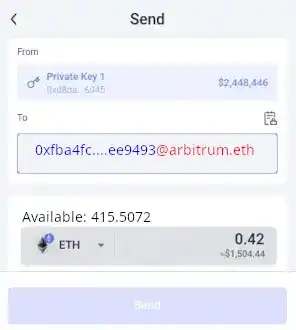
A model of a wallet interface that supports cross-chain addresses
The above content applies to the use case of "someone pays you after you copy-paste an address (or ENS, e.g., [email protected])." If a dapp requests a deposit (e.g., see this Polymarket example), the ideal process would be to extend the web3 API and allow the dapp to make chain-specific payment requests. Then, your wallet will be able to fulfill that request in any way necessary. To provide a good user experience, standardization of the getAvailableBalance request is also needed, and wallets need to carefully consider on which chains to default users' assets for the highest security and transfer convenience.
Chain-specific payment requests can also be embedded in a QR code, which can be scanned by a mobile wallet. In face-to-face (or online) consumer payment scenarios, the receiver will issue a QR code or a web3 API call indicating "I want X units of token Y Z on this chain, with reference ID or callback W," and the wallet can freely fulfill that request in any way. Another option is the claim link protocol, where a user's wallet generates a QR code or URL containing a claim authorization to retrieve a certain amount of funds from their on-chain contract, and the receiver's task is to figure out how to move these funds to their own wallet.
Another related topic is gas payment. If you receive assets on an L2 without ETH and need to send a transaction on that L2, the wallet should be able to automatically use a protocol (e.g., RIP-7755) to pay the on-chain Gas where you have ETH. If the wallet expects you to do more transactions on L2 in the future, it should also only use a DEX to send, for example. ETH worth millions of Gas, so that future transactions can spend Gas directly there (as it's cheaper).
Account Security
One way I conceptualize the challenge of account security is that a good wallet should serve two purposes simultaneously: (i) protecting users from wallet developers' hacks or malicious attacks and (ii) protecting users from their own missteps.
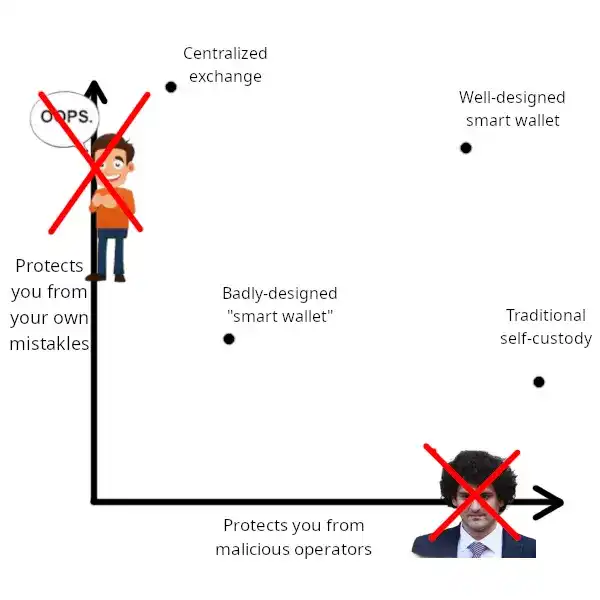
The "missteps" on the left are unintentional. However, when I saw it, I realized it fit the context very well, so I decided to keep it.
My preferred solution to this, for over a decade, has always been social recovery and multi-signature wallets with hierarchical access control. Users' accounts have two layers of keys: a master key and N guardians (e.g., N = 5). The master key is capable of low-value and non-financial operations. Most guardians need to perform either (i) high-value operations, such as sending all funds in the account, or (ii) changing the master key or any guardian. If needed, the master key can be allowed to perform high-value operations via a time lock.
The above is a basic design that can be expanded. Session keys and permission mechanisms like ERC-7715 can help support different balances between convenience and security for various applications. More intricate guardian structures, such as having multiple time-locked durations at different thresholds, can help maximize the chance of successfully recovering a legitimate account while minimizing the risk of theft.
The above is a basic design that can be expanded. Session keys and permission mechanisms like ERC-7715 can help support different balances between convenience and security for various applications. More intricate guardian structures, such as having multiple time-locked durations at different thresholds, can help maximize the chance of successfully recovering a legitimate account while minimizing the risk of theft.
Who or What Should Guardians Be?
For experienced cryptocurrency users in the community of experienced crypto users, a viable option is your friends and family's keys. If you request each person to provide you with a new address, then nobody needs to know who they are - in fact, your guardians don't even need to know each other. The likelihood of collusion is low as long as they do not gossip to you. However, this option might not be available for most new users.
The second option is institutional guardians: companies that provide services where they only sign transactions upon receiving additional confirmation information from you, e.g., confirmation codes, or video calls for high-value users. People have long tried to create these, e.g., I gave an introduction to CryptoCorp in 2013. However, so far, these companies have not been very successful.
The third option is multiple personal devices (such as phone, desktop, hardware wallet). This can work, but it is also challenging to set up and manage for inexperienced users. There is also a risk of multiple devices being lost or stolen, especially when they are in the same location.
Recently, we have started to see more universal key-based solutions. The keys can only be backed up on your devices, making it a personal device solution, or they can be backed up in the cloud, relying on a complex mix of password security, institutional and trusted hardware assumptions for security. In fact, keys are a valuable security gain for the average user, but relying solely on them is not enough to protect a user's life savings.
Fortunately, with ZK-SNARKs, we also have a fourth option: ZK-wrapped centralized ID. Examples of this type include zk-email, Anon Aadhaar, Myna Wallet, and more. Essentially, you can take various forms of centralized ID (corporate or governmental) and convert them into Ethereum addresses that can only be transacted by generating a proof of owning the centralized ID with ZK-SNARKs.
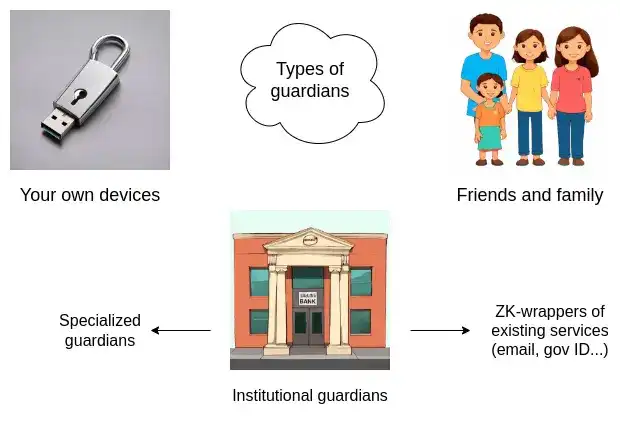
With this addition, we now have a wide range of options, and ZK-wrapped centralized IDs have a unique "user-friendliness" aspect.
To achieve this, it needs to be done through a simplified and integrated UI: you should be able to simply specify that you want "[email protected]" as a guardian, and it should automatically generate the corresponding zk-email Ethereum address under the hood. Advanced users should be able to input their email (and possibly a privacy salt stored in that email) into an open-source third-party app and confirm that the generated address is correct. This should be the case for any other supported guardian types as well.
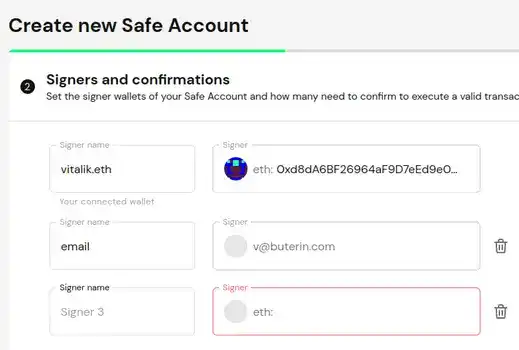
It is important to note that a practical challenge zk-email faces today is its reliance on DKIM signatures, which rotates keys every few months and these keys are not signed by any other authority. This means that zk-email today has a degree of trust requirement beyond the provider itself; if zk-email uses TLSNotary in trusted hardware to verify updated keys, it can mitigate this, but it's not ideal. Ideally, email providers should start signing their DKIM keys directly. Today, I would recommend a guardian to use zk-email, but I would not recommend it for most guardians: do not store funds in zk-email as compromise means you cannot access your funds.
New User and In-App Wallet
New users typically do not want to enter a large number of guardians during their initial registration. Therefore, the wallet should provide them with a very simple option. One natural approach is to use zk-email on their email address, a key stored locally on the user's device (potentially a universal key), and a backup key held by the provider, in a 2-of-3 setup. As users gain more experience or accumulate more assets, they should be prompted at certain points to add more guardians.
Wallet integration into the application is inevitable as apps trying to onboard non-crypto users do not want users to download two new apps at once (the app itself plus an Ethereum wallet), leading to a confusing user experience. However, users of many in-app wallets should be able to link all their wallets together so they only have to worry about one "access control issue." The simplest way is to adopt a layered scheme where there is a quick "linking" process that allows users to set their main wallet as the guardian of all in-app wallets. The Farcaster client Warpcast already supports this:
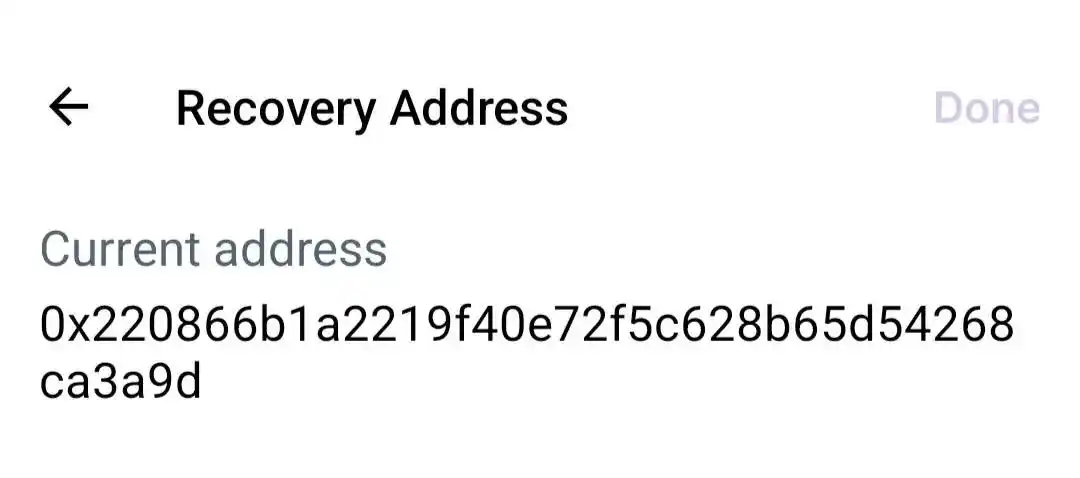
By default, your Warpcast account recovery is controlled by the Warpcast team. However, you can "claim" your Farcaster account and change the recovery to your own address.
Protecting Users from Scams and Other External Threats
In addition to account security, today's wallets have also put in a lot of work to identify fake addresses, phishing, scams, and other external threats, and strive to protect users from such threats. At the same time, many safeguards are still quite primitive: for example, requiring a click to send ETH or other tokens to any new address, whether you are sending $100 or $100,000. There is no one-size-fits-all solution here. It is a series of slow, continuous fixes and improvements targeting different threat categories. However, there is a lot of value in continuing to improve in this area.
Privacy
It is now time to take Ethereum's privacy more seriously. ZK-SNARK technology is now very advanced, privacy technologies that do not rely on backdoors to reduce regulatory risk (such as privacy pools) are becoming more mature, and second-layer infrastructures like Waku and ERC-4337 mempools are slowly becoming more stable. However, to date, conducting private transfers on Ethereum requires users to explicitly download and use a "privacy wallet," such as Railway (or Umbra for stealth addresses). This adds great inconvenience and reduces the number of people willing to transact privately. The solution is that private transfers need to be integrated directly into wallets.
A simple implementation is as follows. The wallet can store a portion of the user's assets as a "private balance" in a privacy pool. When a user initiates a transfer, they will first automatically exit the privacy pool. If the user needs to receive funds, the wallet can generate an invisible address.
In addition, the wallet can automatically generate a new address for each application the user interacts with (e.g., a DeFi protocol). Deposits will come from the privacy pool, and withdrawals will go directly into the privacy pool. This allows the user's activity in one application to be unlinkable from their activity in another application.
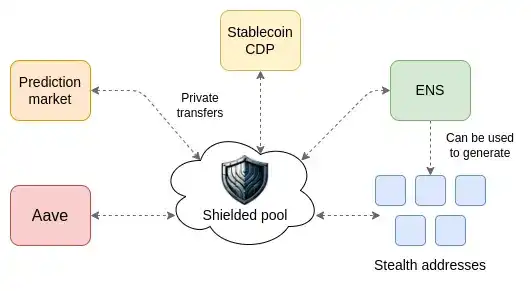
One advantage of this technology is that it not only serves as a natural pathway for preserving privacy in asset transfers but also as a natural pathway for preserving privacy in identity. Identity has already happened on-chain: any application using identity proof gating (e.g., Gitcoin Grants), any token-gated chat, Ethereum followings protocols, and so on are all on-chain identities. We want this ecosystem to preserve privacy as well. This means that a user's on-chain activity should not be aggregated in one place: each project should store separately, and the user's wallet should be the only thing with a "global view" that can simultaneously see all your proofs. A native ecosystem where each user has multiple accounts helps achieve this goal, as do off-chain proof protocols like EAS and Zupass.
This represents a pragmatic vision for Ethereum privacy in the midterm. While some features could be introduced on L1 and L2 to make privacy-preserving transactions more efficient and reliable, it can be achieved now. Some privacy advocates argue that the only acceptable thing is complete privacy for everything: encrypting the entire EVM. I think that might be the ideal long-term outcome, but it requires a more fundamental rethink of the programming model and is not yet mature enough to be deployed on Ethereum. We do need default privacy to obtain a large enough set of anonymity. However, focusing first on (i) transfers between accounts and (ii) identity and identity-related use cases (such as private proofs) is a practical first step, easier to achieve, and wallets can start using now.
Ethereum Wallets Also Need to Become Data Wallets
One consequence of any effective privacy solution is the need for users to store off-chain data, whether for payments, identity, or other use cases. This is evident in Tornado Cash, which requires users to hold a "note" representing a deposit of 0.1-100 ETH. More modern privacy protocols sometimes store encrypted data on-chain and decrypt it using a single private key. This is risky because if the key is leaked, or if quantum computers become feasible, the data becomes entirely public. Off-chain proof protocols like EAS and Zupass highlight the need for off-chain data storage.
A wallet not only needs to be software that stores on-chain access privileges but also software that stores your private data. The non-crypto world is also increasingly recognizing this, e.g., please refer to Tim Berners-Lee's recent work on personal data stores. All the issues we need to address regarding robustly ensuring access control, we also need to address regarding robustly ensuring data accessibility and non-leakage. Perhaps these solutions can be combined: if you have N guardians, use M-of-N secret sharing among these N guardians to store your data. Data is inherently harder to protect because you cannot revoke someone's data share, but we should propose as secure a decentralized hosting solution as possible.
Secure Chain Access
Today, wallets trust their RPC providers to inform them of any information about the chain. This is a vulnerability that has two aspects:
1. RPC providers may try to steal funds by providing them with false information, e.g., about market prices.
2. RPC providers can extract private information about the application the user is interacting with and other accounts.
Ideally, we want to plug both of these vulnerabilities. To address the first issue, we need standardized light clients for L1 and L2 that can directly validate blockchain consensus. Helios has done this for L1 and has been doing some groundwork to support some specific L2s. To properly cover all L2s, we need a standard, through which the configuration smart contract representing L2 (also used for chain-specific addresses) can declare a function that might include logic for getting the latest state root and verifying proofs formatted similarly to ERC-3668 and receipts against these state roots. This way, we can have a universal light client that allows wallets to securely verify any state or event on L1 and L2.
For privacy, the only realistic approach today is to run your full node. However, now L2s are entering the picture, running full nodes for everything is becoming increasingly difficult. The equivalent of a light client here is private information retrieval (PIR). PIR involves servers that hold all copies of the data and clients that send encrypted requests to the servers. The servers perform computations on all the data, return the required data to the client, and encrypt it to the client's key without revealing to the server which data the client accessed.
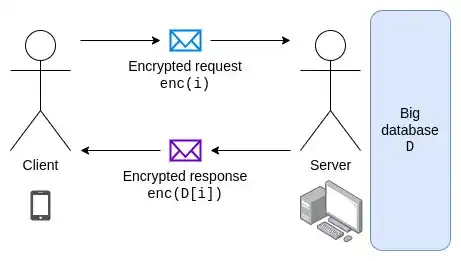
In order to maintain server honesty, each individual database project is a Merkle tree itself, allowing clients to verify them using a light client.
PIR (Private Information Retrieval) involves a very large amount of computation. There are several approaches to solving this problem:
· Brute Force: Improvements in algorithms or specialized hardware may make PIR run fast enough. These techniques may rely on precomputation: the server can store encrypted and shuffled data for each client, which the client can then query. The main challenge in the Ethereum environment is to adapt these techniques to rapidly changing datasets (similar to countries). This makes real-time computation costs lower but likely increases overall computation and storage costs.
· Relaxing Privacy Requirements: For example, limiting each lookup to only have 1 million 'mixins' so that the server knows a million possible values the client can access but not any finer granularity.
· Multi-Server PIR: If you use multiple servers and assume 1-of-N honesty between these servers, the PIR algorithm is usually faster.
· Anonymity Over Confidentiality: Requests can be sent through a mix network to hide the sender of the request rather than the content of the request. However, doing this effectively inevitably adds latency, worsening the user experience.
Identifying the right combination of technologies in the Ethereum environment to maximize privacy while maintaining usability is an open research problem, and I welcome cryptographers to attempt to do so.
Ideal Key Management Wallet
Aside from transaction and state access, another key workflow that needs to work seamlessly across L2 contexts is changing an account's verification configuration: whether changing its keys (e.g., recovery) or making deeper changes to the account's entire logic. Here are three layers of solutions, listed in increasing order of difficulty:
1. Replaying Updates: When a user changes their configuration, the message authorizing this change will be replayed on-chain for every chain where the wallet detects the user holds assets. It is possible that message formats and validation rules can be chain-agnostic, enabling automatic replay across as many chains as possible.
2.Key Store on L1: Configuration information is located on L1, and wallets on L2 use L1SLOAD to read it or remote static calls. This way, updating the configuration on L1 will automatically take effect.
3.Key Store on L2: Configuration information exists on L2, and wallets on L2 use ZK-SNARK to read it. This is similar to (2) except that key store updates may be cheaper but reads may be more expensive.
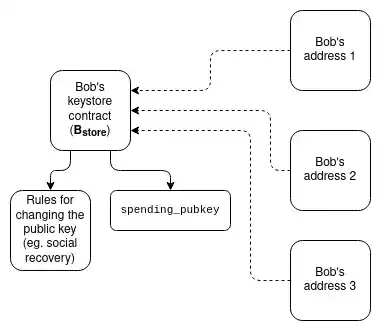
Solution (3) is particularly powerful as it can integrate well with privacy. In a typical "privacy solution," a user possesses a secret s, publishes a "leaf value" L on-chain, and proves L = hash(s, 1) and N = hash(s, 2) for some (never revealed) secret they control. An invalid symbol N is published ensuring that future spending from the same leaf will fail without revealing L, which relies on the security of user s. A recovery-friendly privacy solution would state: s is a location (e.g., an address and storage slot) on-chain, and the user must prove a state query: L = hash(sload(s), 1).
Dapp Security
The weakest link in user security is often the dapp. Most of the time, users interact with applications through websites, where the website implicitly downloads real-time user interface code from the server and then executes it in the browser. If the server is hacked, or DNS is compromised, users will receive a fake copy of the interface that may deceive them into performing arbitrary actions. Wallet features like transaction simulation are very helpful in mitigating risks, but they are far from perfect.
Ideally, we would transition the ecosystem to on-chain content versioning: users would access the dapp through their ENS name, which would contain the IPFS hash of the interface. Updating the interface would require an on-chain transaction from a multisig or DAO. The wallet would show users whether they are interacting with a more secure on-chain UI or a less secure Web2 UI. The wallet could also indicate if users are interacting with a secure chain (e.g., Phase 1+, multisig security audit).
For privacy-conscious users, wallets could also offer a paranoid mode, requiring users to click to allow HTTP requests, not just web3 operations:
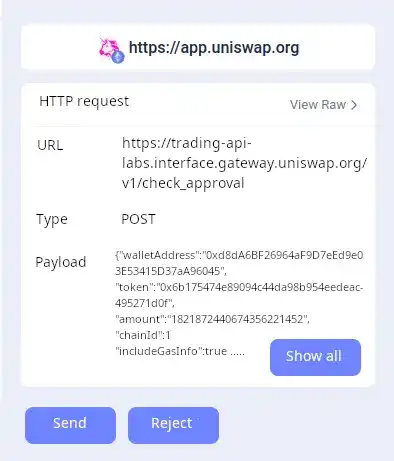
Paranoid Mode Possible Interface Model
A more advanced approach is to go beyond HTML + Javascript and write the dapp's business logic in a dedicated language (possibly a thin layer on top of Solidity or Vyper). Then, the browser can automatically generate any UI for the required functionality. OKContract has already been doing this.
Another direction is Encrypted Economic Information Defense: dapp developers, security firms, chain deployers, and others can create a bond that pays out to affected users (as determined by a on-chain arbitration DAO) if the dapp is hacked or harms users in a highly deceptive manner. Wallets can show users a score based on the size of the bond.
A Longer-Term Future
All of the above has taken place in the context of a traditional interface, where there is pointing, clicking on things, and inputting things into text fields. However, we are also at the cusp of a paradigm shift:
· Artificial Intelligence that may lead us from a click-type paradigm to a "say what you want to do, and the robot figures it out" paradigm.
· Brain-Machine Interfaces: There are both "gentle" methods like eye-tracking and more direct or even invasive technologies (see: this year's first Neuralink patient).
· Client-Side Active Defense: The Brave browser actively protects users from ads, trackers, and many other malign actors. Many browsers, extensions, and crypto wallets have whole teams actively working to shield users from various security and privacy threats. These "active guardians" will only grow stronger in the next decade.
These three trends together will lead to a deeper reimagining of how interfaces work. Through natural language input, eye tracking, or eventually more direct brain-machine interfaces, coupled with your history (perhaps including text messages, as long as all data is processed locally), a "wallet" can understand clearly and intuitively what you want to do. Then, AI can translate that intuition into a concrete "action plan": a series of on-chain and off-chain interactions to accomplish your intent. This can significantly reduce the need for third-party user interfaces. If users do engage with third-party apps (or other users), AI should engage in adversarial thinking on behalf of the user, identify any threats, and propose action plans to mitigate them. Ideally, these AIs should have an open ecosystem generated by different groups with varying biases and incentive structures.
These more radical ideas rely on technology that is very immature today, so I wouldn't put my assets into a wallet that depends on them today. However, similar things seem to be an obvious trend for the future, so it's worth starting to explore in this direction more actively.
猜你喜歡

Sui 加密貨幣價格預測:SUI 價格預計將于2026年1月10日下跌至$1.31
主要收穫 Sui 加密貨幣最近價格呈上漲趨勢,但市場情緒仍然看跌。 技術指標顯示SUI價格可能會在未來五天內下跌23.27%。 SUI在過去30天內已上漲21.80%,目前交易價格高於50日和200日簡單移動平均線。 投資者情緒指標「恐懼與貪婪指數」顯示市場仍處於恐懼狀態,暗示有潛在購買機會。 WEEX Crypto News, 2026-01-06 10:06:51 隨著加密貨幣市場的廣泛波動,Sui 加密貨幣(Sui Crypto)近期的市場表現引起了投資者的極大關注。根據CoinCodex的技術分析,SUI的價格預計將於2026年1月10日下跌至1.31美元,相比現價1.88美元,這意味著未來五天SUI將下跌23.27%。 最近Sui 加密貨幣的市場表現 在過去的30天裡,Sui 加密貨幣呈現出積極的走勢,價格上漲達21.80%。然而,從中長期來看,SUI表現並不理想,過去3個月下降了45.82%,與去年同期相比下降了63.98%。Sui…

Kaspa價格預測:KAS價格到2026年1月9日將下跌至$0.038894
關鍵要點 Kaspa在未來五天預計將下降23.35%,預測價格達到$0.038894。 目前的市場情緒偏向看跌,恐懼與貪婪指數顯示極度恐懼。 KAS在最近30天顯示負面趨勢,價格下降了4.48%。 技術分析指標大多中性,但長期移動平均線顯示出看漲信號。 WEEX Crypto News, 2026-01-06 10:06:55 Kaspa現狀與未來展望 Kaspa(KAS)是一個受投資者密切關注的加密貨幣,其未來走勢在近期更是備受市場熱議。根據Kaspa的價格預測,KAS可能在未來五天內下跌至$0.038894,這將代表著一個-23.35%的價格下降。這一趨勢不僅反映出當前加密貨幣市場的波動性,也顯示出投資者對於Kaspa未來發展的謹慎態度。 在撰寫本文時,Kaspa的交易價格為$0.051824,過去24小時內增長了5.18%,相較於整個加密市場3.52%的增長率,表現出色,同時也相比於比特幣取得了3.28%的優勢。然而,總體市場情緒仍保持在極度恐懼(25)的水平,顯示出投資者的參與度較低,市場觀望情緒濃厚。 Kaspa的近期表現 在最近的30天中,Kaspa的價格整體走勢呈現下降趨勢,跌幅達到4.48%。從中期來看,Kaspa的表現更加悲觀,過去三個月中價格下降了34.90%。1年期的長期趨勢同樣不容樂觀,比起去年同期KAS的交易價格$0.127541,如今的下跌幅度達到了59.37%。2024年8月1日Kaspa達到歷史價格高點$0.208892,而現今價格的高位和低位分別是$0.066494和$0.020431,顯示出近半年來Kaspa的市場波幅。 這段時間Kaspa的市場波動性下降,最近一個月的波動率大約為6.27%,這意味著市場的劇烈波動有所減緩。這段時間中,Kaspa有13天的交易日錄得正增長,表明某些情況下仍存在獲利機會。 技術分析與市場情緒 Kaspa的技術分析表明,目前市場情緒普遍偏向看跌。在技術指標中,有12個顯示出看漲預測,而14個顯示出看跌預測,54%的指標傾向於負面預測,這使得市場對Kaspa的整體預期變得較為謹慎。…

以太娜價格預測:ENA價格預計將降至$0.192294於2026年1月11日前
重點摘要 當前以太娜價格為$0.249202,在未來五天內可能下降23.08%。 市場情緒呈現看跌狀態,恐懼與貪婪指數為44,顯示市場普遍存在恐懼。 本月以來,以太娜的價格波動性高,過去30天有16天價格上升。 關鍵支撐點分別在$0.242274、$0.231037和$0.222901;主要阻力位於$0.261648、$0.269784及$0.281021。 技術分析指出,雖有少數指標表現看多,但總體上68%的指標持看空預測。 WEEX Crypto News, 2026-01-06 10:06:52(today’s date,foramt: day, month, year) 頗具投機性的加密貨幣市場中,價格預測和走勢分析一直備受投資者關注。以太娜(Ethena,ENA)的價格在近期吸引了眾多目光,根據市場數據顯示,ENA的價格預計將在未來幾日內下降約23.08%,降至$0.192294。這一預測激發了市場中對該貨幣的關注及討論。 以太娜近期市場表現 以太娜目前的交易價格為$0.249202,過去24小時內價格上升了3.27%。這個漲幅在一定程度上優於整體加密市場的2.01%上升率。此外,相較比特幣(BTC),ENA當日前進了1.94%,顯示出相對較好的表現。然而,若將當前價格與過去30天相比,以太娜錄得-4.77%的跌幅,更長期來看,於過去三個月內下滑了-53.74%,而整體一年內更是驟降79.96%。…

木星幣價預測——JUP價格預計至2026年1月9日跌至$0.165879
關鍵要點 木星幣(JUP)價格預期在接下來五天內下降23.33%。 當前的價格為$0.217225,比特幣表現出色。 最近30天木星幣呈現負向趨勢,並在過去三個月內下跌54.07%。 市場情緒當前偏向熊市,恐懼與貪婪指數顯示為極度恐懼。 WEEX Crypto News, 2026-01-06 10:06:54 在加密貨幣市場中,木星幣(JUP)的價格表現和預測不容忽視。在本文中,我們將深入分析JUP在未來幾天的價格變動及其潛在的市場走向。本文中所使用的數據來自於過去的市場表現以及多項技術分析指標的結果。 木星幣的現狀與未來預測 截至目前,木星幣的交易價格為$0.217225,經過過去24小時的市場波動後,這一價格已提升4.13%。相較於整體加密市場的平均增長4.49%,木星幣顯得尤其突出。與比特幣相比,JUP今日也獲得了3.21%的提升。 然而,根據市場預測,JUP的價格很可能在未來五天內下滑至$0.165879,這將代表著23.33%的降幅。同時,木星幣在過去30天內已經下跌了4.70%,中期走勢呈現熊市,不容小覷。在過去一年,JUP顯示出77.10%的價格變化,這突出了其在市場中的不穩定性。 近三十天的木星幣走勢 在過去的一段時間裡,木星幣一直表現不佳。這段期間內它不僅失去了價值,也顯露出其波動性相對較低的特點。1個月的波動率達到8.64,讓投資者小心謹慎。今年木星幣的最高價出現在4月1日,當時達到$1.84的高點。而目前的周期高點為$0.221866,低點則為$0.168834。 值得注意的是,市場上的蜂巢情緒指數為25,這意味着投資者情緒非常不安,普遍呈現極度恐懼的狀態。這種產品心理指數的顯示常常預示著潛在的買入良機。 木星幣的技術分析…
Polymarket 發佈房地產市場預測 – 加密交易者現可投機房價
Key Takeaways Polymarket 與 Parcl 合作,讓加密交易者能不擁有房產卻可參與房地產市場價格預測。 用戶可根據大都會區的房價指數變動,交易房價指數上升或下降的合約。 這一新類別將房地產引入 Polymarket 已經涵蓋的大型預測市場中,如選舉、體育和宏觀經濟指標。 透過與 Parcl 的合作,市場解決僅憑明確且可驗證的數據進行結算的要求。 WEEX Crypto News, 2026-01-06 10:07:43…

Worldcoin 被預測在2026年1月11日跌至 $0.483911
主要見解 Worldcoin 預測價在未來五天將下降23.12%,至 $0.483911。 近期市場情緒顯示,目前對 Worldcoin 的看法偏向看跌。 前50天和200天的移動平均線表明市場趨勢呈看漲。 目前的恐懼與貪婪指數顯示投資者的市場展望偏負面。 加密市場的波動性令 Worldcoin 的長期價格預測充滿挑戰。 WEEX Crypto News, 2026-01-06 10:06:52 Worldcoin…

卡爾達諾價格預測:2026年首度金叉出現——聰明的資金已經在買進中嗎?
主要摘要 卡爾達諾(Cardano)在2026年開年即迎來罕見的金叉,價格預測顯示其走勢極為樂觀。 短期價格表現超越中期趨勢,9日均線已越過21日均線,顯示可能出現翻轉信號。 24小時交易量激增31.35%至6.1485億美元,暗示大資金持有者可能已開始動作。 若此金叉能夠爭取到強勁支撐,卡爾達諾有望展開225%的漲幅,並在2026年進一步抬升。 WEEX Crypto News, 2026-01-06 10:07:41 卡爾達諾的看漲信號 2026年對於卡爾達諾而言似乎是一個振奮人心的開端。一道罕見的「金叉」出現在其走勢圖上,引起投資者的廣泛關注。金叉是指短期均線由下向上穿過長期均線,通常被視為強勁的多頭信號,代表著潛在的上漲可能性。 在技術面上,卡爾達諾價格正面臨著極為看好的預測。短期的價格行為已經超越了中期趨勢,9日移動平均線已經超過了21日移動平均線,此類型的交叉通常被解讀為潛在的翻轉信號。這意味著市場可能從持續的下跌中反轉,轉向上升。 儘管在去年12月早些時候曾出現過一次短暫的金叉,但此次金叉伴隨著顯著的交易量增長,引發市場的猜測:此次的金叉是否預示著新一輪牛市的開始。 交易量激增:聰明資金的佈局 伴隨著此次金叉的出現,卡爾達諾的24小時交易量激增了31.35%,達到6.1485億美元。如此顯著的增長通常暗示著大型資金持有者的入場。這類資金被認為較為聰明,通常會提前佈局,在市場出現明顯趨勢之前做出投資決策。 這一波的價格上漲似乎得益於聰明資金的進場,而歷史數據一再顯示,當聰明資金採取行動時,散戶投資者往往會隨之跟進,進一步增強市場的動能。 下一次牛市即將來臨?…

Shiba Inu 價格預測:9個綠色蠟燭和黃金交叉——SHIB即將爆發
主要要點 隨著Shiba Inu 價格上漲20%,未來幾年的價格預測再度升溫。 近期出現的黃金交叉表明強勁的牛市走勢可能繼續。 一旦超越0.00000900美元大關,將可能抹去一個零並重返高點。 SUBBD 將成為2026年最值得關注的AI加密貨幣之一。 Shiba Inu 和SUBBD 的市場動態正受到廣泛的關注和討論。 WEEX Crypto News, 2026-01-06 10:07:43 在過去的幾天內,Shiba…

XRP 價格預測:XRP 突破三個月下行趨勢——2026 年達到 5 美元?
關鍵要點 XRP 最近突破了三個月的下行趨勢,價格上漲了 18%,突破了關鍵的 2.20 美元阻力位。 分析師預測,根據艾略特波浪理論,XRP 可能在 2026 年上漲至 5 美元。 破除自 2017 年以來多次未能突破的 2.00 美元阻力,意味著長期供應枯竭。 若能突破…

領先的AI Claude預測到2026年底XRP、Shiba Inu和Solana的價格
主要要點 Claude AI對XRP的預測是,到2026年底,XRP價格有可能達到10美元。 Shiba Inu(SHIB)或許會比上個高點增長7000%。 Solana(SOL)預計可能會有高達500%的強勁反彈。 Maxi Doge(MAXI)作為新興的迷因幣,具備潛在的巨大增長空間。 WEEX Crypto News, 2026-01-06 10:07:43 Anthropic的Claude AI,以強大的演算法,近期針對XRP、Shiba Inu及Solana這三大加密貨幣發布了最新的價格預測。作為2026年的新年展望,Claude AI表示這三個數位資產將在本年度創下史無前例的新高,有可能達到先前高峰的三倍或更多。 XRP(XRP):預計將達到令人振奮的10美元…
Bittensor 預測:以太坊價格走勢與市場情緒分析
關鍵要點 預計 Bittensor (TAO) 將在未來五天內降至 205.29 美元,此價格減幅為 -23.40%。 市場情緒顯示 TAO 當前為看跌趨勢,投資者信心不足。 最近 TAO 對美元上漲 3.94%,對 BTC 上升 2.69%,…

Official Trump價格預測:TRUMP價格預估將降至$4.15 (截至2026年1月9日)
主要觀點 預測顯示TRUMP在接下來的五天將下降23.18%。 市場情緒偏向於看空,恐懼與貪婪指數顯示為極端恐懼。 近期技術分析中,多數指標顯示為賣出信號。 長期而言,TRUMP過去一年仍有約26.22%的價格增長。 WEEX Crypto News, 2026-01-06 10:08:54 在近期的加密貨幣市場分析中,Official Trump(以下簡稱TRUMP)的價格走勢及其未來五天的價格預測成為關注焦點。根據最新資料顯示,TRUMP目前的交易價約為$5.42,市場預期其價格將在2026年1月9日下降至約$4.15,這意味著在未來五天內TRUMP價格可能會減少23.18%。 正處於極端恐懼之中的市場 目前加密貨幣市場正處於「極端恐懼」的狀態,恐懼與貪婪指數低至25,顯示出投資者的悲觀情緒。雖然TRUMP在最近24小時內表現突出,達到7.85%的漲幅,甚至相較於BTC還經歷了6.33%的收益,但整體市場情緒依然不容樂觀。 近期及歷史價格動向 回顧過去30天,TRUMP表現一直顯示出負面走勢,當前趨勢似乎支持其中期走跌的預測。過去三個月內,TRUMP價格下降了31.28%。然而,若放眼更長遠的時間範疇,過去一年TRUMP的價格仍然增長了26.22%。 2025年1月19日,TRUMP曾達到歷史最高點$76.98,然而自此之後價格一路走跌。目前,其循環高點為$9.56,而低點則為$4.19。這段期間內TRUMP的波動幅度較小,月度波動率僅為7.00%。 關鍵支撐和阻力位…
Ondo Finance 預測:2026年1月9日價格將跌至 $ 0.335745
主要要點 根據最新預測,Ondo Finance (ONDO) 在未來5天內預期將下降23.36%,達到 $0.335745。 當前市場情緒顯示看跌傾向,並且投資者持有極端恐懼情緒。 ONDO最近30天表現不佳,30天內價格已下跌9.45%,一季度內更是下跌了52.77%。 長期來看,自去年以來,ONDO價格已減少72.21%。 2026年1月的技術分析顯示大多數指標均指向看跌,但也有少數買入提示。 WEEX Crypto News, 2026-01-06 10:08:53 在當前激動人心的加密市場中,Ondo Finance (ONDO)…

七大中國金融協會裁定RWA代幣化非法
關鍵要點 中國七大金融協會聯合宣布,實體資產(RWA)的代幣化活動在中國屬非法金融活動,且不具法律依據。 RWA與穩定幣、”無價值的加密貨幣”和挖礦活動一起,被列為非法虛擬貨幣活動的主要表現,並被視為高風險和欺詐方法。 中國的金融監管機構並未批准任何形式的RWA代幣化活動,強調這種活動涉及資金非法籌集、未經授權的公開發行、非法期貨業務操作等多種違法行為。 國內涉及RWA的整個Web3服務生態系統面臨法律責任,尤其是那些為虛擬貨幣業務提供服務的機構和個人。 WEEX Crypto News, 2026-01-06 10:08:53 中國對實體資產代幣化的嚴厲執法 近日,中國的七個主要金融協會一起發表了一則重磅聲明,宣告實體資產(RWA)代幣化為非法金融活動,這樣的舉動再一次強化了其對加密貨幣交易的全面禁令。此聲明顯示,中國互聯網金融協會、中國銀行業協會、中國證券業協會、中國資產管理協會、中國期貨業協會、中國上市公司協會以及中國支付清算協會紛紛警告國內外的從業者,RWA活動在中國法律下並無任何運營的法律依據。 該聲明中將RWA活動與穩定幣、”無價值的加密貨幣”及挖礦活動一起,列為非法虛擬貨幣活動的主要表現,這導致RWA被認為是一種高風險且具有欺詐性的經營方式,而非一種等待監管澄清的新興金融技術。 實體資產代幣化:處於證券法管制下的融資活動 聲明明確指出,實體資產代幣化是指“通過發行代幣或其他具有代幣特徵的權利和債務工具進行的融資和交易活動”,此類行為帶有“虛構資產的風險、商業失敗風險和投機風險”。監管機構強調,“我國的金融監管部門並未批准任何實體資產代幣化活動”,從而消除了任何項目聲稱處於監管探索階段或等待註冊批准的可能性。 這一立場與新加坡等2025年RWA採用全球領先的國家有所不同。官方特別列舉了三項與現行中國法律相關的關鍵違規行為。向公眾發行代幣的項目,並同時籌集資金將面臨非法集資指控,而未經許可進行交易或分發代幣則構成未經授權的公開證券發行。涉及槓桿交易或投機機制的代幣交易可能構成非法期貨業務操作,這些定性直接源於中國刑法和證券法的條款,而非一般性的政策警告。 根據文件,RWA代幣結構無法保證合法的資產所有權或基本資產的清算,不論項目團隊是否認為其資產是真實的且技術透明,監管機構判斷即便是合規的項目,風險的延伸也是不可控的。 此外,中國證券監管機構正暗示國內券商在香港的RWA代幣化業務應當停止。…

加密市場隨著資本部署而上升,聚焦美國就業數據:雷射數位
核心要點 2026年1月起,加密市場迎來穩健起點,由於資本再度投入及市場情緒改善,使得比特幣及以太幣價格上揚。 亞洲市場的交易時段顯示強勁表現,然而美國時段的跟進力度較弱,成為市場密切關注的信號。 本週的美國勞動市場數據,包括非農就業報告,將成為市場的焦點,影響投資者對於宏觀經濟的預期。 整體加密資產的基本面依然穩固,市場情緒相對積極,但地緣政治風險依然是潛在威脅。 WEEX Crypto News, 2026-01-06 10:09:45 在新的年度伊始,加密貨幣市場展示出一段特別的成長,這無疑是由多種因素驅動的。比特幣與以太坊以顯著的漲幅迎接2026年,其中的主要推動力便是受到資本重新投入的影響,以及市場情緒的顯著改善。據雷射數位(Laser Digital)的最新市場評論指出,這種上升趨勢主要反映了年末動態因素和市場新倉位的結果。 年後資金流入推動市場上升 在過去的週末,比特幣的價格從87,000美元攀升至93,000美元,而以太坊則從約2,970美元上升到3,200美元。不久前,比特幣交易價格維持在92,966美元左右,24小時內上漲約1.8%,延續了其在波動的12月後的早期回升趨勢。雷射數位指出,這一動作可能反映了年末的市場動態和新的交易定位。今年1月,隨著稅務損失收割導致的12月賣壓消退,新資金重新流入市場。 2026年1月2日,現貨比特幣ETF出現資金流入,顯示機構需求也恢復跡象。這改變了12月份不斷外流的趨勢,增強了市場看漲的情緒。衍生品活動也反映了這樣的趨勢,年末期權交易桌顯示有約3,000份1月底到期的比特幣看漲期權在12月最後一天交易,顯示市場對於比特幣價格在2026年初走高的預期。 亞洲市場引領,交易者關注美國市場動向 近期的價格走勢遵循了熟悉的模式:亞洲交易時段表現強勁,而美國時段則顯示出較弱的回響。雷射數位表示,這一動態的任何轉變都將是市場的重要信號。若美國市場出現數次強勢交易日,可能會將觀望的投資者吸引回風險資產的懷抱。從技術角度看,比特幣的95,000美元被視為關鍵阻力位,一旦突破該區域,可能會引發進一步的上行動能,而若未能突破,價格可能在近期內保持震盪。 就業數據成市場焦點…

Starknet主網再次停擺:以太坊L2凍結超過兩小時
重要要點 Starknet是一個基於零知識卷積的以太坊Layer-2系統,最近發生了超過兩小時的主網中斷。 雖然Starknet擁有強大的鏈上數據和指標支持,但這次中斷仍然有效地暫停了所有鏈上活動。 Starknet過去一年中出現多次網絡中斷,使人質疑其穩定性和去中心化進程。 市場對此次中斷的反應不大,STRK代幣價格輕微上升。 WEEX Crypto News, 2026-01-06 10:09:45 Starknet的運作中斷最新詳情 最近,Starknet,一個基於以太坊的零知識卷積Layer-2系統,再次遭遇了主網中斷,這讓它的運行穩定性備受質疑。這次中斷發生在星期一,持續超過兩個小時,期間網絡操作完全停止。開發者通過平台X發布消息,表示正在積極調查問題並努力恢復網絡的完全功能。然而,當下並沒有直接的解釋說明這次中斷的具體原因。 當中斷初次更新時,區塊生產已停止超過兩個小時,使用者無法提交或確認交易。這顯然對於依賴於Starknet進行交易和智能合約運行的用戶造成了影響。 Starknet鏈上活動的前景 無論如何,Starknet本身擁有強大的指標支持。在運行初期,其區塊瀏覽器顯示,該網絡自啟動以來處理了超過2.64億筆交易,支持超過5.6萬個活躍賬戶,平均交易費用不到一分錢。此系統的總鎖定價值約為8.4億美元。然而,儘管擁有這些數據和資源,這次主網的中止仍然暫停了去中心化應用程序、錢包和智能合約的所有活動。 Starknet的設計目標是將交易批量處理後提交至以太坊,並提交加密證明來擴展去中心化金融、遊戲和其他智能合約用例,同時依賴於以太坊的結算和安全。在這一點上,它已成為推動以太坊生態系統中BTCFi擴張的重要橋樑。 然而,其網絡在最近的中斷打亂了這些計劃,至少暫時中止了不斷探索的去中心化金融相關功能。與此同時,開發者和用戶仍在等待正常運行的恢復。 累積的網絡中斷模式…

暗死的膜稅幣重獲生機:壓力後強勢反彈
關鍵要點 膜稅幣市值在2026年年初增加超過80億美元,其市佔率自2025年12月的歷史低點迅速反彈。 以PEPE為首的主流膜稅幣年初至今已錄得顯著的雙位數增幅,交易量突破90億美元。 減低的比特幣波動性為膜稅幣吸引資金流入創造了空間,而交易者的恐慌性買入進一步推動了市場的上行勢頭。 根據歷史模擬,2026年膜稅幣市場可能會重現2021年的繁榮,市值有望在第一季度達到690億美元。 WEEX Crypto News, 2026-01-06 10:09:51 在歷經2025年12月的低迷之後,膜稅幣正重新從市場的底部逐漸崛起。這次重生的現象改寫了市場預期,使得過去被視為投機標的的膜稅幣,如今再度回到投資者的聚光燈下。在此一過程中,膜稅幣的市場份額從歷史低點快速回升,促使投資者重新關注這些風險較高的資產。 市場在假期後強勢回彈 市場研究數據顯示,在2025年12月,膜稅幣在其他加密資產市場的主導權降至3.2%,相較2024年11月的11%幾乎縮水三分之二。不過,自2026年年初以來,這一板塊已經增添了超過80億美元的市值,主流膜稅幣出現了令人震驚的雙位數增長。其中,以PEPE的表現最為突出,其年初至今已漲幅達65%,在24小時內單日拉升34%。 同時,BONK和FLOKI等膜稅幣亦分別上漲了49%和40%。這一輪反彈開始於假期結束后,當時交易員通常會持保守立場。然而,比特幣波動性的降低,同時打開了膜稅幣吸引資本的空間。以比特幣為例,在年初突破90,000美元後,近期交投於93,000美元區間。此外,狗狗幣亦在多年的下降趨勢中突破,周漲幅超過20%,而柴犬幣則上漲18.9%。 平台優勢驅動復甦 據Messari的報告,Pump.fun主導了Solana生態系統中的代幣發行,佔據了高達70-77%的新代幣發行量以及每日網絡交易的25%。自2024年初以來,該平台已有超過1,300萬個代幣創建,佔Solana所有代幣的三分之一以上。該平台在生命周期收入方面創下了超過8.66億美元的記錄,其收入幾乎全數用於代幣回購,從而減少了約8%的PUMP流通供應。 儘管有新的競爭者出現,但獨立的膜稅幣依然控制著總市值的86.2%,這顯示出草根發行在社區支持方面擁有更強的黏着性。在這個市場中,狗狗幣類的膜稅幣占據了39.5%的主導地位,而青蛙和貓類代幣如PEPE、POPCAT和MEW也吸引了相當多的關注。地理上的關心度依然集中在美國,其佔據了2025年11月30%的膜稅幣相關信息瀏覽量,比年初的20%有顯著提升。 分析師參攷歷史模式提供指引…
Ledger 再次遭受資料洩露——客戶姓名和聯繫方式暴露
鑄幣平台 Ledger 再次遭遇資料洩露事件,涉及客戶個人信息及聯繫方式的外洩。 這次事故出自於支付處理商 Global-e 的遭受攻擊,並未涉及支付卡信息及 Ledger 硬體錢包的核心安全。 該事件增加了針對 Ledger 客戶的網路釣魚與社會工程攻擊的風險。 在此之前,Trust Wallet 和 MetaMask 也遭遇類似攻擊,整個加密貨幣生態系統的用戶正面臨著高度緊張的安全形勢。 WEEX Crypto…
Sui 加密貨幣價格預測:SUI 價格預計將于2026年1月10日下跌至$1.31
主要收穫 Sui 加密貨幣最近價格呈上漲趨勢,但市場情緒仍然看跌。 技術指標顯示SUI價格可能會在未來五天內下跌23.27%。 SUI在過去30天內已上漲21.80%,目前交易價格高於50日和200日簡單移動平均線。 投資者情緒指標「恐懼與貪婪指數」顯示市場仍處於恐懼狀態,暗示有潛在購買機會。 WEEX Crypto News, 2026-01-06 10:06:51 隨著加密貨幣市場的廣泛波動,Sui 加密貨幣(Sui Crypto)近期的市場表現引起了投資者的極大關注。根據CoinCodex的技術分析,SUI的價格預計將於2026年1月10日下跌至1.31美元,相比現價1.88美元,這意味著未來五天SUI將下跌23.27%。 最近Sui 加密貨幣的市場表現 在過去的30天裡,Sui 加密貨幣呈現出積極的走勢,價格上漲達21.80%。然而,從中長期來看,SUI表現並不理想,過去3個月下降了45.82%,與去年同期相比下降了63.98%。Sui…
Kaspa價格預測:KAS價格到2026年1月9日將下跌至$0.038894
關鍵要點 Kaspa在未來五天預計將下降23.35%,預測價格達到$0.038894。 目前的市場情緒偏向看跌,恐懼與貪婪指數顯示極度恐懼。 KAS在最近30天顯示負面趨勢,價格下降了4.48%。 技術分析指標大多中性,但長期移動平均線顯示出看漲信號。 WEEX Crypto News, 2026-01-06 10:06:55 Kaspa現狀與未來展望 Kaspa(KAS)是一個受投資者密切關注的加密貨幣,其未來走勢在近期更是備受市場熱議。根據Kaspa的價格預測,KAS可能在未來五天內下跌至$0.038894,這將代表著一個-23.35%的價格下降。這一趨勢不僅反映出當前加密貨幣市場的波動性,也顯示出投資者對於Kaspa未來發展的謹慎態度。 在撰寫本文時,Kaspa的交易價格為$0.051824,過去24小時內增長了5.18%,相較於整個加密市場3.52%的增長率,表現出色,同時也相比於比特幣取得了3.28%的優勢。然而,總體市場情緒仍保持在極度恐懼(25)的水平,顯示出投資者的參與度較低,市場觀望情緒濃厚。 Kaspa的近期表現 在最近的30天中,Kaspa的價格整體走勢呈現下降趨勢,跌幅達到4.48%。從中期來看,Kaspa的表現更加悲觀,過去三個月中價格下降了34.90%。1年期的長期趨勢同樣不容樂觀,比起去年同期KAS的交易價格$0.127541,如今的下跌幅度達到了59.37%。2024年8月1日Kaspa達到歷史價格高點$0.208892,而現今價格的高位和低位分別是$0.066494和$0.020431,顯示出近半年來Kaspa的市場波幅。 這段時間Kaspa的市場波動性下降,最近一個月的波動率大約為6.27%,這意味著市場的劇烈波動有所減緩。這段時間中,Kaspa有13天的交易日錄得正增長,表明某些情況下仍存在獲利機會。 技術分析與市場情緒 Kaspa的技術分析表明,目前市場情緒普遍偏向看跌。在技術指標中,有12個顯示出看漲預測,而14個顯示出看跌預測,54%的指標傾向於負面預測,這使得市場對Kaspa的整體預期變得較為謹慎。…
以太娜價格預測:ENA價格預計將降至$0.192294於2026年1月11日前
重點摘要 當前以太娜價格為$0.249202,在未來五天內可能下降23.08%。 市場情緒呈現看跌狀態,恐懼與貪婪指數為44,顯示市場普遍存在恐懼。 本月以來,以太娜的價格波動性高,過去30天有16天價格上升。 關鍵支撐點分別在$0.242274、$0.231037和$0.222901;主要阻力位於$0.261648、$0.269784及$0.281021。 技術分析指出,雖有少數指標表現看多,但總體上68%的指標持看空預測。 WEEX Crypto News, 2026-01-06 10:06:52(today’s date,foramt: day, month, year) 頗具投機性的加密貨幣市場中,價格預測和走勢分析一直備受投資者關注。以太娜(Ethena,ENA)的價格在近期吸引了眾多目光,根據市場數據顯示,ENA的價格預計將在未來幾日內下降約23.08%,降至$0.192294。這一預測激發了市場中對該貨幣的關注及討論。 以太娜近期市場表現 以太娜目前的交易價格為$0.249202,過去24小時內價格上升了3.27%。這個漲幅在一定程度上優於整體加密市場的2.01%上升率。此外,相較比特幣(BTC),ENA當日前進了1.94%,顯示出相對較好的表現。然而,若將當前價格與過去30天相比,以太娜錄得-4.77%的跌幅,更長期來看,於過去三個月內下滑了-53.74%,而整體一年內更是驟降79.96%。…
木星幣價預測——JUP價格預計至2026年1月9日跌至$0.165879
關鍵要點 木星幣(JUP)價格預期在接下來五天內下降23.33%。 當前的價格為$0.217225,比特幣表現出色。 最近30天木星幣呈現負向趨勢,並在過去三個月內下跌54.07%。 市場情緒當前偏向熊市,恐懼與貪婪指數顯示為極度恐懼。 WEEX Crypto News, 2026-01-06 10:06:54 在加密貨幣市場中,木星幣(JUP)的價格表現和預測不容忽視。在本文中,我們將深入分析JUP在未來幾天的價格變動及其潛在的市場走向。本文中所使用的數據來自於過去的市場表現以及多項技術分析指標的結果。 木星幣的現狀與未來預測 截至目前,木星幣的交易價格為$0.217225,經過過去24小時的市場波動後,這一價格已提升4.13%。相較於整體加密市場的平均增長4.49%,木星幣顯得尤其突出。與比特幣相比,JUP今日也獲得了3.21%的提升。 然而,根據市場預測,JUP的價格很可能在未來五天內下滑至$0.165879,這將代表著23.33%的降幅。同時,木星幣在過去30天內已經下跌了4.70%,中期走勢呈現熊市,不容小覷。在過去一年,JUP顯示出77.10%的價格變化,這突出了其在市場中的不穩定性。 近三十天的木星幣走勢 在過去的一段時間裡,木星幣一直表現不佳。這段期間內它不僅失去了價值,也顯露出其波動性相對較低的特點。1個月的波動率達到8.64,讓投資者小心謹慎。今年木星幣的最高價出現在4月1日,當時達到$1.84的高點。而目前的周期高點為$0.221866,低點則為$0.168834。 值得注意的是,市場上的蜂巢情緒指數為25,這意味着投資者情緒非常不安,普遍呈現極度恐懼的狀態。這種產品心理指數的顯示常常預示著潛在的買入良機。 木星幣的技術分析…
Polymarket 發佈房地產市場預測 – 加密交易者現可投機房價
Key Takeaways Polymarket 與 Parcl 合作,讓加密交易者能不擁有房產卻可參與房地產市場價格預測。 用戶可根據大都會區的房價指數變動,交易房價指數上升或下降的合約。 這一新類別將房地產引入 Polymarket 已經涵蓋的大型預測市場中,如選舉、體育和宏觀經濟指標。 透過與 Parcl 的合作,市場解決僅憑明確且可驗證的數據進行結算的要求。 WEEX Crypto News, 2026-01-06 10:07:43…
Worldcoin 被預測在2026年1月11日跌至 $0.483911
主要見解 Worldcoin 預測價在未來五天將下降23.12%,至 $0.483911。 近期市場情緒顯示,目前對 Worldcoin 的看法偏向看跌。 前50天和200天的移動平均線表明市場趨勢呈看漲。 目前的恐懼與貪婪指數顯示投資者的市場展望偏負面。 加密市場的波動性令 Worldcoin 的長期價格預測充滿挑戰。 WEEX Crypto News, 2026-01-06 10:06:52 Worldcoin…


 App
App