
- Buy Crypto
- Markets
- Futures
- Spot
- Copy Trade
 WE-Launch
Why does Hyperliquid earn less than Coinbase?

Original Article Title: Hyperliquid at the Crossroads: Robinhood or Nasdaq Economics
Original Author: @shaundadevens
Translation: Peggy, BlockBeats
Editor's Note: As Hyperliquid's trading volume approaches that of traditional exchanges, what truly deserves attention is no longer just "how large the volume is," but rather where it chooses to sit in the market structure. This article uses the traditional financial industry's "Broker vs. Exchange" division as a reference to analyze why Hyperliquid has proactively adopted a low-fee market layer positioning, and how Builder Codes and HIP-3, while amplifying the ecosystem, exert long-term pressure on platform fees.
Hyperliquid's path reflects the core issue that the entire crypto trading infrastructure is facing: once scale is achieved, how should profits be allocated.
The following is the original text:
Hyperliquid is processing perpetual contract trading volume close to Nasdaq levels, but its profit structure also exhibits "Nasdaq-level" characteristics.
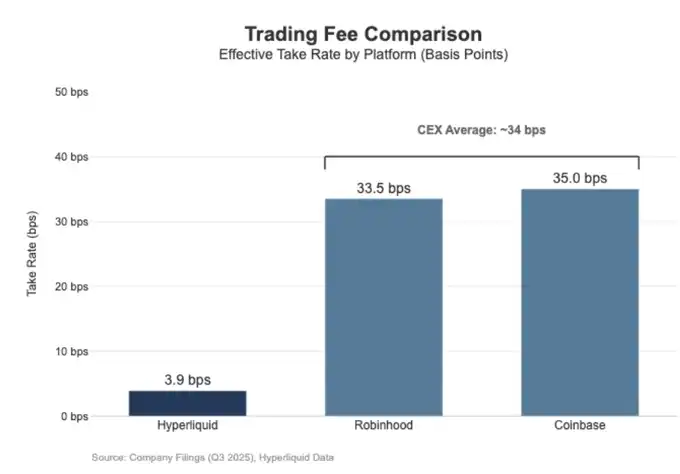
In the past 30 days, Hyperliquid has cleared $205.6 billion in perpetual contract notional trading volume (approximately $617 billion on a quarterly annualized basis), but has generated only $8.03 million in fee revenue, resulting in an effective fee rate of about 3.9 basis points (bps).
This means that Hyperliquid's monetization method is more akin to a wholesale execution venue rather than a retail-oriented high-fee trading platform.
For comparison, Coinbase recorded $295 billion in trading volume in Q3 2025, but achieved $1.046 billion in trading revenue, implying an effective fee rate of about 35.5 basis points.
Robinhood's monetization logic in its crypto business is similar: its $80 billion in crypto asset notional trading volume resulted in $268 million in trading revenue, implying a fee rate of around 33.5 basis points; meanwhile, Robinhood's stock notional trading volume in Q3 2025 reached a high of $647 billion.
Overall, Hyperliquid has risen to the ranks of top-tier trading infrastructure in terms of trading volume, but in terms of fees and business model, it resembles a low-fee execution layer catering to professional traders rather than a retail-oriented platform.
The difference is not only reflected in the fee level, but also in the breadth of monetization dimensions. Retail platforms are often able to profit on multiple income "interfaces" simultaneously. In the third quarter of 2025, Robinhood generated a total of $730 million in trading-related revenue, along with $456 million in net interest income, and $88 million in other revenue (mainly from the Gold subscription service).
In contrast, Hyperliquid currently relies much more on trading fees, and these fees are structurally compressed at single-digit basis point levels at the protocol layer. This means that Hyperliquid's revenue model is more concentrated, more singular, and closer to a low-fee, high-throughput infrastructure role, rather than a retail platform that achieves deep monetization through multiple product lines.
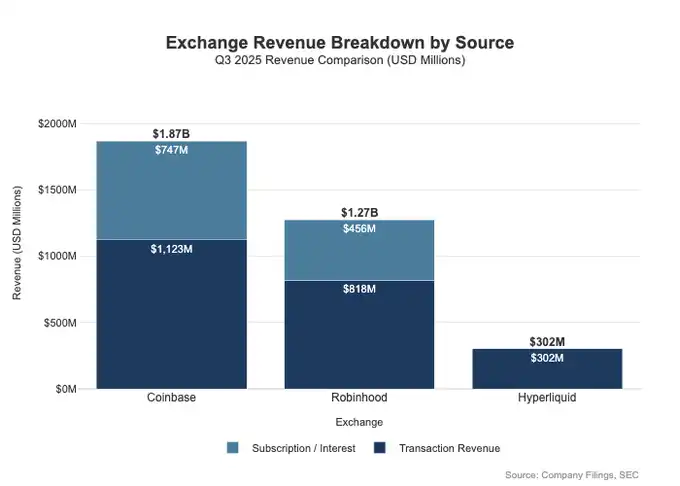
This can be fundamentally explained by a positioning difference: Coinbase and Robinhood are broker/dealer/distribution businesses that leverage their balance sheet and subscription system for multi-layered monetization, while Hyperliquid is closer to the exchange layer. In the traditional financial market structure, the profit pool is naturally divided between these two layers.
Broker/Dealer vs. Exchange Model
In traditional finance (TradFi), the most fundamental distinction is the separation between the distribution layer and the market layer.
Retail platforms like Robinhood and Coinbase are located in the distribution layer, able to capture high-margin monetization facets, while exchanges like Nasdaq are positioned in the market layer, where their pricing power is structurally constrained, and their execution services are pushed by competition towards a commoditized economic model.
Broker/Dealer = Distribution Capability + Customer Balance Sheet
Brokers have control over customer relationships. Most users do not directly access Nasdaq but enter the market through brokers. Brokers are responsible for account opening, custody, margin and risk management, customer support, tax documents, etc., and then route orders to specific trading venues.
It is this "relationship ownership" that allows brokers to monetize in multiple ways beyond trading:
Funds and asset balances: cash aggregation interest spread, margin lending, securities lending
Product Bundling: Subscription Service, Feature Package, Bank Card / Robo-Advisor Product
Routing Economics: Brokerage controls order flow and can embed payment or revenue-sharing mechanisms in the routing chain
This is also why brokerages often earn more than trading venues: the profit pool is truly concentrated in the "distribution + balance" position.
Exchange = Matching + Rules + Infrastructure, Commission Limited
An exchange operates the trading venue itself: matching engine, market rules, deterministic execution, and infrastructure connection. Its main monetization methods include:
Trading Fees (continuously suppressed in highly liquid products)
Rebates / Liquidity Incentives (often most of the nominal fee rate is returned to the market maker in order to compete for liquidity)
Market Data, Network Connection, and Co-location
Listing Fee and Index Authorization
Robinhood's order routing mechanism clearly demonstrates this structure: the customer relationship is held by the brokerage (Robinhood Securities), and the order is then routed to a third-party market center, with the economic benefits during routing being distributed in the chain.
The true high-margin layer is at the distribution end, which controls customer acquisition, customer relationships, and all monetization aspects surrounding execution (such as order flow payment, margin, securities lending, and subscription services).
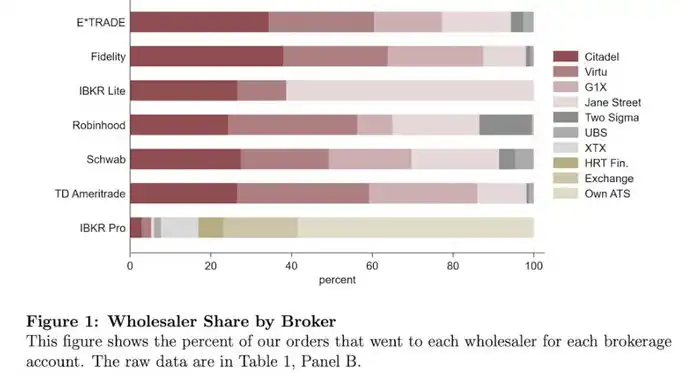
Nasdaq itself is in the low-margin layer. The products it offers are essentially highly commoditized execution capabilities and queue access rights, and its pricing power is strictly limited in the mechanism.
The reason is that: in order to compete for liquidity, trading venues often need to return a large portion of the nominal fee as maker rebates; regulators have set limits on access fees, limiting the fee space that can be charged; at the same time, order routing has high elasticity, and funds and orders can quickly switch between different trading venues, making it difficult for any single venue to raise prices.
This point is very intuitively reflected in the financial data disclosed by Nasdaq: the actual net revenue captured in its cash stock trading is usually only on the order of a fraction of a cent per share. This is a direct reflection of the structural compression of the profit space of market-level exchanges.
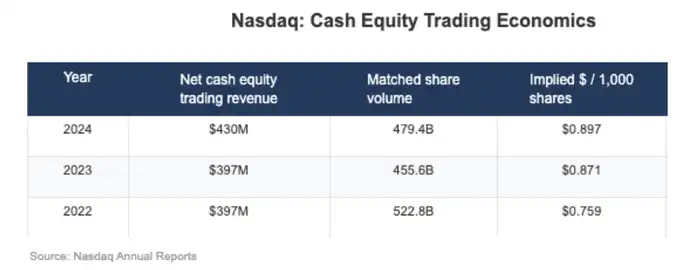
The strategic consequences of this low-profit margin are also clearly reflected in Nasdaq's revenue structure change.
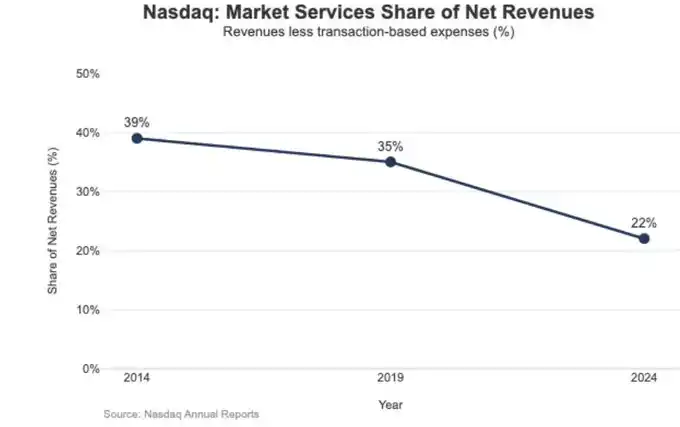
In 2024, Nasdaq's Market Services revenue was $1.02 billion, accounting for 22% of the total revenue of $4.649 billion; a ratio that was as high as 39.4% in 2014 and still at 35% in 2019.
This continuous downward trend is highly consistent with Nasdaq's active shift from a market-volatility-dependent, profit-constrained execution business to a more regular and predictable software and data business. In other words, it is the structurally low-profit space at the exchange level that has driven Nasdaq to gradually shift its growth focus from "matching and execution" to "technology, data, and service-productization."
Hyperliquid as a "Market Layer"
Hyperliquid's approximately 4 basis points (bps) effective fee rate is highly aligned with its intentionally chosen market layer positioning. It is building an on-chain "Nasdaq-style" trading infrastructure:
A high-throughput matching, margin, and clearing system centered around HyperCore, utilizing a maker/taker pricing and market-making rebate mechanism, aiming to maximize execution quality and shared liquidity, rather than conducting multilayer monetization for retail users.
In other words, Hyperliquid's design focus is not on subscription, balances, or distribution-type revenue, but on providing commoditized yet extremely efficient execution and settlement capabilities—this is a typical characteristic of a market layer and an inevitable result of its low-fee structure.
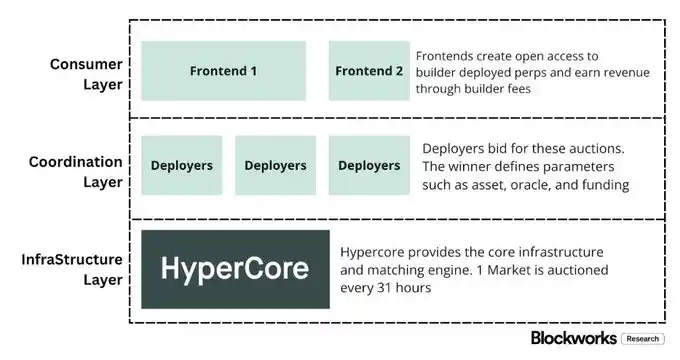
This is reflected in the two most common structural splits that have not yet been truly implemented in the majority of cryptocurrency trading platforms but are very typical in Traditional Finance (TradFi):
One is the permissionless brokerage/distribution layer (Builder Codes).
Builder Codes allow third-party trading interfaces to be built on top of the core exchange and earn economic benefits independently. Among them, the Builder fee has a clear upper limit: a maximum of 0.1% (10 basis points) for perpetual contracts, and a maximum of 1% for spot, and fees can be set at the individual order level. This mechanism thus creates a competitive market at the distribution layer, rather than a single official app monopolizing user access and monetization rights.
Second is Permissionless Listing / Product Layer (HIP-3).
In traditional finance, exchanges usually control listing approvals and product creation. HIP-3 externalizes this function: developers can deploy a perpetual contract inheriting the HyperCore matching engine and API capabilities, while the specific market's definition and operation are the responsibility of the deployer.
In terms of the economic structure, HIP-3 clearly defines the revenue-sharing relationship between the exchange and the product layer: deployers of spot and HIP-3 perpetual contracts can retain up to 50% of the trading fees of the assets they deploy.
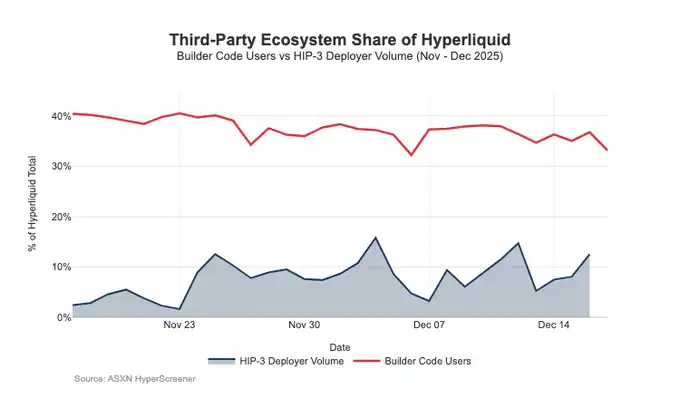
Builder Codes have already shown effectiveness on the distribution end: as of mid-December, approximately one-third of users did not trade through the native interface but through a third-party frontend.
The issue is that this distribution-friendly structure itself creates sustained pressure on the exchange layer's take rate:
1. Price compression.
Multiple frontends simultaneously selling the same underlying liquidity naturally converge competition towards the lowest comprehensive trading cost; meanwhile, Builder fees can be flexibly adjusted at the order level, further driving prices down.
2. Loss of monetization surface.
Frontends control onboarding, product bundling, subscription services, and the complete trading workflow, capturing the high-margin space of the brokerage layer; whereas Hyperliquid can only retain a thinner exchange layer take rate.
3. Strategic routing risk.
Once frontends evolve into true cross-exchange routers, Hyperliquid could be forced into wholesale execution competition, only able to defend order flow through fee reductions or increased rebates.
Overall, Hyperliquid is consciously choosing a low-profit-margin market layer positioning (through HIP-3 and Builder Codes), while allowing a high-margin brokerage layer to grow on top of it.
If Builder frontends continue expanding, they will increasingly determine the pricing structure facing users, control user retention and monetization interfaces, and gain bargaining power at the routing level, structurally putting long-term pressure on Hyperliquid's take rate.
Defend Distribution Rights and Introduce a Non-Exchange Profit Pool
The most direct risk is commoditization.
If a third-party front end can consistently undercut the native interface in price, and even achieve cross-site routing in the end, Hyperliquid will be pushed towards a wholesale execution-type economic model.
Recent design adjustments indicate that Hyperliquid is attempting to explore new revenue streams while trying to avoid this outcome.
Distribution Defense: Maintaining the Economic Competitiveness of the Native Front End
A previously proposed staking discount scheme allows Builders to stake HYPE to receive up to a 40% fee discount, effectively providing a structurally cheaper path for third-party front ends compared to the Hyperliquid native interface. The withdrawal of this scheme equates to the elimination of a direct subsidy for external distribution "price pressure."
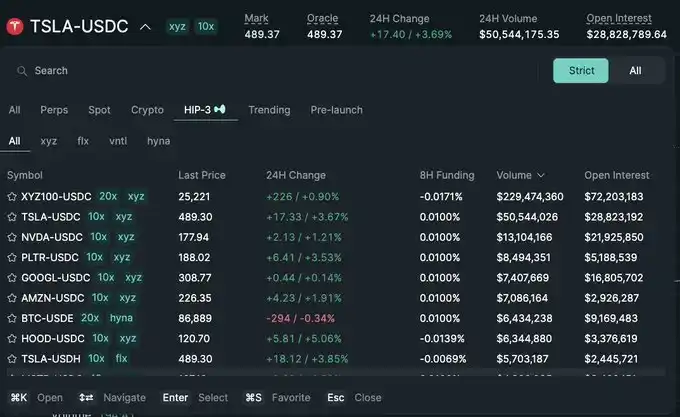
At the same time, HIP-3 markets were initially positioned to be primarily distributed by Builders and not prominently showcased on the main front end; however, these markets have now begun to be displayed in the Hyperliquid native front end under strict listing standards.
This signal is very clear: Hyperliquid still maintains permissionless innovation at the Builder level but will not sacrifice its core distribution rights at the expense of external distribution.
USDH: Shifting from Transactional Liquidation to "Float" Liquidation
The launch of USDH aims to reclaim stablecoin reserve earnings that would have otherwise been captured outside the system. Its publicized structure involves a 50/50 split of reserve earnings: 50% to Hyperliquid and 50% for USDH ecosystem growth.
Additionally, the transaction fee discounts offered on USDH-related markets further reinforce this orientation: Hyperliquid is willing to sacrifice on a single transaction's economics to secure a larger, more sticky, balance-bound profit pool.
In effect, this introduces a revenue stream similar to an annuity for the protocol, the growth of which depends on the monetary base scale and not just nominal trading volume.
Portfolio Margin: Introducing Brokerage-Equivalent Financing Economics
Portfolio Margin unifies the margin for spot and perpetual contracts, allowing different exposures to offset each other and introducing a native lending loop.
Hyperliquid will retain 10% of the interest paid by borrowers, making the protocol's economics increasingly dependent on leverage utilization and interest rate levels, rather than just trade volume. This approach is closer to a broker/prime brokerage revenue model rather than a pure exchange logic.
The Path of Hyperliquid Toward a "Brokerage-Style" Economic Model
On the throughput front, Hyperliquid has already reached the scale of top-tier exchanges; however, in terms of monetization, it still resembles a market layer: with very high nominal trading volume, coupled with a single-digit basis point effective fee rate. The gap with platforms like Coinbase and Robinhood is structural.
Retail platforms sit at the brokerage layer, holding user relationships and fund balances, enabling them to monetize multiple profit pools simultaneously (margin funding, idle cash, subscriptions); whereas pure exchanges sell execution services, which, under liquidity and routing competition, naturally commoditize execution, with net capture being continuously squeezed. Nasdaq is a TradFi reference to this constraint.
Early on, Hyperliquid evidently tilted towards the exchange prototype. By splitting the distribution layer (Builder Codes) from the product creation layer (HIP-3), it accelerated ecosystem expansion and market coverage; however, the cost of this architecture could also push the economics outward: once a third-party frontend decides to aggregate prices and can route cross-exchange, Hyperliquid risks being pressed into a thin-margin wholesale execution track.
Nevertheless, recent actions show a deliberate shift: without relinquishing the unified execution and clearing advantages, defending the distribution rights, and expanding revenue sources to a "balance-based" profit pool.
Specifically: the protocol is no longer willing to subsidize external frontends structurally cheaper than the native UI; HIP-3 is more natively displayed; and asset-liability-style revenue sources are introduced.
USDH brings reserve rewards back to the ecosystem (50/50 split and offers USDH market fee discounts); while portfolio margin introduces financing economics through a 10% cut of borrowing interest.
Overall, Hyperliquid is converging towards a hybrid model: with the execution track as the base, overlaying distribution defense and balance-driven profit pools. This reduces the risk of being stuck in a low basis point, wholesale exchange model, while moving closer to a brokerage-style revenue structure without sacrificing the unified execution and clearing advantages.
Looking ahead to 2026, the unresolved question is: Can Hyperliquid further move towards a brokerage-style economy without undermining its "outsourcing-friendly" model? USDH is the clearest litmus test: at around a $100 million supply level, when the protocol does not control distribution, the expansion of outsourced issuance appears to be slow.
The obvious alternative path could have been at the UI level by automatically converting the approximately $4 billion of USDC holdings into a native stablecoin (similar to Binance's automatic conversion of BUSD).
If Hyperliquid wants to truly capture the prime brokerage layer's profit pool, it may also need brokerage-like behaviors: stronger control, tighter native product integration, and a clearer delineation with the ecosystem team on distribution and balance sheet competition.
You may also like

December 24th Market Key Intelligence, How Much Did You Miss?

Aave Community Governance Drama Escalates, What's the Overseas Crypto Community Talking About Today?

Where Did $362 Million Go? Hyperliquid Counters FUD in Decentralization Showdown

2025 Whale Saga: Mansion Kidnapping, Supply Chain Poisoning, and Billions Liquidated

Absorb Polymarket Old Guard, Coinbase Plunges Into Prediction Market Abyss

Coinbase Joins Prediction Market, AAVE Governance Dispute - What's the Overseas Crypto Community Talking About Today?
Over the past 24 hours, the crypto market has shown strong momentum across multiple dimensions. The mainstream discussion has focused on Coinbase's official entry into the prediction market through the acquisition of The Clearing Company, as well as the intense controversy within the AAVE community regarding token incentives and governance rights.
In terms of ecosystem development, Solana has introduced the innovative Kora fee layer aimed at reducing user transaction costs; meanwhile, the Perp DEX competition has intensified, with the showdown between Hyperliquid and Lighter sparking widespread community discussion on the future of decentralized derivatives.
This week, Coinbase announced the acquisition of The Clearing Company, marking another significant move to deepen its presence in this field after last week's announcement of launching a prediction market on its platform.
The Clearing Company's founder, Toni Gemayel, and the team will join Coinbase to jointly drive the development of the prediction market business.
Coinbase's Product Lead, Shan Aggarwal, stated that the growth of the prediction market is still in its early stages and predicts that 2026 will be the breakout year for this field.
The community has reacted positively to this, generally believing that Coinbase's entry will bring significant traffic and compliance advantages to the prediction market. However, this has also sparked discussions about the industry's competitive landscape.
Jai Bhavnani, Founder of Rivalry, commented that for startups, if their product model proves to be successful, industry giants like Coinbase have ample reason to replicate it.
This serves as a reminder to all entrepreneurs in the crypto space that they must build significant moats to withstand competition pressure from these giants.
Regulated prediction market platform Kalshi launched its research arm, Kalshi Research, this week, aimed at opening its internal data to the academic community and researchers to facilitate exploration of prediction market-related topics.
Its inaugural research report highlights Kalshi's outperformance in predicting inflation compared to Wall Street's traditional models. Kalshi co-founder Luana Lopes Lara commented that the power of prediction markets lies in the valuable data they generate, and it is now time to better utilize this data.
Meanwhile, Kalshi announced its support for the BNB Chain (BSC), allowing users to deposit and withdraw BNB and USDT via the BSC network.
This move is seen as a significant step for Kalshi to open its platform to a broader crypto user base, aiming to unlock access to the world's largest prediction market. Furthermore, Kalshi also revealed plans to host the first Prediction Market Summit in 2026 to further drive industry engagement and development.
The AAVE community recently engaged in heated debates around an Aave Improvement Proposal (AIP) titled "AAVE Tokenomics Alignment Phase One - Ownership Governance," aiming to transfer ownership and control of the Aave brand from Aave Labs to Aave DAO.
Aave founder Stani Kulechov publicly stated his intention to vote against the proposal, believing it oversimplifies the complex legal and operational structure, potentially slowing down the development process of core products like Aave V4.
The community's reaction was polarized. Some criticized Stani for adopting a "double standard" in governance and questioned whether his team had siphoned off protocol revenue, while others supported his cautious stance, arguing that significant governance changes require more thorough discussion.
This controversy highlights the tension between the ideal of DAO governance in DeFi projects and the actual power held by core development teams.
Despite governance disputes putting pressure on the AAVE token price, on-chain data shows that Stani Kulechov himself has purchased millions of dollars' worth of AAVE in the past few hours.
Simultaneously, a whale address, 0xDDC4, which had been quiet for 6 months, once again spent 500 ETH (approximately $1.53 million) to purchase 9,629 AAVE tokens. Data indicates that this whale has accumulated nearly 40,000 AAVE over the past year but is currently in an unrealized loss position.
The founder and whale's increased holdings during market volatility were interpreted by some investors as a confidence signal in AAVE's long-term value.
In this week's top article, Morpho Labs' "Curator Explained" detailed the role of "curators" in DeFi.
The article likened curators to asset managers in traditional finance, who design, deploy, and manage on-chain vaults, providing users with a one-click diversified investment portfolio.
Unlike traditional fund managers, DeFi curators execute strategies automatically through non-custodial smart contracts, allowing users to maintain full control of their assets. The article offered a new perspective on the specialization and risk management in the DeFi space.
Another widely circulated article, "Ethereum 2025: From Experiment to Global Infrastructure," provided a comprehensive summary of Ethereum's development over the past year. The article noted that 2025 is a crucial year for Ethereum's transition from an experimental project to global financial infrastructure. Through the Pectra and Fusaka hard forks, Ethereum achieved significant reductions in account abstraction and transaction costs.
Furthermore, the SEC's clarification of Ethereum's "non-securities" nature and the launch of tokenized funds on the Ethereum mainnet by traditional financial giants like JPMorgan marked Ethereum's gaining recognition from mainstream institutions. The article suggested that whether it is the continued growth of DeFi, the thriving L2 ecosystem, or the integration with the AI field, Ethereum's vision as the "world computer" is gradually becoming a reality.
The Solana Foundation engineering team released a fee layer solution called Kora this week.
Kora is a fee relayer and signatory node designed to provide the Solana ecosystem with a more flexible transaction fee payment method. Through Kora, users will be able to achieve gas-free transactions or choose to pay network fees using any stablecoin or SPL token. This innovation is seen as an important step in lowering the barrier of entry for new users and improving Solana network's availability.
Additionally, a deep research report on propAMM (proactive market maker) sparked community interest. The report's data analysis of propAMMs on Solana like HumidiFi indicated that Solana has achieved, or even surpassed, the level of transaction execution quality in traditional finance (TradFi) markets.
For example, on the SOL-USDC trading pair, HumidiFi is able to provide a highly competitive spread for large trades (0.4-1.6 bps), which is already better than the trading slippage of some mid-cap stocks in traditional markets.
Research suggests that propAMM is making the vision of the "Internet Capital Market" a reality, with Solana emerging as the prime venue for all of this to happen.
The competition in the perpetual contract DEX (Perp DEX) space is becoming increasingly heated.
In its latest official article, Hyperliquid has positioned its emerging competitor, Lighter, alongside centralized exchanges like Binance, referring to it as a platform utilizing a centralized sequencer. Hyperliquid emphasizes its transparency advantage of being "fully on-chain, operated by a validator network, and with no hidden state."
The community widely interprets this as Hyperliquid declaring "war" on Lighter. The technical differences between the two platforms have also become a focal point of discussion: Hyperliquid focuses on ultimate on-chain transparency, while Lighter emphasizes achieving "verifiable execution" through zero-knowledge proofs to provide users with a Central Limit Order Book (CLOB)-like trading experience.
This battle over the future direction of decentralized derivatives exchanges is expected to peak in 2026.
Meanwhile, discussions about Lighter's trading fees have surfaced. Some users have pointed out that Lighter charged as much as 81 basis points (0.81%) for a $2 million USD/JPY forex trade, far exceeding the near-zero spreads of traditional forex brokers.
Some argue that Lighter does not follow a B-book model that bets against market makers, instead anchoring its prices to the TradFi market, and the high fees may be related to the current liquidity or market maker balance incentives. Providing a more competitive spread for real-world assets (RWA) in the highly volatile crypto market is a key issue Lighter will need to address in the future.

Why Did Market Sentiment Completely Collapse in 2025? Decoding Messari's Ten-Thousand-Word Annual Report

Fintechs’ Prediction Market Add-ons and the Risk of User Churn: Insights from Inversion CEO
Key Takeaways Fintech platforms like Robinhood are increasingly adding prediction markets, which may result in higher user churn…

Former SEC Counsel Explains What It Takes to Achieve Compliance in RWA Tokenization
Key Takeaways Shifts in the SEC’s regulatory approach to cryptocurrency are aiding the growth of compliance in Real-World…

Open Source Achilles' Heel: Nofx and Its 9,000-Star Drama, Forking Fiasco, and Open Source Controversy
Upcoming Lighter TGE: What Is a Reasonable Valuation? As a finance and blockchain translation expert, you are familiar with the field's slang and terminology.

Security Tokenization and Prediction Markets: 7 Major Crypto Boons to Watch in 2026

Aave Yield Distribution Dispute, Solana Surpasses Ethereum in Revenue, What's the Overseas Crypto Community Talking About Today?

Breaking Frontiers: Web3 Lawyer Decodes Latest Developments in Stock Tokenization
Messari 2026 Research Report: Insights into Seven Key Crypto Trends

Key Market Insights from December 19th, How Much Did You Miss Out?
UNI Burn Proposal Vote, Lighter TGE Outlook, What's the Topic of Conversation in the Global Crypto Community Today?
Hyperliquid Price Projection: Anticipated Decline to $19.46 by December 22, 2025
Hyperliquid’s market sentiment remains overwhelmingly bearish, with a projected price drop of -22.76% in the next five days.…
December 24th Market Key Intelligence, How Much Did You Miss?
Aave Community Governance Drama Escalates, What's the Overseas Crypto Community Talking About Today?
Where Did $362 Million Go? Hyperliquid Counters FUD in Decentralization Showdown
2025 Whale Saga: Mansion Kidnapping, Supply Chain Poisoning, and Billions Liquidated
Absorb Polymarket Old Guard, Coinbase Plunges Into Prediction Market Abyss
Coinbase Joins Prediction Market, AAVE Governance Dispute - What's the Overseas Crypto Community Talking About Today?
Over the past 24 hours, the crypto market has shown strong momentum across multiple dimensions. The mainstream discussion has focused on Coinbase's official entry into the prediction market through the acquisition of The Clearing Company, as well as the intense controversy within the AAVE community regarding token incentives and governance rights.
In terms of ecosystem development, Solana has introduced the innovative Kora fee layer aimed at reducing user transaction costs; meanwhile, the Perp DEX competition has intensified, with the showdown between Hyperliquid and Lighter sparking widespread community discussion on the future of decentralized derivatives.
This week, Coinbase announced the acquisition of The Clearing Company, marking another significant move to deepen its presence in this field after last week's announcement of launching a prediction market on its platform.
The Clearing Company's founder, Toni Gemayel, and the team will join Coinbase to jointly drive the development of the prediction market business.
Coinbase's Product Lead, Shan Aggarwal, stated that the growth of the prediction market is still in its early stages and predicts that 2026 will be the breakout year for this field.
The community has reacted positively to this, generally believing that Coinbase's entry will bring significant traffic and compliance advantages to the prediction market. However, this has also sparked discussions about the industry's competitive landscape.
Jai Bhavnani, Founder of Rivalry, commented that for startups, if their product model proves to be successful, industry giants like Coinbase have ample reason to replicate it.
This serves as a reminder to all entrepreneurs in the crypto space that they must build significant moats to withstand competition pressure from these giants.
Regulated prediction market platform Kalshi launched its research arm, Kalshi Research, this week, aimed at opening its internal data to the academic community and researchers to facilitate exploration of prediction market-related topics.
Its inaugural research report highlights Kalshi's outperformance in predicting inflation compared to Wall Street's traditional models. Kalshi co-founder Luana Lopes Lara commented that the power of prediction markets lies in the valuable data they generate, and it is now time to better utilize this data.
Meanwhile, Kalshi announced its support for the BNB Chain (BSC), allowing users to deposit and withdraw BNB and USDT via the BSC network.
This move is seen as a significant step for Kalshi to open its platform to a broader crypto user base, aiming to unlock access to the world's largest prediction market. Furthermore, Kalshi also revealed plans to host the first Prediction Market Summit in 2026 to further drive industry engagement and development.
The AAVE community recently engaged in heated debates around an Aave Improvement Proposal (AIP) titled "AAVE Tokenomics Alignment Phase One - Ownership Governance," aiming to transfer ownership and control of the Aave brand from Aave Labs to Aave DAO.
Aave founder Stani Kulechov publicly stated his intention to vote against the proposal, believing it oversimplifies the complex legal and operational structure, potentially slowing down the development process of core products like Aave V4.
The community's reaction was polarized. Some criticized Stani for adopting a "double standard" in governance and questioned whether his team had siphoned off protocol revenue, while others supported his cautious stance, arguing that significant governance changes require more thorough discussion.
This controversy highlights the tension between the ideal of DAO governance in DeFi projects and the actual power held by core development teams.
Despite governance disputes putting pressure on the AAVE token price, on-chain data shows that Stani Kulechov himself has purchased millions of dollars' worth of AAVE in the past few hours.
Simultaneously, a whale address, 0xDDC4, which had been quiet for 6 months, once again spent 500 ETH (approximately $1.53 million) to purchase 9,629 AAVE tokens. Data indicates that this whale has accumulated nearly 40,000 AAVE over the past year but is currently in an unrealized loss position.
The founder and whale's increased holdings during market volatility were interpreted by some investors as a confidence signal in AAVE's long-term value.
In this week's top article, Morpho Labs' "Curator Explained" detailed the role of "curators" in DeFi.
The article likened curators to asset managers in traditional finance, who design, deploy, and manage on-chain vaults, providing users with a one-click diversified investment portfolio.
Unlike traditional fund managers, DeFi curators execute strategies automatically through non-custodial smart contracts, allowing users to maintain full control of their assets. The article offered a new perspective on the specialization and risk management in the DeFi space.
Another widely circulated article, "Ethereum 2025: From Experiment to Global Infrastructure," provided a comprehensive summary of Ethereum's development over the past year. The article noted that 2025 is a crucial year for Ethereum's transition from an experimental project to global financial infrastructure. Through the Pectra and Fusaka hard forks, Ethereum achieved significant reductions in account abstraction and transaction costs.
Furthermore, the SEC's clarification of Ethereum's "non-securities" nature and the launch of tokenized funds on the Ethereum mainnet by traditional financial giants like JPMorgan marked Ethereum's gaining recognition from mainstream institutions. The article suggested that whether it is the continued growth of DeFi, the thriving L2 ecosystem, or the integration with the AI field, Ethereum's vision as the "world computer" is gradually becoming a reality.
The Solana Foundation engineering team released a fee layer solution called Kora this week.
Kora is a fee relayer and signatory node designed to provide the Solana ecosystem with a more flexible transaction fee payment method. Through Kora, users will be able to achieve gas-free transactions or choose to pay network fees using any stablecoin or SPL token. This innovation is seen as an important step in lowering the barrier of entry for new users and improving Solana network's availability.
Additionally, a deep research report on propAMM (proactive market maker) sparked community interest. The report's data analysis of propAMMs on Solana like HumidiFi indicated that Solana has achieved, or even surpassed, the level of transaction execution quality in traditional finance (TradFi) markets.
For example, on the SOL-USDC trading pair, HumidiFi is able to provide a highly competitive spread for large trades (0.4-1.6 bps), which is already better than the trading slippage of some mid-cap stocks in traditional markets.
Research suggests that propAMM is making the vision of the "Internet Capital Market" a reality, with Solana emerging as the prime venue for all of this to happen.
The competition in the perpetual contract DEX (Perp DEX) space is becoming increasingly heated.
In its latest official article, Hyperliquid has positioned its emerging competitor, Lighter, alongside centralized exchanges like Binance, referring to it as a platform utilizing a centralized sequencer. Hyperliquid emphasizes its transparency advantage of being "fully on-chain, operated by a validator network, and with no hidden state."
The community widely interprets this as Hyperliquid declaring "war" on Lighter. The technical differences between the two platforms have also become a focal point of discussion: Hyperliquid focuses on ultimate on-chain transparency, while Lighter emphasizes achieving "verifiable execution" through zero-knowledge proofs to provide users with a Central Limit Order Book (CLOB)-like trading experience.
This battle over the future direction of decentralized derivatives exchanges is expected to peak in 2026.
Meanwhile, discussions about Lighter's trading fees have surfaced. Some users have pointed out that Lighter charged as much as 81 basis points (0.81%) for a $2 million USD/JPY forex trade, far exceeding the near-zero spreads of traditional forex brokers.
Some argue that Lighter does not follow a B-book model that bets against market makers, instead anchoring its prices to the TradFi market, and the high fees may be related to the current liquidity or market maker balance incentives. Providing a more competitive spread for real-world assets (RWA) in the highly volatile crypto market is a key issue Lighter will need to address in the future.
Popular coins
Latest Crypto News


Customer Support:@weikecs
Business Cooperation:@weikecs
Quant Trading & MM:[email protected]
VIP Services:[email protected]
 App
App