Data Analysis How Much Does Raydium Really Rely on pump.fun?

Original Title: "Data Analysis: How Dependent Is Raydium on pump.fun?"
Original Author: Azuma, Odaily Planet Daily
The mainstream DEX protocol on Solana, Raydium (RAY), experienced a sharp decline today, directly triggered by pump.fun seemingly testing its own AMM liquidity pool. The market speculates that this move may lead to future pump.fun ecosystem tokens not being pooled on Raydium after breaking out of the "seed round," but instead being directly diverted to the pump.fun protocol, resulting in a reduction in Raydium's trading volume, corresponding revenue, and buyback amount.
Logic Behind RAY's Decline (Readers familiar with the relevant logic can skip this section)
Let's briefly outline the relationship between Raydium and pump.fun.
As the current leading meme token launchpad platform on Solana, the issuance of pump.fun's token goes through two stages: "seed round" and "public round." After the token is issued, it will first enter the "seed round" trading phase, which relies on pump.fun's protocol's own Bonding Curve for matching transactions. When the trading volume reaches $69,000, it will then enter the "public round" trading phase, at which point liquidity will migrate to Raydium, where a pool will be created and trading will continue.
Next, let's look at Raydium and RAY.
Currently, Raydium charges a 0.25% fee per transaction, with 0.22% allocated to Raydium's liquidity providers (LP) and 0.03% used for RAY buyback and ecosystem support. In summary, Raydium's trading volume will indirectly affect RAY's price through fee revenue.
So the current situation is that if pump.fun builds its own AMM, liquidity will no longer migrate to Raydium in the future, thereby reducing the latter's trading volume, fees, and consequently affecting RAY's value performance.
How Dependent Is Raydium on pump.fun?
Today, there has already been a lot of analysis in the market on the above points. However, it seems that no one has carefully examined how much Raydium relies on pump.fun in terms of trading volume. Therefore, we queried some data sources on Defillama and Dune, and the conclusion is shown in the following figure.
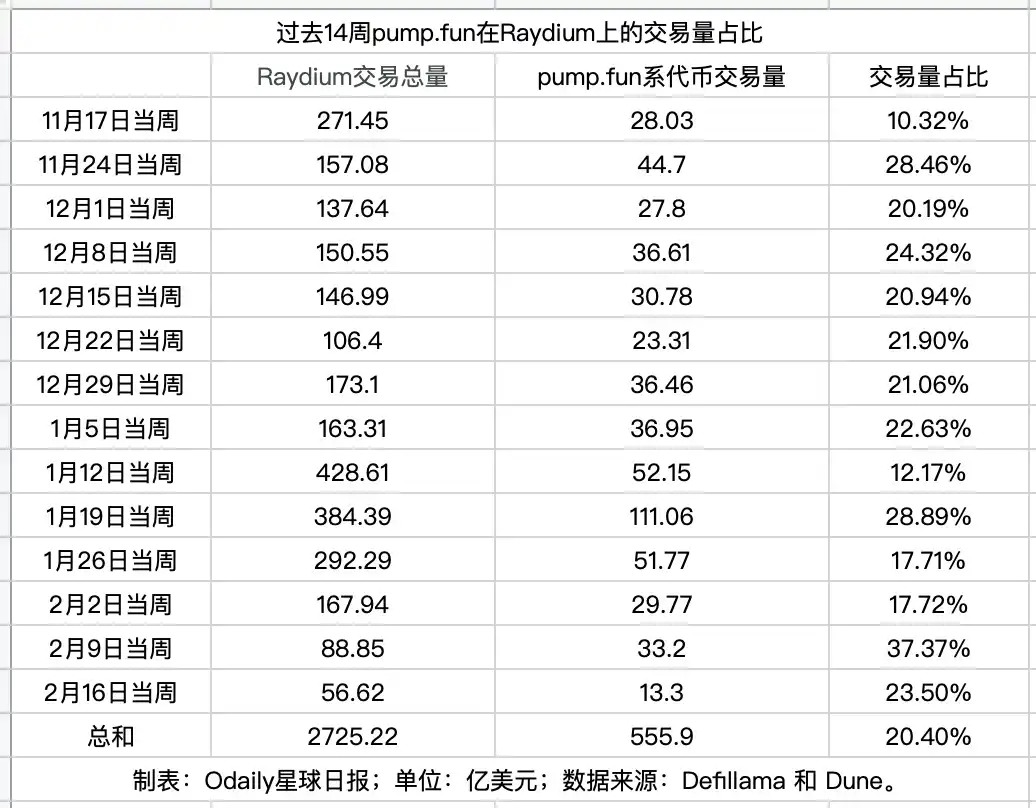
As can be seen from the above chart, in the past 14 weeks, the trading volume of the pump.fun token on Raydium has generally accounted for around 20%. This means that if pump.fun does indeed redirect trading volume from Raydium in the future through its own AMM (excluding autonomous liquidity migration activities due to uncertain platform fee rate differences), Raydium is expected to experience around a 20% reduction in trading volume.
Oversold?
Turning back to the market situation, OKX data shows that RAY dropped to a low of $2.82 today, corresponding to a decrease of over 30% (the data was delayed, but in hindsight, there was indeed some overselling at that time). The current price has gradually recovered to $3.15, representing a 25.43% decrease.
Considering that SOL also experienced a 5.8% decrease, RAY's current decline is basically within a reasonable range, meaning that the market has preemptively priced in pump.fun's frontrunning behavior.
Let's end with a quote from Fluid COO DMH:
“RAY's plummet once again proves to us that ‘distribution >>> tech.’ Both the traditional world (Microsoft) and the crypto space (Metamask) have countless examples showing that if you have a large enough user base, your product isn't that important.”
También te puede interesar

¿Cómo hacer un saldo entre riesgo y retorno en los rendimientos DeFi?

La tesis de Tom Lee sobre Ethereum: Por qué el hombre que acertó el último ciclo está apostando fuerte por Bitmine
Tom Lee se está convirtiendo en uno de los defensores más influyentes de Ethereum. Desde Fundstrat hasta Bitmine, su análisis sobre Ethereum combina el rendimiento del staking, la acumulación de activos y el valor a largo plazo de la red. He aquí por qué «Tom Lee Ethereum» se ha convertido en uno de los temas más seguidos del mundo de las criptomonedas.
Naval sube personalmente al escenario: El histórico choque entre la gente común y el capital de riesgo.

a16z Cripto: 9 gráficos para comprender las tendencias de evolución de las stablecoins

Refutación del artículo «El fin de las criptomonedas», de Yang Haipo

¿Puede un secador de pelo ganar $34,000? Interpretando la paradoja de la reflexividad de los mercados de predicción

Fundador de 6MV: En 2026, ha llegado el "punto de inflexión histórico" para la inversión en criptomonedas
Un VC del mundo cripto dijo que la IA es demasiado loca, y que son muy conservadores.

Abraxas Capital emite $2.89 mil millones en USDT: ¿Impulso de liquidez o simplemente más arbitraje de stablecoins?
Abraxas Capital acaba de recibir $2.89 mil millones en USDT recién emitidos de Tether. ¿Es esta una inyección de liquidez alcista para los mercados de criptomonedas, o es simplemente el negocio habitual de un gigante del arbitraje de stablecoins? Analizamos los datos y el probable impacto en Bitcoin, altcoins y DeFi.
Historial evolutiva de los algoritmos de contrato: Una década de contratos perpetuos, el telón aún no ha caído

Noticias sobre ETF de Bitcoin hoy: $2.1B en entradas indican una fuerte demanda institucional por BTC
Las noticias sobre ETF de Bitcoin registraron $2.1B en entradas durante 8 días consecutivos, marcando una de las rachas de acumulación más fuertes recientes. Esto es lo que significan las últimas noticias sobre ETF de Bitcoin para el precio de BTC y si el nivel de ruptura de $80K es el siguiente.

Tras haber sido expulsado de PayPal, Musk pretende volver al mercado de las criptomonedas

Michael Saylor: El invierno ha terminado – ¿Está en lo correcto? 5 puntos de datos clave (2026)
Michael Saylor tuiteó ayer "El invierno ha terminado." Es breve. Es audaz. Y tiene al mundo cripto hablando.
¿Pero está en lo correcto? ¿O es solo otro CEO inflando sus activos?
Veamos los datos. Seamos neutrales. Veamos si el hielo realmente se ha derretido.

La aplicación WEEX Bubbles ya está disponible y permite visualizar el mercado de criptomonedas de un vistazo
WEEX Bubbles es una aplicación independiente diseñada para ayudar a los usuarios a comprender rápidamente los complejos movimientos del mercado de criptomonedas a través de una visualización intuitiva de burbujas.

El cofundador de Polygon, Sandeep: Escribiendo después de la explosión del puente de cadena

Actualización importante en la web: Más de 10 estilos de gráficos avanzados para obtener una visión más detallada del mercado
Con el fin de ofrecer herramientas de análisis más potentes y profesionales, WEEX ha lanzado una importante actualización de sus gráficos de trading web, que ahora admiten hasta 14 estilos de gráficos avanzados.
Informe matutino | Aethir consigue un contrato empresarial de 260 millones de dólares con Axe Compute; New Fire Technology adquiere el equipo de operaciones de Avenir Group; Kalshi supera el volumen de operaciones de Polymarket.

Fundador de CoinEx: El desenlace de las criptomonedas en mi opinión
¿Cómo hacer un saldo entre riesgo y retorno en los rendimientos DeFi?
La tesis de Tom Lee sobre Ethereum: Por qué el hombre que acertó el último ciclo está apostando fuerte por Bitmine
Tom Lee se está convirtiendo en uno de los defensores más influyentes de Ethereum. Desde Fundstrat hasta Bitmine, su análisis sobre Ethereum combina el rendimiento del staking, la acumulación de activos y el valor a largo plazo de la red. He aquí por qué «Tom Lee Ethereum» se ha convertido en uno de los temas más seguidos del mundo de las criptomonedas.
Naval sube personalmente al escenario: El histórico choque entre la gente común y el capital de riesgo.
a16z Cripto: 9 gráficos para comprender las tendencias de evolución de las stablecoins
Refutación del artículo «El fin de las criptomonedas», de Yang Haipo
¿Puede un secador de pelo ganar $34,000? Interpretando la paradoja de la reflexividad de los mercados de predicción