UTXO Stack: Unlocking Bitcoin Lightning Network Payment Potential

In the cryptocurrency field, while Bitcoin has been widely recognized as a store of value, its application in payment scenarios still faces many challenges. As a peer-to-peer off-chain payment channel solution, Bitcoin's Lightning Network (LN) carries the mission of driving the mainstream adoption of cryptocurrency payments, but it currently has some limitations. Recently, UTXO Stack introduced its Whitepaper, seeking to inject new vitality into the Lightning Network through revolutionary technical design and infrastructure to promote the widespread use of cryptocurrency payments.
Project Overview and Narrative
UTXO Stack is based on a hybrid Lightning Network composed of the Lightning Network (LN) and Fiber Network (LN implementation on Nervos CKB, FN), combined with a Decentralized Liquidity Staking Pool (DLSP), to enhance the liquidity of the Lightning Network and introduce stablecoins into the Bitcoin ecosystem through a complete infrastructure.
On December 19, 2024, UTXO Stack completed a Series A financing round with a valuation of $50 million, with investment from UTXO Management, PAKA, CMS, among others. The new funds will accelerate UTXO Stack's development work. Prior to this, UTXO Stack's seed round financing was announced to be completed on April 4, 2024, with joint leadership from ABCDE Capital and SNZ Capital, and participation from CKB Eco Fund, OKX Ventures, Waterdrip Capital, Matrixport, y2z Ventures, DRK Lab, and UTXO Management.
UTXO Stack will launch the world's first large-scale airdrop incentive plan for BTC liquidity within the Lightning Network in early January 2025. Subsequently, UTXO Stack will coordinate with the CKB Lightning Network Fiber Network mainnet launch to provide liquidity incentives for CKB and RGB++ related assets. UTXO Stack is expected to complete the Token Generation Event (TGE) in Q1 2025, marking the first TGE in the Lightning Network ecosystem.
The focus of the UTXO Stack is on providing decentralized liquidity for the Lightning Network through staking. While bringing liquidity to the LN, it also offers a new native non-custodial revenue channel in the BTCFi (Bitcoin Finance) landscape. Currently, Babylon is the only provider of native non-custodial revenue in BTCFi, with UTXO Stack set to become the second. Furthermore, unlike Babylon, UTXO Stack operates in the Bitcoin LN track, which is still a blue ocean. According to a report by Grand View Research, the global cryptocurrency payment market is projected to reach $21.5 billion by 2030, maintaining a growth rate of 17.1%. Looking at the centralized electronic payment sector, the market size is expected to reach $21.83 trillion. As a superior iteration of centralized payments, the current Lightning Network channels hold about 5,000 BTC (5 billion USD), and with projects like UTXO Stack driving mass adoption in this sector, there is a potential for a thousandfold growth in the long run.
UTXO Stack is committed to addressing the current pain points of the LN and propelling it to become the global payment infrastructure at the core of PayFi (Payment Finance). From the perspective of TPS (Transactions Per Second), the LN outperforms centralized systems and even high-performance public blockchains, making it better suited for the role of a global payment infrastructure. Moreover, the LN has advantages in instant finality, privacy protection, and transaction fees. In the future, as a solution to empower the LN, UTXO Stack is poised to capture immense value within the Bitcoin ecosystem.
From Pain Points to Breakthrough: Innovative Solution of UTXO Stack
While the Lightning Network has demonstrated great potential in low transaction fees, high speed, and privacy, its shortcomings are equally evident in practical applications. Hindered by a lack of stablecoin support, insufficient liquidity, and high user barriers, the development of the Lightning Network still faces challenges. UTXO Stack has proposed a comprehensive set of solutions directly targeting the three core pain points of the LN.
1. Introducing Stablecoin Support: Addressing Bitcoin's Unsuitability for Payments
Currently, a major obstacle to LN's adoption in everyday payments is Bitcoin's unsuitability as a payment currency. Firstly, due to Bitcoin's price volatility, and secondly, its digital gold and store of value properties make people reluctant to spend Bitcoin. UTXO Stack can introduce stablecoins into LN through a hybrid Lightning Network. First, FN leverages the Turing-complete capability of the CKB blockchain to natively support user-defined assets. Therefore, stablecoin assets based on the RGB++ protocol can be issued on the Bitcoin chain, then transferred to the CKB chain through bridgeless cross-chain functionality, and ultimately enter the seamlessly interconnected FN and LN network. This feature expands LN from the current single Bitcoin payment network to an ecosystem supporting stablecoin payments, significantly enhancing its utility.
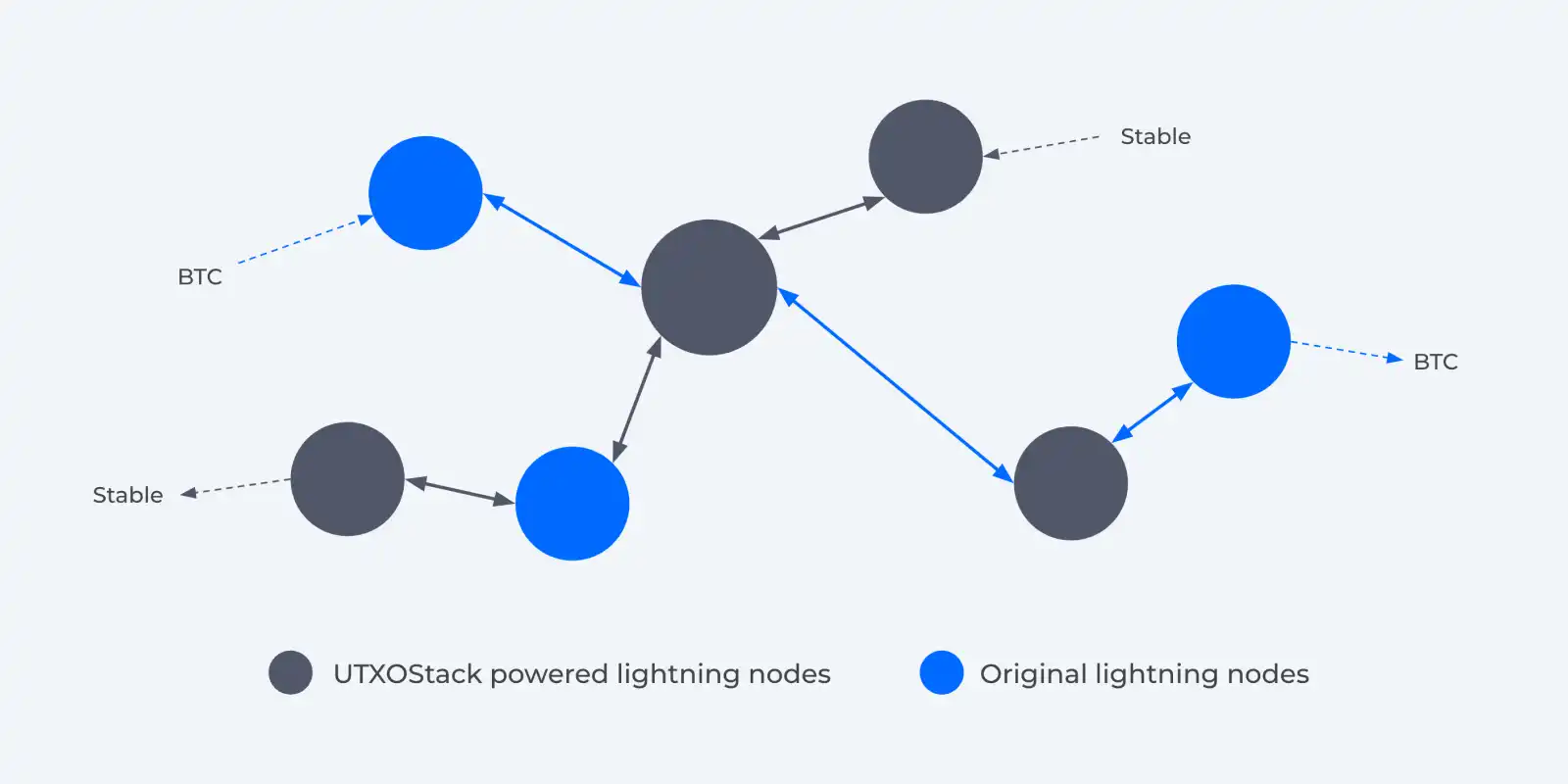
Additionally, as edge nodes between the LN and FN networks, intermediaries can facilitate atomic swaps of assets between the two networks. Seamless exchange of assets like BTC and stablecoins (such as USDI) between the two networks can ensure either completion in full or complete rollback. For example, Alice buys coffee from Bob, and the edge node can receive Alice's BTC payment on the LN side, then transfer it out in the form of equivalent stablecoin on the FN side, continuing through the FN route until reaching the recipient, Bob.
2. Decentralized Liquidity Staking Pool (DLSP): Enhancing Liquidity
Lack of liquidity has always been a core challenge for the LN. UTXO Stack's DLSP allows users to stake Bitcoin, stablecoins, and other assets into a shared liquidity pool, which is then leased to the hybrid Lightning Network. Nodes in the hybrid Lightning Network obtain liquidity from DLSP, providing routing services to LN and FN users. Users pay service fees to nodes, with a portion retained by nodes as revenue, and the majority flowing back into the pool as dividends to DLSP liquidity contributors.
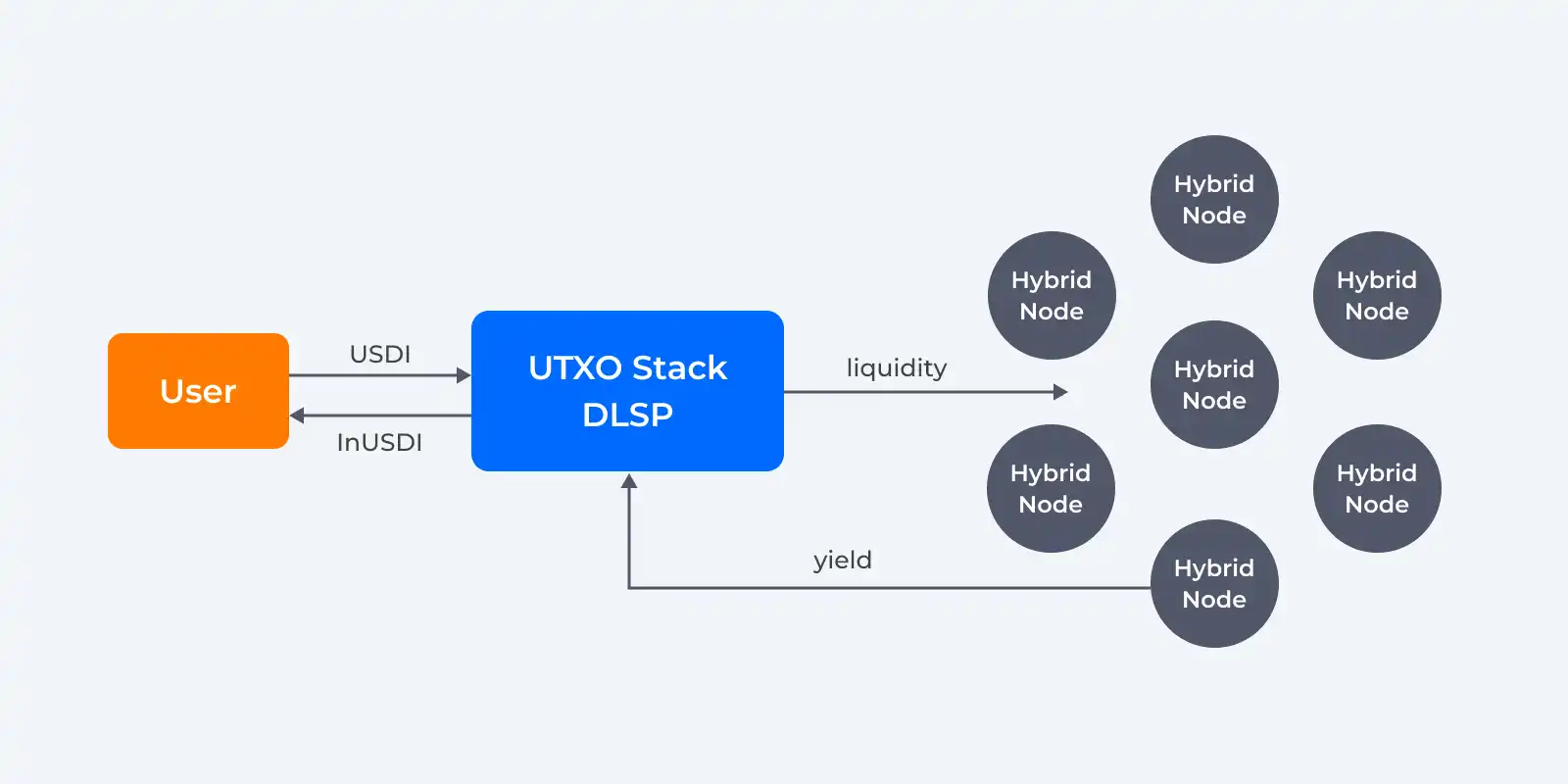
At the same time, DLSP has introduced Liquidity Staking Derivatives (LSD), allowing liquidity assets deposited into DLSP to generate staking certificates at a 1:1 ratio, known as liquidity tokens. As a result, staked assets can not only earn rewards but also maintain asset liquidity, enabling participation in other economic activities (such as DeFi) without hindrance and significantly improving capital efficiency.
Furthermore, leveraging CKB's Turing-complete programmability, DLSP is a smart contract-based system. Through smart contracts, DLSP can achieve automated aggregation of liquidity management, vastly enhancing node operators' liquidity management efficiency. To draw a comparison with a trading platform: existing liquidity leasing is akin to an order book model, while the DLSP approach is more like an Automated Market Maker (AMM).
3. Zero-Cost Channel Opening: Lowering User Entry Barriers
LN channel opening requires an initial fee, creating a certain economic barrier for new users. Through smart contracts, UTXO Stack has introduced the "zero-cost channel opening" model, where DLSP pre-pays the related fees for users. If users subsequently receive a sufficient incoming payment, they can maintain the channel and repay the fees; however, if users do not receive enough incoming payments within a specified period (e.g., three months), the channel will be closed, and any remaining funds will be refunded to DLSP.

This model allows users to open channels without economic burden, streamlining the onboarding process to the Lightning Network and significantly reducing the barriers to using the Lightning Network.
Building a Comprehensive Ecosystem: UTXO Stack's Technical Layout
UTXO Stack provides not just a single-function technical solution but builds a complete hybrid Lightning Network payment ecosystem through a multi-layered infrastructure design. This system, centered around DLSP, combines wallets, payment SDKs, and decentralized asset exchange nodes, providing comprehensive support for users and developers.
1. JoyID Wallet: User Entry Point to the Payment Ecosystem
As a key component of UTXO Stack, the JoyID Wallet not only supports quick payments on LN and FN but also enhances account security and user experience through Passkey technology integration. The JoyID Wallet features the following:
· Multi-asset Support: Users can manage Bitcoin, stablecoins, and other assets in the wallet simultaneously.
· Easy Participation in DLSP: Users can easily stake assets in DLSP with one click to earn rewards.
· Stablecoin Payment Functionality: Users can directly use stablecoins for Lightning payments through the wallet.
Currently, JoyID has surpassed 800,000 users. With its user-friendly interface and comprehensive features, JoyID is poised to become a key gateway to the Lightning payment ecosystem.
2. Decentralized Exchange Nodes: Connecting Asset Bridges
UTXO Stack provides a set of decentralized asset exchange nodes that support decentralized, trustless atomic swaps between Bitcoin, stablecoins, and other assets.
· Core Functionality: Multi-asset atomic swaps (e.g., transactions between Bitcoin and USDI), similar to the previously mentioned edge nodes.
· Use Case: After introducing stablecoins, ensuring seamless interchangeability of various assets in the mixed Lightning network.
3. P2P Payment SDK: Empowering Developers
UTXO Stack's P2P Payment SDK offers developers a quick integration tool to embed the efficient payment functionality of the mixed Lightning network into Web2 applications.
· Typical Use Cases: Content monetization (such as article reading or video watching), subscription services, in-game purchases, etc.
· Developer Support: The SDK can transform existing Web2 services to support P2P payments without the need for complex infrastructure changes.
Through these modules, UTXO Stack not only addresses the technical pain points of the Lightning network but also provides a complete infrastructure for the Lightning payment ecosystem, further driving bidirectional growth for users and developers.
Unveiling the Web5 Vision: The Future of Lightning Payments
UTXO Stack aims to build a truly decentralized peer-to-peer economy ecosystem. In this ecosystem, individuals and entities will seamlessly serve each other through a fair incentive mechanism, fostering collaboration without relying on centralized intermediaries, much like how DLSP allows individuals to contribute liquidity to a pool and receive reasonable returns while meeting the liquidity needs of the Lightning network.
This goal aligns closely with the concept of Web5, where the core is to combine the convenience of Web2 applications with the decentralization of Web3 to provide users with a self-sovereign and straightforward user experience.
By supporting developers in integrating UTXO Stack technology into existing Web2 applications, Lightning payments are not limited to wallet transactions, but can be widely used in various online services:
· Bandwidth or Resource Sharing: Users can rent out idle network bandwidth or computing resources and receive instant payments via the LN.
These use cases can fully meet the real needs of users, whether it's the need to purchase services or the need to sell services to earn revenue. In the future, as more people participate in the Lightning payment network, this peer-to-peer economic model will demonstrate greater synergies, unlocking the potential of Lightning payments and driving the widespread adoption of cryptocurrency. UTXO Stack: Unleashing the Potential of Bitcoin Lightning Network Payments
This article is a contributed piece and does not represent the views of BlockBeats
También te puede interesar

¿Cómo hacer un saldo entre riesgo y retorno en los rendimientos DeFi?

La tesis de Tom Lee sobre Ethereum: Por qué el hombre que acertó el último ciclo está apostando fuerte por Bitmine
Tom Lee se está convirtiendo en uno de los defensores más influyentes de Ethereum. Desde Fundstrat hasta Bitmine, su análisis sobre Ethereum combina el rendimiento del staking, la acumulación de activos y el valor a largo plazo de la red. He aquí por qué «Tom Lee Ethereum» se ha convertido en uno de los temas más seguidos del mundo de las criptomonedas.
Naval sube personalmente al escenario: El histórico choque entre la gente común y el capital de riesgo.

a16z Cripto: 9 gráficos para comprender las tendencias de evolución de las stablecoins

Refutación del artículo «El fin de las criptomonedas», de Yang Haipo

¿Puede un secador de pelo ganar $34,000? Interpretando la paradoja de la reflexividad de los mercados de predicción

Fundador de 6MV: En 2026, ha llegado el "punto de inflexión histórico" para la inversión en criptomonedas
Un VC del mundo cripto dijo que la IA es demasiado loca, y que son muy conservadores.

Abraxas Capital emite $2.89 mil millones en USDT: ¿Impulso de liquidez o simplemente más arbitraje de stablecoins?
Abraxas Capital acaba de recibir $2.89 mil millones en USDT recién emitidos de Tether. ¿Es esta una inyección de liquidez alcista para los mercados de criptomonedas, o es simplemente el negocio habitual de un gigante del arbitraje de stablecoins? Analizamos los datos y el probable impacto en Bitcoin, altcoins y DeFi.
Historial evolutiva de los algoritmos de contrato: Una década de contratos perpetuos, el telón aún no ha caído

Noticias sobre ETF de Bitcoin hoy: $2.1B en entradas indican una fuerte demanda institucional por BTC
Las noticias sobre ETF de Bitcoin registraron $2.1B en entradas durante 8 días consecutivos, marcando una de las rachas de acumulación más fuertes recientes. Esto es lo que significan las últimas noticias sobre ETF de Bitcoin para el precio de BTC y si el nivel de ruptura de $80K es el siguiente.

Tras haber sido expulsado de PayPal, Musk pretende volver al mercado de las criptomonedas

Michael Saylor: El invierno ha terminado – ¿Está en lo correcto? 5 puntos de datos clave (2026)
Michael Saylor tuiteó ayer "El invierno ha terminado." Es breve. Es audaz. Y tiene al mundo cripto hablando.
¿Pero está en lo correcto? ¿O es solo otro CEO inflando sus activos?
Veamos los datos. Seamos neutrales. Veamos si el hielo realmente se ha derretido.

La aplicación WEEX Bubbles ya está disponible y permite visualizar el mercado de criptomonedas de un vistazo
WEEX Bubbles es una aplicación independiente diseñada para ayudar a los usuarios a comprender rápidamente los complejos movimientos del mercado de criptomonedas a través de una visualización intuitiva de burbujas.

El cofundador de Polygon, Sandeep: Escribiendo después de la explosión del puente de cadena

Actualización importante en la web: Más de 10 estilos de gráficos avanzados para obtener una visión más detallada del mercado
Con el fin de ofrecer herramientas de análisis más potentes y profesionales, WEEX ha lanzado una importante actualización de sus gráficos de trading web, que ahora admiten hasta 14 estilos de gráficos avanzados.
Informe matutino | Aethir consigue un contrato empresarial de 260 millones de dólares con Axe Compute; New Fire Technology adquiere el equipo de operaciones de Avenir Group; Kalshi supera el volumen de operaciones de Polymarket.

Fundador de CoinEx: El desenlace de las criptomonedas en mi opinión
¿Cómo hacer un saldo entre riesgo y retorno en los rendimientos DeFi?
La tesis de Tom Lee sobre Ethereum: Por qué el hombre que acertó el último ciclo está apostando fuerte por Bitmine
Tom Lee se está convirtiendo en uno de los defensores más influyentes de Ethereum. Desde Fundstrat hasta Bitmine, su análisis sobre Ethereum combina el rendimiento del staking, la acumulación de activos y el valor a largo plazo de la red. He aquí por qué «Tom Lee Ethereum» se ha convertido en uno de los temas más seguidos del mundo de las criptomonedas.
Naval sube personalmente al escenario: El histórico choque entre la gente común y el capital de riesgo.
a16z Cripto: 9 gráficos para comprender las tendencias de evolución de las stablecoins
Refutación del artículo «El fin de las criptomonedas», de Yang Haipo
¿Puede un secador de pelo ganar $34,000? Interpretando la paradoja de la reflexividad de los mercados de predicción