
- Buy Crypto
- Markets
- Futures
- Spot
- Copy Trade
 WE-Launch
Circle's Acquisition of Axelar Sparks Controversy: AXL Plunges 15% as Long as People Don't Want Coin

Original Article Title: "Circle's Acquisition of Axelar Sparks Controversy: Giant Only Wants People, Not Coin"
Original Article Author: Azuma, Odaily Planet Daily
In the early morning of December 16th, stablecoin giant Circle officially announced that it has completed the signing of an agreement to acquire the core team and technology of Interop Labs, the initial development team of the cross-chain protocol Axelar Network. This move is intended to advance Circle's cross-chain infrastructure strategy and support Circle in achieving seamless and scalable interoperability on its core products such as Arc and CCTP.
This was supposed to be another typical case of an industry giant acquiring a high-quality team, seemingly a win-win situation. However, the key issue lies in the fact that Circle explicitly mentioned in the acquisition announcement that this transaction only involves the Interop Labs team and its proprietary intellectual property, while Axelar Network, the Axelar Foundation, and the AXL token will continue to operate independently under community governance. The other contributing team of the original project, Common Prefix, will take over the relevant activities of Interop Labs.
In simple terms, Circle took away Axelar Network's original development team but explicitly excluded Axelar Network itself and its token AXL.
Impacted by this sudden news, AXL experienced a sharp drop, trading around $0.115 as of approximately 10:00 AM this morning with a 24-hour decline of 15%.
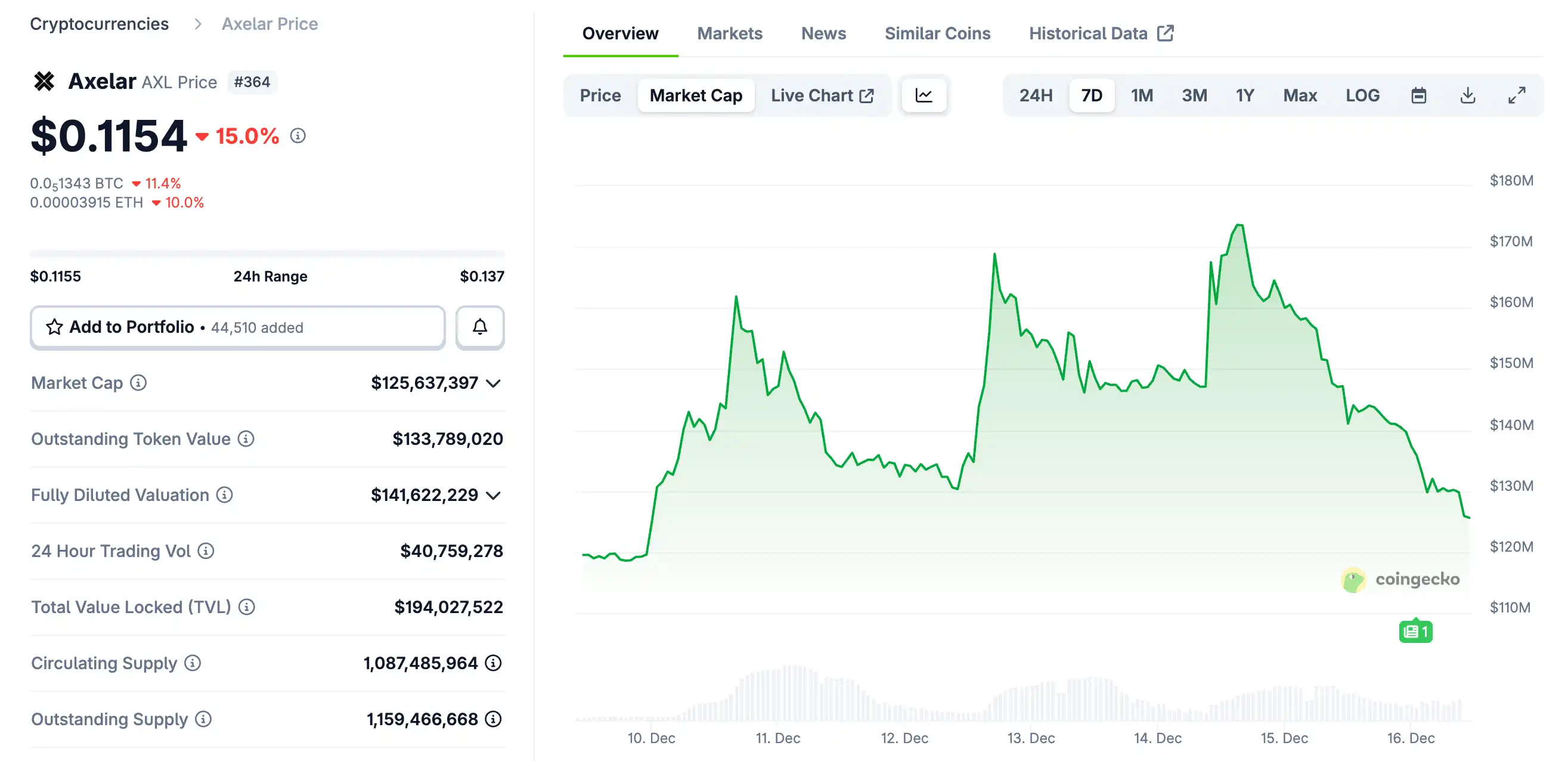
At the same time, the unique situation of the acquisition itself, characterized by "wanting people but not coin," and the ensuing "Equity vs. Token" issue, has sparked numerous discussions within the community, with proponents and opponents of this type of acquisition model holding differing views and engaging in heated debates.
Opposing Viewpoint: Implicit RUG, Chaos by Circle, Only Token Holders Are Hurt
A key force within the opposing camp consists of some VCs, which is not hard to understand—"I invested real money in the project's token equity, held a substantial amount of the token, and now you take away the ones doing the work - what good is this token to me?"
Simon Dedic, Founder of Moonrock Capital, commented on this: "Another acquisition, another RUG. Circle acquires Axelar but explicitly excludes the foundation and AXL token, this is simply a criminal act. Even if it does not violate the law, it goes against ethics. If you are a founder looking to issue a token: either treat it like equity or get lost."
The Block Co-founder and 6MV Founder Mike Dudas commented, "For those who think this is a token vs. equity issue, I can tell you definitively that this is all Circle's doing. There are rumors that Circle's VP of Corporate Development once told a co-founder of Axelar, 'I don't care about your investors,' and without paying any consideration to investors, 'bought' the CEO and IP out from under them, which are crucial to Arc's launch."
Lombard Finance Founder posted Axelar's trend and predicted, "Axelar's core team has been bought by Circle, and AXL may now be worthless. The token has been issued for over three years, the team's equity has already been fully cashed out. Yet, the result is very uncomfortable: the team and/or investors sold tokens for profit, while token holders can only hope for a distant dream."
ChainLink community figure Zach Rynes stated, "This once again exposes the token vs. equity conflict of interest issue plaguing the crypto industry. The development team behind the protocol has been successfully acquired, while token holders who funded that team have received nothing. The so-called continued independent operation under community governance is no different from the development team abandoning users for a better future. If we want to attract real capital, this is the industry's top issue that needs to be addressed."
SOAR Ecosystem Lead Nicholas Wenzel said, "The Axelar token is heading towards zero, thanks for participating. This is another case of token holders gaining nothing while equity holders profit handsomely from the acquisition."
Supporting Viewpoint: Normal Market Behavior, Tokens are inherently at the bottom of the capital structure
If the opposing side focuses more on the unfair treatment of token holders, the supporting side will focus more on the market rules of financing and M&A.
Arca Chief Investment Officer Jeff Dorman believes Circle's actions are fair and explains in detail the capital structure of corporate financing and the natural disadvantage tokens find themselves in.
Businesses raise funds through different levels of the capital structure, and these levels inherently have a clear priority order, with some levels naturally ahead of others — secured debt > unsecured senior debt > subordinated debt > preferred shares > common shares > tokens.
Throughout history, there have been countless cases where the interests of one type of investor have been achieved at the expense of another type of investor.
· In bankruptcy liquidation, creditors succeed at the expense of equity investors;
· In leveraged buyouts (LBOs), equity holders often profit at the expense of debt holders;
· In take-unders, creditors usually have priority over equity holders;
· In strategic acquisitions, both creditors and equity holders usually benefit (but not always);
· And tokens are often at the bottom of the capital structure…
This does not mean that tokens have no value, nor does it mean that tokens necessarily need some kind of "protective mechanism," but the market needs to recognize a reality: when a company acquires another company of already low value, and the tokens issued by that company are virtually worthless, token holders will not magically receive a "unicorn dividend." In such cases, equity returns are often achieved at the expense of token losses.
Avichal Garg, Co-Founder of Electric Capital, also commented: "This is a normal phenomenon. If all future value is created by the team, then there is no company willing to pay returns to investors."
Core Contradiction: What Exactly Are Tokens?
Amid the "talent over tokens" acquisition controversy between Axelar and Circle, both sides of the debate seem to have valid points.
The anger of the opposition is real: Token holders took on risk at the project's most challenging and critical liquidity and narrative support stage, only to be completely excluded at the key value realization point. From the outcome perspective, the core team and intellectual property have achieved value realization, while the tokens have been left in a narrative vacuum of "community governance," and the market has provided the most direct vote through price, which has indeed left all believers in token value deeply frustrated.
The judgment of the supporters also has practical rationality: From a strict capital structure standpoint, tokens are neither debt nor equity, naturally lacking priority in the context of mergers and liquidations. Circle did not violate existing business rules; it simply made a calculated decision based on the assets most valuable to itself.
The true core of the contradiction lies not in whether Circle is ethical, but in an issue that has long been deliberately avoided by the industry: What exactly is a token in the legal and economic structure?
During optimistic times, tokens were assumed to be "quasi-equity," endowed with the imagination of claiming success in the future; however, in real scenarios such as mergers and acquisitions, bankruptcy, and liquidation, they were quickly reduced to their original form of "non-equity instruments." This narrative-based equity and the underlying structure are the root causes of the repeated conflicts.
The Axelar acquisition case may not be the last of such controversies, but hopefully, it can serve as an opportunity for the industry to further contemplate the positioning and significance of tokens—Tokens do not inherently possess rights; only rights that have been institutionalized and structured will be recognized at crucial moments. The specific implementation still requires all industry participants to explore and practice together.
You may also like

Kalshi First Research Report: When Predicting CPI, Crowd Wisdom Beats Wall Street Analysts

Venture Capital Post-Mortem 2025: Hashrate is King, Narrative is Dead
Key Market Information Discrepancy on December 24th - A Must-See! | Alpha Morning Report

2025 Token Postmortem: 84% Peak at Launch, High-Cap Project Turns into a "Rug Pull" Epicenter?
Polymarket Announces In-House L2, Is Polygon's Ace Up?

IOSG: From Compute to Intelligence, a Reinforcement Learning-Driven Decentralized AI Investment Map
AI Trading Risks in Crypto Markets: Who Takes Responsibility When It Fails?
AI trading is already core market infrastructure, but regulators still treat it as a tool — responsibility always stays with the humans and platforms behind it. The biggest risk in 2025 is not rogue algorithms, but mass-adopted AI strategies that move markets in sync and blur the line between tools and unlicensed advice. The next phase of AI trading is defined by accountability and transparency, not performance — compliance is now a survival requirement, not a constraint.

Ether pumps to outsiders, dumps in-house. Can Tom Lee's team still be trusted?

Facing Losses: A Trader’s Journey to Redemption
Key Takeaways Emotional reactions to trading losses, such as increasing risks or exiting the market entirely, often reflect…
Open Source Achilles' Heel: Nofx and Its 9,000-Star Drama, Forking Fiasco, and Open Source Controversy

Trapped Between the Government Iron Curtain and the Dark Web Abyss: The East African Mobile Payment Giant

Security Tokenization and Prediction Markets: 7 Major Crypto Boons to Watch in 2026

Key Market Insights from December 19th, How Much Did You Miss Out?

Hands-On Guide to Participating in CZ-Supported predict.fun

Key Market Information Discrepancy on December 19th, a Must-See! | Alpha Morning Report
Pepe Coin Predicted to Decline to $ 0.000003 by December 22, 2025
Key Takeaways: Pepe Coin is forecasted to drop to $0.000003 by December 22, 2025, marking a decrease of…
AI Trading in Crypto Explained: How Autonomous Trading Is Reshaping Crypto Markets and Crypto Exchanges
AI Trading is rapidly transforming the crypto landscape. Traditional strategies struggle to keep up with crypto’s nonstop volatility and complex market structure, while AI can process massive data, generate adaptive strategies, manage risk, and execute trades autonomously. This article guides WEEX users through what AI Trading is, why crypto accelerates its adoption, how the industry is evolving toward autonomous agents, and why WEEX is building the next-generation AI trading ecosystem.

Call to Join AI Wars: WEEX Alpha Awakens — Global AI Trading Competition with $880,000 Prize Pool
Now, we are calling for AI traders from all over the world to join AI Wars: WEEX Alpha Awakens, a global AI trading competition with $880,000 prize pool.
Kalshi First Research Report: When Predicting CPI, Crowd Wisdom Beats Wall Street Analysts
Venture Capital Post-Mortem 2025: Hashrate is King, Narrative is Dead
Key Market Information Discrepancy on December 24th - A Must-See! | Alpha Morning Report
2025 Token Postmortem: 84% Peak at Launch, High-Cap Project Turns into a "Rug Pull" Epicenter?
Polymarket Announces In-House L2, Is Polygon's Ace Up?
IOSG: From Compute to Intelligence, a Reinforcement Learning-Driven Decentralized AI Investment Map
Popular coins
Latest Crypto News


Customer Support:@weikecs
Business Cooperation:@weikecs
Quant Trading & MM:[email protected]
VIP Services:[email protected]
 App
App