
- Buy Crypto
- Markets
- Futures
- Spot
- Copy Trade
 WE-Launch
Big Brother on the List carried out a rug pull and liquidated his position. Can AAVE, deeply entrenched in a state of emotional polarization, still be bought?

Original Title: "Big Brother Ranking Second Liquidates Holding, Can AAVE Still Be Bought in the Deeply Entrenched Sentiment?"
Original Author: Azuma, Odaily Planet Daily
The leading lending protocol Aave is currently caught in a whirlwind of public opinion, with the escalating sentiment of opposition between the team and the community, which has objectively affected hodlers' confidence in the AAVE token itself.
Earlier today, apart from the project team, protocol contracts, and centralized exchanges, the second-largest whale holder of AAVE liquidated a substantial portion, selling 230,000 AAVE tokens (worth around 38 million USD), causing a 12% short-term price drop in AAVE. It is reported that this "Big Brother Ranking Second" had acquired AAVE between the end of last year and the beginning of this year at an average price of $223.4, and the average price of the liquidation today was around $165, resulting in a final loss of 13.45 million USD.
· Odaily Note: The whale's address is https://debank.com/profile/0xa923b13270f8622b5d5960634200dc4302b7611e.
Event Background: Fee Redistribution Controversy
To understand the community crisis at Aave this time, we need to start with a recent change in the Aave frontend.
On December 4, Aave announced a partnership with Cow Swap to use the latter as the default trading pathway for the Aave frontend exchange function (Odaily Note: previously ParaSwap), achieving better pricing through the latter's MEV-resistant function.
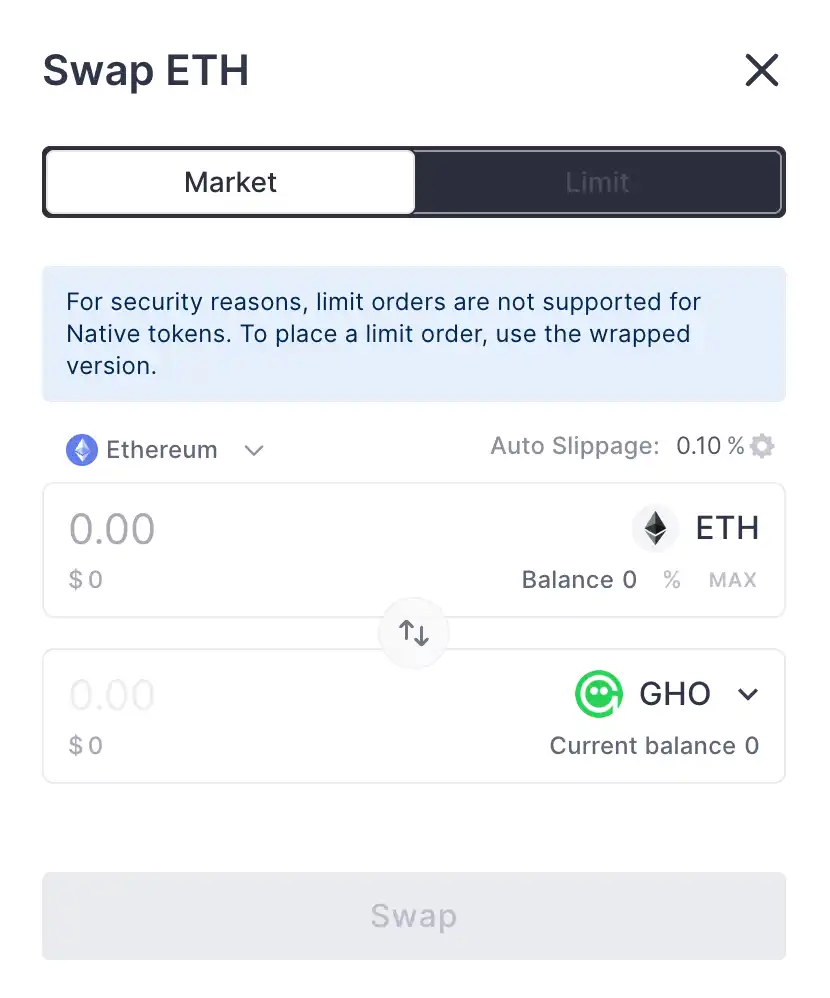
Initially, this seemed like a normal feature upgrade, but the community quickly discovered that when ParaSwap was previously used, the additional fees generated by this function (including referral fees or positive slippage surplus fees) were supposed to flow to the Aave DAO treasury address, but after switching to Cow Swap, it was redirected to the Aave Labs address instead.
Community representative EzR3aL first noticed this change not actively disclosed by Aave, raised questions to the Aave team in the governance forum, and estimated that by tracking Aave's revenue flow on Ethereum and Arbitrum alone, this fee was expected to generate around 200,000 USD weekly, corresponding to an annual revenue of over 10 million USD—this indicates that Aave, almost unnoticed, transferred at least tens of millions of dollars in revenue from the community address to the team address.
Key Dispute: Whose Brand Is Aave Really?
Following the ferment of EzR3aL's post, a large number of AAVE holders have felt betrayed, especially considering that Aave did not communicate with the community before making this change and did not provide any disclosure, somewhat suggesting an intention to conceal this change.
In response to community concerns, Aave Labs provided a direct reply below EzR3aL's post, stating that there should be a clear distinction between the protocol layer and the product layer. Aave's front-end swapping interface is fully operated by Aave Labs, which is responsible for funding, building, and maintaining the feature. This functionality is completely separate from the protocol managed by the DAO, so Aave Labs has the right to independently decide how to operate and generate revenue...Revenue previously flowing to the Aave DAO address was a donation to Aave Labs, not an obligation.
In short, Aave Labs' stance is that Aave's front-end interface and related features essentially belong to the team's product, and revenue generated by them should be considered company property, not to be confused with the protocol controlled by the DAO and its related revenue.
With this statement, a rapid discussion within the community has arisen regarding the ownership of the Aave protocol and product. A well-known DeFi analyst once wrote an article entitled "Who Owns 'Aave': Aave Labs vs Aave DAO," and BlockBeats also republished the Chinese translation for those interested in further reading.
On December 16, the conflict was further exacerbated. Former Aave CTO Ernesto Boado initiated a proposal on the governance forum to transfer control of Aave's brand assets (including domain, social accounts, naming rights, etc.) to AAVE token holders. These assets will be managed through an entity controlled by the DAO (specific form to be determined later) and will have strict anti-takeover protection mechanisms in place.
The proposal received nearly ten thousand views and hundreds of high-quality responses within the Aave governance forum, with various participants in the Aave ecosystem expressing their stance on the proposal below. While some voices also criticized the lack of a thorough execution plan and suspected that it might exacerbate conflicts, the majority of responses expressed support.
Founder Takes a Stand, but Community Is Unconvinced
Amid escalating community sentiment, Aave founder Stani made a forum appearance to respond, stating: "…the proposal takes us in a direction that is detrimental to the Aave ecosystem. It attempts to oversimplify a complex legal and operational issue into a simple 'yes/no' vote, lacking a clear execution path. Dealing with such a complex issue should involve a specifically designed structured process, achieving consensus through multiple checkpoints and specific solutions. For these reasons, I will be voting against this proposal…"
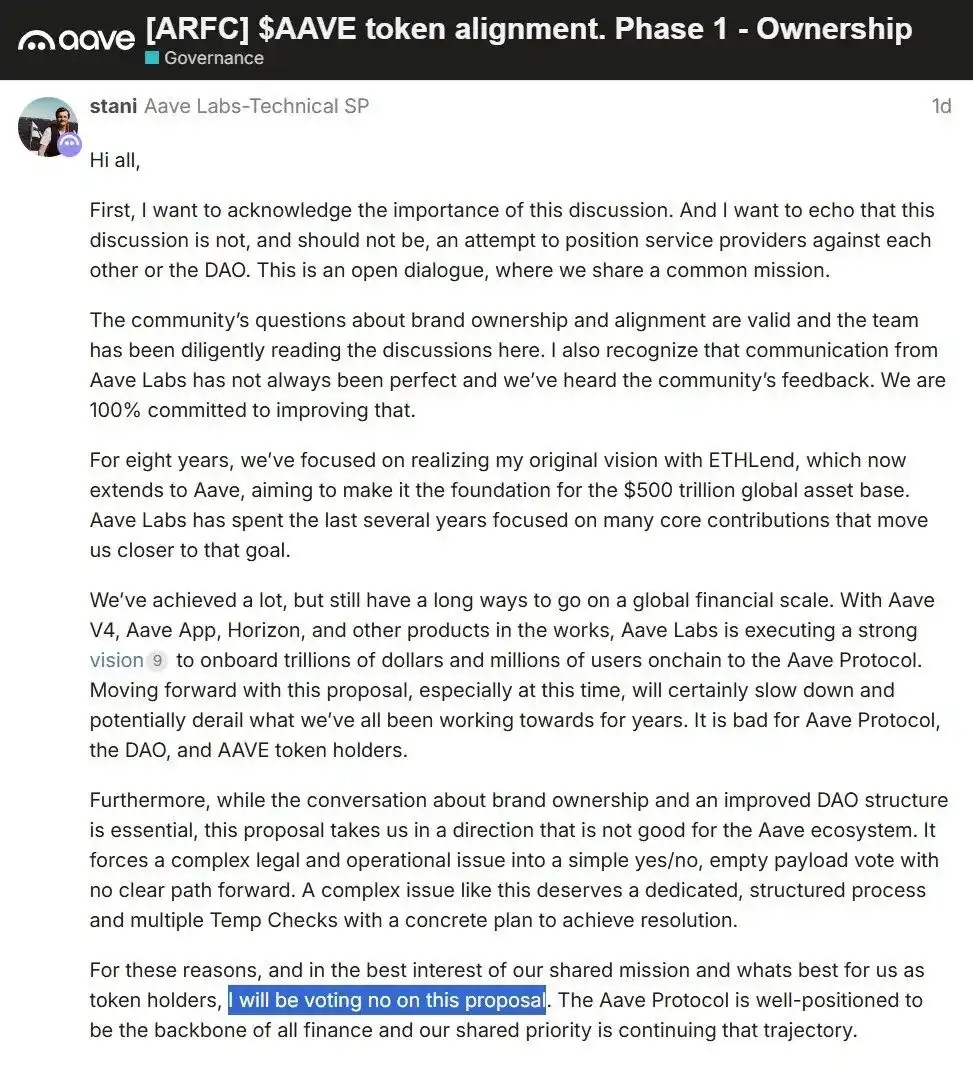
From a business operations standpoint, Stani's claim that the proposal is too hasty may not be unfounded, but in the current discussion environment, this statement can easily be interpreted as 'Aave founder disagrees with transferring brand assets to token holders,' further exacerbating the antagonistic sentiment between the community and the team.
Following Stani's statement, there were even some hostile comments directed at Stani below the original post, while more users expressed their dissatisfaction through the forum or social media. An OG user mentioned considering liquidating their AAVE for the first time, and a loyal AAVE supporter stated: "AAVE holders should realize this is just another DeFi shitcoin. It is neither better nor worse than other coins."
The latest community development is as mentioned at the beginning of this article, with the second whale realizing over a multi-million dollar loss and cutting losses by exiting.
Can AAVE Still Be Bought?
At that time, AAVE was still the darling of A-list institutions like Multicoin Capital, its high-quality brand reputation, strong treasury funds, clear expansion path, robust revenue, and repurchase flow all proving that AAVE is a 'true value coin' distinct from other copycats.
However, in just two weeks, a crisis of public opinion ranging from fee attribution to brand control and team-community relations has plunged AAVE from 'value coin representative' to the center of controversy, even landing it on the list of short-term decliners amidst emotional turmoil.
As of the time of writing, Aave Labs has stated below Ernesto's proposal that they have initiated an ARFC snapshot vote on the proposal, allowing AAVE holders to formally express their stance to clarify the future direction. The outcome of this vote and Aave Labs team's subsequent handling approach are bound to significantly influence Aave's community beliefs and AAVE's short-term price performance.
It is important to emphasize that this event is not simply a "bearish news" or "performance change," but a profound questioning of Aave's existing governance structure and power boundaries.
If you believe that Aave Labs will continue to maintain a high level of alignment with Aave DAO in the long term, and that the current friction is more of a one-time communication and process error, then the emotionally-driven price pullback may be a good buying opportunity. However, if you think that the controversy exposed this time is not just a random issue, but a structural contradiction of long-term unclear interests between the team and the protocol, lacking institutional restraints, then this storm may be just the beginning.
From a broader perspective, Aave's controversy is not unique. As DeFi matures, protocol revenue becomes substantial, and the brand and front end start to have commercial value, some structural contradictions between protocols and products, teams and communities will surface. Aave was put under the spotlight this time not because it made more mistakes, but because it went further.
This debate about fees, brand, and control involves far more than just AAVE and is a question that the entire DeFi industry will sooner or later have to answer.
You may also like

Token VS Equity: The Aave Controversy

Aave Governance Vote Rejected Amidst Tensions Over Brand Ownership
Key Takeaways: A controversial governance proposal at Aave seeking DAO control over brand assets was rejected, sparking significant…

Aave Governance Vote Ends in Rejection after Community Pushback
Key Takeaways: Aave’s governance proposal to transfer brand asset control to a DAO was rejected with 55.29% voting…

Uniswap Token Burn Proposal Approved, What Is the Overseas Crypto Community Talking About Today?

Uniswap Pay Dispute Escalates, Maple Finance Loan volume Hits All-Time High, What's the Overseas Crypto Community Talking About Today?

Aave’s $10M Token Purchase Raises Concerns Over Governance Power
Key Takeaways: Aave founder Stani Kulechov’s $10 million AAVE token purchase sparks debates over governance power concentration. Concerns…

December 24th Market Key Intelligence, How Much Did You Miss?

From Aave to Ether.fi: Who Captured the Most Value in the On-Chain Credit System?
Aave Community Governance Drama Escalates, What's the Overseas Crypto Community Talking About Today?

Coinbase Joins Prediction Market, AAVE Governance Dispute - What's the Overseas Crypto Community Talking About Today?
Over the past 24 hours, the crypto market has shown strong momentum across multiple dimensions. The mainstream discussion has focused on Coinbase's official entry into the prediction market through the acquisition of The Clearing Company, as well as the intense controversy within the AAVE community regarding token incentives and governance rights.
In terms of ecosystem development, Solana has introduced the innovative Kora fee layer aimed at reducing user transaction costs; meanwhile, the Perp DEX competition has intensified, with the showdown between Hyperliquid and Lighter sparking widespread community discussion on the future of decentralized derivatives.
This week, Coinbase announced the acquisition of The Clearing Company, marking another significant move to deepen its presence in this field after last week's announcement of launching a prediction market on its platform.
The Clearing Company's founder, Toni Gemayel, and the team will join Coinbase to jointly drive the development of the prediction market business.
Coinbase's Product Lead, Shan Aggarwal, stated that the growth of the prediction market is still in its early stages and predicts that 2026 will be the breakout year for this field.
The community has reacted positively to this, generally believing that Coinbase's entry will bring significant traffic and compliance advantages to the prediction market. However, this has also sparked discussions about the industry's competitive landscape.
Jai Bhavnani, Founder of Rivalry, commented that for startups, if their product model proves to be successful, industry giants like Coinbase have ample reason to replicate it.
This serves as a reminder to all entrepreneurs in the crypto space that they must build significant moats to withstand competition pressure from these giants.
Regulated prediction market platform Kalshi launched its research arm, Kalshi Research, this week, aimed at opening its internal data to the academic community and researchers to facilitate exploration of prediction market-related topics.
Its inaugural research report highlights Kalshi's outperformance in predicting inflation compared to Wall Street's traditional models. Kalshi co-founder Luana Lopes Lara commented that the power of prediction markets lies in the valuable data they generate, and it is now time to better utilize this data.
Meanwhile, Kalshi announced its support for the BNB Chain (BSC), allowing users to deposit and withdraw BNB and USDT via the BSC network.
This move is seen as a significant step for Kalshi to open its platform to a broader crypto user base, aiming to unlock access to the world's largest prediction market. Furthermore, Kalshi also revealed plans to host the first Prediction Market Summit in 2026 to further drive industry engagement and development.
The AAVE community recently engaged in heated debates around an Aave Improvement Proposal (AIP) titled "AAVE Tokenomics Alignment Phase One - Ownership Governance," aiming to transfer ownership and control of the Aave brand from Aave Labs to Aave DAO.
Aave founder Stani Kulechov publicly stated his intention to vote against the proposal, believing it oversimplifies the complex legal and operational structure, potentially slowing down the development process of core products like Aave V4.
The community's reaction was polarized. Some criticized Stani for adopting a "double standard" in governance and questioned whether his team had siphoned off protocol revenue, while others supported his cautious stance, arguing that significant governance changes require more thorough discussion.
This controversy highlights the tension between the ideal of DAO governance in DeFi projects and the actual power held by core development teams.
Despite governance disputes putting pressure on the AAVE token price, on-chain data shows that Stani Kulechov himself has purchased millions of dollars' worth of AAVE in the past few hours.
Simultaneously, a whale address, 0xDDC4, which had been quiet for 6 months, once again spent 500 ETH (approximately $1.53 million) to purchase 9,629 AAVE tokens. Data indicates that this whale has accumulated nearly 40,000 AAVE over the past year but is currently in an unrealized loss position.
The founder and whale's increased holdings during market volatility were interpreted by some investors as a confidence signal in AAVE's long-term value.
In this week's top article, Morpho Labs' "Curator Explained" detailed the role of "curators" in DeFi.
The article likened curators to asset managers in traditional finance, who design, deploy, and manage on-chain vaults, providing users with a one-click diversified investment portfolio.
Unlike traditional fund managers, DeFi curators execute strategies automatically through non-custodial smart contracts, allowing users to maintain full control of their assets. The article offered a new perspective on the specialization and risk management in the DeFi space.
Another widely circulated article, "Ethereum 2025: From Experiment to Global Infrastructure," provided a comprehensive summary of Ethereum's development over the past year. The article noted that 2025 is a crucial year for Ethereum's transition from an experimental project to global financial infrastructure. Through the Pectra and Fusaka hard forks, Ethereum achieved significant reductions in account abstraction and transaction costs.
Furthermore, the SEC's clarification of Ethereum's "non-securities" nature and the launch of tokenized funds on the Ethereum mainnet by traditional financial giants like JPMorgan marked Ethereum's gaining recognition from mainstream institutions. The article suggested that whether it is the continued growth of DeFi, the thriving L2 ecosystem, or the integration with the AI field, Ethereum's vision as the "world computer" is gradually becoming a reality.
The Solana Foundation engineering team released a fee layer solution called Kora this week.
Kora is a fee relayer and signatory node designed to provide the Solana ecosystem with a more flexible transaction fee payment method. Through Kora, users will be able to achieve gas-free transactions or choose to pay network fees using any stablecoin or SPL token. This innovation is seen as an important step in lowering the barrier of entry for new users and improving Solana network's availability.
Additionally, a deep research report on propAMM (proactive market maker) sparked community interest. The report's data analysis of propAMMs on Solana like HumidiFi indicated that Solana has achieved, or even surpassed, the level of transaction execution quality in traditional finance (TradFi) markets.
For example, on the SOL-USDC trading pair, HumidiFi is able to provide a highly competitive spread for large trades (0.4-1.6 bps), which is already better than the trading slippage of some mid-cap stocks in traditional markets.
Research suggests that propAMM is making the vision of the "Internet Capital Market" a reality, with Solana emerging as the prime venue for all of this to happen.
The competition in the perpetual contract DEX (Perp DEX) space is becoming increasingly heated.
In its latest official article, Hyperliquid has positioned its emerging competitor, Lighter, alongside centralized exchanges like Binance, referring to it as a platform utilizing a centralized sequencer. Hyperliquid emphasizes its transparency advantage of being "fully on-chain, operated by a validator network, and with no hidden state."
The community widely interprets this as Hyperliquid declaring "war" on Lighter. The technical differences between the two platforms have also become a focal point of discussion: Hyperliquid focuses on ultimate on-chain transparency, while Lighter emphasizes achieving "verifiable execution" through zero-knowledge proofs to provide users with a Central Limit Order Book (CLOB)-like trading experience.
This battle over the future direction of decentralized derivatives exchanges is expected to peak in 2026.
Meanwhile, discussions about Lighter's trading fees have surfaced. Some users have pointed out that Lighter charged as much as 81 basis points (0.81%) for a $2 million USD/JPY forex trade, far exceeding the near-zero spreads of traditional forex brokers.
Some argue that Lighter does not follow a B-book model that bets against market makers, instead anchoring its prices to the TradFi market, and the high fees may be related to the current liquidity or market maker balance incentives. Providing a more competitive spread for real-world assets (RWA) in the highly volatile crypto market is a key issue Lighter will need to address in the future.

Audiera Sees Massive Price Surge – Key Cryptocurrency Updates
Key Takeaways Audiera (BEAT) has witnessed significant growth, experiencing a 70.10% increase in the past week. Despite the…

Aave Yield Distribution Dispute, Solana Surpasses Ethereum in Revenue, What's the Overseas Crypto Community Talking About Today?
UNI Burn Proposal Vote, Lighter TGE Outlook, What's the Topic of Conversation in the Global Crypto Community Today?
Hyperliquid User Experiences $21 Million Loss Due to Key Leak
Key Takeaways A Hyperliquid user experienced a $21 million loss as a result of a private key leak,…

Whale Sells a Massive 20,599 ETH to Clear Debts
Key Takeaways In the past two days, a whale identified by the address 0xa339 sold 20,599 ETH at…

Why is it that recent acquisitions in the crypto space no longer include the token?
Key Market Insights for December 17th, how much did you miss out on?
Selling Assets While Snagging a Banking License: What's PayPal Up To?
Token VS Equity: The Aave Controversy
Aave Governance Vote Rejected Amidst Tensions Over Brand Ownership
Key Takeaways: A controversial governance proposal at Aave seeking DAO control over brand assets was rejected, sparking significant…
Aave Governance Vote Ends in Rejection after Community Pushback
Key Takeaways: Aave’s governance proposal to transfer brand asset control to a DAO was rejected with 55.29% voting…
Uniswap Token Burn Proposal Approved, What Is the Overseas Crypto Community Talking About Today?
Uniswap Pay Dispute Escalates, Maple Finance Loan volume Hits All-Time High, What's the Overseas Crypto Community Talking About Today?
Aave’s $10M Token Purchase Raises Concerns Over Governance Power
Key Takeaways: Aave founder Stani Kulechov’s $10 million AAVE token purchase sparks debates over governance power concentration. Concerns…
Popular coins
Latest Crypto News


Customer Support:@weikecs
Business Cooperation:@weikecs
Quant Trading & MM:[email protected]
VIP Services:[email protected]
 App
App